Year: 2020

20 May 2020

Twitter is testing a feature that limits who can reply to your tweets

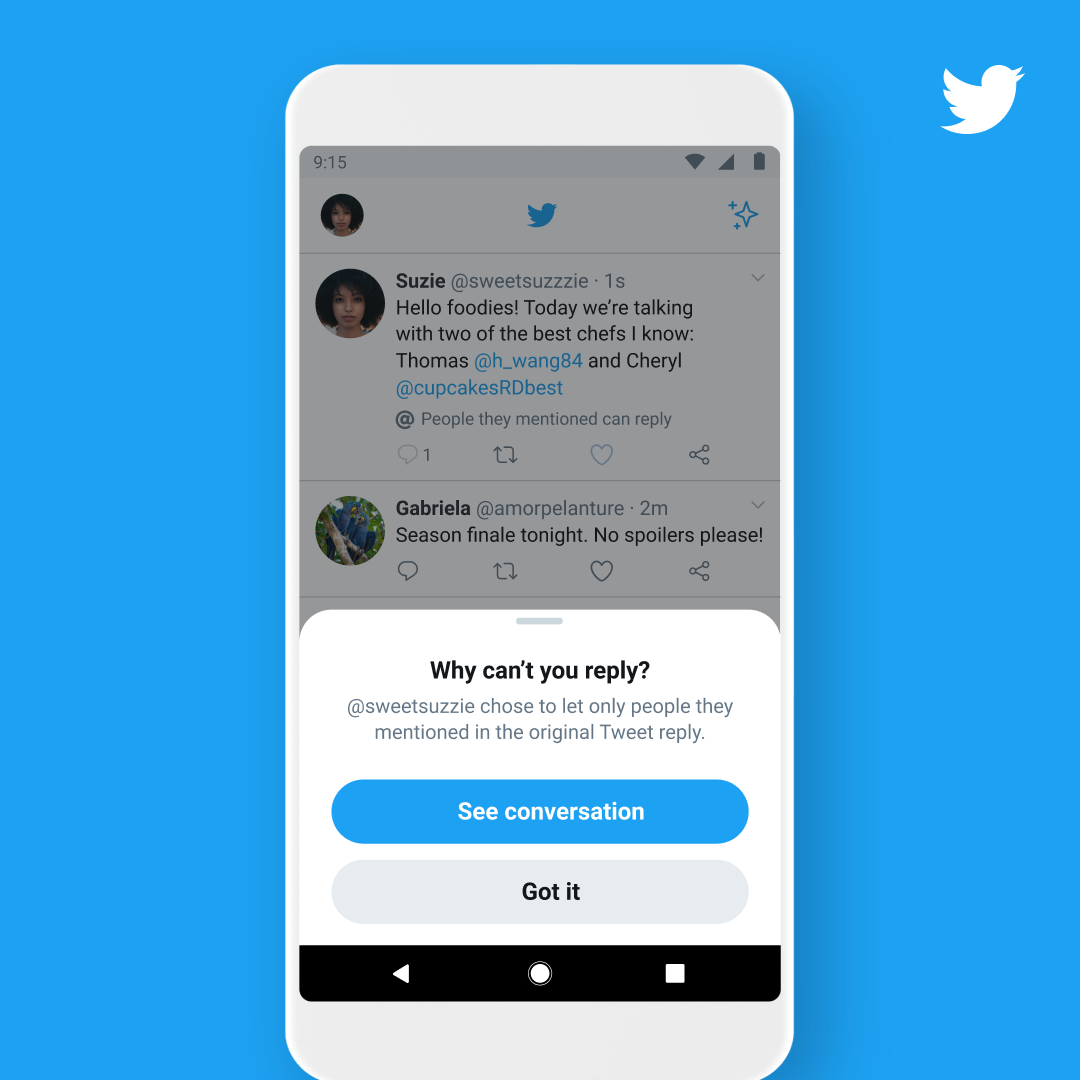
Twitter today acknowledged that it’s begun testing a new setting that let users limit who can reply to tweets. The setting was first noted earlier this year. Similar to Facebook’s post view settings, the current implementation features a small glove icon in the corner. Tapping on it brings up a “Who Can Reply?” window.

From there, users can pick from one of three options: Everyone, People You Follow and Only People You Mention. If you opt for either of the latter, the reply function will greyed out for all who don’t fit the description. They can view, like and retweet the thing, but they won’t be able to reply directly to the sender.

Only a “limited group” can use the test feature right now, though anyone with a Twitter account can view the conversations. Since it’s in testing mode, there’s no guarantee that this will become a universal feature, but Twitter says the roll out is designed to “give people more opportunities to weigh in while still giving people control over the conversations they start.”

Director of Product Management Suzanne Xie mentions the phenomenon of “Reply Guys” in a post announcing the feature. One of Twitter’s greatest benefits and downsides is its openness relative to platforms like Facebook. Anyone and everyone can reply directly to a tweet — and that’s not always ideal for the sender.

Developing…

20 May 2020

Home Chef confirms breach after 8 million user records found on the dark web

Meal delivery service Home Chef has confirmed a data breach, two weeks after a data breach seller listed a database of 8 million customer records on a dark web marketplace.

The Chicago-based company said customer names, email addresses and phone numbers were taken in the breach, along with scrambled passwords. The hackers also took the last four digits of its customers’ credit card numbers and mailing addresses, the company said.

But the company said not all customers are affected, and that it would reach out to those whose information was taken.

News of the breach was first reported by Bleeping Computer.

It comes almost two weeks after a data breach seller, named Shiny Hunters, published marketplace listings of 11 companies — including Home Chef. The listings are purportedly selling customer databases for several other large companies, including 30 million records allegedly taken from dating site Zoosk.

Although most of the companies have yet to acknowledge a breach, the Chronicle of Higher Education at Chapman University said it was aware of the dark web postings. Printing service Chatbooks also confirmed it was hacked.

Last year, a hacker known as Gnosticplayers stole close to one billion records records from dozens of websites, including 151 million user records from MyFitnessPal and 57 million user records from Houzz.

20 May 2020

EdSights raises money to help schools reduce their drop-out rates

While the idea of baring your soul to a chatbot might seem uncomfortable, sisters Claudia and Carolina Recchi think that might be exactly what college students across the United States need right now.

The duo co-founded EdSights in 2017 to support high and medium-risk students to stay in school, and increase university retention rates.

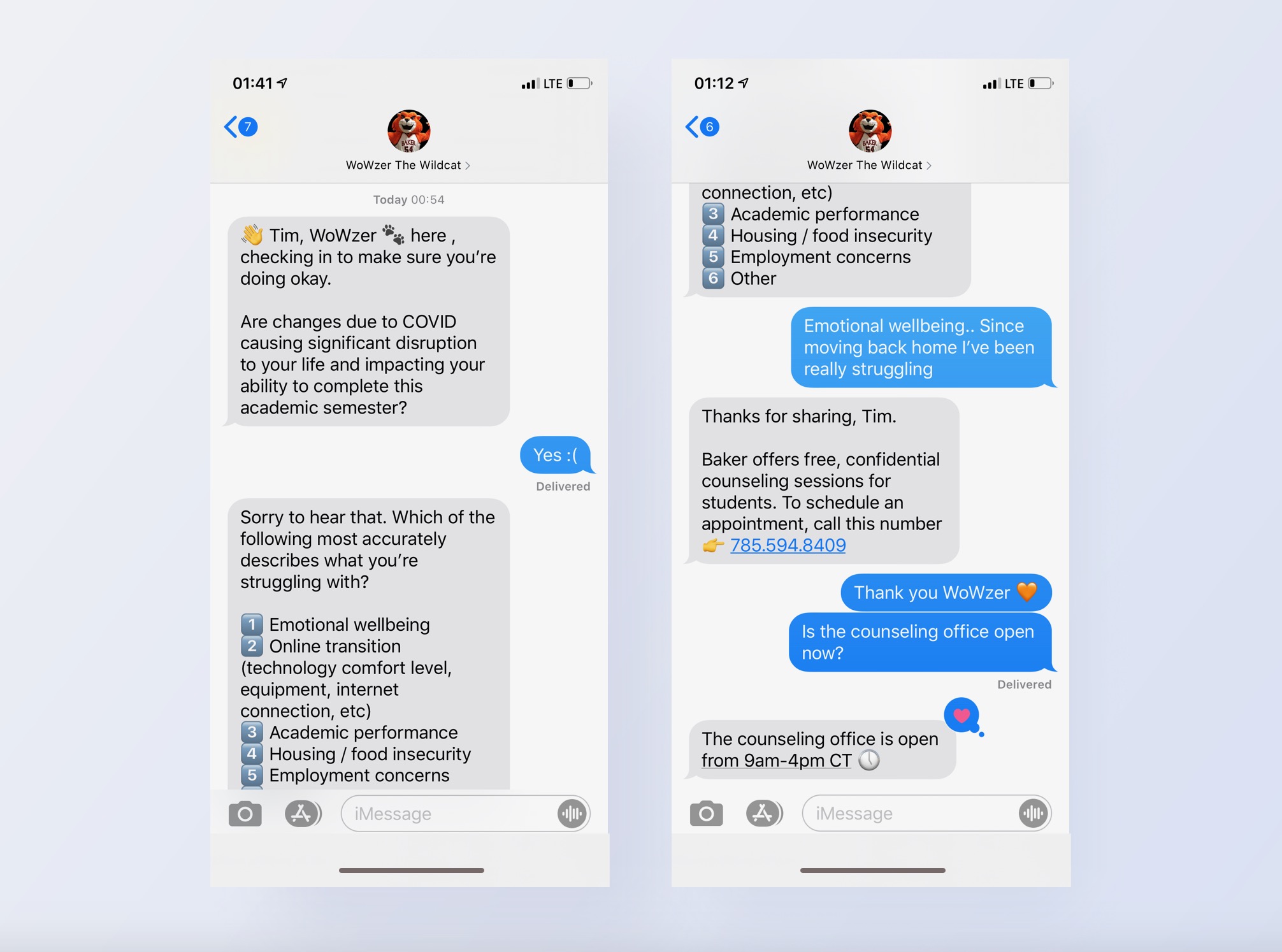
EdSights uses a chatbot, branded under a school’s mascot, to send personalized questions and messages to students to understand their biggest stresses. It then connects them to university resources spanning areas like financial aid, food security and mental health.

As the pandemic has forced millions of students to move off campus and learn from home, the co-founders have found a spurt of growth from colleges looking for new ways to hold onto their students.

And the pandemic has added a new layer of honesty to the answers.

“There is just so much going on with the world, people losing jobs and barely being able to make ends meet. School hardly seems pressing at the moment,” one student wrote. “And yet, grades are still there, determining our future when we aren’t even sure what the future looks like.”

Another wrote, “My work is closed. I have no income.” One said, “Because I am not going out I can’t distract myself from all the things going on in my life.”

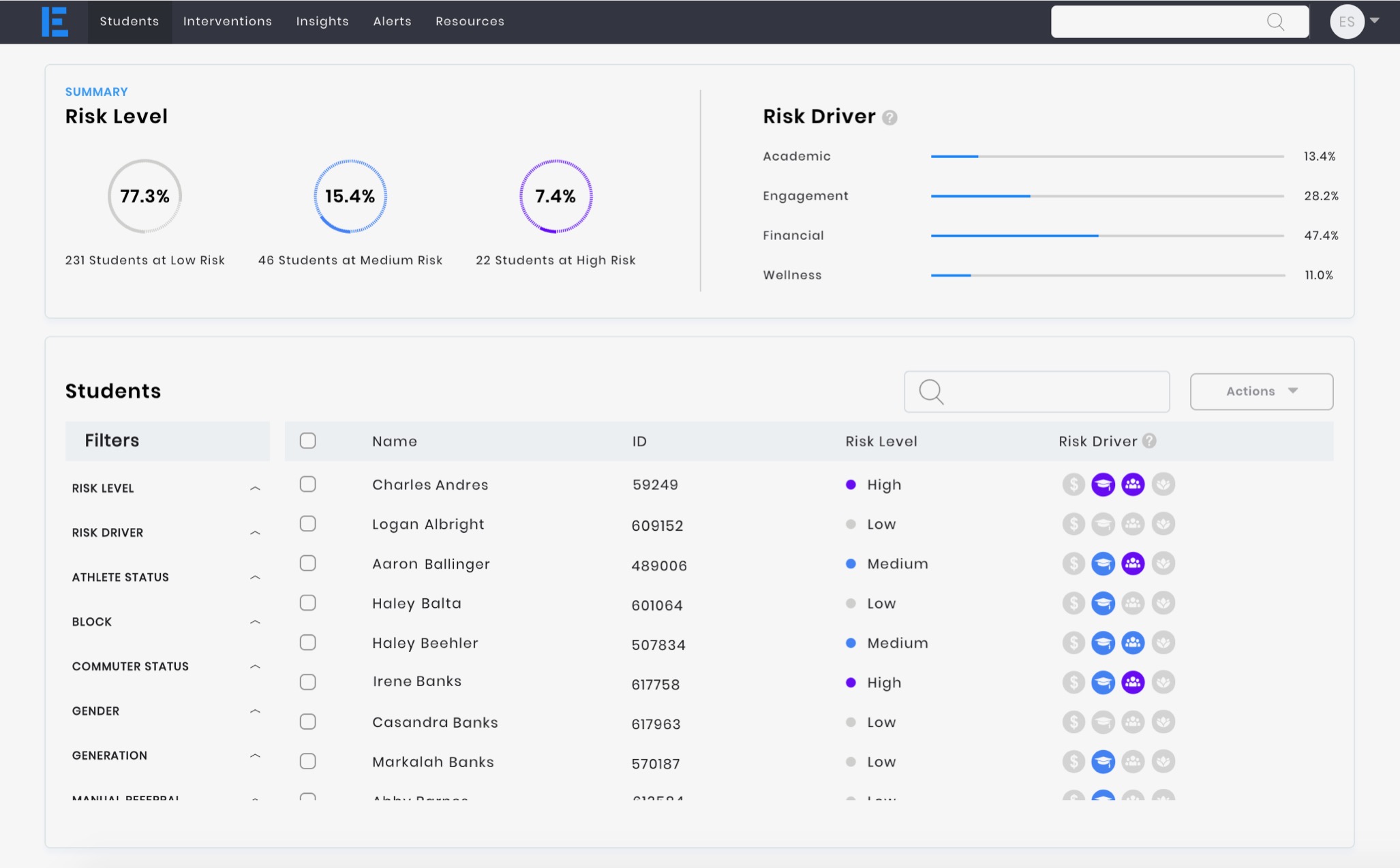
Beyond its chatbot, EdSights has a dashboard for administrators to see what percentage of their students are struggling with specific issues at the moment. The company deals with information on high-risk students and their biggest worries, so privacy is key to their platform. EdSights says it complies with both FERPA and GDPR regulation, and does not rent or sell data to third parties. Students also have the right to request an amendment of their records and receive a full log of it.

“Obviously, universities are also spooked that students won’t show up in the fall,” she said. “So they want to make sure that there’s a connectivity and they feel connected to the university, even if they can’t go to campus.”

The company took one year to scale to 16 customers, including Baker University, Missouri Western State, Bethel University, Culver Stockton College and Westminster College. On average its ARR has been growing by 66% month over month, and it has doubled its revenue since February.

EdSights charges colleges $15 to $25 per student. Most customers bring on their entire student body.

“Before this, we did see a lot of universities asking, ‘can I roll this out to freshmen or can I only roll it out to my first-generation students or maybe those that need additional support?’ ” said Carolina Recchi. “Now, colleges are not only asking us to help with all four years, but we’ve had some institutions ask us to roll it out to graduate students, which was new, because we had never done that before.”

This newfound momentum led the co-founders to raise $1.6 million in venture capital funding from a slew of high-profile investors. Investors from this round include Lakehouse VC, Kairos VC and The Fund.

The new raise also includes investments from Warby Parker, Harry’s, Allbirds, Bonobos and Rent the Runway founders.

The EdSights co-founders say COVID-19 played a part in their company receiving inbound interest from generalist investors, who have been historically skeptical about the space, versus solely getting term-sheets from specialist education firms. In fact, the duo had to turn down a number of investors, a stark difference between the chilling effect other founders claim has covered the entire fundraising scene.

EdSights new funding is another data point of how the pandemic is forcing the general public to be more nuanced in how it thinks about the intersection of education and technology.

In the time of a pandemic, a chatbot could be the only way to remotely support millions of students. Now, it’s just up to EdSights to prove that their technology is necessary in a world where schools start to reopen, whenever that is.

20 May 2020

Shopify announces a new merchant debit card and support for payment installment plans

Shopify is announcing several new products and features today at Reunite, a virtual conference for the one million merchants using the company’s e-commerce platform.

The additions include Shopify Balance, which Chief Product Officer Craig Miller described as an attempt to rethink the bank account in a way that’s better suited to a business’ needs.

“The traditional products offered by banks were created in a world that’s very different,” Miller said. “We went back to first principles of how they should be designed.”

So Shopify Balance is a merchant account with no fees and no minimum balances.

Miller said that “initially,” the only funds in the account will come from Shopify payments —merchants won’t be able to deposit additional money, but they will be able to log in, track cash flow and pay bills. The account comes with a debit card (virtual or physical), and Shopify said it will also offer cashback rewards and discounts on expenses like shipping and marketing.

The company is also announcing a Buy Now, Pay Later feature, allowing merchants to give their customers the option to split their payments into four equal installments, with no interest or additional fees.

Buy Now, Pay Later could be particularly useful for merchants selling bigger ticket items — at a time of record unemployment and economic uncertainty, concerns about “going into a serious amount of debt” could prevent some customers from making these purchases on their credit cards. At the same time, the merchants will still get paid “instantly.” (Miller said Shopify is working with a financial partner for both Balance and Buy Now, Pay Later, though he declined to offer more specifics.)

Shopify plans to release both products will become later in 2020.

Other new features include a Local Delivery option allowing merchants to design a separate delivery experience for local customers, as well as the option to collect tips at checkout.

Miller said the broad theme linking everything Shopify has done in the past few months is a “crazy acceleration of how important digital is” as merchants adapt to the COVID-19 pandemic.

The event also comes just one day after Facebook announced Facebook Shops, which will allow merchants to include digital storefronts on their Facebook Pages and Instagram profiles. Shopify is actually a partner in this initiative; merchants will be able to manage their Facebook and Instagram storefronts from the Shopify platform.

20 May 2020

Google Cloud earns defense contract win for Anthos multi-cloud management tool

Google dropped out of the Pentagon’s JEDI cloud contract battle fairly early in the game, citing it was in conflict with its “AI principals.” However, today the company announced a new 7 figure contract with DoD’s Defense Innovation Unit (DIU), a big win for the cloud unit and CEO Thomas Kurian.

While the company would not get specific about the number, the new contract involves using Anthos, the tool the company announced last year to secure DIU’s multi-cloud environment. In spite of the JEDI contract involving a single vendor, the DoD has always used solutions from all three major cloud vendors — Amazon, Microsoft and Google — and this solution will provide a way to monitor security across all three environments, according to the company.

“Multi-cloud is the future. The majority of commercial businesses run multi-cloud environments securely and seamlessly, and this is now coming to the federal government as well,” Mike Daniels, VP of Global Public Sector at Google Cloud told TechCrunch.

The idea is to manage security across three environments with help from cloud security vendor Netskope, which is also part of the deal.”The multi-cloud solution will be built on Anthos, allowing DIU to run web services and applications across Google Cloud, Amazon Web Services,  and Microsoft Azure — while being centrally managed from the Google Cloud Console,” the company wrote in a statement.

Daniels says that while this is a deal with DIU, he could see it expanding to other parts of DoD. “This is a contract with the DIU, but our expectation is that the DoD will look at the project as a model for how to implement their own security posture.”

Google Cloud Platform remains way back in the cloud infrastructure pack in third place with around 8% market share. For context, AWS has around 33% market share and Microsoft has around 18%.

While JEDI, a $10 billion, winner-take-all prize remains mired in controversy and an on-going battle between The Pentagon, Amazon and Microsoft, this deal shows that the defense department is looking at advanced technology like Anthos to help it manage a multi-cloud world regardless of what happens with JEDI.

20 May 2020

Daily Crunch: Facebook unveils its Shops e-commerce platform

Facebook and Instagram are making a bigger push into e-commerce, MasterClass raises $100 million and Microsoft launches a new project management tool called Lists.

Here’s your Daily Crunch for May 20, 2020.

1. Facebook and Instagram roll out Shops, turning business profiles into storefronts

Both Facebook and Instagram already supported a degree of e-commerce — for example, Facebook has its Marketplace and will likely make a bigger push through its Libra cryptocurrency initiative, while Instagram allows users to buy products featured in posts and ads. But the company’s new tools go further, enabling businesses to create a full-fledged Facebook Shop.

Creating a Shop is free. Businesses just upload their catalog, choose the products they want to feature, then customize it with a cover image and accent colors. Visitors can then browse, save and order products.

2. MasterClass just raised $100 million for celebrity-fueled content

CEO David Rogier said that the capital will be used to create new classes for students and up production to one class a week. The company is also experimenting with an audio-only mode, short form and augmented reality.

3. Microsoft launches Lists, a new Airtable-like app for Microsoft 365

The way Microsoft describes it, Lists is a tool to “track issues, assets, routines, contacts, inventory and more using customizable views and smart rules and alerts to keep everyone in sync.” It features deep integrations into Teams, SharePoint and other Microsoft products and will launch this summer on the web, with mobile apps slated for later this year.

4. Why micromobility may emerge from the pandemic stronger than before

Despite the struggles of individual operators, micromobility (things like scooters, bikes and e-bikes) as a technology will come out of this stronger than before, industry analyst Horace Dediu tells TechCrunch. After all, with ongoing concerns about the disease and social distancing, consumers may look to alternative modes of transportation. (Extra Crunch membership required.)

5. Former Stitch Fix COO Julie Bornstein just took the wraps off her app-only e-commerce startup, The Yes

The Yes is a women’s shopping platform that Bornstein and her co-founder Amit Aggarwal have been quietly building for 18 months, and that they say will create tailor-made experiences for each user.

6. Spotify signs ‘The Joe Rogan Experience’ to an exclusive multi-year deal

Rogan is arguably the biggest and most influential voice in the podcast medium, with a podcast that has dominated Apple’s charts and 8.41 million subscribers on YouTube. The program has often featured right-wing voices, including members of the so-called Intellectual Dark Web, Proud Boy founder Gavin McInnes and de-platformed conspiracy trafficker Alex Jones.

7. Extra Crunch Live: Join Verizon CEO Hans Vestberg for a live Q&A May 26 at 2pm ET/11am PT

Our boss’s boss’s boss’s boss (I’m probably forgetting a few management layers here) is coming on Extra Crunch Live next week to discuss 5G, as well as how founders can manage a company at scale.

The Daily Crunch is TechCrunch’s roundup of our biggest and most important stories. If you’d like to get this delivered to your inbox every day at around 9am Pacific, you can subscribe here.

20 May 2020

Watch Mitsubishi Heavy Industries launch a milestone Space Station resupply mission live

Japan’s Aerospace Exploration Agency (JAXA) is launching a Mitsubishi Heavy Industries (MHI) H-IIB rocket carrying the last of its H-II transfer vehicles. This cargo spaceship has enjoyed a long career of delivering supplies, payloads and experiments to the International Space Station, but MHI is working on a successor that will aim to begin flying in 2022, with advanced capabilities including automated docking. This vehicle will also be designed to make it all the way to NASA’s planned lunar Gateway for long-distance cargo delivery.

This launch is important not just because it’s a milestone for the MHI launch vehicle family, and an ending of sorts before the next phase, but also because it’s carrying some very interesting cargo. There are a number of different experiments, but one in particular stands out: It’s a “space avatar” – essentially a remote-controlled robot that a user on Earth can use effectively as a telepresence bot on the ISS, to allow them to remotely experience what it’s like to be on board the station in orbit.

The launch is set to take place at 2:31 AM local time from Tanegashima Space Center in Japan, which translates to 1:31 PM EDT (10:30 AM PDT).

20 May 2020

Hulu’s biggest redesign in years offers a more standardized experience, improved navigation and discovery

Hulu today will begin rolling out its largest redesign in years. The company is moving towards a more standardized, even Netflix-like user interface featuring collections laid out vertically within the Home screen, while tiles within the collections are laid out horizontally, in scrollable rows. However, the end result is not a Netflix clone, as Hulu continues to make use of its editorial imagery to highlight select titles and now uses a variety of tile sizes to communicate information about the content it recommends.

Hulu will also simplify its top-level navigation, moving categories like “TV,” “Movies,” and “Sports” to the top of the screen, to make it easier for users to drill down into the type of content they watch.

These changes follow Hulu’s first big redesign in 2017 which arrived alongside the launch of Hulu’s Live TV experience. Though that update did help to differentiate Hulu from other streaming services, it also overcomplicated the user interface. Hulu’s customer feedback forums were filled with complaints about the interface being too difficult to navigate and the confusing layout.

To some extent, today’s changes are an acknowledgment on Hulu’s part that its interface had room for improvement. They’re also meant to make it easier for viewers who move between other Disney-owned services, like Disney+ or ESPN+, the company says.

“When we launched the current experience three years or so ago, it was a pretty radical change,” admits Jason Wong, Hulu’s Director of Product Management. “I think a standard has emerged as people have adopted streaming — it’s evident, and not just within the Disney family,” he continues. “We know that the majority of users have between three to five different services, and I think all of them employ this orientation on the living rooms devices.”

Though a desire for more uniformity with the other Disney streaming service was part of the consideration for the changes, Hulu says the overall redesign has been in the works for a year and a half — well before Disney acquired Fox and took operational control of Hulu.

The redesigned user interface combines what works on other streaming services with Hulu’s own unique features.

For instance, Hulu now organizes content into familiar, scrollable horizontal rows, but it continues to showcase its standout titles with bold, cinematic imagery, along with title art, color sampling, and a gradient in larger tiles — much as it did before. However, in the new interface, not all of Hulu’s content gets thrown into this large template. (Seen below).
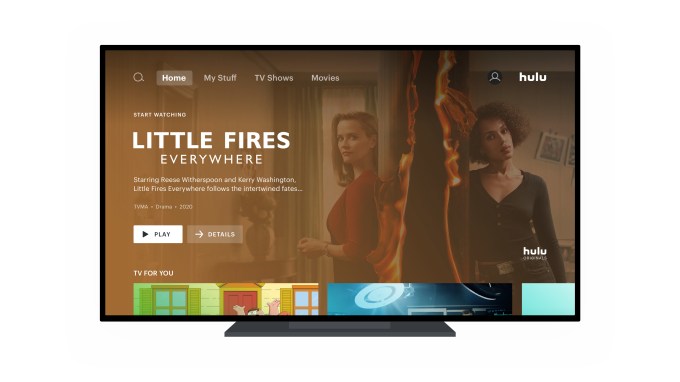
Instead, the large templates will be used to pull in users to start watching new content — like Hulu’s originals or other shows that are popular on the service. Meanwhile, more familiar content — like shows you’re currently watching or those in your “My Stuff” — may not be displayed in the same way.

As you scroll down through the revamped Hulu Home screen, you’ll notice the content is broken up by a variety of differently-sized tiles. In addition to the large, masthead template, there are other larger templates appearing throughout the experience as well as medium and smaller, standard templates. This design encourages users to pause their scroll and consider the highlighted titles, as opposed to getting lost in a sea of titles.
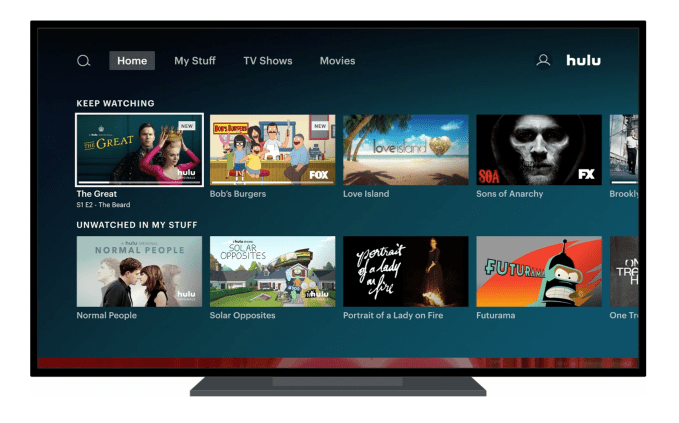
In addition, Hulu is turning its recommendation engine on the selection of the collections and tiles. Every module on the screen can be powered by either editorial curation or algorithms, or some combination of both.

At the top of the Home screen, collections like “Movies for You” or “TV for You” will appear for all users, but as you continue to scroll down, suggested collections will become more personalized to people’s unique interests. While Hulu isn’t being as explicit as Netflix with its “Because You Watched X” collections, it is powering its suggestions based on what content the user has been engaging with.
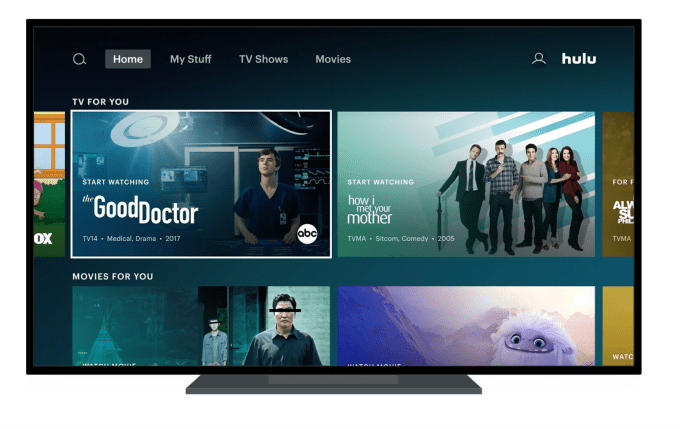
For example, in a row of Sci-Fi Movie recommendations for someone who regularly watched that genre, it may remove the movies you had already watched or gave a thumbs down to from its row of suggestions. It may also remove those from a subgenre you never watched, like Sci-Fi/Horror, while promoting those from another subgenre you watch more often.

Hulu’s editors will also have the ability to rank certain titles first (or within a range), for those times when they want to better highlight a title — like a new release that serves as a tentpole to a genre.

The end result is a row of suggestions personalized and ranked based on your individual tastes, but one that also benefits from human curation.

According to Jim Denney, Hulu VP and Head of Product Management, the user interface redesign will not only help users to better navigate the streaming service, it will also improve discovery.

“One of the things [we wanted to improve on] is around density — giving people enough of a view into Hulu’s catalog. We’ve got one of the largest catalogs of any service available,” Denney explains. Plus, he noted, “When we look at our current [user interface], there are several ways to achieve the same thing. We want to close some of those gaps so it becomes more obvious which path to follow so users don’t get lost.”

These changes speak directly to the user complaints from years’ past, and lay the groundwork for more improvements over time.

Further down the road, Hulu plans to turn its recommendation engine not only on the titles it suggests but on the presentation of those titles to the individual user, too. That means choosing which titles appear in larger or smaller modules, for example, or how and when those modules appear. A new user, for example, might see more of the larger tiles highlighting top Hulu shows compared with how may an existing user would see. Hulu expects to roll this out sometime in 2021.

The new Hulu interface will roll out this week, initially on tvOS and Roku first. In July, it will expand to other platforms and a larger group of users.


20 May 2020

Mammoth Biosciences partners with GSK to develop handheld CRISPR-based COVID-19 test

California-based Mammoth Biosciences has signed a powerful partner for its development of a CRISPR-based test for COVID-19, which would aim to delivery accurate, fast results using a handheld, disposable testing platform. Mammoth Biosciences will be using its DETECTR platform to develop the test, which recently received validation through a peer-reviewed study published in Nature.

Already, Mammoth has its DETECTR platform under evaluation by the FDA for an Emergency Use Authorization (EUA), and partnering with GSK and its consumer healthcare division sets up Mammoth to potentially scale its development and distribution to widespread commercial and consumer availability. Mammoth and GSK aim to have a COVID-19-specific test based on DETECTR ready for FDA evaluation before the end of this year.

The goal is to make it available first to healthcare facilities in the U.S.. It can provide a lot of advantages vs. current solutions for health facility testing, since it provides results in under 20 minutes and can be conducted fully on site using a nasal swab collected from a patient. It’s also fully disposable, making it more convenient and ultimately safer for healthcare professionals to use.

After that, the partners plan to expand availability, ultimately offering the test direct to consumers for over-the-counter use. The nature of the test means it’s not much more difficult to administer than may other at-home diagnostics, which h could further reduce the risk of transmission for infected individuals and make tests much more accessible and widespread.

Note that this likely won’t happen before at least next year given the current development timeline, but given the nature of the ongoing global pandemic, it definitely seems like we’ll still be interested in expanding testing capabilities as one of our ongoing strategies of mitigating the impact of SARS-CoV-2 and COVID-19.

20 May 2020

The Midnight is the new synth pop you need in your life, here’s the world premiere of their new video

If you follow me on Twitter you may have seen me waxing poetic about The Midnight, an LA-based synthwave band that has been putting out modern nostalgia for the 80’s set since 2012. Yeah yeah, why is this on TechCrunch? Because I love it and I know a good chunk of our audience will too, simple as that. Also I’m the boss so no one can tell me what not to post. Deal.

The Midnight is Tyler Lyle and Tim McEwan and their latest album Monsters hits in July of 2020 — but you can check out their discography on Spotify or Apple Music. There is also a dope visual scene on YouTube cutting together their songs with movie montages from the synth era — as well as new bit heavy compositions from video artists.

I’ve been a fan for a few years now, and have listened to all of their releases many times on loop. Especially when I’m in full flow state writing or working on projects. It’s seriously nostalgia rich but also crisp and tight and not at all indulgent beyond the degree it needs to be.

I’m stoked to be able to drop in the world premiere of their new video with Gustavo Torres AKA Kidmograph — a visual artist working in motion design and music videos.  “We’ve been fans of Kidmograph for a very long time and we’re so thankful that we get to partner with him on this lyric video,” said the band. “The ethos of this record about connection uses inspiration from the early PC culture of the late 80s and early 90s. Kidmograph totally nailed it.”

“The idea was to recreate some sort of retro video game where the character goes on an adventure into the depths of the sea (which in fact is the depths of its own mind) looking for an adventure (his love),” says Kidmograph. “At the end, we realize it was all an illusion, built in a small corner of a teenager’s room. The excuse of the lyric video as a video game representation was really fun and a different take to work with. Emulating an old operating system designed for the band, we dive through both the lyrics and visuals as an adventure into the unknown.”

Check out the lyric video premiere for Deep Blue here: