
Year: 2020

01 Apr 2020

LinkedIn’s making its job listing tools free to those recruiting to fight the coronavirus pandemic

Like many other websites at the moment, the career-oriented networking platform LinkedIn has seen a big boost in traffic as a result of people being asked to work from home and stay indoors overall to slow the spread of the coronavirus, with a bump of 55% more conversational activity between existing connections in recent weeks. Now, to leverage that attention in a way that’s more directly helpful during this health crisis, LinkedIn is announcing new measures specifically around job listings.

From today and for the next three months, LinkedIn says it will provide free job postings for “essential” businesses globally — companies in healthcare, as well as warehousing, supermarket, freight delivery, and non-profits working in support or relief roles — in other words, those providing critical front-line services to keep the economy and society in motion. Healthcare will include companies working in areas like medical devices, medical practice (including hospitals), and mental health care.

Alongside this, LinkedIn is creating an “urgent jobs” board to give these openings more priority visibility. People whose skills match up with those needed for these jobs who visit LinkedIn’s jobs homepage will see the special listings highlighted. Those who sign up for job alerts with matching skills will in turn get real-time alerts of the jobs as they get posted.

The volunteer ads also link up with an expanded Recruiting for Good program to help bring in more people to work with non-profits in both volunteer and paid roles. And those doing the recruiting will also get three months of free access to LinkedIn’s talent insights tools to figure out where their (free) ads are best placed around hiring trends and more.

Organizations that have already signed up to use these include the American Red Cross of Los Angeles, the CommonSpirit Health hospital network, Doctors on Demand, and New York Presbyterian Hospital.

The new initiatives underscore the bigger trend of how tech companies are looking to provide whatever assistance they can bring to the table in the midst of the coronavirus pandemic.

(Others include Google, which is trying to help with testing, while also providing a landing page for official and local information, while both Facebook and Twitter are trying to stamp out fake news while surfacing links to official organizations for help.)

Recruitment — which has traditionally been LinkedIn’s biggest revenue generator (as part of Microsoft, it does not regularly report financials on its business lines) — has been in an interesting position within that.

On the one hand, recruitment and its counterpart, employment, have been two of the essential levers in fighting this pandemic.

On the clinical front, hospitals and related care organizations are scrambling to keep up with the surge in demand for their services, leading to major recruitment drives to bring in people with relevant experience, in some cases going straight to the ranks of those who may have left the profession and now are being asked to step in again.

In the UK, for example, some 4,500 doctors and nurses have so far answered the open call to come back into medical service (many will have moved on to other non-clinical or managerial roles in the NHS, or left the public sector, or the profession altogether, not just retired due to age), with more likely to come. And that’s just on the clinical front. We’re seeing a multitude of call outs across other sectors, like technology, to bring in experts in AI and other areas to help design software and hardware to slow the spread of the virus, to alleviate some of the side effects, to identify it faster, and maybe even to potentially cure it.

In another vein, the closures of restaurants and public places has put a big shift on to supermarkets and other food providers to beef up their workforces to meet their rising demands. That’s meant that while many people have lost their old jobs due to closures, they are getting opportunities to redeploy elsewhere.

(The same goes for the collective groundswell of people who have emerged as volunteers to help others who are in need, with hundreds of thousands volunteering to help deliver medications or other essential tasks to supplement the work of front-line healthcare providers.)

On another level, beyond addressing the pandemic in a direct way, employment and recruitment have become something of a canary in the coalmine when it comes to assessing how different sectors and the economy overall is faring, and how it will look when the pandemic starts to subside.

We’ve charted some notable developments of hiring freezes, layoffs and furloughs in the tech world already — as well as hiring boosts for those suddenly finding their businesses in huge demand — and the same thing is playing out across other sectors, a trend LinkedIn, as one of the bigger recruitment portals in the world, is well positioned to see.

“The trend as the virus moves through the world has been a decline in job posts,” said Blake Barnes, Blake Barnes, LinkedIn’s head of careers and talent solutions. “It’s a pattern we saw starting in China with the first wave of the pandemic.” Positively, he noted that “we have also seen that recovery brings growth as well.”

For now, LinkedIn has set some criteria in place to tailor eligibility. For example, nonprofit organization need to be US 501c3 registered, or the global equivalent), providing disaster response or services for COVID-19 relief​. Hospitals meanwhile need to be in critical areas of coronavirus outbreak (based on impact data) and understaffed and in need of urgent clinical frontline workers for COVID-19 response.

Over time, there will likely be more types of businesses added to the mix of “essential” companies (for example, as a car parts company retools to become a ventilator maker) and non-profits over time, and also more evolutions in how job ads get seen by people. The main point was to deploy quickly to start work as soon as possible.

“We are keeping a close eye on situation, but we have already have seen a critical talent shortage,” said Barnes. “We’re starting with the obvious companies, but we’re getting these tools to market where they are most needed. But things change every single day so we’ll be assessing in real time to understand how different sectors are evolving and changing.”

01 Apr 2020

Notion hits $2 billion valuation in new raise

Notion, a startup that operates a workplace productivity platform, has raised $50 million from Index Ventures and other investors at a $2 billion valuation, the company told The New York Times.

A Notion spokesperson confirmed the raise and valuation to TechCrunch.

As startups across the board begin looking at layoffs or raising at less than favorable terms, Notion had been in the unusual position of turning interested investors away for years. With this raise, the firm has amassed $67 million in total funding, the company says. Their last raise of $10M valued them at $800 million.

The company’s highly customizable note-taking app allows enterprise customers to create linked networks of databases and documents.

In November, COO Akshay Kothari told TechCrunch that the company was hoping not to raise outside funding again, “So far one of the things we’ve found is that we haven’t really been constrained by money. We’ve had opportunities to raise a lot more, but we’ve never felt like if we had more money we could grow faster.”

What’s changed? Just the global economy. The firm told the Times that this new raise should put them in a more stable position and leave them with enough funding for “at least” ten years. That said, the startup’s team has expanded rapidly in recent months, growing 40 percent since November. Their user numbers appear to also be growing rapidly, with Kothari telling the Times that total users have “nearly quadrupled” from one million, a figure the company released in early 2019.

Notion offers free and paid accounts, ranging from $5 to $25 billed monthly.

01 Apr 2020

Notion hits $2 billion valuation in new raise

Notion, a startup that operates a workplace productivity platform, has raised $50 million from Index Ventures and other investors at a $2 billion valuation, the company told The New York Times.

A Notion spokesperson confirmed the raise and valuation to TechCrunch.

As startups across the board begin looking at layoffs or raising at less than favorable terms, Notion had been in the unusual position of turning interested investors away for years. With this raise, the firm has amassed $67 million in total funding, the company says. Their last raise of $10M valued them at $800 million.

The company’s highly customizable note-taking app allows enterprise customers to create linked networks of databases and documents.

In November, COO Akshay Kothari told TechCrunch that the company was hoping not to raise outside funding again, “So far one of the things we’ve found is that we haven’t really been constrained by money. We’ve had opportunities to raise a lot more, but we’ve never felt like if we had more money we could grow faster.”

What’s changed? Just the global economy. The firm told the Times that this new raise should put them in a more stable position and leave them with enough funding for “at least” ten years. That said, the startup’s team has expanded rapidly in recent months, growing 40 percent since November. Their user numbers appear to also be growing rapidly, with Kothari telling the Times that total users have “nearly quadrupled” from one million, a figure the company released in early 2019.

Notion offers free and paid accounts, ranging from $5 to $25 billed monthly.

01 Apr 2020

Stocks fall sharply as U.S. government warns of hard weeks ahead

A recent redbound in domestic equity prices faded further into the distance today, as American stocks fell for a second consecutive day following modest Tuesday declines.

After rising from new 52 week lows, all domestic indices after the American president warned of difficult weeks ahead as the country reels from the economic and social impacts of COVID-19. The day’s trading left stocks down heading into Thursday, when a new unemployment claim number is expected.

Some are anticipating a worse number than last weeks 3.3 million claims, a result that was historic in size. If tomorrow’s report is as bad as some expect it would underscore the scale of economic damage the country endures as it seeks to stem the spread of COVID-19 after an initially slow national response that has since splintered into a patchwork of state-led efforts. Many Americans are staying home, a condition that could persist for weeks or months, exacerbating economic damage.

Here’s the day’s results:

  • Dow Jones Industrial Average: -973.65, -4.44%
  • S&P 500: -114.09, -4.41%
  • Nasdaq Composite: -339.52, -4.41%

Shares of SaaS and cloud companies, as tracked by the BVP Nasdaq Emerging Cloud Index fell 4.83% today. As with the broader technology industry, SaaS firms saw their shares fall sharply before recovering some; and, like their industry peers, they are now trending down yet again.

Pressure on automakers

The Big Three Detroit automakers GM, Ford and Fiat Chrysler Automobiles also saw stocks slide after reporting first quarter sales declines. GM reported a 7.1% drop in sales in the first three months of the quarter ended March 31 compared to the same year ago period. FCA reported a 10.4% decline in sales. Ford is expected to report its quarterly sales numbers on Thursday. Tesla, which saw its shares fall 8.1% to $481.56, is expected to report deliveries this week.

GM shares fell today 7.31% to $19.26, while FCA saw its price drop 5.15% to $6.82.

GM and FCA were hardly the only automakers to see a drop in sales caused by falling demand for cars, trucks and SUVs. Hyundai, Nissan and Porsche also reported declines.

With the close of a turbulent Q1 behind us, we are not yet free of the first three months of 2020. Earnings season looms, and with it an endless retrace of the outbreak of the pandemic domestically, as sketched by the numbers of domestically-listed companies. For some firms Q1 numbers will prove a bonanza. For most, however, they will likely show the opposite. So get ready for another quarter of confusion, it’s going to be a long three months.

01 Apr 2020

Self-driving car engineer Anthony Levandowski files motion to force Uber into arbitration

Anthony Levandowski, the star self-driving car engineer who was at the center of a trade secrets lawsuit, has filed a motion to compel Uber into arbitration in the hopes that his former employee will have to shoulder the cost of at least part of the $179 million judgment against him.

The motion to compel arbitration filed this week is part of Levandowski’s bankruptcy proceedings. It’s the latest chapter in a long and winding legal saga that has entangled Uber and Waymo, the former Google self-driving project that is now a business under Alphabet.

The motion represents the first legal step to force Uber to stand by an indemnity agreement with Levandowski. Uber signed an indemnity agreement in 2016 when it acquired Levandowski’s self-driving truck startup Otto . Under the agreement, Uber said it would indemnify — or compensate — Levandowski against claims brought by his former employer, Google.

In Uber’s view the stakes are at least $64 million, according to the ride-hailing company’s annual report filed with the U.S. Securities and Exchange Commission . Although Levandowski, who was ordered in March 2020 to pay Google $179 million, is clearly shooting for more.

“For much of the past three years, Anthony ceded control of his personal defense to Uber because Uber insisted on controlling his defense as part of its duty to indemnify him. Then, when Uber didn’t like the outcome, it suddenly changed its mind and said it would not indemnify him. What Uber did is wrong, and Anthony has to protect his rights as a result,” Levandowksi’s lawyer Neel Chatterjee of Goodwin Procter said in an emailed statement to TechCrunch.

The backstory

Levandowski was an engineer and one of the founding members in 2009 of the Google self-driving project, which was internally called Project Chauffeur. The Google self-driving project later spun out to become Waymo, a business under Alphabet. Levandowski was paid about $127 million by Google for his work on Project Chauffeur, according to the court document filed this week.

Levandowski left Google in January 2016 and started Otto, a self-driving trucking company, with three other Google veterans Lior Ron, Claire Delaunay and Don Burnette. Uber acquired Otto less than eight months later.

Before the acquisition closed, Uber conducted due diligence including hiring outside forensic investigation firm Stroz Friedberg to review the electronic devices of Levandowski and other Otto employees, according to the recent court filing. The investigation discovered that Levandowski had files belonging to Google on his devices, as well as indications that evidence may have been destroyed.

Uber agreed to a broad indemnification agreement in spite of the forensic evidence, which would protect Levandowski against claims brought by Google relating to his previous employment. Levandowski was worried that Google would attempt to get back any or all of the $127 million in compensation he had received.

That forecast didn’t take long to come true. Two months after the acquisition, Google made two arbitration demands against Levandowski and Ron. Uber wasn’t a party to either arbitration. However, it was on the hook under the indemnification agreement, to defend Levandowski.

Uber accepted those obligations and defended Levandowski. While the arbitrations played out, Waymo separately filed a lawsuit in February 2017 against Uber, for trade secret theft. Waymo alleged in the suit, which went to trial and ended in a settlement, that Levandowski stole trade secrets, which were then used by Uber. Under the settlement, Uber agreed to not incorporate Waymo’s confidential information into their hardware and software. Uber also agreed to pay a financial settlement that included 0.34% of Uber equity, per its Series G-1 round $72 billion valuation. That calculated at the time to about $244.8 million in Uber equity.

Meanwhile, the arbitration panel issued an interim award in March 2019 against each of Google’s former employees, including a $127 million judgment against Levandowski. The judgment also included another $1 million that Levandowski and Ron were jointly liable for. Google submitted a request for interest, attorney fees and other costs. A final award was issued in December.

Ron settled in February with Google for $9.7 million. However, Levandowski, disputed the ruling. The San Francisco County Superior Court denied his petition in March, granting Google’s petition to hold Levandowski to the arbitration agreement under which he was liable.

As the legal wrangling between Google and Levandowski and Uber played out, the engineer faced criminal charges. In August 2019, he was indicted by a federal grand jury with 33 counts of theft and attempted theft of trade secrets while working at Google. Last month, Levandowski reached a plea agreement with the U.S. District Attorney and pleaded guilty to one count of stealing trade secrets.

What’s next

Levandowski’s lawyers argue that when the final judgment was entered against him, Uber reneged on its indemnification agreement. Levandowski said he was forced to file for Chapter 11 bankruptcy because Uber has refused to pay.

“While Uber and Levandowski are parties to an indemnification agreement, whether Uber is ultimately responsible for such indemnification is subject to a dispute between the Company and Levandowski,” Uber said, using similar language found in its annual report filed with the SEC.

Even if Levandowski’s legal team is able to convince a judge to compel Uber into arbitration, that doesn’t mean the outcome will be positive. Arbitration could take months to play out. In the end, Levandowski could still lose. But the filing allows Levandowski to speak out — albeit using legalese — and share details of his employment at Google and Uber. Among those are details about what Uber knew (and when) about Levandowski’s activities in recruiting Google employees as well as information he had downloaded onto his laptop, and discovered during the forensic investigation.

The first cracks between Uber and Levandowski appeared in April 2018, based on a timeline in the court document. It was then that Uber told Levandowski it intended to seek reimbursement for expenses used to defend him in the arbitration, according to claims laid out in the motion. Uber told Levandowski at the time, that one reason it was seeking reimbursement is because Levandowski “refused to testify at his deposition through an unjustifiably broad invocation of the Fifth Amendment.” Levandowski had used the Fifth Amendment in the deposition during the arbitration with Google.

Uber never requested Levandowski waive his Fifth Amendment rights and testify during the arbitration, according to the court document. Levandowski said that he immediately alerted Google and the arbitration panel that he was willing to testify and offered to make himself available for deposition before the arbitration hearing.

Levandowski-Uber Motion to Compel by TechCrunch on Scribd

01 Apr 2020

Olive, a startup developing an automation tool for healthcare administration, raises $51 million

Time is money as the old adage goes, and this is doubly true in healthcare systems operating with thin margins now made even thinner thanks to the loss of revenue caused by a freeze on elective procedures.

Stepping in with a technology that automates much of the time-consuming backend processes hospitals and healthcare providers need to keep up with is Olive, a startup out of Columbus, Ohio.

The company, which counts over 500 hospitals representing some of the largest healthcare providers in the U.S. among its customers, has raised a new round of $51 million as it sees significant growth for its business.

The round, raised from investors including Drive Capital, Oak HC/FT, Ascension Ventures, was led by General Catalyst, which recently closed on $2.3 billion in new capital to invest in early stage companies.

As a result of the investment, Ron Paulus, the former president and chief executive of Mission Health, will join the board of directors, the company said in a statement.

Olive’s software toolkit automates administrative tasks like revenue cycle, supply chain management, clinical administration and human resources, the company said in a statement. And demand for the company’s technology is surging. 

According to data provided by the company, roughly half of hospital administrators intend to invest in robotic process automation by 2021,

“There’s a growing, multi-billion dollar problem: healthcare doesn’t have the internet. Instead, healthcare uses humans as routers, forcing workers to toggle between disparate systems — they copy, they paste, they manipulate data – they become robots. They click and type and extract and import, all day long — and it’s one of the leading reasons that one out of every three dollars spent in the industry today is spent on administrative costs,” said Olive chief executive Sean Lane in a September statement.

Olive doesn’t just automate processes, but makes those processes better for hospitals by identifying problem areas that could lead to lost revenues for hospitals. The software has access to pre-existing health claim status data, which allows it to identify where mistakes in previous claims were made. By using accurate coding, hospitals can add additional revenue.

“As a recent health system CEO, I appreciate the duress our hospitals are under as they focus on delivering the best patient care possible under challenging circumstances all while needing to keep the lights on,” said Dr. Ronald A. Paulus. “Olive’s reliable automation of essential back-office processes saves time, reduces errors and allows staff to focus on higher-order work. I am excited to be working closely with Olive’s management team to maximize the outsized positive impact we can have in healthcare on both the administrative and clinical fronts.”

01 Apr 2020

Audible has the first Harry Potter audiobook (as read by Stephen Fry!) up for free right now

If you’ve ever tried to buy the Harry Potter audiobooks, you probably noticed something kind of tricky: there’s two very different versions. The version most widely available in the US is narrated by Jim Dale. The UK version is read by Stephen Fry.

Which is better? I won’t get into that — that’s something the Internet has been arguing about for a decade+ now. I will say, however, that getting the Stephen Fry versions in the US (legally) is usually a pretty big pain in the butt. Different countries, different distribution rights, different licensing — yada yada yada.

It got a bit easier today, albeit for just the first book: Audible has put the Stephen Fry version of Harry Potter and the Philosopher’s Stone up online, for free, until further notice.

Audible says it’s doing this as part of J.K. Rowling’s #HarryPotterAtHome program, in which the author is “relaxing the usual copyright permissions” to make the story available to more children during the ongoing Covid-19 outbreak. The same program is allowing teachers to post videos of themselves reading the series aloud to their students (as long as it’s on a “closed educational platform”… so not like, YouTube) without worrying about getting into a copyright battle.

A few small catches:

  • If you’re in North America and get hooked on Fry’s take on the narration, finding/importing the Fry version of the other books is going to be up to you. Even if you sign up for an Audible account, the rest of the series on Audible is read by Jim Dale. To be clear, Dale’s version is very good! Just know that it’s different.
  • It’ll work across laptops, phones, tablets, etc. with the caveat that it’s streaming only, so plan on listening somewhere with an Internet connection.

You can find the Harry Potter stream — plus a bunch of other family friendly audiobooks as part of Audible’s free Stories program — right here.

01 Apr 2020

Nextdoor updates its app to allow businesses to link to fundraisers, gift cards and more

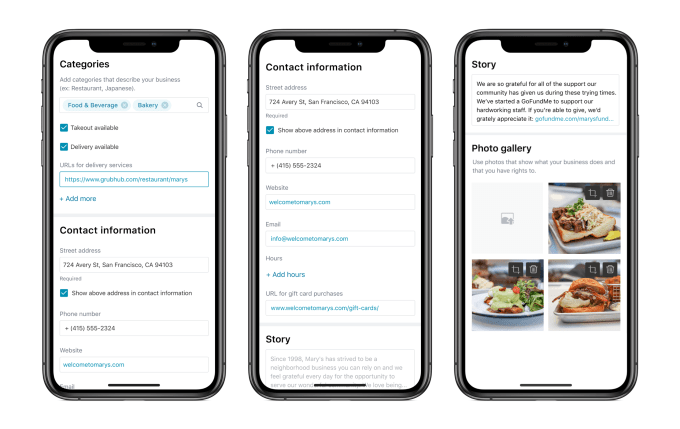
Neighborhood social networking app Nextdoor is rolling out a few changes focused on supporting local businesses. The COVID-19 outbreak has forced many businesses to close their doors, sometimes for good, while others are struggling to stay afloat. As a result, many Nextdoor users have been posting on the app asking how they can help support their favorite businesses during this time. These new updates will allow them to do just that — by buying gift cards from local businesses, donating to fundraisers, or shopping from a business that remains open by way of pickup or delivery.

Buying gift cards from local merchants has quickly emerged as an easy way for customers to help their favorite restaurants and other businesses during the coronavirus pandemic.

New sites, like HelpMainStreet.com and SaveOurFaves.org, have launched in recent days to make this process more organized. OpenTable’s gift card marketplace waived its fees. Meanwhile, other efforts had their hearts in the right place but flubbed the execution — as with Yelp’s disastrous implementation of a GoFundMe integration that didn’t allow participants to easily opt-out.

On Nextdoor, however, the app is simply being updated to allow the local businesses themselves to direct users to whatever websites or fundraisers they already have running.

For example, in the Business Profile section, the local merchant can now add a gift card website address to their profile. When Nextdoor users click the link, they’ll be directed to the page the business has set up for selling gift cards.

Even if the business doesn’t offer online purchases, it could simply add a page to its existing website that instructs users how to buy the gift card from them — perhaps, by calling the business on the phone or reaching out on social media.

In addition, if the business is running a GoFundMe campaign, they’ll now be able to include that link in the “Story” section of their Nextdoor Business Page for Nextdoor users to see.

Their Nextdoor Business Page can also now be customized with their available take-out and delivery options, which is particularly useful for dine-in restaurants that just started offering to-go meals or delivery for the first time, but haven’t partnered with a larger delivery service, like DoorDash, GrubHub or Uber Eats.

In addition, businesses that been voted as a “Nextdoor Neighborhood Favorite” by the community will also now be able to post to the main Nextdoor news feed. Here, they can share updates to their hours, services offered, or operations, which will be seen by a larger number of users.

Nextdoor has also added a Coronavirus Resource Center to help local business owners get updated news, information, and actionable business advice in one spot.

The changes come only a day after Facebook launched Community Help for COVID-19, which allows local community members — including Facebook Pages used by businesses– to both offer aid and request assistance. But posts about supporting your favorite restaurant could easily get lost amid more critical calls for medical supplies needed by area hospitals or food banks in need of volunteers.

On Nextdoor, local businesses may instead find a smaller, but more targeted audience where their real-life neighbors and customers are already engaging with one another.

This isn’t the first COVID-19 related update Nextdoor has rolled out. The company previously updated its app to include a Help Map for neighbors offering to help one another or in need of help themselves.

01 Apr 2020

A former chaos engineer offers 5 tips for handling online disasters remotely

I recently had a scheduled video conference call with a Fortune 100 company.

Everything on my end was ready to go; my presentation was prepared and well-practiced. I was set to talk to 30 business leaders who were ready to learn more about how they could become more resilient to major outages.

Unfortunately, their side hadn’t set up the proper permissions in Zoom to add new people to a trusted domain, so I wasn’t able to share my slides. We scrambled to find a workaround at the last minute while the assembled VPs and CTOs sat around waiting. I ended up emailing my presentation to their coordinator, calling in from my mobile and verbally indicating to the coordinator when the next slide needed to be brought up. Needless to say, it wasted a lot of time and wasn’t the most effective way to present.

At the end of the meeting, I said pointedly that if there was one thing they should walk away with, it’s that they had a vital need to run an online fire drill with their engineering team as soon as possible. Because if a team is used to working together in an office — with access to tools and proper permissions in place — it can be quite a shock to find out in the middle of a major outage that they can’t respond quickly and adequately. Issues like these can turn a brief outage into one that lasts for hours.

Quick context about me: I carried a pager for a decade at Amazon and Netflix, and what I can tell you is that when either of these services went down, a lot of people were unhappy. There were many nights where I had to spring out of bed at 2 a.m., rub the sleep from my eyes and work with my team to quickly identify the problem. I can also tell you that working remotely makes the entire process more complicated if teams are not accustomed to it.

There are many articles about best practices aimed at a general audience, but engineering teams have specific challenges as the ones responsible for keeping online services up and running. And while leading tech companies already have sophisticated IT teams and operations in place, what about financial institutions and hospitals and other industries where IT is a tool, but not a primary focus? It’s often the small things that can make all the difference when working remotely; things that seem obvious in the moment, but may have been overlooked.

So here are some tips for managing incidents remotely:

There were many nights where I had to spring out of bed at 2 a.m., rub the sleep from my eyes and work with my team to quickly identify the problem… working remotely makes the entire process more complicated if teams are not accustomed to it.

01 Apr 2020

Palantir provides COVID-19 tracking software to CDC and NHS, pitches European health agencies

As the floor drops out from under many startups, some tech companies are finding a path forward by meeting new government needs.

Among them is Palantir, a secretive government-friendly big data operation that’s able to ingest vast amounts of information to visualize trends and track individuals—useful tasks as the spread of COVID-19 threatens to overwhelm healthcare systems and ravage economies.

In mid-March, the Wall Street Journal reported that Palantir was working with the CDC to model the potential spread of the virus. Forbes now reports that CDC staffers are now regularly using Palantir’s web app to visualize the spread of the virus and to anticipate hospital needs. According to that report, Palantir is eschewing dealing with sensitive personally identifying information in its coronavirus efforts, instead providing analysis of anonymized hospital and healthcare data, lab results, and equipment supplies through a platform called Palantir Foundry.

In the U.K., Palantir is also providing the National Health Service (NHS) with COVID-19 data analysis through the company’s Foundry software. In a blog post that mentioned the partnership, the U.K. government that it will use Foundry “which has been primarily developed in the UK” to “[enable] disparate data to be integrated, cleaned, and harmonised in order to develop the single source of truth that will support decision-making.”

According to a new report from Bloomberg, Palantir is also pitching its analytics software to government officials in France, Germany, Switzerland and Austria. The company is apparently pitching both its Foundry software and a tool called Gotham, which is best-known for helping intelligence and law enforcement agencies track individuals, as in the case of the company’s work with ICE. Those two tools are being proposed to European health agencies as a blended solution that could help countries get a birds-eye view of the pandemic.

As interest in surveillance technologies ramps up to meet the mounting crisis, privacy advocates are already sounding the alarm. The Electronic Frontier Foundation cautioned that “governments around the world are demanding extraordinary new surveillance powers” to fight the virus and urges close scrutiny of new relationships between governments and private companies that arise out of the pandemic.

Among those relationships: Palantir’s co-founder and chairman Peter Thiel is one of the Trump administration’s most prominent allies in the tech world. His sometimes controversial projects and investments generally attract attention, Palantir included.

Likely aware of its reputation as the shadowy tech giant that helps to power ICE’s deportation machine, Palantir is apparently acknowledging the privacy implications of its new work. In a statement provided to the Wall Street Journal, Palantir’s privacy lead Courtney Bowman asserted that privacy and civil liberty must be taken as “guiding concentrations” in any data-driven COVID-19 response, “not as afterthoughts.”

While it appears to be taking on a new role with the U.S. COVID-19 response, Palantir has worked with the U.S. federal government on infectious health threats for years. In 2010, the CDC used Palantir to monitor an outbreak of cholera in Haiti.

Some of that work is very recent. In late January, Palantir signed a $3.6 million contract with the U.S. Department of Health and Human Services (HHS) to provide software for PEPFAR, a long-running international HIV relief program.