
Year: 2020

30 Mar 2020

Microsoft brings Teams to consumers and launches Microsoft 365 personal and family plans

Microsoft today announced a slew of new products, but at the core of the release is a major change to how the company is marketing its tools and services to consumers.

Office 365, which has long been the brand for the company’s subscription service for its productivity tools like Word, Excel and Outlook, is going away. On April 21, it’ll be replaced by new Microsoft 365 plans, including new personal and family plans (for up to six people), at $6.99 and $9.99 respectively. That’s the same price as the existing Office 365 Personal and Home plans.

“We are basically evolving our subscription from — in our minds — a set of tools to solutions that help you manage across your work and life,” Yusuf Mehdi, Microsoft’s CVP of Modern Life, Search and Devices, told me ahead of today’s announcement.

Microsoft is making similar branding changes to its business plans for Office 365. For the most part. There, they are a bit more convoluted, with Office 365 Business Premium now called Microsoft 365 Business Standard and Microsoft 365 Business now becoming Microsoft 365 Business Premium, but for the most part, this is about branding while prices stay the same.

These new Microsoft 365 Personal and Family plans will include access to Outlook and the Office desktop apps for Windows and macOS, 1TB of OneDrive storage per person (including unlimited access to the more secure OneDrive Personal Vault service) and 50G of Outlook.com email storage, Skype call recording and 60 minutes of Skype landline and mobile phone calls.

And since this is now Microsoft 365 and not Office 365, you can also get Windows 10 technical support with the subscription, as well as additional security features to protect you from phishing and malware attacks.

More than 37 million people currently have personal Office 365 subscriptions and chances are these lower prices will bring more users to the platform in the long run. As Mehdi stressed, Microsoft’s free offerings aren’t going away.

But with today’s release, Microsoft isn’t just changing the branding and launching these new plans, it’s also highlighting quite a few new capabilities in its various applications that are either launching today or in the coming months.

Microsoft Teams gets a personal edition

The highlight of this launch, especially given the current situation around COVID-19, is likely the announcement of Teams for consumers. Teams is already one of Microsoft’s fastest-growing products for businesses, with 44 million people using it. But in its efforts to help people bridge their work and personal lives, it will now launch a new Teams edition for consumers, as well.

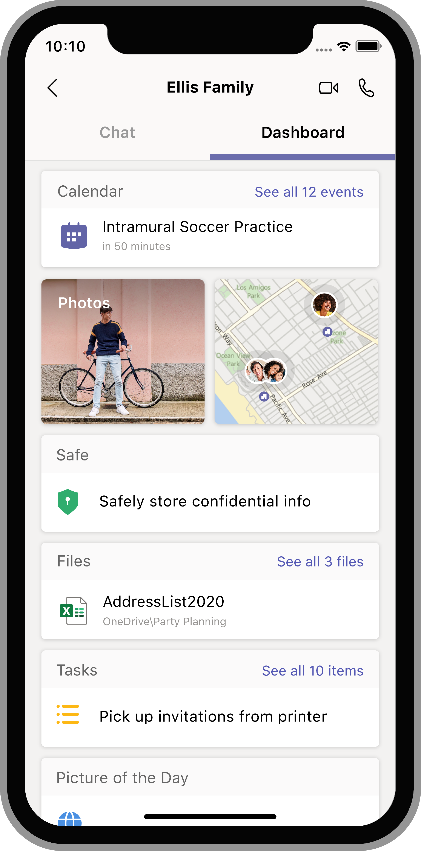
Just like you can switch between work and personal accounts in Outlook, you will soon be able to do the same in Teams. The personal teams view will look a little bit different, with shared calendars for the family, access to OneDrive vaults, photo sharing, etc., but it sits on the same codebase as the business version. You’ll also be able to do video calls and shared to-do lists.
Better writing through AI

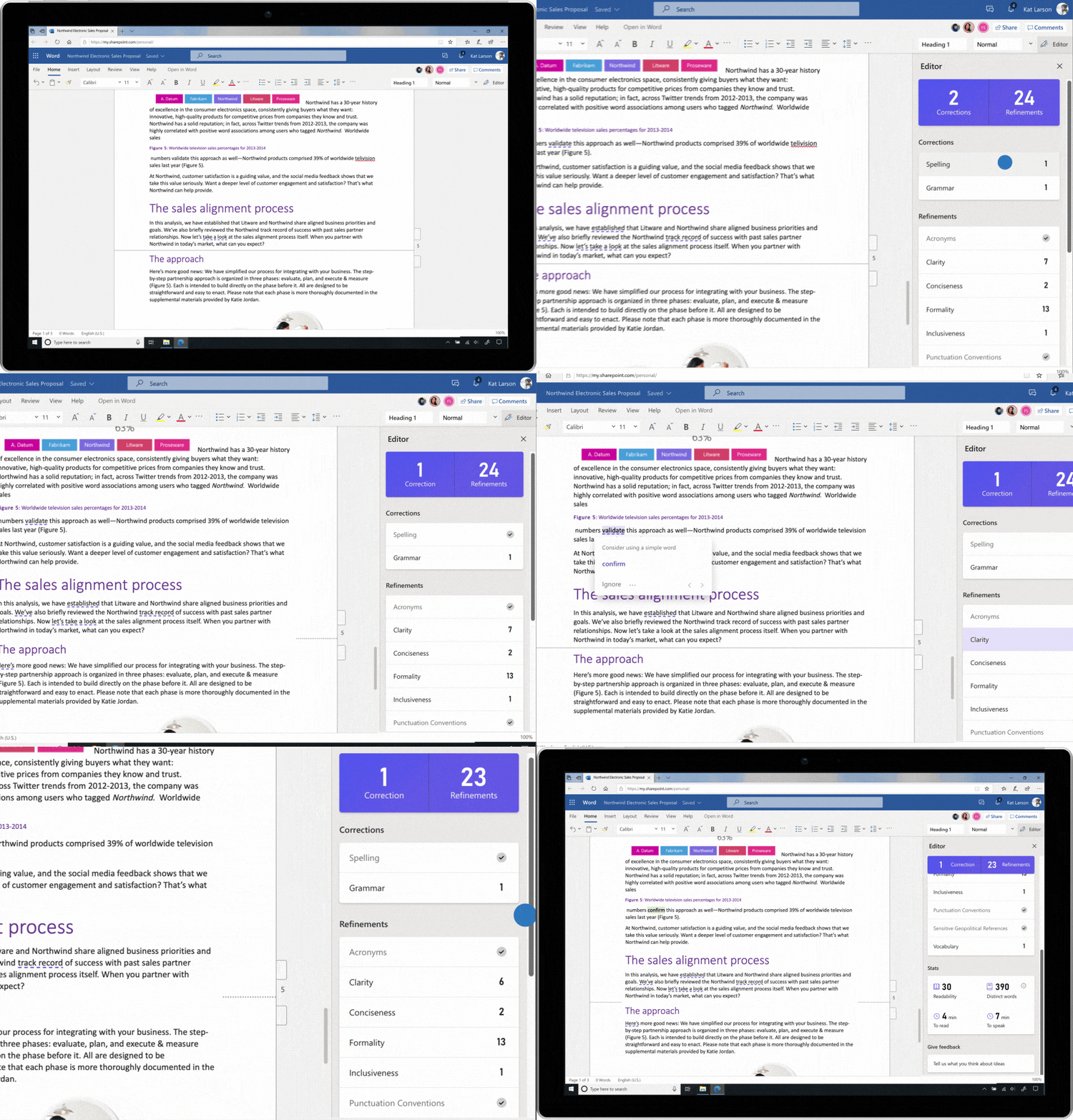
About a year ago, Microsoft announced that Word Online would get a new AI-powered editor that would help you write better. You can think of it as a smarter grammar checker that can fix all of your standard grammar mistakes but can also help you avoid overly complex sentences and bias in your word choices.

This editor is now the Microsoft Editor, and the company is expanding it well beyond Word. The new AI-powered service is now available in 20 languages in Word and Outlook.com — and maybe most importantly, it’ll be available as a Microsoft Edge and Google Chrome plug-in, too.

Free users will get basic spelling and grammar features, while Microsoft 365 subscribers will get a number of more advanced features like the ability to ask the editor to suggest a rewrite of a mangled sentence, a plagiarism checker, style analysis to see if your writing is unclear or too formal, and access to an inclusive language critique to help you avoid unintentional bias.

If you’ve used Grammarly in the past, then a lot of this will sound familiar. Both services now offer a similar set of capabilities, but Microsoft may have an edge with its ability to rewrite sentences.
Better presentations through technology

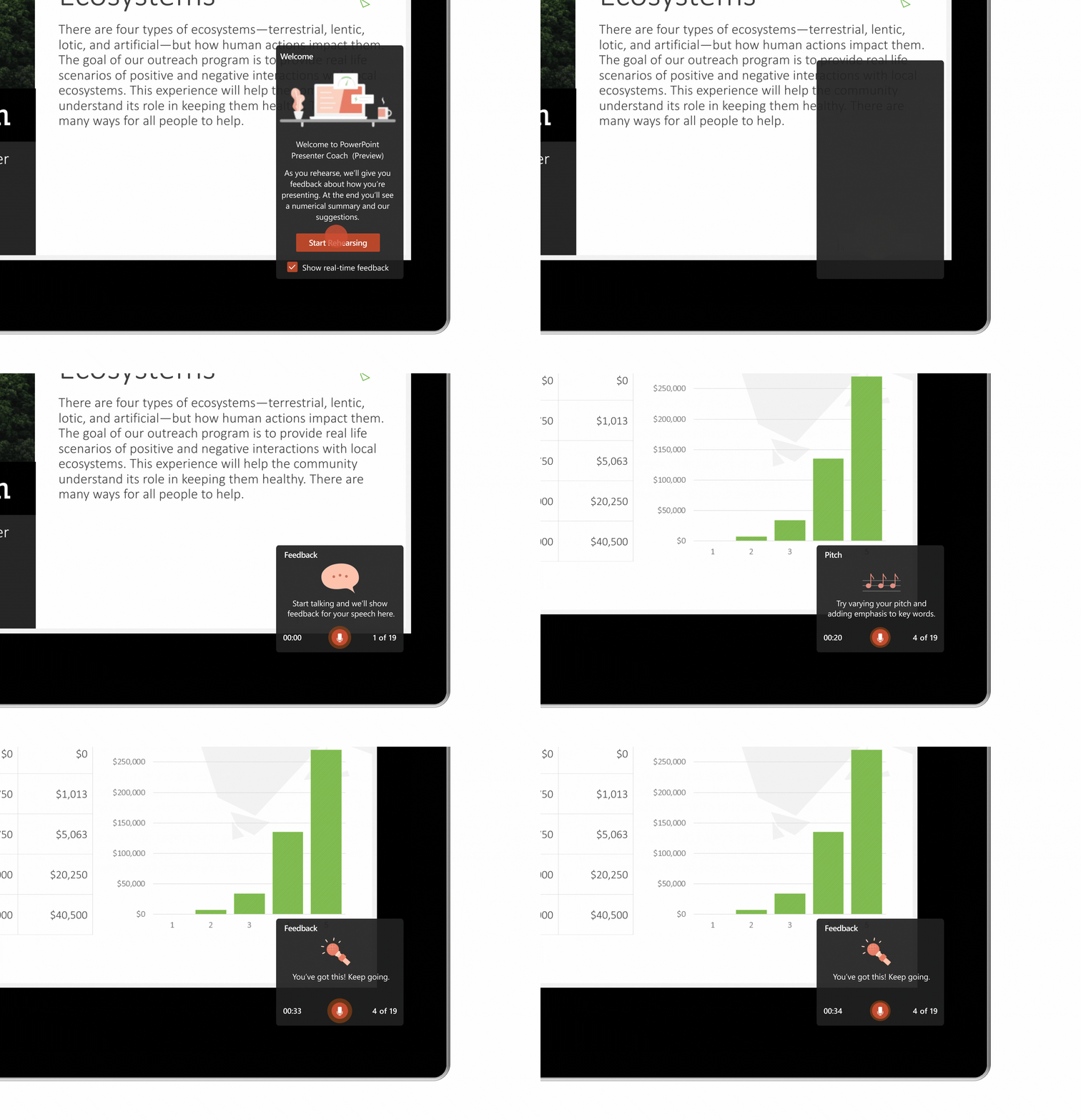
In a similar vein, Microsoft also launched a presentation coach for PowerPoint as a limited test last September. This AI-driven feature helps you avoid filler words and other presentation no-nos.

This feature first launched in the online version of PowerPoint, with a basic set of features. Now, Microsoft 365 subscribers will get two new advanced features, too, that can help you avoid a monotone pitch that puts your audience to sleep and avoid grammar mistakes in your spoken sentences.

Currently, these are still available as a free preview to all but will become Microsoft 365-only features soon.
PowerPoint is also getting an updated Designer to help you create better presentations. It can now easily turn text into a timeline, for example, and when you add an image, it can present you with a set of potential slide layouts.

Microsoft 365 subscribers now also get access to over 8,000 images and 175 looping videos from Getty Images, as well as 300 new fonts and 2,800 new icons.

Excel + Plaid

For you spreadsheet jockeys out there, Microsoft also has some good news, especially if you want to use Excel to manage your personal budgets.

In partnership with Plaid, you can now link your bank accounts to Excel and import all of your expenses into your spreadsheets. With that, you can then categorize your spend and build your own personal Mint. This feature, dubbed “Money in Excel,” will launch in the U.S. in the coming months.
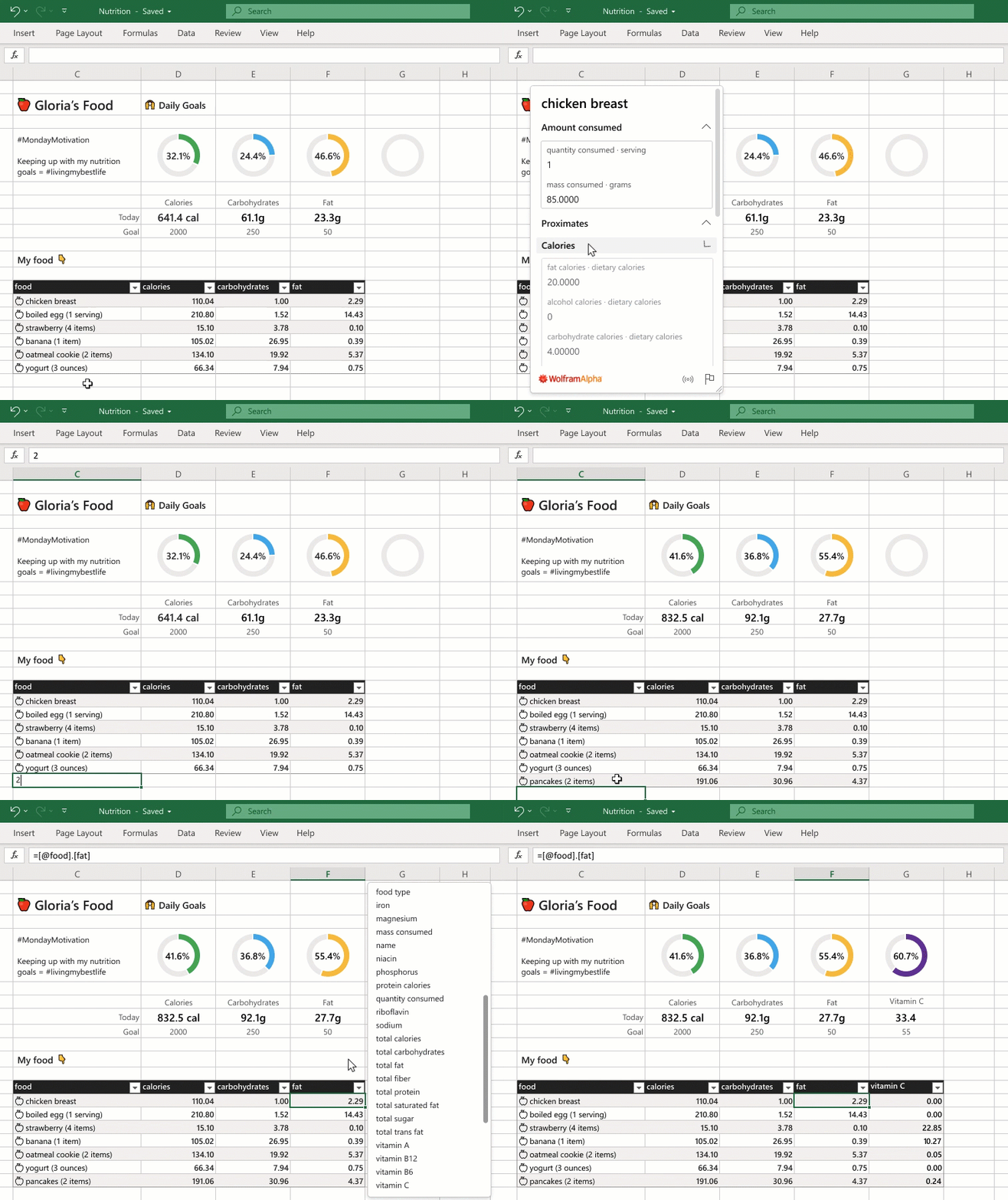
In addition, Excel is getting a lot more cloud- and AI-driven data types that now cover over 100 topics, including nutrition, movies, places, chemistry and — because why not — Pokémon. Like some of the previous features, this is an extension of the work Microsoft did on Excel in the last few years, starting with the ability to pull in stock market and geographical data.

And just like with the previous set of features, you’ll need a Microsoft 365 subscription to get access to these additional data types. Otherwise, you’ll remain restricted to the stock market and geography data types, which will become available to Office Insiders in the spring and then Personal and Family subscribers in the U.S. in the coming months.

Outlook gets more personal

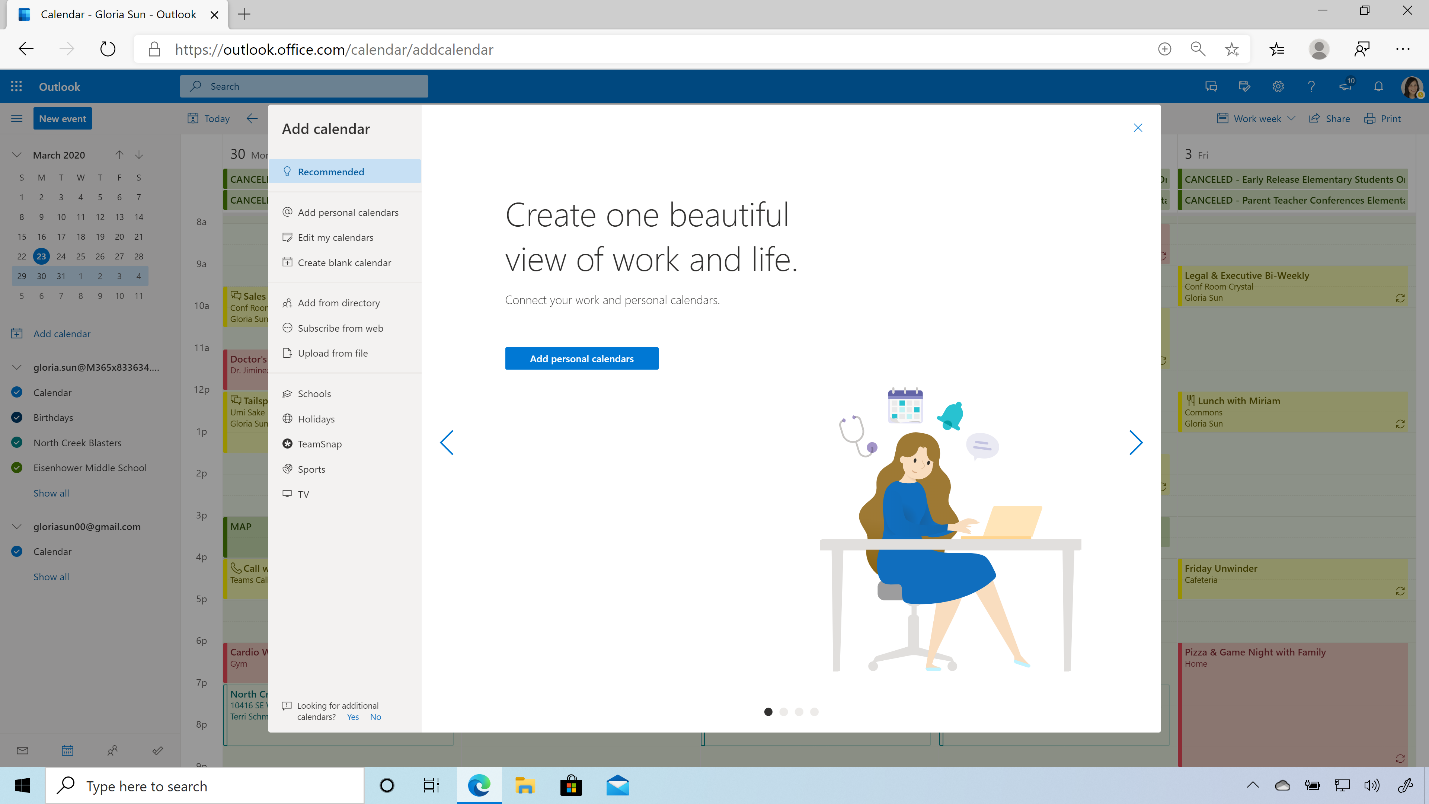
Even though you may want to forget about Outlook and ignore your inbox for a while, Microsoft doesn’t. In Outlook on the web, you can now link your personal and work calendars to ensure you don’t end up with a work meeting in the middle of a personal appointment, because Chris from marketing really needs another sync meeting during your gym time even though a short email would suffice.

Outlook for Android can now summarize and read your emails aloud for you, too. This feature will roll out in the coming months.
Family Safety

While most of the new features here focus on existing applications, Microsoft is also launching one completely new app: Microsoft Family Safety. This app is coming to Microsoft 365 subscribers on iOS and Android and will bring together a set of tools that can help families manage their online activities and track the location of family members.

The app lets families manage the screen time of their kids (and maybe parents, too) across Windows, Android and Xbox, for example. Parents can also set content filters that only allow kids to download age-appropriate apps. But it also allows parents to track their kids in the real world through location tracking and even driving reports. This, as Mehdi stressed, is a feature that kids can turn off, but they’ll probably have to explain themselves to their parents then. Indeed, he stressed that a lot of what the app does is give parents a chance to have a dialog with their kids. What makes the service unique is that it works across platforms, with iOS support coming in the future.

This app is launching as a limited preview now and will be available in the coming months (I think you can spot a trend here).

Partner benefits

Mehdi noted that Microsoft is also partnering with companies like Adobe, Bark, Blinkist, Creative Live, Experian, Headspace and TeamSnap to provide Microsoft 365 subscribers with additional benefits like limited-time access to their products and services. Subscribers will get three free months of access to Adobe’s Creative Cloud Photography plan, for example.

At the core of today’s updates, though, is a mission to bring a lot of the productivity tools that people know from their work life to their personal life, too, with the personal edition of Teams being the core example.

“We’re very much excited to bring this type of value — not increase the price of Office 365 — take a big step forward, and then move to this,” Mehdi said. “We think now more than ever, it is valuable for people to have the subscription service for their life that helps them make the most of their time, protects their family, lets them develop and grow. And our goal or aspiration is: Can we give you the most valuable subscription for your life? I know people value their video subscriptions and music subscriptions. Our aspiration is to provide the most valuable subscription for your life via Microsoft 365 Personal and Family.”
30 Mar 2020

The second wave of unicorn layoffs is brutal

Hello and welcome back to our regular morning look at private companies, public markets and the gray space in between.

There’s a quote from one great American financial panic that I can’t find this morning, but it went something like this: I don’t understand how yesterday we were so rich and today we are so poor.

For startups, we can to adapt the quip somewhat, perhaps to I don’t understand how yesterday everyone was hiring like mad and today layoffs are so prevalent. But, it’s true. After a time when not being able to hire quickly enough was a key risk for startups, unicorns, and public companies alike, staff cuts are the new norm.

This is the second time we’ve seen a wave of layoffs amongst the companies we cover at TechCrunch in recent months. However, the preceding wave seemed to land mostly amidst the companies that made up the Vision Fund’s portfolio. Today’s layoffs are coming more quickly, may cut more deeply and stem from a much broader set of companies.

This morning, let’s remind go over what happened in the first wave of recent unicorn layoffs (Zume, Oyo, Uber, etc) and how it compares to what is happening today as ZipRecruiter, Bird and TripActions cut staff of their own.

30 Mar 2020

Stratolaunch reveals updated fleet, including two hypersonic aircraft and a space plane

High-altitude launch startup Stratolaunch has gone through some changes, but on Monday it revealed design details of two hypersonic aircraft, along with a space plane, all designed to take-off from its flying carrier plane launch platform. If all goes to plan, test flights of the first of these new vehicles will begin in 2022, and the company says it’s fully funded to be able to get to that point.

Stratolaunch was originally founded in 2011 by Microsoft co-founder Paul Allen. Allen unfortunately passed away last year, and the company is now led by a group of investors led by Steve Feinberg. The new ownership is still tracking towards the original goal of the company, however, which is to develop hypersonic atmospheric aircraft.

On Monday, it also unveiled an extension of its mission to get into spaceflight via a new space plane that could potentially carry both cargo and crew. It’s designed to be fully reusable, and is meant to both take up and return cargo with conventional runway landing capabilities.

Stratolaunch’s first goal, however, will be to bring its Talon A hypersonic autonomous aircraft to life. Also designed for full reusability, the Talon A will measure roughly 28 feet in length, and have an 11.3-foot wingspan. It’s designed to fly for over a minute in hypersonic mode for testing, and then slide back down for a fully autonomous landing on a standard runway. The aircraft will not only be able to be deployed from the Stratolaunch carrier aircraft, but will also be designed to take-off on its own autonomously, also like a traditional aircraft from a standard runway.

The aircraft’s main purpose is to provide a testbed for various types of instrumentation and data gathering during hypersonic flight – it’s essentially a lab that can provide real-world experience of something perviously available only in simulation. Up to three of the Talon A vehicles can be transported and launched from one of Stratolaunch’s carrier aircraft at once.

Talon Z, meanwhile, looks to be a larger hypersonic aircraft, but Stratolaunch isn’t sharing much more in the way of details about its capabilities or intended purpose yet. The Black Ice space plane will likewise probably mostly serve customers looking for orbital experimentation, but its cargo and future potential crew capabilities could actually make it well-suited to orbital logistics and potentially even satellite deployment capabilities.

Stratolaunch’s approach with Black Ice is somewhat akin to what Virgin Galactic and Virgin Orbit are doing for commercial passenger spaceflight and small satellite cargo, respectively. The two Virgin companies also use traditional take-off aircraft as the launch platforms for their vehicles, but they’re much further along in their development program. Stratolaunch did complete the first test flight of its carrier aircraft last year, and is aiming to have Talon A ready for commercial service by 2023.

30 Mar 2020

‘It’s part of my job as a VC to remain calm,’ says Anorak’s Greg Castle

As the venture landscape adjusts to the COVID-19 pandemic and seismic shifts in public markets, early-stage VCs are reassessing which bets they’re making, along with questions they’re asking of founders who are exploring bleeding-edge technology.

Anorak Ventures is a small seed-investment firm that bets on emerging tech like AR/VR, machine learning and robotics. I recently hopped on a Zoom call with founder Greg Castle to talk about what he’s seen recently in seed investing and how the sector is responding to the crisis. Castle was an early investor in Oculus; his other bets at Anorak include Against Gravity, 6D.ai and Anduril.

Our conversation has been edited for length and clarity.

TechCrunch: Has this pandemic affected the types of companies that you’re looking at?

Greg Castle: From my experience as an investor thus far, being reactive as an investor and looking at “hot” areas has a lot of pitfalls to be mindful of. I think a lot of the areas that excite me as an investor could benefit from what’s going on here, those areas including robotics, automation, immersive entertainment and immersive computing.

Just generally, do you feel like a recession is more likely to negatively impact emerging tech more so than other areas?

30 Mar 2020

Turbo Systems hires former Looker CMO Jen Grant as CEO

Turbo Systems, a three-year old, no-code mobile app startup, announced today it has brought on industry veteran Jen Grant to be CEO.

Grant, who was previously vice president of marketing at Box and chief marketing officer at Elastic and Looker, brings more than 15 years of tech company experience to the young startup.

She says that when Looker got acquired by Google last June for $2.6 billion, she began looking for her next opportunity. She had done a stint with Google as a product manager earlier in her career and was looking for something new.

She saw Looker as a model for the kind of company she wanted to join, one that had a founder focused on product and engineering, who hired an outside CEO early on to run the business, as Looker had done. She found that in Turbo where founder Hari Subramanian was taking on that type of role. Subramanian was also a successful entrepreneur, having previously founded ServiceMax before selling it to GE in 2016.

“The first thing that really drew me to Turbo was this partnership with Hari,” Grant told TechCrunch. While that relationship was a key component for her, she says even with that, before she decided to join, she spoke to customers and she saw an enthusiasm there that drew her to the company.

“I love products that actually help people. And so Box is helping people collaborate and share files and work together. Looker is about getting data to everyone in the organization so that everyone could be making great decisions, and at Turbo we’re making it easy for anyone to create a mobile app that helps run their business,” she said.

Grant has been on the job for just 30 days, joining the company in the middle of a global pandemic. So it’s even more challenging than the typical early days for any new CEO, but she is looking forward and trying to help her 36 employees navigate this situation.

“You know, I didn’t know that this is what would happen in my first 30 days, but what inspires me, what’s a big part of it is that I can help by growing this company, by being successful and by being able to hire more and more people, and contribute to getting our economy back on track,” Grant said.

She also recognizes that there is a lack of diversity in her new CEO role, and she hopes to be a role model. “I have been fortunate to get to a position where I know I can do this job and do it well. And it’s my responsibility to do this work, my responsibility to show it can be done and shouldn’t be an anomaly.”

Turbo Systems was founded in 2017 and has raised $8 million, according to Crunchbase. It helps companies build mobile apps without coding, connecting to 140 different data sources such as Salesforce, SAP and Oracle.

30 Mar 2020

Security lapse exposed Republican voter firm’s internal app code

A voter contact and canvassing company, used exclusively by Republican political campaigns, mistakenly left an unprotected copy of its app’s code on its website for anyone to find.

The company, Campaign Sidekick, helps Republican campaigns canvass their districts using its iOS and Android apps, which pull in names and addresses from voter registration rolls. Campaign Sidekick says it has helped campaigns in Arizona, Montana, and Ohio — and contributed to the Brian Kemp campaign, which saw him narrowly win against Democratic rival Stacey Abrams in the Georgia gubernatorial campaign in 2018.

For the past two decades, political campaigns have ramped up their use of data to identify swing voters. This growing political data business has opened up a whole economy of startups and tech companies using data to help campaigns better understand their electorate. But that has led to voter records spilling out of unprotected servers and other privacy-related controversies — like the case of Cambridge Analytica obtaining private data from social media sites.

Chris Vickery, director of cyber risk research at security firm UpGuard, said he found the cache of Campaign Sidekick’s code by chance.

In his review of the code, Vickery found several instances of credentials and other app-related secrets, he said in a blog post on Monday, which he shared exclusively with TechCrunch. These secrets, such as keys and tokens, can typically be used to gain access to systems or data without a username or password. But Vickery did not test the password as doing so would be unlawful. Vickery also found a sampling of personally identifiable information, he said, amounting to dozens of spreadsheets packed with voter names and addresses.

Fearing the exposed credentials could be abused if accessed by a malicious actor, Vickery informed the company of the issue in mid-February. Campaign Sidekick quickly pulled the exposed cache of code offline.

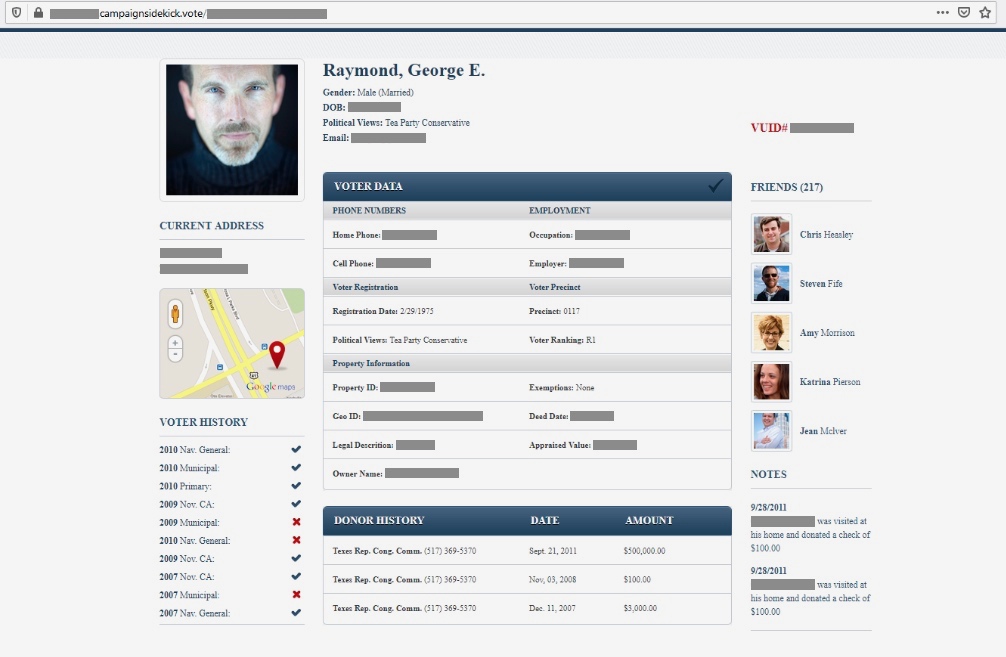
One of the Campaign Sidekick mockups, using dummy data, collates a voter’s data in one place. (Image: supplied)

One of the screenshots provided by Vickery showed a mockup of a voter profile compiled by the app, containing basic information about the voter and their past voting and donor history, which can be obtained from public and voter records. The mockup also lists the voter’s “friends.”

Vickery told TechCrunch he found “clear evidence” that the app’s code was designed to pull in data from its now-defunct Facebook app, which allowed users to sign-in and pull their list of friends — a feature that was supported by Facebook at the time until limits were put on third-party developers’ access to friends’ data.

“There is clear evidence that Campaign Sidekick and related entities had and have used access to Facebook user data and APIs to query that data,” Vickery said.

Drew Ryun, founder of Campaign Sidekick, told TechCrunch that its Facebook project was from eight years prior, that Facebook had since deprecated access to developers, and that the screenshot was a “digital artifact of a mockup.” (TechCrunch confirmed that the data in the mockup did not match public records.)

Ryun said after he learned of the exposed data the company “immediately changed sensitive credentials for our current systems,” but that the credentials in the exposed code could have been used to access its databases storing user and voter data.

30 Mar 2020

Equity Monday: Three funding rounds and a downturn

Good morning friends, and welcome back to TechCrunch’s Equity Monday, a short-form audio hit to kickstart your week.

If you missed Friday’s main episode, it was a fun one so take the time if you have the minutes; we’re settling into a new hosting lineup that is shaping up to be our best ever, so we’re having a blast even if we have to record remotely instead of in the same room.

This morning was a bit of a mixed bag. The world is still in pretty bad shape as societies and governments work to combat COVID-19 and the private and public markets convulse. But there was still news to be found, so we hit on a few key news items, including: The return of HQ Trivia at a perfect time, Microsoft’s booming cloud services demand and the return of tech layoffs.

Not all news was bad, however, as we looked at three early-stage funding events and three seed rounds from Indo, Kaizo, and Lanistar.

Looking ahead left us little joy other than to note that it is very nearly earnings season; Q1 2020 business results should prove to be the most interesting in memory given how much the world changed during the three-month period. Regardless of whether or not you care about the financial side of business or not, it’s going to be a wild ride.

Wrapping today, unicorn layoffs are back in a big way. Bird, TripActions, ZipRecruiter, and others are cutting staff in big chunks. A lot of folks hired to help companies scale look pretty expensive when growth turns negative; layoffs suck and a struggling economy is crap for everyone, but the business cycle is real, so it’s not a huge shock to find ourselves here today. We’re going to cover the cuts, but only with a grimace and good thoughts for the laid off.

And that’s it for this week. Other than that the new Trivium single is epic, we’re out of here.

Equity drops every Monday at 7:00 AM PT and Friday at 6:00 am PT, so subscribe to us on Apple PodcastsOvercastSpotify and all the casts.

30 Mar 2020

FDA grants emergency authorization to system that decontaminates N95 respirator masks for re-use

The global coronavirus pandemic has meant that there’s a widespread effort to develop and advance creative solutions to new problems, like worldwide shortages of necessary front-line medical equipment. One piece of gear that’s necessary for protecting the health of medical workers treating COVID-19 patients are N95 respirator masks, which are masks that specifically filter out very fine particles, including shed virus, with high efficacy. These are in extremely short supply, but a new FDA emergency use authorization could help significantly lessen that burden by opening a path to re-use of N95 masks originally intended for one-time use.

Research, development and lab management company Battelle has received special emergency authorization from the U.S. healthcare regulator to put into use a system it developed to decontaminate used N95 respirator masks using concentrated hydrogen peroxide. The system is able to turn single use respirators into masks that can be used up to 20 times, with a 2.5-hour decontamination process between each use.

The Battelle system is already in operation at its Ohio facility, with a decontamination capacity of up to 80,000 masks per day. That’s a considerable dent in a supply need that will be faced by essentially every healthcare facility faced with a high concentration of COVID-19 patients. The company is working with Columbus -based OhioHealth as its first healthcare system partner, but says that it’ll also start decontaminating masks for three other new major healthcare systems in the area beginning this week.

In order to ensure that everything is done as safely and transparently as possible, the N95 masks that Battelle collects for decontamination and re-use will all go back to the same healthcare facility from which they were collected, and they’ll be labeled with a serial number that provides tracking, which will also include the number of times they’re re-used.

Battelle actually worked with the FDA in 2015 to develop and demonstrate this technology – specifically in anticipation of a scenario where a global pandemic caused a shortage of available equipment. They’re also not the only ones using this technology: Duke University is also using vaporized hydrogen peroxide to decontaminate used respirators, and it’s making the protocols that it established widely available, with compatibility with a number of existing decontamination systems already in use in healthcare facilities.

This technology and method actually aren’t new, and are frequently used in decontamination of equipment used in labs that deal with biohazardous material. Its use specifically for turning single-use N95 masks into reusable gear is new, however – but this EUA from the FDA could pave the way for broader authorized, safe use of the technology to help with the growing need for more equipment.

30 Mar 2020

Germany’s space agency shifts its 3D printing resources to producing protective medical equipment

DLR, German’s space agency and NASA equivalent, is doing what it can to support the global shortages of personal protective equipment (PPE) used by frontline healthcare workers in their efforts to treat those affected by COVID-19. DLR announced that it has successfully tested converting its on-site 3D printers, typically used for producing aerospace-grade parts, to creating medical equipment including protective face masks and ventilators.

There’s a need for various kinds of components and equipment worldwide, and healthcare workers are coming up with solutions that are far less than ideal and not necessarily approved for use by governing healthcare agencies, simply because they have no other options. DLR investigated what it could do working with its Sytemhaus Technik engineering and manufacturing group, which leveraged free and open resources including templates for PPE produced by groups working to address the global shortage.

The agency’s equipment is now being certified by healthcare agencies for medical use, and meanwhile, DLR and Systemhaus Technik are working to share their findings and know-how with other institutions, science and research facilities to help them use their own resources to spin up similar production capacities.

So far, DLR can produce “up to 10 protective masks or 15 valves for ventilators per day,” but it says it hopes to work on building out a network of facilities that can ramp up production to higher rates of output.

The need for this equipment globally is such that any added capacity can help make a difference, but more important might be the knowledge that is developed and shared about doing the same thing on similar 3D printing equipment. Putting aerospace engineers to work on developing solutions that can be repeated in other manufacturing environments, and that meet medical-grade specification requirements, could ultimately help save a lot of lives as health agencies globally work to deal with the influx of patients requiring advanced care as a result of the coronavirus pandemic.

30 Mar 2020

Cell and gene therapy startup ElevateBio raises $170 million

While economic conditions and the ongoing global coronavirus pandemic may not make for the best atmosphere for raising funding, some companies are still announcing round closures with significant money committed. Cambridge-based ElevateBio, for instance, revealed a $170 million Series B funding on Monday, with participation from new investors The Invus Group, Surveyor Capital, EDBI, and Vertex Ventures, along with existing investors F2 Ventures, MPM Capital, EcoR1 Capital, Redmile Group and Samsara BioCapital.

ElevateBio, which was officially launched to the public less than a year ago, specializes in development of new types of cellular and genetic therapies, and operates by the creation of new companies under its portfolio each dedicated to the development and manufacturing of a specific type of therapeutic approach. This funding brings the total raised by ElevateBio to over $300 million, on top of a $150 million Series A round that the company announced last year, led by Swiss investment bank UBS’ Oncology Impact Fund.

The biotech company has ramped up quickly, nearing completion of a 140,000 square foot facilitating in Massachusetts to focus on R&D. It also launched a company called AlloVir that’s working on T-cell immunotherapy for combating viruses that specifically arise stem cell transplantations, and is already in the later stages of clinical trials. Finally, it launched another company called HighPassBio, which is also aimed at helping treat stem cell-related diseases using T-cell therapies, in this case specifically around the potential relapse of leukaemia following a transplant.

As you might expect, ElevateBio is also turning the attention of some of its efforts towards research focused on mitigating the impact of COVID-19; specifically, its AlloVir subsidiary has expanding an existing research agreement in place with the Baylor College of Medicine to work on developing a type of T-cell therapy that can help protect patients with conditions that compromise their immune systems and put them at increased risk for COVID-19.