Month: March 2021

31 Mar 2021

PingPong is a video chat app for product teams working across multiple time zones

From the earliest days of the pandemic, it was no secret that video chat was about to become a very hot space.

Over the past several months investors have bankrolled a handful of video startups with specific niches, ranging from always-on office surveillance to platforms that encouraged plenty of mini calls to avoid the need for more lengthy team-wide meetings. As the pandemic wanes and plenty of startups begin to look towards hybrid office models, there are others who have decided to lean into embracing a fully remote workforce, a strategy that may require new tools.

PingPong, a recent launch from Y Combinator’s latest batch, is building an asynchronous video chat app for the workplace. We selected PingPong as one of our favorite startups that debuted last week.

The company’s central sell is that for remote teams, there needs to be a better alternative to Slack or email for catching up with co-workers across time zones. While Zoom calls might be able to convey a company’s culture better than a post in a company-wide Slack channel, for fully remote teams operating on different continents, scheduling a company-wide meeting is often a non-starter.

PingPong is selling its service as an addendum to Slack that helps remote product teams collaborate and convey what they’re working on. Users can capture a short video of themselves and share their screen in lieu of a standup presentation and then they can get caught up on each other’s progress on their own time. PingPong’s hope is that users find more value in brainstorming, conducting design reviews, reporting bugs and more inside while using asynchronous video than they would with text.

“We have a lot to do before we can replace Slack, so right now we kind of emphasize playing nice with Slack,” PingPong CEO Jeff Whitlock tells TechCrunch. “Our longer term vision is that what young people are doing in their consumer lives, they bring into the enterprise when they graduate into the workforce. You and I were using Instant Messenger all the time in the early 2000s and then we got to the workplace, that was the opportunity for Slack… We believe in the next five or so years, something that’s a richer, more asynchronous video-based Slack alternative will have a lot more interest.”

Building a chat app specifically designed for remote product teams operating in multiple time zones is a tight niche for now, but Whitlock believes that this will become a more common problem as companies embrace the benefits of remote teams post-pandemic. PingPong costs $100 per user per year.

31 Mar 2021

For Hans Tung, the personal becomes public in a growing campaign to ‘stop Asian hate’

Longtime venture capitalist Hans Tung is a big guy. His size might just be lifesaving.

A first-generation Taiwanese-American who came to the U.S., and to Los Angeles specifically, in 1984, it was a fraught time for the then 14-year-old. Two years earlier, a Chinese-American draftsman named Vincent Chin was beaten in Detroit by a Chrysler plant supervisor and his stepson, a laid-off autoworker, who reportedly believed that Chin was of Japanese descent and were angry over the growing success of Japan’s auto industry. Chin, who was attending his own bachelor party the night that he fought off the pair — he was struck repeatedly with a baseball bat — died days later at age 27.

While anti-Asian sentiment may have seemed to lessen over the following decades, it has remained constant, and like countless others, Tung as been on the receiving end of it, he says. “Growing up, I faced my share of taunts, of racial epithets, whether it was in California or Boston or New York.  I’m fortunate that I’m over 6’4″ tall and weigh more than 200 pounds,” or he might be physically harassed at some point, too.

Tung has never been more mindful of his size than now. Even while anti-Asian sentiment never fully dissipated in the U.S., it worsened abruptly last year based on political rhetoric about the coronavirus. “As COVID broke out in China, we knew that Asian Americans would be blamed,” says Tung, who flies back and forth to China routinely for work as a managing director with the cross-border investment firm GGV Capital. “We saw this with SARS, too, but it wasn’t as big a pandemic, so people were being harassed and not killed.”

Anecdotally, Tung believes life is more dangerous right now for Asians in the U.S. based on conversations with friends and family members and the worrisome headlines to emerge of elderly individuals in particular being beaten on the streets of San Francisco and Oakland and on New York subways and outside of Times Square, as happened on Monday when a 65-year-old woman was viscously attacked in a scene that was filmed by an onlooker and has provoked national outrage.

The numbers back him up. From 2019 to 2020, overall hate crime rate declined while hate crimes targeting Asians increased, as first reported by NBC based on analysis released by the Center for the Study of Hate and Extremism at California State University, San Bernardino. Overall, its examination revealed that while such crimes decreased overall by 7 percent last year, those targeting Asian people rose by nearly 150 percent, with the biggest surge in New York, where anti-Asian hate crimes rose from three in 2019 to 28 last year, a 833% increase.

With those numbers seemingly continuing to climb in 2021, Tung and his partners at GGV Capital decided to take action two weeks ago, quickly settling on what they do best, which is to respond to the rising violence with their financial muscle and network.

A first step was publicly offering to match $100,000 in donations to organizations that support the AAPI (Asian American and Pacific Islander) communities. GGV’s move was almost immediately matched by other investors and founders eager to help, including Jeremy Liew of Lightspeed and Eric Kim and Chi-Hua Chien of Goodwater Capital, who also offered to match donations.

Fast forward and Tung says that 11 days into a de facto Twitter campaign, roughly $5 million in donations have now been made by more than 175 founders (including Jen Rubio, Stewart Butterfield, and Eric Yuan) and members of more than 30 venture firms in a kind of partnership that is “rare to see in the VC community,” Tung notes.

It’s a great start, Tung says. At the same time, he notes that the problem is ongoing and that more resources — which everyone is sending on an individual basis to a variety of Asian-American community groups that are dealing with a spiking racism and its implications — are needed. Toward that end, GGV is recommending at least five organizations whose work it believes to be making an impact. These include Asian Americans Advancing Justice, Red Canary Song, GoFundMe Support the AAPI Community, Stop AAPI Hate, and Compassion in Oakland.

Tung takes pains to note that GGV has been active in other campaigns, including AllRaise, the organization that’s bringing more gender equality to investment firms and to the board room. He says that his partners were also highly moved by the Black Lives Matter movement last spring, donating to the NAACP Legal Defense Fund and the Southern Poverty Law Center, among other organizations.

In fact, he says that earlier movements — including an effort by investor Ryan Sarver of Redpoint last year to help both front-line workers and restaurant workers by devising a way for donors to “buy” chef-made meals for hospital staff — have been experiences from which he has learned.

One of those lessons is that when something is close enough to one’s heart, it’s worth the risk of being perceived as a “VC who is showing off” if it moves the needle.

In this case, says Tung, “so many of these crimes are treated as individual incidents and not as hate crimes, which comes with more severe penalties” that he is determined to raise awareness and visibility into the matter, even if it means making himself more vulnerable than he is comfortable.

“When it comes to Asian hate, it’s such a personal matter,” he says.

31 Mar 2021

For Hans Tung, the personal becomes public in a growing campaign to ‘stop Asian hate’

Longtime venture capitalist Hans Tung is a big guy. His size might just be lifesaving.

A first-generation Taiwanese-American who came to the U.S., and to Los Angeles specifically, in 1984, it was a fraught time for the then 14-year-old. Two years earlier, a Chinese-American draftsman named Vincent Chin was beaten in Detroit by a Chrysler plant supervisor and his stepson, a laid-off autoworker, who reportedly believed that Chin was of Japanese descent and were angry over the growing success of Japan’s auto industry. Chin, who was attending his own bachelor party the night that he fought off the pair — he was struck repeatedly with a baseball bat — died days later at age 27.

While anti-Asian sentiment may have seemed to lessen over the following decades, it has remained constant, and like countless others, Tung as been on the receiving end of it, he says. “Growing up, I faced my share of taunts, of racial epithets, whether it was in California or Boston or New York.  I’m fortunate that I’m over 6’4″ tall and weigh more than 200 pounds,” or he might be physically harassed at some point, too.

Tung has never been more mindful of his size than now. Even while anti-Asian sentiment never fully dissipated in the U.S., it worsened abruptly last year based on political rhetoric about the coronavirus. “As COVID broke out in China, we knew that Asian Americans would be blamed,” says Tung, who flies back and forth to China routinely for work as a managing director with the cross-border investment firm GGV Capital. “We saw this with SARS, too, but it wasn’t as big a pandemic, so people were being harassed and not killed.”

Anecdotally, Tung believes life is more dangerous right now for Asians in the U.S. based on conversations with friends and family members and the worrisome headlines to emerge of elderly individuals in particular being beaten on the streets of San Francisco and Oakland and on New York subways and outside of Times Square, as happened on Monday when a 65-year-old woman was viscously attacked in a scene that was filmed by an onlooker and has provoked national outrage.

The numbers back him up. From 2019 to 2020, overall hate crime rate declined while hate crimes targeting Asians increased, as first reported by NBC based on analysis released by the Center for the Study of Hate and Extremism at California State University, San Bernardino. Overall, its examination revealed that while such crimes decreased overall by 7 percent last year, those targeting Asian people rose by nearly 150 percent, with the biggest surge in New York, where anti-Asian hate crimes rose from three in 2019 to 28 last year, a 833% increase.

With those numbers seemingly continuing to climb in 2021, Tung and his partners at GGV Capital decided to take action two weeks ago, quickly settling on what they do best, which is to respond to the rising violence with their financial muscle and network.

A first step was publicly offering to match $100,000 in donations to organizations that support the AAPI (Asian American and Pacific Islander) communities. GGV’s move was almost immediately matched by other investors and founders eager to help, including Jeremy Liew of Lightspeed and Eric Kim and Chi-Hua Chien of Goodwater Capital, who also offered to match donations.

Fast forward and Tung says that 11 days into a de facto Twitter campaign, roughly $5 million in donations have now been made by more than 175 founders (including Jen Rubio, Stewart Butterfield, and Eric Yuan) and members of more than 30 venture firms in a kind of partnership that is “rare to see in the VC community,” Tung notes.

It’s a great start, Tung says. At the same time, he notes that the problem is ongoing and that more resources — which everyone is sending on an individual basis to a variety of Asian-American community groups that are dealing with a spiking racism and its implications — are needed. Toward that end, GGV is recommending at least five organizations whose work it believes to be making an impact. These include Asian Americans Advancing Justice, Red Canary Song, GoFundMe Support the AAPI Community, Stop AAPI Hate, and Compassion in Oakland.

Tung takes pains to note that GGV has been active in other campaigns, including AllRaise, the organization that’s bringing more gender equality to investment firms and to the board room. He says that his partners were also highly moved by the Black Lives Matter movement last spring, donating to the NAACP Legal Defense Fund and the Southern Poverty Law Center, among other organizations.

In fact, he says that earlier movements — including an effort by investor Ryan Sarver of Redpoint last year to help both front-line workers and restaurant workers by devising a way for donors to “buy” chef-made meals for hospital staff — have been experiences from which he has learned.

One of those lessons is that when something is close enough to one’s heart, it’s worth the risk of being perceived as a “VC who is showing off” if it moves the needle.

In this case, says Tung, “so many of these crimes are treated as individual incidents and not as hate crimes, which comes with more severe penalties” that he is determined to raise awareness and visibility into the matter, even if it means making himself more vulnerable than he is comfortable.

“When it comes to Asian hate, it’s such a personal matter,” he says.

31 Mar 2021

Daily Crunch: Facebook makes it easier to view a non-algorithmic News Feed

Facebook has some thoughts and updates about its News Feed, Siri gets some new voices and Tonal becomes a unicorn. This is your Daily Crunch for March 31, 2021.

The big story: Facebook makes it easier to view a non-algorithmic News Feed

Facebook highlighted features today that should make it easier for users to see a version of the News Feed that isn’t shaped by the company’s algorithms. These include a Favorites view that displays posts from up to 30 of your favorite friends and Pages, as well as a Most Recent view, which just shows posts in chronological order. Some of these options existed previously, but they’ll now be easily accessible through a new Feed Filter Bar.

At the same time, the company’s VP of Global Affairs, Nick Clegg, pushed back against criticism of the company’s algorithmic News Feed, saying that personalization is common and useful across the web, though he added, “It would clearly be better if these [content] decisions were made according to frameworks agreed by democratically accountable lawmakers.”

Speaking of content decisions, Facebook also cautioned Donald Trump’s daughter-in-law Lara Trump today for posting an interview with the former president, who has been banned from the social network.

The tech giants

Apple adds two brand new Siri voices and will no longer default to a female or male voice in iOS — This means that every person setting up Siri will choose a voice for themselves.

Instagram officially launches Remix on Reels, a TikTok Duets-like feature — Remix offers a way to record your Reels video alongside a video from another user.

Spotify adds three new types of personalized playlists with launch of ‘Spotify Mixes’ — Your Spotify Mixes will include artist mixes, genre mixes and decade mixes.

Startups, funding and venture capital

Strength-training startup Tonal crosses unicorn status after raising $250M — To date, the at-home fitness tech startup has raised $450 million.

Apple invests $50M into music distributor UnitedMasters alongside a16z and Alphabet —  The focus of UnitedMasters is to provide artists with a direct pipeline to data around the way that fans are interacting with their content and community.

Diversity-focused Harlem Capital raises $134M — Apparently 61% of Harlem Capital’s Fund I portfolio companies are led by Black or Latinx executives, while 43% are led exclusively by women.

Advice and analysis from Extra Crunch

Five machine learning essentials nontechnical leaders need to understand — For engineering and team leaders without an ML background, the incredible pace of change can feel overwhelming and intimidating.

What to make of Deliveroo’s rough IPO debut — After a lackluster IPO pricing run, shares of Deliveroo are lower today, marking a disappointing debut for the hot delivery company.

Embedded procurement will make every company its own marketplace — Merritt Hummer of Bain Capital Ventures argues that with embedded procurement, businesses will buy things they need through vertical B2B apps.

(Extra Crunch is our membership program, which helps founders and startup teams get ahead. You can sign up here.)

Everything else

Report finds going remote made workplaces more hostile for already marginalized groups — The Project Include report is based on a survey of about 2,800 people and interviews with tech workers and subject matter experts in numerous countries and industries.

The Weeknd will sell an unreleased song and visual art via NFT auction — Abel Tesfaye, the Super Bowl-headlining musician known as The Weeknd, is the latest artist to embrace the excitement around NFTs.

Here’s what you don’t want to miss tomorrow at TC Early Stage 2021 — The event will include a wide range of presentations that span the startup ecosystem.

The Daily Crunch is TechCrunch’s roundup of our biggest and most important stories. If you’d like to get this delivered to your inbox every day at around 3pm Pacific, you can subscribe here.

31 Mar 2021

Sarah Kunst will outline how to get ready to fundraise at Early Stage

Sarah Kunst, founding partner at Cleo Capital, has worn many hats. She’s been an entrepreneur, served on plenty of boards, is a contributing author at Marie Clare, has been a senior advisor to Bumble and worked as a consultant in marketing, business development and more.

And with all that experience, she knows all too well that the process of fundraising starts well before your first pitch meeting. That’s why we’re so excited to have Kunst join us at Early Stage in July to discuss how to get ready to fundraise.

This isn’t the first time Kunst has discussed the topic with us. On a recent episode of Extra Crunch Live, Kunst and one of her portfolio company founders Julia Collins described how to conduct the process of fundraising.

For example, there is a story to tell, metrics to share and an art to building momentum before you ever start filling your calendar. That all requires preparation, and Kunst will outline how to go about that at our event in July.

Early Stage is going down twice this year, with our first event taking place tomorrow! Here’s a look at some of the topics we’ll be covering:

Fundraising

  • Bootstrapping Best Practices (Tope Awotona and Blake Bartlett, Calendly)
  • Four Things to Think About Before Raising a Series A (Bucky Moore, Kleiner Perkins)
  • How to Get An Investor’s Attention (Marlon Nichols, MaC Venture Capital)
  • How to Nail Your Virtual Pitch Meeting (Melissa Bradley, Ureeka)
  • How Founders Can Think Like a VC (Lisa Wu, Norwest Venture Partners)
  • The All-22 View, or Never Losing Perspective (Eghosa Omoigui, EchoVC Partners)

Operations:

  • Finance for Founders (Alexa von Tobel, Inspired Capital)
  • Building and Leading a Sales Team (Ryan Azus, Zoom CRO)
  • 10 Things NOT to Do When Starting a Company (Leah Solivan, Fuel Capital)
  • Leadership Culture and Good Governance (David Easton, Generation Investment Management)

The cool thing about Early Stage is that it’s heavy on audience Q&A, ensuring that everyone gets the chance to ask their own specific questions. Oh, and ticket holders get free access to Extra Crunch.

Interested? You can buy a ticket here.

31 Mar 2021

Lowkey raises $7 million from a16z to help game streamers capitalize on short-form video

While the growth of game-streaming audiences have continued on desktop platforms, the streaming space has felt surprisingly stagnant at times, particularly due to the missing mobile element and a lack of startup competitors.

Lowkey, a young gaming startup that builds software for game streamers, is aiming to build out opportunities in bit-sized clips. The startup wants to be a hub for both creating and viewing short gaming clips but also sees a big opportunity in helping streamers cut down their existing content for distribution on platforms like Instagram and TikTok where short-form gaming content sees a good deal of engagement.

The startup announced today that they’ve closed a $7 million Series A led by Andreessen Horowitz with participation from a host of angel investors including Figma’s Dylan Field, Loom’s Joe Thomas and Plaid’s Zach Perret & William Hockey.

We last covered Lowkey in early 2020 when the company was looking to build out a games tournament platform for adults. At the time, the company had already pivoted after going through YC as Camelot but which allowed audiences on Twitch and YouTube pay creators to take on challenges. This latest shift brings Lowkey back to the streaming world but more focused on becoming a tool for streamers and a hub for viewers.

One of the challenges for streamers has been adapting widescreen content for a vertical video form factor, but CEO Jesse Zhang says that it’s not really a problem with most modern games. “Games inherently want to focus you attention on the center of the screen,” Zhang tells TechCrunch. “So, almost all clips extend really cleanly to like a mobile format, which is what we’ve done.”

Twitch and YouTube Gaming have proven to be pretty uninterested in short-form content, favoring the opportunities of long-form stream that allow streamers to press broadcast and upload 30 minutes+ streams. Lowkey users can easily upload footage captured from Lowkey’s desktop app or directly import a linked stream. This allows content creators to upload and comment on their own footage or remix and respond to another streamer’s content.

Lowkey’s desktop app is available on Windows and their new mobile app is now live for iOS.

31 Mar 2021

As Compass downsizes its IPO, signs of weakness appear for high-growth companies

On the same day that Deliveroo’s IPO fizzled at the start of trading, Compass announced via a fresh S-1 filing that it will reduce the number of shares in its impending flotation and sell them at a lower price.

The move by Compass, a venture-backed residential brokerage, to lower its implied public-market valuation and sell fewer shares is a rebuke of the company’s earlier optimism regarding its valuation and ability to raise capital. The company’s IPO is still slated to generate as much as a half-billion dollars, so it can hardly be called a failure if it executes at its rejiggered price range, but the cuts matter.

Especially when we consider several other factors. The Deliveroo IPO, as discussed this morning, was impacted by more than mere economics. And there are questions regarding how interested seemingly more-conservative countries’ stock exchanges will prove in growth-oriented, unprofitable companies.

But added to the mix are recent declines in the valuation of public software companies, effectively repricing the value of high-margin, recurring revenue. The reasons behind that particular change are several, but may include a rotation by public investors into other asset categories, or an air-letting from a sector that may have enjoyed some valuation inflation in the last year.

In that vein, SMB cloud provider DigitalOcean’s own post-IPO declines from its offering price are a bit more understandable, as is a lack of a higher price interval from Kaltura, a video-focused software company, as it looks to list.

Taken together, the various market signs could point to a modest-to-moderate cooling in the tech IPO market. For a host of companies looking to debut via a SPAC, that could prove to be bad news.

31 Mar 2021

Microsoft gets contract worth up to $22 billion to outfit U.S. Army with 120,000 AR headsets

The killer use case for AR/VR might just be warfare.

Today, Microsoft announced that it has received a contract to outfit the United States Army with tens of thousands of augmented reality headsets based on the company’s HoloLens tech. This contract could be worth as much as $21.88 billion over 10 years, the company says.

Microsoft will be fulfilling an order for 120,000 AR headsets for the Army based on their Integrated Visual Augmentation System (IVAS) design. The modified design upgrades the capabilities of the HoloLens 2 for the needs of soldiers in the field.

“The program delivers enhanced situational awareness, enabling information sharing and decision-making in a variety of scenarios,”  a blog post from Microsoft’s Alex Kipman reads.

The contract builds on the two-year $480 million contract that Microsoft won back in 2018 to outfit the U.S. army with augmented reality tech. At the time, the contract detailed that the deal could potentially result in follow-on orders of more than 100,000 headsets. “Augmented reality technology will provide troops with more and better information to make decisions. This new work extends our longstanding, trusted relationship with the Department of Defense to this new area,” a Microsoft spokesperson said in a statement sent to TechCrunch at the time.

Microsoft says this announcement marks the transition from prototyping these designs to producing and rolling them out in the field.

This is a massive scale-up for augmented reality tech that has seen few large-scale rollouts and gives Microsoft a government contractor budget to tackle base technology problems that could scale down to consumer and enterprise-level devices in the future. Many of the industry’s biggest players in augmented reality have been reluctant or outspoken in their avoidance of military contracts but Microsoft has remained undeterred in competing for these contracts.

31 Mar 2021

Facebook says Trump can’t skirt its ban through daughter-in-law’s account

Trump’s daughter-in-law Lara Trump promoted a new interview with the former president on Facebook and Instagram Tuesday, but a workaround to Trump’s ban on two of the world’s most popular social networks wasn’t long for this world.

She was apparently swiftly cautioned by Facebook that anything posted “in the voice of President Trump” is not currently allowed on Facebook or Instagram and would be subject to removal. Trump himself remains banned on Facebook pending a decision by the Oversight Board, the external governing body the company set up to tackle it thorniest platform policy decisions.

Those rules apply to any accounts or pages associated with the Trump campaign as well as any belonging to former surrogates for the campaign, two categories that Lara Trump’s account falls into. Facebook confirmed to TechCrunch that screenshots depicting emails from the company were legitimate.

Facebook does still make a news exemption for Trump, presumably for something more akin to a 60 Minutes interview, but in this case he was being interviewed by someone involved in his campaign who then planned to promote the video on a campaign-associated account.

While Facebook won’t host the video itself, Lara Trump opted for a workaround to the workaround, linking to the interview on Rumble, a video sharing website that saw an influx of Trump supporters late last year.

She also posted to the video on The Right View, a web-based show previously produced by the Trump campaign that the Washington Post describes as “a sort of pro-Trump answer to ABC’s ‘The View.'”

Fox News announced this week that it would bring Lara Trump into the fold, hiring the member of the Trump family on as a paid contributor.

31 Mar 2021

Report finds going remote made workplaces more hostile for already marginalized groups

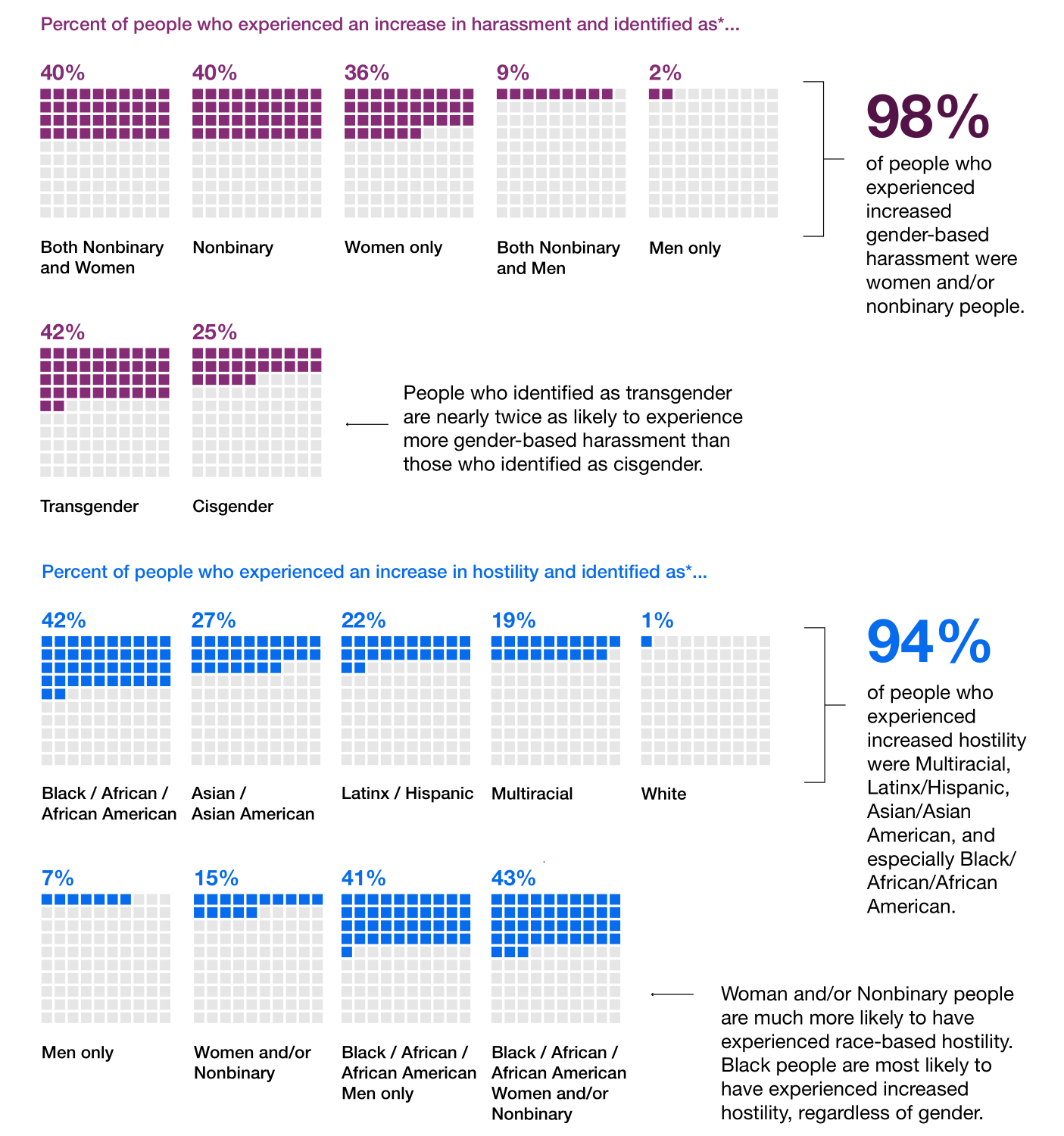
The last year wasn’t an easy one for just about anybody, but a new report from Project Include shows that the shift to remote work affected some groups more negatively than others. Unsurprisingly, it was people already struggling against harassment and bias, particularly women of color and those identifying as LGBTQ, who saw the biggest jumps in those behaviors.

The report is based on a survey of about 2,800 people and interviews with tech workers and subject matter experts in numerous countries and industries. There’s not a lot of good news in it, but why should there be? Sadly, the unprecedented confluence of multiple disasters in 2020 has spawned another, quieter disaster in working conditions.

Remote work has changed how people interact, and the result of that has been, among other things, significant increases to gender- and race-based harassment. Over a quarter of those surveyed reported an increase in harassment and workplace hostility — and of those experiencing increases, 98 percent were women or nonbinary and 99 percent were non-white.

Trans people were much more likely to experience harassment and hostility, as were were all black respondents, especially women and nonbinary people. Asian, Latinx, and multiracial respondents also reported more.

Graphs illustrating the numbers of various demographics experiencing harassment.

Image Credits: Project Include

The switch to remote productivity and communication seems to have made this harassment difficult to avoid. An increase in reliance on 1:1 communication via chat, email, and video calls meant working directly with harassers was inescapable and difficult to report. “Respondents noted that individual harassers would follow them across online spaces to where they were,” the report adds.

People with mental health conditions, particularly those with PTSD, were twice as likely to report experiencing harassment than those without.

Changes to expectations and tools meant big increases to anxiety and drops in work-life balance. Nearly two thirds of respondents reported being expected to work longer days, and more than half said they felt pressure (or were plainly expected) to be online outside of official working hours. 10 percent said managers were checking in daily, and 5 percent reported two or more times per day. Others complained about surveillance software like keystroke and screen monitoring.

Workers with disabilities found that companies often chose productivity and collaboration tools that had inadequate accessibility features — for example, Zoom calls without automatic captioning that required lip-reading to keep up.

As for reporting harassment, most said they did not do so because they didn’t trust their HR department or company at large to handle the complaints properly or respond fairly. One person even reported that it was a person within HR itself that was harassing them. Less than half of respondents said they trusted their company to respond to these issues properly; about a third said they did not trust the company to do so; about the same number said their workplace doesn’t even have the tools to intervene or solve any issue they might bring up.

These and more statistics are available in the report, which goes into detail on a number of other issues and behaviors, as well as making a number of suggestions as to what companies can do to step up. Of course if your company has waited until now to take action, that’s a problem right there. But in general the idea is to actually listen to workers, hold leadership accountable, and take actions with measurable impact like no-meeting days and generous time-off policies.

Most of all, don’t expect things to just “go back to normal.” CEO of Vaya Consulting Nicole Sanchez puts it best as quoted in the report:

Most companies are not ready to bring people back together physically, even electively. People at the executive level are going to be shocked to find out that what they’re actually dealing with is a whole lot of live active trauma. A lot of companies that go back and try and make it like it was before will wonder, ‘why aren’t these pieces fitting together anymore?’ And the answer, I hope, that we get collective agreement on is: Those pieces never fit together. They just fit together for you. Now, you’re seeing all the seams and all of the vulnerabilities, and now you have to reinvent your company.

The authors of the report include Ellen Pao of Project Include itself, Yang Hong of Shoshin Insights, and Caroline Sinders of Convocation Design + Research.