Month: August 2021

30 Aug 2021

Alpaca raises $50M to rapidly scale its API-delivered equities trading business

Alpaca said this morning that it has closed a massive $50 million Series B round of capital. TechCrunch previously covered the company’s late-2019 $6 million seed round and its late-2020 $10 million Series A.

Alpaca offers equities trading software via API. The company initially allowed firms to plug into its technology, powering the trading capabilities of investing groups. More recently, Alpaca has begun allowing other fintech companies to offer equities trading through its service to their consumer user bases, work that fits under the larger embedded finance trend.

Tribe Capital led the company’s Series B, which saw participation from existing investors Spark Capital, Portage Ventures and Social Leverage. New investors including Horizons Ventures also put funds into the round.

Alpaca is an interesting startup. During the savings-and-trading boom of 2020, we used the company’s trading volume growth as a proxy not only for the growth of API-delivered software startups, but also as a window into interest in buying and selling U.S. equities more broadly.

By now offering its trading services to fintechs with consumer end users — the B2B2C model, if you will — Alpaca has expanded its market remit. Per the startup, the number of brokerage accounts it supports has risen some 1,500% this year to more than 100,000. The startup’s CEO, Yoshi Yokokawa, told TechCrunch that it expects to secure 100 partners for its equities trading tech by the end of 2021. That figure was zero at the end of 2020, before its embedded finance product was released.

For Alpaca, working with more fintech companies opens up new revenue streams. The company will continue to generate payment for order flow incomes (PFOF), it said, but by supporting international customers, it can also earn incomes from foreign exchange fees and more.

Notably, Alpaca intends to make its service an anti-cost center by sharing PFOF revenues with partners that embed its fintech APIs. Yokokawa declined to share the PFOF split with customers, but our guess is that something around 15% to 25% makes sense, providing incentives to potential partners to choose Alpaca over rival tech while keeping enough top line on the Alpaca side of the ledger to continue building a venture-scale business.

The startup has big plans: It is moving into the cryptocurrency market, it announced this morning, and partnering with Plaid to make money transfer easier for investors. Recent results from Robinhood, a consumer trading platform popular in the United States, helped underscore just how lucrative crypto trading can be for platforms.

Why raise $50 million? TechCrunch was curious why the company would put so much capital onto its books in a single shot instead of raising a more modest round of, say, $25 million, still a healthy figure for a Series B and one closer in size to its preceding Series A.

Yokokawa said Alpaca has a lot of stuff to build. And to build it all is going to take a lot of folks. Alpaca had just 10 employees when COVID-19 hit, which means that the company has a lot of hiring in front of it. And the sorts of developers it needs, we suppose, aren’t going to come cheap.

Still, big rounds mean big expectations, from both investors and the observer team (that’s us) as well. We’ll check back with the company in a few months to see if it is on track to reach its partner goal for 2021.

30 Aug 2021

Russell Westbrook, Chainsmokers join group pouring $13.5M into prebiotic soda brand Poppi

Poppi, a prebiotic soda brand, closed $13.5 million in a Series A2 round and is on a mission to lead in the new category of “functional soda” by offering a better-for-you product that also tastes good.

The investor group includes CAVU Ventures as well as sports and entertainment celebrities like Russell Westbrook, the Chainsmokers, 24kGoldn, Kygo, Halsey, Kevin Love, Ellie Goulding, Olivia Munn, Nicole Scherzinger, Chantel Jeffries, Bryce Hall, Noah Beck, Josh Richards, Griffin Johnson and Blake Gray.

Husband-and-wife co-founders Stephen and Allison Ellsworth, former oil and gas researchers, launched the soda in 2020 after Allison Ellsworth began having stomach issues about two years prior. She went to doctor after doctor without a definitive diagnosis and decided to take to the internet to find some answers. She not only found that 80% of our body’s immunity stems from gut health, but that she could assist by healing her body through food.

One of the foods that helped with the stomach issues was apple cider vinegar, but drinking it straight everyday became difficult for her. So she went into the kitchen and began concocting a drink that would help her tolerate the vinegar and be tasty enough to drink regularly.

What resulted was a drink that eventually became a hit at a Dallas farmers market, which is where the pair was approached to sell Poppi in Whole Foods Market. They then decided to quit their jobs and do Poppi full time, even gaining a deal from CAVU Ventures co-founder Rohan Oza on Shark Tank in December 2018.

Each can of Poppi includes approximately a tablespoon of apple cider vinegar, sparkling water, real fruit and plant-based sweeteners mixed into a formula that provides a balance of gut-friendly prebiotics known to aid in digestion, immunity and glowing skin.

The drinks retail for $2.49 per can and come in nine flavors like watermelon, strawberry lemon, raspberry rose and orange. They are available in over 7,500 retail locations, including Target, Safeway, Kroger, Publix, Whole Foods and Amazon.com.

Allison and Stephen Ellsworth, Poppi co-founders. Image Credits: Poppi

Now the Ellsworths say they are receiving comments from consumers who say Poppi has “changed their lives.”

“At the end of the day, we are putting out a product that is healthy and tastes good,” Allison Ellsworth said. “We don’t want to be a niche health product — that is secondary to what we are trying to do, but it’s a bonus that we get that, too.”

Another bonus is that within the functional soda category, which has grown 465% year over year based on data from research company SPINS, the Ellsworths boast their annual growth put Poppi in the No. 1 spot based on four-week data from SPINS ending June 13, 2021.

Prior to the round, the company was bootstrapped. Proceeds will be used to expand distribution, scale Poppi’s team of 50 currently and marketing. The company is based in Dallas for now, but Allison Ellsworth said the company is moving its headquarters to Austin.

The company grew its revenue 550% year over year and the funding assists in giving Poppi a burn rate of 12 months and the ability to continue in high-growth mode, Stephen Ellsworth said.

Stevie Clements, chief brand architect at CAVU Ventures and a member of Poppi’s board, said via email that the company’s product, founders and growth to date were the drivers for her firm to invest in the company.

In addition, people are looking for products like Poppi that do more for them, while gut health, in particular, is a highly relevant category. The company’s ability to “deliver real function with incredible flavor is unlike anything on the market,” she said.

“Soda is a massive category ripe for disruption, and Stephen and Allison are a great team with an authentic story that’s really proven to resonate with people,” Clements added. “We’re excited by what Poppi has accomplished thus far and feel strongly that a better-for-you soda that tastes amazing and offers real function can shake up the multibillion dollar soda category.”


30 Aug 2021

Ragnarok ransomware gang shuts down and releases its decryption key

Ragnarok, a ransomware gang operational since 2019 that gained notoriety after launching attacks against unpatched Citrix ADC servers, has shut down and released a free decryption key for its victims.

The gang, sometimes referred to as Asnarok, last week replaced all 12 of the victims listed on its dark web portal with a short instruction on how to decrypt files. This was accompanied by the release of a decryptor, which experts at Emsisoft confirmed contains the master decryption key. The security firm, known for assisting ransomware victims with data decryption, has also released a universal decryptor for Ragnarok ransomware.

Ragnarok is best known for using the Ragnar Locker ransomware to target IT networks. It claimed dozens of victims after exploiting a Citrix ADC vulnerability to search for Windows computers that are vulnerable to the EternalBlue vulnerability — the same vulnerability behind the now-notorious WannaCry attack — and has racked up more than $4.5 million in ransom payments, according to the Ransomwhe.re payments tracker.

In April 2020, the cybercriminals stole 10 terabytes of data belonging to Portuguese energy giant EDP and threatened to leak it if a ransom of $10.9 million was not paid. The gang went on to exfiltrate up to 2TB of data, including bank statements, employee records, and celebrity agreements, from the servers of Italian liquor giant Campari Group, and demanded it hands over $15 million in ransom.

And in November, the short-lived ransomware gang also targeted Capcom, the Japanese video games giant behind titles such as Street Fighter, Resident Evil, and Devil May Cry. The gang reportedly stole the personal data of 390,000 customers, business partners, and other external parties from Capcom’s systems.

News of the shut down was first reported by Bleeping Computer.

With no formal departure note, it’s not clear why Ragnarok has seemingly decided to call it quits. But other ransomware gangs have adopted a similar self-destruction tactic in the face of increasing pressure from the U.S. government, which earlier this year branded ransomware as a national security threat; REvil, the gang behind the JBS attack, mysteriously disappeared from the internet, and DarkSide, the gang behind the Colonial Pipeline incident, also announced it was retiring.

Other ransomware gangs, including Ziggy Avaddon, SynAck, and Fonix, have also all retired from hacking this year, each giving up their keys to help victims recover from their attacks.

Of course, it remains to be seen whether Ragnarok’s disappearance is permanent, or whether it will simply rebrand; the infamous DoppelPayment ransomware gang recently reappeared as Grief Ransomware after months of no activity.

“Even though I am sure is only temporary, it is nice to see another win,” tweeted Allan Liska, from Recorded Future’s Computer Security Incident Response Team.

30 Aug 2021

Flip bags $28M to turn beauty, wellness social commerce on its head

Social commerce startup Flip is mixing live commerce mobile apps with real customer reviews to improve the buying experience and opportunity for the creator economy. Today, the Los Angeles-based company closed on a $28 million Series A led Streamlined Ventures.

Nooruldeen “Noor” Agha, a serial e-commerce entrepreneur, founded Flip in 2019 after emigrating to the United States from Iraq. He had previously lived in Dubai, where he built some companies in the e-commerce space.

It was while leading the companies that he realized that the vision of commerce was broken and that people had a fragmented path to purchase: They may start on social media, then move to video platforms and conclude on yet another site to make the purchase.

Agha believes the future of e-commerce will be driven by shoppers and the experiences they have with social media, so Flip is pulling all of those experiences into one app, mixing in user-generated reviews and live shopping shows for beauty, wellness and health brands. It then adds same-day shipping and back-end logistics, Agha told TechCrunch. Users post video reviews of their purchases and can see in real-time data how they did, as well as receive commissions from sales that resulted from their posts.

“It’s not only a social platform, it is the best post-purchase experience — shipping, rewards, returns — everything people love and in a two-click process,” he added. “Our app is like if TikTok and Amazon had a baby.”

Joining Streamlined Ventures in the latest round is Mubadala Capital Ventures, BDMI and a group of early backers and angel investors, including Ruby Lu, an early investor in Kuaishou, China’s leading social commerce platform. In total, Flip raised $31.5 million, which includes a small seed two years ago, Agha said.

He intends to use the new funding to scale the company and its creator ecosystem, while also expanding the end-to-end logistics part of the platform.

Live commerce originated in China, where McKinsey estimates the market reached $171 billion in 2020 and will jump to a valuation of $423 billion by 2022. Meanwhile, U.S. live commerce market is trailing behind, expecting to reach $11 billion by the end of 2021.

Flip is now signing an average of 20 new brands per week and has already gained partnerships with Unilever and Coty. Agha expects to hit 500 brands by this year’s holiday season. In addition, the company has 1 million downloads and in the last quarter shopped out 30,000 orders, which Agha predicts will double in coming months.

“We were hiding on purpose so we could build out everything and be done when we launched,” he added. “We focused on onboarding brands instead of pushing for growth, but now we expect to have a grand launch at the end of September where we start aggressively pushing growth.”

Ullas Naik, founder and general partner of Streamlined Ventures, said his firm does a lot of investment in e-commerce and marketplaces and was one of the first investors in DoorDash and also backed Rappi.

Commerce has evolved over the past 20 years in a meaningful way, he said. During that time, spend shifted from retail and online, while the quality of the experience has also evolved. He has seen evidence of similar models in other geographies, particularly in China when they have “had massive success.”

“We are most intrigued with how live commerce intersects with social networking to create enhanced shopping experiences,” Naik said. “When I met with Noor and he told me he was going to start with beauty and cosmetics, I thought he was building a unique experience and wanted him to be in a broad range of categories, not just beauty. With what he is building on the back end, with the logistics piece, he is creating a super experience and I’m intrigued by what can be built.”

30 Aug 2021

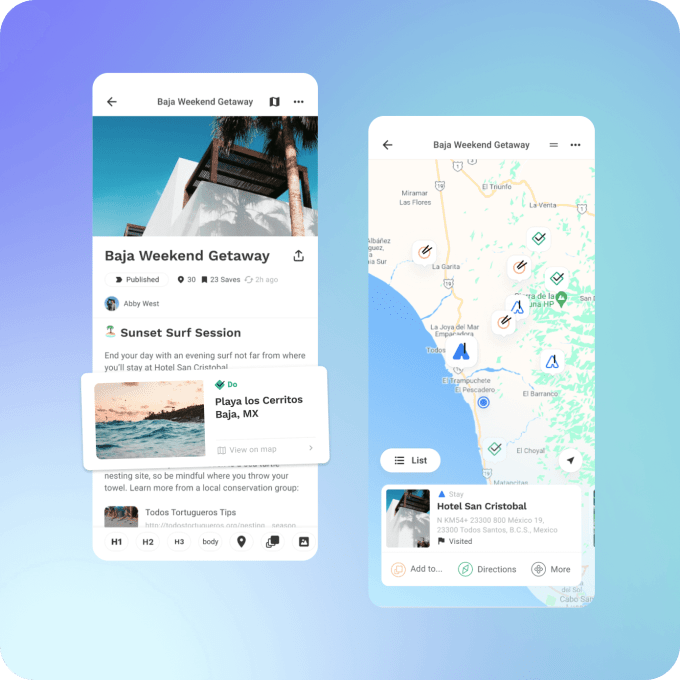
Thatch using $3M round to put travel creators on the map

After a difficult year, the travel industry is gaining steam again this summer and Thatch is carving out a space for itself in the sector by enabling travel creators to monetize their recommendations.

Today the company announced a $3 million Seed II round led by Wave Capital. They were joined by Freestyle VC’s Jenny Lefcourt, Netflix co-founder Marc Randolph and Airbnb’s head of data science for user trust, Kapil Gupta. It brings Thatch’s total investment to $5.2 million since the company was founded by West Askew, Abby West and Shane Farmer in 2018.

Prior to the global pandemic, the company was a subscription-based consumer travel service that matched travelers with someone who would essentially plan their trips from top to bottom. Then the industry came to a grinding halt in 2020, and the co-founders saw a bigger need to help travel creators — those who share their experiences on social media — better connect to their followers and capture value for the travel recommendations, tips and perspectives they create.

“We noticed consumers were willing to pay individuals for their time and expertise,” Abby West told TechCrunch. “Increasingly, instead of going to travel agencies, they are going to Instagram or YouTube and then DM’ing them for information. We are formalizing that relationship so that the travel creator can get paid and can then provide a better experience for the end user.”

Askew and West say travel creators drive billions of dollars of consumer travel spending. Thatch’s free mobile app provides tools for them to build their own travel-based businesses in order to curate, share and will soon be able to sell interactive travel guides and planning services. Thatch makes money when the creators do, taking a small percentage of the transactions.

While the pandemic was detrimental to the travel industry, it gave the Thatch team time to build out its app, and now it is focused on building the creator side and marketing to attract creators to the app. This is where the new funding will come in: The company intends to hire additional engineers, build out new content and launch new features for selling or earning tips on interactive guides that creators produce in the app.

Thatch app. Image Credits: Thatch

(opens in a new tab)

Among the travel creators already using the app, their audience reach is over 12 million, and the company saw a bump in usage in July, a sign that the travel industry is improving, Askew said.

Following the seed, the company will go live with the monetization and booking features so the creators can get paid, and it is looking at a strong first quarter in terms of potential bookings. The founders also want to attract larger creators and build a network for them, with Askew saying they need to be considered like the small businesses that they are and wants to help them grow.

“There is unfortunately a graveyard full of travel companies, but we are doing things differently,” West said. “We are unique with our people-to-people angle, and in this case, with people who have a built-in audience and who are trusted by that audience. That is something we don’t see in this space today.”

Wave Capital’s general partner Riley Newman said he and his other general partner, Sara Adler, both former Airbnb executives, were introduced to the company through one of Thatch’s existing investors.

His firm typically invests in marketplaces at the seed stage and the investment in Thatch marks the first into the travel sector, saying, “It is one we know well from Airbnb and a good moment to dive back into the industry.”

The travel market is poised for growth in the years ahead, especially with the pent-up demand for travel post-pandemic, Newman said. At the same time, the creator economy is on the same trajectory to democratize travel planning similar to the way he said Airbnb did, and that was a compelling vision for Wave Capital.

“Travel planning has been around for a long time, but this is an interesting new angle,” Newman added. “We look at the founding team and see Abby and West having complementary backgrounds and energy. This is a good moment for travel given their approach, and their concept for attacking the market is right and needed.”

30 Aug 2021

Xayn launches a desktop version of its ad-free, privacy-safe search

Berlin-based Xayn, which as we reported last year is doing ad-free, personalized, privacy-safe search as an alternative to tracking and profiling adtech giants like Google, has expanded its product offering — launching a desktop version (in beta for now).

The desktop Xayn WebBeta is described as a “light web version” of the product with similar functionality to the mobile app — though of course there are differences, such as not being able to literally swipe on content to signal interest/disinterest, as you do on Xayn’s mobile apps.

Xayn isn’t a browser itself, per se, though it’s crossing the streams a bit (and can self-describe as a “browsing engine”) — since, as well as private search, it also offers an in-app browsing experience by populating a feed with snippets of content organized in the form of a discovery/news feed.

You’ll likely notice a short lag on loading the software in a desktop browser (also true on mobile) as Xayn’s AI figures out what to populate this feed with. It seems marginally longer the first time you fire the software up — when it’s starting from scratch (localizing the content to your country) vs repeat visits when the AI will have your individual browsing signals to work with.

On the desktop Xayn, you can signal a like or dislike on a particular piece of content by hovering the mouse next to the green (to like) or pink (to dislike) bar, which appear on the left and right sides of the content box respectively, and then clicking on the up (or down) thumb icon that pops up. So it’s actually a left click to like.

And if you really don’t need another feed in your online life you can switch off the discovery view — and have only a search bar on loading.

Search results are displayed by default in a similar grid of rectangular content panes to the discovery feed. Which is a little lacking in information density for this information worker…
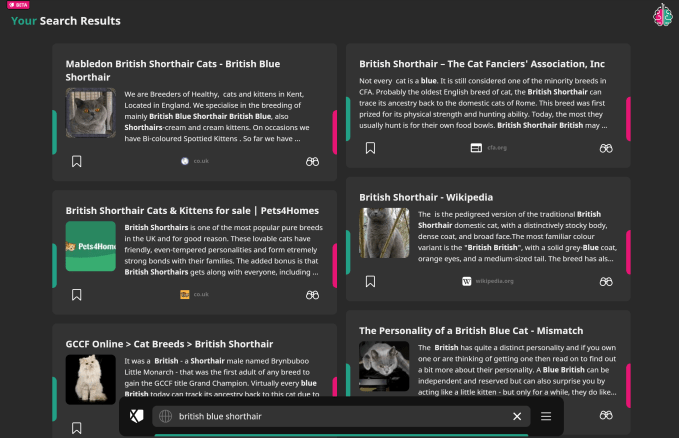
Sample search result page as seen on Xayn’s WebBeta version (Screengrab: Natasha Lomas/TechCrunch)

Xayn’s learning AI can be toggled off whenever you like, by clicking on the brain icon in the top right. Say if you want to browse ‘unwatched’ — i.e. without the stuff you’re looking at being used as learning material for the AI to decide what else you’ll get shown (both for content in the feed and search results).

You can also reset the learning manually by clearing your browsing data — if you want to purge the whole thing and start again.

Another carrot to entice users is no ads: Xayn is ad-free — which of course isn’t the case with other non-tracking private search engines (like DuckDuckGo or Qwant), which tend to rely on showing contextual ads.

And in another break from the search industry ‘norm’, its AI’s search algorithms are open source.

Other features available on the desktop version of Xayn include a ‘deep search’ offering that it says lets users dive into a topic via “a simple click to be shown a personal reference library of relevant content”; and ‘collections’ — a bookmark-like offering which lets users “collect and store their favorite web content by creating, filling, and managing collections”.

Plus, as well as being ad-free itself, Xayn has baked in an ad blocker — blocking ads on third party sites for a “noise-free” browsing experience as it puts it.

Its first focus for the desktop is Chromium-based browsers and Firefox — so Safari users will need to switch to a supported browser to kick the tyres of its WebBeta.

The mobile version of Xayn’s product launched back in December and has been downloaded more than 250,000 times worldwide since then, according to the startup.

Three months after launch it says users were already conducting 100,000+ active daily searches — feeding in the browsing data and interest-based swipes that the AI uses to train and improve the personalized content discovery which is core to Xayn’s value proposition. And because it’s doing all this learning and reranking on device it’s able to tout its user-specific search results as ‘privacy safe’.

It also tries to avoid a filter bubble type effect by consciously injecting variance — so its algorithms don’t always just feed users more of the same.

Both the desktop and mobile version of Xayn use a technique called Masked Federated Learning to tailor the user’s web experience without compromising their privacy.

Google is also of course working on evolving its own ad targeting technology — currently it’s piloting a technology called FloCs (aka ‘federated learning of cohorts’) to put browser users in interest buckets for ad targeting purposes, as it works on deprecating tracking cookies. But its core business remains people profiling and selling your attention to advertisers — something Xayn definitely isn’t doing.

“We started Xayn as a direct response to the false privacy vs convenience dilemma and quickly proved that it’s possible to solve this trade-off so users are no longer losers. In fact, with each update, our fantastic team of engineers and designers demonstrates all over again how privacy, quality, and great UX go hand in hand,” said Leif-Nissen Lundbæk, co-Founder and CEO, in a statement.

“We didn’t want to copy what’s already out there but instead re-think it and create something new. With Xayn, you can find your favorite part of the Internet — either by actively searching the web or by browsing through the discovery feed that offers personalized content suggestions from the entire Internet. Either way, your privacy is always protected.”

“In creating Xayn’s web version, we have taken all the elements that made the app great and adapted them to the desktop browser window,” added Julia Hintz, its head of design, in another statement.

“The privacy-protecting algorithms, the intuitive design, and the smooth animations have found their way into the web version. Users can switch effortless between mobile and desktop without leaving their familiar environment. This is key for the seamless, deep interaction experience that makes Xayn special.”

In the web version of the product, Xayn says users’ personal data stays privately within the browser.

Asked about the security of the desktop product, a spokesperson told us: “Desktop computers are less safe than smartphones in general. However, Xayn protects personal data by using decentralized privacy-preserving machine learning in combination with encryption. From the pure technical point of view, Xayn is actually a browser within a browser on a desktop device. On desktop devices, Xayn runs in a sandbox in the respective browsers and this is how it protects personal data from unwanted third-party access.”

Future features Xayn plans to add includes the ability for mobile and desktop users to synchronize their personalized experience across multiple devices, while keeping their privacy intact, so the AI’s learnings can go with them wherever they’re online.

To check out the WebBeta version of Xayn’s search engine on your desktop computer point your browser at www.xayn.com.

Earlier this summer, Xayn announced a $12 million Series A funding round led by the Japanese investors Global Brain and Japanese telco KDDI, along with participation from prior backers including Berlin’s Earlybird VC — bringing its total financing to $23M+. Unsurprisingly, then, Asia (starting with Japan) is now a big focus for the Berlin startup.


30 Aug 2021

China restricts kids’ online gaming to three hours a week

China’s National Press and Publication Administration has released a notice imposing limits on online gaming for minors. On September 1st, video game companies will have to restrict gaming time to three hours a week — from 8 PM to 9 PM on Friday, Saturday and Sunday.

With this new set of restrictions, Chinese authorities want to tackle addition to online games. According to the National Press and Publication Administration, online gaming has an impact on both the physical and mental health of minors.

In order to implement those time limits, game companies will have to leverage a real name-based registration system. In 2018, Tencent started using this system to limit playtime on Honor of Kings, a widely popular mobile game.

Back then, limits weren’t as strict though as children up to aged 12 could play one hour per day, and up to two hours per day for children between 13 and 18. At the time, authorities were concerned about worsening myopia among minors.

During the signup flow, users have to go through an ID verification system, which means that you can only have one account associated with your real name. Regulators will regularly check whether gaming companies comply with local regulation.

It’s going to be interesting to see how the new rules affect video games as a whole. Online gaming is mentioned specifically, which could mean that solo games won’t be restricted going forward. Similarly, it’s unclear whether console games and foreign games will have to implement the new real name-based registration system.

Some young gamers will also be tempted to circumvent the restrictions by signing up on a foreign server. It’s also worth noting that adult players will still be able to play 24/7.

Following the news, Tencent has issued a statement. “Tencent expressed its strong support and will make every effort to implement the relevant requirements of the Notice as soon as possible,” the company says.

As Bloomberg noticed, NetEase shares are currently down 8% compared to yesterday’s closing price. NetEase is another popular Chinese game development company and its activities aren’t as diversified as Tencent’s activities.

30 Aug 2021

China restricts kids’ online gaming to three hours a week

China’s National Press and Publication Administration has released a notice imposing limits on online gaming for minors. On September 1st, video game companies will have to restrict gaming time to three hours a week — from 8 PM to 9 PM on Friday, Saturday and Sunday.

With this new set of restrictions, Chinese authorities want to tackle addition to online games. According to the National Press and Publication Administration, online gaming has an impact on both the physical and mental health of minors.

In order to implement those time limits, game companies will have to leverage a real name-based registration system. In 2018, Tencent started using this system to limit playtime on Honor of Kings, a widely popular mobile game.

Back then, limits weren’t as strict though as children up to aged 12 could play one hour per day, and up to two hours per day for children between 13 and 18. At the time, authorities were concerned about worsening myopia among minors.

During the signup flow, users have to go through an ID verification system, which means that you can only have one account associated with your real name. Regulators will regularly check whether gaming companies comply with local regulation.

It’s going to be interesting to see how the new rules affect video games as a whole. Online gaming is mentioned specifically, which could mean that solo games won’t be restricted going forward. Similarly, it’s unclear whether console games and foreign games will have to implement the new real name-based registration system.

Some young gamers will also be tempted to circumvent the restrictions by signing up on a foreign server. It’s also worth noting that adult players will still be able to play 24/7.

Following the news, Tencent has issued a statement. “Tencent expressed its strong support and will make every effort to implement the relevant requirements of the Notice as soon as possible,” the company says.

As Bloomberg noticed, NetEase shares are currently down 8% compared to yesterday’s closing price. NetEase is another popular Chinese game development company and its activities aren’t as diversified as Tencent’s activities.

30 Aug 2021

HAAS Alert raises $5M seed round to scale its automotive collision prevention system

HAAS Alert, a SaaS company that provides real-time automotive collision prevention for public safety and roadway fleets, has raised $5 million in seed funding that the company says it will use to scale sales and outreach efforts and prioritize R&D with vehicle-to-vehicle and vehicle-to-infrastructure (V2X) technology partnerships.

The round was led by R^2 and Blu Ventures and joined by TechNexus, Stacked Capital, Urban Us, Techstars, Ride Ventures and Gramercy Fund.

HAAS Alert relies on cellular-based sensors to ingest roadway hazard data from the environment surrounding a vehicle and its predictive technology to digitally alert drivers through their vehicle systems. HAAS Alert’s proprietary digital alerting system, Safety Cloud, can be found on a range of fleet vehicles in the public and private sector, from fire trucks, ambulances and police vehicles to tow trucks, construction and waste vehicles, school buses and more.

“Emergency responders, towing operators, construction and work zone crews and similar municipal fleets have extremely high death and injury rates from collisions,” Jeremy Agulnek, HAAS Alert’s senior vice president of connected vehicle, told TechCrunch. “They also really form the backbone of our communities, and every driver encounters them on the road daily. Many of these jobs are inherently risky to begin with, and yet struck-by incidents still rank as a leading cause of death for all of them.”

HAAS Alert sees advanced driver assistance systems (ADAS) and V2X as the solution, so it built its service to start with those at the highest risk on our roads, and grow from there.

“For us, this is not about using connected vehicles for entertainment and general connectivity – it is specifically about safety,” said Agulnek. “By connecting and protecting these folks, we can immediately bring a connected vehicle experience to all drivers and infrastructure in a way that also makes communities safer. We think that solving for safety with first responders and roadway workers is the most critical component to advancing mobility to the next stage.”

So far, Safety Cloud is present on vehicles in more than 750 public agencies and private organizations that have sent more than 1 billion alerts collectively.

HAAS Alert represents a growing number of startups looking to leverage V2X technology to reduce the risk of collisions, and funding is a big piece of the puzzle. Not only does the software cost money to build and keep updated, but the hardware and human-power costs associated with installing sensors, both on public infrastructure and within vehicles, aren’t cheap. HAAS Alert hopes to reach 10 billion driver safety alerts by 2022, and to do that, it’ll need to attract the automotive sector. Currently, the company works mainly with fleets, but it says the more fleets that are on its platform, the more automotive customers it will attract and vice versa.

We charge reasonable fees for fleet and agency customers to activate their roadway assets on Safety Cloud, and we charge a subscription fee to automotive customers to license the safety alerts, software and other services we provide,” Agulnek said.

The company says it’s actively installing its HA-5 Transponder hardware on vehicles across the nation, which allows equipped vehicles to automatically send digital alerts to approaching drivers when emergency fleets activate their flashing lights. These alerts give road users a heads up to the existence of response personnel on or near the roadway, giving drivers time to slow down or move over.

Agulnek says the hardware setup is quick and easy with minimal downtime, but fleets also have the option of integrating Safety Cloud without hardware via the vehicle’s existing CAD, GPS or telematics system.

“All that is needed to add Safety Cloud alerts to a vehicle is a software update to receive data via the vehicle’s existing telematics capabilities and display driver alerts in the infotainment screen and/or instrument cluster,” Agulnek said. “We are working on a project right now with a car manufacturer where it took less than a week to implement alerts inside their vehicles.”

Computations are done either in the cloud or on the edge of the chips inside the hardware, which means the alerting logic can reside in HAAS Alert’s cloud, in a vehicle OEM’s cloud, in the vehicle’s head unit or a hybrid multi-location architecture, according to Agulnek.

A fleet management platform, the Situational Awareness Dashboard, comes standard with the Safety Cloud and is designed to enable coordinating agencies across jurisdictions to work together. HAAS Alert also includes potential add-ons for specific industries. For example, responder-to-responder (R2R) features a set of lights attached inside a vehicle that sends notifications to responders when other Safety Cloud-equipped vehicles are in active response mode and approaching the same intersection. FleetFusion allows customers to integrate real-time data from Safety Cloud into internal dashboards, third-party applications and traffic management centers.

30 Aug 2021

HAAS Alert raises $5M seed round to scale its automotive collision prevention system

HAAS Alert, a SaaS company that provides real-time automotive collision prevention for public safety and roadway fleets, has raised $5 million in seed funding that the company says it will use to scale sales and outreach efforts and prioritize R&D with vehicle-to-vehicle and vehicle-to-infrastructure (V2X) technology partnerships.

The round was led by R^2 and Blu Ventures and joined by TechNexus, Stacked Capital, Urban Us, Techstars, Ride Ventures and Gramercy Fund.

HAAS Alert relies on cellular-based sensors to ingest roadway hazard data from the environment surrounding a vehicle and its predictive technology to digitally alert drivers through their vehicle systems. HAAS Alert’s proprietary digital alerting system, Safety Cloud, can be found on a range of fleet vehicles in the public and private sector, from fire trucks, ambulances and police vehicles to tow trucks, construction and waste vehicles, school buses and more.

“Emergency responders, towing operators, construction and work zone crews and similar municipal fleets have extremely high death and injury rates from collisions,” Jeremy Agulnek, HAAS Alert’s senior vice president of connected vehicle, told TechCrunch. “They also really form the backbone of our communities, and every driver encounters them on the road daily. Many of these jobs are inherently risky to begin with, and yet struck-by incidents still rank as a leading cause of death for all of them.”

HAAS Alert sees advanced driver assistance systems (ADAS) and V2X as the solution, so it built its service to start with those at the highest risk on our roads, and grow from there.

“For us, this is not about using connected vehicles for entertainment and general connectivity – it is specifically about safety,” said Agulnek. “By connecting and protecting these folks, we can immediately bring a connected vehicle experience to all drivers and infrastructure in a way that also makes communities safer. We think that solving for safety with first responders and roadway workers is the most critical component to advancing mobility to the next stage.”

So far, Safety Cloud is present on vehicles in more than 750 public agencies and private organizations that have sent more than 1 billion alerts collectively.

HAAS Alert represents a growing number of startups looking to leverage V2X technology to reduce the risk of collisions, and funding is a big piece of the puzzle. Not only does the software cost money to build and keep updated, but the hardware and human-power costs associated with installing sensors, both on public infrastructure and within vehicles, aren’t cheap. HAAS Alert hopes to reach 10 billion driver safety alerts by 2022, and to do that, it’ll need to attract the automotive sector. Currently, the company works mainly with fleets, but it says the more fleets that are on its platform, the more automotive customers it will attract and vice versa.

We charge reasonable fees for fleet and agency customers to activate their roadway assets on Safety Cloud, and we charge a subscription fee to automotive customers to license the safety alerts, software and other services we provide,” Agulnek said.

The company says it’s actively installing its HA-5 Transponder hardware on vehicles across the nation, which allows equipped vehicles to automatically send digital alerts to approaching drivers when emergency fleets activate their flashing lights. These alerts give road users a heads up to the existence of response personnel on or near the roadway, giving drivers time to slow down or move over.

Agulnek says the hardware setup is quick and easy with minimal downtime, but fleets also have the option of integrating Safety Cloud without hardware via the vehicle’s existing CAD, GPS or telematics system.

“All that is needed to add Safety Cloud alerts to a vehicle is a software update to receive data via the vehicle’s existing telematics capabilities and display driver alerts in the infotainment screen and/or instrument cluster,” Agulnek said. “We are working on a project right now with a car manufacturer where it took less than a week to implement alerts inside their vehicles.”

Computations are done either in the cloud or on the edge of the chips inside the hardware, which means the alerting logic can reside in HAAS Alert’s cloud, in a vehicle OEM’s cloud, in the vehicle’s head unit or a hybrid multi-location architecture, according to Agulnek.

A fleet management platform, the Situational Awareness Dashboard, comes standard with the Safety Cloud and is designed to enable coordinating agencies across jurisdictions to work together. HAAS Alert also includes potential add-ons for specific industries. For example, responder-to-responder (R2R) features a set of lights attached inside a vehicle that sends notifications to responders when other Safety Cloud-equipped vehicles are in active response mode and approaching the same intersection. FleetFusion allows customers to integrate real-time data from Safety Cloud into internal dashboards, third-party applications and traffic management centers.