
Month: August 2021

24 Aug 2021

Fika Ventures nearly triples its assets under management: “It’s definitely a crazy time”

Fika Ventures is a five-year-old, L.A.-based seed stage fund that has been funding mostly business-to-business startups, as well as fintech companies and a sprinkling of healthcare IT startups — as long as they don’t involve hardware or FDA approval.

The firm’s investors apparently think it’s doing a decent job. After raising $41 million for its debut fund, followed by a $77 million fund that Fika closed in 2019, the outfit is today announcing a third flagship fund with $160 million to invest, along with an opportunity-type fund with $35 million in capital commitments.

That’s a major endorsement for such a young firm. Still, even with upwards of 10 promising portfolio companies — including Formative, a Santa Monica, Calif.-based platform for K-12 teachers to create assessments that raised $70 million in June; Pipe, a Miami-based startup that lets companies sell their recurring revenue streams on its platform and raised $250 million at a $2 billion valuation in May; and Papaya Global, an Israeli startup that’s sells payroll, hiring, onboarding and compliance service and raised $100 million earlier this year — it’s getting harder right now to do what they do, say firm cofounders Eva Ho and TX Zhou. “It’s definitely a crazy time,” Ho offers.

We had a candid conversation with the pair yesterday, edited lightly for length below.

TC: This is now one of the bigger seed-stage firms in L.A. What percentage of your investments are local?

EH: We feel like we have a home court advantage here, so about 40% of our deals are here, then the rest are in markets like Seattle, New York, Boston, Austin, Chicago. We recently did a deal in Toronto because they have a nice AI community there. But we still very much believe in needing boots on the ground so go after geographies where we can fly to board meetings and be there physically to support [our founders] when they need us.

TC: Your new flagship fund is more than twice the size of your last fund. How will that impact how much you invest?

TZ: Our check sizes will grow a bit in tandem with the market. As you know, seed rounds are now quite a bit larger. I think initial checks will be in the $1 million to $3 million range; with the last fund, we reserved up to $6 million per company and now we’ll reserve up to $10 million.

TC: Tell us a little about investing in a market where everybody is a founder, and everyone is also an investor. 

EH: It’s definitely a crazy time. It feels like we’re running a marathon and trying to be in a sprint. We have to have the long view and make bets with that horizon in mind, but at the same time, the decisions for initial and follow-on rounds have gotten just a lot faster.

TC: How do you continue to make good decisions when things are moving so fast?

EH: The things we’ve been doing include increasing the size of the team and doing more work upfront on an industry so that we have more prepared mind coming in. But it continues to be a struggle because everything has been sort of compressed.

TZ: I think in the past, seed funds could get away with being pure generalists, even within sectors. But we’ve been forced over the last 12 months to really understand even more sub sectors within each of our verticals. For example, within fintech, we’ve kind of taken a deep dive in real estate and insurance, and that that helps us come into deals [prepared] given how fast they’re moving these days.

TC: What is the fastest deal you’ve done?

TZ: In the past, deals that we were looking at were getting done in two to three weeks; now the average time is probably a week to a week-and-a-half to make a final decision. I’d say the fastest we’ve moved is in five days, in a situation where we’ve known the entrepreneur for years so there was strong validation on a personal level. There was also good founder-market fit in terms of what they wanted to do.

EH: We just pull ourselves out of certain rounds that are moving [super fast] and/or valuation expectation upfront is just crazy. You see a lot of pre-seed rounds right now that are pre-product, pre-traction, pre-revenue that are done at $15 million or $20 million or $30 million post-money valuations. We’ll certainly flex for the right things, but there is just a lot of froth in the market right now.

TC: If the terms are right, are you funding pre-seed, pre-product, pre-traction teams?

EH: To be very frank, we have moved a little earlier in some cases. In the first fund, we [invested about] 15% in pre-seed startups, which to us means very early product and very early traction and sometimes no traction. In fund two, we’ve invested maybe 25% in pre-seed deals because the really good founders who’ve been shown that they’re able to execute and have vision — they get snapped up quickly, so you have to adapt and evolve a bit and move downstream a little more. That said, I think almost all the companies we fund have some sort of [minimum viable product] and some initial design partners in place, even if they don’t have any meaningful revenues yet.

TC: What percentage of your investments in your most recent fund have gone to repeat founders?

TZ: I’d say 15% to 20%. Obviously, we can’t and don’t limit ourselves to [serial entrepreneurs], but with repeat founders, deals move even faster than before.

TC: What’s the most absurd thing you’ve seen in this go-go market?

TZ: I think the most absurd thing we’ve heard are funds that are making decisions after a 30-minute call with the founder.

TC: Would you ever pass on a company because you’re not that excited about the rest of the cap table?

TZ: The speed of deals has forced us to really quickly hone in on what we care about. In the past, we had the luxury of having this long laundry list of things we wanted to check off and in a positive way, we’ve been forced to hone in on the three to five things that we really care about for each deal.

The bigger challenge is that investors who decide in 30 minutes create unrealistic expectations by founders. Sometimes they expect everyone to process information that quickly, and I think what they’re missing is that these funds are not processing the information.

TC: What’s one way you get founders to slow down and pay attention?

TZ:  We actually give every founder that we’ve come close to making a decision on a complete list of every single founder that we’ve backed in the past with their contact information.

Initially, we did this to help us win deals, but I think very quickly founders get a sense of what it’s like to work with us, too.
24 Aug 2021

Microsoft will bring cloud gaming to Xbox consoles this holiday season

Microsoft is moving into the next phase of its plan to bring Xbox Cloud Gaming to as many devices as possible, and it’s one of the most important steps yet. Starting this holiday season, Xbox Game Pass Ultimate subscribers will have access to cloud gaming on Xbox Series X/S and Xbox One consoles.

The company, which made the announcement during its Gamescom showcase, said you’ll be able to fire up more than 100 games without having to download them first. At some point in the future, Xbox One owners can play some Series X/S games through the cloud, such as Microsoft Flight Simulator. You’ll know a title is cloud gaming-compatible if you see a cloud icon next to it in the Game Pass library. Microsoft is targeting 1080p gameplay at 60 frames per second.

Xbox Cloud Gaming is already available on phones, tablets and PC. Microsoft is also working on Xbox game streaming sticks as well as a smart TV cloud gaming app. This summer, the company started transitioning cloud gaming onto beefier Xbox Series X hardware after launching the service on Xbox One S-based blade servers.

Editor’s note: This post originally appeared on Engadget.

24 Aug 2021

Bankers chase Byju’s for IPO, valuation pegged up to $50 billion

Nearly every top investment bank is chasing Byju’s and nudging the most valuable Indian startup to seriously explore the public markets as soon as next year.

Most banks have given Byju’s a proposed valuation in the range of $40 to $45 billion, but some including Morgan Stanley have pitched a $50 billion valuation if the startup lists next year, according to two people with knowledge of the matter.

The startup, which has raised $1.5 billion since the beginning of the pandemic last year, was most recently valued at $16.5 billion.

The banks’ excitement comes as the Indian public market has shown a glimpse of strong appetite for consumer tech stocks. Food delivery Zomato had a stellar $1.3 billion debut on Indian stock exchanges last month. Scores of other top startups including Paytm, PolicyBazaar, Nykaa, Ixigo, and MobiKwik have also filed paperworks for their IPOs.

Byju Raveendran (pictured above), the founder and chief executive of the eponymous startup, has publicly suggested in the past that he may list the firm in two to three years. According to a senior executive, who wish to not be named as the matter is private, and an investor, the startup has not set a concrete timeline for an IPO.

In the immediate future, odds of Byju’s raising again is high. The startup has received several inbound requests from investors to raise at a valuation of about $21.5 billion, the people said.

The startup has use a significant portion of its recent fundraises to acquire firms. Earlier this year, it acquired Indian physical coaching institute Aakash for nearly $1 billion. It has also acquired Great Learning, and U.S.-based Epic, among others, for over $1 billion in cash and stock deals.

Byju’s prepares students pursuing undergraduate and graduate-level courses, and in recent years it has also expanded its catalog to serve all school-going students. Tutors on the Byju’s app tackle complex subjects using real-life objects such as pizza and cake.

The pandemic, which prompted New Delhi to enforce a months-long nationwide lockdown and close schools, accelerated its growth, and those of several other online learning startups including Unacademy and Vedantu.

As of early this year, Byju’s said it had amassed over 80 million users, 5.5 million of whom are paying subscribers. Byju’s, which is profitable, is on track to generate revenue of $300 million in the U.S. this year (per Raveendran), and as high as $1.1 billion in revenue overall by the end of the calendar year, according to a person familiar with the matter.

Byju’s declined to comment.

24 Aug 2021

Boston’s startup market is more than setting records in scorching start to year

The global startup community is currently enjoying a period of fundraising success that may be unprecedented in the history of technology and venture capital. While this is happening around the world, few startup hubs in the world are reveling in a greater boost to their ability to attract capital than Boston.

The well-known U.S. city is a traditional venture capital hub, but one that seemed to fall behind its domestic rivals Silicon Valley and New York City in recent years. However, data indicates that Boston’s startup activity in fundraising terms has reached a new, higher plateau, funneling record sums into the city’s upstart technology companies this year.

And, according to local investors, there could be room for further acceleration in capital disbursement.


The Exchange explores startups, markets and money.

Read it every morning on Extra Crunch or get The Exchange newsletter every Saturday.


The Exchange wanted to better understand what’s driving Boston’s rapid-fire results, and discover if there is any particular need for caution or concern. Is the market overheated? According to local investors Rob Go from NextView, Jamie Goldstein from Pillar VC, Lily Lyman from Underscore, and Sanjiv Kalevar from OpenView, things may be more than warm, but Boston’s accelerating venture capital totals in 2021 are not based on FOMO or other potentially ephemeral trends.

Instead, Boston is benefiting from larger structural changes to at least the U.S. venture capital market, helping close historical gaps in its startup funding market and access funds that previously might have skipped the region. And local university density isn’t hurting the city’s cause, either, boosting its ability to form new companies during a period of rich investment access.

Let’s talk data, and then hear from the investing crew about just what is going on over in Beantown.

A record year in the making

When discussing venture capital data, we often note that it is somewhat laggy, with rounds announced long after they are closed. In practice, this means that more recent data can undersell how a particular quarter has performed. With Boston’s 2021 thus far, all that we can say is that if this data includes normal venture capital lag, it will simply be all the more incredible.

24 Aug 2021

Ispace unveils bigger moon lander capable of surviving lunar nights

Ispace, a Japanese space startup that aims to lead the development of a lunar economy, has unveiled its design for a large lander that could go to the moon as early as 2024.

Tokyo-based ispace said this next-gen lander, dubbed Series 2, would be used on the company’s third planned moon mission. The lander is both larger in size and payload capacity than the company’s first lander, coming in at around 9 feet tall and 14 feet wide including legs. The vehicle will be capable of carrying up to 500 kilograms to the moon’s surface and 2,000 kilograms to lunar orbit. Series 1, which will fly in 2022 and 2023, has a maximum payload capacity of only 30 kilograms.

Crucially, the new lander is designed to be able to survive the frigid lunar nighttime, possibly as long as a two-week stint on the moon’s surface. It’s also capable of landing on either the near or far side of the moon, including its polar regions.

The new lander has a few other features as well: it has multiple payload bays, and an advanced guidance, navigation and control (GNC) system to ensure the craft sticks the landing on the moon’s surface. The GNC technology is being provided by engineering developer Draper, a company with a deep footprint in the space industry. Draper is which is also one of fourteen eligible contractors for NASA’s Commercial Lunar Payload Services (CLPS) initiative.

Ispace said in a statement that the lander has completed its preliminary design review; the next stage is manufacturing and assembly, which will be completed in partnership with General Atomics, a defense and aerospace technology company.

The partnership with Draper – a CLPS contractor – is key, as ispace wants its Series 2 to compete in the NASA program. “Over the next few months, we will work closely with Draper and General Atomics to prepare for the next NASA CLPS task order,” Kyle Acierno, CEO of ispace’s U.S.-based subsidiary, said.

Ispace is developing the next-gen lander out of its North American offices in Colorado, and it intends to also manufacture the vehicle in the United States. In the meanwhile, the company is still at work preparing for its first two lunar missions in 2022 and 2023. The company said the Series 1 lander is undergoing final assembly of the flight module at a facility in Germany owned by space launch company ArianeGroup. The customer manifest for the first mission is full, but ispace did say payload capacity is still available for the subsequent mission.

The lander unveiling comes just weeks after ispace announced the close of a $46 million Series C funding round, capital it said at the time would go toward the second and third planned missions.

24 Aug 2021

TechCrunch Disrupt 2021 kicks off in less than a month

We’re less than one month away from kicking off our flagship global event, TechCrunch Disrupt 2021. And we’re feeling the adrenaline rush that can only come when more than 10,000 startup icons, experts, founders, investors and makers gather to learn, inspire, connect, collaborate, compete and network.

Buy your pass here and brace yourself for three full days of Disrupt.

Let’s take a look at just some of the opportunity that can help you move the needle on your startup aspirations.

You’ll find plenty of startup action on two distinct stages. First up, the Disrupt main stage featuring in-depth interviews and panel discussions with a who’s-who of tech, policy and celebrity-slash-entrepreneurial talent — like Calendly CEO Tope Awotona, U.S. Secretary of Transportation Pete Buttigieg and movie-star-turned-pot-businessman Seth Rogan.

The Extra Crunch stage is where you’ll find a deep bench of subject-matter experts sharing practical how-to content. You’ll take away actionable insights you can put into practice now — when you need it most. We’re talking essential topics like How to Raise Your First Dollars and The Subtle Challenges of Assessing Product-Market Fit.

Tip of the tech iceberg: Check out the full Disrupt 2021 agenda and don’t forget — your pass includes video-on-demand. You can relax knowing you won’t miss a single presentation.

Don’t miss the hundreds of innovative startups strutting their considerable stuff in Startup Alley, the virtual expo area. Dive into an ocean of opportunity — ask for a product demo, schedule a 1:1 video meeting or explore potential ways to collaborate.

Networking is a huge part of Disrupt, and you’ll find multiple ways to make valuable connections. Whether they happen spontaneously in our virtual event platform (the chat is where it’s at!) or curated meetups through CrunchMatch, our AI-powered platform, you’ll meet smart, exciting people eager to make a business connection. Who knows where a simple conversation can lead?

Don’t miss Startup Battlefield — the epic pitch competition that launched big-name companies like Dropbox, Mint, TripIt, Vurb and many more. Top early-stage startups from around the world — from any country and industry — will compete for a shot at $100,000 in equity-free prize money. You might just catch the next unicorn in its pony stage. It’s more than thrilling — as noted by Jessica McLean, Director of Marketing and Communications, Infinite-Compute:

Watching the Startup Battlefield was fantastic. You could see the ingenuity and innovation happening in different technology spaces. Just looking at the sheer number of other pitch decks and hearing the judges tear them down and give feedback was very helpful.

TechCrunch Disrupt 2021.takes place September 21-23 — that’s less than a month away, folks! Buy your pass, plan your schedule and get ready to join your people and move your business forward.

Is your company interested in sponsoring or exhibiting at Disrupt 2021? Contact our sponsorship sales team by filling out this form.

24 Aug 2021

TechCrunch Disrupt 2021 kicks off in less than a month

We’re less than one month away from kicking off our flagship global event, TechCrunch Disrupt 2021. And we’re feeling the adrenaline rush that can only come when more than 10,000 startup icons, experts, founders, investors and makers gather to learn, inspire, connect, collaborate, compete and network.

Buy your pass here and brace yourself for three full days of Disrupt.

Let’s take a look at just some of the opportunity that can help you move the needle on your startup aspirations.

You’ll find plenty of startup action on two distinct stages. First up, the Disrupt main stage featuring in-depth interviews and panel discussions with a who’s-who of tech, policy and celebrity-slash-entrepreneurial talent — like Calendly CEO Tope Awotona, U.S. Secretary of Transportation Pete Buttigieg and movie-star-turned-pot-businessman Seth Rogan.

The Extra Crunch stage is where you’ll find a deep bench of subject-matter experts sharing practical how-to content. You’ll take away actionable insights you can put into practice now — when you need it most. We’re talking essential topics like How to Raise Your First Dollars and The Subtle Challenges of Assessing Product-Market Fit.

Tip of the tech iceberg: Check out the full Disrupt 2021 agenda and don’t forget — your pass includes video-on-demand. You can relax knowing you won’t miss a single presentation.

Don’t miss the hundreds of innovative startups strutting their considerable stuff in Startup Alley, the virtual expo area. Dive into an ocean of opportunity — ask for a product demo, schedule a 1:1 video meeting or explore potential ways to collaborate.

Networking is a huge part of Disrupt, and you’ll find multiple ways to make valuable connections. Whether they happen spontaneously in our virtual event platform (the chat is where it’s at!) or curated meetups through CrunchMatch, our AI-powered platform, you’ll meet smart, exciting people eager to make a business connection. Who knows where a simple conversation can lead?

Don’t miss Startup Battlefield — the epic pitch competition that launched big-name companies like Dropbox, Mint, TripIt, Vurb and many more. Top early-stage startups from around the world — from any country and industry — will compete for a shot at $100,000 in equity-free prize money. You might just catch the next unicorn in its pony stage. It’s more than thrilling — as noted by Jessica McLean, Director of Marketing and Communications, Infinite-Compute:

Watching the Startup Battlefield was fantastic. You could see the ingenuity and innovation happening in different technology spaces. Just looking at the sheer number of other pitch decks and hearing the judges tear them down and give feedback was very helpful.

TechCrunch Disrupt 2021.takes place September 21-23 — that’s less than a month away, folks! Buy your pass, plan your schedule and get ready to join your people and move your business forward.

Is your company interested in sponsoring or exhibiting at Disrupt 2021? Contact our sponsorship sales team by filling out this form.

24 Aug 2021

Paxos renames its stablecoin from PAX to USDP

Paxos, the company behind the Paxos Standard stablecoin (PAX), has announced that it is changing the name of its cryptoasset. Paxos Standard is now Pax Dollar, and you’ll soon be able to identify it on your favorite cryptocurrency exchange, wallet or explorer under the USDP ticker.

Other than the name, USDP remains fundamentally identical to PAX. Like other stablecoins, USDP has been invented so that its value doesn’t fluctuate over time when you compare it to fiat currencies. The value of USDP is indexed to USD. At any point in time, one USDP is worth one USD.

Stablecoins provide many advantages. Sending money is as easy as moving crypto assets from one wallet to another. You don’t have to enter intermediary bank information, worry about local regulation, etc. Many people around the world don’t have bank accounts — stablecoins and cryptocurrency wallets could potentially become an alternative to traditional bank accounts.

You can also use stablecoins to take advantage of DeFi projects (decentralized finance). For instance, you can contribute to lending pools and earn interests from your stablecoin holdings.

In addition to USDP, other popular stablecoins include USD Coin (USDC) and Tether (USDT). As you can see, a naming convention has emerged over time. And Paxos says that it is changing the name of its stablecoin for this reason in particular.

Whenever Paxos issues new tokens, it stores some USD and USD equivalent in a bank account. Right now, Paxos uses US Treasury Bills with short maturities as USD equivalent. Auditing firms regularly check the company’s claims.

Paxos tries to position itself as a company that is deeply committed to regulation. It has recently written a report highlighting the differences between USDP, USDC and USDT. According to the company, USDC and USDT shouldn’t be considered as regulated assets because of their reserves. Paxos wants to emerge as the most legitimate player in the space so that big corporate clients choose Paxos as their preferred partners.

A couple of days ago, Circle announced that USDC would switch to cash and cash equivalent for USDC reserves. I’m sure we’ll hear more from cryptocurrency companies and their stablecoin reserve strategies in the future.

24 Aug 2021

Paxos renames its stablecoin from PAX to USDP

Paxos, the company behind the Paxos Standard stablecoin (PAX), has announced that it is changing the name of its cryptoasset. Paxos Standard is now Pax Dollar, and you’ll soon be able to identify it on your favorite cryptocurrency exchange, wallet or explorer under the USDP ticker.

Other than the name, USDP remains fundamentally identical to PAX. Like other stablecoins, USDP has been invented so that its value doesn’t fluctuate over time when you compare it to fiat currencies. The value of USDP is indexed to USD. At any point in time, one USDP is worth one USD.

Stablecoins provide many advantages. Sending money is as easy as moving crypto assets from one wallet to another. You don’t have to enter intermediary bank information, worry about local regulation, etc. Many people around the world don’t have bank accounts — stablecoins and cryptocurrency wallets could potentially become an alternative to traditional bank accounts.

You can also use stablecoins to take advantage of DeFi projects (decentralized finance). For instance, you can contribute to lending pools and earn interests from your stablecoin holdings.

In addition to USDP, other popular stablecoins include USD Coin (USDC) and Tether (USDT). As you can see, a naming convention has emerged over time. And Paxos says that it is changing the name of its stablecoin for this reason in particular.

Whenever Paxos issues new tokens, it stores some USD and USD equivalent in a bank account. Right now, Paxos uses US Treasury Bills with short maturities as USD equivalent. Auditing firms regularly check the company’s claims.

Paxos tries to position itself as a company that is deeply committed to regulation. It has recently written a report highlighting the differences between USDP, USDC and USDT. According to the company, USDC and USDT shouldn’t be considered as regulated assets because of their reserves. Paxos wants to emerge as the most legitimate player in the space so that big corporate clients choose Paxos as their preferred partners.

A couple of days ago, Circle announced that USDC would switch to cash and cash equivalent for USDC reserves. I’m sure we’ll hear more from cryptocurrency companies and their stablecoin reserve strategies in the future.

24 Aug 2021

NoRedInk raises $50 million Series B to help students become better writers

“In order to become a better writer, read your written words out loud.”

That’s one of the first, and best, writing tips I ever received. I always found the advice ironic because it required me to change the medium of my writing to become a better writer. Still, all these years later, it’s true: vocalizing your words helps identify typos and incomplete thoughts, but also notice more subtle things like awkward turns of phrases or a weird rhythm in your sentence structure. Best of all, if you find yourself bored of your own text while reading out loud, you know readers will be, too.

This is all to say that writing, even for those who love writing, is a deeply human art built on top of nonobvious rules. While those complications don’t exactly scream for a tech solution, NoRedInk, a San Francisco-based startup, has spent nearly a decade trying to help students get better at their writing through software.

NoRedInk announced today that its digital writing curriculum, which pairs adaptive learning with Mad Libs-style prompts, has helped it raise a $50 million Series B led by Susquehanna Growth Equity, with participation from True Ventures. Other investors in the company include GSV, Rethink Education and Kapor Capital.

The financing event comes nearly six years after its Series A, a signal that the company has ambition to scale meaningfully in the coming months and years. With millions more, though, NoRedInk has to address its biggest challenge: the intricacies of the subject matter that it wants to make simple.

Founder and CEO Jeff Scheur built NoRedInk in 2012 when he was an English teacher in Chicago. The site served as a way to help kids get more than “red ink” on their papers, a nod at how teachers often use red ink to mark corrections and suggestions on assignments.

“Kids get feedback on their paper and they have no idea what to do with it,” Scheur said. “They see the grade, but they tend to just throw it out… so I figured out how to help them apply very difficult-to-learn skills that we expect kids to know, but don’t explicitly teach them.”

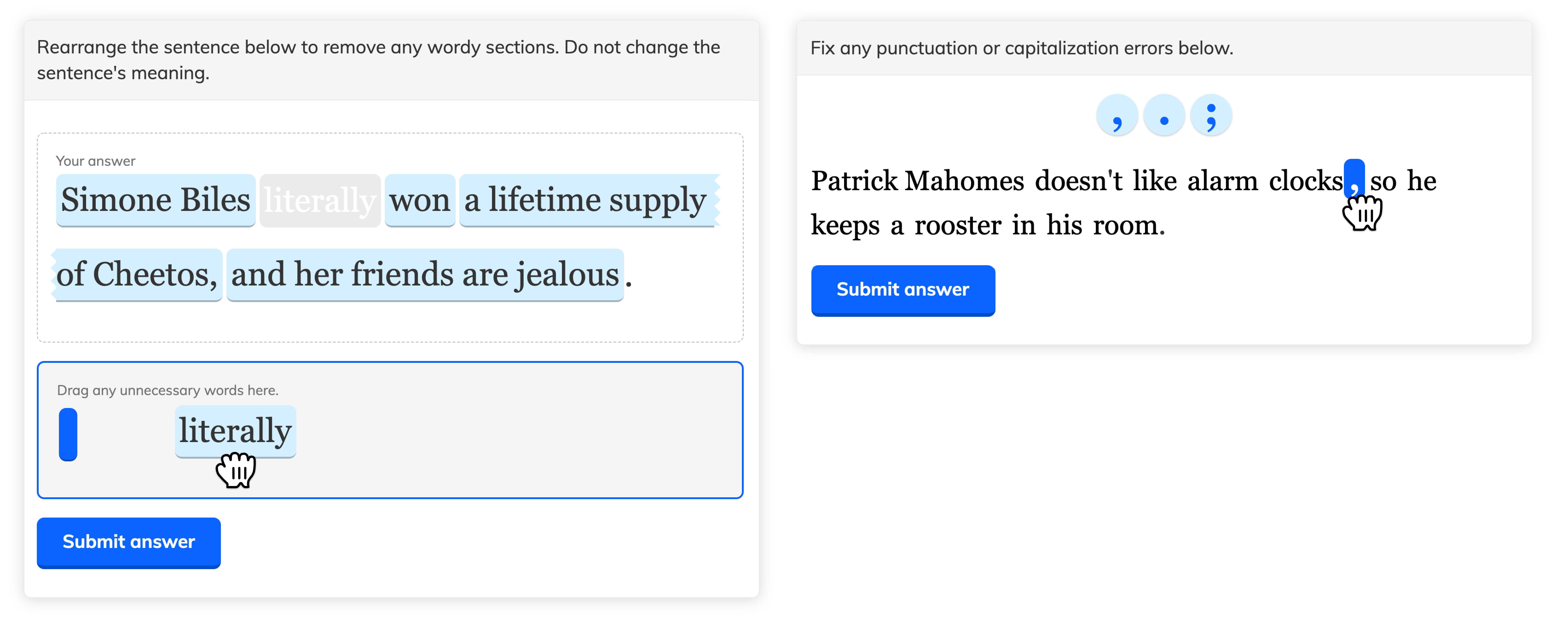
Since launch, NoRedInk’s goal is to help students with writing skills ranging from how to structure an essay to how to cut fluff from their arguments to how to cite correctly.

Image Credits: NoRedInk

“One of the great challenges about teaching writing is that we want to demystify the process of becoming a great writer without reducing the art form of expression,” he said. “So that means providing kids with lots of targeted personalized practice, and helping them realize that there’s no one way to write.”

It thus makes sense that NoRedInk uses adaptive learning, an educational method that uses an algorithm to get inputs of learners, such as strength areas or preferences, to create an output that better meets them where they are. After asking students for their favorite characters and role models, NoRedInk creates personalized writing exercises targeting each student’s interests, then guides them through the writing process with light support.

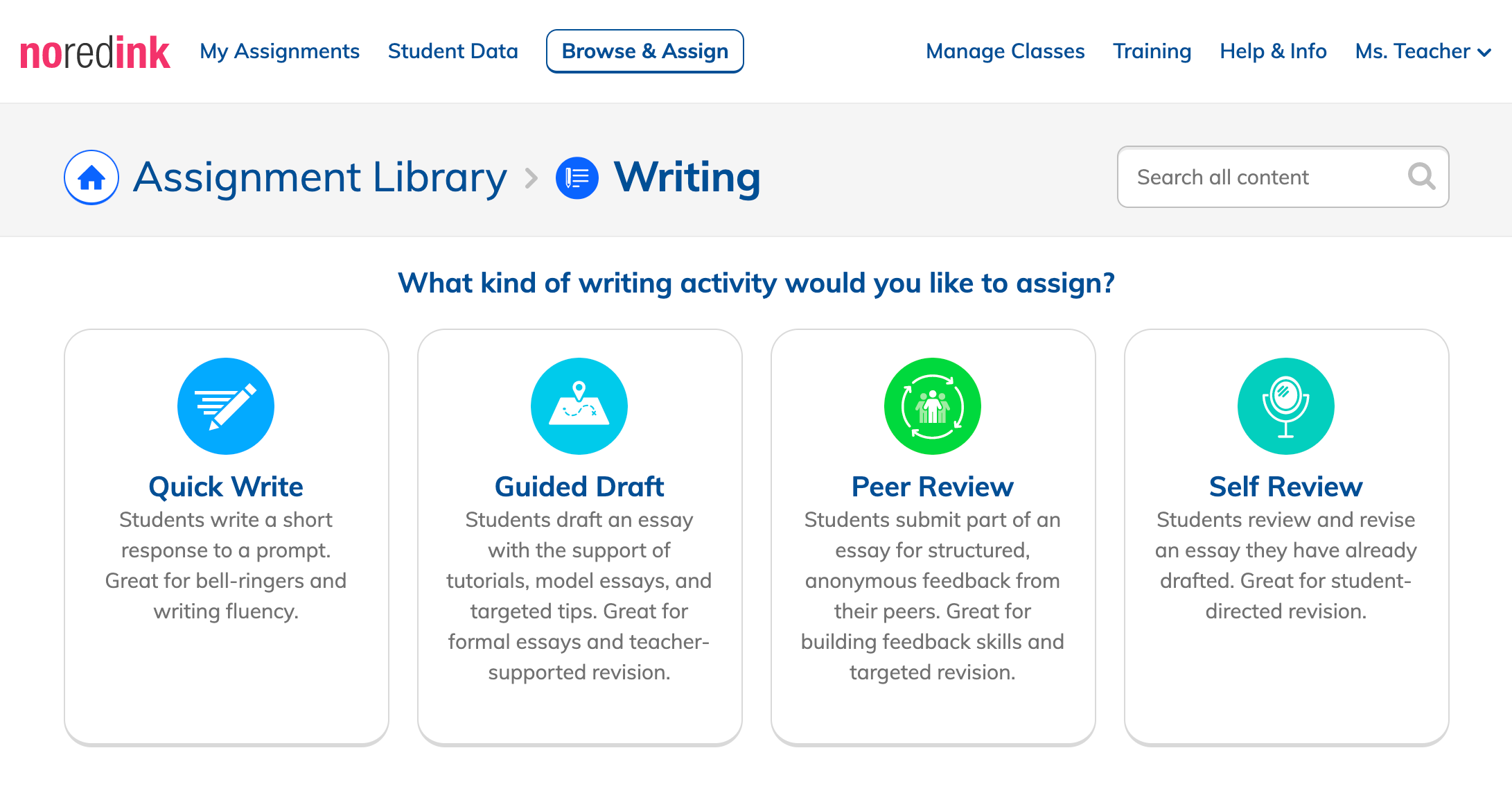
noredink

Image Credits: NoRedInk

Scheur described part of the goal of NoRedInk as “breaking down difficult to learn skills with various degrees of scaffolding.”

To date, more than 10 billion exercises have been completed on NoRedInk’s practice engine — which is data the company uses to underscore problem areas, shared struggles and potential blind spots of traditional curriculum for its districts.

NoRedInk has a free-but-limited version of its platform for teachers to try, but offers a full-fledged premium version that integrates with learning management systems and other classrooms to offer a school and district a view of progress.

As the business expands, NoRedInk might need to get deeper into drafts in order to win over market share. Will it ever play the role of suggesting tone the way that AI-based grammar and writing unicorn Grammarly does? For now, it appears not.

“Grammarly is a modern-day spellcheck,” Scheur said. “NoRedInk is very different; it’s what schools and districts use to teach skills.”