Month: August 2021

19 Aug 2021

Indian fintech CRED launches peer-to-peer lending feature Mint

India’s CRED, which rewards users for paying their credit-card bills on time, is broadening its offerings to help its 7.5 million members gain more from the service.

The Bangalore-based startup said on Thursday that CRED users can now lend to one another at an interest rate of up to 9% annually.

Kunal Shah, founder and chief executive of CRED, said the startup is rolling out this feature, dubbed CRED Mint, initially to some users after testing this internally for months.

“We’re super excited about this because it’s the first time our community members will be able to invest in one another directly. It’s going to focus on high-quality, low-risk, but much better, inflation-beating returns you can get on your money,” he said in an interview with TechCrunch.

CRED members have on average 200,000 Indian rupees ($2,685) sitting in their savings accounts, the startup said. “At up to 9% interest, CRED Mint will help these users India’s most creditworthy individuals to be rewarded for responsible financial behaviour with a smarter way to make idle money work for them. CRED members can apply for early access to Mint.”

Peer-to-peer lending is not a new business idea. Several large and small firms operate in this space, but CRED appears to be uniquely positioned to solve one of the biggest challenges this category faces: defaulters. According to some estimates, more than 20% of individuals taking a loan in a peer-to-peer service don’t pay back.

CRED members have a credit score of 750 or higher, making them the most trustworthy audience to provide financial services. On CRED, a user has to have a credit score of 750 or higher to join the app.

“We do believe that the product-market fit of our offering is very strong. We believe that this could set a new benchmark for what fintechs should be doing,” said Shah. CRED also does lending itself — which is available to limited members — and has disbursed about $269 million to customers in loans,

“Even at the scale of CRED Cash, the default rate has historically been less than 1%. To reduce risk further, the invested money will be routed directly to an escrow account held by CRED’s NBFC partner, Liquiloans, and diversified across 200+ borrowers on average,” the startup said.

For CRED Mint, the startup has partnered with Liquiloans, an RBI-registered P2P NBFC. Shah said CRED will eventually partner with more players. Users can invest between 100,000 Indian rupees ($1,345) to $13,450 in about two minutes, and also request withdrawal at any time with no penalty.

“The withdrawal process is fully online, and the money with interest will be returned to the investor within a working day. As a digital platform, CRED reduces friction, inefficiency, commissions, and overheads to pass on higher earnings for members,” the startup said.

CRED, backed by Tiger Global, Ribbit Capital, and Sequoia Capital India and valued at $2.2 billion in April round, has also received inbound requests from internal investors to raise a new round of over $300 million. The proposed terms value CRED at about $4 billion post-money. CRED isn’t currently in advanced stages to close a round. Shah declined to comment on fundraise talks.
19 Aug 2021

Spatial audio is coming to Netflix on iPhone and iPad

If you use AirPods Pro or AirPods Max, your mobile Netflix-watching is about to get a bit more immersive. Yesterday, Netflix confirmed that it has begun rolling out spatial audio support on iPhone and iPad on iOS 14 after the feature was spotted by a Reddit user.

Netflix joins streaming competitors like HBO Max, Disney+, and Peacock in enabling this feature, while other popular apps like Amazon Prime Video and YouTube still don’t have this functionality. Still, Netflix said the rollout won’t be immediate — users who have the update should be able to toggle it on or off in the Control Center.

Recently, Apple has been emphasizing its spatial audio features. The company first announced that it would bring spatial audio to AirPods Pro during the WWDC conference in 2020 — during this year’s conference, Apple added that Apple Music subscribers would gain access to spatial audio and lossless audio streaming at no extra charge. This even supports dynamic head tracking, which adjusts the sound when you move your head.  The Android version of the Apple Music app also supports spatial and lossless audio. In February, Spotify said it would rollout a high-end subscription service, Spotify HiFi, which would enable lossless audio, though there’s been no news since.

Last month, Netflix revealed that it start looking toward mobile gaming in addition to its original movies and television series. The company has already experimented with interactive entertainment with projects like Black Mirror: Bandersnatch and its Stranger Things games.

“We view gaming as another new content category for us, similar to our expansion into original films, animation and unscripted TV,” the company said in its quarterly earnings report.

Spatial audio is popular among video game players — so while this update will enhance the streaming video experience on iPhone and iPad, perhaps we’ll see this feature at play in eventual Netflix mobile games, too.

19 Aug 2021

Eaze to become America’s largest cannabis delivery service after buying Green Dragon

Eaze this week announced  significant plans to expand into one the U.S.’s largest cannabis delivery services. One of the original on-demand cannabis delivery services, the Bay Area-based company is set to acquire cannabis retailer and cultivator Green Dragon, which operates in the hot markets of Colorado and Florida. Combined with existing operations in California and Michigan, the deal would find Eaze operating in America’s four largest cannabis markets.

Less than two years ago, it was unclear if Eaze would have enough cash to continue operating. According to TechCrunch’s reporting, it was experiencing significant trouble raising funds and went through unannounced layoffs. The company was switching from providing delivery services to operating as a delivery dispensary. Eaze was effectively the Uber of Weed, attempting to become the Amazon of Weed.

Founded in 2014 by Keith McCarty, Eaze has raised over $255 million to date. The company cycled through leadership and has seen three CEOs, with Rogelio Choy leading it since 2019. Former CEO Jim Patterson recently pleaded guilty in a $100 million scheme to deceive banks into processing credit and debit payments in cannabis purchases. The case is similar to one brought against Eaze in 2019, though the company denied involvement and is not a defendant in the case against Patterson. The future was unclear, but now two years later, it’s raising more funds and is on track to become the nation’s largest multi-state cannabis delivery service.

The company switched gears in 2019 and closed a previously-announced Series D financing round of $90 million in August 2020. This year, Eaze is trying to close a $75 million Series E with 80% of the funds already committed. The company expects this round to close in November. Eaze tells TechCrunch that this round will value Eaze at more than $700 million — double its fundraising valuation in 2019. The anticipated funding will be used to drive additional retail expansion.

Eaze Chief Strategy Officer Cory Azzalino justifies the higher valuation as such, “The company is fundamentally different. Even our California operations are significantly larger than they were back in 2019 from a revenue standpoint. But also just in terms of future growth opportunities. There’s a substantial increase in our addressable market. Florida, Michigan and Colorado create some $6 billion worth of incremental market size.”

Eaze is quickly becoming a major national cannabis operator. Earlier in 2021, it announced that its delivery service will be moving into Michigan, the hottest cannabis market in the midwest. If the Green Dragon purchase closes, the company also gains delivery operations in Colorado (now approving cannabis delivery companies) and Florida (a state with a massive medical marijuana market). According to a press release, Green Dragon saw more than one million transactions in 2020, and its Colorado stores grew 39% in 2020. In July, the company turned to Florida, announcing the opening of its first two dispensaries in the state and its intention to secure 20 more locations by the end of 2021.

The timing couldn’t be better for Eaze. In June 2021 Apple changed an App Story policy, allowing licensed cannabis dispensaries to list and sell cannabis products (flower, edibles, and vapes) directly from an iOS app. Eaze jumped, becoming the first retailer to sell weed from an iPhone app. However, purchases are only possible in Eaze’s two markets: California and (soon) Michigan.

“Eaze has achieved exponential growth over the last two years by successfully shifting to vertical operations and continuing to grow our loyal customer base,” said Eaze CEO Rogelio Choy said in a released statement. “Green Dragon’s airtight operations in Colorado and expansion into Florida’s booming market adds key operational capabilities to our national footprint and cements our leadership as California’s largest MSO. Together, we are well-positioned to leverage the market’s explosive growth now and into the future.”

19 Aug 2021

Senators challenge TikTok’s ‘alarming’ plan to collect users’ voice and face biometrics

TikTok’s plans to collect biometric identifiers from its users has prompted concern among U.S. lawmakers, who are demanding the company reveal exactly what information it collects and what it plans to do with that data.

In a letter sent earlier this month addressed to TikTok CEO Shou Zi Chew, Sens. Amy Klobuchar (D-MN) and John Thune, (R-SD) say they are “alarmed” by the recent change to TikTok’s privacy policy, which allows the company to “automatically collect biometric data, including certain physical and behavioral characteristics from video content posted by its users.”

TechCrunch first reported details of the new privacy policy back in June, when TikTok said it will seek “required permissions” to collect “faceprints and voiceprints” where required by law, but failed to elaborate on whether it’s considering federal law, states laws, or both (only a handful of U.S. states have biometric privacy laws, including Illinois, Washington, California, Texas and New York).

Klobuchar and Thune’s letter asks TikTok to explicitly explain what constitutes a “faceprint” and “voiceprint”, as well as to explain how this data will be used and how long it will be retained. The senators also quizzed TikTok on whether any data is gathered for users under the age of 18; whether it makes any inferences about its users based on the biometric data it collects; and to provide a list of all third parties that have access to the data.

“The coronavirus pandemic led to an increase in online activity, which has magnified the need to protect consumers’ privacy,” the letter reads. “This is especially true for children and teenagers, who comprise more than 32% of TikTok’s active users and have relied on online applications such as TikTok for entertainment and for interaction with their friends and loved ones.”

TikTok has been given until August 25 to respond to the lawmakers’ questions. A TikTok spokesperson did not immediately comment.

This isn’t the first time TikTok’s excessive data collection plans have come under scrutiny. Earlier this year, the company paid out $92 million to settle a class-action lawsuit claiming it unlawfully collected users’ biometric data and shared it with third parties. This came after the FTC in 2019 slapped TikTok with a $5.7 million fine for violating the Children’s Online Privacy Protection Act (COPPA), which requires apps to receive parental permission before collecting a minor’s data.

19 Aug 2021

Regology snares $8M Series A to help navigate maze of global regulations

Every country has its own bundle of laws, rules and regulations, and they change on a regular basis making it an enormous challenge to keep up with it all. That usually requires large staffs filling in spreadsheets and unwieldy processes, but Regology, an early stage startup wants to change that by putting some automation to work on the problem.

Today the company announced an $8 million Series A led by Acme Capital with participation from existing investors Gagarin Capital and Pine Wave Investments.

Company co-founder and CEO Mukund Goenka spent more than 15 years working in the banking industry where he saw first-hand the difficulties in keeping up with regulations and the financial consequences of failing to do so. He formed Regology to provide large global companies with a way to stay on top of these myriad regulations.

Goenka says that his company started by compiling a database of laws. “We have a very large database of laws that is constantly updated, covering geographies from five continents, and a number of countries and jurisdictions. We also cover the lawmaking process of going from bills all the way to laws to regulations and a number of agencies and their regular updates on a daily basis. And it covers a number of industries and topic areas as well,” Goenka explained.

They don’t stop there though. They also give customers a framework for automating compliance wherever they are doing business, and they constantly review the laws and updates to help sure their customers are staying in compliance over time. Their target market is large Fortune 500. companies, and while Goenka couldn’t name specific ones, he did say that it included some of the largest tech companies and biggest banks.


The company launched in 2017 and today has 20 full time employees with plans to at least double that by the end of the year. He says that being diverse is essential in a business that is already looking at the regulatory environment in 25 countries. Understanding how each of these countries works is essential to the business and that requires a diverse workforce to pull off.

Goenka says that the company has been remote from day one, long before COVID. While there is still a small office in Palo Alto, he intends to keep remain mostly remote, even when it’s considered safe to reopen offices.

19 Aug 2021

Diamond Age raises $8M to speed up home construction with 3D printing and robot arms

Bay Area-based Diamond Age this week announced that it has raised $8 million. The seed round is led by Prime Movers Lab and Alpaca VC and features a slew of additional firms, including Dolby Family Ventures, Calm Ventures, Gaingels, Towerview Ventures, GFA Venture Partners and Suffolk Construction.

The startup looks to put a slew of key emerging technologies to work in service of building houses with fewer workers in a significantly truncated time frame. Diamond Age claims that when, fully realized, its tech will be able to reduce manual human labor by 55% and shrink the construction time on a single family home from nine months to 30 days. Part of this funding will go toward putting the processes in place to construct a 1,100-square-foot “demonstration house” as proof of concept.

“We need to build high-quality affordable single-family homes for the next generation striving for the American dream,” co-founder and CEO Jack Oslan said in a release, “and the only way we can solve this problem is with automation.”

Specifically, the company relies on robotic and 3D printing solutions. The former involves a set of 26 different robotic arm attachments to assist with the construction. That tech is coupled with a gantry-based 3D printing technology designed to construct interior and exterior walls for the structure.

Specifically, the company is looking to target the housing crunch in its Bay Area backyard. The systems will be available to construction companies through a RaaS (robotics as a service) rental model. Pricing specifics for the system have not been revealed.

ockquote>

19 Aug 2021

UIPath CEO Daniel Dines is coming to TC Sessions: SaaS to talk RPA and automation

UIPath came seemingly out of nowhere in the last several years, going public last year in a successful IPO during which it raised over $527 million. It raised $2 billion in private money prior to that with its final private valuation coming in at an amazing $35 billion. UIPath CEO Daniel Dines will be joining us on a panel on automation at TC Sessions: Saas on October 27th.

The company has been able capture all this investor attention doing something called Robotic Process Automation, which provides a way to automate a series of highly mundane tasks. It has become quite popular, especially to help bring a level of automation to legacy systems that might not be able to handle more modern approaches to automation involving artificial intelligence and machine learning. In 2019 Gartner found that RPA was the fastest growing category in enterprise software.

In point of fact,  UIPath didn’t actually come out of nowhere. It was founded in 2005 as a consulting company and transitioned to software over the years. The company took its first VC funding, a modest $1.5 million seed round in 2015, according to Crunchbase data.

As RPA found its market, the startup began to take off, raising gobs of money including a $568 million round in April 2019 and $750 million in its final private raise in February 2021.

Dines will be appearing on a panel discussing the role of automation in the enterprise. Certainly, the pandemic drove home the need for increased automation as masses of office workers moved to work from home, a trend that is likely to continue even after the pandemic slows.

As the RPA market leader, he is uniquely positioned to discuss how this software and other similar types will evolve in the coming years and how it could combine with related trends like no-code and process mapping. Dines will be joined on the panel by investor Laela Sturdy from Capital G and ServiceNow’s Dave Wright where they will discuss the state of the automation market, why it’s so hot and where the next opportunities could be.

In addition to our discussion with Dines, the conference will also include Databricks’ Ali Ghodsi, Salesforce’s Kathy Baxter and Puppet’s Abby Kearns, as well as investors Casey Aylward and Sarah Guo, among others. We hope you’ll join us. It’s going to be a stimulating day.

Buy your pass now to save up to $100. We can’t wait to see you in October!

Is your company interested in sponsoring or exhibiting at TC Sessions: SaaS 2021? Contact our sponsorship sales team by filling out this form.

19 Aug 2021

Aileen Lee and Guild Education’s Rachel Carlson will share how to get to yes on Extra Crunch Live

Aileen Lee is one of the most prestigious and successful venture capitalists of the past decade. Before starting her own firm in Cowboy Ventures, Lee was a partner at KPCB for more than 12 years. Her portfolio includes DocSend, Ironclad, Philz Coffee, StyleSeat and many, many more.

So it should come as no surprise that we’re absolutely thrilled to have Lee join us alongside one of her portfolio company founders, Guild Education’s Rachel Carlson, on an upcoming episode of Extra Crunch Live. Click to register for free!

Extra Crunch Live brings founders and their investors together to pop the lid off of the black box that is fundraising. How did they meet? Why did they choose each other? What got them to yes? How do they work together now?

These are the pieces of the fundraising process that often aren’t covered in your average “how to fundraise” blog posts and programming, and we’re here to get these questions answered.

Extra Crunch Live also features the ECL Pitch-off, which gives folks in the audience the chance to raise their hand and pitch their startup to our guests, who will give their live feedback.

But I’m getting ahead of myself. Let’s get to know our guests.

Lee has been one of the most sought-after investors in Silicon Valley for as long as I’ve been in tech. A founding partner at All Raise, she is committed to diversity and inclusion and has an eye for talent, realizing that the former often precedes the latter.

She’s been on the Midas List a handful of times, and is also listed as one of Forbes’ most influential people.

Rachel Carlson founded Guild Education in 2015 and has led the company since. Guild has raised upwards of $370 million from investors that include General Catalyst, Felicis, Bessemer and more.

We’ll talk to these two about how to get to yes, what sings in a pitch deck and how they operate as partners to this day.

Extra Crunch Live is 100% free to folks who attend live, but only Extra Crunch members can access the content on-demand. If you’re not yet an Extra Crunch member, sign up here.

This episode of Extra Crunch Live goes down August 25 at 12pm PT/3pm ET. See you there!

19 Aug 2021

General Motors and AT&T will offer 5G connectivity in certain vehicles from model year 2024

General Motors and AT&T will be rolling out 5G connectivity in select Chevy, Cadillac and GMC vehicles from model year 2024, in a boost that the two companies say will bring more reliable software updates, faster navigation and downloads, and better coverage on roadways.

Executives said in a media briefing that the rollout of the 5G architecture will also bring benefits for GM models that are 4G LTE-equipped, such as those from model year 2019 and newer. Once available, vehicle owners of select models “will easily migrate to the new network infrastructure once available,” the companies said in a news release.

“There’s going to be a performance boost and improvements as AT&T improves their infrastructure, so that the vehicles connected with 4G capabilities, model year 19 and beyond, they will also start to perceive an improvement in their performance,” GM’s VP of global connected services, Santiago Chamorro, said during a media briefing Wednesday.

5G technology has generated a lot of hype for its promises to boost speed and reduce latency across a range of industries, a next-gen tech that everyone thought would change the world far sooner than now. That hasn’t happened (yet), in part because network rollout was much slower than people anticipated. So this announcement can be taken as a clear signal that, at the very least, AT&T thinks its 5G network will be mature enough to handle “millions” of connected vehicles by 2024.

Tom DeMaria, GM’s executive director of global connected services, added that the performance boost will not require GM pushing a significant software update to vehicles, but that the vehicles will be “seamlessly migrated.”

Faster and more reliable connectivity is key to many automakers’ market plans, which nearly across the board involve complex in-car software features and wireless over-the-air updates to keep everything from the music system to (if it’s an electric vehicle) the battery operational. It will also be key for other technologies like advanced driver assistance systems, which are swiftly becoming another key way that automakers seek to distinguish themselves to drivers.

General Motors has been developing what it calls Super Cruise, a suite of SAE Level 2 features that can temporarily take over the vehicle providing certain conditions are met, and the driver stays alert at all times. Think of it as GM’s answer to Tesla’s Autopilot, another system that is by no means “self-driving.” This tech, plus things like infotainment, all operate under the umbrella of what GM calls its vehicle intelligence platform, the underlying hardware architecture.

“Network connectivity is an enabler that complements really well with what GM is doing in terms of its hardware and its software,” Chamorro added.

19 Aug 2021

Bedrock modernizes seafloor mapping with autonomous sub and cloud-based data

The push for renewable energy has brought offshore wind power to the forefront of many an energy company’s agenda, and that means taking a very close look at the ocean floor where the installations are to go. Fortunately Bedrock is here to drag that mapping process into the 21st century with its autonomous underwater vehicle and modern cloud-based data service.

The company aims to replace the standard “big ship with a big sonar” approach with a faster, smarter, more modern service, letting companies spin up regular super-accurate seafloor imagery as easily as they might spin up a few servers to host their website.

“We believe we’re the first cloud-native platform for seafloor data,” said Anthony DiMare, CEO and cofounder (with CTO Charlie Chiau) of Bedrock. “This is a big data problem — how would you design the systems to support that solution? We make it a modern data service, instead of like a huge marine operation — you’re not tied to this massive piece of infrastructure floating in the water. Everything from the way we move sonars around the ocean to the way we deliver the data to engineers has been rethought.”

The product Bedrock provides customers is high-resolution maps of the seafloor, made available via Mosaic, a familiar web service that does all the analysis and hosting for you — a big step forward for an industry where “data migration” still means “shipping a box of hard drives.”

Normally, DiMare explained, this data was collected, processed, and stored on the ships themselves. Since they were designed to do everything from harbor inspections to deep sea surveys, they couldn’t count on having a decent internet connection, and the data is useless in its raw form. Like any other bulky data, it needs to be visualized and put in context.

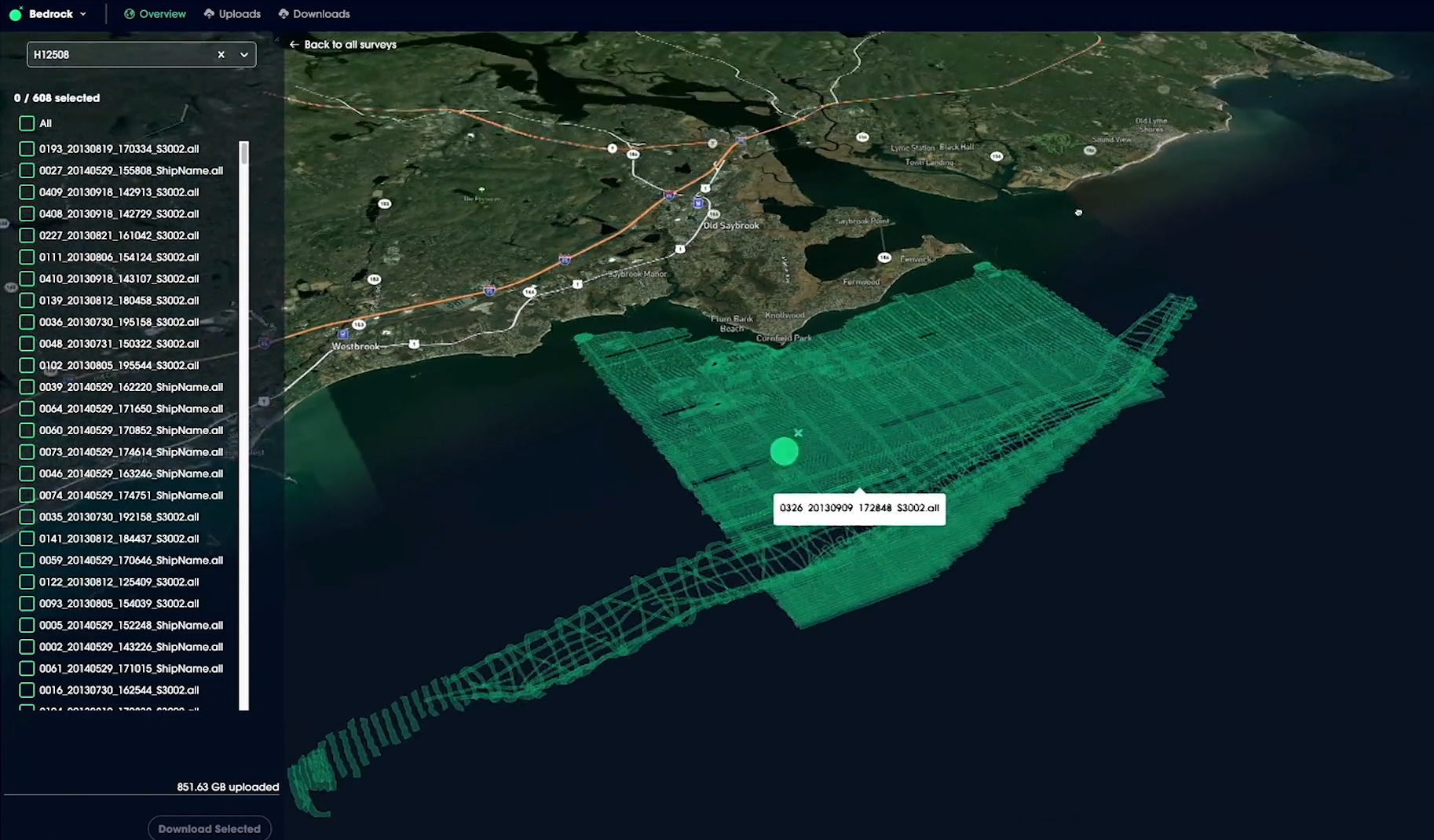
Example of data in the Mosaic system from Bedrock, showing a map and trails of data points.

Image Credits: Bedrock

“These datasets are extremely large, tens of terabytes in size,” said DiMare. “Typical cloud systems aren’t the best way to manage 20,000 sonar files.”

The current market is more focused on detailed, near-shore data than the deep sea, since there’s a crush to take part in the growing wind energy market. This means that data is collected much closer to ordinary internet infrastructure and can be handed off for cloud-based processing and storage more easily than before. That in turn means the data can be processed and provided faster, just in time for demand to take off.

As DiMare explained, while there may have been a seafloor survey done in the last couple decades of a potential installation site, that’s only the first step. An initial mapping pass might have be made to confirm the years-old maps and add detail, then another for permitting, for environmental assessments, engineering, construction, and regular inspections. If this could be done with a turnkey automated process that produced even better results than crewed ships for less money, it’s a huge win for customers relying on old methods. And if the industry grows as expected to require more active monitoring of the seafloor along every U.S. coast, it’s a win for Bedrock as well, naturally.

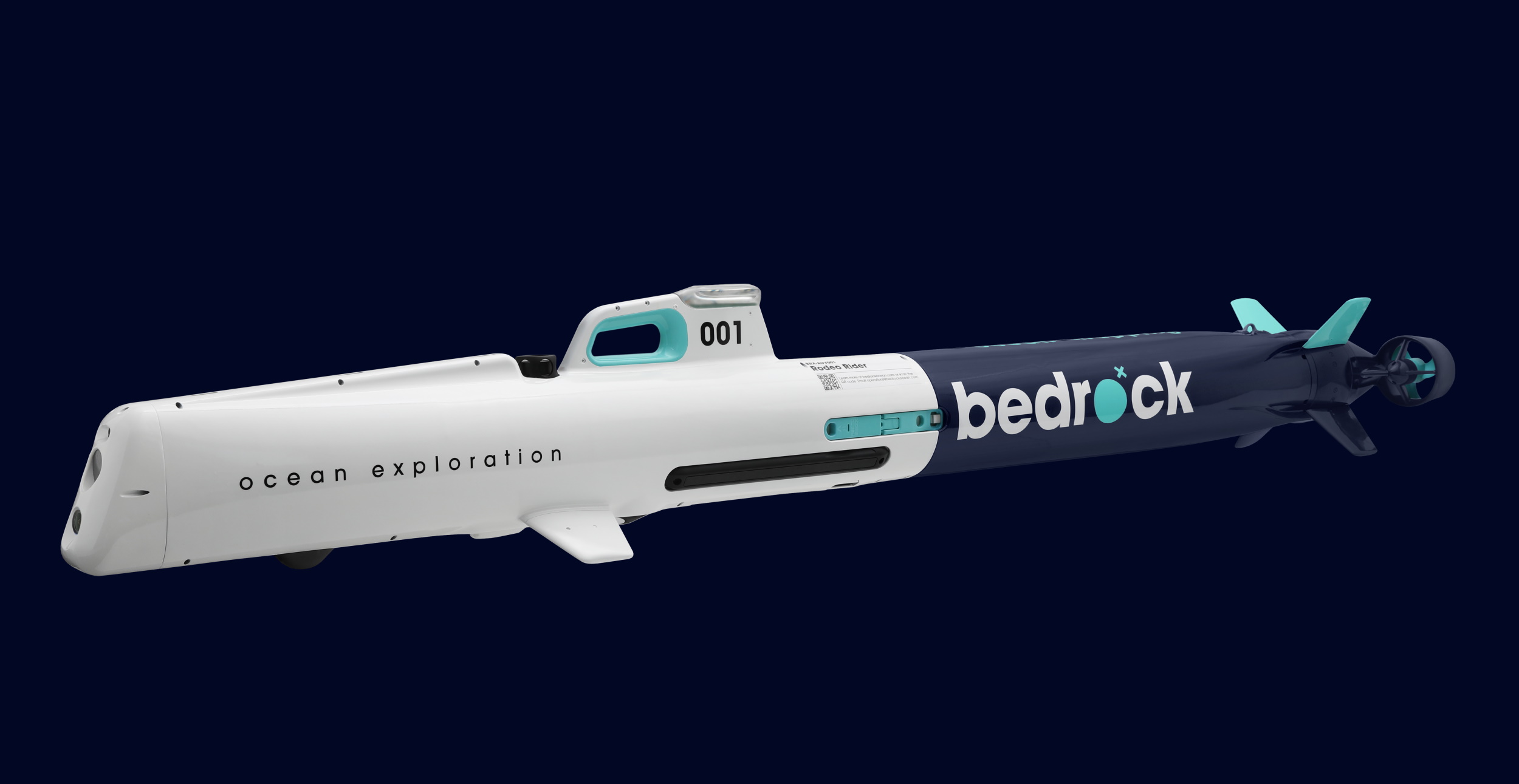
CG render of the AUV.

Image Credits: Bedrock

To make this all happen, of course, you need a craft that can collect the data in the first place. “The AUV is a piece of technology we built solely to enable a data product,” said DiMare, but noted that, originally, “we didn’t want to do this.”

“We started to spec out what it looked like to use an off the shelf system,” he explained. “But if you want to build a hyper-scalable, very efficient system to get the best cost per square meter, you need a very specific set of features, certain sonars, the compute stack… by the time we listed all those we basically had a self-designed system. It’s faster, it’s more operationally flexible, you get better data quality, and you can do it more reliably.”

And amazingly, it doesn’t even need a boat — you can grab it from the back of a van and launch it from a pier or beach.

“From the very beginning one of the restrictions we put on ourselves was ‘no boats.’ And we need to be able to fly with this thing. That totally changed our approach,” said DiMare.

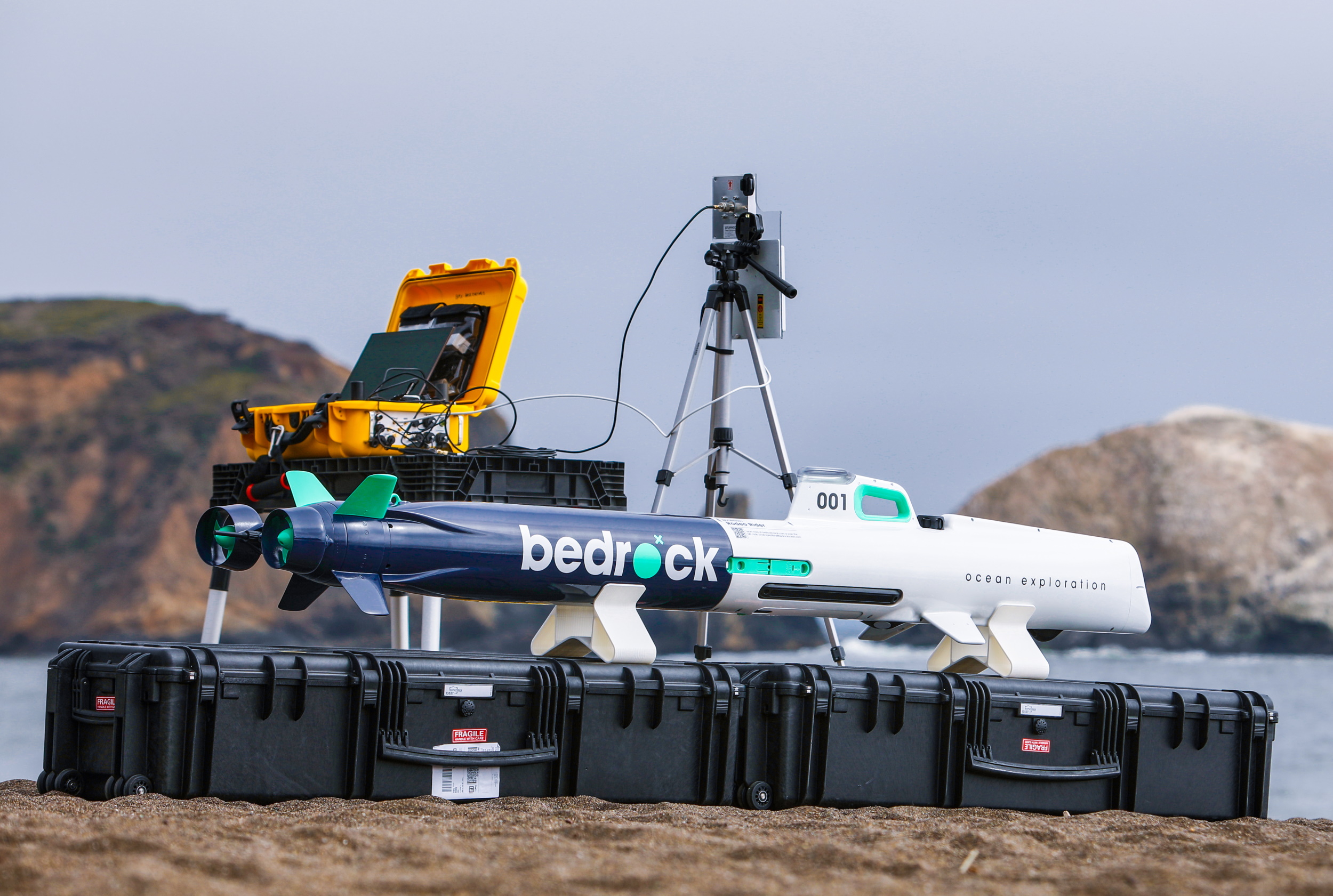
View of the AUV on a beach

Image Credits: Bedrock

The AUV packs a lot into a small package, and while the sensor loadout is variable depending on the job, one aspect that defines the craft is its high-frequency sonar.

Sonars operate in a wide range of frequencies, from the hundreds to the hundreds of thousands of hertz. Unfortunately that means that ocean-dwelling creatures, many of which can hear in that range, are inundated with background noise, sometimes to the point where it’s harmful or deters them from entering an area. Sonar operating about 200 kHz is safe for animals, but the high frequency means the signal attenuates more quickly, reducing the range to 50-75 meters.

That’s obviously worthless for a ship floating on the surface — much of what it needs to map is more than 75 meters deep. But if you could make a craft that always stayed within 50 meters of the seabed, it’s full of benefits. And that’s exactly what Bedrock’s AUV is designed to do.

The increased frequency of the sonar also means increased detail, so the picture its instruments paint is better than what you’d get with a larger wave. And because it’s safe to use around animals, you can skip the (very necessary but time-consuming) red tape at wildlife authorities. Better, faster, cheaper, and safer is a hell of a pitch.

Today marks the official launch of Mosaic, and to promote adoption Bedrock is offering 50 gigs of free storage — of any kind of compatible map data, since the platform is format-agnostic.

There’s a ton of data out there that’s technically “public” but is nevertheless very difficult to find and use. It may be a low-detail survey from two decades ago, or a hyper-specific scan of an area investigated by a research group, but if it were all in one place it would probably be a lot more useful, DiMare said.

“Ultimately we want to get where we can do the whole ocean on a yearly basis,” he concluded. “So we’ve got a lot of work to do.”