Month: August 2021

18 Aug 2021

Pakistan’s Airlift raises $85 million for its quick commerce startup, eyes international expansion

A one-year-old startup that is attempting to build the railroads for e-commerce in Pakistan has just secured a mega round in a major boost to the South Asia nation’s nascent startup ecosystem.

Airlift operates a quick commerce service in eight cities in Pakistan. Users can order groceries, other essential items including medicines and electronic products from Airlift website or app and have it delivered to them in 30 minutes.

The startup said on Wednesday that it has raised $85 million in its Series B financing round at a valuation of $275 million. Harry Stebbings of 20VC and Josh Buckley of Buckley Ventures co-led the financing round, by far the largest for a Pakistani startup.

Sam Altman, former president of Y Combinator, Biz Stone, co-founder of Twitter and Medium, Steve Pagliuca, co-chairman of Bain Capital, Jeffrey Katzenberg, ex-chief executive of Disney and Quibi, and Taavet Hinrikus, founder and chief executive of TransferWise also participated in the new round, which brings the startup’s to-date raise to $110 million.

Stanley Tang, co-founder of DoorDash, Simon Borrero, founder and chief executive of Rappi, Baastian Lehman, founder and chief executive of Postmates, Quiet Capital and Indus Valley Capital also participated in the new round.

Airlift started as a transit business, building a service similar to Uber for buses in Pakistan. The startup was already clocking over 35,000 rides a day before the pandemic arrived, disrupting all mobility in the country.

That’s when Usman Gul, the founder and chief executive of Airlift, took the call to pivot to quick commerce, he told TechCrunch in an interview.

“This entire space of quick commerce is on the brink of global transformation. Airlift is in the forefront for leading that transformation in Asia and Africa,” he said. Gul said he plans to expand the service to many international markets in the next few months.

Gul left his job at DoorDash and moved back to Pakistan to start Airlift. “The idea was to create impact at the base of the pyramid and solve problems that would enrich millions of lives — for whom change is desperately needed. That drove my transition frankly,” he said.

This is a developing story. More to follow…

18 Aug 2021

RaRa Delivery gets $3.25M for its ambitious on-demand delivery plans in Indonesia

RaRa Delivery’s ambitious goal is to offer same-day deliveries in Indonesia without burning cash like many on-demand logistics providers. The company announced today it has raised $3.25 million in seed funding led by Sequoia Capital India’s Surge program and East Ventures. Other participants included 500 Startups, Angel Central, GK Plug and Play and angel investors Royston Tay and Yang Bin Kwok.

Launched in 2019, RaRa Delivery relies on a proprietary engine that batches orders and optimizes delivery routes based on data like real-time traffic information. It currently operates in Greater Jakarta and is getting ready to expand into five other Indonesian cities this year.

RaRa Delivery’s goal is to integrate with all major marketplaces in Indonesia, so sellers can offer it as a delivery option to customers. It also partners with brands, small e-commerce businesses and seller aggregators. Some notable clients include e-commerce platform Blibli, coffee delivery startup Kopi Kenangan, Grab Merchant, healthcare platform Alodokter and grocery store Sayurbox. RaRa Delivery says its daily order volume has grown 15 times over the past year, due in part to increased demand for grocery and medical supply deliveries during the pandemic.

Before launching RaRa Delivery, co-founder and chief executive officer Karan Bhardwaj worked at Unilever, managing its e-commerce supply chain in Southeast Asia and Australasia. During that time, he dealt with many kinds of distribution channels, including marketplaces, e-commerce aggregators and last-mile delivery providers.

Over the past few years, Bhardwaj watched customer expectations for deliveries change. Many are no longer satisfied with even next-day delivery. They want their orders delivered the same day, often within a few hours.

“A good experience over time becomes a need rather than a luxury,” said Bhardwaj. The United States has Amazon Prime, China has courier service SF Express and South Korea has Coupang, but “same-day delivery adoption has not reached its true potential in Indonesia because of the lack of the right supply solution, and that’s exactly what we are trying to crack.”

Bhardwaj added that people are willing to pay two to three times more for same-day delivery versus next day delivery, and even higher fees for deliveries within an hour.

But many traditional logistics players, with their hub-and-spoke distribution models, are not designed for on-demand deliveries, while on-demand providers have high operational costs because their drivers fulfill one order per trip.

“If a business has 10 orders, they are going to send 10 drivers and everyone is going to pick up one order,” said Bhardwaj. “They can do a three-hour delivery service, but there is no consolidation, no optimization, the cost per order is very high, there distance limits, weight limits and they don’t offer cash on delivery.”

RaRa Delivery’s real-time batching engine was created as a more scalable and sustainable alternative. The company’s driver fleet fulfills orders for many different types of businesses—food and beverage, grocery, healthcare and e-commerce—which all have different time requirements for their deliveries. For example, a restaurant needs deliveries to happen within an hour, but for grocery stores that timeframe can be three hours, and for e-commerce stores, up to eight hours.

Once orders are made, RaRa Delivery’s system groups them into batches, optimizing capacity, distance, time slots and driving routes based on real-time traffic data. A batch can have between two to 15 orders, and their composition is flexible. For example, some batches might entail a series of pick-ups followed by deliveries, while others might have pick-ups interspersed with deliveries, depending on what creates the most efficient route.

Bhardwaj said this increases how much RaRa Delivery’s drivers can earn because they perform multiple deliveries per trip, and reduce their downtime. Each RaRa Delivery batch takes about two to six hours to complete.

“In a normal on-demand scenario, a driver takes an order, finishes that order and waits for another order. That waiting time is what reduces the potential earnings of a driver,” he said.

RaRa Delivery also enables cash on delivery. Typically, when a delivery service offers COD, that means drivers need to go back to a hub to drop off the money. RaRa Delivery’s reconciliation product shows drivers how much cash to collect for each order. Once they are done, it generates a code that the driver can use a convenience store to deposit the cash, instead of a hub.

The startup’s plans for its seed funding include expanding its product ecosystem, which currently includes the batching engine, a seller portal, real-time order tracking, a chatbot for customers and the COD reconciliation.

It’s focused on Tier 1 cities in Indonesia for its initial rollout, before expanding into smaller cities and covering all of Indonesia within a couple of years. Then RaRa Delivery plans to expand into other countries. Bhardwaj said its batching engine is geography-agnostic, so it requires minimal localization for new markets.


17 Aug 2021

South Korean online secondhand marketplace Danggeun Market raises $162M at a $2.7B valuation

Danggeun Market, the publisher of South Korea’s hyperlocal community app Karrot, announced on 18 August it has raised $162 million in a Series D round of funding with a valuation of $2.7 billion. (By the way, Danggeun means carrot in Korean.)

This round funding was led by DST Global, with additional participation from Aspex Management, Reverent Partners, and existing investors such as Goodwater Capital, Altos Ventures, SoftBank Ventures Asia, Kakao Ventures, Strong Ventures, and Capstone Partners.

The latest funding officially makes Danggeun Market a unicorn and the $205 million represents the final total fundraised.

The company plan to strengthen its capabilities in local commerce with Danggeun Pay, or Karrot Pay, which is set to launch this year, and Danggeun’s platform Karrot enables approximately 300,000 local SMBs partners to go digitalized by offering offline to online (O2O) service. Danggeun Market’s consumers access everything from fresh local produce delivery to essential services including cleaning, education, real estate brokerage, and used cars in their local communities.

The funding proceeds from the new round will be used for further global expansion, business diversification, R&D, investment in advanced artificial intelligence and machine learning technology, and recruiting team talent.

“Danggeun Market plans to focus on accelerating further overseas market expansion for the next two years after closing Series D funding, and in South Korea, we will diversify our business, aiming to be a super app,” co-founder and co-CEO Gary Kim said in an exclusive conversation with TechCrunch.

Danggeun Market, which is short for “the market in your neighborhood”, was founded by Gary Kim and Paul Kim in 2015.

Danggeun Market also plans to launch its payment service Karrot Pay, expand offline to online (O2O) service for South Korean SMEs that use its platform Karrot and invest to develop advanced artificial intelligence and machine learning in its platform for suggesting personalized feeds for users to stay longer, Kim continued.

Danggeun Market is expected to get approval from South Korea’s financial supervisory service (FSS) as early as September for two licenses such as payment gateway operator (PG) and prepaid payment means operator to launch Danggeun Market’s payment service, Karrot Pay, this year, Kim said.

Danggeun Market, which already launched its global version of hyperlocal community app Karrot in the U.K. in November 2019, currently operates the Karrot app in 72 local communities in 4 countries such as the U.K., the U.S., Canada, and Japan.

“We see some active transactions in Manchester, Birmingham, and Toronto,” Kim said. Danggeun Market launched Karrot in Canada and the U.S. in September and October 2020, respectively. In February 2021, it opened in Japan, Kim said.

When asked regarding the next foreign market location, “Danggeun Market will not designate a particular country this time. We will change our overseas penetration strategy slightly by opening the app Karrot globally and monitor the countries that show organic growth and then we will narrow down specific countries and cities to focus on more,” Kim said.

The company will still seek the high population density areas in foreign markets and keep the distance limit set, Danggeun’s unique feature, that only shows people listings from sellers located within 6km radius in South Korea and 10 miles (about 15km) maximum for the UK for providing hyperlocalized community service.

For the next round, Gary Kim said it depends on its global expansion growth. If its global business works well and Karrot draws more global users and reaches active MAU and transactions the company has set, Danggeun Market will definitely raise another funding in two years, Kim said. “We are not in a hurry for an IPO at this stage since we can raise enough capital in the private market now. We want to consider going public after we make stable profits,” Kim said.

Danggeun Market now claims its total registered users exceed 21 million (South Korea has a total of 20.92 million households) and has consistently experienced over 300 % year-on-year growth since 2018.

The company has reached 1.8 million monthly active users (MAUs) in 2019, 4.8 million MAUs in 2020, and finally increased to 14.2 million MAUs in 2021, growing 3x every year over the past three years. According to global app analytics platform AppAnnie, Danggeun Market users spend an average of 2hours and 2minutes per month on the app.

“Over the past few years, Danggeun Market has demonstrated overwhelming dominance in the Korean C2C market… with unique user behavior from location-based communities, Danggeun Market continues to showcase its potential as THE hyperlocal super app,” Managing Partner at DST Investment Management John Lindfors said.

“COVID-19 highlighted the importance of people wanting to connect to their neighbors and community. When meeting a friend for a simple coffee can no longer be taken for granted, we realize all the more importance of our relationships and community. Danggeun Market’s service bridges the offline and online world, enhancing both in-person interactions as well as purely digital ones. The core of Danggeun Market’s growth is its digital end-to-end platform that allows consumers to feel both genuinely part of their communities as well as have the comfort and safety of being part of a larger network that can grow together,” co-founder and Managing Partner at Goodwater Capital Eric Kim said.


17 Aug 2021

Taking consumer subscription software to the great outdoors

The pandemic has been extremely painful for many. But as lockdowns lifted and people began resuming their outdoor hobbies, mobile-first businesses have seen growth accelerate as consumers turned to digital tools to improve their time outdoors.

The Dyrt, for example, is the top camping app on the Apple and Google Play App Stores. The app sits at the confluence of two trends: An increased interest in outdoor recreation and travel, and an explosion in consumer subscription software (CSS).

The Dyrt launched its premium offering in 2019, The Dyrt PRO, in time to take advantage of the rising number of Americans making the great outdoors part of their lifestyle. A year later, it had a new subscriber every two minutes paying for features like offline maps and detailed camping information.

CSS businesses at the forefront of outdoor activities have closed major deals in recent years such as hunting app OnX (Summit Partners), hiking app Alltrails (Spectrum Equity), Surfline (The Chernin Group) and mountain bike leader Pinkbike (Outside Media). Companies like Netflix and Spotify have trained consumers to pay monthly or annual fees for software that enhances their lives, creating a business model investors view as reliable and poised for growth.

I think of different outdoor activities almost like individual genres on Netflix. Dominating camping or surfing might be like capturing the streaming market for comedy or horror.

Fitness and the outdoor passion space is one of the most exciting CSS categories in a growing landscape that includes everything from family planning/management services to entertainment and education. I believe CSS is still in the early stages of its growth — perhaps where B2B SaaS was a decade ago.

So what sets apart the great CSS businesses from the good ones?

Passion equals profits on the CSS flywheel

The beauty of the CSS model is the complete alignment between the business and its customers. CSS companies don’t have to please advertisers, and they can design purely for their users.

This dynamic is particularly powerful for CSS companies in the outdoors space, which make your favorite outdoor activity better with performance analytics and enhanced information such as maps, reviews, air quality reports and fire warnings. Consumers are happy to spend money on the activities and hobbies they enjoy, and CSS companies are able to make pleasing those consumers their top priority.

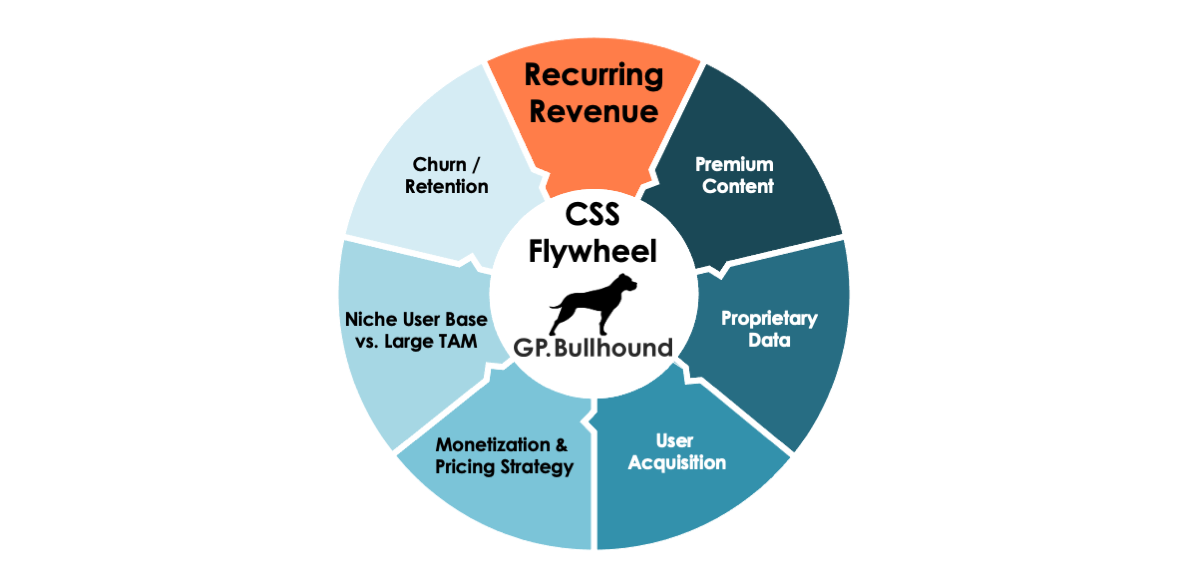
The result is what I call the CSS flywheel, in which a quality CSS product attracts and retains loyal users. Those users contribute their data through posts, photos and reviews, which creates a better product that further attracts new users, and so on.

The CSS flywheel shows the cycle that results when a quality CSS product attracts and retains loyal users.

The CSS flywheel shows the cycle that results when a quality CSS product attracts and retains loyal users. Image Credits: GP Bullhound

When companies get this flywheel right, it’s incredibly appealing to investors, because of the advantages of scale in CSS. Each niche will probably be dominated by one or two players, and a given niche can have tens of millions of consumers.

17 Aug 2021

Daily Crunch: Salesforce rolls out initial post-acquisition Slack integrations

To get a roundup of TechCrunch’s biggest and most important stories delivered to your inbox every day at 3 p.m. PDT, subscribe here.

Hello and welcome to Daily Crunch for August 17, 2021. Today we have what struck us as the most interesting collection of startup news in some time. And we’re keeping an international perspective, diving into Brazil’s IPO market and — see below — fintech industry, while also looking at what’s ahead for Nigeria’s burgeoning startup industry. (Africa is busy!)

Before we dive into all of the goodness, demo tables are now live for our October TC Sessions: SaaS 2021 event, and we’ve got big biotech plans for Disrupt. Now, the news. — Alex

The TechCrunch Top 3

  • Salesforce starts to integrate with Slack: As Ron Miller notes, we’ve known that SFDC has big plans for workplace chat app Slack. You don’t spend $28 billion without a plan (the deal wasn’t cheap). Today the CRM giant announced early integrations with Slack, which should be exciting to all you BigCorp denizens who use both tools. In the set of new tooling are things like “dedicated deal rooms,” which are like huddles, but for a particular sales effort.
  • Travel startups are fundable again: That’s the takeaway from news that Hopper, a startup that helps consumers book flights and hotel stays, raised $175 million in a new round that values the company at $3.5 billion. What about the COVID-19 resurgence that many markets are currently enduring? The startup’s products that facilitate more flexible travel are doing numbers, Hopper told TechCrunch.
  • Crypto exchanges are venture darlings: Today’s news that crypto trading platform Bitpanda has raised $263 million at a $4.1 billion valuation is merely part of a trend that TechCrunch has seen in recent weeks of crypto exchanges raising huge checks at high prices. What’s driving the trend? Coinbase’s simply enormous and very public success in recent quarters. Everyone wants to fund the next Coinbase.

Startups/VC

First up, TechCrunch has been covering the African startup market with much more focus in recent quarters, as you may have noticed. Sadly, per our own Tage Kene-Okafor, news from a key nation in the African tech scene is not good. New regulations that could land in Nigeria are more “concerning than friendly,” he writes.

  • OnlyFans markets SFW app: Sure, OnlyFans is known mostly for its adult content and monetization thereof, but there’s more to the service than just that. The company is pushing a porn-free app that is devoid of monetization to highlight content from its creators that you could watch at work. Let’s see how it performs.
  • Maven earns unicorn horn: On the back of a $110 million round co-led by Dragoneer Investment Group and Lux Capital, Maven is now a unicorn. The startup’s valuation is “a rare landmark moment for women’s health, and women-led startups more broadly,” Natasha Mascarenhas wrote for TechCrunch. Maven focuses on comprehensive women’s health support.
  • More on Brazil in a moment, but Nuvemshop is now worth $3.1 billion after raising $500 million in a single round. Nuvemshop is a Brazilian e-commerce company that is often likened to a Shopify for the region. Its latest round was co-led by Insight Partners and Tiger Global Management, TechCrunch reports.
  • Startup takes on space junk: The issue of space around our planet being full of, well, junk is being taken on by “Aurora Propulsion Technologies, a Finnish company that develops thrusters and de-orbiting modules for small satellites,” TechCrunch reports. Rocket Lab is handling the launch.
  • $50M for better feature flags: If you are building an application, you may want to test new features with a limited set of users. Feature flags can help you do just that. The tech is big enough business that Split.io just landed eight figures of capital to keep building its business.
  • Monte Carlo proves that the data market is more than just lakes: Data observability startup Monte Carlo just closed a $60 million round at four times the price that it raised its Series B earlier this year. The company has seen 8x ARR growth in the last year. The company is a reminder that for high-growth software, there is no limit to available capital in today’s market.
  • And because you’ve read this far, how about some robot pizzas?

What does Brazil’s new receivables regulation mean for fintechs?

The Brazilian Central Bank made a major reform to the way payments are processed that may throw the doors open for e-commerce in South America’s largest market.

Historically, merchants who accepted credit card payments had two options: Receive the full payment distributed over two to 12 installments, or offer a deep discount to receive a smaller sum up front.

But in June 2021, the BCB created new “registration entities” that permit “any interested receivables buyer/acquirer to make an offer for those receivables, forcing buyers to become more competitive in their discount offers,” says Leonardo Lanna, head of payment products at Monkey Exchange.

The new framework benefits consumers and sellers, but for the region’s startups, “it opens the door to a plethora of opportunities and new business models, from payments to credit.”

(Extra Crunch is our membership program, which helps founders and startup teams get ahead. You can sign up here.)

Big Tech Inc.

  • Apple has an effort called Impact Accelerator, and, according to TechCrunch reporting, the megacorp is working to “to find and elevate minority-owned small businesses taking on sustainability and climate change.” A first group of 15 participants has been selected. We have the details.
  • And to close out today’s news, a final Big Tech story, but in reverse. Remember when fintech companies were taking on banks? Well, now they are buying banks. Call it revenge of the startups.

TechCrunch Experts: Growth Marketing

Illustration montage based on education and knowledge in blue

Image Credits: SEAN GLADWELL (opens in a new window) / Getty Images

We’re reaching out to startup founders to tell us who they turn to when they want the most up-to-date growth marketing practices. Fill out the survey here.

Read one of the testimonials we’ve received below!

Marketer: Jack Abramowitz

Recommended by: Frida Leibowitz, Debbie

Testimonial: “Jack is personable, sharp and overall a super helpful guy. He genuinely wanted to help and started adding value before we even formalized our relationship. Whether it’s making useful intros or getting into the nitty-gritty details of campaign strategies, he rolls up his sleeves and gets right in the trenches together with the team. He has really treated our project as his own.”

Community

Join Danny Crichton on Thursday, August 19, at 2 p.m. PDT/5 p.m. EDT for a Twitter Spaces interview with Sukhinder Singh Cassidy, author of “Choose Possibility: Take Risks and Thrive (Even When You Fail).”

17 Aug 2021

Extra Crunch roundup: The Nuro EC-1, early-stage growth tactics, understanding Salesforce+

In 2010, Google’s autonomous vehicle project placed self-driving cars on Bay Area streets and freeways, but practical applications were thought to be at least a decade away.

The futurists were right on schedule: In 2020, Mountain View-based Nuro was testing its second-generation R2 robotic vehicle, the first to earn a federal exemption to operate an autonomous vehicle.

But before Nuro could even consider reaching product-market fit, its founders had to overcome technological challenges, win over regulators and strike partnerships with a range of consumer-facing companies.

“Neither JZ nor I think of ourselves as classic entrepreneurs or that starting a company is something we had to do in our lives,” says co-founder Dave Ferguson. “It was much more the result of soul searching and trying to figure out what is the biggest possible impact that we could have.”


Full Extra Crunch articles are only available to members.
Use discount code ECFriday to save 20% off a one- or two-year subscription.


Across four articles, reporter Mark Harris (The Guardian, Wired, MIT Technology Review) explores Nuro’s origins and operations, including the founders’ decision to focus on creating autonomous delivery vehicles instead of entering the passenger EV market.

I’ve lived inside the San Francisco Bay Area bubble for most of my adult life, so it’s interesting to see how people in Houston’s Woodland Heights neighborhood react to seeing Nuro’s R2 delivering pizza and prescriptions on a limited basis.

As one Redditor recently posted in r/houston: “With these self-driving cars, it’s only a matter of time before a country song is written about a guy’s truck leaving him.”

Part 1: How Google’s self-driving car project accidentally spawned its robotic delivery rival

Part 2: Why regulators love Nuro’s self-driving delivery vehicles

Part 3: How Nuro became the robotic face of Domino’s

Part 4: Here’s what the inevitable friendly neighborhood robot invasion looks like

Thanks very much for reading Extra Crunch!

Walter Thompson
Senior Editor, TechCrunch
@yourprotagonist

Why fintechs are buying up legacy financial services companies

Image of a bank vault.

Image Credits: Peter Dazeley (opens in a new window) / Getty Images

Why bother to beat the competition when you can buy them outright?

“It used to be that if you were a fintech startup or, for lack of a better term, a digitally native financial services business, you might be eyeing an acquisition from an incumbent in the industry,” Ryan Lawler writes.

“But lately, fintech upstarts are the ones doing the acquiring.”

Growth tactics that will jump-start your customer base

Image of a megaphone on a pink background with colorful balls in the air to represent marketing.

Image Credits: Jasmin Merdan (opens in a new window) / Getty Images

“With audiences spread out over so many platforms, reaching cult status requires some level of hacking,” Jenny Wang, a principal investor at Neo, writes in a guest column.

Covering everything from collecting user-generated content to launching splashy guerrilla marketing strategies that can take advantage of someone else’s events, she shares several growth tactics for startups, plus the metrics required to track their success.

There could be more to the Salesforce+ video streaming service than meets the eye

Behind the scenes of video recording or filming online movie by 8K high definition digital camera and professional monitor. And flare lighting set up with film crew team in the studio production.

Image Credits: ppengcreative / Getty Images

Salesforce announced last week that it plans to launch a video streaming service.

The industry analysts who enterprise reporter Ron Miller interviewed said the initiative has tremendous potential, but one noted that Salesforce will have to dig deep to compete in today’s crowded media landscape.

Salesforce hasn’t released details on the type of programming it plans to offer, but given its vast and diverse customer base, its options are many. Said Brent Leary of CRM Essentials:

“A customer could sponsor a show, advertise a show or possibly collaborate on a show. And have leads generated from the show [which could be] directly tied to the activity from those options and track ROI. And it’s all done on one platform. And the content lives on with ads living on with them.”

More companies should shift to a work-from-home model

An orange tabby kitten rests his paw on a hand as a person works from home

Image Credits: Ann Schwede (opens in a new window) / Getty Images

Karl Laughton, president and COO of Insightly, offers best practices for companies looking to make the move to a remote model.

“Employers are at a crucial crossroads when it comes to deciding where and how to let employers do their jobs,” he writes in a guest column. “There are those who will adopt the work-from-anywhere model and those who resist it.

“Those who resist it will likely struggle to keep employees.”

Early-stage benchmarks for young cybersecurity companies

3D illustration of a conceptual maze.

Image Credits: Getty Images under a Olivier Le Moal (opens in a new window) license.

YL Ventures’ Yoav Leitersdorf and Michael Cortez lay out a roadmap for founders of early-stage cybersecurity companies that are heading toward unicorn status.

“The early days of any young startup decide how successful it can be, which is why we’ve developed a focused, value-add program to support cybersecurity founders during this most critical stage and maximize their potential in building market-leading companies,” they write in a guest column.

“It’s never too early to think big, and, with the right support, launch the next industry titan.”

The hyperactive late-stage market should keep the startup investing game afoot

Alex Wilhelm considers last week’s funding news from Carta, Chime and Discord and noodles on what the recent rounds mean for startups.

“Understanding why investors are so willing to buy minute stakes in dozens of private companies worth billions of dollars is key to grokking the crush of investment we see among younger technology startups.”

17 Aug 2021

YouTube upgrades search with chapter previews and better recommendations for translated videos

YouTube announced two feature updates today to make it easier for people to find the content they’re looking for on the platform. This includes visual search features and easier discovery of foreign language videos that have captions in the user’s local language.

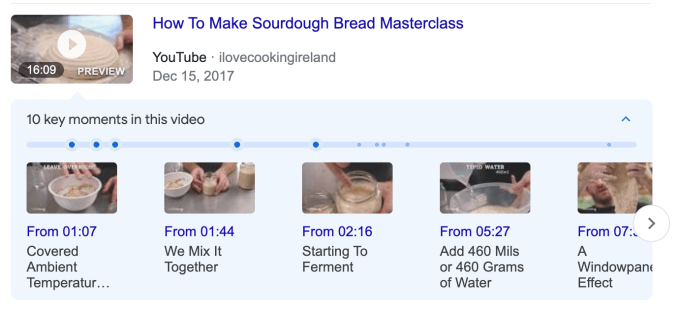
On desktop, YouTube users can hover over a video’s thumbnail and watch a brief clip play. This functionality will now extend to mobile with the added ability to browse the chapters within a video. From the search page, users can jump directly to the chapter they’re most interested in.

chapters appear in youtube search

“Let’s say you’re looking for a good sourdough recipe and want to work on your kneading technique. With these new search results, you can see all the steps in the video, from feeding the starter to pulling the bread out of the oven — and skip right to the chapter on kneading,” wrote Pablo Paniagua, Director of Product Management, in a blog post.

The other product update recommends videos in other languages to the user, so long as the video has captioning available in their language. So, to extend YouTube’s sourdough example, if you speak Icelandic and can’t find a good sourdough tutorial in your language, YouTube might recommend an English-language tutorial with Icelandic subtitles. To start, YouTube will supplement search results with English-language videos, but it plans to expand to more languages.

an example of non-native language subtitles on a video

Image Credits: YouTube

In India and Indonesia, YouTube is also testing a feature to complement search results with links to other sites from Google Search.

“Not all searches may have enough high-quality or relevant video content to fully address what you’re looking for,” Panaigua explained.

Google Search already had a feature that let users skip to select moments in a video. Even late last year, Google (parent company to YouTube) experimented with a mobile search feature that would recommend short-form videos from TikTok and Instagram. But, the video would open within the search engine to keep users on Google, rather than opening the TikTok or Instagram apps.

Image Credits: YouTube (screenshot by TechCrunch)

These updates to YouTube’s search feature emerge in the midst of ongoing controversy around the platform’s search algorithm. Last month, Mozilla published research suggesting that YouTube’s algorithm continued to promote “bottom-feeding” content. Mozilla crowd-sourced data from participants who used a browser extension called RegretsReporter, which asks users to self-report YouTube videos they wish they didn’t watch. Mozilla found that YouTube regrets were 60% higher in countries where English isn’t the primary language. Still, a representative from YouTube said that features that might potentially mitigate this — for example, recommending foreign videos with local language captions — were not developed in response to the Mozilla report.

“Our teams have been working on these features for months with the goal of helping users find what they’re looking for, from how-tos to DIYs,” a spokesperson from YouTube said.

17 Aug 2021

Fortnite adds a new mode that’s basically Among Us

Fortnite now boasts its own version of one of the pandemic’s hottest games.

Fortnite-maker Epic just introduced into the game a new limited-time mode called Impostors; it follows the hit format that sent Among Us to Twitch’s front page — and Congress — during the pandemic’s earlier days.

Up to 10 people can play the new Impostors game mode simultaneously, divided into two competing factions: agents and… impostors. Eight agents work to complete tasks around the new map before the two impostors can sabotage their efforts by eliminating agents and undoing their work. And because it’s Fortnite, you can also teleport players randomly around the map and turn everyone into a banana.

The game takes place in a new interior map location that properly conjures the claustrophobic paranoia that makes the social deception-style game intense to play and fun to watch. During each round, the players come together to vote on who they think is secretly working against the agents, which generally leads to a lot of spicy conversation. Players can stick with a smaller group (by picking the private game mode) if they’d like to keep things intimate.

Happily, you can still try it out if you don’t have a group of friends to play with, though this kind of game works best with people you know. While public voice chat is off in the new mode, players in open matches can communicate through a quick chat box and the game’s emotes to vote on who they think has infiltrated the group.

It’s too early to say if Fortnite’s Among Us clone will take off in the same way as the game that inspired it, or how long it’ll stick around. But considering that Fortnite is still one of the most popular games in the world, a new hit whodunnit game mode that’s eminently streamable is just icing on the cake.

17 Aug 2021

Insider hacks to streamline your SOC 3 certification application

If you’re a tech company offering anyone a service, somewhere in your future is a security assessment giving you the seal of approval to manage clients’ data and operate on your devices. No one takes security lightly anymore. The business costs of cyberattacks have now hit an all-time high. Government bodies, companies and consumers need the assurance that the next software they download isn’t going to be an open door for hackers.

For good reason, security certifications like the SOC 3 really put you through the wringer. My company, Waydev, has just attained the SOC 3 certification, becoming one of the first development analytics tools to receive that accreditation. We learned so much from the process, we felt it was right to share our experience with others that might be daunted by the prospect.

As a non-tech founder, it was hard not only to navigate the process, but to appreciate its value. But by putting our business caps on, our team was able to optimize our approach and minimize the time and effort needed to achieve our goal. In doing so, we were granted SOC 3 compliance in two weeks, as opposed to the two months it takes some companies.

We also turned the assessment into an opportunity to better our product, align our internal teams, boost our brand and even launch partnerships.

So here’s our advice on how teams can smoothly reach an SOC 3 while simultaneously balancing workloads and minimizing disruption to users.

First, bring your teams on board

Because we can’t expect employees to stack those hours on top of their regular workdays, as a leader you have to accept — and communicate — that the speed of your output will inevitably decrease.

As a founder, you’ll be acting as captain steering a ship into that SOC 3 port, and you’ll need all members of your crew to join forces. This isn’t a job for a specially designated security team alone and will require deep involvement from your development and other teams, too. That might lead to internal resistance, as they still have a full-time job tending to your product and customers.

That’s why it’s so important to start by being crystal clear with your employees about what this process will mean to their work lives. However, they have to embrace the true benefits that will arise. SOC 3 will immediately raise your brand’s appeal and likely see new customers come in as a result.

Each employee will also come out the other end with well-honed cybersecurity skills — they’ll have a deep understanding of potential cyber threats to the company, and all security initiatives will carry a far lighter burden. There’s also the sense of pride and fulfillment that comes with having an indisputable edge over your competitors.

17 Aug 2021

Insider hacks to streamline your SOC 3 certification application

If you’re a tech company offering anyone a service, somewhere in your future is a security assessment giving you the seal of approval to manage clients’ data and operate on your devices. No one takes security lightly anymore. The business costs of cyberattacks have now hit an all-time high. Government bodies, companies and consumers need the assurance that the next software they download isn’t going to be an open door for hackers.

For good reason, security certifications like the SOC 3 really put you through the wringer. My company, Waydev, has just attained the SOC 3 certification, becoming one of the first development analytics tools to receive that accreditation. We learned so much from the process, we felt it was right to share our experience with others that might be daunted by the prospect.

As a non-tech founder, it was hard not only to navigate the process, but to appreciate its value. But by putting our business caps on, our team was able to optimize our approach and minimize the time and effort needed to achieve our goal. In doing so, we were granted SOC 3 compliance in two weeks, as opposed to the two months it takes some companies.

We also turned the assessment into an opportunity to better our product, align our internal teams, boost our brand and even launch partnerships.

So here’s our advice on how teams can smoothly reach an SOC 3 while simultaneously balancing workloads and minimizing disruption to users.

First, bring your teams on board

Because we can’t expect employees to stack those hours on top of their regular workdays, as a leader you have to accept — and communicate — that the speed of your output will inevitably decrease.

As a founder, you’ll be acting as captain steering a ship into that SOC 3 port, and you’ll need all members of your crew to join forces. This isn’t a job for a specially designated security team alone and will require deep involvement from your development and other teams, too. That might lead to internal resistance, as they still have a full-time job tending to your product and customers.

That’s why it’s so important to start by being crystal clear with your employees about what this process will mean to their work lives. However, they have to embrace the true benefits that will arise. SOC 3 will immediately raise your brand’s appeal and likely see new customers come in as a result.

Each employee will also come out the other end with well-honed cybersecurity skills — they’ll have a deep understanding of potential cyber threats to the company, and all security initiatives will carry a far lighter burden. There’s also the sense of pride and fulfillment that comes with having an indisputable edge over your competitors.