Month: August 2021

16 Aug 2021

How Nuro became the robotic face of Domino’s

Pandemic pizza was definitely a thing.

U.S. consumers forked out a record-breaking $14 billion to have pizza delivered to their doors in 2020, and nearly half of that total was spent with just one brand: Domino’s.

“Domino’s is the home of pizza delivery,” said Dennis Maloney, Domino’s chief innovation officer. “Delivery is at the core of who we are, so it’s very important for us to lead when it comes to the consumer experience of delivery.”

U.S. consumers forked out a record-breaking $14 billion to have pizza delivered to their doors in 2020, and nearly half of that total was spent with just one brand: Domino’s.

In its latest TV ad, an order of Domino’s pizza speeds to its destination inside a Nuro R2X delivery autonomous vehicle (AV). The R2X (now known as R2) deftly avoids potholes, falling trees and traffic jams caused by The Noid — a character created by Domino’s in the 1980s to symbolize the difficulties of delivering a pizza in 30 minutes or less.

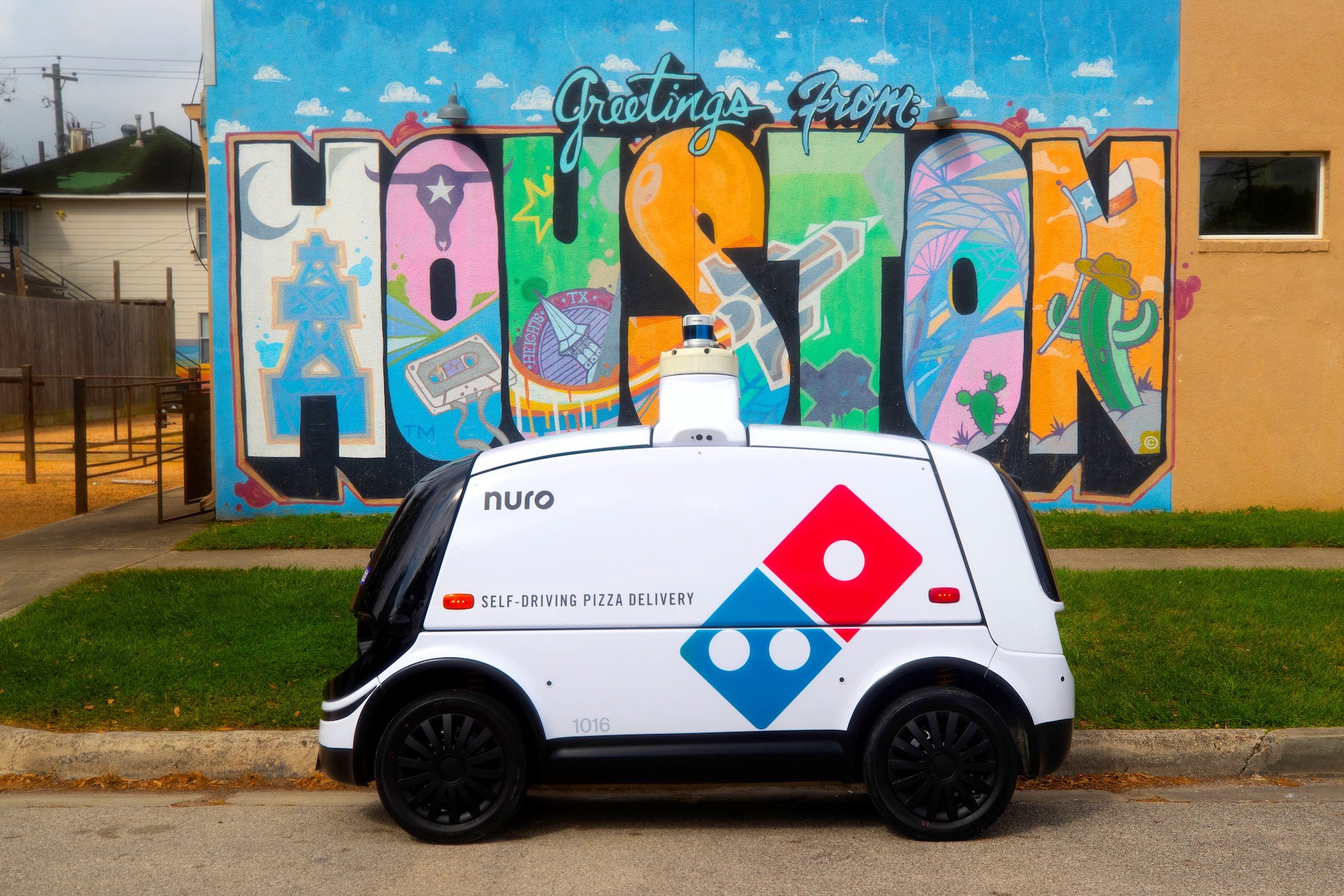
The reality is much more sedate. Domino’s currently has just one R2X that operates from a single Domino’s store on the generally calm streets of Woodland Heights in Houston, Texas. And since the AV’s introduction in April, The Noid has yet to put in an appearance.

“The R2X adds a bunch of efficiencies while not taking away from any existing capabilities,” Maloney said. “As we start getting the bot into regular operation, we’ll see if it plays out the way we expect it to. So far, all the indications are good.”
Nuro-Domino

Nuro and Domnio’s launched the autonomous pizza delivery service in Huston in April this year. Image Credits: Nuro

Partnerships are key for Nuro. The company’s business model is to sign contracts with established brands that either have their own branded vehicles or use traditional delivery companies like UPS or the U.S. Postal Service.

Nuro is carrying out trials and pilot deliveries with a number of companies, including fast casual restaurant chain Chipotle, Kroger grocery stores, CVS pharmacies, bricks-and-mortar retail behemoth Walmart, and, most recently, global parcel courier FedEx. While it is a dizzyingly impressive list for a company less than five years old, their interest was driven as much by global trends as by Nuro’s technology, admits Cosimo Leipold, head of partnerships at Nuro.

“Everybody today wants what they want and they want it faster than ever, but frankly they’re not willing to pay for it,” Leipold said. “We’ve reached a point where almost every company is going to have to offer delivery services, and now it’s just the question of how they’ll do it in the best possible way and with the most possible control.”

Nuro’s delivery AVs — aka bots — offer the tantalizing promise of safe, reliable and efficient delivery without sacrificing revenue and customer data to third-party platforms like Grubhub, DoorDash or Instacart. Alongside Nuro’s stated aim of driving the cost of delivery down to zero, it is little surprise that Nuro now finds itself in the enviable position of being able to pick and choose the partners it wants — and the less enviable position of having to choose which partner to prioritize.

Here’s the story of how one of Nuro’s biggest partnerships came to be, and the lessons and companies that will drive its future growth.

Deliveries with extra cheese

Domino’s has a long history of innovating in delivery, usually accompanied by a strong marketing campaign. In the 1980s, the company bought 10 customized Tritan Aerocar 2s, a Jetsons-styled three-wheeler, for use as delivery vehicles. In 2015, the company unveiled the DXP, a Chevrolet Spark modified with a single seat and a built-in warming oven, designed specifically for transporting pizza.

16 Aug 2021

Here’s what the inevitable friendly neighborhood robot invasion looks like

In early 2021, a Nuro autonomous delivery vehicle pulled to a halt at a four-way stop in its hometown of Mountain View, California to let a user cross. This seemingly humdrum moment quickly looked like a decidedly science fiction storyline — the user was a small sidewalk robot from another startup on its own mission.

“Obviously, we yielded to it, but it was, wow, we have entered a different world,” said Amy Jones Satrom, head of Operations at Nuro.

Mountain View is home to competitor Waymo and other autonomous vehicle testing activity. But for those who want to take part in that science fiction scene, Houston provides the full experience.

Nuro’s operations team has to delicately balance speed, safety, convenience and congestion, even as the company embarks on a growth spurt that will see robots spreading to other cities, states and partners in the months ahead.

Waymo is testing self-driving trucks in Houston, and a fully driverless shuttle service is due to start public service there early next year. Nuro’s Texas effort started in April, when an R2 robot began its commercial pizza delivery service in partnership with Domino’s. Some customers ordering pizzas from the Domino’s Woodland Heights store will see the option to have their pies delivered by robot.

Customers can trace the progress of the self-driving vehicle on the Domino’s app and, when it pulls up outside their home, tap in a unique PIN on its touchscreen to access their order. Nuro is also operating in Houston with Kroger supermarkets and FedEx.

Nuro-validation test

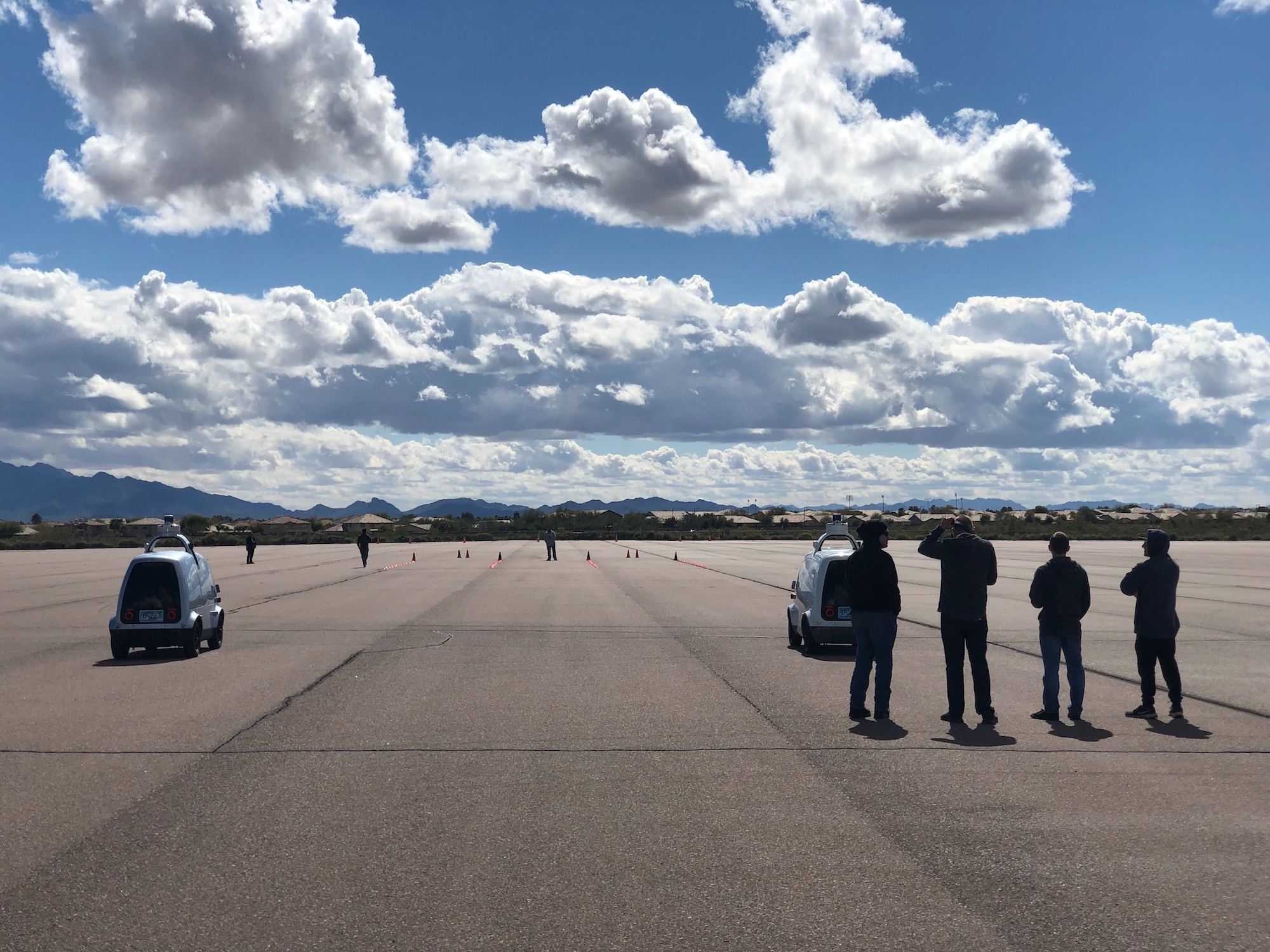
Nuro team on test track during early validation in AZ, before first ever public road deployment in Arizona. Image credit: Nuro

“One of the things we laugh about is how customers constantly talk to the bot,” Dennis Maloney, Domino’s chief innovation pfficer said. “It’s almost like they think it’s ‘Knight Rider.’ It’s very common for customers to thank it or say goodbye, which is great because that indicates we’re creating an engaging experience that they’re not frustrated by.”

Creating an experience, where people want to chat with their new robot neighbors instead of chasing them down the street with pitchforks, falls to Jones Satrom’s operations team. It has to delicately balance speed, safety, convenience and congestion, even as Nuro embarks on a growth spurt that will see robots spreading to other cities, states and partners in the months ahead.

Here’s how it manages that, and what the future holds for Nuro’s ever-so-gentle robot invasion.

Mapping the territory

Few people are as well suited to overseeing Nuro’s high-stakes robot rollout as Jones Satrom, who started her career as a nuclear engineer on an aircraft carrier and previously managed the integration of Kiva Systems’ robots into Amazon’s warehouses.

16 Aug 2021

The hyperactive late-stage market should keep the startup investing game afoot

As last week came to a close, funding news involving three major U.S. technology startups lit up on Twitter.

Carta closed a $500 million Series G at a $7.4 billion price tag. Chime put together a $750 million round at a $25 billion valuation. And Discord was reported to be hunting up new cash that would value it at around $15 billion.


The Exchange explores startups, markets and money.

Read it every morning on Extra Crunch or get The Exchange newsletter every Saturday.


Each funding round has something special about it that we need to discuss. Why? Because while it’s well-known that the unicorn market is crowded — reaching a $1 billion valuation in today’s capital-flush markets is no longer particularly rare for startups — the number of startups worth a multiple of that valuation threshold is growing rapidly. And understanding why investors are so willing to buy minute stakes in dozens of private companies worth billions of dollars is key to grokking the crush of investment we see among younger technology startups.

To make the point, CB Insights’ unicorn leaderboard lists 55 companies with valuations of $7.5 billion or more. That’s nearly five dozen companies worth more than Carta after its most recent round. According to the list, 38 of today’s unicorns are worth $10 billion or more.

The 55 startups valued at $7.5 billion and more are worth more than $1 trillion in aggregate, while the 38 decacorns are worth more than $900 billion when counted as a group.

We’ve become too accustomed to simply reading the latest nine-figure round invested at an 11-figure price and shrugging. So, this morning, let’s talk about Carta and Chime and Discord and why each of them may have managed their latest, or anticipated, valuation gain.

When we talk about unicorns, we’re simply discussing a generally growth-oriented cohort of technology upstarts. But once a startup reaches closer to the $10 billion valuation threshold, we’re really talking about ducks increasingly too big for their pond. They are the next set of IPOs both domestically and abroad.

16 Aug 2021

Cisco beefing up app monitoring portfolio with acquisition of Epsagon for $500M

Cisco announced on Friday that it’s acquiring Israeli applications monitoring startup Epsagon at a price pegged at $500 million. The purchase gives Cisco a more modern microservices-focused component for its growing applications monitoring portfolio.

The Israeli business publication Globes reported it had gotten confirmation from Cisco that the deal was for $500 million. TechCrunch has asked Cisco for comment on that figure.

The acquisition comes on top of a couple other high profile app monitoring deals including AppDynamics, which the company bought in 2018 for $3.7 billion and ThousandEyes, which it nabbed last year for $1 billion.

With Epsagon, the company is getting a way to monitor more modern applications built with containers and Kubernetes. Epsagon’s value proposition is a solution built from the ground up to monitor these kinds of workloads, giving users tracing and metrics, something that’s not always easy to do given the ephemeral nature of containers.

As Cisco’s Liz Centoni wrote in a blog post announcing the deal, Epsagon adds to the company’s concept of a full-stack offering in their applications monitoring portfolio. Instead of having a bunch of different applications monitoring tools for different tasks, the company envisions one that works together.

“Cisco’s approach to full-stack observability gives our customers the ability to move beyond just monitoring to a paradigm that delivers shared context across teams and enables our customers to deliver exceptional digital experiences, optimize for cost, security and performance and maximize digital business revenue,” Centoni wrote.

That experience point is particularly important because when an application isn’t working, it isn’t happening in a vacuum. It has a cascading impact across the company, possibly affecting the core business itself and certainly causing customer distress, which could put pressure on customer service to field complaints, and the site reliability team to fix it. In the worst case, it could result in customer loss and an injured reputation.

If the application monitoring system can act as an early warning system, it could help prevent the site or application from going down in the first place, and when it does go down, help track the root cause to get it up and running more quickly.

The challenge here for Cisco is incorporating Epsagon into the existing components of the application monitoring portfolio and delivering that unified monitoring experience without making it feel like a Frankenstein’s monster of a solution globbed together from the various pieces.

Epsagon launched in 2018 and has raised $30 million. According to a report in the Israeli publication, Calcalist, the company was on the verge of a big Series B round with a valuation in the range of $200 million when it accepted this offer. It certainly seems to have given its early investors a good return. The deal is expected to close later this year.

16 Aug 2021

How one founder identified a gap in education working as a teacher and built a startup to fix it

Amanda DoAmaral was an educator herself before she decided to found a tech company aimed at improving the education system. That’s a surprisingly rare credential for a startup founder in this area to possess — despite the obvious benefits of real, first-hand experience. Her company, Fiveable, focuses on modernizing (including a remote-first approach) a key and often overlooked part of education for students: Building an active community of peers to share knowledge with. Hear how she took her dissatisfaction with an inadequate system and turned that into the motivation to build a venture-scale business outside of it on this week’s episode of Found.

We talked to Amanda about her path to entrepreneurship, which is not your typical founder story, despite her experience living and teaching in the Bay Area. Amanda shares how her considerable experience in education, both in terms of her own education, as well as her job as a teacher, led her to the frustrating realization that while tech had a lot to offer kids in school, the system just wasn’t set up to support that or make it happen. Building a company that focused on a particularly underserved aspect of remote learning ended up being the best path forward — and it just so happened that the market Fiveable entered would accelerate dramatically shortly after the company’s founding due to the Covid-19 pandemic.

We loved our time chatting with Amanda, and we hope you love yours listening to the episode. And of course, we’d love if you can subscribe to Found in Apple Podcasts, on Spotify, on Google Podcasts or in your podcast app of choice. Please leave us a review and let us know what you think, or send us direct feedback either on Twitter or via email at found@techcrunch.com, or leave us a voicemail at (510) 936-1618. And please join us again next week for our next featured founder.

16 Aug 2021

Facebook adds four new branches to its 2Africa subsea cable network

Facebook today announced that it would extend the “most comprehensive” subsea cable to serve the African continent and Middle East region to four more branches.

Facebook will do this in collaboration with the 2Africa consortium that includes China Mobile International, MTN GlobalConnect, Orange, STC, Telecom Egypt, Vodafone, and WIOCC.

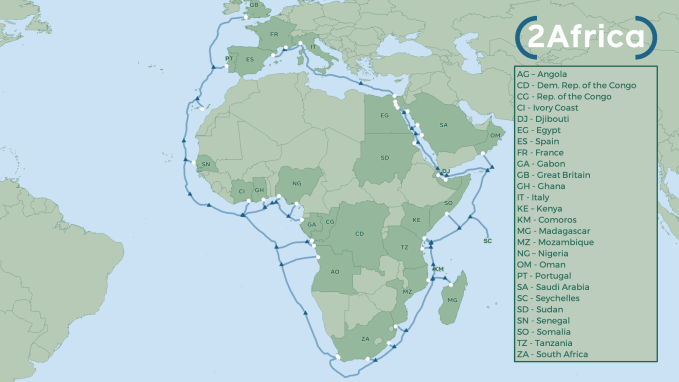
The new branches are Seychelles, the Comoros Islands, Angola, and the south-eastern part of Nigeria. They join the recently announced extension to the Canary Islands.

Last year, Facebook announced the 2Africa project to lay 37,000 km (22,990 miles) of cables. These cables interconnect Europe, via Egypt, and the Middle East, via Saudi Arabia, and 21 landings in 16 African countries.

At the time, the involved parties said the 2Africa project would be completed either by 2023 or early 2024. And once live, 2Africa should be able to serve more than the total combined capacity of all subsea cables serving Africa at the moment. 

2Africa

Image Credits: 2Africa

According to the company’s new statement released by the consortium, the plan is still to go live in late 2023. The consortium says 2Africa has made some progress as a big part of the subsea route survey activity is complete. The Egypt and Mediterranean Seas connections are almost complete as well, the statement read. In addition, the marine surveys for the new sections are scheduled to be completed by the end of this year.  

The consortium selected Nokia’s Alcatel Submarine Networks (ASN) to build the new branches, bringing 2Africa landings to 35 in 26 countries. 

“The significant investment by Facebook in 2Africa builds on several other investments we have made in the continent, including infrastructure investments in South Africa, Uganda, Nigeria, and DRC.  The COVID-19 pandemic has highlighted the importance of connectivity as billions of people around the world rely on the internet to work, attend school, and stay connected to the people they care about,” a Facebook spokesperson said regarding the company’s continued investment in Africa.

“2Africa will not only be an important element for advancing connectivity infrastructure across the African continent, but it will also be a major investment that comes at a critical time for economic recovery. With more and more people relying on the internet, subsea cables are a vital ingredient to ensure they always are connected to what matters. While Facebook invests in submarine cables to provide better experiences for people using our products, our investments drive a more cost-effective internet for all.” 

16 Aug 2021

Facebook adds four new branches to its 2Africa subsea cable network

Facebook today announced that it would extend the “most comprehensive” subsea cable to serve the African continent and Middle East region to four more branches.

Facebook will do this in collaboration with the 2Africa consortium that includes China Mobile International, MTN GlobalConnect, Orange, STC, Telecom Egypt, Vodafone, and WIOCC.

The new branches are Seychelles, the Comoros Islands, Angola, and the south-eastern part of Nigeria. They join the recently announced extension to the Canary Islands.

Last year, Facebook announced the 2Africa project to lay 37,000 km (22,990 miles) of cables. These cables interconnect Europe, via Egypt, and the Middle East, via Saudi Arabia, and 21 landings in 16 African countries.

At the time, the involved parties said the 2Africa project would be completed either by 2023 or early 2024. And once live, 2Africa should be able to serve more than the total combined capacity of all subsea cables serving Africa at the moment. 

2Africa

Image Credits: 2Africa

According to the company’s new statement released by the consortium, the plan is still to go live in late 2023. The consortium says 2Africa has made some progress as a big part of the subsea route survey activity is complete. The Egypt and Mediterranean Seas connections are almost complete as well, the statement read. In addition, the marine surveys for the new sections are scheduled to be completed by the end of this year.  

The consortium selected Nokia’s Alcatel Submarine Networks (ASN) to build the new branches, bringing 2Africa landings to 35 in 26 countries. 

“The significant investment by Facebook in 2Africa builds on several other investments we have made in the continent, including infrastructure investments in South Africa, Uganda, Nigeria, and DRC.  The COVID-19 pandemic has highlighted the importance of connectivity as billions of people around the world rely on the internet to work, attend school, and stay connected to the people they care about,” a Facebook spokesperson said regarding the company’s continued investment in Africa.

“2Africa will not only be an important element for advancing connectivity infrastructure across the African continent, but it will also be a major investment that comes at a critical time for economic recovery. With more and more people relying on the internet, subsea cables are a vital ingredient to ensure they always are connected to what matters. While Facebook invests in submarine cables to provide better experiences for people using our products, our investments drive a more cost-effective internet for all.” 

16 Aug 2021

Equity Monday: Hacks, IPOs, and the next generation of American tech giants

Hello and welcome back to Equity, TechCrunch’s venture capital-focused podcast where we unpack the numbers behind the headlines.

This is Equity Monday, our weekly kickoff that tracks the latest private market news, talks about the coming week, digs into some recent funding rounds and mulls over a larger theme or narrative from the private markets. You can follow the show on Twitter here. I also tweet.

It’s a surreal day to talk about technology, but here we are. If you can pull your eyes away from the greater geopolitical tragedy that is our world today, here’s what we talked about:

  • T Mobile may have suffered a material breach. If this bears out, it could be a leading tech story for the week. Vice has confirmed that at least some of the data in the leak appears genuine.
  • Indian travel service ixigo is going public. The company’s IPO follows Zomato’s own domestic debut.
  • And speaking of IPOs, the Tencent Music offering in Hong Kong could be on hold until next year.
  • And a trio of American tech companies raised a raft of capital as last week concluded. Carta put together $500 million in a huge deal, as Chime raised $750 million. And as the week closed, Discord was reported to be hunting up a new round at a $15 billion price tag.

And stocks are set to open lower this morning. That’s the morning report. Equity is back on Wednesday.

Equity drops every Monday at 7:00 a.m. PST, Wednesday, and Friday at 6:00 a.m. PST, so subscribe to us on Apple PodcastsOvercastSpotify and all the casts!

16 Aug 2021

Equity Monday: Hacks, IPOs, and the next generation of American tech giants

Hello and welcome back to Equity, TechCrunch’s venture capital-focused podcast where we unpack the numbers behind the headlines.

This is Equity Monday, our weekly kickoff that tracks the latest private market news, talks about the coming week, digs into some recent funding rounds and mulls over a larger theme or narrative from the private markets. You can follow the show on Twitter here. I also tweet.

It’s a surreal day to talk about technology, but here we are. If you can pull your eyes away from the greater geopolitical tragedy that is our world today, here’s what we talked about:

  • T Mobile may have suffered a material breach. If this bears out, it could be a leading tech story for the week. Vice has confirmed that at least some of the data in the leak appears genuine.
  • Indian travel service ixigo is going public. The company’s IPO follows Zomato’s own domestic debut.
  • And speaking of IPOs, the Tencent Music offering in Hong Kong could be on hold until next year.
  • And a trio of American tech companies raised a raft of capital as last week concluded. Carta put together $500 million in a huge deal, as Chime raised $750 million. And as the week closed, Discord was reported to be hunting up a new round at a $15 billion price tag.

And stocks are set to open lower this morning. That’s the morning report. Equity is back on Wednesday.

Equity drops every Monday at 7:00 a.m. PST, Wednesday, and Friday at 6:00 a.m. PST, so subscribe to us on Apple PodcastsOvercastSpotify and all the casts!

16 Aug 2021

U.S. safety regulator opens investigation into Tesla Autopilot following crashes with parked emergency vehicles

U.S. auto regulators have opened a preliminary investigation into Tesla’s Autopilot advanced driver assistance system, citing 11 incidents in which vehicles crashed into parked first responder vehicles while the system was engaged.

The Tesla vehicles involved in the collisions were confirmed to have either have had Autopilot or a feature called Traffic Aware Cruise Control engaged, according to investigation documents posted on the National Highway Traffic and Safety Administration’s website. Most of the incidents took place after dark and occurred despite “scene control measures” such as emergency vehicle lights, road cones, and an illuminated arrow board signaling drivers to change lanes.

“The investigation will assess the technologies and methods used to monitor, assist, and enforce the driver’s engagement with the dynamic driving task during Autopilot operation,” the document says.

The investigation covers around 765,000 Tesla vehicles that span all currently available models: Tesla Model Y, Model X, Model S, and Model 3. The eleven incidents or fires resulted in 17 injuries and one fatality. They occurred between January 2018 and July 2021.

This is not the first time Tesla’s Autopilot has fallen under the scrutiny of NHTSA, the country’s top vehicle safety regulator. In 2017, the agency investigated an incident that resulted in a fatal crash in 2016, though the EV maker was found to be at no-fault in the accident. NHSTA has investigated a further 25 crashes involving Tesla’s ADAS since, the Associated Press reported when it broke the story Monday.

In June, NHTSA issued an order requiring automakers to report crashes involving vehicles equipped with ADAS or Levels 3-5 of automated driving systems.

“NHTSA reminds the public that no commercially available motor vehicles today are capable of driving themselves,” an agency spokesperson told TechCrunch on Monday.

TechCrunch has reached out to Tesla, which has dissolved its media relations division, for comment and will update the story if the company responds.