Month: August 2021

05 Aug 2021

Elude raises $2.1M to show spontaneous travelers the best destinations for their budgets

As more people dust off their luggage and passports after stowing them away during the global pandemic, Elude aims to show travelers a new way to take spontaneous trips.

The Los Angeles-based startup launched its travel discovery mobile app Thursday, a budget-first search engine that shows people how far their money will take them. The platform’s personalized onboarding experience customizes trip packages and offers future travel suggestions based on those preferences.

The idea for the company came three years ago from Alex Simon, CEO, and Frankie Scerbo, CMO, who met in college and bonded over their love of traveling and would do so together any time they had a long weekend. One New Year’s they tried planning a trip, but everything was too expensive. Not being able to find something on their budget, they came up with the idea for Elude.

Rather than searching by destination, Elude gathers information like budget, time frame and trip preferences (think beach versus mountains), then presents users with flight and hotel results for destinations they may never have thought existed or could be traveled to on their budgets.

The company taps into the same flight and hotel databases that all online travel companies use that store hundreds of thousands of flights and hotels and only suggests hotels with 3.5 stars and above.

Elude app

The co-founders have now raised $2.1 million in seed funding led by a group of investors including Mucker Capital, Unicorn Ventures, Upfront Scout Fund, StartupO, Grayson Capital and Flight VC.

When Erik Rannala, co-founder and managing partner at Mucker Capital, initially invested in Elude, it was before the global pandemic. However, he sees travel getting back to normal, though with flights now more expensive than before, more people are looking for travel deals, something that wasn’t being addressed until Elude came along.

Travel is “a massive category,” with most people in either “look mode” or “book mode,” with the money only being made in book mode, Rannala said. By taking a budget-first approach, Elude is bridging people from look mode to book mode more quickly.

“The way they have done it is to help people discover something new based on their budget that is available to book right now,” he added. “It’s a unique way to solve the problem and to give people a good deal.”

With millenials spending over $200 billion annually on travel, Elude’s goal is to reduce the hours of scrolling in search of a trip and more time actively booking vacations. Whereas competitors may show flights only or hotels only, Elude produces flight and hotel packages.

“In just a few clicks, we can show you, for example, that you could go to Barcelona for the same price as Miami,” Scerbo told TechCrunch. “If you knew that kind of information, you would take a better trip. This opens doors to taking a trip every few months instead of the one or two trips a year most people take.”

Prior to today, Elude was in private beta mode where the company had amassed some 40,000 people on the waitlist. Simon said.

Elude plans to use the funding to advance technology, marketing function, operations and customer support.


05 Aug 2021

Google’s Nest Cams and Doorbell get a refresh

Yesterday’s leak didn’t leave much to the imagination. And today’s big Nest reveal confirms pretty much everything we saw — which is precisely what happens when Google’s the one doing the leaking. Still, this morning’s announcement marks one of the biggest refreshes to Google’s home security line in recent memory, with updates to various configurations of Nest’s security cam and doorbell.

Depending on how you count, Google’s announcing up to four devices today. The list includes: the Google Nest Cam battery, Google Nest Doorbell ($180, each), the $280 Google Nest Cam with floodlight and the $100 Google Nest Cam.

Image Credits: Google

The Nest Cams feature a design that looks a bit like they stepped out of some Pixar movie. The $100 basic Nest Cam is a second-gen wired device, designed for indoor-use only. The $180 model, meanwhile, adds battery power and waterproofing, making it suitable for either indoor or outdoor use.

The company says it should get around three months of battery life on a charge, assuming your home has an average of nine to 12 recorded “events” a day. The numbers obviously fluctuate a fair bit, depending on how much action your house sees on a typical day. The AI/ML is trained to record specific activities, triggered by things like people, animals or package deliveries, depending on the setting.

Image Credits: Google

“Building a camera that uses ML to recognize objects requires showing the ML model millions of images first,” Google writes in a blog post. “Our new Nest Cameras and Doorbells have been trained on 40 million images to accommodate lots of different environments and lighting conditions. Thanks to a cutting edge TPU chip, our new cameras run an ML model up to 7.5 times per second, so reliability and accuracy are even better. 3. Works in any home: Nest Cam and Doorbell’s wire-free design.”

Image Credits: Google

I quite like the new streamlined design for the doorbell. Being battery powered means you can install it without having to futz with wiring. Without direct access to a hardwired chime, you can configure to ring through connected Google devices like Nest speakers and smart displays. Unlike the wired Nest Hello (which Google is keeping on the market), the new doorbell doesn’t offer continuous recording, owing to battery constraints. It should give you around three months of use, on average.

The new nest devices are up for preorder today in 18 countries and will go on sale August 24.

05 Aug 2021

Former Facebook teammates raise $10.4M in Sequoia-led round to launch features development

Statsig is taking the A/B testing applications that drive Facebook’s growth and putting similar functionalities into the hands of any product team so that they, too, can make faster, data-informed decisions on building products customers want.

The Seattle-based company on Thursday announced $10.4 million in Series A funding, led by Sequoia Capital, with participation from Madrona Venture Group and a group of individual investors, including Robinhood CPO Aparna Chennapragada, Segment co-founder Calvin French-Owen, Figma CEO Dylan Field, Instacart CEO Fidji Simo, DoorDash exec Gokul Rajaram, Code.org CEO Hadi Partovi and a16z general partner Sriram Krishnan.

Co-founder and CEO Vijaye Raji started the company with seven other former Facebook colleagues in February, but the idea for the company started more than a year ago.

He told TechCrunch that while working at Facebook, A/B testing applications, like Gatekeeper, Quick Experiments and Deltoid, were successfully built internally. The Statsig team saw an opportunity to rebuild these features from scratch outside of Facebook so that other companies that have products to build — but no time to build their own quick testing capabilities — can be just as successful.

Statsig’s platform enables product developers to run quick product experiments and analyze how users respond to new features and functionalities. Tools like Pulse, Experiments+ and AutoTune allow for hundreds of experiments every week, while business metrics guide product teams to build and ship the right products to their customers.

Raji intends to use the new funding to hire folks in the area of design, product, data science, sales and marketing. The team is already up to 14 since February.

“We already have a set of customers asking for features, and that is a good problem, but now we want to scale and build them out,” he added.

Statsig has no subscription or upfront fees and is already serving millions of end-users every month for customers like Clutter, Common Room and Take App. The company will always offer a free tier so customers can try out features, but also offers a Pro tier for 5 cents per event so that when the customer grows, so does Statsig.

Raji sees adoption of Statsig coming from a few different places: developers and engineers that are downloading it and using it to serve a few million people a month, and then through referrals. In fact, the adoption the company is getting is “bottom up,” which is what Statsig wants, he said. Now the company is talking to bigger customers.

There are plenty of competitors for this product, including incumbents in the market, according to Raji, but they mostly focus on features, while Statsig provides insights and ties metrics back to features. In addition, the company has automated analysis where other products require manual set up and analysis.

Sequoia partner Mike Vernal worked at Facebook prior to joining the venture capital firm and had worked with Raji, calling him “a top 1% engineer” that he was happy to work with.

Having sat on many company boards, he has found that many companies spend a long time talking about sales and marketing, but very little on product because there is not an easy way to get precise numbers for planning purposes, just a discussion about what they did and plan to do.

What Vernal said he likes about Statsig is that the company is bringing that measurement aspect to the table so that companies don’t have to hack together a poorer version.

“What Statsig can do, uniquely, is not only set up an experiment and tell if someone likes green or blue buttons, but to answer questions like what the impact this is of the experiment on new user growth, retention and monitorization,” he added. “That they can also answer holistic questions and understand the impact on any single feature on every metric is really novel and not possible before the maturation of the data stack.”


05 Aug 2021

Plant-based cereal startup OffLimits pours $2.3M into new products

For Emily Elyse Miller, founder and CEO of OffLimits, launching during a global pandemic was “interesting to navigate,” but in the end, worked out.

“Unfortunately, ‘fun cereal’ is associated with being unhealthy, and I wanted people to have fun with their food again, but in a healthy way,” Miller told TechCrunch. “There are a few startups in the space tackling the healthy side of cereal, but I wanted to take on the culture of breakfast.”

She split her time between fashion and food, attending the Fashion Institute of Technology before getting into the trends and forecasting space. It was there that she started writing about food and design, traveling all over the world. She said she “became obsessed with morning rituals” and worked with chefs to open their doors for breakfast. She even wrote a book on breakfast.

Miller launched OffLimits in 2020 out of Science Inc.’s startup studio. OffLimits uses whole ingredients, and its flavors are organic, vegan, gluten-free and lightly-sweetened with organic cane sugar. Since its launch, OffLimits’ two cereals Dash (turns your milk into cold brew coffee) and Zombie (Pandan-flavored, similar to vanilla and green) were picked up in stores like Intelligentsia and are available online. The cereals retail for $8.50 per box.

She is now announcing a $2.3 million round of funding that encompasses friends and family, pre-seed and seed financing. The backing comes from Science Inc., Crosslink, Canaan, DBC Creative CEO Dana Cowin, Surface Magazine CEO Marc Lotenberg, TikTok executive Nick Tran and NTWRK president Moksha Fitzgibbons.

Miller said the breakfast market was valued at $16 billion in the U.S. and $30 billion globally. Building a cereal brand is capital-intensive and difficult to produce, so the new funding will go toward scaling into retail, hiring new talent and building up inventory.

Over the past few years, new brands like OffLimits have popped up, offering legacy brands a chance to pivot to new audiences, but largely they have not, she added.

“There is definitely room to grow and with the Gen Z mindset of questioning legacy brands, we want to support what is new,” Miller said. “We are one of the few that are all plant-based, which was both a disturbing and surprising fact to find out. It was really important that OffLimits had an extremely clean panel. We want something all chefs can be excited about.”

In addition to the funding, the company released new flavors, including Spark (strawberry flavor with antioxidants) and Flex, which has a cinnamon flavor and is targeted toward a health and workout-oriented audience. To commemorate the company’s first year in business, it is offering a “birthday pack” so that customers can try all four flavors. Miller heard from customers that they like mixing cereal flavors, so the pack will encourage personalization. There is also an edible glitter product launching in September that Miller said “turns the cereal bowl into a disco party.”

Products sold out twice already and the company is now on its third production, with plans to offer mini boxes, where the milk can be poured directly in, and optimizing the supply chain for future growth.

Aside from the flavors, Miller wanted a focus on the boxes themselves and the mascots for each one. The cereal mascots all have profiles on the website and include a female pink bunny for Dash and a zombie that eats cereal all day.

“We don’t want to impart anything on the characters, and want to keep them open to be molded into different things,” Miller added. “We want to appeal to counter-cultures in whatever sense that is.”


05 Aug 2021

Hydroponic farming startup Just Vertical cultivates growth at home 

The indoor growing industry is starting to scale. Farms that utilize hydroponics (grow produce without soil, usually in large warehouses) and traditional greenhouses have started to become integral parts of our food supply chain, mainly for leafy greens like lettuce, spinach and arugula.   

Vertical hydroponic farming is often seen as a sustainable alternative to traditional growing. It uses 95% less water, has less impact on soil and the urban farms can be placed in food deserts or close to grocers to cut down on transportation costs. But the high-energy usage for lighting the indoor farms has often thwarted cutting down on carbon emissions from agriculture.  

Industry leader AeroFarms announced it’s going public sometime this year. Plenty, the SF-based vertical farm company, expanded into 17 Safeways across Northern California. Gotham Greens, the East Coast urban farming business, is pushing past the COVID-19 recession and building indoor farms in geographies like Colorado and California. Overall, the global vertical farming market is expected to reach 5.8 billion by 2026, a compound annual growth rate of 14%. 

But Canadian-based startup Just Vertical is working to add home gardeners to the indoor growing movement. Its two products, the Aeva and the Eve, are marketed as elegant pieces of furniture that can grow between eight and 10 pounds of food a month using hydroponic technology. 

The products use a wooden cabinet as the base, and the growing mechanism extends upward about five feet. The Aeva and the Eve can grow leafy greens, zucchini, strawberries, herbs, peppers and cucumbers. The company is currently expanding into flowers and it even grew hops for microbreweries. Beyond selling the hardware, Just Vertical offers a subscription model for its seeds and peat moss pods. 

“It’s meant for anyone that can’t grow either all year round or doesn’t have the capability without a backyard or a balcony,” co-founder Kevin Jakiela said. “We didn’t want to be just another countertop version.”

Those countertop competitors include Click and Grow and Aerogardens, which are mainly used for herbs. But larger competitors do exist, like Tower Garden and ZipGrow. But Just Vertical is trying to be both décor and garden in a way these other versions are not. 

According to Jakiela, the company’s biggest markets are condos and homes, followed by restaurants, schools, cafes and bars. The company is also picking up interest in office space as décor rather than just truly food-focused.

“I want to be an amenity in condominiums or houses — part of the pre-builds. Kind of like where you could choose your type of dishwasher and washing machine — we want to be the next microwave equivalent,” Jakiela said. “Also get into large retailers like IKEA.”

The company has sold 1,500 units and has seed investment from District Ventures, the fund from Arlene Dickinson (a “shark” on Canada’s version of Shark Tank called Dragon’s Den). The company is currently aiming for a Series A this September. 

[gallery ids="2185754,2185753,2185752"]

Just Vertical’s high price point, between $600 and $1,000, makes it unlikely it will really make a difference for families that struggle with food security or even a huge impact on environmental concerns. 

Jakiela acknowledged that right now the target consumer is “a Whole Foods shopper.” But the website still touts data citing the environmental benefits of the products, including more than 112,000,000 miles of food transport saved and over 2,000,000 liters of water saved due to people growing their own food. But Jakiela hopes that, as the company scales, it can really start to make a social and business impact.

“I want to be able to go away from the hobbyist and go for more impact,” he said. “Like a restaurant where they can truly offset some of their costs by using an Aeva, we want to be more front-facing in grocery stores. Build out our retail and distributed network, targeting the social piece of things.”

Just Vertical decided that starting on the high-end consumer side would help them prove market fit and be able to go to grocery stores with proven success to really make an impact. 

“It’s very difficult, especially as a startup, to go knocking on any grocery store’s door and say ‘hey, we have an idea for you,” he said. “They say ‘get out of here, come back with sales, come back with validation’ or you’re in a loop of an eight to 12-month process with no guarantees. There’s a lot of hoops to go through. [Grocers] don’t want to be first. But they don’t want to be last at the same time.”

05 Aug 2021

Checkmarx acquires open source supply chain security startup Dustico

Checkmarx, an Israeli provider of static application security testing (AST), has acquired open-source supply chain security startup Dustico for an undisclosed sum. 

Founded in 2020, Dustico provides a dynamic source-code analysis platform that employs machine learning to detect malicious attacks and backdoors in software supply chains. 

The acquisition will see Checkmarx combine its AST capabilities with Dustico’s behavioral analysis technology to give customers a consolidated view into the risk and reputation of open-source packages, and as a result, a more comprehensive approach to preventing supply chain attacks. 

The deal comes amid a sharp rise in supply chain attacks, in which threat actors slip malicious code into a trusted piece of software or hardware. Last December, it was revealed that Russian hackers had breached software firm SolarWinds to plant malicious code in its IT management tool Orion. This allowed the hackers — later identified as Russia’s Foreign Intelligence Service (SVR) — to access as many as 18,000 networks that used the Orion software.

Dustico’s technology, which is similar to that offered by Sonatype, analyses open source packages using a three-pronged approach. First, it factors in trust, providing visibility into the credibility of package providers and individual contributors in the open-source community, and then it examines the health of packages to determine their level of maintenance. Finally, Dustico’s advanced behavioral analysis engine inspects the package and looks for malicious attacks hiding within including backdoors, ransomware, multi-stage attacks, and trojans. 

This insight, coupled with vulnerability results from Checkmarx’s AST solutions, aims to give organizations and developers greater insights for managing the risks associated with open-source and the supply chains dependent on them, according to the two companies.

“We’re thrilled to welcome Dustico and its team to Checkmarx as the Israeli tech ecosystem continues to push the boundaries of cybersecurity innovation and talent,” said Emmanuel Benzaquen, CEO of Checkmarx. “Blending Dustico’s differentiated approach to open-source analysis with Checkmarx’s security testing capabilities will bring disruptive value to our customers as they manage the challenges with securing software supply chains.”

The acquisition of Dustico comes after Checkmarx was bought by private equity firm Hellman & Friedman at a valuation of $1.15 billion in March 2020. Prior to this, in 2015, the company was sold to Insight Partners with an $84 million investment. 

05 Aug 2021

Accel leads Lucid Lane’s $16M round aimed at treating people with medication dependency

Telehealth company Lucid Lane raised $16 million in Series A funding to continue developing its platform that enables real-time intervention for people with medication dependence and substance-use disorders.

Adnan Asar, co-founder and CEO of Lucid Lane, started the company five years ago after watching his wife struggle to stop taking medication she was prescribed following an illness.

There are 40 million people prescribed opioids and benzodiazepines each year, many like Asar’s wife, after surgery or in conjunction with cancer treatment to address acute and chronic pain as well as co-occurring mental health challenges, he told TechCrunch.

However, though the medications work well, out of the number of people prescribed, about 15 million people will continue to use the medication after the prescription runs out. This leads to ballooning healthcare costs with the healthcare system spending $150 billion annually to take care of this population, Asar said.

Lucid Lane’s latest services are aimed toward avoidance of becoming a persistent medication user or addict. They include comprehensive medication taper management for those dependent on opioids, benzodiazepines, alcohol and nicotine, and a medication assisted treatment designed for patients diagnosed with opioid and alcohol substance disorders. The evidence-based treatments are available in more than 25 states.

Its technology utilizes web and mobile-based applications to provide remote patient monitoring and connection to dedicated therapists on a daily basis. A newly developed analytics engine collects health signals from patients to measure symptoms like anxiety, depression, pain levels and withdrawal effects so that the platform and therapists can personalize their treatments. If needed, the engine will connect patients instantly with an on-call counselor.

Over 90% of Lucid Lane patients who start medication tapering safely taper off, while members who are persistent opioid or benzodiazepine users tapered by 50% in six months after they started the process, which is better than Centers for Disease Control and Prevention guidelines, Asar said. Patients also reported improvements in pain, emotional well-being and quality of life.

The Series A funding comes one year after the Los Altos-based company secured $4 million in a seed round. Accel Partners led the Series A and was joined by Battery Ventures, AME Cloud Ventures, Morado Ventures and strategic angel investors. As part of the investment, Eric Wolford, venture partner at Accel, joined the Lucid Lane board of directors.

Asar wasn’t planning for the Series A until later this year, but as the healthcare world was changing around him, venture capital firms began knocking on his door asking when he was raising the next round.

“I met Eric through Battery Ventures, and we had tremendous alignment with passion and mission and it seemed a great fit,” Asar said.

Wolford said he recognized how big of a problem opioid addiction was, that it was a worthy cause, and the size of the market opportunity. “There is something beyond the returns that is compelling, the extent of the problem and the awareness that exists already,” he added.

He also felt that Asar and his team knew the healthcare system and how to introduce technology into it. He mentioned that the industry is complicated to interface with due the complex nature of payers, providers, patients and regulations from state to state. He said that Lucid Lane was embracing the system and working with it.

Wolford was also attracted to the personalized nature of the company’s approach and that it can become the standard of care, taking the pressure off of doctors who want to do right by their patients, but want to prescribe less medication so they don’t become dependent.

“It’s a pressure release value so doctors are appropriately prescribing drugs, are accommodating patients and also providing an intervention to avoid the bad that may start,” he added. “Personalization is what doesn’t exist in healthcare right now, and will help get a person to a state of wholeness and encouragement while also progressing them when they are ready.”

Indeed, things are moving quickly for Lucid Lane. As with the healthcare industry itself, the global pandemic helped adoption of the company’s telehealth platform surge as remote care became more mandatory than a discretionary feature. In addition, Asar said it would have normally taken two years for the company to get into Medicare, but with the government’s updated regulations around telehealth, Lucid Lane is now nationwide with Medicare.

The company has a team of more than 40 therapists across 30 states and will be using the new funding to drive its commercial growth, including building up its sales, business development and product development teams. In addition to a leadership team with experience across the technology spectrum, Lucid Lane also announced that Beau Norgeot, former Anthem clinical AI executive, is joining the company as its chief data officer.

The company is also engaged in peer-reviewed, evidence-based, clinical trials at academic institutions, including Stanford University, the United States Veteran Affairs System and The University of Texas Health System.

“We are the only company addressing the whole spectrum of dependent patients and addicted patients,” Asar said. “Doctors don’t have the time or capability to do this, so we work with them to set a goal for patients to improve their quality of life and reduce their pain.”


05 Aug 2021

As edtech evolves, LatAm reskilling platforms raise millions to bring outcomes into the mix

As Latin America attracts record-breaking venture capital totals, education technology startups in the region are given new opportunities to grow. In the past week, Coderhouse, a live cohort-based learning platform, and Crehana, an on-demand skills development service for the enterprise, both announced financing rounds.

The back-to-back raises are a reminder that edtech’s relevance in LatAm isn’t just growing in classrooms, but also within organizations across LatAm. It’s a sign that both consumers and employers believe in the importance of reskilling in today’s new, ever-changing future of work.

Broad but better

Coderhouse, founded in 2014 by Christian Patiño, is a platform for LatAm professionals to take live, online cohort-based courses in topics such as data, coding, design and marketing.

Patiño explained how the original online education platforms, also known as MOOCs, are “super accessible,” with low completion rates. The response to this then became boot camps, which he deems are “way more effective” but inaccessible due to low acceptance rates and high costs. With both sides of the spectrum in mind, he wants Coderhouse to sit somewhere in the middle, combining the affordability of MOOCs (massive open online course providers) and the engagement of bootcamps.

At $100 per course, Coderhouse offers small-group classes led by instructors and teacher assistants, with curriculum designed through partnerships with top companies.

The company announced this week that it has raised a $13.5 million Series A round led by Monashees, along with Reach Capital, David Velez from Nubank, Guillermo Rauch from Vercel, Hugo Barra (former head of VR at Facebook) and the founders of Loggi, Rappi, Wildlife Studios, Méliuz, MadeiraMadeira, Cornershop, Bitso, Casai, Clara, RunaHR and Belvo.

It’s Coderhouse’s first venture capital check after bootstrapping for years. Since 2019, Coderhouse has grown revenue 10x year over year, and has reached a $12 million run-rate. Now, with formal backing, the founders are focused on growing that total by offering more services in Latin America. Patiño said that 80% of their revenue comes from Argentina, and the capital resources will help them grow their 21,000 student base to other countries.

The startup serves a variety of students, including people who are looking for new jobs, people who want to get promoted within their current companies and entrepreneurs and freelancers who want to master a business-imperative skill such as marketing or copywriting. The broadness in early adopters could make it hard for the company to provide outcomes at scale — someone looking to be promoted has very different needs than someone who is looking for a new job — but for now, it’s helping the early-stage company find its voice.

The round was the first LatAm investment for Reach Capital, a U.S.-based edtech firm. Partner Esteban Sosnik explained how Coderhouse’s strategy is a response to LatAm’s talent bottleneck, as digital momentum in the region continues and roles change. He believes the broadness of Coderhouse’s offering makes it “tough to define one definition for outcomes.”

Sosnik thinks that graduation rates are a good proxy for impact and student satisfaction. So far, 90% of users who pay for Coderhouse graduate from their course, and of that cohort, 80% of students claim that salaries increase post-graduation. Down the road, he could see Coderhouse offering more data on the long-term economic impact of how taking a course can impact job trajectory two to four years down the line.

Coderhouse UX. Image Credits: Coderhouse

The company has no filters that limit students from taking courses, so it maintains quality by rigorous vetting of teachers. The founder estimates that only 8% of teachers are accepted to teach on Coderhouse’s platform, resulting in nearly 2,000 active teachers with the company today.

A challenge for the startup will be scaling its teacher assistant [TA] to student ratio. Right now, there are 20 students to one TA, and Patiño wants to introduce more peer-to-peer work and grading to limit how labor intensive a class is for instructors.

As Coderhouse figures out how to be an affordable bootcamp for aspiring and current employees, Crehana is finding its stride in going straight to the companies that employ them.

Centralize it all

Crehana is a one-stop shop for employers to retrain their employees. Where it goes niche in clientele focus, it goes broad in services: It wants to do the “entire value chain” of learning, from assessing skill gaps to offering content to address weak spots to tracking progress. Right now, there are more than 400 instructors/mentors that teach over 700 courses across 100,000 techniques and competencies needed for jobs.

Crehana announced today that it has raised a $70 million Series B just months after a $13 million Series A extension round. Per CEO Diego Olcese, the round will lead to “aggressively scaling” an offering that now accounts for half of Crehana’s revenue: Crehana for Business.

Crehana for Business is an enterprise solution packaged for a specific company looking to up-skill a portion of their staff. Crehana will continue to offer individual seats on its learning platform, but Crehana for Business illustrates what Olcese sees as the future: the centralization of education as a focus within companies.

“We’re building this so companies can understand the end-to-end process of employee development in the company, from the onboarding process to when an employee gets promoted in their job,” he said. “We are centralizing that management for HR teams.”

Diego Olcese, founder of Crehana. Image Credits: Crehana

It’s a big bet, one that Udemy has been working on for years. The San Francisco-based platform launched an enterprise product that now has over 7,000 customers, hitting near $200 million in annual recurring revenue. Crehana didn’t disclose specifics around revenue, but did say that it had 10x year over year growth in Crehana for Business, with the overall business hitting 4x year over year growth; both metrics are between 2019 to 2020.

Olcese said that Crehana’s biggest difference from Udemy is in how it handles content. Crehana produces, designs and publishes all content on its site, and selects which teachers will instruct on which topics. Comparatively, Udemy has a more open marketplace that allows anyone to start teaching after their identity is verified.

Crehana’s hands-on content strategy makes sense, but is hard to scale; and content isn’t competitive forever. This tension is why the company thinks its future looks more like Crehana for Business, which uses content as part of a broader infrastructure on how employees are skilled, instead of looking like a content provider.

As it works toward becoming an education infrastructure layer, Crehana is experimenting with technology that would allow companies to create their own content that isn’t just localized to geography, but is tuned into personalities, management structures and more.

As for if it ever wants to become a company that would help Nubank, a LatAm fintech darling valued at $30 billion, create its own mini-university to train and up-skill employees, the founder was clear: “It’ll be better than a university,” he said.

The Venn diagram in between them both

Generally speaking, Crehana and Coderhouse’s pair of financings show that investors see LatAm’s digital transformation having a fundamental, long-tail impact on edtech adoption within regional companies. The question then becomes, which is the best way to serve a newly hungry group of learners, and what is the easiest answer for employers’ biggest stresses: unqualified candidates.

The two companies differ in strategy. Coderhouse, for example, believes in delivering education en masse and through affordable chunks. By using cohort-based methodology, the startup helps consumers work on specific skills that can help in a variety of different scenarios, from promotions to finding new jobs. Meanwhile, Crehana believes that going in-house with institutions could be the sweet spot needed to make true change. It is focusing on localized content as an initial moat, but long-term it thinks that employers need a simple way to track employees as they learn, retain and engage with new skills. The company may look more like a learning infrastructure than a content provider.

While the strategies look different in sales, both build off of current strides in edtech, not limited to but including the ability to learn online, the understanding that lifelong learning is a key competitive advantage for professionals.


05 Aug 2021

Octane raises $52M at a $900M+ valuation to help people finance large recreational purchases

Most of the time when people get loans, it’s for big life purchases such as a house or a car.

But not every big purchase is a necessity. Some are more for fun, and the financing options for those types of buys — such as motorcycles and ATVs — are more limited. Today, Octane Lending, a company that embarked seven years ago on remedying that, announced it has raised $52 million in a Series D round of funding that values the company at over $900 million.

The company, which offers “instant” financing for large recreational purchases, boasts impressive financials in a startup world whose inhabitants are mostly unprofitable. For one, Octane is both net income and operating cash flow positive, and expects to originate more than $1 billion in the next 12 months. It has been doubling revenue annually, and CEO and co-founder Jason Guss projects that the company will see “over $100 million in revenue” this year. Its valuation is now “more than double” what it was at the time of its July 2020 $25 million raise, according to Guss.

Progressive Investment Company Inc., a member of the Progressive Insurance group, led its latest financing, which included participation from existing backers Valar Ventures, Upper90, Contour Venture Partners, Citi Ventures, Third Prime and Parkwood, as well as new investors Gaingels and ALIVE. 

With the latest round, New York-based Octane has now raised more than $192 million in total equity funding since its 2014 inception.

Octane launched with the goal of “making lending better in overlooked markets,” according to Guss. Specifically, Octane initially set out to build a lender marketplace to streamline retail financing in the powersports category. Put more simply, it wanted to help people who want to buy things like motorcycles, snowmobiles, jet skis and ATVs get the financing they need to do so.

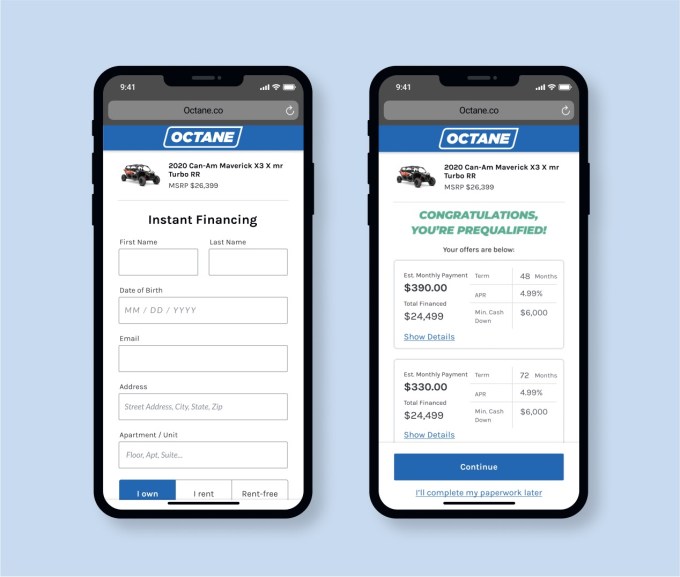
“We quickly learned that the buying journey in powersports markets was broken beyond just financing,” Guss told TechCrunch. “We elevated our goal to build an end-to-end buying solution including editorial content, consumer pre-qualification tools, instant full-spectrum financing and digital deal closing.”

Image Credits: Octane

Because lending is involved in about 80% of powersports purchases and about 80% of lending happens in the dealership, Octane focused first on building a lending platform for dealerships and consumers. Then in 2016, it launched Roadrunner Financial, a wholly owned-and-operated lender, so that it could offer full spectrum lending, “expand access to credit and speed up transactions through digitization and automation.” Today, the company is partnered with 3,800 dealers.

With an anchor in dealerships, Octane then expanded its scope. Last year, it acquired Cycle World and UTV Driver, along with five other brands from Bonnier with a goal “to inspire and inform powersports enthusiasts across the nation.” Also last year, it launched Octane Pre-qual, which enables consumers to instantly prequalify for financing on OEM and dealership websites with a soft credit pull. With that offering, Octane aims to help direct consumers to a dealership, close their loan and complete their purchase in one place.

“We are growing dramatically because we make transactions faster and simpler to close for consumers and dealerships,” Guss said. “We are the only platform to offer end-to-end purchasing benefits in the markets we play in.”

Looking ahead, Octane plans to use its new capital to expand to adjacent “other passion purchase” markets and continue to launch customer engagement tools as well as buying solutions for consumers shopping for powersports vehicles online. It also wants to continue to add dealership, OEM and brand partners, which today include BRP, Suzuki and Triumph Motorcycles.

“We define a passion purchase as a major discretionary purchase that brings people joy,” Guss said.Most innovation and investment is focused on large, marquee markets such as small business, auto and homes.” As people spent less toward travel and eating out once the COVID-19 pandemic hit, the powersports market got a boost, growing double digits last year, noted Guss.

“Our core customer base was not significantly impacted by COVID economically so consumer demand and loan performance remained strong,” he said.

Andrew Quigg, chief strategy officer at Progressive Insurance, believes that technology and consumers’ needs continue to evolve.

Octane’s point-of-sale loan origination platform provides benefits to consumers and dealerships in a specialty segment of the lending market,” he said. “We like to partner with innovative, forward-thinking companies and believe that our investment in Octane aligns very well with this strategy.” 

Octane describes itself as a remote-first workplace that has offices in New York and Dallas. It has grown its team by 50% in the last year, from 213 to 336 employees.

05 Aug 2021

Early Affirm employees raise $70M for SentiLink, an identity verification startup

SentiLink, an identity verification technology startup, has raised $70 million in a Series B funding round led by Craft Ventures.

Felicis Ventures, Andreessen Horowitz (a16z) and NYCA also participated in the financing, which brings the company’s total raised to $85 million since its 2017 inception. The company declined to reveal at what valuation the money was raised, saying only it was “at a very high multiple” of its 2019 $15 million Series A led by a16z.

Naftali Harris and Max Blumenfeld founded SentiLink in mid-2017 after their experience working as data scientists at Affirm, where they built out the company’s risk function. At one point during their tenure at the installment loan provider, they came across a “peculiar” fraud case, where 12 identities applied for loans using the same name and date of birth but 12 different Social Security numbers. 

The pair was surprised to discover that all 12 of the identities had real credit reports with 750+ credit scores despite not being real people. It was then they realized how big a problem identity verification was and how poorly it was done, and founded SentiLink with Affirm CEO and founder Max Levchin’s blessing and investment.

San Francisco-based SentiLink aims to help banks, lenders and financial institutions detect fraud at the point of application through a real-time API. Specifically, those APIs detect fake and stolen identities for new account applications. For example, before a bank issues a new credit card, it will send the application information to SentiLink. SentiLink’s models and technology assess the credit card application for various fraud risks, including identity theft and synthetic fraud. If SentiLink detects the application as high risk, the bank will ask for more information or reject the application. 

SentiLink works with more than 100 financial institutions, including three of the top 10 banks in the U.S. It has verified several hundred million applications to date, and saw its revenue grow by “5x” over the last year, according to Harris.

Craft Ventures co-founder and general partner David Sacks said SentiLink’s growth trajectory is “one of the fastest” he’s ever seen.

“Their traction with companies from new startups to major U.S. banks is impressive,” he added. “All of this stems from the team’s deep understanding of fraud and identity. I learned about fraud attacks I didn’t even think were possible from talking with Naftali and Max.”

Harris said the company was a few months away from profitability before its Series B but decided the opportunity was “too big to grow slowly.” So it opted to put off profitability so it could expand more “aggressively.” 

With the slew of companies in the space out there, it can be hard to differentiate what makes one unique compared to others.

To Harris, the biggest differentiation in SentiLink’s approach is how much it emphasizes “deep understanding of fraud and identity in our models.”

“We have a team of fraud investigators that manually review applications every day looking for fraud, and we use their insights and discoveries in our fraud models and technology,” he told TechCrunch. “This deep understanding is so important to us that every Friday the entire company spends an hour reviewing fraud cases.”

SentiLink, Harris added, focuses on “deeply” understanding fraud and identity, and then using technology to productionalize these insights.  Those discoveries include the deterioration of phone/name match data and uncovering “same name” fraud. 

“This deep understanding is so important that SentiLink employs a team of risk analysts whose full time job is to investigate new kinds of fraud and discover what the fraudsters are doing,” the company says. 

SentiLink, like so many other startups, saw an increase in business during the COVID-19 pandemic.

The various government assistance programs were rife with fraud. This had a cascading effect throughout financial services, where fraudsters that had successfully stolen government money attempted to launder it into the financial system,” Harris said. “As a result we’ve been very busy, particularly with checking and savings accounts that until now have had relatively little fraud.”

The startup plans to use its new capital to build out its product suite and do some hiring. Today it has 25 employees, with five accepted offers, and expects to end the year with a headcount of 45-50.

“Identity verification has so many aspects to it and approaches, and so we plan to significantly expand our product suite beyond the scoring API that we’ve started with,” Harris told TechCrunch. “Part of this will include continuing to invest heavily in our product team, part of this will involve partnering with other companies, and it may also include acquisitions.” 

At the end of September, for example, the company plans to launch a KYC (“Know Your Customer”) solution.   

Mike Marg, a principal at Craft, said Harris and Blumenfeld’s experience at Affirm “was a clear sign they were experts on this subject.”

“We love it when founders have an earned secret or insight around a massive problem that outsiders don’t understand, and SentiLink is a perfect example of this,” he said. “Their fast growth only validated that the problem they were solving for customers was urgent and painful.”

Other companies in the identity verification space that have recently raised money include Persona and Socure.