Year: 2021

10 Sep 2021

DataRobot CEO Dan Wright coming to TC Sessions: SaaS to discuss role of data in machine learning

Just about every company is sitting on vast amounts of data, which they can use to their advantage if they can just learn how to harness it. Data is actually the fuel for machine learning models, and with the proper tools, businesses can learn to process this data and build models to help them compete in a rapidly-changing marketplace, to react more quickly to shifting customer requirements and to find insights faster than any human ever possibly could.

Boston-based DataRobot, a late-stage startup that has built a platform to help companies navigate the machine learning model lifecycle, has been raising money by the bushel over the last several years including $206 million in September 2019 and another $300 million in July. DataRobot CEO Dan Wright will be joining us on a panel to discuss the role of data in business at TC Sessions: SaaS on October 27th.

The company covers the gamut of the machine learning lifecycle including preparing data, operationalizing it and finally building APIs to make it useful for the organization as it attempts to build a soup-to-nuts platform. DataRobot’s broad platform approach has appealed to investors.

As we wrote at the time of the $206 million round:

The company has been catching the attention of these investors by offering a machine learning platform aimed at analysts, developers and data scientists to help build predictive models much more quickly than it typically takes using traditional methodologies. Once built, the company provides a way to deliver the model in the form of an API, simplifying deployment.

DataRobot has raised a total of $1 billion on $6.3 billion post valuation, according to Pitchbook data and it’s been putting that money to work to add to its platform of services. Most recently the company acquired Algorithmia, which helps manage machine learning models.

As the pandemic has pushed more business online, companies are always looking for an edge and one way to achieve that is by taking advantage of AI and machine learning. Wright will be joined on the data panel by Monte Carlo co-founder and CEO Barr Moses and AgentSync co-founder and CTO Jenn Knight to discuss the growing role of data in business operations

In addition to our discussion with Wright, the conference will also include Microsoft’s Jared Spataro, Amplitude’s Olivia Rose, as well as investors Kobey Fuller and Laela Sturdy, among others. We hope you’ll join us. It’s going to be a thought-provoking lineup.

Buy your pass now to save up to $100. We can’t wait to see you in October!

10 Sep 2021

Apple prohibited from blocking outside payment in Epic ruling

A judge this morning issued a ruling in California’s Epic v. Apple case, siding with the Fortnite maker on the topic of third-party payments. Effectively, the judge has ruled that Apple cannot prohibit developers from adding links for alternative payments beyond Apple’s App Store-based monetization.

The mobile giant’s control over fees on iOS has long been a sticking point for Epic and the veritable cash cow of its in-gaming micro-transactions.

The ruling notes, in part,

Apple Inc. and its officers, agents, servants, employees, and any person in active concert or participation with them (“Apple”), are hereby permanently restrained and enjoined from prohibiting developers from (i) including in their apps and their metadata buttons, external links, or other calls to action that direct customers to purchasing mechanisms, in addition to In-App Purchasing and (ii) communicating with customers through points of contact obtained voluntarily from customers through account registration within the app.

We’ve reached out to Apple and Epic for comment on this morning’s ruling.

Developing…

10 Sep 2021

Iceland’s Crowberry Capital launches $90M Seed and Early-stage fund aimed at Nordics

Crowberry Capital, operating in Reykjavik and Copenhagen, has launched Crowberry II: a $90 million seed and early-stage fund aimed at startups in the Nordic region. A second close – bringing in an additional $40 million – is planned for July 2022.

The EIF (European Investment Fund) is the lead LP on the fund, after putting in €20 million from the EU’s “InnovFin Equity” program. This is InnovFin Equity’s first VC fund in Iceland.

Other investors include Icelandic Pension funds, several family offices, and angels including David Helgason, founder of Unity Technologies.

Crowberry II, which claims to be the largest VC fund operating out of Iceland, is headed up by three women founders, Hekla Arnardottir, Helga Valfells, and Jenny Ruth Hrafnsdottir.

The Crowberry I fund (a $40m fund launched in 2017), invested in startups in the areas of Gaming, SaaS, Healthtech, and Fintech.

Hekla Arnardottir said: “An incorrect assumption is that because we are women, we are only interested in supporting female founders. As our investment record shows, we support companies because they are game changers, irrespective of the gender of their senior team members. However, we also benefit, as an all-female team, from a circumspection which means that we can see potential in businesses and sectors which are typically overlooked by others in our space.”

She added: “Inclusivity is good for business, and through being open and approachable, your deal-flow multiplies in parallel to your talent pool, and businesses are built with a broader potential user base. It’s crazy that in 2020, female-led startups received just 2.3% of VC Funding, yet Crowberry considers this to be an opportunity: where the Nordics lead in gender equality on a societal level, we want to show that the region can also show the way in terms of inventive venture support.”

Crowberry’s previous fund (Crowberry I) featured 15 companies, of which 33% had female CEOs.

10 Sep 2021

WhatsApp will finally let users encrypt their chat backups in the cloud

WhatsApp said on Friday it will give its two billion users the option to encrypt their chat backups to the cloud, taking a significant step to put a lid on one of the tricky ways private communication between individuals on the app can be compromised.

The Facebook-owned service has end-to-end encrypted chats between users for more than a decade. But users have had no option but to store their chat backup to their cloud — iCloud on iPhones and Google Drive on Android — in an unencrypted format.

Tapping these unencrypted WhatsApp chat backups on Google and Apple servers is one of the widely known ways law enforcement agencies across the globe have been able to access WhatsApp chats of suspect individuals for years.

Now WhatsApp says it is patching this weak link in the system.

“WhatsApp is the first global messaging service at this scale to offer end-to-end encrypted messaging and backups, and getting there was a really hard technical challenge that required an entirely new framework for key storage and cloud storage across operating systems,” said Facebook’s chief executive Mark Zuckerberg said in a post announcing the new feature.

Store your own encryption keys

The company said it has devised a system to enable WhatsApp users on Android and iOS to lock their chat backups with encryption keys. WhatsApp says it will offer users two ways to encrypt their cloud backups, and the feature is optional.

In the “coming weeks,” users on WhatsApp will see an option to generate a 64-digit encryption key to lock their chat backups in the cloud. Users can store the encryption key offline or in a password manager of their choice, or they can create a password that backs up their encryption key in a cloud-based “backup key vault” that WhatsApp has developed. The cloud-stored encryption key can’t be used without the user’s password, which isn’t known by WhatsApp.

(Image: WhatsApp/supplied)

“We know that some will prefer the 64-digit encryption key whereas others want something they can easily remember, so we will be including both options. Once a user sets their backup password, it is not known to us. They can reset it on their original device if they forget it,” WhatsApp said.

“For the 64-digit key, we will notify users multiple times when they sign up for end-to-end encrypted backups that if they lose their 64-digit key, we will not be able to restore their backup and that they should write it down. Before the setup is complete, we’ll ask users to affirm that they’ve saved their password or 64-digit encryption key.”

A WhatsApp spokesperson told TechCrunch that once an encrypted backup is created, previous copies of the backup will be deleted. “This will happen automatically and there is no action that a user will need to take,” the spokesperson added.

Potential regulatory pushback?

The move to introduce this added layer of privacy is significant and one that could have far-reaching implications.

End-to-end encryption remains a thorny topic of discussion as governments continue to lobby for backdoors. Apple was reportedly pressured to not add encryption to iCloud Backups after the FBI complained, and while Google has offered users the ability to encrypt their data stored in Google Drive, the company allegedly didn’t tell governments before it rolled out the feature.

When asked by TechCrunch whether WhatsApp, or its parent firm Facebook, had consulted with government bodies — or if it had received their support — during the development process of this feature, the company declined to discuss any such conversations.

“People’s messages are deeply personal and as we live more of our lives online, we believe companies should enhance the security they provide their users. By releasing this feature, we are providing our users with the option to add this additional layer of security for their backups if they’d like to, and we’re excited to give our users a meaningful advancement in the safety of their personal messages,” the company told TechCrunch.

WhatsApp also confirmed that it will be rolling out this optional feature in every market where its app is operational.  It’s not uncommon for companies to withhold privacy features for legal and regulatory reasons. Apple’s upcoming encrypted browsing feature, for instance, won’t be made available to users in certain authoritarian regimes, such as China, Belarus, Egypt, Kazakhstan, Saudi Arabia, Turkmenistan, Uganda, and the Philippines.

At any rate, Friday’s announcement comes days after ProPublica reported that private end-to-end encrypted conversations between two users can be read by human contractors when messages are reported by users.

“Making backups fully encrypted is really hard and it’s particularly hard to make it reliable and simple enough for people to use. No other messaging service at this scale has done this and provided this level of security for people’s messages,” Uzma Barlaskar, product lead for privacy at WhatsApp, told TechCrunch.

“We’ve been working on this problem for many years, and to build this, we had to develop an entirely new framework for key storage and cloud storage that can be used across the world’s largest operating systems and that took time.”

10 Sep 2021

Have ‘The Privacy Talk’ with your business partners

As a parent of teenagers, I’m used to having tough, sometimes even awkward, conversations about topics that are complex but important. Most parents will likely agree with me when I say those types of conversations never get easier, but over time, you tend to develop a roadmap of how to approach the subject, how to make sure you’re being clear, and how to answer hard questions.

And like many parents, I quickly learned that my children have just as much to teach me as I can teach them. I’ve learned that tough conversations build trust.

I’ve applied this lesson about trust-building conversations to an extremely important aspect of my role as the chief legal officer at Foursquare: Conducting “The Privacy Talk.”

The discussion should convey an understanding of how the legislative and regulatory environment are going to affect product offerings, including what’s being done to get ahead of that change.

What exactly is ‘The Privacy Talk’?

It’s the conversation that goes beyond the written, publicly-posted privacy policy, and dives deep into a customer, vendor, supplier or partner’s approach to ethics. This conversation seeks to convey and align the expectations that two companies must have at the beginning of a new engagement.

RFIs may ask a lot of questions about privacy compliance, information security, and data ethics. But it’s no match for asking your prospective partner to hop on a Zoom to walk you through their broader approach. Unless you hear it first-hand, it can be hard to discern whether a partner is thinking strategically about privacy, if they are truly committed to data ethics, and how compliance is woven into their organization’s culture.

10 Sep 2021

Microsoft acquires TakeLessons, an online and in-person tutoring platform, to ramp up its edtech play

Microsoft said in January this year that Teams, its online collaboration platform, was being used by over 100 million students — boosted in no small part by the Covid-19 pandemic and many schools going partly or fully remote. Now, it’s made another acquisition to continue expanding its position in the education market.

The company has acquired TakeLessons, a platform for students to connect with individual tutors in areas like music lessons, language learning, academic subjects and professional training or hobbies, and for tutors to book and organize the lessons they give, both online and in person.

Terms of the deal have not been disclosed but we are trying to find out. San Diego-based TakeLessons had raised at least $20 million from a range of VCs and individuals that included LightBank, Uncork Capital, Crosslink Capital and others. TakeLessons posted a short note in the form of a Q&A confirming the deal on its site. The note said that it will continue operating business as usual for the time being, with the intention of taking its platform to a wider global audience.

It’s not clear how many active students and tutors TakeLessons had on its platform at the time of acquisition, but for some context, another big player in the area of online one-to-one tutoring, GoStudent out of Europe, raised $244 million in funding earlier this year that valued it at $1.7 billion. Others in online tutoring like Brainly are also seeing valuations in the hundreds of millions.

Given the relatively modest amount raised by TakeLessons, it’s likely this was a much lower valuation. Yet the acquisition is still one that gives Microsoft the infrastructure and beginnings of setting up a much more aggressive play in mass-market online education, potentially to go head-to-head with these and other big platforms.

TakeLessons today offers instruction in a wide variety of areas, including music lessons (which was where it had gotten its start) through to languages, academic subjects and test prep, computer skills, crafts and more. It has been around since 2006 and got its start first as a platform for people to connect with tutors local to them for in-person lessons, before progressing into online lessons to complement that business.

The pandemic has precipitated a shift to a much bigger wave of the latter, with online tutoring apparently the majority of what is offered on TakeLessons platform today. These lessons continue to be offered on a one-on-one basis, but additionally students can take part in group lessons online via the startup’s Live platform.

The shift to online education that we’ve seen take hold around the world is likely why Microsoft sees a big opportunity here.

On the heels of many schools around the world scrambling for better online learning platforms to manage remote learning during lockdowns and quarantines, educators, families and students have been using (and paying for) a variety of different tools. Within that, Microsoft has been pushing hard to make Teams a leader in that area.

That was built on years of traction already in the market (and a number of other investments and acquisitions that Microsoft has made over the years).

But it also comes amid a new insurgence of competition arising from the current state of affairs. That includes adoption of Google Classroom, as well as a wide variety of more targeted point solutions for specific purposes like video lessons (Zoom figures big here); apps for lesson planning and homework planning; online on-demand tutorials in specific areas like math or languages or science to bolster in-class learning experiences; and more.

The Microsoft way is to bring as many features into a platform as possible to make it more sticky and less likely that users will turn to other apps, providing more value for money around the Microsoft offer. In other words, I’d expect to see Microsoft do more deals and launch more features to cover all of the services that it doesn’t already provide through its educational tools.

(Case in point: my children’s school uses Teams for online lessons, in part because it already uses Outlook for its email system. Now, the school has announced that it will no longer be using a different third-party app for homework planning; instead, teachers will be assigning homework and managing it via Teams. For a cash-strapped state school like ours, it makes sense that it would opt out of paying for two apps when it can get the same features in just one of them. The kids are not happy about this! This is what Microsoft leverages with its platform play.)

NextLessons is somewhat adjacent to that school-focused education strategy. Yes, there will be a big audience of students and their families who might represent a good cross-selling opportunity for tutoring, but NextLessons represents also a more mass-market offering, open to anyone who might want to learn something, not just those already using Microsoft Education products.

So the interest here is likely not just students who want to supplement their online learning — there is a big audience for online tutoring — but any lifelong learner, as well as the many consumers or professionals out there who have gotten interested in learning something new, especially in the last 1.5 years of spending more time alone and/or at home.

And with that, there are other potential opportunities for NextLessons in the Microsoft universe.

Just yesterday, Microsoft CEO Satya Nadella and Ryan Roslansky, the CEO of Microsoft-owned LinkedIn, held an online presentation about what work will look like in the future. Education — specifically professional development — figured strongly in that discussion, with the conversation coinciding with LinkedIn launching a new Learning Hub.

LinkedIn has not only been working for years on building out its education business, but it has also long been looking for a more sticky inroad into doing more with video on its platform.

Something like NextLessons could, interestingly, kill those two birds with one stone. While LinkedIn’s education content up to now has not been something specifically tied to “live” online lessons, you could imagine a bridge between Microsoft’s latest acquisition and what LinkedIn might consider next, too.

10 Sep 2021

BNPL is not a winner-takes-all game

Hello and welcome back to Equity, TechCrunch’s venture-capital-focused podcast, where we unpack the numbers behind the headlines.

Natasha and Mary Ann took over this week’s show with Chris and Grace, which meant that our overdeveloped senses of curiosity filled up the script just fine (even on a somewhat short week). Unintentionally, today’s episode was built around a theme of inclusion – from auto-insurance to women’s health, and from payments to knowledge.

But here are some more specifics on what we got into:

Remember when we were all thinking about what ‘the new normal’ would look like? Well, I guess it’s here.

Equity drops every Monday at 7:00 a.m. PDT, Wednesday, and Friday morning at 7:00 a.m. PDT, so subscribe to us on Apple PodcastsOvercastSpotify and all the casts.

10 Sep 2021

Startup insurance provider Vouch raises $90M, now valued at $550M

Vouch, a provider of business insurance to startups and high-growth companies, announced today it has raised $90 million in new funding.

The $90 million figure was raised across two rounds: a $60 million Series C co-led by SVB Capital (a subsidiary of Silicon Valley Bank) and Ribbit Capital that values the company at $550 million, and a previously unannounced $30 million Series B1 led by Redpoint Ventures.

With the latest financing, San Francisco-based Vouch has now raised a total of $160 million since its 2018 inception. Other investors include Allegis Group, Sound Ventures and SiriusPoint.

While there are many insurance technology companies out there that serve consumers, there are far fewer that offer it to companies, much less startups. Vouch describes itself as “a new kind of insurance platform” for startups that offers fully digital, “tailored coverage that takes minutes to activate.”

Over the past year, Vouch has seen impressive growth. The company declined to reveal hard revenue figures, but said it saw “7x” increase in its customer base year over year and currently protects over $5.7 billion in risk across thousands of policies. Today, Vouch has more than 1,600 clients, including Pipe, Middesk, Neighbor and Routable. It is also the “preferred” business insurance provider to the customers of Silicon Valley Bank, Brex, Carta and WeWork. Y Combinator too also refers Vouch to its portfolio companies. 

To Vouch co-founder and CEO Sam Hodges, the ability to attract some of the highest-profile businesses in the startup world speaks to the company’s understanding of the startup ecosystem. 

“It’s our responsibility to meet startup founders where they are, and give startups flexibility as they navigate changing laws, regulations and the virtual and physical locations of their businesses,” he said.

Like many other companies, Vouch had to shift its model during the pandemic to adapt to the different types of emerging risks businesses have faced. For example, last year, Vouch saw a change in where its startup clients’ teams were distributed. Before the pandemic, nearly 30% of the teams were remote. During the pandemic, that figure has shifted to over 53%. As a result, Vouch developed a broader range of insurance coverages to adapt to the “new normal.”

Included in its new line of proprietary products and services aimed at startups are: work from anywhere coverage, broader cyber coverages and embedded insurance. It also expanded its underwriting capabilities to serve early-stage to growth-market startups.

In particular, the work from anywhere coverage is in direct response to the pandemic-related shift in remote work and can insure up to $500,000 per occurrence and can include a specified property owned by a startup regardless of the location of that property.

One major differentiator for Vouch, said Hodges, is that it is now the only business insurance provider that has its own insurance carrier, which means the company backs its own policies.

“This capability means we have a lot of control over how we build and underwrite our policies — which translates into superior coverage and a better experience for our clients,” he said.

 Hodges co-founded Vouch with Travis Hedge three years ago after seeing how challenging it could be for a company to get the business insurance it needs to start and then scale.

The goal is to make it as easy as possible to onboard new customers and personalize the coverage as much as possible based on each company’s needs based on what they do, their customer base, stage of growth and the founder’s threshold for risk.

“A typical client can get a quote and bind their coverage online in under 10 minutes, without any phone calls or paperwork,” he told TechCrunch. “Vouch also has many coverage features that are uniquely geared for startups. For example, our directors and officers coverage includes a cap table coverage feature meant specifically to protect startups.”

Vouch looks at startups that need business insurance on a case by case basis, Hodges added. 

For example, it asks questions like, “Does an e-commerce company handle a very limited amount of client-sensitive information?” If so, it could make sense that it has a lower cyber insurance coverage limit and pay less for its policy. 

Conversely, if a startup is trying to raise money, it might need to invest more in Vouch’s directors and officers insurance to make sure it is covered should disputes arise in the future. 

Looking ahead, Hodges said the new capital would go toward continued investment in technical capabilities, an expansion of its product offerings, more hiring and building embedded insurance for its partners.

With regard to the embedded capabilities, within the next 12 months, all of the company’s partners’ customers will be able to purchase Vouch insurance directly from those partners’ websites. Vouch’s headcount has more than doubled, from 55 employees in September 2020 to 125 full-time employees presently, and Hodges expects that will continue to grow.

Greg Becker, president and CEO of SVB Financial Group, said that Vouch’s mission aligns with SVB’s in that they both aim to “empower the innovation economy.” 

That’s what Vouch is doing today, helping startups and tech innovators mitigate their risks as they grow,” he wrote via email. “We are proud to co-lead Vouch’s latest funding round to give startups access to the insurance they need as they add headcount, increase their customer base, or raise funding rounds of their own.”


10 Sep 2021

MaxRewards banks $3M to reveal best payment methods that reap the most rewards

When Anik Khan graduated from college, his first job was working on credit cards and business expenses at Accenture. There, he found that someone could bring in a couple of thousand dollars just by having the right credit cards and following the rewards and promotions.

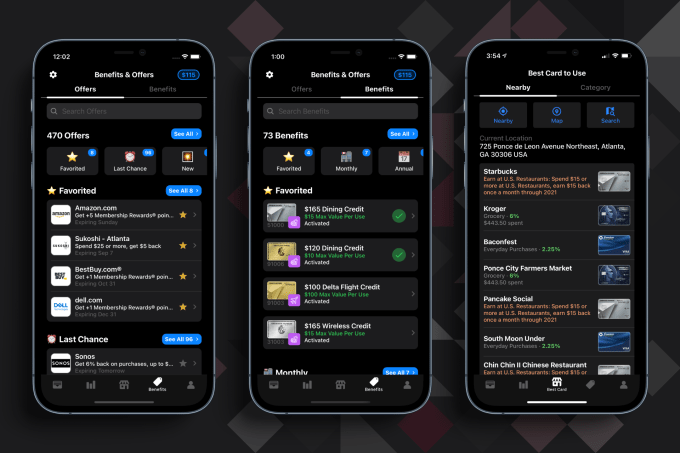
It was back in 2017 when he and David Gao got the idea for his company MaxRewards, a digital wallet app that manages credit cards and automatically activates benefits like rewards, cashback offers and monthly credits. It also makes recommendations at the point of purchase on which card would yield the best reward for that purchase.

Going after the some 83% of Americans that have a credit card, the app version was officially launched in 2019, and now the Atlanta-based company is announcing a $3 million seed round co-led by Dundee Venture Capital and Calano Ventures. Also backing the company are Techstars, Fintech Ventures Fund, Service Provider Capital and Fleetcor president Nick Izquierdo.

Tracking his own credit cards manually prior to MaxRewards, Khan recalled in one year, getting $16,000 in rewards. However, utilizing those benefits was time-consuming and difficult, because the rewards and savings aren’t always made evident by the credit card companies.

“Other companies have tried to do something similar, but the issue is you don’t have the reward information or the offers,” Khan told TechCrunch. “If you were to aggregate this information, you still would have to activate all of these things and use them before they expired.”

Users connect their accounts and when they make a purchase, their location is cross-referenced with the merchant and an algorithm is applied to tell the user which card to use. The average app user has six credit cards.

MaxRewards is free to download and use, and the majority of the app’s functionalities are free. Users who want additional features, like the auto activation or rewards, can join MaxRewards Gold and are given the opportunity to choose their own monthly price — the average is over $25 per month — based on the value they expect to gain, Khan said.

MaxRewards offers and benefits. Image Credits: MaxRewards

Ron Watson, partner at Dundee, said his firm invests in seed-stage companies between the coasts and is interested in consumer and e-commerce companies. Watson said he was impressed with what MaxRewards has been able to do with a team of three. He also relates to the company’s mission, having grown up in a lower, middle-class family that did not frequently go on vacations.

When he got his first job and was suddenly flying everywhere, he recalls building up so many rewards to the point where he was able to go on a vacation to Hawaii and only spend maybe $100, he said.

“I used to put my points into a spreadsheet, but as I got older and had kids, I realized how hard it was for the average person to do that and how important it is to have automation,” Watson said. “I downloaded the app, and on the first day, saved $20.”

The company is often compared to NerdWallet or Mint, but in terms of functionality, Khan said he feels MaxRewards is unique due to its credit card system connectors. Rather than rely on third-party aggregators to discover the rewards, MaxRewards leverages its own proprietary connectors to card systems.

There are hundreds of thousands of offers to be discovered, and consumers are asking for even more features, so Khan decided it was time to go after seed funding. He had raised a small seed, about $200,000, from his time at Techstars, but the new funding will enable him to add to his team of three people. He expects to be at 20 by the end of the year. Khan also wants to accelerate its user acquisition, product improvement and compliance.

Next up, the company is going to automate rewards and savings across additional platforms like debit cards, payment apps and cashback apps, as well as create browser extensions and a web app. Khan also wants to do more on the education side with regard to using credit cards in a smart manner.

Arron Solano, managing partner at Calano, met Khan through Techstars and said he is an advocate for using credit cards in the right way. His firm was looking for a company like MaxRewards.

“During our first call, I remember telling my partner that Anik was a bulldog who knew what he was talking about, especially at that stage,” Solano added. “He had strong team members, his vision lined up well and that checked off a massive box for us. He energized us and showed he could find a market with insanely high ‘super users.’ ”

10 Sep 2021

Amagi tunes into $100M for cloud-based video content creation, monetization

Media technology company Amagi announced Friday $100 million to further develop its cloud-based SaaS technology for broadcast and connected televisions.

Accel, Avataar Ventures and Norwest Venture Partners joined existing investor Premji Invest in the funding round, which included buying out stakes held by Emerald Media and Mayfield Fund. Nadathur Holdings continues as an existing investor. The latest round gives Amagi total funding raised to date of $150 million, Baskar Subramanian, co-founder and CEO of Amagi, told TechCrunch.

New Delhi-based Amagi provides cloud broadcast and targeted advertising software so that customers can create content that can be created and monetized to be distributed via broadcast TV and streaming TV platforms like The Roku Channel, Samsung TV Plus and Pluto TV. The company already supports more than 2,000 channels on its platform across over 40 countries.

“Video is a complex technology to manage — there are large files and a lot of computing,” Subramanian said. “What Amagi does is enable a content owner with zero technology knowledge to simplify that complex workflow and scalable infrastructure. We want to make it easy to plug in and start targeting and monetizing advertising.”

As a result, Amagi customers see operational cost savings on average of up to 40% compared to traditional delivery models and their ad impressions grow between five and 10 times.

The new funding comes at a time when the company is experiencing rapid growth. For example, Amagi grew 30 times in the United States alone over the past few years, Subramanian said. Amagi commands an audience of over 2 billion people, and the U.S. is its largest market. The company also sees growth potential in both Latin America and Europe.

In addition, in the last year, revenue grew 136%, while new customer year over year growth was 44%, including NBCUniversal — Subramanian said the Tokyo Olympics were run on Amagi’s platform for NBC, USA Today and ABS-CBN.

As more of a shift happens with video content being developed for connected television experiences, which he said is a $50 billion market, the company plans to use the new funding for sales expansion, R&D to invest in the company’s product pipeline and potential M&A opportunities. The company has not made any acquisitions yet, Subramanian added.

In addition to the broadcast operations in New Delhi, Amagi also has an innovation center in Bangalore and offices in New York, Los Angeles and London.

“Consumer behavior and infrastructure needs have reached a critical mass and new companies are bringing in the next generation of media, and we are a large part of that growth,” Subramanian said. “Sports will come on quicker, while live news and events are going to be one of the biggest growth areas.”

Shekhar Kirani, partner at Accel, said Amagi is taking a unique approach to enterprise SaaS due to that $50 billion industry shift happening in video content, where he sees half of the spend moving to connected television platforms quickly.

Some of the legacy players like Viacom and NBCUniversal created their own streaming platforms, where Netflix and Amazon have also been leading, but not many SaaS companies are enabling the transition, he said.

When Kirani met Subramanian five years ago, Amagi was already well funded, but Kirani was excited about the platform and wanted to help the company scale. He believes the company has a long tailwind because it is saving people time and enabling new content providers to move faster to get their content distributed.

“Amagi is creating a new category and will grow fast,” Kirani added. “They are already growing and doubling each year with phenomenal SaaS metrics because they are helping content providers to connect to any audience.