Year: 2021

08 Sep 2021

Real-time database platform SingleStore raises $80M more, now at a $940M valuation

Organizations are swimming in data these days, and so solutions to help manage and use that data in more efficient ways will continue to see a lot of attention and business. In the latest development, SingleStore — which provides a platform to enterprises to help them integrate, monitor and query their data as a single entity, regardless of whether that data is stored in multiple repositories — is announcing another $80 million in funding, money that it will be using to continue investing in its platform, hiring more talent and overall business expansion. Sources close to the company tell us that the company’s valuation has grown to $940 million.

The round, a Series F, is being led by Insight Partners, with new investor Hewlett Packard Enterprise, and previous backers Khosla Ventures, Dell Capital, Rev IV, Glynn Capital, and GV (formerly Google Ventures) also participating. The startup has to date raised $264 million, including most recently an $80 million Series E as recently as last December, just on the heels of rebranding from MemSQL.

The fact that there are three major strategic investors in this Series F — HPE, Dell and Google — may say something about the traction that SingleStore is seeing, but so too do its numbers: 300%+ increase in new customer acquisition for its cloud service and 150%+ year-over-year growth in cloud

Raj Verma, SingleStore’s CEO, said in an interview that its cloud revenues have grown by 150% year over year and now account for some 40% of all revenues (up from 10% a year ago). New customer numbers, meanwhile, have grown by over 300%.

“The flywheel is now turning around,” Verma said. “We didn’t need this money. We’ve barely touched our Series E. But I think there has been a general sentiment among our board and management that we are now ready for the prime time. We think SingleStore is one of the best kept secrets in the database market. Now we want to aggressively be an option for people looking for a platform for intensive data applications or if they want to consolidate databases to 1 from 3, 5 or 7 repositories. We are where the world is going: real-time insights.”

With database management and the need for more efficient and cost-effective tools to manage that becoming an ever-growing priority — one that definitely got a fillip in the last 18 months with Covid-19 pushing people into more remote working environments. That means SingleStore is not without competitors, with others in the same space including Amazon, Microsoft, Snowflake, PostgreSQL, MySQL, Redis and more. Others like Firebolt are tackling the challenges of handing large, disparate data repositories from another angle. (Some of these, I should point out, are also partners: SingleStore works with data stored on AWS, Microsoft Azure, Google Cloud Platform, and Red Hat, and Verma describes those who do compute work as “not database companies; they are using their database capabilities for consumption for cloud compute.”)

But the company has carved a place for itself with enterprises and has thousands now on its books, including GE, IEX Cloud, Go Guardian, Palo Alto Networks, EOG Resources, and SiriusXM + Pandora.

“SingleStore’s first-of-a-kind cloud database is unmatched in speed, scale, and simplicity by anything in the market,” said Lonne Jaffe, managing director at Insight Partners, in a statement. “SingleStore’s differentiated technology allows customers to unify real-time transactions and analytics in a single database.” Vinod Khosla from Khosla Ventures added that “SingleStore is able to reduce data sprawl, run anywhere, and run faster with a single database, replacing legacy databases with the modern cloud.”

08 Sep 2021

New leAD Sports & Health, Tavistock Group fund comes as sport tech market poised for double-digit growth

Sports and health technology investor leAD Sports & Health Tech Partners and private investment organization Tavistock Group have come together to launch the $30 million Lake Nona Sports & Health Tech Fund for early-stage startups in the areas of fan engagement, connected athletes, health and well-being.

In addition to both of those general partners, investors in the fund include Kevin Reid, Andrew White and Harold Primat, leAD co-founder and CEO Christoph Sonnen told TechCrunch.

Founded in 2016, leAD Sports & Health Tech Partners was inspired by Adi Dassler, who founded sportswear company Adidas. Dassler’s family is one of the partners and biggest funders to date, Sonnen said.

Its first fund, called Advantage, invested at the Series A stage and has four companies under it currently, and will eventually have 10 to 15 companies in the portfolio, Anne Joachim, leAD’s finance director, said.

The Lake Nona fund will invest in seed and pre-Series A to support founders by bridging the gap between those two rounds to help them grow, she added. The fund is expected to be able to invest in 20 companies with smaller ticket sizes.

“When we moved to Nona, we were looking to integrate between sports and health tech, especially in the areas of mindfulness and longevity, which are two hot topics we are seeing,” Sonnen said.

The new fund comes as the global sports technology market is poised to grow at a compounded annual growth rate of 17.5% to reach $40.2 billion by 2026, up from a valuation of around $17.9 billion in 2021, according to consultancy ResearchandMarkets.com.

Sonnen expects sports, esports and healthcare to be one big trend, driven by the global pandemic, that he doesn’t see stopping soon. For example, rather than people going back to the gym exclusively, it will be a hybrid of workouts and a bigger emphasis on sleep and recovery.

Of the technology out there, Joachim says devices enabling users to train in different ways is one of the more faster-moving segments.

“We learned during COVID about training without the gym, and we see more fascinating things coming out of that,” she added. “We are already seeing new technologies really disrupt the market and expect this to continue over the next couple of the years. We are also seeing more companies focused on mindfulness and training the brain like your body.”


08 Sep 2021

DJI’s smartphone camera stabilizer gets smaller for the OM 5

DJI’s camera stabilization tech started life as an outgrowth of its drone tech, and has managed to develop into a robust line of its own. Roughly this time last year, the company announced that its smartphone-focused Osmo line was being rebranded to the simpler OM. Today, the OM 5 arrives, with a more compact design, improved image tracking and an upgraded phone clamp.

Portability seems to be the primary selling point this time out. The device is roughly one-third smaller than last year’s model, making it a fair bit lighter than the OM 4, as well. The device now ships with a built-in extension rod (to capture more angles) and improved physical controls with additional on-board buttons.

Image Credits: DJI

DJI appears to be focusing a bit more on entry-level users this time out, with a new ShotGuide feature that has access to tutorials and editing to capture better shots the first time around. The system’s image tracking gets an upgrade, as well. “ActiveTrack 4.0 now supports tracking at up to 3x zoom at 5 m/s, and precisely identifies and steadily follows the subject centered in frame, even while in action,” per the company.

The three-axis system has a bunch of built-in shooting modes, as is DJI’s wont. The list includes Gesture Control, Timelapse/Motionlapse/Hyperlapse, Panorama, Dynamic Zoom (for a Hitchcock-style effect), Glamour Effects for automatic retouches and a Spin Shot mode, which, well, spins the phone around a bunch. There are also a number of templates for Story Mode, adding music and movements — basically it’s social media mode.

The new clamp is designed to fit over a case — meaning you don’t have to pull off the protection in order to get your phone on the OM 5. There’s also a new Fill Light Phone Clamp accessory, which adds a light to the front of the device. That will run $59 when it’s available at an unspecified later date.

The OM 5, meanwhile, is available starting today for $159.

08 Sep 2021

UnitQ raises $30M in Accel-led round to help companies improve product quality

Product quality is hugely important when it comes to the success of a product. Even if your product seems really cool, if it’s buggy or doesn’t work well, many people will just stop using it rather than taking the time to figure it out or even report a problem.

UnitQ, a Burlingame, California-based startup using a data-driven approach to product quality, today announced it has raised $30 million in a Series B funding round led by Accel to tackle this issue. In a nutshell, the company uses artificial intelligence to help businesses determine what is specifically impacting product quality at any given time, notes unitQ co-founder and CEO Christian Wiklund.

While he would not disclose valuation or hard revenue figures, the CEO says unitQ has been tripling its ARR (annual recurring revenue) every 12 months. 

The SaaS company’s goal is to give engineering, support, product ops and product management teams the ability to identify and, more importantly, fix quality issues that might be impacting customer satisfaction and retention.

Specifically, unitQ says it identifies actionable insights in a variety of ways. For one, it gathers user feedback from public sources like app reviews and social media and from private sources such as support tickets, support chats and surveys. It also does this through its own API, which connects to other external data sources. Currently, the company integrates into, and pulls insights from, 26 platforms and also ingests the data from anywhere there is user feedback.

With all these data points, Wiklund said, unitQ then “automatically tags and analyzes” quality issues with the goal of delivering “the most comprehensive and accurate view of product quality yet.”

The startup is mostly focused on consumer companies, but also has some B2B clients. Customers include Chime, Pandora, The RealReal, NerdWallet, Strava and AppLovin, among others.

“Our goal is to not only enable them to move faster and build higher-quality products, we want to help them build a quality company,” Wiklund told TechCrunch.

The premise behind the company is that these days, when so many consumer-facing industries are incredibly crowded, it can be difficult to stand out.

“Product features are a bit too easy to replicate and copy so most apps and products have a very similar feature set,” he said. “It’s hard to compete with features pricing too. Even content is becoming a commodity. But quality is the one thing that we all experience and the one thing that when we touch a product, we form our opinion.”

And poor quality, Wiklund maintains, can impact the growth of a company in many ways, such as reputation and pace of product development. 

“So we want to make sure that every conversion cycle inside of the product is as fine-tuned as possible,” he said.

Image Credits: UnitQ

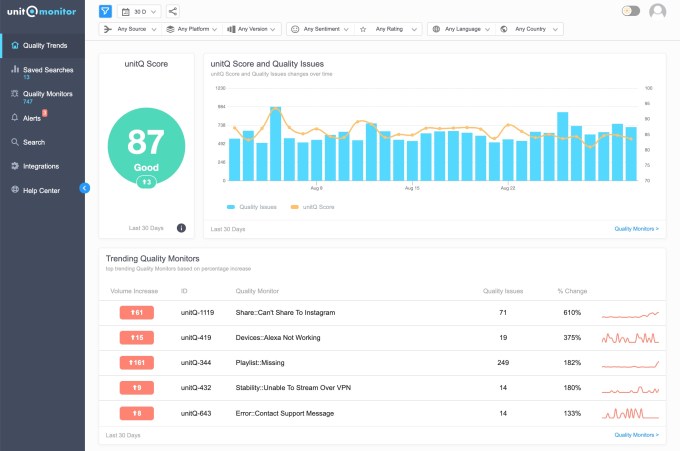
The company says that on average, its customers are able to increase their product quality by 20% in 30 days. It also touts that its technology is able to glean insights that are more valuable than Net Promoter Scores (NPS) — a tool used by many product teams that tend to be based mostly on surveys that are proactively sent out by businesses. Such scores, Wiklund said, are more likely to capture positive sentiments and “represent a tiny fraction of users.”

Existing backers Creandum — the early-stage Swedish fund which also backed Shopify — and Gradient Ventures, Google’s AI-focused venture fund, also put money in the round, which brings the startup’s total amount raised since its 2018 launch to $41 million.  

UnitQ plans to use its new capital toward beefing up its engineering and go-to-market teams, according to Wiklund. 

The idea for unitQ was born out of the co-founding duo’s previous company, Skout. That Andreessen Horowitz-backed social app had over 50 million app installations before being acquired by MeetMe for $28.5 million in cash and approximately 5.37 million common shares in 2016. 

“During the decade we worked on Skout, we never lost sight of the user experience and our top priority was ensuring people were happy with our product,” Wiklund recalls. “We would have loved to have access to a product like unitQ.”

DI Repotage

Andrew Braccia and Ben Fletcher of Accel, who worked on the deal, believe the fact that the founding team are repeat founders who intimately understand the problem that they are solving is a big advantage. 

“The customer feedback was over-the-top positive. Spotify, Cornershop, Pinterest, Whoop and Strava all rave that not only does unitQ ingest all of their data from app store reviews, internal support tickets and social media feedback, but they correlate this data so that it gives them the highest-value bug and improvement fixes for their products, something they could not find elsewhere,” Fletcher told TechCrunch.

They also believe that unitQ is creating a category around aggregating user feedback and then tying it back to product and engineering teams.  

“Similar to PagerDuty for incident management and DataDog for performance observability; unitQ is creating a new category around product quality and quality scores and indicators for their end customers; we think this would be really, really large,” Braccia added. “Teams are citing that churn is going down, revenue is going up, and engineering teams are shipping code faster for the things that really matter for their products because of the insights that they are getting from unitQ.”

08 Sep 2021

Google Workspace opens up spaces for all users

Employee location has become a bit more complicated as some return to the office, while others work remotely. To embrace those hybrid working conditions, Google is making more changes to its Google Workspace offering by going live with spaces — its tool for small group sharing — in Google Chat for all users.

Spaces integrates with Workspace tools, like the calendar, Drive and documents, to provide a more hybrid work experience where users can see the full history, content and context of conversations regardless of their location.

Google’s senior director of product management Sanaz Ahari wrote in a blog post that customers wanted spaces to be more like a “central hub for collaboration, both in real time and asynchronously. Instead of starting an email chain or scheduling a video meeting, teams can come together directly in a space to move projects and topics along.”

Here are some new features users can see in spaces:

  • One interface for everything — inbox, chats, spaces and meetings.
  • Spaces, and content therein, can be made discoverable for people to find and join in the conversation.
  • Better search ability within a team’s knowledge base.
  • Ability to reply to any message within a space.
  • Enhanced security and admin tools to monitor communication.

Employees can now indicate if they will be virtual or in-person on certain days in Calendar for collaboration expectations. As a complement, users can call colleagues on both mobile and desktop devices in Google Meet.

Calendar work location

In November, all customers will be able to use Google Meet’s Companion Mode to join a meeting from a personal device while tapping into in-room audio and video. Also later this year, live-translated captions will be available in English to French, German, Portuguese and Spanish, with more languages being added in the future.

In addition, Google is also expanding its Google Meet hardware portfolio to include two new all-in-one video conferencing devices, third-party devices — Logitech’s video bar and Appcessori’s mobile device speaker dock — and interoperability with Webex by Cisco.

Google is tying everything together with a handbook for navigating hybrid work, which includes best practice blueprints for five common hybrid meetings.


08 Sep 2021

Addi raises $75M to advance ‘buy now, pay later’ in LatAm, nearly triples valuation

Buy now, pay later is officially everywhere, and Latin America is no exception.

Today, one startup in the region, Addi, is announcing a $75 million extension to its Series B, bringing the total round size to $140 million. In late May, the startup announced it had raised $35 million in an equity round led by Union Square’s Opportunity Fund, and $30 million in debt funding from Architect Capital.

The company, which has dual headquarters in Bogota, Colombia, and São Paulo, Brazil, declined to reveal its new valuation other than to say it is “nearly triple” what it was 90 days ago when it closed on the first tranche of its Series B, and that it is now in the “hundreds of millions” of dollars range.

New York-based Greycroft led the extension, which also included participation from new backers GGV Capital, Citius Capital and Intersection Growth Partners, as well as existing investors Union Square’s Opportunity Fund, Andreessen Horowitz, Endeavor Catalyst, Foundation Capital, Monashees and Quona Capital. 

With the latest financing, Addi has now raised a total of $220 million in debt and equity since its September 2018 inception — $140 million of that in equity and over $80 million in debt.

Addi co-founder and CEO Santiago Suarez, says he, Daniel Vallejo and Elmer Ortega started the company with a vision of making digital commerce a reality in Latin America — a region where an estimated fewer than 25% of people have a credit card.

“To do this, we had to solve the payment problem,” he said. “We wanted to make frictionless payments possible while allowing customers to afford what they wanted.”

Addi started with a buy now, pay later offering, which allowed consumers to make purchases in minutes with “just a few clicks.” Today, the company allows customers to pay for their purchases over three months at no cost. For bigger purchases, Addi lets them pay for up to 24 months at what it describes as “competitive and fair rates.”

Addi is currently available for e-commerce, mobile and brick-and-mortar purchases in Brazil and Colombia, with plans to expand across Latin America in the coming years. In particular, it plans to enter the Mexican market in 2022.

Since the beginning of this year alone, Addi has grown its GMV (gross merchandise volume) by 13x, according to Suarez.

“And our ARR has seen similar growth,” he said.

Like many other companies, Addi temporarily saw a slowdown in business as a result of the COVID-19 pandemic. But it quickly bounced back.

“We lost 99% of our GMV in 20 days when the pandemic hit. We had to make some painful decisions, including letting go of many of our colleagues at a very difficult time,” Suarez recalled. “We also refocused the business on e-commerce and digital payments, and we haven’t looked back since then.”

As a result, Addi reached its pre-COVID high again in March/April of 2021, and has grown by about 3x since.

For now, the company is more focused on growth than profitability, Suarez added.

“This round has increased our focus on making digital commerce ubiquitous and accessible across Latin America,” he said.

Indeed, Latin America led the world in e-commerce sales growth last year. For its part, Addi currently has more than 150,000 customers, a number that is growing at 30% to 40% month over month. On the merchant side, it has close to 500 merchant partners, including brands such as Arturo Calle, Mario Hernandez, Keep Running and Claro. Earlier this year, it inked a strategic partnership with Banco Santander.

Addi currently has over 260 employees (or as Suarez put it, partners), up from less than 120 a year ago. The company prides itself as being “one of the few Latin American startups” that grants equity to everyone on staff.

“And we make it a point of speaking about partners and co-owners rather than employees,” Suarez told TechCrunch.

The company plans to use the new capital to speed up its product roadmap and geographic expansion. On the product side, it will be launching “a one-click checkout solution” for its merchant partners and customers by year’s end. Addi will also be accelerating its entry into Mexico, as mentioned previously, where it’s aiming to launch in early 2022.

Greycroft’s Thabet Mahayni said that prior to investing in Addi, his firm had been tracking the startup “for a long time.”

“In addition to an exceptional team, we believe the BNPL value proposition is stronger in LatAm than anywhere else in the world,” Mahayni told TechCrunch.” We…believe they have an opportunity to fundamentally reshape the entire consumer payments experience in the region.”

That is in part because currently, consumers in Latin America have very few alternatives when it comes to credit, he points out. Card penetration is very low and those who apply for credit “face a cumbersome and frustrating application process,” Mahayni added.

And those who do have credit cards are often given very low limits with high interest rates.

“It’s easy to see how this dynamic makes it difficult and expensive for consumers to access safe and reliable credit,” he said. 

Addi, according to Mahayni, has “rebuilt the entire onboarding, underwriting and fraud stack so they can provide safer credit alternatives to consumers while enabling merchants to meaningfully increase their basket sizes and GMV.”

It’s the second LatAm investment for Greycroft, which previously invested in Rocket.chat, a Brazilian enterprise communication and collaboration platform.

In Mexico next year, Addi will join existing player, Nelo. That startup raised $3 million in April, and at the time, was live with more than 45 merchants and over 150,000 users. Also, Alchemy earlier this year entered the Mexican market.

08 Sep 2021

Amazon’s cashierless ‘Just Walk Out’ tech is coming to Whole Foods stores

After launching it in Go stores and then bringing it to larger Freshsupermarkets, Amazon’s cashierless “Just Walk Out” tech will soon arrive in two Whole Foods locations. The service, which lets you pick up goods from shelves and (yep) just walk out, is coming to new stores in Washington DC and Sherman Oaks, California next year, the company announced.

“By collaborating with Amazon to introduce Just Walk Out shopping at these two Whole Foods Market stores, our customers will be able to… save time by skipping the checkout line,” said Whole Foods co-founder John Mackey.

As we’ve detailed previously, Just Walk Out uses computer vision, sensors and AI to let you walk into a store, sign in with an app, fill up your bags and leave without the need to join a checkout line. On top of using the tech in its own Go and Fresh stores, Amazon signed a deal last year to license its technology to third-party retailers.

The technology will work the same at Whole Foods, which is owned by Amazon. Shoppers can opt to use the tech when they enter the store by scanning an app, inserting a debit card linked to their Amazon account, or by placing their palm over the Amazon One palm-scanning system.

Unions have proclaimed that Amazon’s cashierless tech will cost workers jobs, but Amazon said the new Whole Foods locations will “employ a comparable number of team members as existing Whole Foods stores of similar sizes.” Rather, employees will be able to “spend even more time interacting with customers and delivering a great shopping experience,” Amazon said in a press release.

Editor’s note: This post originally appeared on Engadget.

08 Sep 2021

Continental’s eco-friendly concept tire includes a renewable tread

Many efforts are underway to reduce the environmental impact of cars, but what about the tires those cars ride on? Continental thinks it might help. Roadshow reports the company has introduced the Conti GreenConcept (yes, a concept tire) where more than half of the materials are “traceable, renewable and recycled.” You can even renew the natural rubber tread with little trouble — not a completely new idea, but refreshable treads have generally been reserved for large commercial trucks. Three renewals would be enough to ensure the material used for casing is cut in half relative to the total mileage.

About 35 percent of the materials are renewables, including dandelion rubber, silicate made from rice husk ash and a string of vegetable oils and resins. Another 17 percent is polyester yarn made from recycled PET bottles, reclaimed steel and recovered carbon black.

The design should improve the efficiency of the cars themselves, Continental added. New casing, sidewall and tread patterns make the GreenConcept about 40 percent lighter than a conventional tire at about 16.5lbs, That, in turn, leads to 25 percent lower rolling resistance than the highest-rated tires in the EU. Continental estimates you’d get six percent more range from an electric vehicle.

While you might not outfit your car with these exact tires any time soon, this is more than just a thought exercise. Continental plans to gradually deploy its recycling technology starting in 2022, including the production of tires using recycled bottles.

Efforts like the Conti GreenConcept are partly meant to burnish Continental’s public image. It wants to be the most environmentally responsible tire company by 2030, and become completely carbon-neutral by 2050 “at the latest.” However, it also hints at a more holistic approach to eco-friendly cars where many components, not just the powertrain, are kinder to the planet.

Editor’s note: This post originally appeared on Engadget.

08 Sep 2021

Gaia Capital Partners in Paris rebrands as Revaia, closes first €250M growth fund

Paris-based VC fund Gaia Capital Partners has change its name to Revaia and announced the final closing of its first growth fund, at €250 million. The firm said it exceeded its initial target of €200 million, and the fund will be ‘ESG focused’.

Revaia is also claiming to be Europe’s largest female-founded VC fund, although TechCrunch has not been able to verify that at the time of publication.

As Gaia Capital Partners, Revaia launched its first fund in late 2019, the portfolio for which currently consists of ten investments, including Aircall, recently achieved a unicorn valuation. Other investments include Epsor (Paris: Epsor designs and distributes employee savings and retirement plans), GetAccept (SF: an all-in-one sales enablement solution that assists B2B sales reps in closing remote deals), gohenry (London: a kids money management application), Planity (Paris: an online booking platform for hair and beauty salons), Welcome to the Jungle (Paris: a multichannel media company), and Yubo (Paris: a social platform for Generation Z).

Alice Albizzati, co-founder of Revaia said in a statement: “When we set up the firm, we were determined to create an investment strategy in line with our convictions – a focus on European companies with high ambitions but with no compromise on sustainability – and with the objective of bridging the gap between private and public markets. Our venture has performed beyond our initial expectations.”

The firm now has an office in Paris and Berlin, as well as a presence in New York and Toronto

The fund’s institutional investors include insurance companies such as Generali, Allianz, and Maif, pension funds, other institutional investors such as Bpifrance, as well as over 50 family offices and Angels.

Elina Berrebi, co-founder of Revaia, said: “We are very grateful to our investors and entrepreneurs who trusted us as we accelerated the build-up of our portfolio. This final closing of our first fund is a huge milestone. It is a solid foundation from which we can support future European technology leaders with their ambitions and sustainability plans, as well as expand and internationalize our team while building a strong value creation platform.”

Revaia said the new fund had already begun investing, and “two new investments should be announced soon”.

The firm says it aims to invest in around 15 companies and expand across Europe.

It’s also partnered with listed market sustainable investor Sycomore Asset Management.

08 Sep 2021

Beauty Pie, an online buyers’ club, picks up $100M to boost its beauty and wellness business

The beauty industry is worth some $500 million annually, and the Covid-19 pandemic has led to a sharp rise in the proportion of sales being carried out online. Today, a London-based beauty startup is announcing a major round of funding in hopes of reaping the spoils of that trend with a direct-to-consumer online storefront selling own-label goods.

Beauty Pie, which describes itself as a buyers club for high-end beauty and wellness products — any consumer in the U.K. or U.S. can buy direct, but when one joins the buying club either for a month (£10/$15) or a year (£59/$59), deep discounts per item kick in — has raised $100 million, funding that it will use to continue expanding into a wider set of categories, and to target users with a wider set of sales channels and more infrastructure (warehouses, more pop-up retail) to source and sell its “basics”-styled goods, typified by clean and simple, no-frills packaging with a focus on product inside.

“I don’t believe in business models where you spend tons on marketing,” Canadian founder and CEO Marcia Kilgore said in an interview. “So we want to focus the funding on opening new warehouses, moving into new territories, and maybe some pop-ups. We are Sephora meets Costco.”

The funding — a Series B — is being co-led by Index Ventures and Insight Partners, with previous backers Balderton Capital, General Catalyst and Latitude VC (a sister fund to London-based seed investor LocalGlobe) also participating. Beauty Pie, founded in 2016, has now raised $170 million to date. It’s not disclosing its valuation, but from what we understand estimates on PitchBook of $1.33 billion are not accurate (close sources tell us that the valuation is under $1 billion currently).

Beauty products are for many a very discretionary purchase, and that is even more the case for the higher end of that market — expensive and luxury brands. Skincare, cosmetics, hair products, and the rest are not in the same category of essentials as food, and if you do absolutely need a product, there are very cheap alternatives always available.

However, the last year and a half of Covid-19 living has had an interesting impact on that relationship. Many consumers have seen the opportunities to go out and spend money on activities significantly curtailed, and at the same time they have been looking for ways to pamper themselves in these complicated times. Combining that with the fact that non-essential stores were forced to close, or saw significantly reduced footfall, in many parts of the world, and that has translated to a huge boost for online shopping for beauty products, and especially nice ones. Treat yourself has become a fully-fledged beauty and wellness sales strategy.

The key to Beauty Pie’s model is that it sources and buys in high-end products from a range of producers and sells them under its own private label. Not unlike Amazon in its own private-label endeavors and how it combines this with its own Prime buying club model, this lets Beauty Pie sell products that compete with the best on the market, while also undercutting those high-end brands in the process. It says typical mark-ups for brands are 10x the cost of making a product.

By offering products in two tiers — one for those not in the club, and one for those who are paying a premium to be in the club — it also means that the startup still makes a margin on the items that it sells. The very simple approach is also reflected in the products themselves, which emphasize what is inside the packaging more than what it looks like on the outside, the implication being that Beauty Pie’s own focus is on the substance more than the aesthetics (ironic given that the end game is all about making us all look and smell better).

The model has so far been a successful one for the company, even with the initial stumbles it, like others, faced at the start of the pandemic. For Beauty Pie, when Covid-19 kicked off, it took its foot off ad spend, Kilgore said, because it could see supply issues shaping up, and it did so to manage how much demand it was going to get in, so that customers would not turn away disappointed. That soon got up to speed again, and now the company has some 300 to 400 SKUs on offer.

Kilgore claims that its customer retention rates are currently higher than Spotify’s and Netflix’s and twenty times higher than other D2C beauty companies, partly a result of the buyers’ club model. Members more than doubled in the last year, with revenues growing by more than 100%, and the company turned profitable last year for the first time, too.

“After only 48 months in operation, Beauty Pie‘s annual and monthly subscriber figures are incredible,” Danny Rimer, a partner at Index Ventures, wrote last December (likely a blog post that subtly kicked off the fundraising that we are writing about today). “At Index, we’ve never seen customer retention like this before.”

It helps, too, that Kilgore is not a first-time founder. She’s also the force behind the shoe brand Fitflop, Soap and Glory and other apparel and beauty enterprises.

“Marcia has spent decades building businesses that genuinely treat customers the way she would want to be treated, and Beauty Pie is the epitome of that ethos. With its transformative value chain and membership model, [it] lets members have their pie and eat it too: the best products at the best prices,” noted Rebecca Liu, Principal at Insight Partners, in a statement.