Year: 2021

28 Aug 2021

Can the world really just fall apart?

Books on climate change, as diverse as the library is, tend to fall into a couple of categories. There are the field guides and observational accounts that chronicle the destruction of our world and make it legible for readers worldwide. There are the policy and tech analyses that splay out options for the future, deliberating tradeoffs and offering guidance to individuals and governments on their decisions. There are the histories that look at missed opportunities, and the geological histories that show what our world was really like over the eons.

Then there’s the much darker category of dystopia.

Dystopic visions of the future are engaging precisely because they are visions. That makes them easy fodder for climate fiction (“cli-fi”) novels or even video games like Final Fantasy VII, a stream of work that has accelerated much in the way that carbon has in the atmosphere. Yet, it’s a field that almost uniquely remains focused on the imagination, of “what if” scenarios and running those contexts to their narrative conclusions.

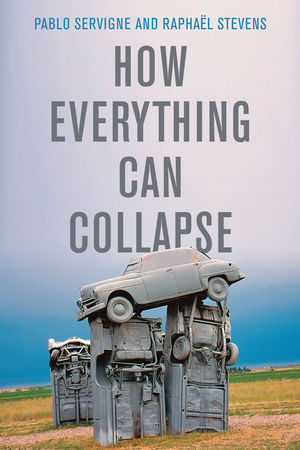
What makes “How Everything Can Collapse: A Manual for our Times” a rare read is that it is both dystopic and non-fiction.

The book, which was translated into English last year and first published in French in 2015, argues for a hard acceptance of what the authors Pablo Servigne and Raphaël Stevens dub “collapsology.” Less a movement like the Extinction Rebellion and Deep Adaptation communities that have risen up in the Anglophone world, collapsology is centered around a multi-disciplinary and systematic inquiry into the state of our world, our civilization, and our society.
In this, they spurn the American frame of progress and technological advancement to solve challenges, as well as humanity’s innate hopeful desire to see a better world going forward. Instead, they want to understand what’s really happening today, and whether the stresses, shocks, and crises that smash into our consciousness on a regular basis are really just a mirage or a phenomenon far more profound.

It shouldn’t be hard to glean what their answer is. Servigne and Stevens walk through earth systems like energy and food production and more as they scout for tipping points, physical limits, and the other impassable barriers to society’s exponential development. What they find is troubling, of course. Exponential human population growth over more than a century has led to practically insatiable demand for every resource and alimentation that the planet has in stock.

That’s a story many of us are familiar with, but where it gets interesting is when they start to systematically explore what that demand has done for efficiency. Perhaps the most striking example they offered was the history of petroleum and Energy Return on Energy Invested, or the amount of oil and gas it takes to drill for that very resource. ERoEI, they note, has declined from 35:1 in 1990 to a factor today of about 11:1. Fuel is getting harder to find — and that means we use more fuel to drill for less fuel. It’s a negative feedback loop — and worse, an exponential one — and there’s little reason to expect these trends to reverse.

These sorts of negative feedback loops are everywhere in earth systems today if you look closely for them. The permafrost is melting in the Arctic, the Amazon rainforest today emits more carbon dioxide than it absorbs, higher temperatures are making it more difficult and more expensive to grow food. All this at a time when the human population is expected to add several billion more individuals this century.

As with any system, there are lock-ins where components can’t adapt because they are connected to other systems. We can’t replace gas because the entire financial and industrial system is predicated on an abundant and relatively affordable form of energy. We could try to limit the use of automobiles and trucks, but few people (in the West at least) live anywhere near the farms or mining sites where the key sustaining goods of our society come from. Those ears of corn and bags of potatoes are going to have to travel to us, or we to them, but either way, traveling is going to take place.

In the authors’ collective minds, collapsology is about coming to terms with the reality of the systems all around us and just reading the dials. It’s about accepting tipping points, discontinuities, and other non-linear paths in these systems and projecting what they mean for our own lives and those of others. It’s a call to reality, rather than a call to arms. Just look, the authors practically say.

While the first half of the book is mostly centered around exploring systems and how they inter-connect, the second half of the work explores us as humans, and debating collapsology as a phenomenon. Is it too negative? Why do we have psychological barriers that prevent us from seeing the fragility of our ecosystems and our planet? How will art and movies and books adapt to our new context? How are we going to respond to the challenges that are about to confront us in a much more visceral way? The answers — when they are available — are interesting if not always novel.

Climate Change Books Summer 2021

It’s fascinating to see a bit of a cultural counterpoint to the American sensibility. In some ways, collapsology is just the latest manifestation of French existentialism, updated for the twenty-first century. The book doesn’t provide solutions, nor does it necessarily argue that progress must happen or even that it could happen. Instead, it just observes the human condition, and the conditions around humans. Humans are diverse, and they are going to react to the cataclysm in the diverse ways one would come to expect.

The book offers no solution and paints a dreary future that’s just on the cusp of dystopia. But the title is fascinating, since it posits a conditional rather than an assurance. The world “can collapse” not that it “will collapse.” A reader will be forgiven for thinking the latter is the case the book is making, but ultimately, Servigne and Stevens believe that the only way to avoid collapse is to fully see the world in all its complexity. Collapsology then is really anti-collapsology, or deeply understanding the brittleness of our systems before the limits are reached. That’s a refreshingly intellectual point of view, if not necessary a salve to the fears we read and see and feel every day.


How Everything Can Collapse: A Manual for our Times by Pablo Servigne and Raphaël Stevens. Translated from French by Andrew Brown.

Wiley, 2020, 250 pages

Originally published as “Comment tout peut s’effondrer: Petit Manuel de collapsologie à l’usage des générations présentes”

See Also

28 Aug 2021

Now that summer is forever, here are 6 books on climate change to sharpen your intuitions and models

The climate is finally hitting a climax. Decades of discussions and reports by scientists have yielded pathbreaking works by writers like Elizabeth Kolbert, and today, climate fiction and non-fiction are even becoming global bestselling works. Everyone wants to read about collapse, dystopia, the aftermath — it’s in the very air we breathe after all, what with the IPCC just reporting once again that all numbers point hotter, redder, and closer to us than ever.

The shelves of climate change books extend ever farther, and yet, one can’t help but feel that not much is changing about such a dynamic topic. There are always more details to unravel of course: another species that’s meeting the end of its precarious existence, a river that no longer flows, a town losing its last sparks of civilization. Yet, we know the tropes and the typical plots at this point (or just deny any of it is happening so it doesn’t matter anyway). The most challenging problem on the Earth today is, frankly, getting a bit repetitive.

The upshot is that there are still original works, works that push the edges of our understanding, reformulate some of the old tropes, and can deliver a forceful punch that unmoors our thinking and forces us to confront the familiar destruction with a new empathy.

I wanted to find the most intriguing books for engineers and technologists who are interested in more systematic ways for understanding what is happening to our planet. Not so much on point solutions (although we have one book on that), but rather books that can develop our thinking about how to understand the changes that are by now inevitably coming.

And so, I picked out and reviewed six books that I think represent a strong canon by which to develop our intuitions about climate change, not just as an environmental problem, but as an economic, social, and personal one as well. They range from systems-thinking analyses and prototypical non-fiction to personal reflections and an atmospheric novel. Each in its own way can help us come to terms with what will be the most challenging collective mission in our lives.

Call it beach reading, while that beach is still there.

28 Aug 2021

Data scientists: don’t be afraid to explore new avenues

I’m a native French data scientist who cut his teeth as a research engineer in computer vision in Japan and later in my home country. Yet I’m writing from an unlikely computer vision hub: Stuttgart, Germany.

But I’m not working on German car technology, as one would expect. Instead, I found an incredible opportunity mid-pandemic in one of the most unexpected places: An ecommerce-focused, AI-driven, image-editing startup in Stuttgart focused on automating the digital imaging process across all retail products.

My experience in Japan taught me the difficulty of moving to a foreign country for work. In Japan, having a point of entry with a professional network can often be necessary. However, Europe has an advantage here thanks to its many accessible cities. Cities like Paris, London, and Berlin often offer diverse job opportunities while being known as hubs for some specialties.

While there has been an uptick in fully remote jobs thanks to the pandemic, extending the scope of your job search will provide more opportunities that match your interest.

Search for value in unlikely places, like retail

I’m working at the technology spin-off of a luxury retailer, applying my expertise to product images. Approaching it from a data scientist’s point of view, I immediately recognized the value of a novel application for a very large and established industry like retail.

Europe has some of the most storied retail brands in the world — especially for apparel and footwear. That rich experience provides an opportunity to work with billions of products and trillions of dollars in revenue that imaging technology can be applied to. The advantage of retail companies is a constant flow of images to process that provides a playing ground to generate revenue and possibly make an AI company profitable.

Another potential avenue to explore are independent divisions typically within an R&D department. I found a significant number of AI startups working on a segment that isn’t profitable, simply due to the cost of research and the resulting revenue from very niche clients.

Companies with data are companies with revenue potential

I was particularly attracted to this startup because of the potential access to data. Data by itself is quite expensive and a number of companies end up working with a finite set. Look for companies that directly engage at the B2B or B2C level, especially retail or digital platforms that affect front-end user interface.

Leveraging such customer engagement data benefits everyone. You can apply it towards further research and development on other solutions within the category, and your company can then work with other verticals on solving their pain points.

It also means there’s massive potential for revenue gains the more cross-segments of an audience the brand affects. My advice is to look for companies with data already stored in a manageable system for easy access. Such a system will be beneficial for research and development.

The challenge is that many companies haven’t yet introduced such a system, or they don’t have someone with the skills to properly utilize it. If you finding a company isn’t willing to share deep insights during the courtship process or they haven’t implemented it, look at the opportunity to introduce such data-focused offerings.

In Europe, the best bets involve creating automation processes

I have a sweet spot for early-stage companies that give you the opportunity to create processes and core systems. The company I work for was still in its early days when I started, and it was working towards creating scalable technology for a specific industry. The questions that the team was tasked with solving were already being solved, but there were numerous processes that still had to be put into place to solve a myriad of other issues.

Our year-long efforts to automate bulk image editing taught me that as long as the AI you’re building learns to run independently across multiple variables simultaneously (multiple images and workflows), you’re developing a technology that does what established brands haven’t been able to do. In Europe, there are very few companies doing this and they are hungry for talent who can.

So don’t be afraid of a little culture shock and take the leap.

27 Aug 2021

OnePlus Buds Pro review: Much better

What does a company have to do to differentiate wireless earbuds in 2021? The near ubiquity of good hardware has made this an increasingly difficult question to answer. I’ve probably tested around 10 different sets of buds over the last year or so, and honestly, they were all pretty good.

Companies like Nura and Nothing are taking interesting approaches to the category, but for hardware makers who also sell their own handsets, sometimes being the best pair of headphones for a specific mobile device is enough.

OnePlus is in something of a void between the two worlds. The company makes its own phones, of course, but doesn’t pull in numbers approaching goliaths like Samsung and Apple. Fittingly, the OnePlus Buds Pro walk that line — serving as a solid pair of buds that play nicely with its own devices, while sprinkling in a few — at the very least — interesting additions that somewhat differentiate them from a crowded field.

OnePlus’s work in the category has been — to this point — unexceptional at best, and downright lackluster at worst. I was very much unimpressed when the company finally entered the fully wireless category last year, after a tethered play in the space. The sub-$100 price point was nice, but they otherwise felt like a set that could have flown maybe three or four years ago, when the pickings were far slimmer.

Image Credits: Brian Heater

The Pros are, mercifully, better in practically every respect. That has to be a bit of a relief for the company, as one of its co-founders launched his own new headphones within a month of their product. At $150, the product comes in at a $50 premium over both the Ear (1) and its standard buds. It’s a fair price for what you’re getting here, however, taking a broader look at the current landscape.

I should note, that for this review, I took the headphones for a spin with a non-OnePlus Android phone I had handy, as well as an iPhone. That requires the use of the HeyMelody OnePlus/Oppo app, which is, in a word, lacking. But it gets the job done with some key features. There’s a fit test to ensure that you have a good seal, and OnePlus Audio ID, which helps you create a custom sound profile.

The latter is a rudimentary version of what Nura offers with an old-school sound test that runs you through a number of different tones, asking whether you can hear the playback. It’s a bit of a slog, but it ultimately makes a difference. The result was a fair bit fuller and richer when I finished. Unfortunately, there’s not a lot of EQ customization beyond that. That said, I really don’t have a lot to complain about on the sound side of things, beyond an over reliance on bass.

Image Credits: Brian Heater

The noise canceling, which can either be controlled on the app or via the headphones’ stems, is also effective. A long (three-second) click of the stems, meanwhile, will pop up one of the buds’ most unique features: Zen Mode Air. It’s a clever if unnecessary addition in an era when every tech company is thinking about mindfulness. The feature pipes white noise into your eyes. The default is “Warm Sunrise” — kind of a meadow soundscape with chirping birds and insects. There are four other preloaded sounds, including campfires and the beach. It’s not a feature I ever thought I’d need, but in year where everything is stressful basically all of the time, I kind of dig it.

On the design side, companies have one of two choices these days. You can either embrace the AirPod or try something defiantly different. It’s pretty clear with a glance which direction OnePlus went. It’s a bit less pronounced on the matte black pair the company sent for review, but the white versions are unmistakable. The metal stems appear to be tossed in so as to not make them infringingly close to the market leaders.

Image Credits: Brian Heater

From a comfort perspective, they’re tough to beat. I’ve had them in for extended periods and gone running with them in and have no complaints. I guess there’s something to the AirPods design, after all. Battery life is pretty stellar, with five to seven hours on the buds (depending on ANC usage) and a combined 28 to 38 (ditto) with the slim case factored in. The case also supports wireless charging — an increasingly ubiquitous feature at this price point.

OnePlus clearly wanted to hew close to its budget roots by launching with the $99 buds first. But I think there’s something to the Google approach of showing what you can do with a more premium model and then dropping the budget take. There’s a strong case to be made that these were the headphones OnePlus should have released a year or two ago. But, hey, better late than never.

27 Aug 2021

Making a splash in the marketing world

“There are three common blunders that most SaaS marketers make time and again when it comes to clarity and high-converting content,” says Konrad Sanders, founder and CEO of The Creative Copywriter, “1. Not differentiating from competitors. 2. Not humanizing ‘tech talk.’ 3. Not tuning their messaging to prospects’ stage of awareness at the appropriate stage of the funnel.”

In an oversaturated market, how can you differentiate yourself? This week in marketing, Sanders took the time to answer that, break down B2B SaaS marketing, and tell us how marketers can do it right. Anna Heim, Extra Crunch daily reporter, interviewed Robert Katai, a Romanian marketing expert, as part of our TechCrunch Experts series. If there’s a growth marketer that you think we should know about, fill out our survey and tell us why!

Marketer: One Net Inc.
Recommended by: The Good Ride
Testimonial: “Exceptional SEO expertise. My e-comm startup relies 100% on SEO traffic and three years ago we were delisted from Google because we didn’t understand about duple content. One Net fixed our site and optimized it for Google, which allowed us to get back into the SERPs. Bottom line is: They saved our business.”

Marketer: Natalia Bandach, Hypertry
Recommended by: Jean-Noel Saunier, Growth Hacking Course
Testimonial: “Natalia is someone with an out-of-the-box approach to growth drivers and experimentation, full of creative solutions and many ideas that she quickly tests through experimentation. Rather than focusing on one area, she tries to verify what makes the most sense to a business and designs experiments that are crucial not only short but also long term. She is an ethical growth manager, likes to know that the business brings real value and is ready to pivot in every direction, [which] she does fast, however, with a focus on the team’s well-being, professional growth and always avoiding burnout.”

Help TechCrunch find the best growth marketers for startups.

Provide a recommendation in this quick survey and we’ll share the results with everybody.

Marketer: Avi Grondin, Variance Marketing
Recommended by: Adam Czach, Explorator Labs
Testimonial: “They have a hands-on approach and worked with my team to not only drive results, but educate us on how we can grow our company further.”

Marketer: Nate Dame, Profound Strategy
Recommended by: Amanda Valle, Adobe
Testimonial: “They offered a robust content research, management and writing platform, which is enabling us to manage, produce and collaborate around our content better.”

Marketer: Oren Greenberg, Kurve
Recommended by: Michael Lorenzos
Testimonial: “He’s the most well-versed growth marketer I’ve met with a wide range of expertise and an uncanny ability to zoom in and out for business context and tactical implementation.”

(Extra Crunch) Are B2B SaaS marketers getting it wrong?: Konrad Sanders, a content strategist in addition to being the founder and CEO at The Creative Copywriter, wrote about SaaS marketing for Extra Crunch. He dove into what SaaS marketers are getting wrong, how to stand out in the crowded industry and the importance of how to approach each section of your funnel. Sanders says, “By creating content for every stage of the funnel, you’ll address your prospects’ concerns at the appropriate point in the buyer journey and increase the chances that when they do come to make a purchase, it’s with you.”

Romanian marketing expert Robert Katai explains how to get the most out of your content: This week, Anna profiled Robert Katai. Katai told her all about Romania’s startup scene and his views on repurposing content. When speaking about using content for carousels on Instagram and LinkedIn, he says, “The first slide should grab attention — it can be a question. The second slide can be a link to the interview so that even if people don’t click it, it will be on their minds. Then you can have slides with insights.” Read the full interview to find out what the third slide should be!

Tell us who your favorite startup growth marketing expert to work with is by filling out our survey.

27 Aug 2021

Daily Crunch: In latest tech crackdown, China plans severe algorithm restrictions

To get a roundup of TechCrunch’s biggest and most important stories delivered to your inbox every day at 3 p.m. PDT, subscribe here.

Hello and welcome to Daily Crunch for Friday, August 27, 2021. What a week! In the last 24 hours we’ve had big news from around the world, including China’s latest regulatory push, Apple making modest concessions regarding the App Store and, of course, startup news aplenty.

Oh, and Canva CEO Melanie Perkins is coming to Disrupt. — Alex

The TechCrunch Top 3

  • China to crack down on algorithms: The push to more closely regulate and control China’s domestic technology market continued Friday with a government body announcing a draft set of rules for algorithms. The new rules come as China seeks to limit corporate data collection and more. Irony, of course, is dead.
  • Corporations can’t get enough startup equity: That’s our takeaway from digging into the recent, record results from the corporate venture capital (CVC) world. CVCs are taking part in more, bigger startup funding rounds. We dug into the why and the how of the latest data.
  • Apple makes smallest App Store concession: Per a settlement today, TechCrunch reports that Apple will now allow apps to “share information on how to pay for purchases outside of their iOS app or the App Store.” Apple called the change a clarification, which was interesting. Apple’s grip on the App Store is still tight, but we may be seeing indicators that its hold is slipping modestly.

Startups/VC

Up top, let’s talk about a16z, the venture capital conglomerate. Sure, it has crypto funds and main funds and other funds aplenty. But today the group announced a $400 million capital pool just for seed deals. The fund size indicates that a16z is either expecting to pay lots for seed equity or that it is going to make a host of bets. We’ll see.

  • Rivian files to go public: In case you were looking for yet another EV company to add to your personal investments, good news! Rivian has filed privately to go public! Frankly, we’re excited by this deal; Lordstown this is not. The company recently closed $2.5 billion in external capital, bringing it to more than $10 billion in total. We want to know what all that funding has bought the firm in terms of results.
  • Forbes is also going public: Via a SPAC, we should note, but yes, Forbes the media-and-magazine company is taking advantage of the boom in blank-check combinations to take itself public. We dug into its deck to see what the company has coming up and how heavily COVID-19 impacted its results.
  • Toast is also going public, but your humble servant failed to get a post up on the matter by the time it was newsletter o’clock. More to come on TechCrunch.com.
  • Payroll API startup Zeal raises Series A: The embedded fintech space is busy, and competitive, which makes what Zeal is building rather interesting. Is there a big enough market for just a payroll API product? A few years ago I would have quibbled, but if the OKR startup world has taught me anything, it’s to not underestimate how much demand there is in the world for software.
  • Sitenna wants to help telcos place 5G antennas: Coming in the next batch of Y Combinator-backed startups, Sitenna is looking for a piece of the capital wave that will push 5G mobile connectivity into our lives. The startup is neat, so read the post, but also keep in mind that demo day for YC is next week, so we’re heading into a very heavy news cycle over the next few days.
  • Sastrify raises $7M: Based in Cologne, Sastrify wants to help companies buy and manage their SaaS spend. Why does the world need this? Well, now that all software is a subscription fee, not overpaying and generally knowing what one is paying for is a big deal. And big deals plus some founder work equals a startup. Notably, Sastrify is already cash-flow-positive despite its youth.

The pre-pitch: 7 ways to build relationships with VCs

Many founders must overcome a few emotional hurdles before they’re comfortable pitching a potential investor face-to-face.

To alleviate that pressure, Unicorn Capital founder Evan Fisher recommends that entrepreneurs use pre-pitch meetings to build and strengthen relationships before asking for a check:

This is the ‘we actually aren’t looking for money; we just want to be friends for now’ pitch that gets you on an investor’s radar so that when it’s time to raise your next round, they’ll be far more likely to answer the phone because they actually know who you are.

Pre-pitches are good for more than curing the jitters: These conversations help founders get a better sense of how VCs think and sometimes lead to serendipitous outcomes.

“Investors are opportunists by necessity,” says Fisher, “so if they like the cut of your business’s jib, you never know — the FOMO might start kicking hard.”

(Extra Crunch is our membership program, which helps founders and startup teams get ahead. You can sign up here.)

Big Tech Inc.

  • Peloton’s bad week: What happens when you have a lackluster earnings report — by Wall Street’s standards — and then get “subpoenaed by both the U.S. Department of Justice and Department of Homeland Security”? Well, your share price goes down, and you hope that Monday will wind up much better than how Friday went.
  • Tesla wants to sell power: This is a fun one. Per an application, the world learned that Tesla wants to sell power in Texas under the rubric of being a retail electric provider, meaning that it may “purchase wholesale electricity from power generators and sell it to customers,” per TechCrunch.
  • Twitter tried to bring back the old times: By having its service stutter and go down for folks today. Remember the good old times, when Twitter broke all the time? Personally, I miss the Fail Whale. Twitter, we reckon, does not.
  • To close us out, Venky Adivi from Canonical has some thoughts on open source software and the U.S. government. Spoiler: The news is mostly good.

TechCrunch Experts: Growth Marketing

Illustration montage based on education and knowledge in blue

Image Credits: SEAN GLADWELL (opens in a new window) / Getty Images

We’re reaching out to startup founders to tell us who they turn to when they want the most up-to-date growth marketing practices. Fill out the survey here.

Read one of the testimonials we’ve received below!

Marketer: Natalia Bandach, Hypertry

Recommended by: Jean-Noel Saunier, Growth Hacking Course

Testimonial: “Natalia is someone with an out-of-the-box approach to growth drivers and experimentation, full of creative solutions and many ideas that she quickly tests through experimentation. Rather than focusing on one area, she tries to verify what makes the most sense to a business and designs experiments that are crucial not only [in the short term] but also [in the long run]. She is an ethical growth manager, likes to know that the business brings real value, and is ready to pivot in every direction, [which] she does fast — however, with a focus on the team’s well-being, professional growth and always avoiding burnout.”

Community

Image Credits: Diversion Books

Join Danny Crichton on Twitter Spaces on Tuesday, August 31st at 1 p.m. PDT/4 p.m. EDT as he talks with Azeem Azhar about his upcoming book, “The Exponential Age: How Accelerating Technology is Transforming Business, Politics and Society,” which will be released on September 7, 2021.

27 Aug 2021

TikTok bans viral ‘milk crate challenge’ over safety concerns

TikTok has banned the popular ‘milk crate challenge’ from its platform due to concerns that users participating in the trend could be seriously injured. The challenge saw TikTok users stacking milk crates into a pyramid and then attempting to climb across the unstable structure.

A spokesperson from the company told TechCrunch in an email that “TikTok prohibits content that promotes or glorifies dangerous acts, and we remove videos and redirect searches to our Community Guidelines to discourage such content. We encourage everyone to exercise caution in their behavior whether online or off.”

In most videos depicting the trend, TikTok users are seen tumbling to the ground as they try to climb up one side of the makeshift pyramid and down the other. The ban comes after several healthcare workers took to social media to voice their concerns about the trend and the danger it poses to those participating in it.

Searching for the trend’s hashtag on the app now brings up a “no results found” notice. The search results page notifies users that “this phrase may be associated with behavior or content that violates our guidelines. Promoting a safe and positive experience is TikTok’s top priority.” However, some videos depicting the trend are still visible on the app if users search for incorrect spellings of keywords associated with the challenge, such as ‘milk craate’ or ‘milk cratee.’ It’s worth noting that although these videos don’t have a significant amount of views, they’ve still managed to slip through the cracks of the ban and remain on the app.

TikTok’s rise to popularity has seen numerous dangerous challenges go viral on the platform over the past few years. In 2019, a popular ‘throw it in the air’ trend involved TikTok users forming a circle where nobody is allowed to move and then putting a phone on the floor to record them throwing an item up in the air on top of themselves to see who the object hits on its way down. Last year, a popular ‘skull-breaker’ trend that went viral on the app prompted criminal charges after a teen was hospitalized as a result of the challenge. The trend involved tricking a person to fall backwards on their head.

Dangerous trends like these, including the most recent milk crate challenge, have forced TikTok to take action to prevent its users from putting themselves in harmful situations.

27 Aug 2021

Extra Crunch roundup: Pre-pitch tactics, Warby Parker S-1, Israel’s fintech ecosystem

Forget what you’ve heard: There are many shortcuts to success.

Tapping into someone else’s experience is a tried-and-true method, which is why two-time Y Combinator participant Chris Morton wrote a guest post for Extra Crunch with advice for founders hoping to be accepted by the famed accelerator.

Morton, who has also reviewed thousands of YC applications, shares his thoughts on when to submit an application, what to do if you miss the deadline and whether you’ll need to relocate if accepted.

“Remember that your application should be good enough to get an interview, not win a prize,” says Morton. “Go back to work instead of spending more time perfecting an application.”


Full Extra Crunch articles are only available to members
Use discount code ECFriday to save 20% off a one- or two-year subscription


Robert Katai

Image Credits: Robert Katai under a license.

In an interview with reporter Anna Heim, Romania-based marketer Robert Katai discussed some of the methods he uses to help clients refine their content and branding strategies.

“Today, content creation is free — everybody can do it. The hard part is how you distribute and amplify that.”

Katai also shared his impressions of Romania’s startup ecosystem, suggestions for maintaining top-of-mind status with customers, and reinforced the often-overlooked need to continually repurpose content to grab mindshare.

Like our other growth marketing interviews, there’s no paywall.

Thanks very much for reading Extra Crunch this week! I hope you have a fantastic weekend.

Walter Thompson
Senior Editor, TechCrunch
@yourprotagonist

Why global investors are flocking to back Latin American startups

Image Credits: Bryce Durbin / TechCrunch

Latin America’s increasingly dynamic venture capital scene has been making headlines of late. To learn more about why investors are so enthusiastic, senior reporter Mary Ann Azevedo spoke to several who are actively engaged with the region:

  • Shu Nyatta, managing partner, SoftBank
  • Ethan Choi, partner, Accel
  • Julie Ruvolo, director of venture capital, LAVCA
  • Bill Cilluffo, partner, QED Investors
  • Ana Cristina Gadala-Maria, principal, QED Investors
  • Ross Darwin, principal, Owl Ventures

“I am not surprised by all the activity,” Mary Ann writes. “However, I am a bit taken aback by the sheer number of rounds, the caliber of firms leading them and the sky-high valuations.

“It seems that the region is finally, and deservedly, being taken seriously. This is likely just the beginning.”

Corporate venture capital follows the same trend as other VC markets: Up

Corporations are not remaining on the sidelines of the fiery 2021 venture capital game, Alex Wilhelm and Anna Heim note in The Exchange.

After parsing data from CB Insights and Stryber and chatting with a handful of investors, Alex and Anna concluded that the corporate venture capital market looks a lot like other VC markets.

“Perhaps this should not be a surprise,” they write. “We’ve seen non-venture funds flow into the later stages of startup land, pushing VCs toward earlier-stage and more venture-y deals. Why would CVCs be immune to the same trend?”

Ramp and Brex draw diverging market plans with M&A strategies

Image Credits: Bryan Mullennix (opens in a new window) / Getty Images

Corporate spending management startup Brex raised a $300 million Series C and acquired Buyer just a week after rival Brex announced it had acquired Israeli fintech Weav.

Ryan Lawler and Alex Wilhelm dug into the Ramp-Brex rivalry, and what those acquisitions say about their diverging strategies.

“From a high level, all of the recent deal-making in corporate cards and spend management shows that it’s not enough to just help companies track what employees are expensing these days,” they write.

“As the market matures and feature sets begin to converge, the players are seeking to differentiate themselves from the competition.”

Boston’s startup market is more than setting records in scorching start to year

Alex Wilhelm and Anna Heim interviewed VCs and corralled data to present a detailed picture of Boston’s startup funding scene.

“Boston is benefiting from larger structural changes to at least the U.S. venture capital market, helping close historical gaps in its startup funding market and access funds that previously might have skipped the region,” they write.

“And local university density isn’t hurting the city’s cause, either, boosting its ability to form new companies during a period of rich investment access.”

Europe’s quick-commerce startups are overhyped: Lessons from China

Image of a motorcycle courier speeding down a street.

Image Credits: Andrew Holt (opens in a new window) / Getty Images

Half of the companies offering instant grocery delivery in Europe were founded last year as the pandemic reshaped most aspects of our existence.

To date, they’ve raised about $2 billion, but Picus Capital’s Alexander Kremer says startup lessons from China suggest that “instant delivery is not the magic bullet to crack the dominance” of old-school grocery players.

“If the performance of online grocery platforms in China (a market five to seven years ahead of Europe in terms of online retail) is anything to go by, a range of B2C business models would be more likely to displace the traditional grocery retailers.”

D2C specs purveyor Warby Parker files to go public

For The Exchange, Alex Wilhelm examines the S-1 filing from Warby Parker, “a consumer hardware company with two main sales channels, largely attractive economics, falling losses and rising adjusted profitability. You could even argue that it handled the pandemic well, despite COVID-19’s negative impact on its operations.”

But how are its growth prospects?

Dear Sophie: Can I still get a green card through marriage if I’m divorcing?

lone figure at entrance to maze hedge that has an American flag at the center

Image Credits: Bryce Durbin/TechCrunch

Dear Sophie,

I received a conditional green card after my wife and I got married in 2019. Recently, we have made the difficult decision to end our marriage. I want to continue living and working in the United States.

Is it still possible for me to complete my green card based on my marriage through the I-751 process or do I need to do something else, like ask my employer to sponsor me for a work visa?

— Better to Have Loved and Lost

Using AI to reboot brand-client relationships

Artificial intelligence robot arm and businessman completing gear jigsaw puzzle (teamwork).

Image Credits: Getty Images under an alashi (opens in a new window)license.

Marketing automation can help boost key metrics, but it can also be a disservice to brands by perpetually devaluing goods and services, ShareThis’ Michael Gorman writes in a guest column.

Companies with a narrow focus on driving conversions are missing the bigger picture: AI can help create richer experiences that identify consumer actions and intent while also improving customer experiences.

“We live in a world rich with data, and insights are growing more vibrant every day,” he writes.

Israel’s maturing fintech ecosystem may soon create global disruptors

Abstract of israel map network, internet and global connection concept, Wire Frame 3D mesh polygonal network line, design sphere, dot and structure. Vector illustration eps 10. (Abstract of israel map network, internet and global connection concept, W

Image Credits: Thitima Thongkham (opens in a new window) / Getty Images

Fintech startups based in Israel raised more than $1.8 billion in 2019, but in Q1 2021, companies in the category raised $1.1 billion.

Facilitating a wide range of services, more than a dozen fintech unicorns have already emerged in a country that has a population slightly smaller than Los Angeles County, many of them started by entrepreneurs who lacked financial backgrounds.

“So what is it about Israeli-founded fintech startups that stand out from their scaling neighbors across the pond?” asks Flint Capital’s Tel Aviv-based investor, Adi Levanon.

Forbes jumps into hot media liquidity summer with a SPAC combo

For The Exchange, Alex Wilhelm takes stock of Forbes’ SPAC combination during a week when POLITICO was snatched up for more than $1 billion by Axel Springer and just a few months after BuzzFeed went public via a blank-check company.

“Is it the most exciting debut? No,” he writes.

“But it does highlight that with enough sheer gumption, one can take a magazine business into the digital age and keep aggregate revenue growing. That’s worth something.”

Are B2B SaaS marketers getting it wrong?

A square peg forced into a round hole. 3D render with HDRI lighting and raytraced textures.

Image Credits: mevans (opens in a new window) / Getty Images

Technical jargon is one of the most annoying aspects of technology marketing.

Sadly, it tends to perpetuate itself: Marketers are terrified of making a wrong move, so they tend to copy what everyone else is doing.

If you want to attract customers and drive higher conversions, cut the jargon.

“Do everything you can to be immediately understood and you’ll have a much better chance of cutting through the noise and pushing clear and persuasive benefits in a way no prospect can resist,” advises Konrad Sanders, CEO of The Creative Copywriter.

27 Aug 2021

Linux 5.14 set to boost future enterprise application security

Linux is set for a big release this Sunday August 29, setting the stage for enterprise and cloud applications for months to come. The 5.14 kernel update will include security and performance improvements.

A particular area of interest for both enterprise and cloud users is always security and to that end, Linux 5.14 will help with several new capabilities. Mike McGrath, vice president, Linux Engineering at Red Hat told TechCrunch that the kernel update includes a feature known as core scheduling, which is intended to help mitigate processor-level vulnerabilities like Spectre and Meltdown, which first surfaced in 2018. One of the ways that Linux users have had to mitigate those vulnerabilities is by disabling hyper-threading on CPUs and therefore taking a performance hit. 

“More specifically, the feature helps to split trusted and untrusted tasks so that they don’t share a core, limiting the overall threat surface while keeping cloud-scale performance relatively unchanged,” McGrath explained.

Another area of security innovation in Linux 5.14 is a feature that has been in development for over a year-and-a-half that will help to protect system memory in a better way than before. Attacks against Linux and other operating systems often target memory as a primary attack surface to exploit. With the new kernel, there is a capability known as memfd_secret () that will enable an application running on a Linux system to create a memory range that is inaccessible to anyone else, including the kernel.

“This means cryptographic keys, sensitive data and other secrets can be stored there to limit exposure to other users or system activities,” McGrath said.

At the heart of the open source Linux operating system that powers much of the cloud and enterprise application delivery is what is known as the Linux kernel. The kernel is the component that provides the core functionality for system operations. 

The Linux 5.14 kernel release has gone through seven release candidates over the last two months and benefits from the contributions of 1,650 different developers. Those that contribute to Linux kernel development include individual contributors, as well large vendors like Intel, AMD, IBM, Oracle and Samsung. One of the largest contributors to any given Linux kernel release is IBM’s Red Hat business unit. IBM acquired Red Hat for $34 billion in a deal that closed in 2019.

“As with pretty much every kernel release, we see some very innovative capabilities in 5.14,” McGrath said.

While Linux 5.14 will be out soon, it often takes time until it is adopted inside of enterprise releases. McGrath said that Linux 5.14 will first appear in Red Hat’s Fedora community Linux distribution and will be a part of the future Red Hat Enterprise Linux 9 release. Gerald Pfeifer, CTO for enterprise Linux vendor SUSE, told TechCrunch that his company’s openSUSE Tumbleweed community release will likely include the Linux 5.14 kernel within ‘days’ of the official release. On the enterprise side, he noted that SUSE Linux Enterprise 15 SP4, due next spring, is scheduled to come with Kernel 5.14. 

The new Linux update follows a major milestone for the open source operating system, as it was 30 years ago this past Wednesday that creator Linus Torvalds (pictured above) first publicly announced the effort. Over that time Linux has gone from being a hobbyist effort to powering the infrastructure of the internet.

McGrath commented that Linux is already the backbone for the modern cloud and Red Hat is also excited about how Linux will be the backbone for edge computing – not just within telecommunications, but broadly across all industries, from manufacturing and healthcare to entertainment and service providers, in the years to come.

The longevity and continued importance of Linux for the next 30 years is assured in Pfeifer’s view.  He noted that over the decades Linux and open source have opened up unprecedented potential for innovation, coupled with openness and independence.

“Will Linux, the kernel, still be the leader in 30 years? I don’t know. Will it be relevant? Absolutely,” he said. “Many of the approaches we have created and developed will still be pillars of technological progress 30 years from now. Of that I am certain.”


27 Aug 2021

The pre-pitch: 7 ways to build relationships with VCs

Most founders fall into an extremely common trap: Just because you produced outstanding results for the last round of investors doesn’t mean new investors will believe you. This new cohort hasn’t seen that performance firsthand, and they have no reason to trust you yet.

As a founder approaching your next round, it’s common to wonder, “How do I get this new group of investors to trust that I will perform?”

In our experience, founders who fundraise successfully are great at building relationships, and they usually deliver what we call “the pre-pitch.” This is the “we actually aren’t looking for money; we just want to be friends for now” pitch that gets you on an investor’s radar so that when it’s time to raise your next round, they’ll be far more likely to answer the phone because they actually know who you are.

But the concept of the pre-pitch goes deeper than just having potential investors be aware of your existence. Building relationships with potential future investors requires you to think less like a founder and more like a marketer — much of the relationship heavy lifting comes long before it’s time to ask for a capital commitment.

If an investor has made a deal in your space, there’s a good chance they know an earlier-round investor who could potentially be a good fit for you today.

There’s a host of advantages to the pre-pitch approach:

  • Good practice: You’re not asking for money. Instead, you’re offering a sneak peek. Since your relationship-builder pre-pitch doesn’t have millions on the line, you’ll invariably be less anxious, which leads to better relationships. Remember: If it’s not a good fit, who cares?
  • Candid feedback: When you’re not asking for money, you’re more likely to receive honest feedback that you might not get in a high-stakes environment.
  • Set the baseline: You should go over where you’re currently at, why it’s actually not time to raise capital quite yet (the inverse of “Why Now”), and what you still have to accomplish until the time is right.
  • Performance-based trust: Put your performance where your mouth is by showing your potential investor where you are today and what you expect to do in the short term. Later on, you can prove to them that you achieved what you said you would.

7 ways to build relationships with VCs

Now you’re probably wondering, “What the heck do I say to build a good relationship with that next-round investor?” Here are a few notes on how to approach the pre-pitch:

Seek the relationship, not the money

Acknowledge you’re early, but mention that you think it could potentially be a good fit later on. State it up front that you’re seeking a relationship and want to find out if you could eventually be a good fit for one another. Don’t sneak in an ask; let the relationship blossom organically.

Here’s an example: “We’re actually not raising yet, and we’re probably too early for you. But I think this is something you might be very interested in, and thought it made sense to reach out, open up a relationship and see if there might be a fit.”

Don’t waste time