Year: 2021

27 Aug 2021

The stars are aligning for federal IT open source software adoption

In recent years, the private sector has been spurning proprietary software in favor of open source software and development approaches. For good reason: The open source avenue saves money and development time by using freely available components instead of writing new code, enables new applications to be deployed quickly and eliminates vendor lock-in.

The federal government has been slower to embrace open source, however. Efforts to change are complicated by the fact that many agencies employ large legacy IT infrastructure and systems to serve millions of people and are responsible for a plethora of sensitive data. Washington spends tens of billions every year on IT, but with each agency essentially acting as its own enterprise, decision-making is far more decentralized than it would be at, say, a large bank.

While the government has made a number of moves in a more open direction in recent years, the story of open source in federal IT has often seemed more about potential than reality.

But there are several indications that this is changing and that the government is reaching its own open source adoption tipping point. The costs of producing modern applications to serve increasingly digital-savvy citizens keep rising, and agencies are budget constrained to find ways to improve service while saving taxpayer dollars.

Sheer economics dictate an increased role for open source, as do a variety of other benefits. Because its source code is publicly available, open source software encourages continuous review by others outside the initial development team to promote increased software reliability and security, and code can be easily shared for reuse by other agencies.

Here are five signs I see that the U.S. government is increasingly rallying around open source.

More dedicated resources for open source innovation

Two initiatives have gone a long way toward helping agencies advance their open source journeys.

18F, a team within the General Services Administration that acts as consultancy to help other agencies build digital services, is an ardent open source backer. Its work has included developing a new application for accessing Federal Election Commission data, as well as software that has allowed the GSA to improve its contractor hiring process.

18F — short for GSA headquarters’ address of 1800 F St. — reflects the same grassroots ethos that helped spur open source’s emergence and momentum in the private sector. “The code we create belongs to the public as a part of the public domain,” the group says on its website.

Five years ago this August, the Obama administration introduced a new Federal Source Code Policy that called on every agency to adopt an open source approach, create a source code inventory, and publish at least 20% of written code as open source. The administration also launched Code.gov, giving agencies a place to locate open source solutions that other departments are already using.

The results have been mixed, however. Most agencies are now consistent with the federal policy’s goal, though many still have work to do in implementation, according to Code.gov’s tracker. And a report by a Code.gov staffer found that some agencies were embracing open source more than others.

Still, Code.gov says the growth of open source in the federal government has gone farther than initially estimated.

A push from the new administration

The American Rescue Plan, a $1.9 trillion pandemic relief bill that President Biden signed in early March 2021, contained $9 billion for the GSA’s Technology Modernization Fund, which finances new federal technology projects. In January, the White House said upgrading federal IT infrastructure and addressing recent breaches such as the SolarWinds hack was “an urgent national security issue that cannot wait.”

It’s fair to assume open source software will form the foundation of many of these efforts, because White House technology director David Recordon is a long-time open source advocate and once led Facebook’s open source projects.

A changing skills environment

Federal IT employees who spent much of their careers working on legacy systems are starting to retire, and their successors are younger people who came of age in an open source world and are comfortable with it.

About 81% of private sector hiring managers surveyed by the Linux Foundation said hiring open source talent is a priority and that they’re more likely than ever to seek out professionals with certifications. You can be sure the public sector is increasingly mirroring this trend as it recognizes a need for talent to support open source’s growing foothold.

Stronger capabilities from vendors

By partnering with the right commercial open source vendor, agencies can drive down infrastructure costs and more efficiently manage their applications. For example, vendors have made great strides in addressing security requirements laid out by policies such as the Federal Security Security Modernization Act (FISMA), Federal Information Processing Standards (FIPS) and the Federal Risk and Authorization Management Program (FedRamp), making it easy to deal with compliance.

In addition, some vendors offer powerful infrastructure automation tools and generous support packages, so federal agencies don’t have to go it alone as they accelerate their open source strategies. Linux distributions like Ubuntu provide a consistent developer experience from laptop/workstation to the cloud, and at the edge, for public clouds, containers, and physical and virtual infrastructure.

This makes application development a well-supported activity that includes 24/7 phone and web support, which provides access to world-class enterprise support teams through web portals, knowledge bases or via phone.

The pandemic effect

Whether it’s accommodating more employees working from home or meeting higher citizen demand for online services, COVID-19 has forced large swaths of the federal government to up their digital game. Open source allows legacy applications to be moved to the cloud, new applications to be developed more quickly, and IT infrastructures to adapt to rapidly changing demands.

As these signs show, the federal government continues to move rapidly from talk to action in adopting open source.

Who wins? Everyone!

27 Aug 2021

The pure hell of managing your JPEGs

Hello and welcome back to Equity, TechCrunch’s venture capital-focused podcast, where we unpack the numbers behind the headlines.

Natasha and Alex and Grace and Chris were joined by none other than TechCrunch’s own Mary Ann Azevedo, in her first-ever appearance on the show. She’s pretty much the best person and we’re stoked to have her on the pod.

And it was good that Mary Ann was on the show this week as she wrote about half the dang site. Which meant that we got to include all sorts of her work in the rundown. Here’s the agenda:

And that’s a wrap, for, well, at least the next 5 seconds.
Equity drops every Monday at 7:00 a.m. PDT, Wednesday, and Friday morning at 7:00 a.m. PDT, so subscribe to us on Apple PodcastsOvercastSpotify and all the casts.
27 Aug 2021

Twitter experiencing widespread outages

Twitter users in Canada and parts of the U.S. appear to be having trouble accessing the social media platform on Friday morning. Reports from third-party web monitoring service Downdetector indicate the issue is impacting users across Canada and mainly the eastern parts of the U.S. near the Canadian border, though users from more states continue to report outages as well.

The social media giant’s official status page indicates all systems are currently fully operational. TechCrunch has reached out to Twitter for more information and will update this story accordingly.

The outage began at around 8:30 AM ET according to most reports, lasting for upwards of an hour for some users. As of just before 10 AM ET, it appears that service is restored for most, if not all based on information from users.

Developing…

27 Aug 2021

As 5G demand grows, Sitenna helps telcos find more cell tower locations, faster

The buildout of 5G networks continues apace, with wide-scale deployments across much of the developed world. Yet, one of the largest challenges with closing the gaps in coverage maps are constraints on 5G transmissions. Because of the spectrum that 5G technology uses compared to 4G, telecom operators need to install many times more towers to deliver the advertised bandwidth with the same quality signal that users expect.

Installing cell towers is a daunting proposition though. An operator has to find exactly the right location in terms of line of sight to users, then make sure the location has power and internet access, and then negotiate a contract with the property owner to keep the tower there for a decade or more. Now repeat tens of thousands of times (and maybe even more).

Sitenna, which will debut next week as part of Y Combinator’s Summer 2021 Demo Day, wants to radically speed up the process of selecting tower sites and securing contracts, creating a marketplace for landlords, tower operators and telcos alike.

Tower siting and access to poles have in some cases emerged as national infrastructure priorities. In the United States, the challenges around installing new towers — and new towers quickly — became a top priority of the FCC during the Trump administration, which launched a 5G FAST Plan to try to ease regulations around tower installation.

Sitenna’s founders Daniel Campion and Brian Sexton saw an opportunity with such programs to help with the movement. Over the past year, they have built out what is essentially a marketplace that on one hand, helps property owners figure out if they have an asset that’s worth investigating for telecom usage, and on the other, helps tower operators select and digitally sign deals for installation.

Sitenna co-founder and CEO Daniel Campion. Image Credits: Sitenna

The company launched in the United Kingdom in June, and “it kind of resonated,” Campion said, noting that 65,000 real estate assets and roughly 15% of the towers in the UK are now on the platform. The company has kicked off two pilots with Vodafone and its tower provider Cornerstone. He said the company intends to enter the U.S. market in the first quarter of next year.

While the company is starting with a marketplace, like many startups today, it is also augmenting that marketplace with B2B SaaS tools. In its case, that means tools for telcos to manage the process of onboarding a new tower location and then managing the asset. “Once they find the site, they ping pong emails back and forth,” Campion said. “So we have built some tools to help them on their workflows.”

Sitenna’s platform allows landlords and tower operators to inspect and transact tower locations. Image Credits: Sitenna

While there is definitely a large wave of tower installations underway now with the transition to 5G wireless, that wave doesn’t mean that tower installation will suddenly dry up in a few years. Campion notes that there is a “continual refresh of 15-20% on the carrier side” due to everything from changing usage patterns and building redevelopment to just standard hardware replacement.

And of course, there is always 6G, which while completely amorphous today, is a real thing that I get invites to conferences for. There’s always going to be a next generation of wireless, and Sitenna wants to become the center for managing that infrastructure.

27 Aug 2021

Forbes jumps into hot media liquidity summer with a SPAC combo

What a busy week in the world of media liquidity.

That’s a sentence you don’t get to write often. Regardless, news broke this week that Axel Springer is buying U.S. political journalism outfit POLITICO. The transaction was expected, but the eye-popping roughly $1 billion price tag still has tongues wagging. We even got on the podcast to chat about it.

And Forbes announced that it is going public via a SPAC. The business publication’s news follows BuzzFeed’s journey to the public markets through a blank-check company. Hot media liquidity summer? Something like that.


The Exchange explores startups, markets and money.

Read it every morning on Extra Crunch or get The Exchange newsletter every Saturday.


That TechCrunch is in the process of being sold to private equity, of course, is not something that we should forget. Shoutout to the Verizon bankers who found a way to get rid of us while also deleveraging Verizon’s debt profile. Ten points.

I want to take a quick tour of the Forbes SPAC deck this morning. Our notes on BuzzFeed’s are here, in case you want to run comparisons. This will be easy and fun. Perfect Friday morning fare. Into the data!

What’s it worth?

In corporate-speak, Forbes Global Media Holdings is merging with blank-check company Magnum Opus Acquisition Limited. The transaction will close either Q4 2021 or Q1 2022, Forbes estimates.

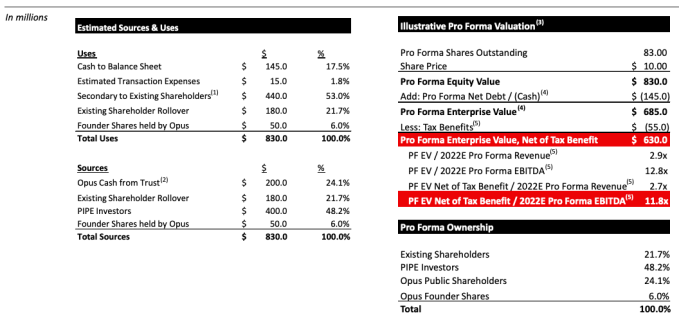
The deal itself is somewhat modest in scale compared with other SPAC deals we’ve recently looked into. Forbes reports that it will sport “an implied pro forma enterprise value of $630 million, net of tax benefits,” after its completion. Some $600 million in gross proceeds will be derived from Magnum Opus funds “and $400 million of additional capital through a private placement of ordinary shares of the combined company,” Forbes writes.

The company will sport an equity valuation of $830 million after the deal closes, per its own calculations. That number will change some depending on redemptions ahead of the combination. The gap between the large dollars going into the deal and the modest final valuation of the public Forbes entity is due to some $440 million in secondary transactions for existing Forbes shareholders.

In case you’d prefer all of that in table form, here’s the Forbes investor deck:

Image Credits: Forbes SPAC deck

Is $830 million a fair price? Let’s dig into Forbes’ results.

27 Aug 2021

Stonehenge Technology Labs bags $2M, gives CPG companies one-touch access to metrics

Stonehenge Technology Labs wants consumer packaged goods companies to gain meaningful use from all of the data they collect. It announced $2 million in seed funding for its STOPWATCH commerce enhancement software.

The round was led by Irish Angels, with participation from Bread and Butter Ventures, Gaingels, Angeles Investors, Bonfire Ventures and Red Tail Venture Capital.

CEO Meagan Kinmonth Bowman founded the Arkansas-based company in 2019 after working at Hallmark, where she was tasked with the digital transformation of the company.

“This was not a consequence of them not being good marketers or connected to mom, but they didn’t have the technology to connect their back end with retailers like Amazon, Walmart or Hobby Lobby,” she told TechCrunch. “There are so many smart people building products to connect with consumers. The challenge is the big guys are doing things the same way and not thinking like the 13-year-olds on social media that are actually winning the space.”

Kinmonth Bowman and her team recognized that there was a missing middle layer connecting the world of dotcom with brick and mortar. If the middle layer could be applied to the enterprise resource plans and integrate public and private data feeds, a company could be just as profitable online as it could be in traditional retail, she said.

Stonehenge’s answer to that is STOPWATCH, which takes in over 100 million rows of data per workspace per day, analyzes the data points, adds real-time alerts and provides the right data to the right people at the right time.

Dan Rossignol, a B2B SaaS investor, said the CPG world is also about consumerizing our life, and the global pandemic showed that even at home, people could have a productive day and business. Rossignol likes to invest in underestimated founders and saw in Stonehenge a company that is getting CPGs out from underneath antiquated technologies.

“What Meagan and her team are doing is really interesting,” he added. “At this stage, it is all about the people, and the ability to bet on doing something larger.”

Kinmonth Bowman said she had the opportunity to base the company in Silicon Valley, but chose Bentonville, Arkansas instead to be closer to the more than 1,000 CPG companies based there that she felt were the prime customer base for STOPWATCH.

The platform was originally created as a subsidiary of a consulting company, but in 2018, one of their clients told them they just wanted the software rather than also paying for the consulting piece. The business was split, and Stonehenge went underground for eight months to make a software product specifically for the client.

Kinmonth Bowman admits the technology itself is not that sexy — it is using exact transfer loads to extract data from hundreds of systems into a “lake house,” and then siloing it by retailer and other factors and then presenting the data in different ways. For example, the CEO will want different metrics than product teams.

Over the past year, the company has doubled its revenue and also doubled the amount of contracts. It already counts multiple Fortune 100 companies and emerging brands as some of its early users and plans to use the new funding to hire a sales team and go after some strategic relationships.

Stonehenge is also working on putting together a diverse workforce that mimics the users of the software, Kinmonth Bowman said. One of the challenges has been to get unique talent to move to Arkansas, but she said it is one she is eager to take on.

Meanwhile, Brett Brohl, managing partner at Bread and Butter Ventures, said the Stonehenge team “is just crazy enough, smart and driven” to build something great.

“All of the biggest companies have been around for a long time, but not a lot of large organizations have done a good job digitizing their businesses,” he said. “Even pre-COVID, they were building fill-in-the-blank digital transformations, but COVID accelerated technology and hit a lot of companies in the face. That was made more obvious to end consumers, which puts more pressure on companies to understand the need, which is good for STOPWATCH. It went from paper to Excel spreadsheets to the next cloud modification. The time is right for the next leap and how to use data.”

27 Aug 2021

Accounting platform Synder raises $2M to automate e-commerce bookkeeping

As Synder’s two co-founders Michael Astreiko and Ilya Kisel wrap up their time at Y Combinator, they also announced their seed round of $2 million from TMT Investments.

Though the round was acquired before going into the accelerator program, the Belarus-based pair wanted to wait to publicly share the milestone. As they focus their sights on their next journey of growth and expansion, the new funding will go toward attracting more clients, visibility and sales.

The company bills itself as an easy accounting platform for e-commerce businesses. It was originally founded as CloudBusiness in 2016 and developed accounting automation and management of business finances for small and mid-size businesses.

Astreiko and Kisel started Synder, in 2018 and a year later focused on the company full-time to develop an easy way for commerce companies to shift to omnichannel sales, something Astreiko told TechCrunch can be “a huge pain” due to the complexity of different payment systems and high fees.

“There are a lot of solutions on the market, but you still have to have special knowledge to operate within accounting or commerce,” Kisel said. “For us, the simplicity means that it is worth it if you can have access in several clicks to consolidated inventory, profits and liabilities. Small businesses sometimes are not sharing this information due to competition, but if something is working and easy, they will definitely share it.”

Synder does the heavy lifting for companies by connecting sales channels like Amazon, Shopify, eBay and Etsy into one platform that users can manage with one-click operations. It also created a way to help the accounting stream so that all of the different payment methods can still be used, Kisel said.

The company is already working with 4,000 clients, and will now be fast-tracking their expansion, but will need the right people on board to help the company grow, Astreiko said.

Igor Shoifot, a partner at TMT Investments, said he will join Synder’s board after the company graduates from YC. He likes the simplicity of what the company is doing.

“Often the best solutions are economical, succinct and elegant — you can be onboarded in 10 minutes,” he added. “There is really nobody that really provides a similar solution that was that easy or didn’t require downloading or installing something. I also like their focus on growth, the fact they have no burn and they are making money.”

Synder’s business model is a subscription SaaS model that starts off as a free trial, and users can purchase additional services inside the platform to fit small and large companies.

Its more than 15 employees are spread around Europe, and the company just started hiring in the areas of marketing and sales in the U.S.


27 Aug 2021

YC grad Buoyant wants to solve middle-mile delivery with cargo airships

A number of companies have emerged in recent years aiming to resurrect the airship, an early technology that was abandoned in favor of airplanes and helicopters.

Flying Whales in France, Hybrid Air Vehicles in the U.K., Lockheed Martin and billionaire Sergey Brin all have airship projects in development, particularly focused on carrying cargo. None have yet started servicing customers.

Buoyant wants to be the first.

The startup graduated from Y Combinator this year with the goal of building small unmanned airships to move middle-mile cargo. Think depot-to-depot delivery, rather than depot-to-home. The two founders, Ben Claman and Joe Figura, say they can cut the cost of delivery in half, relative to flights performed by small planes or helicopters. And they say they’ll succeed where others have stalled by staying small — instead of building massive, multi-hundred-foot airships that need a lot of capital to build and a lot of gas to lift, Buoyant’s final vehicle will only be around 60 feet long.

Claman and Figura are two MIT hardware engineers who cut their teeth building spacecraft and antennas. Both had worked on projects with previous employers that involved providing low-cost connectivity to remote places, like Alaska (Claman also grew up there).

Image Credits: Buoyant. Buoyant founders Joe Figura and Ben Claman.

“What [Joe and I] were talking about when we were working at these companies was how hard it is to get actual goods to these places, not just the internet,” Claman said. “In these places, people are shopping online, they’re getting things sent to them. They sometimes have to wait weeks or months for them to arrive.”

Claman added when the company started YC, they had imagined building an airship that’s closer to their existing prototype — a small craft capable of doing last-mile deliveries for Amazon, for example.

“We’ve talked to a bunch of companies, and it seemed like from talking to them, that rural middle-mile is a much bigger problem than rural last-mile. Let’s say you have 5,000 people living in a community, you can basically subcontract the postal service to one of those people to do the last-mile delivery. … But getting the parcels from your main hub to that place is actually really challenging and really, really expensive.”

To solve that problem, Buoyant developed a “hybrid” battery electric airship, meaning that it generates around 70% of its lift using lighter-than-air gas — in this case, helium. The remaining 30% of the lift comes from its tilt-rotor architecture. This hybrid design is what Buoyant says solves the notoriously difficult problem of dropping off cargo – difficult because as airships offload weight, they risk shooting back up into the air. The tilt-rotor allows the airship to operate closer to a helicopter during takeoff and landing.

But where helicopters need to be capable of lifting their weight — anywhere from 1,500 to 10,000 pounds of carbon fiber and stainless steel — Buoyant’s airship will only need to lift the weight of the payload itself and its airframe. Not only do Buoyant’s founders say this saves on capital costs, but they’re developing the ship to eventually run autonomously, so the company won’t have to use pilots.

Buoyant has built and flown four prototype airships. The most recent sub-scale ship that went to air is 20 feet long, with airspeeds of up to 35 miles per hour and a payload capacity of 10 pounds, but the ultimate aim is to build an airship that’s capable of delivering up to 650 pounds of cargo at a cruise speed of around 60 miles per hour.

The airship has been operating under a Part 107 license. Before the company can start serving customers, it will need to achieve two certifications: a type certification verifying the airworthiness of the craft and operator certifications for the groups flying them. “Both require a lot of flight hours, which will be our main development activity,” Figura said on HackerNews.

Looking ahead, the company is planning to continue iterating its flight control system and doing a field demo with the sub-scale prototype in the coming months. Buoyant wants to build a full-scale version next year, which Claman said they will likely manufacture in-house.

These next few steps will be crucial for Buoyant to turn letters of intent worth $5 million that it has signed with several potential customers —  including from an Alaskan regional air carrier — into official contracts.

Buoyant also has two pilot programs in the pipeline: one with the sub-scale prototype this fall, and the second with the full-scale ship in a year’s time, both with logistics/parcel delivery companies.

“People were building blimps before computers, people were building blimps before they really understood aerodynamics, so we have some advantage there on just the length of time that people have been building airships,” Claman added. “There’s a lot of data out there. It’s not like airship development has stopped. People have been developing airships continuously, basically, over 100 years.”

27 Aug 2021

Andreessen Horowitz just rolled out a $400 million fund that’s expressly for seed deals

Andreessen Horowitz is begun to announce new funds almost as routinely as some startups have begun announcing follow-on rounds. After announcing a third biotech fund in February 2020 that’s currently investing $750 million; a pair of new funds totaling $4.5 billion last November; and, most recently, a new $2.2 billion crypto-focused fund, the firm is rolling out a brand new fund: a $400 million vehicle that is focused expressly on backing seed-stage companies.

In the broader historical context of the firm, it’s an interesting development. Many years ago, Andreessen Horowitz backed away from making seed stage deals to avoid the appearance of conflicts of interest — even while the firm didn’t have a conflict policy around nascent deals. As Marc Andreessen explained it back in 2013, there is often too much uncertainty at the earliest stages of company formation, and though it conveyed this thinking to founders, they didn’t always listen, and bets that evolved to be similar made them feel bad and caused problems.

Of course, things changed over time, competition is competition, and before long, the firm was again writing checks to very young startups. In fact, today, not only have seed-stage investments again become very much part of the program, but that since the beginning of 2020, about half the firm’s investments have been in seed companies, according to a16z Indeed, General Partner Martin Casado said yesterday that the new fund is largely about optimizing its processes around seed deals, and ensuring investors are rewarded properly for the associated risk. Here’s some of that conversation, edited lightly for length:

TC: You say this seed fund doesn’t change anything about your investment strategy, that it’s more about putting a formal structure around these deals. So we won’t necessarily see even more seed-stage deals out of Andreessen Horowitz?

MC: Well what’s interesting is the entire industry has picked up the pace dramatically in the last three years. I think the industry has doubled the number of seed funds, and we’ve kept pace with the industry. The seed investments from Andreessen Horowitz have gone up dramatically in the last three years in response to the industry. That we have a separate seed fund doesn’t mean we’re going to pick up the pace [further still].

TC: How might formalizing this new fund impact your relationship with other seed stage firms?

MC: We work closely with seed funds and we plan to continue to do so. I do think the environment has become more and more competitive at the seed stage, and if you actually look at some seed [stage startups] that I have personally been involved, [they’ve received] term sheets from hedge funds, growth funds — all the way down to angel investors. Everybody is in the mix at the seed stage. I think this is an evolution of the industry rather than kind of a key shift.

TC: Who will be making these seed investments at a16z? Is there a team that will be primarily managing the fund?

MC: We do not have seed specific investors [investing this new capital]. If we do Series A and Series B deals, it’s the same set of investors.

TC: Andreessen Horowitz has used scouts in the past. Is that true currently and if, so, what percentage of your seed-stage deals come from them?

MC: Yes, we use scouts, but they are responsible for zero percent of our seed-stage deals. That’s an independent function where they can put small dollars in deals of their choosing, but those, to us, aren’t seed [deals]. Seeds to us are $1 million to $4 million led by an investor at the firm where we get real ownership and have real involvement.

TC: So these scouts are really just founders and operators who Andreessen Horowitz wants in its ecosystem?

MC: The scouts serves two functions. We get to develop a relationship with key people and key influencers, whether they’re entrepreneurs are they’re going to be entrepreneurs. It also gives us access to interesting deal flow to see what activity is happening now and kind of draft off that judgment.

TC: You mention $1 million to $4 million checks.  What constitutes a seed investment, in a16z’s view?

MC: Typically, for us, let’s say it’s $6 million — these aren’t hard and fast rules — and we typically don’t take board seats.

TC: And you look to own how much with that first check?

MC: We don’t have target ownership, really. It all depends  on the market dynamics; we tend to respond to the market.

TC: You mention that it’s gotten very competitive, seed-stage investing. Do you prefer to go it alone or work with a syndicate or investors?

MC: Personally, I love working with other seed funds. We absolutely do not have any sort of internal rules or biases one way or the other on this. I think independent GPs have independent views on this. For myself, I love it because there are great seed funds out there that I love splitting deals with or sharing deals with that we then work on together.

TC: And you want to see what, exactly? How early is too early for the firm to invest?

M: If we know the space very very well, meaning we’ve done the work in the space and we have a deal partner like myself [who is] particularly expert in a space, it can be just a person and an idea, because we believe that we understand the market. We’ve invested in solo  founders before their company existed.

If we don’t understand the space very well, we’d like to see kind of some maturity in the company, maybe some early customer traction, maybe some early product work, maybe an early demo, because that way we’ll have a better sense of the market. So I would say the maturity of the actual company we invest in is inversely correlated with our knowledge.

TC: What the decision-making process look like? I’m guessing it’s different when you’re writing a $6 million check versus a check that’s many times bigger than that.

MC: Yeah, the amount of work and scrutiny that we do for seed tends to be less than for a Series A. The number of people involved is less. And because we’re not taking a board seat, the firm’s [time] commitment is a bit less. So it just tends to be a lighter-weight process. Typically, we have at least two GPs take a look [whereas] if we’re doing an A and above, you want to kind of everybody in the vertical to be involved, and then, for the larger checks, everybody in the fund [is involved].

TC: What are some of the firm’s most successful seed investments?

MC: We’ve had some great ones. Slack was first money. Databricks was first money. I believe we had a seed check in Coinbase.

Pictured above: Casado at a TechCrunch Disrupt event in 2019.

27 Aug 2021

Zeal banks $13M to offer employers a ‘build your own’ payroll product infrastructure

Embedded fintech company Zeal secured $13 million in Series A funding to continue developing its platform for building individualized payroll products.

Spark Capital led the Series A, with participation from Commerce Ventures and a group of individual investors, including Marqeta CEO Jason Gardner and CRO Omri Dahan, Robinhood founder Vlad Tenev, UltimateSoftware executives Mitch Dauerman and Bob Manne and Namely founder Matt Straz. The latest round now gives the company $14.6 million in total funding, which includes a $1.6 million seed round in 2020, CEO Kirti Shenoy told TechCrunch.

The Bay Area company’s origin was as Puzzl, a payment processing startup for the gig economy, founded in 2018 by Shenoy and CTO Pranab Krishnan. It was part of Y Combinator’s 2019 cohort. The pair had to pivot the company after needing to move some of its thousands of 1099 contractors to W2 employee status.

They went looking for payroll processors that could handle high volumes of payroll automatically, like ADP or Paycor, but found they didn’t match some of the capabilities Shenoy and Krishnan wanted, including to pay workers daily and customize earning components.

To ensure other companies didn’t run into the same problem, they decided to build a payroll API that enables their customers to build their own payroll products, even being able to pay their workers everyday. Traditionally, companies would layer together antiquated third-party payroll tools and spend millions of dollars on consulting fees. Zeal’s API tool modernizes the payroll process and takes on the payroll liability while managing the back-end payment logistics, Shenoy said.

Currently, enterprises use Zeal to pay large volumes of workers and keep payment data on their own native systems, while software platforms that sell business-to-business services use Zeal to build their own payroll product to sell to their customers.

“Our mission is to touch every American paycheck with our tax and payment technology, ensuring that American employees are paid correctly and efficiently,” Krishnan said.

And that is a complex goal: there are 200 million American employees, over $8.8 trillion of payroll is processed annually in the U.S. and the country’s 11,000 tax jurisdictions produce over 25,000 income tax code changes a year.

Meanwhile, Shenoy cited IRS data that showed more than 40% of small and medium businesses pay at least one payroll penalty per year. That was one of the drivers for Zeal’s latest product, the Abacus gross-to-net calculator, which payroll companies can use to ensure they are compliant in paying their income taxes.

The co-founders intend to use the new funding to build out their team and strengthen compliance measures to ensure its track record with enterprises.

“We are starting to win more enterprise deals and moving millions of dollars each day,” Shenoy said. “This has been a legacy space for so long, so companies want to work with a provider to move fast.”

Shenoy predicts that more companies will shift to hyper-customized experiences in the next five to 10 years. Whereas the default was a company like ADP, companies will want to control their own data and build products so their customers can do everything payroll-related from one platform.

As part of the investment, Spark Capital’s partner Natalie Sandman has joined Zeal’s board of directors. She previously invested in other embedded fintech companies like Affirm and Marqeta and thinks there are new experiences in the sector that APIs can unlock.

Sandman felt the payroll-building pain points herself when she worked at Zenefits. At the time, the company was trying to do the same thing, but there were no APIs to connect with. There were all of these spreadsheets to transfer data, but one wrong deduction would trickle down and cause a tax penalty.

Shenoy and Krishnan are both “customer-obsessed,” she said, and are balancing speed with thoughtfulness when it comes to understanding how their customers want to build payroll products.

She is seeing a macro shift to audience-driven human resources where bringing new employees online will mean embedding them into products that will be more valuable versus the traditional spreadsheet.

“To me, it is a no-brainer that APIs provide flexibility in the way wages and deductions need to be made,” Sandman said. “You can lose trust in your employer. Payroll is at the deepest trust point and where you want transparency and a robust solution to solve that need.”