Year: 2021

25 Aug 2021

Cybersecurity VC funding surges to a record $11.5B in 2021

The pandemic completely upended the threat landscape as we know it. Ransomware accounted for an estimated 2.9 million attacks so far in 2021, and supply-chain attacks that targeted Kaseya and SolarWinds have increased fourfold over 2020, according to the European Union’s cybersecurity agency, ENISA, which recently warned that the more traditional cybersecurity protections are no longer effective in defending against these types of attacks.

This has created an unprecedented need for emerging technologies, attracting both organizations and investors to look closer at newer cybersecurity technologies.

“We are seeing a perfect storm of factors coming together to create the most aggressive threat landscape in history for commercial and government organizations around the world,” said Dave DeWalt, founder and managing director of NightDragon, which recently invested in multi-cloud security startup vArmour. “As an investor and advisor, I feel we have a responsibility to help these organizations better prepare themselves to mitigate this growing risk.”

According to Momentum Cyber’s latest cybersecurity market review out Wednesday, investors poured $11.5 billion in total venture capital financing into cybersecurity startups in the first half of 2021, up from $4.7 billion during the same period a year earlier.

More than 36 of the 430 total transactions surpassed the $100 million mark, according to Momentum, which includes the $543 million Series A raised by passwordless authentication company Transmit Security and the $525 million round closed by cloud-based security company Lacework.

“As an investor in the cyber market for over fifteen years, I can say that this market climate is unlike anything we’ve seen to date,” said Bob Ackerman, founder and managing director of AllegisCyber Capital, which recently led a $26.5 million investment in cybersecurity startup Panaseer. “It is encouraging to finally see CEOs, boards of directors, investors and more paying serious attention to this space and putting the resources and capital in place to fund the innovations that address the cybersecurity challenges of today and tomorrow.”

Unsurprisingly, M&A volume also saw a massive increase during the first six months of the year, with significant deals for companies in cloud security, security consulting, and risk and compliance. Total M&A volume reached a record-breaking $39.5 billion across 163 transactions, according to Momentum, more than four-times the $9.8 billion spent in the first half of 2020 across 93 transactions.

Nine M&A deals in 2021 so far have been valued at greater than $1 billion, including Proofpoint’s $12.3 billion acquisition by Thoma Bravo, Auth0’s $6.4 billion acquisition by Okta, and McAfee’s $4 billion acquisition by TG.

“Through the first half of 2021, we have witnessed unprecedented strategic activity with both M&A and financing volumes at all-time highs,” said Eric McAlpine and Michael Tedesco, managing partners at Momentum Cyber. “We fully expect this trend to continue through the rest of the year and into 2022.”

Read more on Extra Crunch:

25 Aug 2021

Cribl raises $200M to help enterprises do more with their data

At a time when remote work, cybersecurity attacks and increased privacy and compliance requirements threaten a company’s data, more companies are collecting and storing their observability data, but are being locked in with vendors or have difficulty accessing the data.

Enter Cribl. The San Francisco-based company is developing an “open ecosystem of data” for enterprises that utilizes unified data pipelines, called “observability pipelines,” to parse and route any type of data that flows through a corporate IT system. Users can then choose their own analytics tools and storage destinations like Splunk, Datadog and Exabeam, but without becoming dependent on a vendor.

The company announced Wednesday a $200 million round of Series C funding to value Cribl at $1.5 billion, according to a source close to the company. Greylock and Redpoint Ventures co-led the round and were joined by new investor IVP, existing investors Sequoia and CRV and strategic investment from Citi Ventures and CrowdStrike. The new capital infusion gives Cribl a total of $254 million in funding since the company was started in 2017, Cribl co-founder and CEO Clint Sharp told TechCrunch.

Sharp did not discuss the valuation; however, he believes that the round is “validation that the observability pipeline category is legit.” Data is growing at a compound annual growth rate of 25%, and organizations are collecting five times more data today than they did 10 years ago, he explained.

“Ultimately, they want to ask and answer questions, especially for IT and security people,” Sharp added. “When Zoom sends data on who started a phone call, that might be data I need to know so I know who is on the call from a security perspective and who they are communicating with. Also, who is sending files to whom and what machines are communicating together in case there is a malicious actor. We can also find out who is having a bad experience with the system and what resources they can access to try and troubleshoot the problem.”

Cribl also enables users to choose how they want to store their data, which is different from competitors that often lock companies into using only their products. Instead, customers can buy the best products from different categories and they will all talk to each other through Cribl, Sharp said.

Though Cribl is developing a pipeline for data, Sharp sees it more as an “observability lake,” as more companies have differing data storage needs. He explains that the lake is where all of the data will go that doesn’t need to go into an existing storage solution. The pipelines will send the data to specific tools and then collect the data, and what doesn’t fit will go back into the lake so companies have it to go back to later. Companies can keep the data for longer and more cost effectively.

Cribl said it is seven times more efficient at processing event data and boasts a customer list that includes Whole Foods, Vodafone, FINRA, Fannie Mae and Cox Automotive.

Sharp went after additional funding after seeing huge traction in its existing customer base, saying that “when you see that kind of traction, you want to keep doubling down.” His aim is to have a presence in every North American city and in Europe, to continue launching new products and growing the engineering team.

Up next, the company is focusing on go-to-market and engineering growth. Its headcount is 150 currently, and Sharp expects to grow that to 250 by the end of the year.

Over the last fiscal year, Cribl grew its revenue 293%, and Sharp expects that same trajectory for this year. The company is now at a growth stage, and with the new investment, he believes Cribl is the “future leader in observability.”

“This is a great investment for us, and every dollar, we believe, is going to create an outsized return as we are the only commercial company in this space,” he added.

Scott Raney, managing director at Redpoint Ventures, said his firm is a big enterprise investor in software, particularly in companies that help organizations leverage data to protect themselves, a sweet spot that Cribl falls into.

He feels Sharp is leading a team, having come from Splunk, that has accomplished a lot, has a vision and a handle on the business and knows the market well. Where Splunk is capturing the machine data and using its systems to extract the data, Cribl is doing something similar in directing the data where it needs to go, while also enabling companies to utilize multiple vendors and build apps to sit on top of its infrastructure.

“Cribl is adding opportunity by enriching the data flowing through, and the benefits are going to be meaningful in cost reduction,” Raney said. “The attitude out there is to put data in cheaper places, and afford more flexibility to extract data. Step one is to make that transition, and step two is how to drive the data sitting there. Cribl is doing something that will go from being a big business to a legacy company 30 years from now.”

25 Aug 2021

Cribl raises $200M to help enterprises do more with their data

At a time when remote work, cybersecurity attacks and increased privacy and compliance requirements threaten a company’s data, more companies are collecting and storing their observability data, but are being locked in with vendors or have difficulty accessing the data.

Enter Cribl. The San Francisco-based company is developing an “open ecosystem of data” for enterprises that utilizes unified data pipelines, called “observability pipelines,” to parse and route any type of data that flows through a corporate IT system. Users can then choose their own analytics tools and storage destinations like Splunk, Datadog and Exabeam, but without becoming dependent on a vendor.

The company announced Wednesday a $200 million round of Series C funding to value Cribl at $1.5 billion, according to a source close to the company. Greylock and Redpoint Ventures co-led the round and were joined by new investor IVP, existing investors Sequoia and CRV and strategic investment from Citi Ventures and CrowdStrike. The new capital infusion gives Cribl a total of $254 million in funding since the company was started in 2017, Cribl co-founder and CEO Clint Sharp told TechCrunch.

Sharp did not discuss the valuation; however, he believes that the round is “validation that the observability pipeline category is legit.” Data is growing at a compound annual growth rate of 25%, and organizations are collecting five times more data today than they did 10 years ago, he explained.

“Ultimately, they want to ask and answer questions, especially for IT and security people,” Sharp added. “When Zoom sends data on who started a phone call, that might be data I need to know so I know who is on the call from a security perspective and who they are communicating with. Also, who is sending files to whom and what machines are communicating together in case there is a malicious actor. We can also find out who is having a bad experience with the system and what resources they can access to try and troubleshoot the problem.”

Cribl also enables users to choose how they want to store their data, which is different from competitors that often lock companies into using only their products. Instead, customers can buy the best products from different categories and they will all talk to each other through Cribl, Sharp said.

Though Cribl is developing a pipeline for data, Sharp sees it more as an “observability lake,” as more companies have differing data storage needs. He explains that the lake is where all of the data will go that doesn’t need to go into an existing storage solution. The pipelines will send the data to specific tools and then collect the data, and what doesn’t fit will go back into the lake so companies have it to go back to later. Companies can keep the data for longer and more cost effectively.

Cribl said it is seven times more efficient at processing event data and boasts a customer list that includes Whole Foods, Vodafone, FINRA, Fannie Mae and Cox Automotive.

Sharp went after additional funding after seeing huge traction in its existing customer base, saying that “when you see that kind of traction, you want to keep doubling down.” His aim is to have a presence in every North American city and in Europe, to continue launching new products and growing the engineering team.

Up next, the company is focusing on go-to-market and engineering growth. Its headcount is 150 currently, and Sharp expects to grow that to 250 by the end of the year.

Over the last fiscal year, Cribl grew its revenue 293%, and Sharp expects that same trajectory for this year. The company is now at a growth stage, and with the new investment, he believes Cribl is the “future leader in observability.”

“This is a great investment for us, and every dollar, we believe, is going to create an outsized return as we are the only commercial company in this space,” he added.

Scott Raney, managing director at Redpoint Ventures, said his firm is a big enterprise investor in software, particularly in companies that help organizations leverage data to protect themselves, a sweet spot that Cribl falls into.

He feels Sharp is leading a team, having come from Splunk, that has accomplished a lot, has a vision and a handle on the business and knows the market well. Where Splunk is capturing the machine data and using its systems to extract the data, Cribl is doing something similar in directing the data where it needs to go, while also enabling companies to utilize multiple vendors and build apps to sit on top of its infrastructure.

“Cribl is adding opportunity by enriching the data flowing through, and the benefits are going to be meaningful in cost reduction,” Raney said. “The attitude out there is to put data in cheaper places, and afford more flexibility to extract data. Step one is to make that transition, and step two is how to drive the data sitting there. Cribl is doing something that will go from being a big business to a legacy company 30 years from now.”

25 Aug 2021

Cribl raises $200M to help enterprises do more with their data

At a time when remote work, cybersecurity attacks and increased privacy and compliance requirements threaten a company’s data, more companies are collecting and storing their observability data, but are being locked in with vendors or have difficulty accessing the data.

Enter Cribl. The San Francisco-based company is developing an “open ecosystem of data” for enterprises that utilizes unified data pipelines, called “observability pipelines,” to parse and route any type of data that flows through a corporate IT system. Users can then choose their own analytics tools and storage destinations like Splunk, Datadog and Exabeam, but without becoming dependent on a vendor.

The company announced Wednesday a $200 million round of Series C funding to value Cribl at $1.5 billion, according to a source close to the company. Greylock and Redpoint Ventures co-led the round and were joined by new investor IVP, existing investors Sequoia and CRV and strategic investment from Citi Ventures and CrowdStrike. The new capital infusion gives Cribl a total of $254 million in funding since the company was started in 2017, Cribl co-founder and CEO Clint Sharp told TechCrunch.

Sharp did not discuss the valuation; however, he believes that the round is “validation that the observability pipeline category is legit.” Data is growing at a compound annual growth rate of 25%, and organizations are collecting five times more data today than they did 10 years ago, he explained.

“Ultimately, they want to ask and answer questions, especially for IT and security people,” Sharp added. “When Zoom sends data on who started a phone call, that might be data I need to know so I know who is on the call from a security perspective and who they are communicating with. Also, who is sending files to whom and what machines are communicating together in case there is a malicious actor. We can also find out who is having a bad experience with the system and what resources they can access to try and troubleshoot the problem.”

Cribl also enables users to choose how they want to store their data, which is different from competitors that often lock companies into using only their products. Instead, customers can buy the best products from different categories and they will all talk to each other through Cribl, Sharp said.

Though Cribl is developing a pipeline for data, Sharp sees it more as an “observability lake,” as more companies have differing data storage needs. He explains that the lake is where all of the data will go that doesn’t need to go into an existing storage solution. The pipelines will send the data to specific tools and then collect the data, and what doesn’t fit will go back into the lake so companies have it to go back to later. Companies can keep the data for longer and more cost effectively.

Cribl said it is seven times more efficient at processing event data and boasts a customer list that includes Whole Foods, Vodafone, FINRA, Fannie Mae and Cox Automotive.

Sharp went after additional funding after seeing huge traction in its existing customer base, saying that “when you see that kind of traction, you want to keep doubling down.” His aim is to have a presence in every North American city and in Europe, to continue launching new products and growing the engineering team.

Up next, the company is focusing on go-to-market and engineering growth. Its headcount is 150 currently, and Sharp expects to grow that to 250 by the end of the year.

Over the last fiscal year, Cribl grew its revenue 293%, and Sharp expects that same trajectory for this year. The company is now at a growth stage, and with the new investment, he believes Cribl is the “future leader in observability.”

“This is a great investment for us, and every dollar, we believe, is going to create an outsized return as we are the only commercial company in this space,” he added.

Scott Raney, managing director at Redpoint Ventures, said his firm is a big enterprise investor in software, particularly in companies that help organizations leverage data to protect themselves, a sweet spot that Cribl falls into.

He feels Sharp is leading a team, having come from Splunk, that has accomplished a lot, has a vision and a handle on the business and knows the market well. Where Splunk is capturing the machine data and using its systems to extract the data, Cribl is doing something similar in directing the data where it needs to go, while also enabling companies to utilize multiple vendors and build apps to sit on top of its infrastructure.

“Cribl is adding opportunity by enriching the data flowing through, and the benefits are going to be meaningful in cost reduction,” Raney said. “The attitude out there is to put data in cheaper places, and afford more flexibility to extract data. Step one is to make that transition, and step two is how to drive the data sitting there. Cribl is doing something that will go from being a big business to a legacy company 30 years from now.”

25 Aug 2021

Bodo.ai secures $14M, aims to make Python better at handling large-scale data

Bodo.ai, a parallel compute platform for data workloads, is developing a compiler to make Python portable and efficient across multiple hardware platforms. It announced Wednesday a $14 million Series A funding round led by Dell Technologies Capital.

Python is one of the top programming languages used among artificial intelligence and machine learning developers and data scientists, but as Behzad Nasre, co-founder and CEO of Bodo.ai, points out, it is challenging to use when handling large-scale data.

Bodo.ai, headquartered in San Francisco, was founded in 2019 by Nasre and Ehsan Totoni, CTO, to make Python higher performing and production ready. Nasre, who had a long career at Intel before starting Bodo, met Totoni and learned about the project that he was working on to democratize machine learning and enable parallel learning for everyone. Parallelization is the only way to extend Moore’s Law, Nasre told TechCrunch.

Bodo does this via a compiler technology that automates the parallelization so that data and ML developers don’t have to use new libraries, APIs or rewrite Python into other programming languages or graphics processing unit code to achieve scalability. Its technology is being used to make data analytics tools in real time and is being used across industries like financial, telecommunications, retail and manufacturing.

“For the AI revolution to happen, developers have to be able to write code in simple Python, and that high-performance capability will open new doors,” Totoni said. “Right now, they rely on specialists to rewrite them, and that is not efficient.”

Joining Dell in the round were Uncorrelated Ventures, Fusion Fund and Candou Ventures. Including the new funding, Bodo has raised $14 million in total. The company went after Series A dollars after its product had matured and there was good traction with customers, prompting Bodo to want to scale quicker, Nasre said.

Nasre feels Dell Technologies Capital was “uniquely positioned to help us in terms of reserves and the role they play in the enterprise at large, which is to have the most effective salesforce in enterprise.”

Though he was already familiar with Nasre, Daniel Docter, managing director at Dell Technologies, heard about Bodo from a data scientist friend who told Docter that Bodo’s preliminary results “were amazing.”

Much of Dell’s investments are in the early-stage and in deep tech founders that understand the problem. Docter puts Totoni and Nasre in that category.

“Ehsan fits this perfectly, he has super deep technology knowledge and went out specifically to solve the problem,” he added. “Behzad, being from Intel, saw and lived with the problem, especially seeing Hadoop fail and Spark take its place.”

Meanwhile, with the new funding, Nasre intends to triple the size of the team and invest in R&D to build and scale the company. It will also be developing a marketing and sales team.

The company is now shifting from financing to customer- and revenue-focused as it aims to drive up adoption by the Python community.

“Our technology can translate simple code into the fast code that the experts will try,” Totoni said. “I joined Intel Labs to work on the problem, and we think we have the first solution that will democratize machine learning for developers and data scientists. Now, they have to hand over Python code to specialists who rewrite it for tools. Bodo is a new type of compiler technology that democratizes AI.”


25 Aug 2021

Bodo.ai secures $14M, aims to make Python better at handling large-scale data

Bodo.ai, a parallel compute platform for data workloads, is developing a compiler to make Python portable and efficient across multiple hardware platforms. It announced Wednesday a $14 million Series A funding round led by Dell Technologies Capital.

Python is one of the top programming languages used among artificial intelligence and machine learning developers and data scientists, but as Behzad Nasre, co-founder and CEO of Bodo.ai, points out, it is challenging to use when handling large-scale data.

Bodo.ai, headquartered in San Francisco, was founded in 2019 by Nasre and Ehsan Totoni, CTO, to make Python higher performing and production ready. Nasre, who had a long career at Intel before starting Bodo, met Totoni and learned about the project that he was working on to democratize machine learning and enable parallel learning for everyone. Parallelization is the only way to extend Moore’s Law, Nasre told TechCrunch.

Bodo does this via a compiler technology that automates the parallelization so that data and ML developers don’t have to use new libraries, APIs or rewrite Python into other programming languages or graphics processing unit code to achieve scalability. Its technology is being used to make data analytics tools in real time and is being used across industries like financial, telecommunications, retail and manufacturing.

“For the AI revolution to happen, developers have to be able to write code in simple Python, and that high-performance capability will open new doors,” Totoni said. “Right now, they rely on specialists to rewrite them, and that is not efficient.”

Joining Dell in the round were Uncorrelated Ventures, Fusion Fund and Candou Ventures. Including the new funding, Bodo has raised $14 million in total. The company went after Series A dollars after its product had matured and there was good traction with customers, prompting Bodo to want to scale quicker, Nasre said.

Nasre feels Dell Technologies Capital was “uniquely positioned to help us in terms of reserves and the role they play in the enterprise at large, which is to have the most effective salesforce in enterprise.”

Though he was already familiar with Nasre, Daniel Docter, managing director at Dell Technologies, heard about Bodo from a data scientist friend who told Docter that Bodo’s preliminary results “were amazing.”

Much of Dell’s investments are in the early-stage and in deep tech founders that understand the problem. Docter puts Totoni and Nasre in that category.

“Ehsan fits this perfectly, he has super deep technology knowledge and went out specifically to solve the problem,” he added. “Behzad, being from Intel, saw and lived with the problem, especially seeing Hadoop fail and Spark take its place.”

Meanwhile, with the new funding, Nasre intends to triple the size of the team and invest in R&D to build and scale the company. It will also be developing a marketing and sales team.

The company is now shifting from financing to customer- and revenue-focused as it aims to drive up adoption by the Python community.

“Our technology can translate simple code into the fast code that the experts will try,” Totoni said. “I joined Intel Labs to work on the problem, and we think we have the first solution that will democratize machine learning for developers and data scientists. Now, they have to hand over Python code to specialists who rewrite it for tools. Bodo is a new type of compiler technology that democratizes AI.”


25 Aug 2021

Fitbit adds ECG and stress-level scanning to its Charge fitness tracker

Fitness band market share is undoubtedly contracting, thanks in no small part to the massive popularity of smartwatches. But 13.1 million overall shipments in Q1 2021 is nothing to sneeze at. People are still buying non-watch fitness trackers, due to their lower price and non-invasiveness.

Announced this morning via the Google Keyword blog, the latest version of Fitbit’s Charge line looks to further blur the line line between the categories. The latest version of the premium fitness band adds a color touchscreen, along with ECG (heart) and EDA (stress) sensors.

Naturally those sorts of smartwatch-level features also come with a $30 price increase, up to $180 — putting it at the same price point as 2019’s Versa 2 and $50 less than the Versa 3. Like I said, the lines have blurred. Fitbit also offers a number of cheaper trackers, including the $100 Inspire 2, though the company is well aware that it can’t really compete on the super low end of the market.

The addition of ECG monitoring brings a feature to the band that has largely been the realm of pricier smartwatches. It’s been popular with both users and doctors, who often recommend it for day to day monitoring of conditions like a-fib. That’s in addition to heart rate monitoring, which can be used around the clock, courtesy of a battery that’s rated at a full week (though the always-on option for the full-color AMOLED touchscreen will undoubtedly eat into that).

Still photography of Fitbit Charge 5. Image Credits: Fitbit

EDA monitoring, which Fitbit first offered on the Sense last fall, is designed to detect a wearer’s stress levels by way of their finger sweat glands. That’s coupled with a “Stress Management Score” available through the Fitbit app, “so you can see each morning if you’re mentally ready to take on more challenges, or if you need to recharge.” The idea of viewing my own stress numbers over the past year is likely enough to drive them up even higher.

All of that feeds into the larger Health Metrics dashboard, which the company is setting up as a kind of one-stop shop that also includes sleep and standard fitness. The Charge also offers integration with third-party mindfulness apps like Ten Percent Happier and Calm, the latter of which is a part of a new partnership that brings the wildly popular meditation app’s content to Fitbit Premium members.

Premium also gets a new feature called Daily Readiness Score, which Fitbit describes thusly:

Coming soon to Premium is our new Daily Readiness Score, which will use insights from your body via your Fitbit device, including your activity, heart rate variability (HRV) and recent sleep, to help you assess when you’re ready to push yourself physically — in other words, if you should workout or prioritize recovery. By wearing your Fitbit device daily (including while you sleep), you’ll receive a personalized score each morning along with details on what impacted it, with suggestions like a recommended activity level and Premium content to help you make the best decisions for your body and make your workouts more efficient.

Oh, and here’s a picture of Fitbit’s new brand ambassador, for good measure. Looks familiar:

Image Credits: Fitbit

The Charge 5 is the first major release since Fitbit officially became a part of Google. We haven’t seen a lot of major changes yet (though CEO James Park is now officially “VP, GM & Co-founder,” per his billing). Expect to see something more significant on that front when the company unveils its next smartwatch.

25 Aug 2021

Forward Kitchens cooks up $2.5M to transform existing kitchens into digital storefronts

Forward Kitchens was working quietly on its digital storefront for restaurants and is now announcing a $2.5 million seed round.

Raghav Poddar started the company two years ago and was part of the Y Combinator Summer 2019 cohort. Poddar told TechCrunch he has been a foodie his entire life. Lately, he was relying on food delivery and pickup services, and while visiting with some of the restaurant owners, he realized a few things: first, not many had a good online presence, and second, these restaurants had the ability to cook cuisine representative of their communities.

That led to the idea of Forward Kitchens, which provides a turnkey tool for restaurants to set up an online presence, including food delivery, where they can create multiple digital storefronts easily and without having to contact each delivery platform. The company ran pilot programs in a handful of restaurants, and this is the first year coming out of stealth.

“It’s an expansion of what they have on the menu, but is not immediately available in the neighborhood,” Poddar added. “Kitchens can keep the costs and headcount the same, but be able to service the demand and get more orders because it is fulfilling a need for the neighborhood, which is why we can grow so fast.”

Here’s how it works: Forward Kitchens goes into a restaurant and takes into account its capacity for additional cooking and the demographic area, as well as what food is available near it, and helps the restaurant create the storefront.

Each restaurant is able to build multiple storefronts, for example, an Italian restaurant setting up a storefront just to sell its popular mac n’ cheese or other small plates on demand. A couple hundred digital storefronts were already created, Poddar said.

A group of investors, including Y Combinator, Floodgate, Slow Ventures and SV Angel and angel investors Michael Seibel of YC, Ram Shriram and Thumbtack’s Jonathan Swanson, were involved in the round.

The new funding will be used to expand the company’s footprint and reach, and to hire a team in operations, sales and engineering to help support the product.

“Forward Kitchens is empowering independent kitchens to create digital storefronts and receive more online sales,” Seibel said via email. “With Forward Kitchens, a kitchen can create world-class digital storefronts at the click of a button.”

25 Aug 2021

Forward Kitchens cooks up $2.5M to transform existing kitchens into digital storefronts

Forward Kitchens was working quietly on its digital storefront for restaurants and is now announcing a $2.5 million seed round.

Raghav Poddar started the company two years ago and was part of the Y Combinator Summer 2019 cohort. Poddar told TechCrunch he has been a foodie his entire life. Lately, he was relying on food delivery and pickup services, and while visiting with some of the restaurant owners, he realized a few things: first, not many had a good online presence, and second, these restaurants had the ability to cook cuisine representative of their communities.

That led to the idea of Forward Kitchens, which provides a turnkey tool for restaurants to set up an online presence, including food delivery, where they can create multiple digital storefronts easily and without having to contact each delivery platform. The company ran pilot programs in a handful of restaurants, and this is the first year coming out of stealth.

“It’s an expansion of what they have on the menu, but is not immediately available in the neighborhood,” Poddar added. “Kitchens can keep the costs and headcount the same, but be able to service the demand and get more orders because it is fulfilling a need for the neighborhood, which is why we can grow so fast.”

Here’s how it works: Forward Kitchens goes into a restaurant and takes into account its capacity for additional cooking and the demographic area, as well as what food is available near it, and helps the restaurant create the storefront.

Each restaurant is able to build multiple storefronts, for example, an Italian restaurant setting up a storefront just to sell its popular mac n’ cheese or other small plates on demand. A couple hundred digital storefronts were already created, Poddar said.

A group of investors, including Y Combinator, Floodgate, Slow Ventures and SV Angel and angel investors Michael Seibel of YC, Ram Shriram and Thumbtack’s Jonathan Swanson, were involved in the round.

The new funding will be used to expand the company’s footprint and reach, and to hire a team in operations, sales and engineering to help support the product.

“Forward Kitchens is empowering independent kitchens to create digital storefronts and receive more online sales,” Seibel said via email. “With Forward Kitchens, a kitchen can create world-class digital storefronts at the click of a button.”

25 Aug 2021

Accel leads $18M Series A for Knoetic, a startup that wants to make HR professionals’ lives easier with software

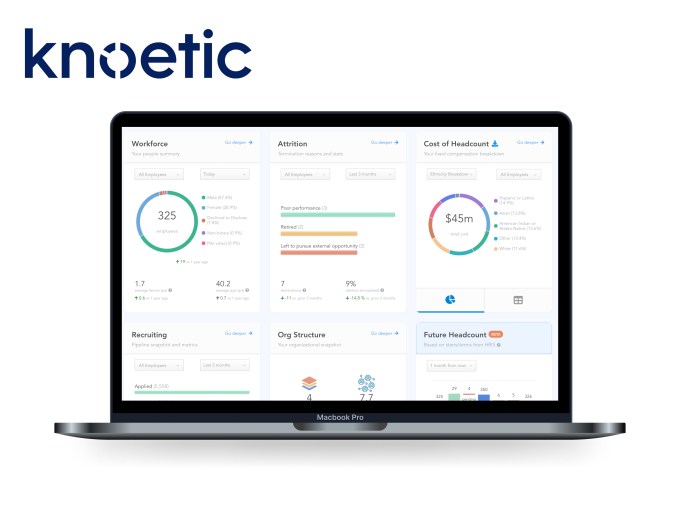
Knoetic, a startup that has built a software analytics platform for chief people officers, emerged from stealth today with $18 million in Series A funding.

For the unacquainted, chief people officers are also known as heads of human resources, or HR.

Accel led the financing, which notably also included participation from over 100 angel investors, including a number of executives, VCs and former and current chief people officers (CPOs) of companies such as Mozilla, Pinterest, Gusto, Box, Twilio, Fitbit, Kickstarter, Looker, Hired and GitHub.

For founder and CEO Joseph Quan, the fact that so many people who worked in the industry put money in the round as angels was huge validation that Knoetic is on the right track.

Founded in March 2020, the New York City-based startup has built a platform that combines a social network and a SaaS analytics tool for chief people officers. When the COVID-19 pandemic hit last year, human resources leaders found themselves in a position they’d never before been — hiring talent remotely and having to work virtually to retain workers that previously came to an office.

Quan himself has worked in a variety of roles in the HR technology space, including at Twine, Knoetic’s predecessor company. 

Image Credits: Knoetic; Founder and CEO Joseph Quan

“The reason we exist was really born out of the pandemic. We noticed in our ecosystem of chief people officers that their role was thrust into the spotlight and it was a really tough time for them, and also a really lonely time,” Quan told TechCrunch. “Everyone was kind of scrambling for answers and we just realized this was a time to actually put together a network that allows all these people to commiserate and tackle some of their hardest questions, and then from that, form the basis for a broader vision.”

Over 1,000 HR professionals are members of Knoetic’s social community, which the company has embedded directly into its people analytics software. The result, Quan said, is an “Insight Engine” designed to give CPOs both quantitative and qualitative insights with the goal of helping them make “smarter, holistic” decisions about their workforce. The network is a referral-only community aimed at giving HR professionals a forum to discuss best practices and their “most pressing challenges,” such as how to navigate the COVID Delta variant and transition to and from remote work, Quan said.

 Chief people officers can also use Knoetic to do things like build board decks and present data to their CEOs. The company also claims the platform can help CPOs improve employee retention, compensation and hiring. 

Image Credits: Knoetic

In a short amount of time, Knoetic has built an impressive customer and community base, including the likes of Lyft, Squarespace, Amplitude, Discord, Dollar Shave Club and Zapier. 

Vas Natarajan of Accel believes that Knoetic is solving “a deep pain point.”

“We see how overstretched people teams are trying to wrangle information to make organizational decisions,” he wrote via email. “Across our best companies is a strong people function backed by great data to help inform all kinds of decisions around compensation, performance, and diversity and inclusion, among other things. Knoetic is uniformly solving this for everyone.”

The startup will use its new capital toward building out new products and hiring. It currently has about 25 employees, and Quan expects that number to grow to “north of 40” by year’s end.

“We want to build the single greatest network for HR professionals and build a dedicated community team,” he said.

Down the line, Quan also envisions creating an analytics engine that is “prescriptive and predictive” and can do things like tell HR leaders what kind of turnover their companies are seeing, what they can do about it and how to improve retention.

“And then it would be predictive as we gather more big data points as more people use the platform,” he added. “Then we could use that data to proactively predict who’s going to be a fast-rising company or who’s going to trip over the next 12 months. We’re starting to build those kinds of models on the back end.”