Year: 2021

10 Aug 2021

Feds dismantle Blue Origin and Dynetics protests of NASA’s SpaceX lunar lander award

Blue Origin and Dynetics are still steaming over NASA’s decision to award only one contract — to SpaceX — to build a Human Landing System for the Artemis program. Their protest of the decision was recently rejected, and now the Government Accountability Office’s arguments, which Blue Origin publicly questioned, are available for all to read. Here are a few highlights from the point-by-point takedown of the losing companies’ complaints.

In case you can’t quite remember (2020 was a long year), NASA originally selected the three companies mentioned for early funding to conceptualize and propose a lunar landing system that could put boots on the Moon in 2024. They suggested the next step would be, if possible, to pick two proposals to move forward with. But when the time for awards rolled around, only SpaceX walked away with a contract.

Dynetics and Blue Origin protested the decision separately, but on similar grounds: first, NASA should have awarded two companies as promised, and not doing so is risky and anti-competition. Second, it should have adjusted the terms of the award process when it learned it didn’t have much budget to set aside for it. Third, NASA didn’t evaluate the proposals fairly, showing a bias to SpaceX and against the others in various ways.

The GAO puts all of these concerns to bed in its report — and in the process makes Blue Origin’s follow-up complaint, that the agency’s “limited jurisdiction” meant it couldn’t adequately address the protests, look like the sour grapes it is.

One and done

Image Credits: SpaceX

As to awarding one rather than two companies a contract, the answer is right there in black and white. The announcement clearly stated multiple times that the whole thing was contingent on having enough money in the first place. NASA may have preferred , hoped, even expected to award two contracts, but it was very clear that it would be awarding “up to two” or “one or more” of them. After all, what if only one met the requirements and the others didn’t? Would NASA be obligated to throw money at an unsuitable applicant? No, and that’s more or less what happened.

From the report:

Even where a solicitation contains an intention to make multiple awards, we have recognized that an agency is not required to do so if the outcome of proposal evaluation dictates that only one contract should be awarded. For example, regardless of an agency’s intention, it cannot, in making contract awards, exceed the funds available.

The GAO explains that the decision-making process at NASA weighted the technical approach the highest, then price, then management (i.e. organization, scheduling, etc.). Each company’s proposal was evaluated independently on each of these characteristics, and the final results were compared. Here’s a top-level summary of the ratings assigned:

Chart showing evaluations for SpaceX, Blue Origin, and Dynetics. SpaceX comes out on top and with the lowest price.

Image Credits: GAO / NASA

And the report again:

The technical approach factor was to be more important than the total evaluated price factor, which in turn was to be more important than the management approach factor; the non-price factors, when combined, were significantly more important than price.

…Contrary to the protesters’ arguments, even assuming a comparative analysis was required, SpaceX’s proposal appeared to be the highest-rated under each of the three enumerated evaluation criteria as well as the lowest priced.

When the budget for NASA was finalized, it left less for the HLS program than expected, and the agency was forced to make some tough choices. Luckily they had a proposal that was as good or better than the others technically (the most important factor), considerably better than the others organizationally, and came in at a very reasonable cost. It was a clear choice to award a contract to SpaceX.

But having done so, NASA found that the cupboard was bare. Even so, Blue Origin argued that it deserved to be contacted about somehow making it work. Perhaps, they suggested, if NASA had come to them to negotiate, they could have put together a proposal that might have looked even better than SpaceX’s. (Jeff Bezos’s brazen after-the-fact $2B offer suggests they had some wiggle room.)

NASA, however, had already concluded otherwise, as the GAO confirms:

…The agency concluded that it was not “insurmountable” to negotiate with SpaceX to shift approximately $[DELETED] in FY2021 proposed milestone payments (or approximately [DELETED] percent of the $2.941 billion total proposed price) to later years to meet NASA’s FY2021 funding limitations. In contrast, the SSA concluded that it was implausible for Blue Origin ($5.995 billion) and Dynetics ($9.082 billion) to materially reduce their significantly higher total proposed prices without material revisions to their respective technical and management approaches…

Redactions notwithstanding, it’s not difficult to see the issue here. While it was conceivable, even reasonable for SpaceX to shift a few hundred million or so around to make the fiscal math work, already questionable at the $3B mark, it was not conceivable that Blue Origin or Dynetics could shave half or more off their costs to meet those same fiscal milestones happen.

As NASA’s selection group explained at the time:

After accounting for a contract award to SpaceX, the amount of remaining available funding is so insubstantial that, in my opinion, NASA cannot reasonably ask Blue Origin to lower its price for the scope of work it has proposed to a figure that would potentially enable NASA to afford making a contract award to Blue Origin.

Blue Origin complained that NASA should have warned them that the budget might lead to restrictions in the selection process, but the GAO simply notes that not only is the federal budget hardly secret, but that the companies waited until after the award was made to raise an issue. Such complaints need to be timely in order to be taken seriously, it wrote, and furthermore there is nothing in the complaints that suggests that even had NASA warned them, anything would have turned out differently.

There is also the question of whether choosing a single provider is “anticompetitive and unduly risky,” as the protests put it. While the GAO admits that “these important questions of policy may merit further public debate,” the complaint is moot since NASA didn’t have the money to do more than one in the first place. As voters and advocates of a generous budget for space exploration, we may say it’s a shame that NASA didn’t have $6B more to play with, but that doesn’t mean the agency’s decision to put the money it had to the best purpose possible was incorrect.

In space, no one can hear you cry

Image Credits: Joe Raedle / Getty Images

Blue Origin and Dynetics alleged that the process was biased in favor of SpaceX in that the various companies were unfairly evaluated for strengths and weaknesses. But the GAO sees these complaints for the fluff that they are.

In one case, Blue Origin complains that the announcement did not specifically require the vehicles to be able to land in the dark. Well, first of all, it does, and second of all, space is dark. If your design doesn’t take that into account, you’re gonna have a bad time out there.

In another instance, the communications systems proposed by Blue Origin and SpaceX both were flagged for not meeting certain requirements — but Blue Origin got a “significant weakness” listed for its system and SpaceX only got a “weakness.” Evidence of preferential treatment, they suggest.

Not so much, says the GAO: “Even a cursory review of the evaluation record demonstrates material differences between the
proposals that support NASA’s different evaluation findings.” In this case four of Blue Origin’s communications links didn’t work as required, and a fifth was a maybe. SpaceX only had two not work right. This sort of substantial difference appeared in each of the objections cited by the complainants.

In fact, the report goes on to say:

We note that Blue Origin fails to rebut any of the analysis presented by the contracting officer with respect to Blue Origin’s or SpaceX’s proposals. In fact, Blue Origin initially challenged the agency’s evaluation of its own proposal, but then affirmatively withdrew that protest ground after receipt of the agency report.

Blue Origin groused that SpaceX got extra points for a design that focused on the crew’s safety, health, and comfort, despite many of the design choices not being explicitly required. The GAO says NASA is well within its discretion as an expert agency to consider these as meritorious — in fact, they call it a “representative example of why discretion is due” in such cases — and really, if you’re objecting on the grounds that the competition’s capsule was too nice, it may be advisable to reconsider your priorities.

Image Credits: Blue Origin

Even had several of the decisions been successfully challenged, it wouldn’t have changed the outcome, the report explains.

SpaceX received the following evaluation totals:

  • Technical: 3 significant strengths; 10 strengths; 6 weaknesses; and 1 significant weakness
  • Management: 2 significant strengths; 3 strengths; and 2 weaknesses

While Blue Origin received the following:

  • Technical: 13 strengths; 14 weaknesses; and 2 significant weaknesses
  • Management: 1 significant strength; 2 strengths; and 6 weaknesses

It’s never a pleasant occasion to find one has been thoroughly beat on practically every factor that counts, but that really seems to be the factor here. Dynetics and its complaint meet the same fate, by the way, but with a bit more rough treatment.

…Even allowing for the possibility that the protesters could prevail on some small subset of their challenges to NASA’s evaluation, the record reflects that NASA’s evaluation was largely reasonable, and the relative competitive standing of the offerors under the non-price factors would not materially change…

The protests are denied.

It’s a pretty brutal documentation of the shortcomings of Blue Origin and Dynetics, and one that would not have been necessary had the companies taken their lumps and accepted that NASA isn’t out to get them. They lost fair and square, and now they look like whiny also-rans instead of ambitious could-bes.

10 Aug 2021

Unity to acquire Parsec in its biggest acquisition to date

Unity, the company behind the super popular 2D/3D engine of the same name, is today announcing plans to make its biggest acquisition to date. Unity says it will acquire Parsec, a remote desktop tool for developers and creatives, for $320 million in cash.

Parsec’s pitch has long been remote desktop access without compromise. Tuned for creatives, it works fine even if your rig has multiple high resolution displays. It’ll stream your work-in-progress artwork without screwing up the colors, and it’ll play friendly with fancier input devices like pressure sensitive drawing tablets.

Parsec began its life back in 2016, initially focused on helping gamers stream games from their powerful PCs to other (generally less powerful) devices. It turns out the same things that made it good for game players — low latency, high-resolution display support, and compatibility with all kinds of different input devices — made it good for game makers as well. After noticing a number of users across the creative industry tapping Parsec to beam into their workstations, the company started rolling out plans and features just for creative teams. When the pandemic sent more teams home and away from their office setups, usage of Parsec took off.

“We believe that, more and more, creators will need to be able to work anywhere” Unity Senior Vice President Marc Whitten told me in a call earlier this week. “They’re going to work in groups that are dispersed by distance, or they’re going to be in a hybrid environment where they might be working in the office sometimes and at home sometimes.”

“I think that’s going to mean that those creators are going to need to have access to the power they need on the glass that they have, wherever they are.” he adds. “And Parsec is a great example of a company that has just deeply innovated in that space.”

Whitten also alluded to this being the beginning of a deeper cloud push for Unity: “I think you’re gonna see that Parsec is a great foundational block for a broad sort of cloud ambition that we have as a company,” he said. “You’re going to see a lot more from us in that particular regards.”

Parsec’s total funding before the acquisition was $33 million, according to Crunchbase. Its most recent funding was a $25 million Series B led by Andreessen Horowitz last December.

Whitten tells me that he doesn’t foresee any changes for existing Parsec users, but couldn’t comment yet on any potential changes to subscriptions/pricing.

10 Aug 2021

What’s driving the global surge in retail media spending?

Most businesses by now are well versed with the consequences of the COVID-19 pandemic: Faltering offline sales, flexible work-from-anywhere options, fluctuating foot traffic with lockdown mandates and e-commerce becoming a channel many brands wished they had built infrastructure for earlier.

As a record number of consumers in Southeast Asia move from shopping malls to online platforms like Shopee, Lazada, Tiki and Tokopedia, the advertising dollars are naturally flowing in. Emerging markets are witnessing the advent of retail media right now.

Amazon paved the way in North America in 2018 by launching Amazon Advertising to become the first bid-and-buy marketplace. BCG now estimates retailers have a $100 billion business opportunity to capture, if they can keep up.

The money is where the consumer is

To understand why retailers will capture more ad spend, it’s important to evaluate what modern day marketing has become.

Is it bus stop advertisements? Bidding on Google keywords or a Clubhouse session? Or is it a viral TikTok video? As the world becomes more connected and the lines between offline and online blur even more, modern day marketing is a mix of all the channels tied to key performance metrics.

The main goal of marketing, no matter the medium, is to highlight a business or product to the right consumers to score a potential sale. And like most things, there is a bad, a good and a much better way of doing things.

E-commerce as an advertising channel is unique, because it encapsulates the entire consumer journey from start to finish, especially as marketplaces continue to steal the share of search from search engines.

Traditional marketing channels were primarily linear TV, radio and print, because the mediums were highly popular at the time. However, with the birth of the internet newer platforms emerged such as email, websites and streaming. Then came the rise of social media and apps that shook up the advertising landscape. But regardless of these shifts, there has always been one constant: The business went where the consumer was.

So when sources of traffic and revenue once again change, let’s say due to a pandemic, the marketing mix follows. In the next 12 months alone, many marketers are planning to decrease spending in cinema, print and out of home (OOH), while the majority will increase budgets in social and search, according to Nielsen.

The search for superior advertising channels

So which channels will benefit as money flows out of outdated buckets? A good indicator is ad revenue trends in mature markets like the U.S. While Google and Facebook remain the dominant advertising players, Amazon has eaten into the duopoly’s ad revenue pie in the U.S., growing its share from 7.8% to 10.3% in 2020 alone, according to eMarketer.

How? Because the most valuable advertising channel is the one that has the most measurable touch points with the consumer.

10 Aug 2021

Product School raises $25M in growth equity to scale its product training platform

Traditional MBA programs can be costly, lengthy, and often lack the application of real world skills. Meanwhile, big global brands and companies who need Product Managers to grow their businesses can’t sit around waiting for people to graduate. And the EdTech space hasn’t traditionally catered for this sector.

This is perhaps why Product School, says it has secured $25 million in growth equity investment from growth fund Leeds Illuminate (subject to regulatory approval) to accelerate its product and partnerships with client companies.

The growth funding for the company comes after bootstrapping since 2014, in large part because product managers (PMs) no longer just inside tech companies but have become sought after across almost virtually all industries.

Product School provides certificates for individuals as well as team training, and says it has experienced and upwelling of business since Covid switched so many companies into Digital ones. It also now counts Google, Facebook, Netflix, Airbnb, PayPal, Uber, and Amazon amongst its customers.

“Product managers have an outsized role in driving digital transformation and innovation across all sectors,” said Susan Cates, Managing Partner of Leeds Illuminate. “Having built the largest community of PM’s in the world validates Product School’s certification as the industry standard for the market and positions the company at the forefront of upskilling top-notch talent for global organizations.”

Carlos Gonzalez de Villaumbrosia, CEO and Founder of Product School, who started the company after moving from Spain, said: “There has never been a better time in history to build digital products and Product School is excited to unlock value for product teams across the globe to help define the future. Our company was founded on the basis that traditional degrees and MBA programs simply don’t equip PMs with the real-world skills they require on the job.”

Product school has also produced the The Product BookThe Proddy Awards and ProductCon.

It’s main competitor is MindTheProduct community and training platform, which has also boostrapped.

10 Aug 2021

Zomato’s losses widen in first quarterly earnings since IPO

Zomato’s losses more than tripled in its first quarterly earnings report since its listing last month as the company’s expenses grew and the pandemic hit the firm’s dining-out business.

The Gurgaon-headquartered firm reported (PDF) a net loss of $48 million in the quarter that ended in June, up from about $13.5 million during the same period last year.

The 12-year-old firm also reported strong revenue growth, moving from $35.7 million to $113.4 million during the aforementioned period as more people in the country began to order food online.

The firm said it delivered more than 100 million food orders last quarter and has surpassed a billion orders in the past six years.

“This is largely on account of non-cash ESOP expenses which have increased meaningfully in Q1 FY22 due to significant ESOP grants made in the quarter pursuant to creation of a new ESOP 2021 scheme. This divergence in reported profit/loss and Adjusted EBITDA will continue going forward,” a blog post signed by top Zomato executives read.

The executive said in the post that the second wave of the coronavirus, which hit the country beginning in April, “significantly impacted the dining-out business in Q1 FY22 reversing most of the gains the industry made in Q4 FY21.”

Zomato’s shares on BSE.

Shares of Zomato, which had a stellar debut on the Indian stock exchanges last month, fell 4% on Tuesday ahead of the results and ended at slightly below the original issue price of $1.68 a share on July 13, which valued Zomato then at $13 billion.

The company said it will hold one call with analysts a year — instead of the typical four — and address questions through blogs and quarterly shareholder letters.

In India, Zomato competes with Swiggy, which is backed by SoftBank and Prosus. Last month, the Indian food delivery startup said it had raised $1.25 billion in a new financing round. SoftBank Vision Fund 2 evaluated Zomato before making its bet on Swiggy, people familiar with the dealflow said.

Both the firms in recent quarters have expanded to new categories including grocery delivery.

Zomato is the first Indian consumer internet startup in the current wave to go public. India’s financial services Paytm and MobiKwik as well as online insurer PolicyBazaar and online beauty products firm Nykaa have filed the paperworks to go public later this year.

10 Aug 2021

VCs are betting big on Kubernetes: Here are 5 reasons why

I worked at Google for six years. Internally, you have no choice — you must use Kubernetes if you are deploying microservices and containers (it’s actually not called Kubernetes inside of Google; it’s called Borg). But what was once solely an internal project at Google has since been open-sourced and has become one of the most talked about technologies in software development and operations.

For good reason. One person with a laptop can now accomplish what used to take a large team of engineers. At times, Kubernetes can feel like a superpower, but with all of the benefits of scalability and agility comes immense complexity. The truth is, very few software developers truly understand how Kubernetes works under the hood.

I like to use the analogy of a watch. From the user’s perspective, it’s very straightforward until it breaks. To actually fix a broken watch requires expertise most people simply do not have — and I promise you, Kubernetes is much more complex than your watch.

How are most teams solving this problem? The truth is, many of them aren’t. They often adopt Kubernetes as part of their digital transformation only to find out it’s much more complex than they expected. Then they have to hire more engineers and experts to manage it, which in a way defeats its purpose.

Where you see containers, you see Kubernetes to help with orchestration. According to Datadog’s most recent report about container adoption, nearly 90% of all containers are orchestrated.

All of this means there is a great opportunity for DevOps startups to come in and address the different pain points within the Kubernetes ecosystem. This technology isn’t going anywhere, so any platform or tooling that helps make it more secure, simple to use and easy to troubleshoot will be well appreciated by the software development community.

In that sense, there’s never been a better time for VCs to invest in this ecosystem. It’s my belief that Kubernetes is becoming the new Linux: 96.4% of the top million web servers’ operating systems are Linux. Similarly, Kubernetes is trending to become the de facto operating system for modern, cloud-native applications. It is already the most popular open-source project within the Cloud Native Computing Foundation (CNCF), with 91% of respondents using it — a steady increase from 78% in 2019 and 58% in 2018.

While the technology is proven and adoption is skyrocketing, there are still some fundamental challenges that will undoubtedly be solved by third-party solutions. Let’s go deeper and look at five reasons why we’ll see a surge of startups in this space.


Containers are the go-to method for building modern apps

Docker revolutionized how developers build and ship applications. Container technology has made it easier to move applications and workloads between clouds. It also provides as much resource isolation as a traditional hypervisor, but with considerable opportunities to improve agility, efficiency and speed.

10 Aug 2021

Twitter suspends Marjorie Taylor Greene temporarily for spreading vaccine misinformation

Twitter temporarily suspended Rep. Marjorie Taylor Greene on Tuesday after the Georgia Republican posted a tweet that claimed vaccines don’t reduce the spread of Covid-19.

“These vaccines are failing & do not reduce the spread of the virus & neither do masks,” Greene tweeted, contradicting the scientific community and calling for the FDA to refuse to approve vaccines. Greene’s tweet remains up on her Twitter feed, but it’s paired with a misinformation warning from the company that points users to information from the CDC.

Twitter told TechCrunch the tweet was “labeled in line with [Twitter’s] COVID-19 misleading information policy” and will result in Greene’s account being frozen in read-only mode for seven days in light of “repeated violations” of Twitter’s platform rules. Last month, Greene was suspended for 12 hours for falsely claiming that the virus posed little threat to healthy people under the age of 65.

The new suspension is Greene’s fourth slap on the wrist from Twitter under its current strike-based system for Covid-19-related misinformation. Greene is a repeat rule-breaker on the platform, which puts her account in jeopardy of a permanent ban if she offends a fifth time after her account is reinstated.

In spite of a widely available trio of vaccines proven to dramatically and effectively reduce the severity of Covid-19 infections or prevent them outright, Covid cases are on the rise in the U.S. in a major way. Florida continues to break its own record for daily infections, topping the numbers the state saw during the pre-vaccine months of 2020.

Online misinformation continues to play a major role in discouraging Americans from seeking the vaccine, even with the highly contagious delta variant on the rise. In states like Alabama, where vaccination rates are some of the lowest in the nation, those numbers have begun trending up as residents realize how vulnerable they are to the new variant, which is ravaging pockets of the population that haven’t yet sought the shot.

10 Aug 2021

OpenAI upgrades its natural language AI coder Codex and kicks off private beta

OpenAI has already made some big changes to Codex, the AI-powered coding assistant the company announced last month. The system now accepts commands in plain English and outputs live, working code, letting someone build a game or web app without so much as naming a variable. A few lucky coders (and, one assumes, non-coders) will be able to kick the tires on this new Codex API in a free private beta.

Codex is best thought of as OpenAI’s versatile language engine, GPT-3, but trained only on code instead of ordinary written material. That lets it do things like complete lines of code or entire sections, but when it was announced it wasn’t really something a non-coder would be able to easily interact with.

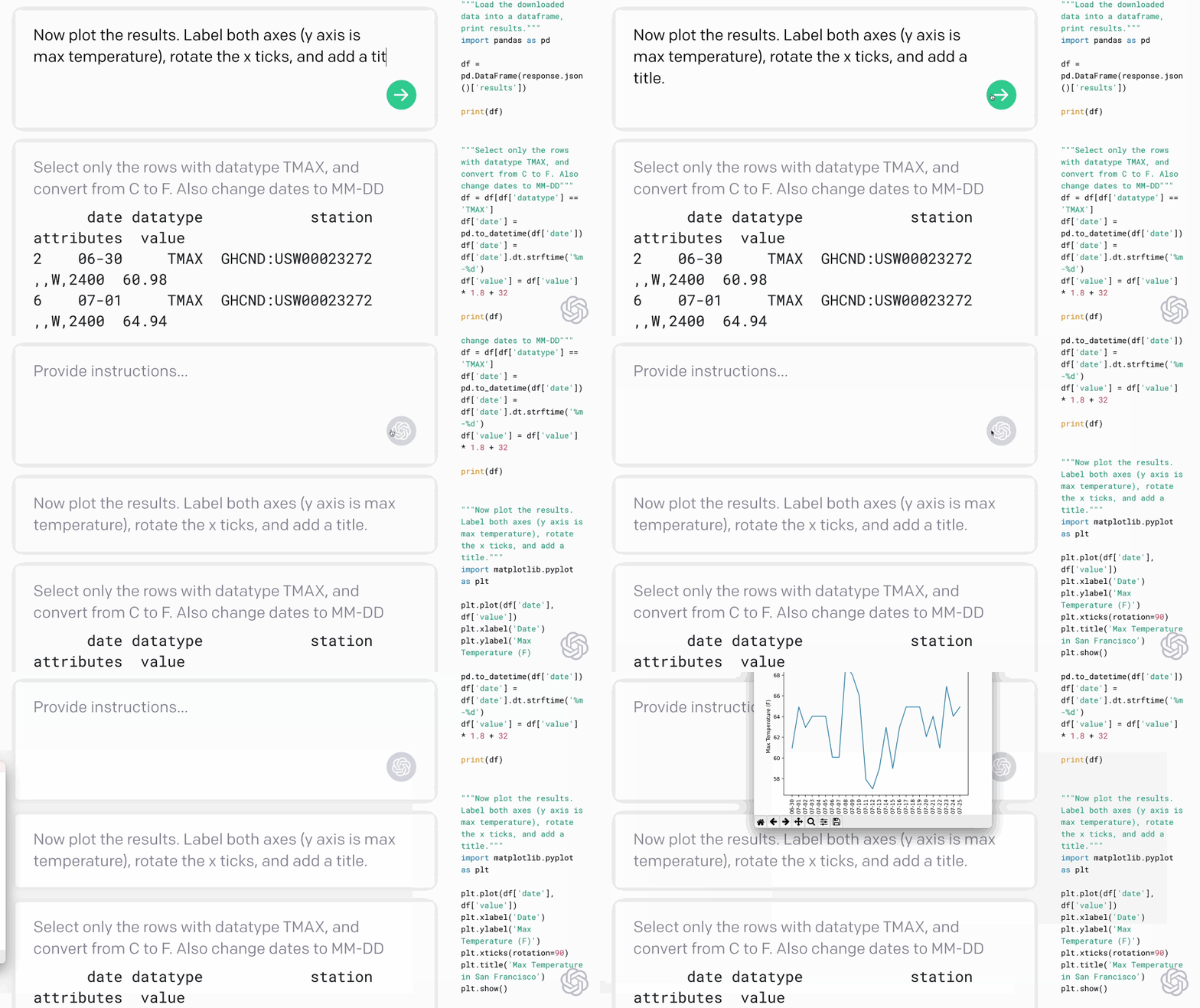
That’s changed with this new API, which interprets ordinary, everyday requests like “make the ball bounce off the sides of the screen” or “download that data using the public API and sort it by date” and puts out working code in one of a dozen languages.

I was treated to a live demo in which OpenAI co-founders Greg Brockman (CTO) and Wojciech Zaremba (Codex lead) built a simple game from scratch and explained what was going on behind the curtain.

“Programming is about having a vision and dividing it into chunks, then actually making code for those pieces,” Brockman explained. The intention with Codex is to let coders spend more time on the first part than the second. After all, a huge amount of code is duplicating or outright copying what others have done before — it can be creative, of course, but no one is going to exercise their imagination in doing basic things like deploying a web server for testing a bit of code. Brockman did just that with a simple line — “create a web page that says that” or some such.

OpenAI's Codex AI collects data and turns it into a live graph.

Image Credits: OpenAI

A second later there were a dozen lines of Javascript doing just that in a totally standard way.

“This is the worst part of programming,” said Brockman. “I’ve written this kind of code probably a couple dozen times, and I always forget exactly how it works. I don’t know these APIs, and I don’t have to. You can just do the same things easier, with less keystrokes or interactions.”

Because Codex is trained on basically all the public code on GitHub, among other repositories, it’s aware of all the standard practices, the 50 or 100 times someone includes a web server, keyboard controls, or object manipulations and animations in their code. And because the natural language side has all of GPT-3’s usual understanding, it gets when you say “make it smaller and crop it” and then “have its horizontal position controlled by the left and right arrow keys” you’re referring to the same “it.”

It also keeps its own work in mind, several kilobytes worth of coding context for itself — so it knows the naming conventions it must stick to, the existing bounds and requests, and other info that the user’s input would have implied.

It’s also aware of generalities embedded in the code corpus. For instance, when Brockman told it to “make the boulder fall from the sky,” the system didn’t ask what the “sky” is even though it hadn’t been defined on the largely blank canvas. Not only did it have the boulder fall from the top of the screen, but the falling speed accelerated like an object normally would — because its best guess at what “falling” and “sky” mean from other uses and context.

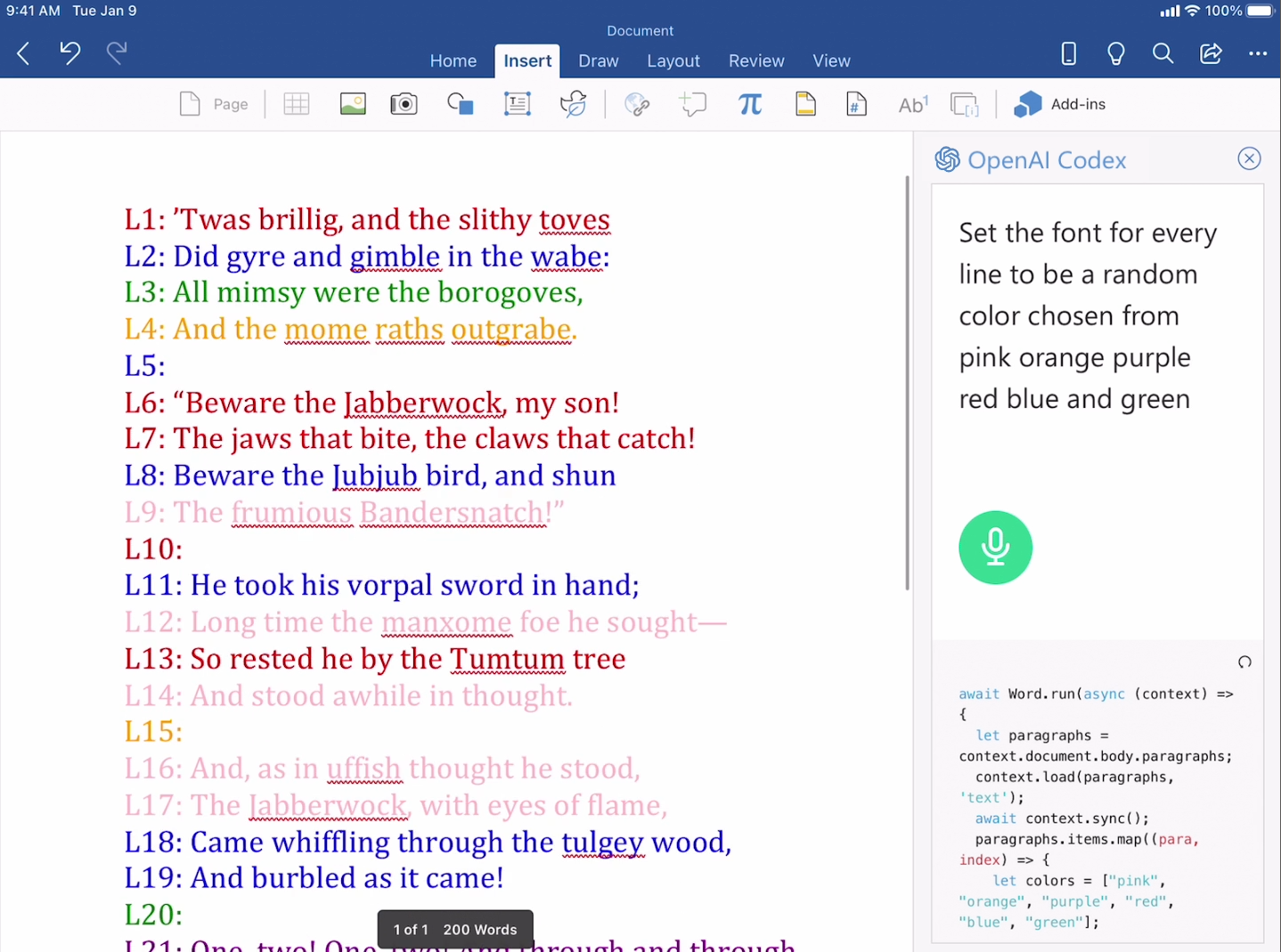
OpenAI's Codex AI modifies a Word document according to simple instructions.

Image Credits: OpenAI

“We think it provides a new way to interact with existing software,” said Zaremba, who built a limited version of this for his PhD thesis years ago, while they demoed a Codex plug-in for Microsoft Word. Automation exists for many tasks in word processors, of course, but what if you get a weird formatting issue and you want to fix 100 different instances? Type “make all the text the same size and font, and make double spaces single” and it’ll do that, snipping out stray styles and picking the most likely size and font considered to be “normal.” Then type “make all the headings 24-point and bold” and it zooms through doing that, and so on.

It’s worth noting here that this sort of thing is convenient for many, but crucial to those who lack the ability to do these things due to things like disabilities. If you’re operating your word processor using voice commands or a joystick, being able to perform complex tasks like the above is extremely helpful. A blind coder, like anyone else, can patch together a standard public test server, but the process of skimming Stack Overflow, grabbing the best snippet, checking the syntax, changing the relevant variables and so on will almost certainly be a longer one.

And for those working within the confines of syntax and conventions handed down from on high, Codex can easily be made to reflect those by exposing the model to the documentation. Codex can also convert and port code from one language to another — much the same way a translation engine turns Spanish into French.

Brockman said that, as with GPT-3, they are only scratching the surface of what’s possible and are hoping to be surprised by what developers come up with (after all, OpenAI didn’t predict AI Dungeon). The beta will be private, like the one for GPT-3, but devs can apply and describe their project and the Codex team will review them for inclusion. Eventually the API will be a paid public one, but the timing and pricing are still to be determined on that.

10 Aug 2021

FEMA just tested the U.S. national emergency alert system

emergency alert

FEMA will test its national emergency alert system later this week. Image: Getty Images

Did you hear it? FEMA just ran its first nationwide test of the U.S. emergency alert system since the pandemic.

The Federal Emergency Management Agency, or FEMA, tested both the Emergency Alert System (EAS), which broadcasts an emergency tone and message on televisions and radios, and the Wireless Emergency Alerts (WEA), a newer system that sends emergency notifications to smartphones. This was the second nationwide test of the WEA after its debut in 2018, and the first test for all U.S. cell phones who chose to opt-in to receive test alerts.

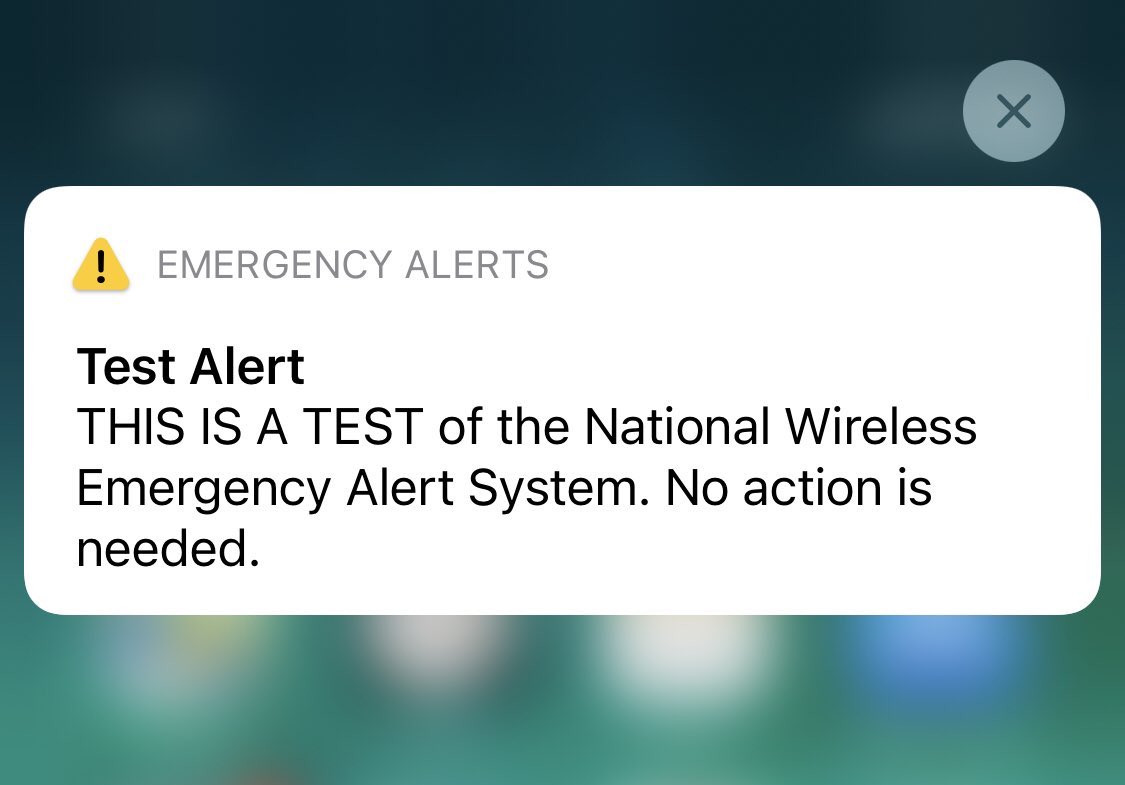
The test began around 2:20 p.m. ET. If you opted-in to the test, you likely got a message on your phone that said: “This is a test of the National Wireless Emergency Alert System. No action is needed.” (The FCC explains how to opt-in to test alerts.)

For the first time, the WEA test sent the same test message in Spanish to phones that have Spanish set as the default language.

This is what the test WEA emergency alert looks like. Image Credits: WA Emergency Management (opens in a new window)

Since the last nationwide test in 2019, FEMA said it has improved WEA to send longer, detailed messages to the majority of phones that support it. The update also allows authorities to include tappable links, like web addresses.

FEMA runs these tests every year or two to ensure the system is working properly. It’s no small task: A national emergency alert system designed to broadcast the same message to potentially hundreds of millions of people at any given time is fraught with technological hurdles that require close co-operation from the cell carriers and broadcast networks.

The EAS system has been around since the late 1990s, but WEA was developed in more recently as more Americans rely on their phones. WEA alerts, like EAS alerts, are designed to be sent by local and state authorities for public safety alerts, missing children and imminent threats, such as severe weather. More recently, FEMA rolled out “presidential alerts,” which are supposed to be sent to every phone in the U.S. in the event of a national emergency. Presidential alerts, unlike other alerts, can be issued by the sitting president for any reason, and Americans cannot opt out.

WEA broadcasts emergency notifications through the cell towers of an affected area — such as an area about to be hit by a storm — rather than sending tens of millions of text messages, which would grind the cell networks to a halt. The alerts are created by local, state or federal authorities and are authenticated by FEMA through the Integrated Public Alert & Warning System, or IPAWS, and then passed to cell carriers to deliver the emergency alert.

The emergency alert system, though, is far from perfect. In 2018, an erroneous alert sent to Hawaii residents warned of an imminent ballistic missile threat,” and that “this is not a drill.” Minutes later, the alert was canceled. The false warning came as tensions between the U.S. and North Korea were at an all-time high, during which Pyongyang was regularly test-firing rockets used for its nuclear weapons program.

Security experts have also long warned that the EAS systems pose security risks. Last year, researchers found dozens of internet-connected, special-purpose servers , used by television and radio stations to interrupt their broadcasts to relay an emergency alert, which they said could allow a hacker to break in and compromise the servers.

10 Aug 2021

44.01 secures $5M to turn billions of tons of carbon dioxide to stone

Reducing global greenhouse gas emissions is an important goal, but another challenge awaits: lowering the levels of CO2 and other substances already in the atmosphere. One promising approach turns the gas into an ordinary mineral through entirely natural processes; 44.01 hopes to perform this process at scale using vast deposits of precursor materials and a $5M seed round to get the ball rolling.

The process of mineralizing CO2 is well known among geologists and climate scientists. A naturally occurring stone called peridotite reacts with the gas and water to produce calcite, another common and harmless mineral. In fact this has occurred at enormous scales throughout history, as witnessed by large streaks of calcite piercing peridotite deposits.

Peridotite is normally found miles below sea level, but on the easternmost tip of the Arabian peninsula, specifically the northern coast of Oman, tectonic action has raised hundreds of square miles of the stuff to the surface.

Talal Hasan was working in Oman’s sovereign investment arm when he read bout the country’s coast having the largest “dead zone” in the world, a major contributor to which was CO2 emissions being absorbed by the sea and gathering there. Hasan, born into a family of environmentalists, looked into it and found that, amazingly, the problem and the solution were literally right next to each other: the country’s mountains of peridotite, which theoretically could hold billions of tons of CO2.

Around that time, in fact, the New York Times ran a photo essay about Oman’s potential miracle mineral, highlighting the research of Peter Kelemen and Jeurg Matter into its potential. As the Times’ Henry Fountain wrote at the time:

If this natural process, called carbon mineralization, could be harnessed, accelerated and applied inexpensively on a huge scale — admittedly some very big “ifs” — it could help fight climate change.

That’s broadly speaking the plan proposed by Hasan and, actually, both Kelemen and Matter, who make up the startup’s “scientific committee.” 44.01 (the molecular weight of carbon dioxide, if you were wondering) aims to accomplish mineralization economically and safely with a few novel ideas.

First is the basic process of accelerating the natural reaction of the materials. It normally occurs over years as CO2 and water vapor interact with the rock — no energy needs to be applied to make the change, since the reaction actually results in a lower energy state.

“We’re speeding it up by injecting a higher CO2 content than you would get in the atmosphere,” said Hasan. “We have to drill an engineered borehole that’s targeted for mineralization and injection.”

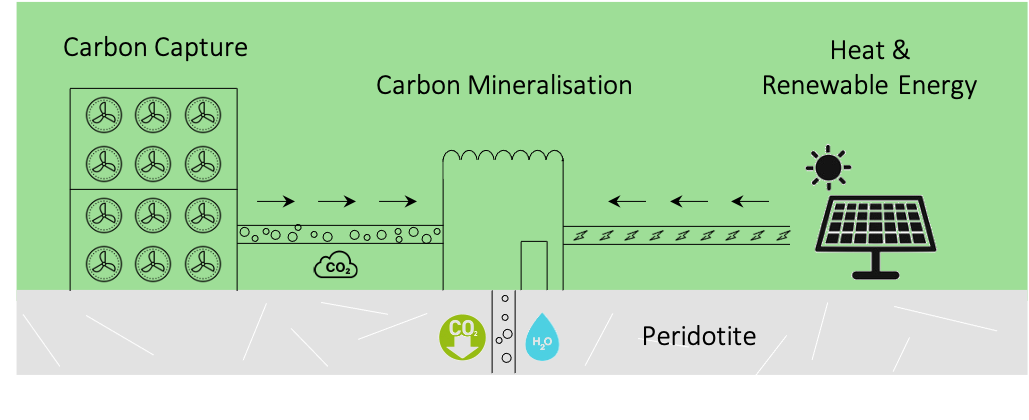
Diagram showing how carbon can be sequestered as a mineral.

Image Credits: 44.01

The holes would maximize surface area, and highly carbonated water would be pumped in cyclically until the drilled peridotite is saturated. Importantly, there’s no catalyst or toxic additive, it’s just fizzy water, and if some were to leak or escape, it’s just a puff of CO2, like what you get when you open a bottle of soda.

Second is achieving this without negating the entire endeavor by having giant trucks and heavy machinery pumping out new CO2 as fast as they can pump in the old stuff. To that end Hasan said the company is working hard at the logistics side to create a biodiesel-based supply line (with Wakud) to truck in the raw material and power the machines at night, while solar would offset that fuel cost at night.

It sounds like a lot to build up, but Hasan points out that a lot of this is already done by the oil industry, which as you might guess is fairly ubiquitous in the region. “It’s similar to how they drill and explore, so there’s a lot of existing infrastructure for this,” he said, “but rather than pulling the hydrocarbon out, we’re pumping it back in.” Other mineralization efforts have broken ground on the concept, so to speak, such as a basalt-injection scheme up in Iceland, so it isn’t without precedent.

Third is sourcing the CO2 itself. The atmosphere is full of it, sure, but it’s not trivial to capture and compress enough to mineralize at industrial scales. So 44.01 is partnering with Climeworks and other carbon capture companies to provide an end point for their CO2 sequestration efforts.

Plenty of companies are working on direct capture of emissions, be they at the point of emission or elsewhere, but once they have a couple million tons of CO2, it’s not obvious what to do next. “We want to facilitate carbon capture companies, so we’re building the CO2 sinks here and operating a plug and play model. They come to our site, plug in, and using power on site, we can start taking it,” said Hasan.

How it would be paid for is a bit of an open question in the exact particulars, but what’s clear is a global corporate appetite for carbon offsetting. There’s a large voluntary market for carbon credits beyond the traditional and rather outdated carbon credits. 44.01 can sell large quantities of verified carbon removal, which is a step up from temporary sequestration or capture — though the financial instruments to do so are still being worked out. (DroneSeed is another company offering a service beyond offsets that hopes to take advantage of a new generation of emissions futures and other systems. It’s an evolving and highly complex overlapping area of international regulations, taxes, and corporate policy.)

For now, however, the goal is simply to prove that the system works as expected at the scales hoped for. The seed money is nowhere near what would be needed to build the operation necessary, just a step in that direction to get the permits, studies, and equipment necessary to properly perform demonstrations.

“We tried to get like minded investors on board, people genuinely doing this for climate change,” said Hasan. “It makes things a lot easier on us when we’re measured on impact rather than financials.” (No doubt all startups hope for such understanding backers.)

Apollo Projects, a early stage investment fund from Max and Sam Altman, led the round, and Breakthrough Energy Ventures participated. (Not listed in the press release but important to note, Hasan said, were small investments from families in Oman and environmental organizations in Europe.)

Oman may be the starting point, but Hasan hinted that another location would host the first commercial operations. While he declined to be specific, one glance at a map shows that the peridotite deposits spill over the northern border of Oman and into the eastern tip of the UAE, which no doubt is also interested in this budding industry and, of course, has more than enough money to finance it. We’ll know more once 44.01 completes its pilot work.