Year: 2021

09 Aug 2021

LawVu, a cloud-based platform for in-house legal teams, raises $17M NZD from Insight Partners

In-house legal teams play a critical role in companies, but a lot of them don’t have the same kind of technology as their counterparts in sales or finance. Instead, they often rely on email, shared inboxes and spreadsheets. LawVu gives them a cloud-based platform to share legal advice, documents, communicate with each other or external counsel and create reports for the rest of the company, including the C-suite. “LawVu is to legal what Salesforce is to sales teams,” co-founder and chief strategy officer Tim Boyne told TechCrunch in an email.

The Tauranga, New Zealand-based company announced today that it has raised $17 million NZD (about $11.9 million USD) in Series A funding led by Insight Partners, the venture firm known for its ScaleUp program for growth-stage startups, with participation from returning investor AirTree Ventures. Its previous funding was a seed round of about $1.8 million USD led by Shasta Ventures and AirTree, announced in May.

LawVu was founded in 2015 by Boyne, who spent over a decade working in IT and operations at law firms, and Sam Kidd, a SaaS project management expert. Since LawVu was designed for distributed teams and remote workers, adoption increased dramatically in 2020 during the COVID-19 pandemic. LawVu’s annual recurring revenue tripled in 2020 and is continuing to grow. While it has users in 30 countries, about two-thirds of its recurring revenue now comes from the United States and Australia, with clients like Telstra, AMP, Linktree, Expedia, PwC and Instacart.

The company plans to hire key leadership roles in the U.S. for its global go-to-market strategy and open U.S. offices as it continues developing LawVu’s technology.

LawVu is used by in-house legal teams ranging from one person to more than 300. Its fastest adoption is coming from teams of five to 500 legal professionals.

The startup serves in-house legal teams, instead of law firms, because “in-house lawyers have very different incentives and objectives to their private practice peers. This creates a vastly different set of needs for in-house lawyers to be effective at their jobs, particularly on the technology front,” Boyne said.

For example, private practice lawyers focus on specific projects, charging clients on time spent. In contrast, in-house lawyers have to balance “reactive work,” or what their company asks for, and “proactive work,” or anticipating the business’ needs and reducing risks.

LawVu’s cloud platform serves as a “legal workspace” that combines all the tech tools in-house legal teams need. For example, it lets them manage matter (or legal issues that can include advice requests, contract executions, M&A transactions or litigation), contracts, documents, e-billing and outsourced work.

For in-house legal teams, LawVu’s analytics helps the rest of their company understand exactly what they do by providing metrics using data that is usually tucked away in email inboxes or a salesperson’s files, Boyne said.

“Legal work is largely invisible. Unlike other industries, legal is at the very beginning of its data journey,” Boyne said. He added, “as lawyers migrate their work into our workspace, everything is able to be captured as data. For the first time, the legal function now has the ability to see demand, types of work, team capacity, future hiring needs, what law firms are performing well, even process areas to automate with other tools.”

In addition to helping in-house legal teams become more productive, LawVu also helps them prove their value to decision makers. Boyne explained that legal teams are often overlooked because they are viewed as cost centers which do not directly add to a company’s profit, and who come in at the end of a project or decision.

“Typically as a business scales really fast, the legal team can be left behind with the capacity to only fight fires and no time to engage and add much needed strategic value. If you don’t have the data to back up the value and work you are doing, it becomes very hard to get more resources when needed, be this tech or people,” Boyne said.

“LawVu workspace allows them to streamline their service, have information at their fingertips, deliver outcomes quickly, measure and demonstrate value, all freeing them up to truly become a valued member of the business leadership team.”

Insight Partners managing director Rachel Geller will join LawVu’s board. In a statement, she said, “LawVu’s global growth speaks volumes to its future as a business and ability to provide high-value outcomes to legal teams. Its combination of intuitive user experience and excellent customer feedback make LawVu stand out in the legal tech industry.”

09 Aug 2021

Siga secures $8.1M Series B to prevent cyberattacks on critical infrastructure

Siga OT Solutions, an Israeli cybersecurity startup that helps organizations secure their operations by monitoring the raw electric signals of critical industrial assets, has raised $8.1 million in Series B funding.

Siga’s SigaGuard says its technology, used by Israel’s critical water facilities and the New York Power Authority, is unique in that rather than monitoring the operational network, it uses machine learning and predictive analysis to “listen” to Level 0 signals. These are typically made up of components and sensors that receive electrical signals, rather than protocols or data packets that can be manipulated by hackers.

By monitoring Level 0, which Siga describes as the “richest and most reliable level of process data within any operational environment,” the company can detect cyberattacks on the most critical and vulnerable physical assets of national infrastructures. This, it claims, ensures operational resiliency even when hackers are successful in manipulating the logic of industrial control system (ICS) controllers.

Amir Samoiloff, co-founder and CEO of Siga, says: “Level 0 is becoming the major axis in the resilience and integrity of critical national infrastructures worldwide and securing this level will become a major element in control systems in the coming years.”

The company’s latest round of funding — led by PureTerra Ventures, with investment from Israeli venture fund SIBF, Moore Capital, and Phoenix Contact — comes amid an escalation in attacks against operational infrastructure. Israel’s water infrastructure was hit by three known cyberattacks in 2020 and these were followed by an attack on the water system of a city in Florida that saw hackers briefly increase the amount of sodium hydroxide in Oldsmar’s water treatment system. 

The $8.1 million investment lands three years after the startup secured $3.5 million in Series A funding. The company said it will use the funding to accelerate its sales and strategic collaborations internationally, with a focus on North America, Europe, Asia, and the United Arab Emirates. 

Read more:

09 Aug 2021

Moove raises $23M to create flexible options for drivers to own cars in Africa

Africa is home to more than a billion people where a majority have limited or no access to vehicle financing. In fact, the continent has the lowest per capita vehicle ownership in the world. In 2019, Africa had fewer than 900,000 new vehicle sales. The U.S. sold more than 17 million new cars that same year.

In Nigeria, owning a car is a luxury very few people can afford. It is a similar case across Africa where car owners often recycle used cars between themselves because of the difficulty of accessing new ones. Moove, an African mobility company with a fintech play, wants to change that and is raising $23 million in Series A to scale rapidly across the continent.

Moove was founded by Ladi Delano and Jide Odunsi in 2019. In an interview with TechCrunch, Delano said he and Odunsi, whilst trying to figure out the problems to solve in Nigeria after years of running successful businesses, were left startled by the figures highlighted above: Less than a million new cars sold in an entire continent and over 17 million in the U.S. alone.

“It became clear to us that people aren’t buying cars in Africa because there’s no access to finance. When you look anywhere else in the world, you have financing in most parts of the developed world when you try to buy a car. It’s that way in the UK, or Europe and the US. And that’s what’s driving mobility drive and vehicle sales,” Delano said during the interview.

The founders saw it as a huge task to address this deficit and figured that deploying an asset financing model was the go-to approach. Moove says it is democratizing vehicle ownership by employing a revenue-based vehicle financing model. However, this applies to only a subset of the driving population across the continent: mobility entrepreneurs.  

Why mobility entrepreneurs instead of the overall populace? Delano tells TechCrunch that inasmuch as Moove is changing how people have access to new cars in Africa, he wants the company to solve some of the unemployment problems facing the continent, even more so in Nigeria.

So instead of providing the service for individuals from all spheres of life who cannot guarantee a payback, why not target mobility entrepreneurs who would use the opportunity to work and, in turn, generate income to pay back.

Mobility entrepreneurs include drivers who work in the mobility space (car-hailing, ride-hailing, bus-hailing, among others). Although they make up a small part of Africans who need Moove’s services, Delano says the market for mobility entrepreneurs is enormous.

Moove is Uber’s exclusive car financing and vehicle supply partner in sub-Saharan AfricaThe company embeds its alternative credit-scoring technology, allowing access to proprietary performance and revenue analytics to underwrite loans. It provides loans to these drivers by selling them new vehicles and financing up to 95% of the purchase within five days of sign up. They can choose to pay back their loans over 24, 36, or 48 months, using a percentage of the weekly revenue generated while driving on Uber.

Moove’s loan repayment process is more suitable to drivers than what traditionally exists in the market. Nigerian banks, for instance, are known to collect a 10-50% deposit from drivers; Moove says it charges 5%. The net effective annual interest rate also differs significantly. Nigerian banks charge between 20 to 25%; however, Moove runs on an 8-13% rate.

Also, when you consider the tenure of a vehicle financing loan, Nigerian banks rarely give a repayment duration of more than two years. Moove’s maximum duration is four years. In the long run, Delano says the company wants to extend the repayment duration to five years, a span with more parity to the West.

That said, Moove is looking to add financing to other vehicle classes and types in the coming months, including buses and trucks.

Though Moove was founded in 2019, it didn’t fully launch until June 2020. In a full year of operation, Moove has scaled aggressively. With headquarters in the Netherlands, the company counts Lagos, Accra, Johannesburg as cities where it operates. Moove has over 19,000 drivers using its platform, while up to 13,000 are on its waitlist. Moove-financed cars have also completed over 850,000 Uber trips, and Delano says the company has grown 60% month-on-month since last year.

Moove raised a $5.5 million seed round last year. The majority of the funding came from the founders and Iyinoluwa Aboyeji, c-founder of Andela and Flutterwave, and a key partner at the company. In addition to its $23 million Series A, Moove also revealed that it raised $40 million in debt financing, bringing Moove’s total funding to $68.5 million.

Speedinvest and Left Lane Capital led the Series A round. Other investors like DCM, Clocktower Technology Ventures, thelatest.ventures, LocalGlobe, Tekton, FJ Labs, Palm Drive Capital, Kora Capital, KAAF Investments, Class 5 Global, and Victoria van Lennep, co-founder of Lendable, Verod,  Kepple Africa Ventures, and one of Moove’s existing lenders, Emso Asset Management, also joined the round. Moove’s investment is the first for many of its U.S. backers in this round.

“With Ladi and Jide at the helm of a world-class team, and their unique approach to vehicle financing, Moove has quickly established itself as one of the most exciting tech companies in Africa,” said the general partner at Speedinvest, Stefan Klestil. “The company’s expansion to three cities in under 12 months demonstrates the huge demand for vehicle financing in Africa, where just five percent of new cars are purchased with financing, compared to 92 percent in Europe.”

Delano and Odunsi are British-born Nigerians educated at the London School of Economics, Oxford University, and MIT. Delano has always been an entrepreneur. Odunsi, on the other hand, was an investment banker at Goldman Sachs and a management consultant at McKinsey.

Both reconnected years after (since parting ways in their teens) to run a venture studio called Grace Lake Partners with thick they have built three non-tech successful businesses in Africa in the past decade. Moove is their first tech business, and Delano calls it the fastest-growing he has ever run.

The Series A funding will allow Moove to grow and expand into new markets. It gives the company ammunition to develop and launch new products and services geared towards gaining more share in a competitive market where Nigeria’s Autochek and South Africa’s FlexClub are making significant strides.

Delano believes what gives Moove an edge over other companies is its trademark of getting drivers to access new cars instead of used ones. He also adds that the company is moving towards creating electric and hybrid vehicle fleets. He cites helping mobility entrepreneurs who need to have fuel-efficient cars and climate change as reasons for creating this new product line.

But how will EVs be affordable for the average Uber driver in Africa? Delano argues that with Moove’s strong bargaining power with its OEM partners and the debt financing raised, Moove can buy new EV cars and resell them at a lower price to thousands of drivers. The aim is to ensure that at least 60% of the vehicles it finances are electric or hybrid in the coming years. The company is also trying to drive gender inclusion by increasing the number of female drivers using its platform to 50%.

One interesting bit in Moove’s imminent plans is creating wallets for drivers who do not have bank accounts to make and accept payments. The feature is live only in Ghana and will be coming to other markets in no distant time.

“Moove’s technology is fundamentally changing access to mobility and empowering thousands to earn a new source of income,” said managing partner at Left Lane Capital, Dan Ahrens. “As we look ahead, the potential for that technology and the Moove team to expand even further is very exciting. They have the opportunity to become a full-service mobility fintech and expand their offerings to insurance and other financial services.”

09 Aug 2021

India’s UpGrad enters unicorn club with $185 million fundraise

UpGrad, a Bangalore-based startup that specializes in higher education and upskilling courses, said on Monday it has raised $185 million in a new financing round that valued it at $1.2 billion.

Singapore’s Temasek, the World Bank’s International Finance Corporation, and IIFL financed the new round.

“We are pleased with the investor interest ever since we opened up for fundraise, and had our maiden raise from Temasek, followed by IFC and IIFL in the last 60 days,” said Ronnie Screwvala, cofounder and chairperson of upGrad.

Screwvala, who became famous after producing several Bollywood blockbusters, said on Monday that the startup will deploy the fresh funds to explore several merger and acquisition opportunities.

This is a developing story. More to follow…

09 Aug 2021

Two months after its Series A, Pintu gets $35M in new funding led by Lightspeed

Just two months after its last funding announcement, Indonesian crypto assets platform Pintu has closed a $35 million Series A+. The new round was led by Lightspeed Ventures, with participation from returning investors like Alameda Ventures, Blockchain.com Ventures, Castle Island Ventures, Coinbase Ventures, Intudo Ventures and Pantera Capital.

Pintu’s previous funding, a $6 million Series A led by Pantera, Intudo and Coinbase Ventures, was announced in late May. Pintu is the latest investment app in Southeast Asia to quickly raise a much larger follow-on round as interest in retail investing grows. Other examples include Bibit, Ajaib and Syfe.

Andrew Adjiputro, Pintu’s chief operating officer, told TechCrunch that Pintu raised a Series A+, instead of a Series A extension or Series B, because its focus on product development and execution is still the same. “With the Coinbase IPO and a lot of new users onboarding, we think it’s the right time for us to raise a larger round to finance faster growth,” he said. “It’s good momentum for us to launch new products and grab the market.”

Pintu plans to use its Series A+ on “aggressive” hiring for all its teams and rolling out new features and products. During the first half of 2021, Pintu says app downloads grew by 3.5x through organic growth, while active traders on the platform increased by 4x.

The platform currently offers trades on 16 cryptocurrencies, with plans to add more coins, including NFT tokens.

Adjiputro said Coinbase’s successful initial public offering in April helped fuel interest in crypto trading, especially among first-time investors.

“They became curious and the bread and butter of our business is essentially education,” said Adjiputro. “We have a lot of education on our platform and it attracts this new breed of investors who want to learn more.”

While the rate of retail investment in Indonesia is still low, its growing quickly because of a confluence of factors, including people’s desire to diversify and increase their assets during the pandemic.

For many of Pintu’s users, the app was their first introduction to investing instead of stocks, Adjiputro said. The company recently surveyed current users, asking about the top five asset classes they are invested in. Crypto came in third after mutual funds and digital gold, and before stocks at number four.

The preference for crypto over stocks is echoed in figures released by the Indonesian Ministry of Trade, which showed that as of June 2021, there were over 6.6 million crypto investors in Indonesia, or about triple the 2.2 million public equity investors in the country.

Pintu is a licensed crypto broker under the Indonesian Commodity Futures Trading Regulatory Agency (BAPPEBTI). It has a low minimum investment rate of 11,000 IDR, or about 75 cents USD, making more attractive to new investors.

Timothius Martin, the company’s chief marketing officer, was a first-time investor when he started using Pintu. He told TechCrunch that the number one draw was accessibility. “It’s easy to start investing and also withdraw assets. In Indonesia, we are now at a stage where people have heard about crypto, about Bitcoin, are very interested and may already want to invest, but there are not many options that are easy enough for them to understand.”

Instead of encouraging users to make an investment when the open the app for the first time, Pintu presents them with educational materials. For example, one of its features is Pintu Academy, a collection of articles and videos. While Pintu’s target demographic is millennials, it’s also attracting older demographics, including people who have traded other assets, like stocks, but want to learn more about the fundamentals of crypto trading.

Adjiputro said Pintu’s focus on education is what differentiates from other Indonesian crypto platforms like Indodax and Tokocrypto.

The company is getting ready to launch new features, like Pintu Earn, a crypto asset account that lets users earn interest on a variety of crypto assets, and e-wallet integration for easier deposits and withdrawals.

It’s also deciding what coins to add next. “We’re very selective in terms of the coins we introduce, because this is a platform for first-time investors and beginners, so we want to protect them, not only in terms of our UI, but also the selection of coins we have,” Martin said.

Pintu’s criteria for new coins include ones that have a high market cap, meaning adoption is already relatively mainstream. It also looks at how long a coin has been around and its liquidity.

Pintu plans to focus on expanding in Indonesia before entering other Southeast Asian markets.

In a statement, Lightspeed partner Hemant Mohapatra said, “Lightspeed has invested in over 17 crypto and blockchain companies globally including FTX, Blockchain.com, Offchain Labs and more. We believe crypto is at an inflection point to become an important asset class globally, and will give rise to massive companies that will become regional leaders. Pintu has created the strongest market brand, best user experience and hands down one of the strongest teams we’ve ever come across in this market.”


09 Aug 2021

How to claim a student discount for Extra Crunch

Students can get access to Extra Crunch at a discounted rate of $50/year (plus tax).  Here’s how to claim the discount:

  • Use a .edu or university email address and send a message to our customer support team at extracrunch@techcrunch.com. Please let them know that you are seeking the student discount.
  • The team will respond within 24 hours with a unique link to claim your discount.

If you are part of a student group like an entrepreneurial club and interested in getting access for a large number of users, reach out to travis@techcrunch.com to learn more about custom discounts on large groups.

What is Extra Crunch?

Extra Crunch is a members-only community from TechCrunch that helps startup teams and founders get ahead. Membership includes analysis and advice from experienced entrepreneurs on startup topics like fundraising and growth. Members can discover how successful startups operate through deep-dive interviews with founders and investors, and spot trends and opportunities with market analysis, investor surveys, and topical newsletters.

If you have interest in attending TechCrunch events, you can save 20% on tickets as an Extra Crunch member. Once you join Extra Crunch, reach out to our customer service team with the event name to receive a discount code for any TechCrunch event.

For questions about this offer, reach out to customer support at extracrunch@techcrunch.com.

08 Aug 2021

Pixels, Palm readers and Pokémon problems

Hello friends! That’s what Lucas always starts off with, right?

Lucas is out for a few weeks, so I’ll be handling Week In Review until he’s back. TL;DR on me: I’m Greg, and I’ve been with TechCrunch for a long, long time. I joined around the time Twitter found the vowels in its name and people thought Facebook’s valuation was laughably high at $15 billion. (For reference, Facebook’s market cap broke $1 trillion last month.)

Enough about me! Want this in your inbox every week? Sign up here. Oh and by the way, Sarah Perez’s popular This Week In Apps column is now a weekly newsletter. Sarah rules and does a damned good job of wrapping up everything you need to know about the world of apps, so be sure to sign up, so you can get it in your inbox every Saturday morning.

And now, here’s a quick overview of what you might’ve missed this week.

The Big Thing

Image Credits: Bryce Durbin / TechCrunch

While Zoom has been around since 2011, its growth in 2020 was just on a whole different level. The pandemic blasted Zoom into the product-name-as-a-verb hall of fame pretty much overnight, with “let’s Zoom next week” joining the ranks of “Xerox this for me?” or “Photoshop it” or “Google it.”

With rapid growth, of course, comes growing pains.

Among these pains was a significant uptick in trolling. The idea of “Zoombombing” was born, wherein unapproved attendees crash a Zoom call and flood it with nasty images, hate speech, and whatever else they can blast out before the moderator (often unfamiliar with Zoom’s interface) figures out how to lock it down.

By April of 2020, Zoom had tweaked its settings to make meetings a bit less zoombomb-able by default — but by that point, a lawsuit had already been filed. Fourteen lawsuits were filed, in fact, and later condensed into one. The suits argued that the company hadn’t done enough to prevent Zoombombing, as well as shared user data with third parties without the user’s permission.

This week Zoom agreed to an $85 million settlement, along with a promise to add even more safeguards against would-be crashers. It’s an interesting example of how massive/sudden popularity can cause all new problems … but, well, considering that Zoom’s market cap went from $34 billion in March 2020 to $118 billion as of this week, I doubt anyone there is too crushed about it.

Other Things

Google previews the Pixel 6

Google’s next flagship Android phone is coming! When? TBD. How much? Good question! The company held back an unusual number of details in its first official acknowledgement of the Pixel 6’s existence, presumably to keep the focus on the custom AI-centric system on a chip they’re building for it. We know it’s got a big ol’ camera bump (or “camera bar,” as they’re calling it) and there will be two models (Pixel 6 and Pixel 6 Pro). But beyond that, we’re stuck relying on leaked specs for now. Fortunately, said leaks have been pretty spot on thus far.

Robinhood’s wild ride

Robinhood went public this week — and, perhaps fittingly for the app that played no small role in the GameStop/AMC/etc. meme stock bonanza earlier this year, its first few days of trading have been something of a rollercoaster. It opened at $38, slipped on day one, only to rocket up to the $70s on day two. As I write this, it’s slowly heading back down to earth with a current price of around $53. As for the root cause of the volatility… as Alex Wilhelm put it: “This happens in 2021; we just have to get used to it.”

Pokémon Go players are mad

Because the fundamental concepts of Pokémon Go (Talk to strangers! Hang out in huge groups!) don’t work as well in a pandemic, Niantic tweaked a bunch of stuff last year to make the game more playable from home. Among other things, they bumped up the real-world radius in which players could interact with in-game landmarks, allowing you to do more while moving less. This week they started rolling those changes back as a “test”… and, well, people are mad. The company presumably has some data-driven reasons to revert… but from the outside, with the pandemic still ongoing, it just looks like a bad decision. Niantic has responded to the community uproar by forming an internal team to examine the options, promising updates by September 1st.

WhatsApp gets self-destructing, single-view photos

This week, WhatsApp embraced its inner-Snapchat with the introduction of “view once” mode, which allows users to send photos and videos that can be viewed once before they self-destruct. Be aware, though, that you probably don’t want to go and use it to send those top-secret documents (and/or butt pics); unlike Snapchat, WhatsApp won’t even give you a heads-up if the viewer takes a screenshot.

Amazon wants to pay you $10 to scan your palm

Last year Amazon started letting customers at its checkout-free grocery stores pay for goods by waving their palm print over a biometric scanner. Now they’re paying new customers $10 to scan their print and get onboard. This story was super popular on the site this week, and I’m left wondering if it’s because people are mad about Amazon gobbling up all this biometric data or because they want the $10. Probably a bit of both.

Twitter kills Fleets

RIP Fleets. Less than a year after Twitter decided it too needed to clone Snapchat Stories, the company has ditched the concept. Why? It says it hoped it would entice new users; instead, the only people using it were those who were already pretty hardcore.

Square buys Afterpay

The buy-now, pay-later space got real big real fast, and Square wants in. This week the company announced its intent to acquire Afterpay, a company that lets you split big purchases across 6 weeks without credit checks or interest, for an earth-shattering $29 billion.

Google’s new Nest cams

Google’s got some new Nest camera gear coming later this month, including a few things that you might be surprised they didn’t make already — like a battery-powered outdoor camera and a motion-activated floodlight camera for your porch.

Elon’s Big Ship

The fun news: This week SpaceX put together the tallest rocket ship in history, with its fully stacked Starship rocket coming together at an absurd 390 feet tall (or 475 feet if you count the launch pad). The less fun news: It’s not going anywhere for now, as this assembly was just a fit test — put it together, take it apart, make sure nothing broke. An actual launch of this mammoth configuration isn’t expected until later this year, but it should be quite the spectacle.

Extra Things

Five factors founders must consider before choosing their VC

We’ve heard it on repeat lately: With so much capital flooding the market, now is the time for founders to be picky about who they let invest. But what things should you consider? Agya Ventures’ co-founder Kunal Lunawat has a few notes, from how well a VC understands your vision, to their background, to good ol’ gut instinct.

Avoid these common financial mistakes so your startup doesn’t die on the vine

Startups are hard enough without trying to deal with screwed up finances. In this article, Zeni founder Swapnil Shinde outlines three different financial pitfalls that are easy to fall into, but avoidable: fragmented finances, old data, and founders that don’t know when/what to delegate.

08 Aug 2021

Digital transformation depends on diversity

Across industries, businesses are now tech and data companies. The sooner they grasp and live that, the quicker they will meet their customer needs and expectations, create more business value and grow. It is increasingly important to reimagine business and use digital technologies to create new business processes, cultures, customer experiences and opportunities.

One of the myths about digital transformation is that it’s all about harnessing technology. It’s not. To succeed, digital transformation inherently requires and relies on diversity. Artificial intelligence (AI) is the result of human intelligence, enabled by its vast talents and also susceptible to its limitations.

Therefore, it is imperative for organizations and teams to make diversity a priority and think about it beyond the traditional sense. For me, diversity centers around three key pillars.

People

People are the most important part of artificial intelligence; the fact is that humans create artificial intelligence. The diversity of people — the team of decision-makers in the creation of AI algorithms — must reflect the diversity of the general population.

This goes beyond ensuring opportunities for women in AI and technology roles. In addition, it includes the full dimensions of gender, race, ethnicity, skill set, experience, geography, education, perspectives, interests and more. Why? When you have diverse teams reviewing and analyzing data to make decisions, you mitigate the chances of their own individual and uniquely human experiences, privileges and limitations blinding them to the experiences of others.

One of the myths about digital transformation is that it’s all about harnessing technology. It’s not.

Collectively, we have an opportunity to apply AI and machine learning to propel the future and do good. That begins with diverse teams of people who reflect the full diversity and rich perspectives of our world.

Diversity of skills, perspectives, experiences and geographies has played a key role in our digital transformation. At Levi Strauss & Co., our growing strategy and AI team doesn’t include solely data and machine learning scientists and engineers. We recently tapped employees from across the organization around the world and deliberately set out to train people with no previous experience in coding or statistics. We took people in retail operations, distribution centers and warehouses, and design and planning and put them through our first-ever machine learning bootcamp, building on their expert retail skills and supercharging them with coding and statistics.

We did not limit the required backgrounds; we simply looked for people who were curious problem solvers, analytical by nature and persistent to look for various ways of approaching business issues. The combination of existing expert retail skills and added machine learning knowledge meant employees who graduated from the program now have meaningful new perspectives on top of their business value. This first-of-its-kind initiative in the retail industry helped us develop a talented and diverse bench of team members.

Data

AI and machine learning capabilities are only as good as the data put into the system. We often limit ourselves to thinking of data in terms of structured tables — numbers and figures — but data is anything that can be digitized.

The digital images of the jeans and jackets our company has been producing for the past 168 years are data. The customer service conversations (recorded only with permissions) are data. The heatmaps from how people move in our stores are data. The reviews from our consumers are data. Today, everything that can be digitized becomes data. We need to broaden how we think of data and ensure we constantly feed all data into AI work.

Most predictive models use data from the past to predict the future. But because the apparel industry is still in the nascent stages of digital, data and AI adoption, having past data to reference is often a common problem. In fashion, we’re looking ahead to predict trends and demand for completely new products, which have no sales history. How do we do that?

We use more data than ever before, for example, both images of the new products and a database of our products from past seasons. We then apply computer vision algorithms to detect similarity between past and new fashion products, which helps us predict demand for those new products. These applications provide much more accurate estimates than experience or intuition do, supplementing previous practices with data- and AI-powered predictions.

At Levi Strauss & Co., we also use digital images and 3D assets to simulate how clothes feel and even create new fashion. For example, we train neural networks to understand the nuances around various jean styles like tapered legs, whisker patterns and distressed looks, and detect the physical properties of the components that affect the drapes, folds and creases. We’re then able to combine this with market data, where we can tailor our product collections to meet changing consumer needs and desires and focus on the inclusiveness of our brand across demographics. Furthermore, we use AI to create new styles of apparel while always retaining the creativity and innovation of our world-class designers.

Tools and techniques

In addition to people and data, we need to ensure diversity in the tools and techniques we use in the creation and production of algorithms. Some AI systems and products use classification techniques, which can perpetuate gender or racial bias.

For example, classification techniques assume gender is binary and commonly assign people as “male” or “female” based on physical appearance and stereotypical assumptions, meaning all other forms of gender identity are erased. That’s a problem, and it’s upon all of us working in this space, in any company or industry, to prevent bias and advance techniques in order to capture all the nuances and ranges in people’s lives. For example, we can take race out of the data to try and render an algorithm race-blind while continuously safeguarding against bias.

We are committed to diversity in our AI products and systems and, in striving for that, we use open-source tools. Open-source tools and libraries by their nature are more diverse because they are available to everyone around the world and people from all backgrounds and fields work to enhance and advance them, enriching with their experiences and thus limiting bias.

An example of how we do this at Levi Strauss & Company is with our U.S. Red Tab loyalty program. As fans set up their profiles, we don’t ask them to pick a gender or allow the AI system to make assumptions. Instead, we ask them to pick their style preferences (Women, Men, Both or Don’t Know) in order to help our AI system build tailored shopping experiences and more personalized product recommendations.

Diversity of people, data, and techniques and tools is helping Levi Strauss & Co. revolutionize its business and our entire industry, transforming manual to automated, analog to digital, and intuitive to predictive. We are also building on the legacy of our company’s social values, which has stood for equality, democracy and inclusiveness for 168 years. Diversity in AI is one of the latest opportunities to continue this legacy and shape the future of fashion.

08 Aug 2021

The Station: An ADAS business bidding war, the gig worker fight heats up and Biden’s executive order

The Station is a weekly newsletter dedicated to all things transportation. Sign up here — just click The Station — to receive it every weekend in your inbox.

Hello readers: Welcome to The Station, your central hub for all past, present and future means of moving people and packages from Point A to Point B.

Before you dive in, I wanted to flag one article that digs into the drunk driving tech provision inserted in the $1 trillion infrastructure bill. Rebecca Bellan looks at the companies developing driver detection technology. The industry could get a boost from the provision that would require automakers to build into new cars technology that can tell if drivers are under the influence.

As always, you can email me at kirsten.korosec@techcrunch.com to share thoughts, criticisms, offer up opinions or tips. You can also send a direct message to me at Twitter — @kirstenkorosec.

Micromobbin’

the station scooter1a

Let’s start out with the latest drama with JOCO, a private docked electric bike service that’s trying really hard to fight Citi Bike’s hold over NYC. The company, which aims to provide docked e-bikes based out of private locations, is currently undergoing legal struggles with the city that says docked e-bikes are the domain of Citi Bike and no one else. Now, JOCO is pivoting its services to provide e-bikes for the NYC delivery and courier sector. Gotta make use of that hardware.

Meanwhile, Lyft, which owns Citi Bike, is working on capturing more market share with Lyft Pink Annual, a new multimodal transportation membership that provides unlimited bikeshare benefits across Lyft-operated bikeshare systems in New York, Chicago, SF, Minneapolis, Portland, Columbus, Denver and Santa Monica. It’s $199/year, which Lyft says is $40 cheaper over the course of a year when compared to monthly. Aside from unlimited 45-minute pedal bike rides, discounted e-bike rides and unlocks and 15% off all personal rideshare rides, members get cool stuff like free food delivery with Seamless+ or Grubhub+ membership, free rental upgrades with SIXT, priority airport pickups and other transportation perks.

While we’re on the subject of e-bikes, Lime is featuring Wheels, another e-bikeshare platform in Seattle, on its app which will give the smaller company more visibility and business and Lime more omnipresence.

Let’s talk about scooters

Abu Dhabi-based micromobility company Fenix has acquired Palm, a shared e-scooter company in Turkey, for $5 million — the exact amount the company raised last November and this past February during its seed round. While Lime and Bird have a pretty big global footprint, Fenix is quickly positioning itself as the shared micromobility leader in the Middle East as it plans to continue to expand into Turkey, a country of 83 million people.

Speaking of the Middle East, e-scooter designer and manufacturer Inokim announced that it’s merged its business operations in Israel with its manufacturing facility in China into one business entity. The merger with a premium Chinese manufacturer will provide the company with better control over the entire value chain for its electric scooters from R&D to manufacturing to marketing and sales as it plans to ramp up its global expansion, the company says.

Bird announced the launch of its Community Safety Zones, which are geo-fenced zones around high-pedestrian areas like schools and hospitals that will automatically slow Bird’s scooters down. The zones will launch near schools in Miami, and Bird hopes to expand the program to all its partner cities.

Berlin-based Tier, which recently won the London e-scooter trial, is partnering with AI startup Captur to encourage riders and pedestrians to snitch on misparking, misuse and abandonment of scooters. To report an issue, people need only scan the QR code on the scooter, and a member of Tier’s Street Ranger crew will head out to solve the issue in “under ten minutes.” Snitches get incentives to report issues with the dangling carrot of points towards a donation to a charity of their choice.

Gogoro, a Taiwanese company that runs a network of battery swapping refueling platforms for electric scooters, mopeds and motorcycles, has announced its 400,000th Gogoro Network monthly subscriber. The company says it’s surpassed 200 million battery swaps since its 2015 launch. This is a pretty major milestone in an industry (battery swapping) that hasn’t really taken off anywhere but Asia, which positions Gogoro to lead the charge when they start expanding more broadly outside the APAC region.

Deal of the week

money the station

Whoop! It’s a bidding war.

Remember last week when I highlighted Magna International’s plan to acquire Swedish automotive tech company Veoneer for $3.8 billion? Welp, it got a bit more interesting Thursday after Qualcomm submitted its own bid for the company for $800 million more.

Qualcomm’s $4.6 billion offer, which comes in at $37 per share, has already received approval from the company’s board and would not need a stockholder vote. Veoneer and Magna said in July that both companies’ boards had approved the acquisition.

Why does any of this matter? These companies might not have the name recognition of the Big Three automakers, but they’re making and supplying a lot of the tech that goes into the millions of new vehicles being sold to customers, like you, today.

Veoneer is a developer of advanced driver assistance systems, decision-making vehicle hardware and software that can perform a limited set of actions under certain conditions, like changing lanes on a highway or emergency braking. ADAS has become a big and growing business as the timeline to commercialize autonomous vehicle technology has lengthened.

The bidding war between Magna and Qualcomm suggests the companies are bullish on the future of ADAS technology, as each one seeks to stay competitive with Tier-1 ADAS suppliers Continental and Bosch. Qualcomm’s market capitalization currently sits at $164.8 billion, while Magna’s is $25.3 billion. It’s unclear whether Magna will submit a counter-bid.

Other deals that got my attention ….

Bolt Technology, which competes with Uber in Europe and Africa, doubled its valuation to 4 billion euros ($4.8 billion) after raising 600 million euros from Sequoia Capital and Tekne Capital Management, Bloomberg reported. The funds will be used to fund a grocery-delivery service that its calling Bolt Market. FYI: The Information’s Kate Clark had snippets of this story weeks before it was officially announced.

Bridgestone acquired fleet management platform company Azuga Holdings Inc. for $391 million. Look for an article this coming week from me that looks at how this fits into the tire company’s growth plan.

Elroy Air raised a $40 million Series A, including financing from Lockheed Martin’s venture capital arm, to ramp up the building, testing and validation of its inaugural autonomous cargo drone. Marlinspike Capital and Prosperity7 and existing investors Catapult Ventures, DiamondStream Partners, Side X Side Management, Shield Capital Partners and Precursor Ventures also participated. This latest round brings Elroy’s total raised to $48 million to date.

John Deere, the agricultural equipment and technology giant agreed to acquire Bear Flag Robotics for $250 million. That’s a huge win for Bear Flag and its backers. The startup, founded in 2017 and a member of the YC winter cohort of 2018, had raised just $12.5 million in seed funding.

MotoRefi added another $5 million to its Series B, bringing the total to $50 million. Here’s the original article on the raise, which at the time was $45 million.

Nuvve Holding Corp., a vehicle-to-grid (V2G) platform company, formed a joint venture with Stonepeak Partners (specifically some its “investment vehicles” that it manages) and its portfolio company Evolve Transition Infrastructure. The $750 million venture called Levo Mobility will focus on advancing the electrification of transportation by funding V2G-enabled electric vehicle fleet deployments.

Third Wave Automation raised $40 million in a Series B round led by Norwest Venture Partners, including participation from prior investors Innovation Endeavors and Eclipse, along with Toyota Ventures, according to a Form D filed with regulators. Matt Howard, general partner at Norwest Venture Partners, will join Third Wave’s board of directors.

Voi, the micromobility startup, raised $45 million in a round led by The Raine Group. Existing investors including VNV Global participated alongside new investors. The company did not specify who those new investors are. Voi’s total funding to $205 million. The funds will be used to research and develop computer vision technology that will improve safety, keep users from riding on sidewalks and ensure scooters are properly parked.

Notable news and other tidbits

Lots to read here. Let’s go.

Autonomous vehicles

Baidu launched Apolong II, a new generation of multi-purpose autonomous minibuses designed to be customizable for purposes like public transport, mobile policing, healthcare providers and other commercial industry scenarios. This is an upgrade from its Apolong predecessor, which means it got an upgrade in computing power and sensors.

The company said its Apolong series vehicles have already been deployed in 22 urban parks in Beijing, Guangzhou, Xiong’an, Chongqing and Foshan.

Earnings season

Since there are sooooo many new compamies going piublic, we’re beefing up our coverage in this area. We’ll be looking at the numbers and other news that come out of the earnings reports.

Fisker: The company is pre-revenue but still managed to generate $27,000 in the second quarter from merchandise sales. It had a net loss of $46.2 million, or $0.16 per share, compared to a net loss of $176.8 million in the previous quarter. That large net loss in Q1 came from changes in how the SEC treated non-cash items and resulted in warrants liability of $138 million. The public warrants are now retired.

Loss from operations were $53.1 million in the second quarter compared to a loss of $33 million in the first quarter. Cash and cash equivalents were $962 million, slightly lower than the $985.1 million in the first quarter.

I spoke to co-founder Henrik Fisker and the interesting bits from the interview and remarks made during the earnings call centered on expectations that operating expenses will reach between $490 million and $530 million this year, a slight increase in its business outlook for the year that is driven by R&D spending on prototypes for its Ocean SUV, testing and validation of advanced technology, hiring and its “accelerating” partnership with Foxconn. Read on to learn more about this relationship with Foxconn.

GM: The company’s earnings were dragged down by $800 million in warranty expenses from its twice-issued recall for 2017 to 2019 Chevrolet Bolt electric vehicles. Costs associated with fixing defective Bolt batteries make up the lion’s share of GM’s $1.3 billion in warranty expenses last quarter.

GM reported revenues of $34.2 billion, up $1.7 billion from the first quarter 2021, and $17.4 billion up from its year-ago quarterly result. GM also reported net income of $2.84 billion in the second quarter, up from a year-ago loss of $758 million, largely driven by the pandemic and associated economic fallout. GM’s adjusted income of $4.1 billion is inclusive of recall costs.

Income was boosted by used car prices, truck and SUV sales, and strong profits at GM Financial. GM’s lending arm posted net sales of $3.4 billion and adjusted income of $1.58 billion for the quarter.

Lyft: managed to produce positive adjusted EBITDA in the quarter, a profit metric favored by technology upstarts that have yet to generate net income, a stricter method of calculating profitability. Adjusted EBITDA for the second quarter was $23.8 million.

Revenue was $765 million in the second quarter, more than double the $339.3 million million it brought in during the same period last year. While that is remarkable, remember last year at this time the economy and ride-hailing were getting pummeled by the COVID-19 pandemic.

Lyft’s Q2 revenue grew 25.6% over last quarter’s $609 million. That means that despite rising case counts in the United States thanks to the delta COVID-19 variant, Lyft still managed to grow. Read on for more on Lyft’s earnings.

Nikola: reported a net loss of $143 million in the second quarter, up from a $115.7 million loss in the same period last year. Its adjusted loss was 20 cents per share, which is actually better than analysts expected. The company’s cash balance at the end of the quarter was $632.6 million. Importantly, the pre-revenue company warned that supply chain constraints are causing numerous delays forcing it to slash its vehicle delivery projections in half.

Nikola said plans to produce 50 to 100 electric semi trucks in this year have been lowered to 25 to 50 units. The company also cut its revenue forecast for the year to $0 to $7.5 million. It was previously $15 million to $30 million.

TuSimple: The autonomous trucking company reported $1.5 million in revenue in Q2. The bigger news from the earnings report, which FreightWaves caught, is that the company is waiting for the Committee on Foreign Investment in the United States to finish its review. Specifically, they’re looking at the the 2017 acquisition of the U.S. business of TuSimple LLC by Tusimple (Cayman) Ltd. It was assumed that the investigation was focused on China’s Sina investment in TuSimple.

Uber: While Lyft managed to generate positive adjusted EBITDA in the second quarter, Uber did not. However, Uber did generate positive net income of $1.14 billion in the quarter thanks to its investments in other companies like Didi and Aurora Innovation.

Its Q2 performance was enough to keep Uber on track toward its pre-tax profitability goal. Read on for our (me and Alex Wilhelm) closer look at Uber’s earnings.

Also, Uber’s massive $250 million stimulus package launched in April to incentivize drivers back onto the app after a pandemic-induced shortage contributed to its losses.

U.S. Postal Service: saw shipping and package volume fall by 14.1% year-on-year in its fiscal year 2021 third quarter as a surge in demand for package delivery services began to slow, FreightWaves reported.

Revenue for that sector of its business fell 7.8% in the quarter. Shipping and package volume is still higher than pre-pandemic levels.

Velodyne Lidar: Corporate DRAMA is expensive. The sensor company’s second quarter earnings show a company spending more to find new customers for its products while grappling with an increasingly expensive internal drama. Among its costs: $8 million in equity compensation for its recently resigned CEO Anand Gopalan and a 21% jump in general and administrative expenses due to increased public company and legal expenses. (The board is in a battle with its founder David Hall and wife, Marta Hall).

The company said it expects general and administrative expenses to increase by about 35% in 2021. The company is also investing heavily in growth, namely in sales and marketing. A large majority of operating expenses were spent on sales and marketing. Velodyne spent $47.2 million in the second quarter, which is up massively from $7.1 million in the first quarter.

Electric vehicles

Arrival announced it will be co-developing its digital fleet and vehicle capabilities for the automotive industry with Microsoft. This cloud-based approach using Microsoft Azure will enable advanced uses of telemetry, vehicle and fleet data management across vehicle fleets, according to the company.

GM is adding two new zero-emissions vehicles to its commercial portfolio as it looks to expand its first-to-last-mile business arm, BrightDrop. The first vehicle will be a battery electric cargo van under the Chevrolet brand that will likely be similar to the popular Chevy Express van. The second will be a medium-duty truck that CEO Mary Barra said “will put both the Ultium and Hydrotec hydrogen fuel cell technology to work.”

Pen Test Partners, U.K. cybersecurity company, identified several vulnerabilities in six home electric vehicle charging brands and a large public EV charging network. While the charger manufacturers resolved most of the issues, the findings are the latest example of the poorly regulated world of Internet of Things devices, which are poised to become all but ubiquitous in our homes and vehicles.

Volkswagen Group CEO Herbert Diess had a difficult time recharging his electric vehicle during a road trip. His experience isn’t unusual. When I saw his comments on LinkedIn, which were then picked up by media outlets, I thought to myself: ‘this is why executives should be trying out products early!’ EV charging woes are old news and Diess is just experiencing these now?

EVTOLS and flight

Lilium is negotiating the terms for a 220-aircraft, $1 billion order with one of Brazil’s largest domestic airlines. Should the deal with Azul move forward, it would mark the largest order in Lilium’s history and its first foray into South American markets. The 220 aircraft would fly as part of a new, co-branded airline network that would operate in Brazil.

United Airlines announced that it will require its U.S. employees to get vaccinated against COVID-19 this fall, the Hill reports. United is the first major airline to issue a vaccine mandate. Employees will be required to show proof of vaccination five weeks after the Food and Drug Administration grants the vaccines full approval, or Oct. 25, whichever comes first.

Ride-hailing

Lyft, Uber, Doordash and Instacart are part of a coalition of app-based ride-hailing and on-demand delivery companies that filed a petition for a ballot initiative in Massachusetts that would keep gig economy workers classified as independent contractors as the industry takes a fight it won in California on the road.

The ballot measure proposed by the Massachusetts Coalition for Independent Work comes nearly a year after California voters approved a similar measure known as Proposition 22 that pitted labor rights advocates against gig economy companies in a costly multimillion battle. Uber CEO Dara Khosrowshahi expressed his support also expressed his support for this measure during the company’s Q2 earnings call.

07 Aug 2021

This Week in Apps: In-app events hit the App Store, TikTok tries Stories, Apple reveals new child safety plan

Welcome back to This Week in Apps, the weekly TechCrunch series that recaps the latest in mobile OS news, mobile applications and the overall app economy.

The app industry continues to grow, with a record 218 billion downloads and $143 billion in global consumer spend in 2020. Consumers last year also spent 3.5 trillion minutes using apps on Android devices alone. And in the U.S., app usage surged ahead of the time spent watching live TV. Currently, the average American watches 3.7 hours of live TV per day, but now spends four hours per day on their mobile devices.

Apps aren’t just a way to pass idle hours — they’re also a big business. In 2019, mobile-first companies had a combined $544 billion valuation, 6.5x higher than those without a mobile focus. In 2020, investors poured $73 billion in capital into mobile companies — a figure that’s up 27% year-over-year.

This Week in Apps offers a way to keep up with this fast-moving industry in one place, with the latest from the world of apps, including news, updates, startup fundings, mergers and acquisitions, and suggestions about new apps and games to try, too.

Do you want This Week in Apps in your inbox every Saturday? Sign up here: techcrunch.com/newsletters

Top Stories

Apple to scan for CSAM imagery

Apple announced a major initiative to scan devices for CSAM imagery. The company on Thursday announced a new set of features, arriving later this year, that will detect child sexual abuse material (CSAM) in its cloud and report it to law enforcement. Companies like Dropbox, Google and Microsoft already scan for CSAM in their cloud services, but Apple had allowed users to encrypt their data before it reached iCloud. Now, Apple’s new technology, NeuralHash, will run on users’ devices, tatformso detect when a users upload known CSAM imagery — without having to first decrypt the images. It even can detect the imagery if it’s been cropped or edited in an attempt to avoid detection.

Meanwhile, on iPhone and iPad, the company will roll out protections to Messages app users that will filter images and alert children and parents if sexually explicit photos are sent to or from a child’s account. Children will not be shown the images but will instead see a grayed-out image instead. If they try to view the image anyway through the link, they’ll be shown interruptive screens that explain why the material may be harmful and are warned that their parents will be notified.

Some privacy advocates pushed back at the idea of such a system, believing it could expand to end-to-end encrypted photos, lead to false positives, or set the stage for more on-device government surveillance in the future. But many cryptology experts believe the system Apple developed provides a good balance between privacy and utility, and have offered their endorsement of the technology. In addition, Apple said reports are manually reviewed before being sent to the National Center for Missing and Exploited Children (NCMEC).

The changes may also benefit iOS developers who deal in user photos and uploads, as predators will no longer store CSAM imagery on iOS devices in the first place, given the new risk of detection.

In-App Events appear on the App Store

Image Credits: Apple

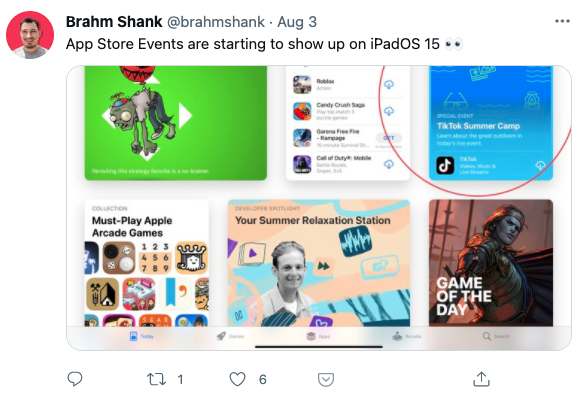
Though not yet publicly available to all users, those testing the new iOS 15 mobile operating system got their first glimpse of a new App Store discovery feature this week: “in-app events.” First announced at this year’s WWDC, the feature will allow developers and Apple editors alike to showcase directly on the App Store upcoming events taking place inside apps.

The events can appear on the App Store homepage, on the app’s product pages or can be discovered through personalized recommendations and search. In some cases, editors will curate events to feature on the App Store. But developers will also be provided tools to submit their own in-app events. TikTok’s “Summer Camp” for creators was one of the first in-app events to be featured, where it received a top spot on the iPadOS 15 App Store.
Weekly News

Platforms: Apple

Apple expands support for student IDs on iPhone and Apple Watch ahead of the fall semester. Tens of thousands more U.S. and Canadian colleges will now support mobile student IDs in the Apple Wallet app, including Auburn University, Northern Arizona University, University of Maine, New Mexico State University and others.

Apple was accused of promoting scam apps in the App Store’s featured section. The company’s failure to properly police its store is one thing, but to curate an editorial list that actually includes the scams is quite another. One of the games rounded up under “Slime Relaxations,” an already iffy category to say the least, was a subscription-based slime simulator that locked users into a $13 AUD per week subscription for its slime simulator. One of the apps on the curated list didn’t even function, implying that Apple’s editors hadn’t even tested the apps they recommend.

Tax changes hit the App Store. Apple announced tax and price changes for apps and IAPs in South Africa, the U.K. and all territories using the Euro currency, all of which will see decreases. Increases will occur in Georgia and Tajikistan, due to new tax changes. Proceeds on the App Store in Italy will be increased to reflect a change to the Digital Services Tax effective rate.

Game Center changes, too. Apple said that on August 4, a new certificate for server-based Game Center verification will be available via the publicKeyUrl.

Fintech

Robinhood stock jumped more than 24% to $46.80 on Tuesday after initially falling 8% on its first day of trading last week, after which it had continued to trade below its opening price of $38.

Square’s Cash app nearly doubled its gross profit to $546 million in Q2, but also reported a $45 million impairment loss on its bitcoin holdings.

Coinbase’s app now lets you buy your cryptocurrency using Apple Pay. The company previously made its Coinbase Card compatible with Apple Pay in June.

Social

An anonymous app called Sendit, which relies on Snap Kit to function, is climbing the charts of the U.S. App Store after Snap suspended similar apps, YOLO and LMK. Snap was sued by the parent of child who was bullied through those apps, which led to his suicide. Sendit also allows for anonymity, and reviews compare it to YOLO. But some reviews also complained about bullying. This isn’t the first time Snap has been involved in a lawsuit related to a young person’s death related to its app. The company was also sued for its irresponsible “speed filter” that critics said encouraged unsafe driving. Three young men died using the filter, which captured them doing 123 mph.

TikTok is testing Stories. As Twitter’s own Stories integrations, Fleets, shuts down, TikTok confirmed it’s testing its own Stories product. The TikTok Stories appear in a left-hand sidebar and allow users to post ephemeral images or video that disappear in 24 hours. Users can also comment on Stories, which are public to their mutual friends and the creator. Stories on TikTok may make more sense than they did on Twitter, as TikTok is already known as a creative platform and it gives the app a more familiar place to integrate its effects toolset and, eventually, advertisements.

Facebook has again re-arranged its privacy settings. The company continually moves around where its privacy features are located, ostensibly to make them easier to find. But users then have to re-learn where to go to find the tools they need, after they had finally memorized the location. This time, the settings have been grouped into six top-level categories, but “privacy” settings have been unbundled from one location to be scattered among the other categories.

A VICE report details ban-as-a-service operations that allow anyone to harass or censor online creators on Instagram. Assuming you can find it, one operation charged $60 per ban, the listing says.

TikTok merged personal accounts with creator accounts. The change means now all non-business accounts on TikTok will have access to the creator tools under Settings, including Analytics, Creator Portal, Promote and Q&A. TikTok shared the news directly with subscribers of its TikTok Creators newsletter in August, and all users will get a push notification alerting them to the change, the company told us.

Discord now lets users customize their profile on its apps. The company added new features to its iOS and Android apps that let you add a description, links and emojis and select a profile color. Paid subscribers can also choose an image or GIF as their banner.

Twitter Spaces added a co-hosting option that allows up to two co-hosts to be added to the live audio chat rooms. Now Spaces can have one main host, two co-hosts and up to 10 speakers. Co-hosts have all the moderation abilities as hosts, but can’t add or remove others as co-hosts.

Messaging

Tencent reopened new user sign-ups for its WeChat messaging app, after having suspended registrations last week for unspecified “technical upgrades.” The company, like many other Chinese tech giants, had to address new regulations from Beijing impacting the tech industry. New rules address how companies handle user data collection and storage, antitrust behavior and other checks on capitalist “excess.” The gaming industry is now worried it’s next to be impacted, with regulations that would restrict gaming for minors to fight addiction.

WhatsApp is adding a new feature that will allow users to send photos and videos that disappear after a single viewing. The Snapchat-inspired feature, however, doesn’t alert you if the other person takes a screenshot — as Snap’s app does. So it may not be ideal for sharing your most sensitive content.

Telegram’s update expands group video calls to support up to 1,000 viewers. It also announced video messages can be recorded in higher quality and can be expanded, regular videos can be watched at 0.5 or 2x speed, screen sharing with sound is available for all video calls, including 1-on-1 calls, and more.

Streaming & Entertainment

American Airlines added free access to TikTok aboard its Viasat-equipped aircraft. Passengers will be able to watch the app’s videos for up to 30 minutes for free and can even download the app if it’s not already installed. After the free time, they can opt to pay for Wi-Fi to keep watching. Considering how easy it is to fall into multi-hour TikTok viewing sessions without knowing it, the addition of the addictive app could make long plane rides feel shorter. Or at least less painful.

Chinese TikTok rival Kuaishou saw stocks fall by more than 15% in Hong Kong, the most since its February IPO. The company is another victim of an ongoing market selloff triggered by increasing investor uncertainty related to China’s recent crackdown on tech companies. Beijing’s campaign to rein in tech has also impacted Tencent, Alibaba, Jack Ma’s Ant Group, food delivery company Meituan and ride-hailing company Didi. Also related, Kuaishou shut down its controversial app Zynn, which had been paying users to watch its short-form videos, including those stolen from other apps.

Twitch overtook YouTube in consumer spending per user in April 2021, and now sees $6.20 per download as of June compared with YouTube’s $5.60, Sensor Tower found.
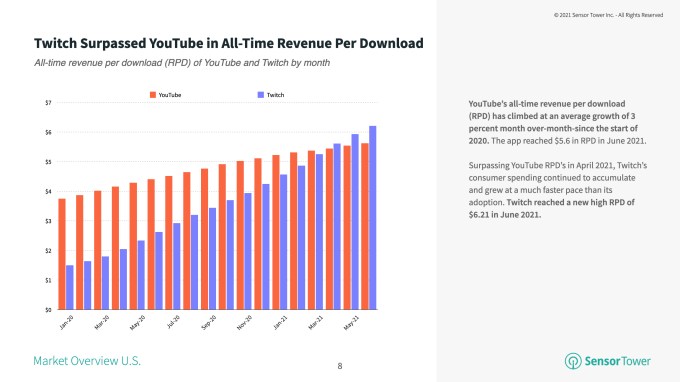
Image Credits: Sensor Tower

Spotify confirmed tests of a new ad-supported tier called Spotify Plus, which is only $0.99 per month and offers unlimited skips (like free users get on the desktop) and the ability to play the songs you want, instead of only being forced to use shuffle mode.

The company also noted in a forum posting that it’s no longer working on AirPlay2 support, due to “audio driver compatibility” issues.

Mark Cuban-backed audio app Fireside asked its users to invest in the company via an email sent to creators which didn’t share deal terms. The app has yet to launch.

YouTube kicks off its $100 million Shorts Fund aimed at taking on TikTok by providing creators with cash incentives for top videos. Creators will get bonuses of $100 to $10,000 based on their videos’ performance.

Dating

Match Group announced during its Q2 earnings it plans to add to several of the company’s brands over the next 12 to 24 months audio and video chat, including group live video, and other livestreaming technologies. The developments will be powered by innovations from Hyperconnect, the social networking company that this year became Match’s biggest acquisition to date when it bought the Korean app maker for a sizable $1.73 billion. Since then, Match was spotted testing group live video on Tinder, but says that particular product is not launching in the near-term. At least two brands will see Hyperconnect-powered integrations in 2021.

Photos

The Photo & Video category on U.S. app stores saw strong growth in the first half of the year, a Sensor Tower report found. Consumer spend among the top 100 apps grew 34% YoY to $457 million in Q2 2021, with the majority of the revenue (83%) taking place on iOS.
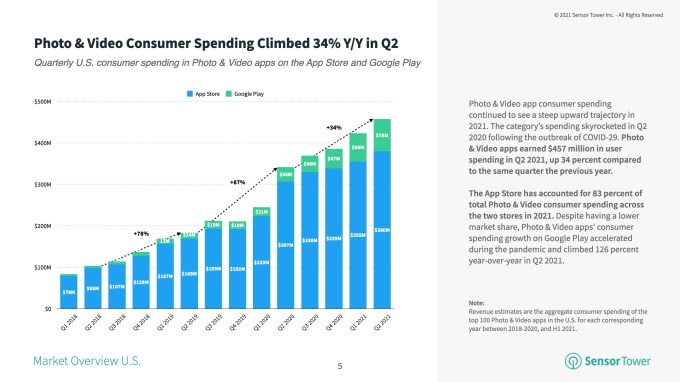
Image Credits: Sensor Tower

Gaming

Epic Games revealed the host of its in-app Rift Tour event is Ariana Grande, in the event that runs August 6-8.

Pokémon GO influencers threatened to boycott the game after Niantic removed the COVID safety measures that had allowed people to more easily play while social distancing. Niantic’s move seemed ill-timed, given the Delta variant is causing a new wave of COVID cases globally.

Health & Fitness

Apple kicked out an app called Unjected from the App Store. The new social app billed itself as a community for the unvaccinated, allowing like-minded users to connect for dating and friendships. Apple said the app violated its policies for COVID-19 content.

Google Pay expanded support for vaccine cards. In Australia, Google’s payments app now allows users to add their COVID-19 digital certification to their device for easy access. The option is available through Google’s newly updated Passes API which lets government agencies distribute digital versions of vaccine cards.

COVID Tech Connect, a U.S. nonprofit initially dedicated to collecting devices like phones and tablets for COVID ICU patients, has now launched its own app. The app, TeleHome, is a device-agnostic, HIPAA-compliant way for patients to place a video call for free at a time when the Delta variant is again filling ICU wards, this time with the unvaccinated — a condition that sometimes overlaps with being low-income. Some among the working poor have been hesitant to get the shot because they can’t miss a day of work, and are worried about side effects. Which is why the Biden administration offered a tax credit to SMBs who offered paid time off to staff to get vaccinated and recover.

Popular journaling app Day One, which was recently acquired by WordPress.com owner Automattic, rolled out a new “Concealed Journals” feature that lets users hide content from others’ viewing. By tapping the eye icon, the content can be easily concealed on a journal by journal basis, which can be useful for those who write to their journal in public, like coffee shops or public transportation.

Edtech

Recently IPO’d language learning app Duolingo is developing a math app for kids. The company says it’s still “very early” in the development process, but will announce more details at its annual conference, Duocon, later this month.

Educational publisher Pearson launched an app that offers U.S. students access to its 1,500 titles for a monthly subscription of $14.99. the Pearson+ mobile app (ack, another +), also offers the option of paying $9.99 per month for access to a single textbook for a minimum of four months.

News & Reading

Quora jumps into the subscription economy. Still not profitable from ads alone, Quora announced two new products that allow its expert creators to monetize their content on its service. With Quora+ ($5/mo or $50/yr), subscribers can pay for any content that a creator paywalls. Creators can choose to enable a adaptive paywall that will use an algorithm to determine when to show the paywall. Another product, Spaces, lets creators write paywalled publications on Quora, similar to Substack. But only a 5% cut goes to Quora, instead of 10% on Substack.

Utilities

Google Maps on iOS added a new live location-sharing feature for iMessage users, allowing them to more easily show your ETA with friends and even how much battery life you have left. The feature competes with iMessage’s built-in location-sharing feature, and offers location sharing of 1 hour up to 3 days. The app also gained a dark mode.

Security & Privacy

Controversial crime app Citizen launched a $20 per month “Protect” service that includes live agent support (who can refer calls to 911 if need be). The agents can gather your precise location, alert your designated emergency contacts, help you navigate to a safe location and monitor the situation until you feel safe. The system of live agent support is similar to in-car or in-home security and safety systems, like those from ADT or OnStar, but works with users out in the real world. The controversial part, however, is the company behind the product: Citizen has been making headlines for launching private security fleets outside law enforcement, and recently offered a reward in a manhunt for an innocent person based on unsubstantiated tips.

Funding and M&A

? Square announced its acquisition of the “buy now, pay later” giant AfterPay in a $29 billion deal that values the Australian firm at more than 30% higher than the stock’s last closing price of AUS$96.66. AfterPay has served over 16 million customers and nearly 100,000 merchants globally, to date, and comes at a time when the BNPL space is heating up. Apple has also gotten into the market recently with an Affirm partnership in Canada.

? Gaming giant Zynga acquired Chinese game developer StarLark, the team behind the mobile golf game Golf Rival, from Betta Games for $525 million in both cash and stock. Golf Rival is the second-largest mobile golf game behind Playdemic’s Golf Clash, and EA is in the process of buying that studio for $1.4 billion.

?  U.K.-based Humanity raised an additional $2.5 million for its app that claims to help slow down aging, bringing the total raise to date to $5 million. Backers include Calm’s co-founders, MyFitness Pal’s co-founder and others in the health space. The app works by benchmarking health advice against real-world data, to help users put better health practices into action.

? YELA, a Cameo-like app for the Middle East and South Asia, raised $2 million led by U.S. investors that include Tinder co-founder Justin Mateen and Sean Rad, general partner of RAD Fund. The app is focusing on signing celebrities in the regions it serves, where smartphone penetration is high and over 6% of the population is under 35.

? London-based health and wellness app maker Palta raised a $100 million Series B led by VNV Global. The company’s products include Flo.Health, Simple Fasting, Zing Fitness Coach and others, which reach a combined 2.4 million active, paid subscribers. The funds will be used to create more mobile subscription products.

? Emoji database and Wikipedia-like site Emojipedia was acquired by Zedge, the makers of a phone personalization app offering wallpapers, ringtones and more to 35 million MAUs. Deal terms weren’t disclosed. Emojipedia says the deal provides it with more stability and the opportunity for future growth. For Zedge, the deal provides?….um, a popular web resource it thinks it can better monetize, we suspect.

? Mental health app Revery raised $2 million led by Sequoia Capital India’s Surge program for its app that combines cognitive behavioral therapy for insomnia with mobile gaming concepts. The company will focus on other mental health issues in the future.

? London-based Nigerian-operating fintech startup Kuda raised a $55 million Series B, valuing its mobile-first challenger bank at $500 million. The inside round was co-led by Valar Ventures and Target Global.

? Vietnamese payments provider VNLife raised $250 million in a round led by U.S.-based General Atlantic and Dragoneer Investment Group. PayPal Ventures and others also participated. The round values the business at over $1 billion.

Downloads

Mastodon for iPhone
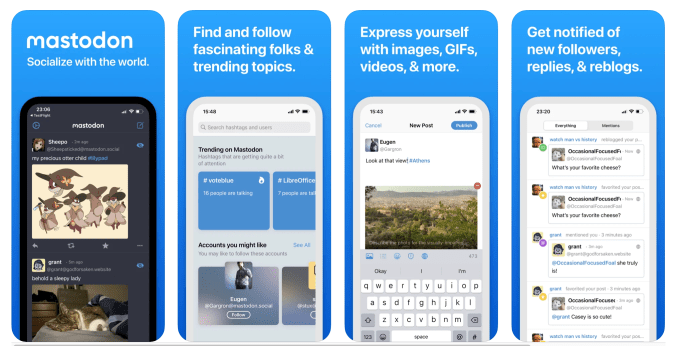
Fans of decentralized social media efforts now have a new app. The nonprofit behind the open source decentralized social network Mastodon released an official iPhone app, aimed at making the network more accessible to newcomers. The app allows you to find and follow people and topics; post text, images, GIFs, polls, and videos; and get notified of new replies and reblogs, much like Twitter.

Xingtu

@_666eveITS SO COOL FRFR do u guys want a tutorial? #fypシ #醒图 #醒图app♬ original sound – Ian Asher

TikTok users are teaching each other how to switch over to the Chinese App Store in order to get ahold of the Xingtu app for iOS. (An Android version is also available.) The app offers advanced editing tools that let users edit their face and body, like FaceTune, apply makeup, add filters and more. While image-editing apps can be controversial for how they can impact body acceptance, Xingtu offers a variety of artistic filters which is what’s primarily driving the demand. It’s interesting to see the lengths people will go to just to get a few new filters for their photos — perhaps making a case for Instagram to finally update its Post filters instead of pretending no one cares about their static photos anymore.

Tweets

Facebook still dominating top charts, but not the No. 1 spot:  

Not cool, Apple: 

This user acquisition strategy: 

Maybe Stories don’t work everywhere: