Year: 2021

06 Aug 2021

Kickstarter’s CEO on the future of crowdfunding

Kickstarter announced on Wednesday that backers have pledged $6 billion to more than 200,000 projects over the course of the crowdfunding site’s history. The milestone comes a little over a year after the platform hit the $5 billion mark.

A matter of weeks before the company hit that last massive round number, however, it revealed starker news. Kickstarter reduced its staff by 39%, through a combination of layoffs and buyouts, as newly minted CEO Aziz Hasan noted a 35% drop in new projects. The company wasn’t alone, certainly, in suffering major setbacks in the face of a pandemic, but that likely didn’t cushion the blow of a downturn with “no clear sign of rebound,” according to the executive.

With another $1 billion pledge in the intervening 15 months, however, it’s probably safe to say that predictions of crowdfunding’s demise were somewhat premature. Like most of the rest of us, the pandemic has spurred a reprioritization and recentering, and the service that has long been synonymous with the category looked to new methods of engagement.

After a dozen years of being the face of crowdfunding, plenty of question marks still remain. The past decade has seen something of a hype bubble for the process, and for some, the shine has worn off a bit, courtesy of undelivered gifts and unfinished campaigns. What will the next decade hold for crowdfunding’s biggest name? And will the pandemic fundamentally transform how people back projects on the internet?

We sat down with Hasan to discuss the past year, the company’s big milestone and the future of crowdfunding.

(This interview has been edited for length and clarity.)

When you took the role of CEO in 2019, what changes did you feel like you needed to implement?

I’d really like to touch on the connection that I’ve always felt with Kickstarter. It, for me personally, is a place where I feel like both my personal passion and what we do on a day-to-day basis came together really well. At one of the first all-hands when I got hired, I said what’s beautiful about the job that I get to do is that every evening I go home and I illustrate. And so I get to feel the hard pain, a lot of the insecurity and the uncertainty that comes with being a creator.

“I see crowdfunding as probably one of the best mechanisms to go independently and create the thing that you want and to find the support that you need and the resources that you need.”

I come in every morning and I say, “OK, how am I going to fix that? What can I do to make that process better, make that easier?” And so that for me was just this underlying motivation. This is what gets me out of bed in the morning. The thought to me was, “What are the ways in which we have the greatest strength in helping creators find the funding that they need?”

I think one of the greatest opportunities that I really see is that the backers are such an incredible part of this puzzle, and for us, for the longest time we really focused on the creator tools and really making sure that the creators have a way to share their project. What we’ve seen is that backers are such a tremendous part of this process and their ability to discover the joy, the fun, the curiosity that they feel through that process is such an important part of the experience as well. And so here’s a place where we can actually put some focus and some time and attention on what the backer experience looks like. And so that really has been a big mantra for me as we’ve been moving forward.

What does it mean to impact the backer experience? In the past two years, how has the backer experience changed?

One is just making it simpler and easier for backers to find projects that they would care about. And I think us being just a space where this stuff exists, I think just putting it out there as it is on a home page or through the creator that you know isn’t enough. And so there are a lot of channels that we’ve been using, particularly thinking about our emails and newsletters and these points of connection that we have with the backer over the course of their journey and actually introducing projects that they might like through that process. So we have a recommendation engine that we’ve been developing over the last few years that’s meant to help connect, make better connections based on either affinity, which you might like, or the way that you backed in the past or projects that you might’ve watched.

Early last year, Kickstarter went through a fairly large round of layoffs — 40%, according to reports. How did the company navigate the earliest days of the pandemic and what do you feel you’ve done to help right that ship?

What we saw in our platform was that creators just kind of off the bat had the same level of uncertainty everybody else was feeling. We saw a slowdown of projects and what we saw was about 40% of our pledge volume dipping. And as a result, there’s a lot of projects that fell off as a result of that. There were some very, very concerning times. The big thing that we thought about was, we need to make sure that our business is resilient for the future, make sure that we’re actually just set up operationally in a way that we can withstand uncertainty as it comes. Through that really tough time and then, kind of peeking out toward the end of 2020, the backers didn’t change their pattern of behavior. Even though creators were launching fewer projects during that really difficult time, what we saw was that the backers remained extremely eager to keep pushing forward and supporting creative work.

So things like our pledge rates and success rates remained quite high and that’s especially if you think about the games community, comics, publishing a number of these spaces where we’ve always seen strong engagement. That engagement actually continued through. About four or five months after that initial dip, we slowly started to see some of the creators come back online, because I think they also started to recognize that the backers are there. They haven’t changed their backing patterns. And so what that did for us is that started to give us a bit of understanding here that we should start to connect back to the creators and let them know that the backers are here.

06 Aug 2021

$100M donation powers decade-long moonshot to create solar satellites that beam power to Earth

It sounds like a plan concocted by a supervillain, if that villain’s dastardly end was to provide cheap, clean power all over the world: launch a set of three-kilometer-wide solar arrays that beam the sun’s energy to the surface. Even the price tag seems gleaned from pop fiction: one hundred million dollars. But this is a real project at Caltech, funded for a nearly a decade largely by a single donor.

The Space-based Solar Power Project has been underway since at least 2013, when the first donation from Donald and Brigitte Bren came through. Donald Bren is the chairman of Irvine Company and on the Caltech board of trustees, and after hearing about the idea of space-based solar in Popular Science, he proposed to fund a research project at the university — and since then has given over $100M for the purpose. The source of the funds has been kept anonymous until this week, when Caltech made it public.

The idea emerges naturally from the current limitations of renewable energy. Solar power is ubiquitous on the surface, but of course highly dependent on the weather, season, and time of day. No solar panel, even in ideal circumstances, can work at full capacity all the time, and so the problem becomes one of transferring and storing energy in a smart grid. No solar panel on Earth, that is.

A solar panel in orbit, however, may be exposed to the full light of the sun nearly all the time, and with none of the reduction in its power that comes from that light passing through the planet’s protective atmosphere and magnetosphere.

The latest prototype created by the SSPP, which collects sunlight and transmits it over microwave frequency.

“This ambitious project is a transformative approach to large-scale solar energy harvesting for the Earth that overcomes this intermittency and the need for energy storage,” said SSPP researcher Harry Atwater in the Caltech release.

Of course, you would need to collect enough energy that it’s worth doing in the first place, and you need a way to beam that energy down to the surface in a way that doesn’t lose most of it to the aforementioned protective layers but also doesn’t fry anything passing through its path.

These fundamental questions have been looked at systematically for the last decade, and the team is clear that without Bren’s support, this project wouldn’t have been possible. Attempting to do the work while scrounging for grants and rotating through grad students might have prevented its being done at all, but the steady funding meant they could hire long-term researchers and overcome early obstacles that might have stymied them otherwise.

The group has produced dozens of published studies and prototypes (which you can peruse here), including the lightest solar collector-transmitter made by an order of magnitude, and is now on the verge of launching its first space-based test satellite.

“[Launch] is currently expected to be Q1 2023,” co-director of the project Ali Hajimiri told TechCrunch. “It involves several demonstrators for space verification of key technologies involved in the effort, namely, wireless power transfer at distance, lightweight flexible photovoltaics, and flexible deployable space structures.”

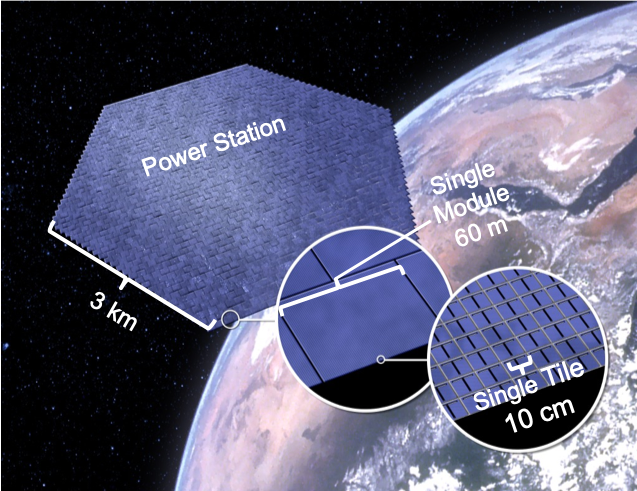
Diagram showing how tiles like the one above could be joined together to form strips, then spacecraft, then arrays of spacecraft.

These will be small-scale tests (about 6 feet across), but the vision is for something rather larger. Bigger than anything currently in space, in fact.

“The final system is envisioned to consist of multiple deployable modules in close formation flight and operating in synchronization with one another,” Hajimiri said. “Each module is several tens of meters on the side and the system can be build up by adding more modules over time.”

Image of how the final space solar installation could look, a kilometers-wide set of cells in orbit.

Image Credits: Caltech

Eventually the concept calls for a structure perhaps as large as 5-6 kilometers across. Don’t worry — it would be far enough out from Earth that you wouldn’t see a giant hexagon blocking out the stars. Power would be sent to receivers on the surface using directed, steerable microwave transmission. A few of these in orbit could beam power to any location on the planet full time.

Of course that is the vision, which is many, many years out if it is to take place at all. But don’t make the mistake of thinking of this as having that single ambitious, one might even say grandiose goal. The pursuit of this idea has produced advances in solar cells, flexible space-based structures, and wireless power transfer, each of which can be applied in other areas. The vision may be the stuff of science fiction, but the science is progressing in a very grounded way.

For his part, Bren seems to be happy just to advance the ball on what he considers an important task that might not otherwise have been attempted at all.

“I have been a student researching the possible applications of space-based solar energy for many years,” he told Caltech. “My interest in supporting the world-class scientists at Caltech is driven by my belief in harnessing the natural power of the sun for the benefit of everyone.”

We’ll check back with the SSPP ahead of launch.

06 Aug 2021

$100M donation powers decade-long moonshot to create solar satellites that beam power to Earth

It sounds like a plan concocted by a supervillain, if that villain’s dastardly end was to provide cheap, clean power all over the world: launch a set of three-kilometer-wide solar arrays that beam the sun’s energy to the surface. Even the price tag seems gleaned from pop fiction: one hundred million dollars. But this is a real project at Caltech, funded for a nearly a decade largely by a single donor.

The Space-based Solar Power Project has been underway since at least 2013, when the first donation from Donald and Brigitte Bren came through. Donald Bren is the chairman of Irvine Company and on the Caltech board of trustees, and after hearing about the idea of space-based solar in Popular Science, he proposed to fund a research project at the university — and since then has given over $100M for the purpose. The source of the funds has been kept anonymous until this week, when Caltech made it public.

The idea emerges naturally from the current limitations of renewable energy. Solar power is ubiquitous on the surface, but of course highly dependent on the weather, season, and time of day. No solar panel, even in ideal circumstances, can work at full capacity all the time, and so the problem becomes one of transferring and storing energy in a smart grid. No solar panel on Earth, that is.

A solar panel in orbit, however, may be exposed to the full light of the sun nearly all the time, and with none of the reduction in its power that comes from that light passing through the planet’s protective atmosphere and magnetosphere.

The latest prototype created by the SSPP, which collects sunlight and transmits it over microwave frequency.

“This ambitious project is a transformative approach to large-scale solar energy harvesting for the Earth that overcomes this intermittency and the need for energy storage,” said SSPP researcher Harry Atwater in the Caltech release.

Of course, you would need to collect enough energy that it’s worth doing in the first place, and you need a way to beam that energy down to the surface in a way that doesn’t lose most of it to the aforementioned protective layers but also doesn’t fry anything passing through its path.

These fundamental questions have been looked at systematically for the last decade, and the team is clear that without Bren’s support, this project wouldn’t have been possible. Attempting to do the work while scrounging for grants and rotating through grad students might have prevented its being done at all, but the steady funding meant they could hire long-term researchers and overcome early obstacles that might have stymied them otherwise.

The group has produced dozens of published studies and prototypes (which you can peruse here), including the lightest solar collector-transmitter made by an order of magnitude, and is now on the verge of launching its first space-based test satellite.

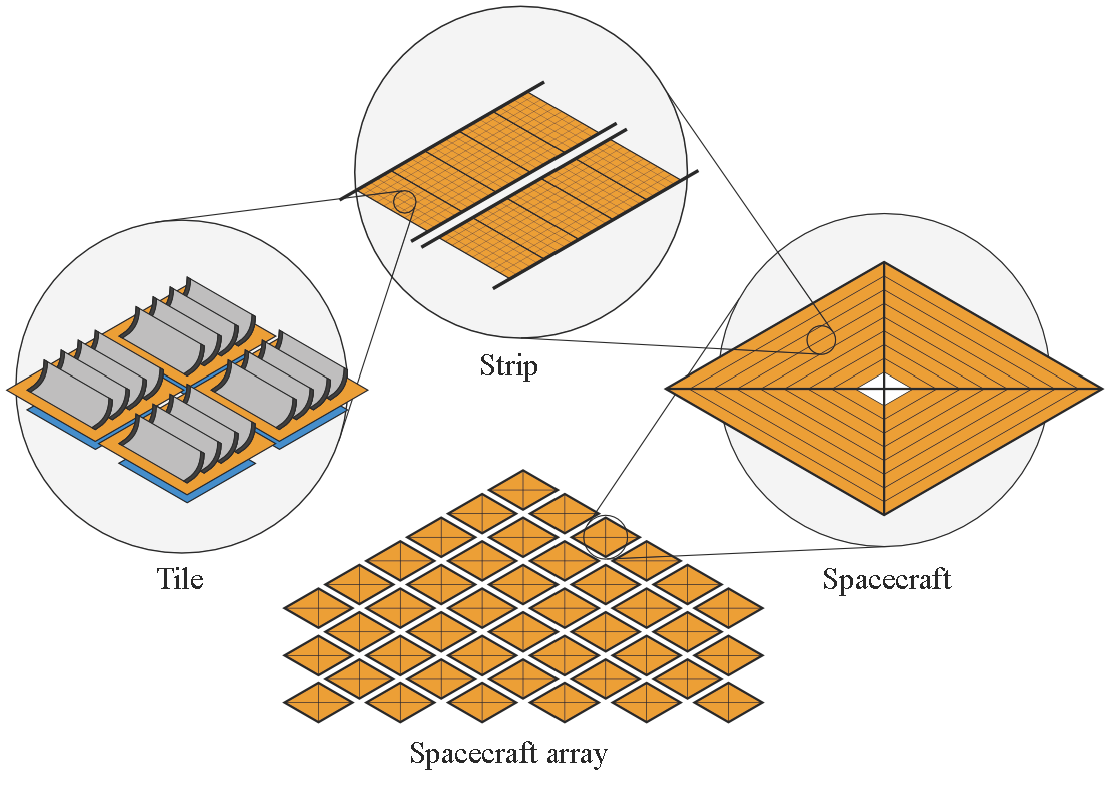
“[Launch] is currently expected to be Q1 2023,” co-director of the project Ali Hajimiri told TechCrunch. “It involves several demonstrators for space verification of key technologies involved in the effort, namely, wireless power transfer at distance, lightweight flexible photovoltaics, and flexible deployable space structures.”

Diagram showing how tiles like the one above could be joined together to form strips, then spacecraft, then arrays of spacecraft.

These will be small-scale tests (about 6 feet across), but the vision is for something rather larger. Bigger than anything currently in space, in fact.

“The final system is envisioned to consist of multiple deployable modules in close formation flight and operating in synchronization with one another,” Hajimiri said. “Each module is several tens of meters on the side and the system can be build up by adding more modules over time.”

Image of how the final space solar installation could look, a kilometers-wide set of cells in orbit.

Image Credits: Caltech

Eventually the concept calls for a structure perhaps as large as 5-6 kilometers across. Don’t worry — it would be far enough out from Earth that you wouldn’t see a giant hexagon blocking out the stars. Power would be sent to receivers on the surface using directed, steerable microwave transmission. A few of these in orbit could beam power to any location on the planet full time.

Of course that is the vision, which is many, many years out if it is to take place at all. But don’t make the mistake of thinking of this as having that single ambitious, one might even say grandiose goal. The pursuit of this idea has produced advances in solar cells, flexible space-based structures, and wireless power transfer, each of which can be applied in other areas. The vision may be the stuff of science fiction, but the science is progressing in a very grounded way.

For his part, Bren seems to be happy just to advance the ball on what he considers an important task that might not otherwise have been attempted at all.

“I have been a student researching the possible applications of space-based solar energy for many years,” he told Caltech. “My interest in supporting the world-class scientists at Caltech is driven by my belief in harnessing the natural power of the sun for the benefit of everyone.”

We’ll check back with the SSPP ahead of launch.

06 Aug 2021

SenpAI.GG wants to be your AI-powered video game coach

With most popular online video games, there’s a huge gap between being a good player and a great one. A casual player might be able to hold their own against other casual players, only for a random pro to wander by and chew through everyone like they’re somehow playing with a different set of rules.

Could an AI-driven voice in your ear help close that gap, if only a bit? SenpAI.GG, a company out of Y Combinator’s latest batch, thinks so.

Much of that aforementioned gap boils down to practice, muscle memory, and — let’s face it — natural ability. But as a game gets older/bigger/more complex, the best players tend to have a wealth of one resource that’s oh-so-crucial, if not oh-so-fun to gather: information.

What guns do the most damage at this range? Which character is best suited to counter that character on this map? Hell, what changed in that “minor update” that flashed across your screen as you were booting up the game? Wait, why is my favorite weapon suddenly so much harder to control?

Staying on top of all this information as players discover new tactics and updates shift the “meta” is a challenge in its own right. It usually involves lots of Twitch streams, lots of digging around Reddit threads, and lots of poring over patch notes.

SenpAI.GG is looking to surface more of that information automatically and help new players get good, faster. Their desktop client presents you with information it thinks can help, post-game analysis on your strategies, plus in-game audio cues for the things you might not be great at tracking yet.

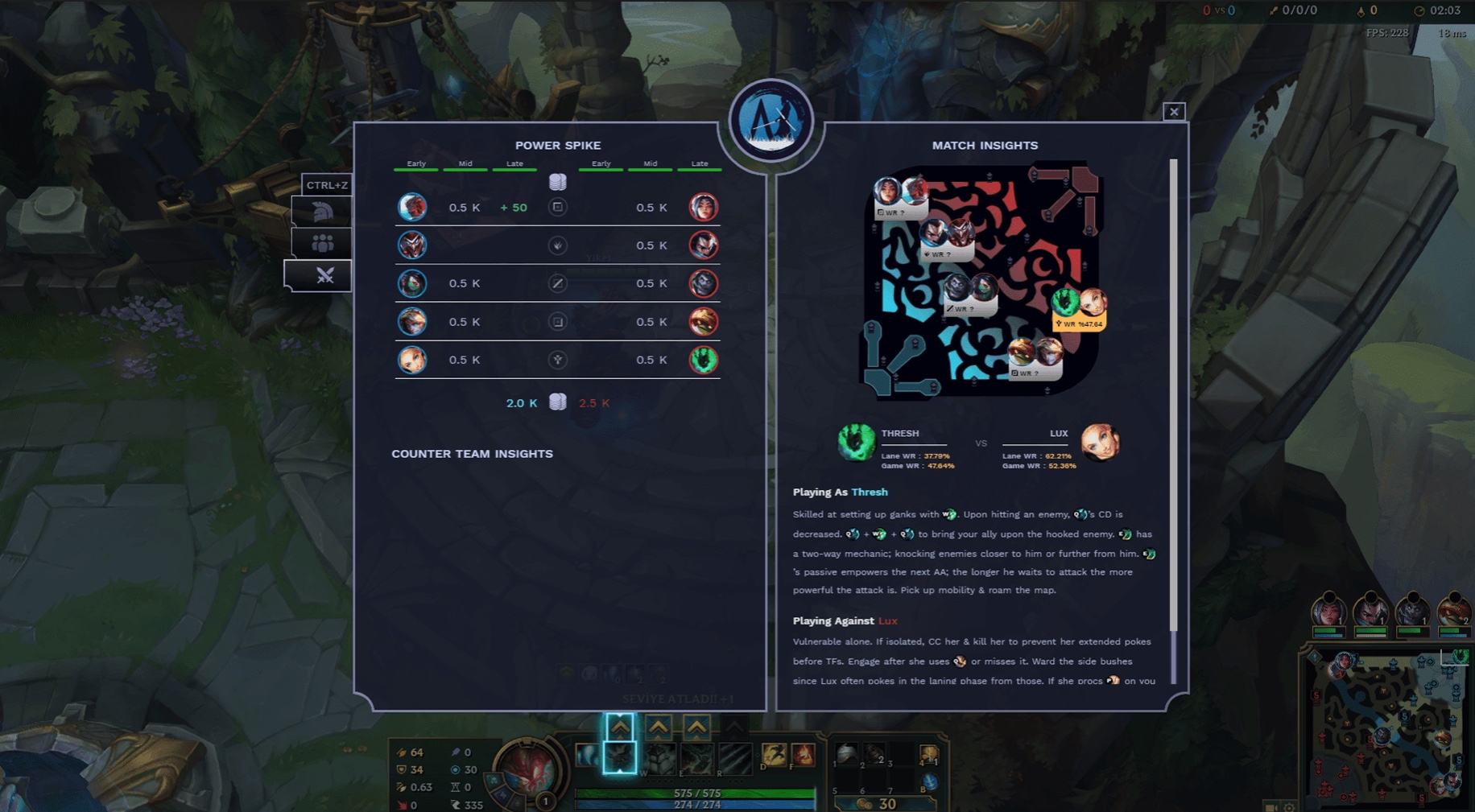
It currently supports a handful of games — League of Legends, Valorant, and Teamfight Tactics — with the info it provides varying from game to game. In LoL, for example, it’ll look at both team’s selected champions and try to recommend the one you could pick to help most; in Valorant, meanwhile, it can give you an audio heads up that one of your teammates is running low on health (before said teammate starts yelling at you to heal them), when you’ve forgotten to reload, or how long you’ve got before the Spike (read: game-ending bomb) explodes.

SenpAI.GG’s in-game overlay providing League of Legends insights. Image Credits: SenpAI.GG 

Just as important as the information it provides is the information it won’t provide. In my chat with him, SenpAI.GG founder Olcay Yilmazcoban seemed very aware that there’s a hard-to-define line here where “assistant” blurs into “cheating tool” — but the company follows certain rules to stay on the right side of things and prevent their players from getting banned.

They won’t, for example, ever take action on a player’s behalf — they might fire an audio cue to say “hey, you should heal that teammate”, but they won’t press the button for you. They’ll only generate their real-time insights from what’s on your screen — not anything hidden within the running process. They also won’t do things like reveal an enemy’s location just because your teammate is also running the app and can see them. Think “good player standing over your shoulder,” not “wall hack.” The company says that they’re always within each game developer’s competitive fairness guidelines, and only work with approved/provided APIs.

It’s a good idea because it’s one that, arguably, never gets old. With each new game they support, they’ve got a new potential audience to serve. Meanwhile, it’s not as if the old games/insights will expire — a game’s big ol’ book-of-stuff-you-need-to-know tends to only get bigger and more complex as a game ages and the patches pile up. There are games I’ve been playing for years where I’d still love a voice assistant that says “Oh hey, the recoil on the gun you just picked up has gotten way more intense since the last time you played.” SenpAI.GG isn’t there yet, but there’s a ton of natural room for growth.

Yllmazcoban tells me that they currently have over 400,000 active users, with a team of eleven people working on it. The base app is free, with plans to offer advanced features for a couple bucks a month.

06 Aug 2021

SenpAI.GG wants to be your AI-powered video game coach

With most popular online video games, there’s a huge gap between being a good player and a great one. A casual player might be able to hold their own against other casual players, only for a random pro to wander by and chew through everyone like they’re somehow playing with a different set of rules.

Could an AI-driven voice in your ear help close that gap, if only a bit? SenpAI.GG, a company out of Y Combinator’s latest batch, thinks so.

Much of that aforementioned gap boils down to practice, muscle memory, and — let’s face it — natural ability. But as a game gets older/bigger/more complex, the best players tend to have a wealth of one resource that’s oh-so-crucial, if not oh-so-fun to gather: information.

What guns do the most damage at this range? Which character is best suited to counter that character on this map? Hell, what changed in that “minor update” that flashed across your screen as you were booting up the game? Wait, why is my favorite weapon suddenly so much harder to control?

Staying on top of all this information as players discover new tactics and updates shift the “meta” is a challenge in its own right. It usually involves lots of Twitch streams, lots of digging around Reddit threads, and lots of poring over patch notes.

SenpAI.GG is looking to surface more of that information automatically and help new players get good, faster. Their desktop client presents you with information it thinks can help, post-game analysis on your strategies, plus in-game audio cues for the things you might not be great at tracking yet.

It currently supports a handful of games — League of Legends, Valorant, and Teamfight Tactics — with the info it provides varying from game to game. In LoL, for example, it’ll look at both team’s selected champions and try to recommend the one you could pick to help most; in Valorant, meanwhile, it can give you an audio heads up that one of your teammates is running low on health (before said teammate starts yelling at you to heal them), when you’ve forgotten to reload, or how long you’ve got before the Spike (read: game-ending bomb) explodes.

SenpAI.GG’s in-game overlay providing League of Legends insights. Image Credits: SenpAI.GG 

Just as important as the information it provides is the information it won’t provide. In my chat with him, SenpAI.GG founder Olcay Yilmazcoban seemed very aware that there’s a hard-to-define line here where “assistant” blurs into “cheating tool” — but the company follows certain rules to stay on the right side of things and prevent their players from getting banned.

They won’t, for example, ever take action on a player’s behalf — they might fire an audio cue to say “hey, you should heal that teammate”, but they won’t press the button for you. They’ll only generate their real-time insights from what’s on your screen — not anything hidden within the running process. They also won’t do things like reveal an enemy’s location just because your teammate is also running the app and can see them. Think “good player standing over your shoulder,” not “wall hack.” The company says that they’re always within each game developer’s competitive fairness guidelines, and only work with approved/provided APIs.

It’s a good idea because it’s one that, arguably, never gets old. With each new game they support, they’ve got a new potential audience to serve. Meanwhile, it’s not as if the old games/insights will expire — a game’s big ol’ book-of-stuff-you-need-to-know tends to only get bigger and more complex as a game ages and the patches pile up. There are games I’ve been playing for years where I’d still love a voice assistant that says “Oh hey, the recoil on the gun you just picked up has gotten way more intense since the last time you played.” SenpAI.GG isn’t there yet, but there’s a ton of natural room for growth.

Yllmazcoban tells me that they currently have over 400,000 active users, with a team of eleven people working on it. The base app is free, with plans to offer advanced features for a couple bucks a month.

06 Aug 2021

How to hire and structure a growth team

Everyone at an organization should own growth, right? Turns out when everyone owns something, no one does. As a result, growth teams can cause an enormous amount of friction in an organization when introduced.

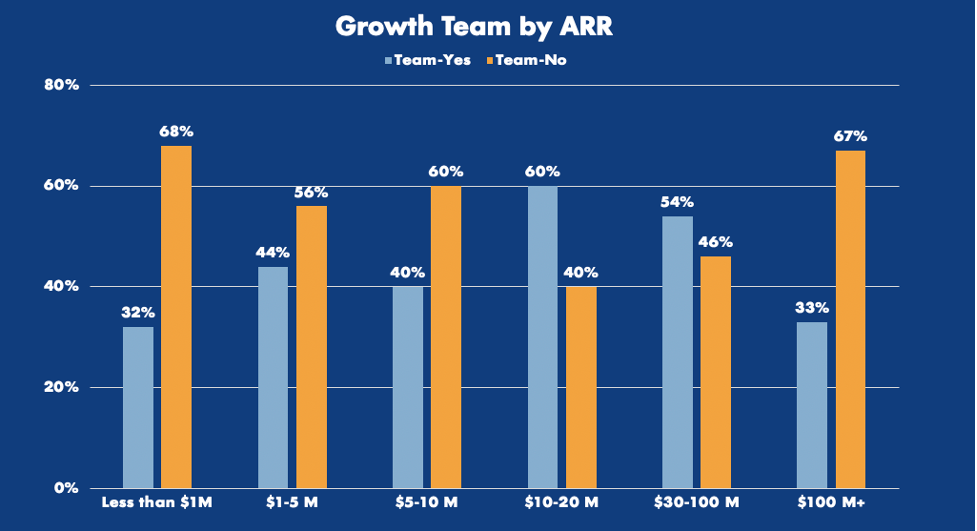
Growth teams are twice as likely to appear among businesses growing their ARR by 100% or more annually. What’s more, they also seem to be more common after product-market fit has been achieved — usually after a company has reached about $5 million to $10 million in revenue.

Graph of the prevalence of growth teams in companies, by ARR

Image Credits: OpenView Partners

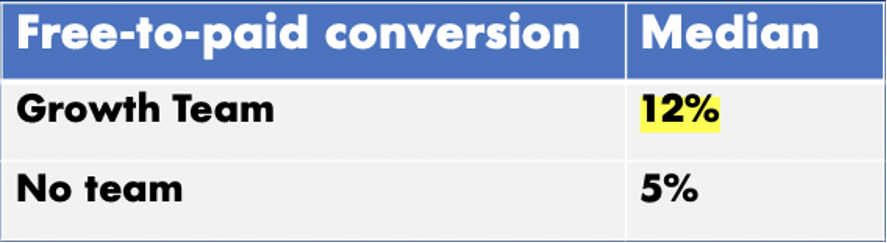
I’m not here to sell you on why you need a growth team, but I will point out that product-led businesses with a growth team see dramatic results — double the median free-to-paid conversion rate.

Free-to-paid conversions in companies with growth teams are higher

Image Credits: OpenView Partners

How do you hire an early growth leader?

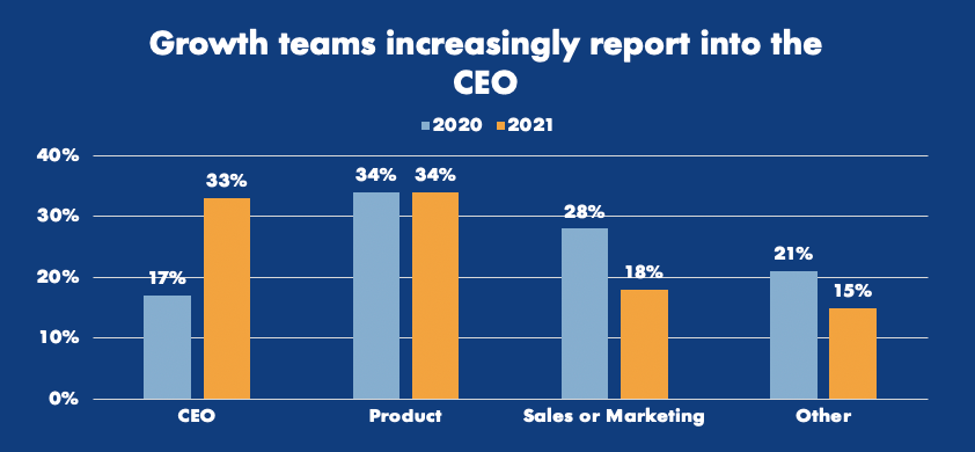
According to responses from product benchmarks surveys, growth teams have transitioned dramatically from reporting to marketing and sales to reporting directly to the CEO.

Some of the early writing on growth teams says that they can be structured individually as their own standalone team or as a SWAT model, where experts from various other departments in the organization converge on a regular cadence to solve for growth.

Graph showing more growth teams now report to CEOs than marketing, sales or product

Image Credits: OpenView Partners

My experience, and the data I’ve collected from business-user focused software companies, has led me to the conclusion that growth teams in business software should not be structured as “SWAT” teams, with cross-functional leadership coming together to think critically about growth problems facing the business. I find that if problems don’t have a real owner, they’re not going to get solved. Growth issues are no different and are often deprioritized unless it’s someone’s job to think about them.

Becoming product-led isn’t something that happens overnight, and hiring someone will not be a silver bullet for your software.

I put early growth hires into a few simple buckets. You’ve got:

Product-minded growth experts: These folks are all about optimizing the user experience, reducing friction and expanding usage. They’re usually pretty analytical and might have product, data or MarketingOps backgrounds.

06 Aug 2021

How to hire and structure a growth team

Everyone at an organization should own growth, right? Turns out when everyone owns something, no one does. As a result, growth teams can cause an enormous amount of friction in an organization when introduced.

Growth teams are twice as likely to appear among businesses growing their ARR by 100% or more annually. What’s more, they also seem to be more common after product-market fit has been achieved — usually after a company has reached about $5 million to $10 million in revenue.

Graph of the prevalence of growth teams in companies, by ARR

Image Credits: OpenView Partners

I’m not here to sell you on why you need a growth team, but I will point out that product-led businesses with a growth team see dramatic results — double the median free-to-paid conversion rate.

Free-to-paid conversions in companies with growth teams are higher

Image Credits: OpenView Partners

How do you hire an early growth leader?

According to responses from product benchmarks surveys, growth teams have transitioned dramatically from reporting to marketing and sales to reporting directly to the CEO.

Some of the early writing on growth teams says that they can be structured individually as their own standalone team or as a SWAT model, where experts from various other departments in the organization converge on a regular cadence to solve for growth.

Graph showing more growth teams now report to CEOs than marketing, sales or product

Image Credits: OpenView Partners

My experience, and the data I’ve collected from business-user focused software companies, has led me to the conclusion that growth teams in business software should not be structured as “SWAT” teams, with cross-functional leadership coming together to think critically about growth problems facing the business. I find that if problems don’t have a real owner, they’re not going to get solved. Growth issues are no different and are often deprioritized unless it’s someone’s job to think about them.

Becoming product-led isn’t something that happens overnight, and hiring someone will not be a silver bullet for your software.

I put early growth hires into a few simple buckets. You’ve got:

Product-minded growth experts: These folks are all about optimizing the user experience, reducing friction and expanding usage. They’re usually pretty analytical and might have product, data or MarketingOps backgrounds.

06 Aug 2021

Online retailers: Stop trying to beat Amazon

Brick-and-mortar stores forced to close due to pandemic lockdowns had to quickly pivot to an online-only model. Understandably, newcomers to the digital retail scene found themselves behind the curve in attracting online buyers, particularly in the face of popular established events like Amazon Prime Day. This year’s Prime Day, held June 21-22, was reportedly the biggest ever on the platform.

Online retailers that have opted to forge their own path to generate sales often wonder how they can compete with Amazon.

The reality is that Amazon’s true unique selling proposition is its distribution network. Online retailers will not be able to compete on this point because Amazon’s distribution network is so fast. Instead, it’s important to focus on areas where they can excel — without having to become a third-party seller on Amazon’s platform.

The following are seven key tips that are relevant for online retailers that want to attract and retain customers without having to partner with Amazon or to try to beat it at its own game.

Gain a 360-degree view of the customer

An online retailer needs to consider what kind of experience it wants to create; customers expect smooth processes on every step of their online shopping journey.

One idea is to implement a consumer data platform that will help the retailer gain the best insights into their customers: who they are and what they like, which websites they frequent and other relevant information. Retailers can use this data to then target customers with ads for products they’ll actually want to buy. Consumer data platforms can even help online retailers target consumers across platforms as well as in the store.

Ensure smooth and glitch-free pre-sale transactions

One of the biggest frustrations with online retailers is the performance of a website, from getting on the site through the closing of the sale. If something fails or glitches at any point in the process of searching for a product and paying for it, the customer will leave and not come back.

The solution to this problem involves a lot of testing of the user interface to ensure a good user experience. Tests should be done on all e-commerce segments on a site, including the basket and ad banners. By inserting tags along the customer journey, a retailer can track lost sales and see where problems happen on their website.

Offer a broad variety of payment options

As a payment option, PayPal recently experienced a record 36% year-on-year growth in payment volume between the third quarter of 2019 and Q3 2020. Despite PayPal’s popularity, Amazon does not accept it as a form of payment.

06 Aug 2021

Venture capital probably isn’t dead

Venture capitalists are chatting this week about a recent piece from The Information titled “The End of Venture Capital as We Know It.” As with nearly everything you read, the article in question is a bit more nuanced than its headline. Its author, Sam Lessin, makes some pretty good points. But I don’t fully agree with his conclusions, and want to talk about why.

This will be fun, and, because it’s Friday, both relaxed and cordial. (For fun, here’s a long-ass podcast I participated in with Lessin last year.)

A capital explosion

Lessin notes that venture capitalists once made risky wagers on companies that often withered away. Higher-than-average investment risk meant that returns from winning bets had to be very lucrative, or else the venture model would have failed.

Thus, venture capitalists sold their capital dearly to founders. The prices that venture capitalists have historically paid for startup equity in high-growth tech upstarts make IPO pops appear de minimis; it’s the VCs who make out like bandits when a tech company floats, not the bankers. The Wall Street crew just gets a final lap at the milk saucer.

Over time, however, things changed. Founders could lean on AWS instead of having to spend equity capital on server racks and colocation. The process of building software and taking it to market became better understood by more people.

Even more, recurring fees overtook the traditional method of selling software for a one-time price. This made the revenues of software companies less like those of video game companies, driven by episodic releases and dependent on the market’s reception of the next version of any particular product.

As SaaS took over, software revenues kept their lucrative gross margin profile but became both longer-lasting and more dependable. They got better. And easier to forecast to boot.

So, prices went up for software companies — public and private.

Another result of the revolution in both software construction and distribution — higher-level programming languages, smartphones, app stores, SaaS and, today, on-demand pricing coupled to API delivery — was that more money could pile into the companies busy writing code. Lower risk meant that other forms of capital found startup investing — super-late stage to begin with, but increasingly earlier in the startup lifecycle — not just possible, but rather attractive.

With more capital varieties taking interest in private tech companies thanks in part to reduced risk, pricing changed. Or, as Lessin puts it, thanks to better market ability to metricize startup opportunity and risk, “investors across the board [now] price [startups] more or less the same way.”

You can see where this is going: If that’s the case, then the model of selling expensive capital for huge upside becomes a bit soggy. If there is less risk, then venture capitalists can’t charge as much for their capital. Their return profile might change, with cheaper and more plentiful money chasing deals, leading to higher prices and lower returns.

The result of all of the above is Lessin’s lede: “All signs seem to indicate that by 2022, for the first time, nontraditional tech investors — including hedge funds, mutual funds and the like — will invest more in private tech companies than traditional Silicon Valley-style venture capitalists will.”

Capital crowding into the parts of finance once reserved for the high priests of venture means that the VCs of the world are finding themselves often fighting for deals with all sorts of new, and wealthier, players.

The result of this, per Lessin, is that venture “firms that grew up around software and internet investing and consider themselves venture capitalists” must “enter the bigger pond as a fairly small fish, or go find another small pond.”

Yeah, but

The obvious critique of Lessin’s argument is one that he makes himself, namely that what he is discussing is not as relevant to seed investing. As Lessin puts it, his argument’s impact on seed investing is “far less clear.”

Agreed. Sure, it’s the end of venture capital as we know it. But it’s not the end of venture capital, because if capitalism is going to continue, there’s always going to need to be risky-ass shit for VCs to bet on at the bottom.

The factors that made later-stage SaaS investing something that even idiots can make a few dollars doing become scarce the earlier one looks in the startup world. Investing in areas other than software compounds this effect; if you try to treat biotech startups as less risky than before simply because public clouds exist, you are going to fuck up.

So the Lessin argument matters less in seed-stage and earlier investing than it does in the later stages of startup backing, and doubly less when it comes to earlier investing in non-software companies.

While it’s a little-known fact, some venture capitalists still invest in startups that are not software-focused. Sure, nearly every startup involves code, but you can make a lot of money in a lot of ways by building startups, especially tech startups. The figuring-out of SaaS investing does not mean that investing in marketplaces, for example, has enjoyed a similar decline in risk.

So, the VCs-are-dead concept is less true for seed and non-software startups.

Is Lessin correct, then, that the game really has changed for middle- and late-stage software investing? Of course it has, but I think that he takes the concept of less risky, private-market software investing in the wrong direction.

First, even if private-market investing in software has a lower risk profile than before, it’s not zero. Many software startups will fail or stall out and sell for a modest sum at best. As many in today’s market as before? Probably not, but still some.

This means that the act of picking still matters; we can vamp as long as we’d like about how venture capitalists are going to have to pay more competitive prices for deals, but VCs could retain an edge in startup selection. This can limit downside, but may also do quite a lot more.

Anshu Sharma of Skyflow — and formerly of Salesforce and Storm Ventures, where I first met him — made an argument about this particular point earlier this week that I am sympathetic with.

Sharma thinks, and I agree, that venture winners are getting bigger. Recall that a billion-dollar private company was once a rare thing. Now they are built daily. And the biggest software companies aren’t worth the few hundred billion dollars that Microsoft was largely valued at between 1998 and 2019. Today they are worth several trillion dollars.

More simply, a more attractive software market in terms of risk and value creation means that outliers are even more outlier-y than before. This means that venture capitalists that pick well, and, yes, go earlier than they once did, can still generate bonkers returns. Perhaps even more so than before.

This is what I am hearing about certain funds regarding their present-day performance. If Lessin’s point held up as strongly as he states it, I reckon that we’d see declining rates of return at top VCs. We’re not, at least based on what I am hearing. (Feel free to tell me if I am wrong.)

So yes, venture capital is changing, and the larger funds really are looking more and more like entirely different sorts of capital managers than the VCs of yore. Capitalism is happening to venture capital, changing it as the world of money itself evolves. Services were one way that VCs tried to differentiate from one another, and probably from non-venture capital sources, though that was discussed less when The Services Wars were taking off.

But even the rapid-fire Tiger can’t invest in every company, and not all its bets will pay out. You might decide that you’d be better off putting capital into a slightly smaller fund with a slightly more measured cadence of dealmaking, allowing selection at the hand of fund managers that you trust to allocate your funds among other pooled capital to bet for you. So that you might earn better-than-average returns.

You know, the venture model.

06 Aug 2021

Australia’s v2Food aims to expand its plant-based meats to Europe and Asia with €45M raise

v2Food is one of many new contenders in the alternative protein space, founded in Australia but now setting its sights on Europe, Asia and beyond. It has a few key advantages over the competition, and with €45M in new funding it may be finding its way to plates in the Eurozone soon.

The company has seen strong uptake in its home market, and the first goal is to be #1 in Australia, said CEO and Founder Nick Hazell, formerly of Masterfoods and Pepsico R&D. But in the meantime they’ll be expanding their presence in Asia, where partner Burger King has launched a Whopper with their patty, and in Europe, where the product’s minimal suspicious elements come into play.

Currently v2Food makes plant-based ground beef and patties, sausages, and a ready-made Bolognese sauce. Obviously they have strong competition in those categories, which are sort of the opening play of most alternative protein companies. But v2Food has a leg up on many of them in two ways.

A package of v2Food's ground meat and someone cooking it in a kitchen.

Image Credits: v2Food

First, v2Food products are made, or at least can be made, using “any standard meat production facility.” That’s a big plus for scaling and a minus for cost, since economies of scale are already in play. The processes for creating and mixing the plant-derived and other artificial substances that make up alternative proteins in general aren’t always amenable to existing infrastructure. This also opens the door to partnerships with existing meat companies that might have balked at having to switch processes. (Incidentally, Hazell noted that what they’re aiming for isn’t so much about replacing traditional meats so much as growing the market in a new direction, a philosophy those companies may appreciate.)

Second, as the press release announcing the fundraise puts it, “v2food products do not contain GMOs, preservatives, colors or flavorings. This makes it an ideal product for the European market, where the many large competitors have been unable to enter the market due to strict regulation.” It’s also a soft advantage for winning over in-store buyers vacillating between two plant-based options; who hasn’t on occasion ended up going for the one with fewer ingredients that proudly touts its lack of preservatives and such? The alt-protein buying demographic is likely especially sensitive to this consideration.

The €45M round is a “B Plus,” led by European impact fund Astanor and with participation from Huaxing Growth Capitol Fund, Main Sequence, and ABC World Asia. The money is going towards both R&D and scaling.

“This funding is an important step towards v2food’s goal of transforming the way the world produces food,” said Hazell. “It’s imperative that we scale quickly because these global issues need immediate solutions.”

To that end a large portion will go towards simply creating enough product to meet demand. They’re also doubling R&D spend to both accelerate new products and improve the existing ones. And rather than import the necessary ingredients to Australia, they’re exploring the possibility of building a local manufacturing facility there. With luck and a bit of plant-based elbow grease, the region could become a net exporter, propping up the local economy as well as building up v2Food’s resilience and cutting costs.

The Europe expansion is still a twinkle in the company’s (and Astanor’s) eye, for even with its simplicity and non-GMO origins, it’s not trivial to launch a new product in the European market.