Year: 2021

23 Jul 2021

Serverless Stack raises $1M for open-source application framework

Open-source framework startup Serverless Stack announced Friday that it raised $1 million in seed funding from a group of investors that includes Greylock Partners, SV Angel and Y Combinator.

The company was founded in 2017 by Jay V and Frank Wang in San Francisco, and they were part of Y Combinator’s 2021 winter batch.

Serverless Stack’s technology enables engineers to more easily build full-stack serverless apps. CEO V said he and Wang were working in this space for years with the aim of exposing it to a broader group of people.

While tooling around in the space, they determined that the ability to build serverless apps was not getting better, so they joined Y Combinator to hone their idea on how to make the process easier.

Here’s how the technology works: The open-source framework allows developers to test and make changes to their applications by directly connecting their local machines to the cloud. The problem with what V called an “old-school process” is that developers would upload their apps to the cloud, wait for it to run and then make any changes. Instead, Serverless Stack connects directly to the cloud for the ability to debug applications locally, he added.

Since its launch six months ago, Serverless Stack has grown to over 2,000 stars on GitHub and was downloaded more than 60,000 times.

Dalton Caldwell, managing director of YC, met V and Wang at the cohort and said he was “super impressed” because the pair were working in the space for a long time.

“These folks are experts — there are probably just half a dozen people who know as much as they do, as there aren’t that many people working on this technology,” Caldwell told TechCrunch. “The proof is in the pudding, and if they can get people to adopt it, like they did on GitHub so far, and keep that community engagement, that is my strongest signal of staying power.”

V has earmarked the new funding to expand the team, including hiring engineers to support new use cases.

Serverless initially gravitated toward specific use cases — APIs are now allowing its community to chime in and it is using that as a guide, V said. It recently announced more of a full-stack use case for building out APIs with a database and also building out the front end frameworks.

Ultimately, V’s roadmap includes building out more tools with a vision of getting Serverless Stack to the point where a developer can come on with an idea and take it all the way to an IPO using his platform.

“That’s why we want the community to drive the roadmap,” V told TechCrunch. “We are focused on what they are building and when they are in production, how they are managing it. Eventually, we will build out a dashboard to make it easier for them to manage all of their applications.”


23 Jul 2021

Paystand banks $50M to make B2B payments cashless and with no fees

It’s pretty easy for individuals to send money back and forth, and there are lots of cash apps from which to choose. On the commercial side, however, one business trying to send $100,000 the same way is not as easy.

Paystand wants to change that. The Scotts Valley, California-based company is using cloud technology and the Ethereum blockchain as the engine for its Paystand Bank Network that enables business-to-business payments with zero fees.

The company raised $50 million Series C funding led by NewView Capital, with participation from SoftBank’s SB Opportunity Fund and King River Capital. This brings the company’s total funding to $85 million, Paystand co-founder and CEO Jeremy Almond told TechCrunch.

During the 2008 economic downturn, Almond’s family lost their home. He decided to go back to graduate school and did his thesis on how commercial banking could be better and how digital transformation would be the answer. Gleaning his company vision from the enterprise side, Almond said what Venmo does for consumers, Paystand does for commercial transactions between mid-market and enterprise customers.

“Revenue is the lifeblood of a business, and money has become software, yet everything is in the cloud except for revenue,” he added.

He estimates that almost half of enterprise payments still involve a paper check, while fintech bets heavily on cards that come with 2% to 3% transaction fees, which Almond said is untenable when a business is routinely sending $100,000 invoices. Paystand is charging a flat monthly rate rather than a fee per transaction.

Paystand’s platform. Image Credits: Paystand

On the consumer side, companies like Square and Stripe were among the first wave of companies predominantly focused on accounts payable and then building business process software on top of an existing infrastructure.

Paystand’s view of the world is that the accounts receivables side is harder and why there aren’t many competitors. This is why Paystand is surfing the next wave of fintech, driven by blockchain and decentralized finance, to transform the $125 trillion B2B payment industry by offering an autonomous, cashless and feeless payment network that will be an alternative to cards, Almond said.

Customers using Paystand over a three-year period are able to yield average benefits like 50% savings on the cost of receivables and $850,000 savings on transaction fees. The company is seeing a 200% increase in monthly network payment value and customers grew two-fold in the past year.

The company said it will use the new funding to continue to grow the business by investing in open infrastructure. Specifically, Almond would like to reboot digital finance, starting with B2B payments, and reimagine the entire CFO stack.

“I’ve wanted something like this to exist for 20 years,” Almond said. “Sometimes it is the unsexy areas that can have the biggest impacts.”

As part of the investment, Jazmin Medina, principal at NewView Capital, will join Paystand’s board. She told TechCrunch that while the venture firm is a generalist, it is rooted in fintech and fintech infrastructure.

She also agrees with Almond that the B2B payments space is lagging in terms of innovation and has “strong conviction” in what Almond is doing to help mid-market companies proactively manage their cash needs.

“There is a wide blue ocean of the payment industry, and all of these companies have to be entirely digital to stay competitive,” Medina added. “There is a glaring hole if your revenue is holding you back because you are not digital. That is why the time is now.”


23 Jul 2021

After going public via a SPAC, Taboola acquires e-commerce marketing network Connexity for $800M

Taboola, the company that operates a popular grid-based advertising and content recommendation network across media properties, today announced an acquisition to expand its reach further into e-commerce, its first big move since going public in June by way of a SPAC: it is paying $800 million in a combination of cash and stock to buy Connexity, a marketing technology company that operates an retail- and e-commerce-focused advertising network. Connexity has been owned by Symphony Technology Partners since 2011.

The deal — coming in the form of $260 million from cash on hand, $300 million from committed debt financing and approximately $240 million through the issuance of ordinary shares to the seller — will supersize and further diversify Taboola, which currently has a market cap of about $1.9 billion and is in hot competition with another content recommendation network operator, Outbrain: the two were set to merge operations but eventually went their own ways, and Outbrain itself went public this month.

Taboola said it expects the combined company to have gross profit of over $500 million for the fiscal year ended March 31, 2021 (ex- traffic acquisition costs, or TAC), with $185 million of adjusted EBITDA for the period, with both figures growing 20% in 2021 versus 2020.

Connexity was originally called Shopzilla before rebranding, and it has over the years amassed a number of related businesses, including Become.com, Skimlinks and PriceGrabber. (Even Connexity itself was an acquisition made by Shopzilla when it was primarily a shopping search engine.) Together, it’s helped the company build out what has become a sizable network focused around the business of e-commerce.

While Taboola focuses on content recommendations and advertising that runs alongside that, and Connexity is more squarely focused on the business of e-commerce, the two have something in common. They both position themselves as viable alternatives to the big players in advertising and discovery, giving publishers and retailers another way of making revenues and finding new customers without selling out data and a cut to the Googles, Facebooks and Amazons of this world.

While keeping the landscape competitive and providing viable alternatives to beleaguered publishers sounds like a noble enough effort, there are of course potential drawbacks. Taboola’s approach has long incurred a lot of criticism for disseminating click-bait and other garbage links, and some might have an issue with the concept of now a deeper move into e-commerce and selling merchandise along side that. Some in the media industry (and within the world of journalism in particular) has long aimed to keep commercial and other vested interests at arms length from its content, and so it will be worth watching to see how and if that effort shifts as publishers continue to look for profit.

Adam Singolda, the CEO and co-founder of Taboola, very much understands the challenges that publishers face, and he sees his company as building solutions to address that. He told TechCrunch that when Taboola went public, part of its sell to investors was that it would move into newer “types” of recommendations, covering new segments, that would also further scale the bigger operation, and this is a part of that strategy.

“We believe the future of the open web is e-commerce,” he added.

Taboola today has 9,000 digital property partners, 13,000 direct advertisers and 500 million daily active users on its platform, where publishers can use the content recommendation format to recirculate their own content as well as that of other publishers and advertisers on the Taboola network.

For Connexity’s part, it covers various activities like affiliate links, influencer marketing, in-stream advertising, shopping search ads, and more. Its customers include 1,600 direct merchants, and 6,000 publishers ((Walmart, Wayfair, Skechers, Macy’s, eBay and Otto are some of the most high profile of these). And in total, it says its network has some 40,000 retail-oriented publishers that can select from a pool of 750 million product offers, and an audience of 100 million shoppers.

And in a very fragmented e-commerce world rife with challenges in keeping online consumers’ attention, it says its various activities have generated over 800 million shopping leads and in 2020 more than $2 billion in sales for its customers.

That is still a relatively small part of the pie, though. eMarketer estimates that the e-commerce media market is worth some $35 billion in the U.S. alone.

Added to that, Taboola’s bet is that the publishers it already works with are going to be getting deeper into this space as part of their own drive to maximize more revenues per visitor/reader and make their own business models more viable (alongside diversifying into paid content, paywalls, alternative advertising formats like sponsored content, events, and so on).

“62% of US publishers expect ecommerce to be one of their biggest revenue channels,” Singolda said. “I strongly believe every publisher’s leadership these days have e-Commerce as a top 3 thing they want to get into in a big way.”

Connexity is a fairly multichannel offering today — a byproduct of all the acquisitions it has made into adjacent technologies — and Taboola plans to keep it all, with “massive cross sell and upselling opportunities, bringing eCommerce to every publisher on the open web, driving higher yields, going global with e-Commerce, empowering editorial teams what to write about around e-Commerce,” Singolda said.

Connexity on its own is a substantial business, and the shift to more e-commerce in the wake of the global Covid-19 pandemic has put a focus on the different tools it has in its armory to capture attention and convert ordinary site visitors into browsers and then into shoppers. It says that in 2019 it generated $151 million of revenue, $63 million of ex-TAC gross profit and $28 million of adjusted EBITDA in 2019, with that figure increasing to $172 million of revenue, $78 million of ex-TAC gross profit and $38 million of adjusted EBITDA in 2020.

23 Jul 2021

Food delivery firm Zomato surges 65% in key India debut

Shares in Zomato, a Gurgaon-based food delivery company and first of India’s consumer tech startups to go public, closed up 64.7% in its debut day of trading in Mumbai, delivering a key insight into the appetite investors have for the world’s second largest internet market’s burgeoning startup ecosystem.

Zomato’s shares traded all day above the issue price of 76 Indian rupees ($1) and surged as high as 138.9 Indian rupees ($1.87). The 12-year-old firm ended day one of trading on BSE in Mumbai at 125.2 Indian rupees ($1.68), securing a market cap of $13.2 billion, up from about $5 billion valuation it had attained in private markets during the startup’s fundraise earlier this year.

The startup’s $1.3 billion initial public offering was 40 times subscribed last week.

Friday’s milestone of Zomato has equally been significant for the rest of the industry as startup founders and investors closely watched the performance. India’s Twitter timeline on Friday was flooded with well wishes and celebratory messages from industry colleagues.

Ashish Dave, India head of Mirae Asset, a backer of Zomato, said the listing and performance of Zomato today has delivered the missing piece of liquidity in Indian startup ecosystem.

“This validates that we can generate large IPOs, which then makes our startups more attractive for global LPs. It also gives Indian investors a chance to participate in the India tech journey rather than from watching it from sidelines,” he told TechCrunch, adding that retail investors of this generation will finally find a way to get in on the action with the brands they recognize and have grown with.

Zomato chief executive Deepinder Goyal was quick to reciprocate. In a blog post, Goyal wrote, “Today is a big day for us. A new Day Zero. But we couldn’t have gotten here without the incredible efforts of India’s entire internet ecosystem. Jio’s prolific growth has set all of us up for unprecedented scale. Flipkart, Amazon, Ola, Uber, Paytm – have also over the years, collectively laid the railroads that are enabling companies like ours to build the India of the future.”

“They say it takes a village to raise a child, and we are no exception. Hundreds of people have selflessly played a part in making Zomato what it is today.”

Indian tech startups have raised a record amount of capital this year as some high-profile investors have doubled down in the South Asian market. Swiggy, Zomato’s chief rival in India, said earlier this week it had raised $1.25 billion from SoftBank’s Vision Fund 2 and Prosus among others at a valuation of $5.5 billion.

A handful of other firms are also preparing to publicly list within a few months. Financial services startups Paytm and MobiKwik filed for their initial public offerings earlier this month. Online insurance aggregator Policybazaar is expected to file its paperwork within a few weeks.

“I don’t know whether we will succeed or fail – we will surely, like always, give it our best. But I hope that the fact that we are here, inspires millions of Indians to dream bigger than we ever have, and build something way more incredible than what we can dream of,” wrote Goyal.

23 Jul 2021

Kitchenful combines meal planning with a grocery concierge service

Meet Kitchenful, a new German startup backed by Y Combinator that wants to make it easier to cook at home by taking care of menu ideas and grocery shopping. The service is currently available in early access in Germany with a focus on Berlin and Munich.

When you sign up to Kitchenful, you first have to set your preferences and goals. You can choose vegan, vegetarian, dairy-free and gluten-free options, but you can also focus on slow carbs recipes, a diet focused on healthy fats, etc.

After that, you get a meal plan for the coming week. You can review and customize each meal. For instance, if you plan to have guests, you can add a couple of persons to your Tuesday dinner. You can also remove vegetables if you usually buy your vegetables at a farmers market.

Once you’re ready to order, a virtual grocery basket is automatically generated for the user. You can review, add something that isn’t on the list, such as household items, and confirm.

Kitchenful then transfers your list of items to a major supermarket near you. The startup doesn’t fulfill orders directly — they rely on partners for that part of the process. That’s why Kitchenful describes itself as a grocery concierge service.

“Our main revenue stream is a concierge fee which we collect directly from our users for creating personalized weekly menus, handling the basket creation process, providing personalized cooking instructions for the recipes as well as leftover ideas. Additionally, we receive a commission from our supermarket partners per generated order,” Kitchenful co-founder and CEO Christian Schiller told me.

This isn’t Schiller’s first experience in food delivery. He previously spent four years as Vice President of Product at HelloFresh, a popular meal-kit company.

Kitchenful is just getting started. It has raised $1 million from Y Combinator, N26 co-founder and CEO Valentin Stalf, Souq co-founder Samih Toukan, HighSnobiety’s David Fischer, DurstExpress MD Maik Ludewig, and Mendeley co-founder Victor Henning.

The company has already established partnerships with REWE in Germany, Walmart and Kroger in the U.S. By partnering with supermarkets, Kitchenful can offer a great variety of products at supermarket prices.

It’s a different take on meal kits with a different approach to logistics, so it’s going to be interesting to see if Kitchenful becomes a popular alternative to both grocery delivery and meal-kit services.

23 Jul 2021

GM is bringing its upgraded hands-free Super Cruise driving system to six vehicles in 2022

GM is rolling out three major upgrades including automatic lanes changes and towing support to its hands-free driver assistance system Super Cruise and making it available in six vehicles, including the 2022 all-new GMC Hummer EV pickup truck.

While GM has steadily improved Super Cruise since its introduction in 2017, for years it has been limited to its luxury Cadillac brand. The improvements and additional vehicles mark the automaker’s willingness — and perhaps readiness — to sell owners of its Chevrolet- and GMC-branded pickup trucks on the technology.

When GM launched Super Cruise, it was only available in one Cadillac model — the full-size CT6 sedan — and restricted to divided highways. That began to change in 2019 when GM announced plans to expand where Super Cruise would be available. Now the system can be activated on more than 200,000 miles of roads in the United States.

And GM is planning to expand even further. By 2023, GM aims to bring Super Cruise to 22 vehicles, including the upcoming EVs Cadillac Lyriq and GMC Hummer SUV.

The company said Friday it is adding automatic lane changes that function without a driver prompt to Super Cruise. This feature in the enhanced Super Cruise will be available in the 2022 Cadillac Escalade, Cadillac CT4, Cadillac CT5, Chevrolet Silverado, GMC Hummer EV Pickup and GMC Sierra. GM has also developed and will launch a new feature that will allow drivers to engage the hands-free assistance system while trailering their boat or camper. This trailering feature will be available only in 2022 model year vehicles that have towing capability. Finally, GM has upgraded its in-car navigation to show drivers the highways where Super Cruise can be used.

Super Cruise uses a combination of lidar map data, high-precision GPS, cameras and radar sensors, as well as a driver attention system, which monitors the person behind the wheel to ensure they’re paying attention. Unlike Tesla’s Autopilot driver assistance system, users of Super Cruise do not need to have their hands on the wheel. However, their eyes must remain directed straight ahead.

The automatic lane change feature in Super Cruise will still require the driver to keep their eyes on the road. When the system is engaged, the driver no longer needs to engage the turn signal to indicate a desire to change lanes. Instead, the system, if engaged, will make the lane change on its own after alerting the driver. The system will move the vehicle to other lane to pass a slower vehicle.

The driver-prompted automatic lane change will be the default when the vehicle is towing a boat, camper or trailer.

All of these upgrades are possible thanks to GM’s newish digital vehicle platform called VIP, or vehicle intelligent platform, which provides more electrical bandwidth and data processing power, enabled engineers to add to Super Cruise’s capabilities. Vehicles equipped with this VIP electrical architecture can add features Super Cruise via over-the-air software updates. That means certain 2021 models, specifically the Cadillac Escalade, will get these new upgrades.

There are a couple of vehicles, namely the 2022 Chevrolet Bolt EUV, that have a different version of Super Cruise because it is not equipped the VIP. As a result, the Bolt EUV won’t get these upgrades.

23 Jul 2021

GM is bringing its upgraded hands-free Super Cruise driving system to six vehicles in 2022

GM is rolling out three major upgrades including automatic lanes changes and towing support to its hands-free driver assistance system Super Cruise and making it available in six vehicles, including the 2022 all-new GMC Hummer EV pickup truck.

While GM has steadily improved Super Cruise since its introduction in 2017, for years it has been limited to its luxury Cadillac brand. The improvements and additional vehicles mark the automaker’s willingness — and perhaps readiness — to sell owners of its Chevrolet- and GMC-branded pickup trucks on the technology.

When GM launched Super Cruise, it was only available in one Cadillac model — the full-size CT6 sedan — and restricted to divided highways. That began to change in 2019 when GM announced plans to expand where Super Cruise would be available. Now the system can be activated on more than 200,000 miles of roads in the United States.

And GM is planning to expand even further. By 2023, GM aims to bring Super Cruise to 22 vehicles, including the upcoming EVs Cadillac Lyriq and GMC Hummer SUV.

The company said Friday it is adding automatic lane changes that function without a driver prompt to Super Cruise. This feature in the enhanced Super Cruise will be available in the 2022 Cadillac Escalade, Cadillac CT4, Cadillac CT5, Chevrolet Silverado, GMC Hummer EV Pickup and GMC Sierra. GM has also developed and will launch a new feature that will allow drivers to engage the hands-free assistance system while trailering their boat or camper. This trailering feature will be available only in 2022 model year vehicles that have towing capability. Finally, GM has upgraded its in-car navigation to show drivers the highways where Super Cruise can be used.

Super Cruise uses a combination of lidar map data, high-precision GPS, cameras and radar sensors, as well as a driver attention system, which monitors the person behind the wheel to ensure they’re paying attention. Unlike Tesla’s Autopilot driver assistance system, users of Super Cruise do not need to have their hands on the wheel. However, their eyes must remain directed straight ahead.

The automatic lane change feature in Super Cruise will still require the driver to keep their eyes on the road. When the system is engaged, the driver no longer needs to engage the turn signal to indicate a desire to change lanes. Instead, the system, if engaged, will make the lane change on its own after alerting the driver. The system will move the vehicle to other lane to pass a slower vehicle.

The driver-prompted automatic lane change will be the default when the vehicle is towing a boat, camper or trailer.

All of these upgrades are possible thanks to GM’s newish digital vehicle platform called VIP, or vehicle intelligent platform, which provides more electrical bandwidth and data processing power, enabled engineers to add to Super Cruise’s capabilities. Vehicles equipped with this VIP electrical architecture can add features Super Cruise via over-the-air software updates. That means certain 2021 models, specifically the Cadillac Escalade, will get these new upgrades.

There are a couple of vehicles, namely the 2022 Chevrolet Bolt EUV, that have a different version of Super Cruise because it is not equipped the VIP. As a result, the Bolt EUV won’t get these upgrades.

23 Jul 2021

Jack Dorsey says bitcoin will be a big part of Twitter’s future

Twitter CEO Jack Dorsey confirmed to investors that bitcoin will be a “big part” of the company’s future, as he sees opportunities to integrate the cryptocurrency into existing Twitter products and services, including commerce, subscriptions, and other new additions like the Twitter Tip Jar and Super Follows.

Dorsey has been a staunch bitcoin advocate for years, but how it would be put into action on Twitter’s platform had not yet been spelled out in detail. However, Dorsey has often publicly touted the cryptocurrency, saying it reminds him of the “early days of the internet” and that there wasn’t “anything more important” in his lifetime for him to work on.

More recently, Dorsey launched a $23.6 million bitcoin fund with Jay Z and announced plans to lead his other company Square into the decentralized financial services market by way of bitcoin. Square also this year acquired a majority stake Jay Z’s TIDAL music service with an eye toward how blockchain technologies and cryptocurrencies could change the music business.

Today, Dorsey also dubbed bitcoin one of three key trends for Twitter’s future, along with A.I and decentralization — the latter which Twitter is pursuing through its “Bluesky” initiative.

He touted bitcoin to investors on Twitter’s second quarter earnings call, saying it could help the company move faster in terms of its product expansions, while explaining that it was the “best candidate” to become the “native currency” of the internet.

“If the internet has a native currency, a global currency, we are able to able to move so much faster with products such as Super Follows, Commerce, Subscriptions, Tip Jar, and we can reach every single person on the planet because of that instead of going down a market-by-market-by-market approach,” Dorsey explained. “I think this is a big part of our future. I think there is a lot of innovation above just currency to be had, especially as we think about decentralizing social media more and providing more economic incentive. So I think it’s hugely important to Twitter and to Twitter shareholders that we continue to look at the space and invest aggressively in it,” he added.

A Twitter rep confirmed this is the first time that Dorsey has spoken publicly about how Twitter could integrate bitcoin into its product lineup.

Dorsey also pointed out Twitter would not be alone in pursuing a crypto strategy, noting that Facebook was backing the digital currency Diem.

“There’s an obvious need for this, and appreciation for it. And I think that an open standard that’s native to the internet is the right way to go, which is why my focus and our focus eventually will be on bitcoin,” he noted.

Overall, Twitter delivered strong earnings in a pandemic rebound which saw the company posting its fastest revenue growth since 2014, according to CNBC, which drove Twitter shares 9% higher in extended trading. The company pulled in Q2 revenue of $1.19 billion versus the $1.07 billion Wall St. expected, a majority ($1.05 billion) from its advertising business. It also saw earnings per share of 20 cents versus the 7 cents expected.

However, monetizable daily active users (mDAUs) — Twitter’s own invented metric meant to fluff up often flat monthly user growth — were only at 206 million, an 11% year-over-year increase, while analysts were counting on 206.2 million. The company blamed the decline on a slower news cycle and end of shelter-in-place in many U.S. communities, which may have impacted Twitter usage during the quarter.


22 Jul 2021

Commercial EV company Arrival to build electric buses for Anaheim

Arrival, the commercial electric vehicle company that is shaking up the traditional auto production line with AI-run microfactories, has been chosen to build electric buses for the City of Anaheim, California.

The Federal Transportation Administration awarded Anaheim a $2 million grant in 2019, and on Thursday the city’s transportation network announced the plan to partner with Arrival to achieve its goal of running California’s first all-electric bus fleet by 2025.

The U.K.-based company said Anaheim, which operates transit services to and from Disneyland and other local attractions, would be the first customer for its lightweight-battery bus. Arrival will start with five 40-foot buses, but did not respond to requests for more information about when the buses would launch and when to expect more additions to the fleet.

The buses for Anaheim will be built in Arrival’s first U.S. microfactory in Rock Hill, South Carolina. Arrival’s other microfactory is in Charlotte, North Carolina, but the startup aims to have 31 microfactories all over the country by the end of 2024.

Arrival’s partnership with Anaheim Transportation Network also includes workforce development programs, according to a statement from the EV company. Local community colleges with electrical and mechanical engineering programs will be able to give eligible students internships to gain experience working with zero-emission transportation.

“The Arrival Bus will change the face of public transportation when it hits the roads,” said Mike Ableson, CEO of Arrival Automotive. “Our first order from a U.S. transit operator is just the beginning.”

Arrival, which recently went public via a SPAC merger, already has a number of notable  partnerships. Last year, it signed an agreement with UPS to roll out an initial order of 10,000 electric delivery vehicles through 2024. In May the company partnered with Uber to create a purpose-built EV for ride-hailing, and just last week, the company announced an initial order of 3,000 EVs from LeasePlan, a Dutch “car-as-a-service” company.

22 Jul 2021

Trouble in fandom paradise: Tumblr users lash out against its beta subscription feature

The Tumblr community often refers to itself as the Wild West of the internet, and they’re not wrong. A text post with over 70,000 notes puts it best: “Tumblr is my favorite social media site because this place is literally uninhabitable for celebrities. No verification system, no algorithm that boosts their posts, it’s a completely lawless wasteland for them.”

But like any social media company, Tumblr needs to keep itself afloat in order for its users to continue sharing esoteric fan art, incomprehensible shitposts, and overly personal diary entries hidden beneath a “Read More” button. Yesterday, Tumblr announced the limited beta test of its Post+ subscription feature, which — if all goes as planned — will eventually let Tumblr users post paywalled content to subscribers that pay them $3.99, $5.99 or $9.99 per month.
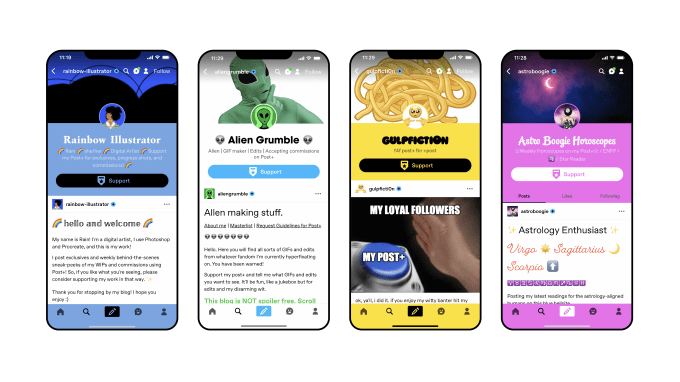
Image Credits: Tumblr

Tumblr is far from the first social media platform to seek revenue this way — Twitter is rolling out Super Follows and a Tip Jar feature, and this week, YouTube announced a tipping feature too. Even Instagram is working on its own version of Twitter’s Super Follows that would let users create “exclusive stories.” But on a website with a community that prides itself as being a “completely lawless wasteland” for anyone with a platform (save for Wil Wheaton and Neil Gaiman, who are simply just vibing), the move toward paywalled content was not welcomed with open arms.

Monetization is a double-edged sword. It’s not considered uncool for a Tumblr artist to link to a third-party Patreon or Ko-fi site on their blog, where their most enthusiastic followers can access paywalled content or send them tips. So Post+ seems like an obvious way for Tumblr to generate revenue — instead of directing followers to other websites, they could build a way for fans to support creators on their own platform while taking a 5% cut. This isn’t unreasonable, considering that Twitter will take 3% revenue from its new monetization tools, while video-centric platforms like YouTube and Twitch take 30% and 50%, respectively. But Tumblr isn’t Twitter, or YouTube, or Twitch. Unlike other platforms, Tumblr doesn’t allow you to see other people’s follower counts, and no accounts are verified. It’s not as easy to tell whether the person behind a popular post has 100 followers or 100,000 followers, and the users prefer it that way. But Post+ changes that, giving bloggers an icon next to their username that resembles a Twitter blue check.

A Tumblr Post+ creator profile

Tumblr rolled out Post+ this week to a select group of hand-picked creators, including Kaijuno, a writer and astrophysicist. The platform announced Post+ on a new blog specific to this product, rather than its established staff blog, which users know to check for big announcements. So, as the most public user who was granted access, the 24-year-old blogger was the target of violent backlash from angry Tumblrites who didn’t want to see their favorite social media site turn into a hypercapitalist hellscape. When Kaijuno received death threats for beta testing Post+, Tumblr’s staff intervened and condemned harassment against Post+ users.

“We want to hear about what you like, what you love, and what concerns you. Even if it’s not very nice. Tell us. We can take it,” Tumblr wrote on its staff blog. “What we won’t ever accept is the targeted harassment and threats these creators have endured since this afternoon. […] all they’re doing is testing out a feature.”

Before making their post, a representative from Tumblr’s staff reached out to Kaijuno directly to check in on them regarding the backlash, but there’s only so much that Tumblr can do after a user has already been threatened for using their product.

“I felt like the sacrificial lamb, because they didn’t announce Post+ beforehand and only gave it to a few people, which landed me in the crosshairs of a very pissed off user base when I’m just trying to pay off medical bills by giving people the option to pay for content,” Kaijuno told TechCrunch. “I knew there’d be some backlash because users hate any sort of change to Tumblr, but I thought that the brunt of the backlash would be at the staff, and that the beta testers would be spared from most of it.”

Why do Tumblr users perceive monetization as such a threat? It’s not a question of whether or not it’s valuable to support creators, but rather, whether Tumblr is capable of hosting such a service. Multiple long-time, avid Tumblr users that spoke to TechCrunch referenced an incident in late 2020 when people’s blogs were being hacked by spam bots that posted incessant advertisements for a Ray-Ban Summer Sale.

“Tumblr is not the most well-coded website. It’s easy to break features,” Kaijuno added. “I think anything involving trusting Tumblr with your financial information would have gotten backlash.”

Tumblr users also worried about the implications Post+ could have on privacy — in the limited beta, Post+ users only have the ability to block people who are subscribed to their blog if they contact Tumblr support. In cases of harassment by a subscriber, this could leave a blogger vulnerable in a potentially dangerous situation.

“Ahead of our launch to all U.S.-based creators this fall, Post+ will allow creators to block subscribers directly,” a Tumblr spokesperson told TechCrunch.

Still, the Extremely Online Gen Z-ers who now make up 48% of Tumblr know that they can’t expect the platform to continue existing if it doesn’t pull in enough money to pay for its staff and server fees. In 2018, Tumblr lost almost one-third of its monthly page views after all NSFW content was banned — since then, the platform’s monthly traffic has remained relatively stagnant.
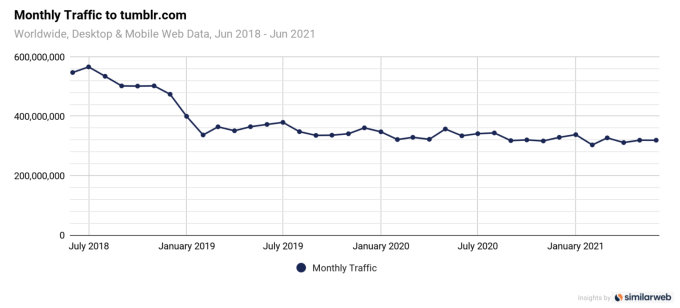
Image Credits: SimilarWeb

A former Tumblr employee told TechCrunch that the feature that became Post+ started out as a Tip Jar. But higher-ups at Tumblr — who do not work directly with the community — redirected the project to create a paywalled subscription product.

“I think a Tip Jar would be a massive improvement,” said the creator behind the Tumblr blog normal-horoscopes. Through the core audience they developed on Tumblr, they make a living via Patreon, but they don’t find Post+ compelling for their business. “External services [like Patreon] have more options, more benefits, better price points, and as a creator I get to choose how I present them to my audience.”

But a paywalled subscription service is different in the collective eyes of Tumblr. For a site that thrives on fandom, creators that make fan art and fanfiction worry that placing this derivative work behind a paywall — which Post+ encourages them to do — will land them in legal trouble. Even Archive of Our Own, a major fanfiction site, prohibits its users from linking to sites like Patreon or Ko-Fi.

“Built-in monetization attracts businesses, corporate accounts, people who are generally there to make money first and provide content second,” said normal-horoscopes. “It changes the culture of a platform.”

Across Tumblr, upset users are rallying for their followers to take Post+’s feedback survey to express their frustrations. The staff welcomes this.

“As with any new product launch, we expect our users to have a healthy discussion about how the feature will change the dynamics of how people use Tumblr,” a Tumblr spokesperson told TechCrunch. “Not all of this feedback will be positive, and that’s ok. Constructive criticism fuels how we create products and ultimately makes Tumblr a better place.”

Tumblr’s vocal community has been empowered over the years to question whether it’s possible for a platform to establish new revenue streams in a way that feels organic. The protectiveness that Tumblr’s user base feels for the site — despite their lack of faith in staff — sets it apart from social media juggernauts like Facebook, which can put ecommerce front and center without much scrutiny. But even three years after the catastrophic porn ban, it seems hard for Tumblr to grow without alienating the people that make the social network unique.

Platforms like Reddit and Discord have remained afloat by selling digital goods, like coins to reward top posters, or special emojis. Each company’s financial needs are different, but Tumblr’s choice to monetize with Post+ highlights the company’s lack of insight into its own community’s wishes.