
Year: 2021

14 Jul 2021

Great Question gets $2.5M seed round to make customer research easier

Great Question's user dashboard

Great Question’s user dashboard

Customer research is invaluable for software companies, but there are many obstacles, like finding the right group of people to survey. Great Question wants to make building and talking to their own panels accessible to all companies, no matter their size. The startup, which recently completed Y Combinator’s summer 2021 program, announced today that it has raised $2.5 million in seed funding.

Great Question launched in February 2021, and its clients include Linktree, Honeybook, O’Reilly Media and MainStreet. The platform has been used to interview customers about product ideas and strategy, find product-market fit, conduct usability studies on UX designs and see how well marketing landing pages perform. Great Question’s seed round came from investors including Funders Club, January Capital, Nomo VC and Twenty-Two Ventures. Angel investors like Warren Hogarth, co-founder of Empower Finance; Jon Williams, co-founder of Culture Amp and Pyn; Jason Smale, senior vice president of engineering at Zendesk; and Robbie Allan, former group product manager at Intercom also participated.

Before founding Great Question, PJ Murray and Ned Dwyer sold their last startup, web developer marketplace Elto, to GoDaddy in 2015. In email, Dwyer told TechCrunch that they did very little formal research at Elto. “We would talk to customers, but it wasn’t structured or consistent.”

After joining GoDaddy, however, they became “a lot more rigorous in our approach to building product—we suddenly had a much larger audience, a bigger team and aggressive targets.” Murray and Dwyer also had the advantage of working with GoDaddy’s UX research team.

The two saw an opportunity to make customer research more accessible to product development teams. Dwyer said that if companies outsource to a large UX research provider, the starting price can be $40,000 a year. On the other hand, Great Question’s freemium pricing model includes paid subscription plans for $49 and $199 a month.

Great Question has almost all of the things needed for customer research—survey smart templates, prototype tests, scheduling tools and transcription—in one place, so teams can share information easily. One of its most important features is customer recruitment and filtering tools. Dwyer explained that many UX research companies sell access to panels they have already built. That means clients often get feedback from relatively homogenous groups of people who are not their target customers—for example, college students or stay at home parents who signed up to answer surveys so they can earn extra cash or gift cards.

Great Question builds custom landing pages where users can opt into panels, decide what kind of research they want to participate in and how often they are willing to answer questions (for example, the platform automates rolling studies, sending questions to different groups of customers every two weeks). Great Question lets its clients integrate incentives programs, such as Tremendous, to compensate participants with cash or gift cards. But many of the people who participate in research through Great Question are motivated because they want to have a say in products they are already using, or find out first about upcoming releases, Dwyer said.
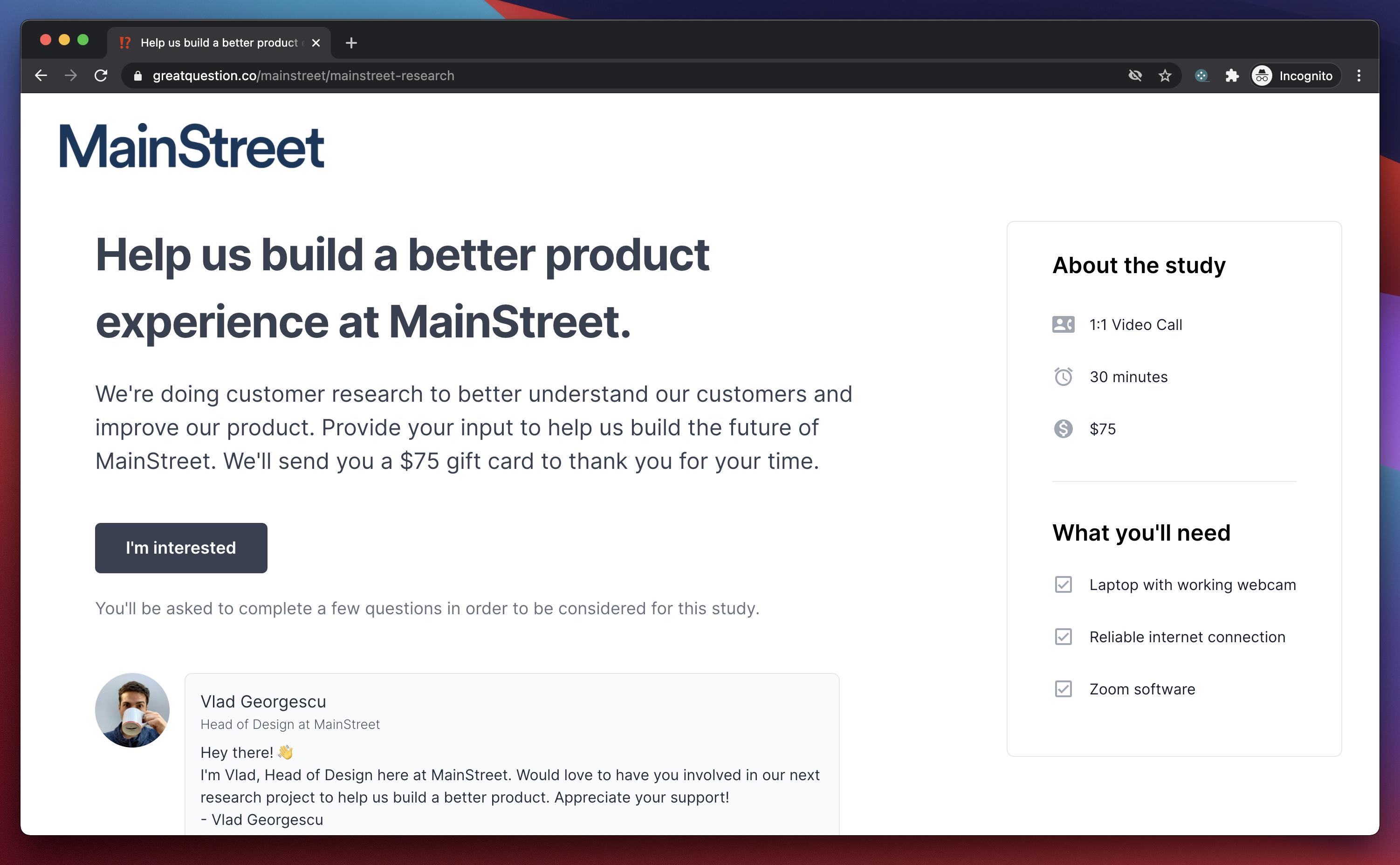
A landing page created for MainStreet with Great Question's user research platform

A landing page created for MainStreet with Great Question’s user research platform

Once customer panels are created, Great Question provides smart templates for surveys or interviews and automatically schedules them for distribution. This saves clients time. For example, MainStreet approached Great Question when it was preparing to release a product that would change its onboarding flow. The startup, which lets small businesses find and claim tax credits and economic incentives, didn’t have time to perform customer research before the launch. “Within 24 hours of signing up to Great Question they’d booked eight customer interviews—this was over Christmas mind you—and got the usability feedback they needed to iterate on the designs before they went to production,” said Dwyer.

In a statement about the investment, Funders Club co-founder and chief executive officer said Alix Mittal said, “Even the best product and business teams know everyday iteration, large pivots, and new launches can be hit or miss. We backed Great Question because they provide the missing tool to effortlessly incorporate customers into product and business decisions and to never miss the mark.”


14 Jul 2021

Walmart will be bringing Symbotic robots to 25 distribution centers

Ask anyone who runs a fulfillment/warehouse robotics company what companies’ top motivation is for embracing automation and they’ll probably cite labor shortages or shipping speeds. The looming truth of the matter boils down to one word: Amazon. And while it’s true that smaller businesses are feeling the worst crunch, no one is immune to the online retailer’s dominance. Not even Walmart.

Today, the fellow retail giant announced its latest robotics partnership, teaming with Massachusetts-based automation company Symbotic. The two announced today an extension of their relationship that will bring robotics to 25 regional Walmart distribution centers. The company says the rollout will take “several years” to complete.

The deal follows a 2017 pilot that brought Symbotic’s autonomous robotics platform to Walmart’s Brooksville, Florida distribution center in a bid to increase freight sorting, stocking and unloading.

“The digital transformation happening today, alongside evolving customer habits, is reshaping the retail industry,” Walmart’s Joe Metzger said in a release. “To serve customers now, and in the future, our business must provide the right tools and training to our associates so they can deliver the items our customers want, when they want them, with unmatched convenience. We’re investing in our supply chain at an unprecedented scale in order to optimize that process end-to-end.”

Walmart has been aggressive about piloting robots over the last several years, in hopes of expediting some of its processes. As we’ve noted before, however, its results have, thus far, been uneven. Most notable is the case of Bossa Nova Robotics. The startup was thrown for a loop when Walmart ended its contract with the inventory robotics maker. That’s what pilots are for, of course, but that likely doesn’t dull the sting for the smaller company.

Symbotic has a significantly stronger track record, however. The company lists among its partners one of Walmart’s biggest competitors: Target. And while Walmart could be exploring the possibility of acquiring its own startups (à la Amazon, which built its robotics wing atop its acquisition of Kiva Systems), it seems like existing ties could make such a deal a large hurdle.

14 Jul 2021

Investment app Syfe raises $29.6M Series B led by returning investor Valar Ventures

A photo of Syfe founder Dhruv Arora

Syfe founder Dhruv Arora

Investment apps in Southeast Asia are attracting a lot of funding, and now some are raising fast follow-on rounds, too. For example, Indonesian robo-advisor app Bibit raised $65 million in May just four months after a $30 million growth round. Now Singapore-based Syfe is announcing that it has closed a $40 million SGD (about $29.6M USD) Series B, only nine months after its Series A. It also said all of Syfe’s full-time employees will receive equity in the company.

The latest round’s lead investor is Valar Ventures, which also led Syfe’s Series A, marking the fintech-focused venture capital firm’s first investment in an Asian startup. Returning investors Presight Capital and Unbound participated, too.

This brings Syfe’s total raised so far to $70.7 million SGD (about $52.3 million USD) since it was founded in 2019. The startup did not disclose its Series B post-money valuation, but founder and chief executive officer Dhruv Arora told TechCrunch it increased 3.6 times from its Series A. The company also hasn’t disclosed total user numbers, but assets under management have grown four times since January, thanks in large part to user referrals and the launch of new products like Syfe Cash+ and Core portfolios.

“To be honest, we weren’t really looking to raise a Series B,” Arora told TechCrunch. “We saw some of the positive outcomes of resources from our Series A. We really scaled up the team and started launching new products and options for our users.” Syfe probably could have waited another six months to a year to raise a new round, he added, but its investors approached the startup again and offered good terms for another round.

About 50% to 70% of new users each month come through recommendations from existing customers, which keeps Syfe’s acquisition costs extremely low, Arora says. Since the beginning of this year, it has also doubled its team in Singapore to more than 100 people, allowing the startup to explore different kind of distribution strategies and partnerships. The app currently has users in 42 countries, but only actively markets in Singapore, where it holds a Capital Markets Services license from the Monetary Authority of Singapore (MAS). It has plans to announce a second market soon.

Syfe was founded in 2017 and launched its app in July 2019. Prior to starting Syfe, Arora was an investment banker at UBS Investment Bank before serving as vice president and head of growth at Indian grocery delivery startup Grofers.

While retail investment rates are still low in Southeast Asia, interest has jumped significantly over the past year. One of the reasons most commonly cited is the economic impact of COVID-19, which motivated people to earn returns from their money instead of keeping it in saving accounts.

“Most of my career has been within Hong Kong, Singapore and parts of India. I think culturally we’ve always been told to save, save, save,” Arora says. “It made sense because banks were giving good interest rates, but now the majority of economies are in negative real rate of interest.” Along with consumers’ growing familiarity with online wallets and other digital financial services, this set the stage for investment apps to come in, attracting customers who might not have gone to traditional brokerages.

Arora says he expected people to become more interested in investing, but gradually, over the course of about five to seven years. Instead, that shift is happening much more quickly. “My view is that tomorrow’s saving accounts become smart investing accounts. That’s been my view ever since we started Syfe, but this last year has made it evident that it has to happen and has to happen much bigger. So I think this wave will continue,” he says.

While many investment apps focus on millennial users, Syfe’s target demographic is wider. In the last six to nine months, Arora says there has been an uptick in users aged 50 and above on the platform, and its oldest user is 93 years old.

“The users in that segment have become a bigger percentage and the reality is that they typically have more disposable income. The average customer in their 50s will deploy, in our experience, almost twice the more conventional demographic which might be between 30 to 40,” says Arora.

Out of the many investment apps that have emerged in Southeast Asia, users most often compare Syfe to Stashaway, Endowus and Autowealth when shopping around for a platform. Arora says the space has a lot of room to grow because retail investment in the region is still very low. “I think it’s still super early in the game. There is enough room for multiple players and I think more will come into this domain, because if you can get your acquisition metrics into place, this can be a very profitable business.”

In terms of differentiating, Syfe is focused on new product development and user localization and personalization so customers can create more customized portfolios.

Syfe has a team of financial advisors for users who want person-to-person consultations, but Arora says most of Syfe’s investors rely entirely on its app to decide how to invest. Over the last nine months, it has only added one new advisor to its team, while focusing on making its user interface more intuitive.

“The human touch is optional, but it’s not necessary and in many cases, it’s only needed to help people understand the offering once,” says Arora. “But our goal is always going to be technology company and for the app to become so intuitive that whether you are 18 or 93, you are able to use the offering with very limited guidance.”

In a press statement, Valar Ventures founding partner Andrew McCormack says, “Syfe was our first investment in Asia and we’ve been impressed by its rapid, sustained growth over the past couple of years. The opportunity for the company to meet the saving and investment needs of a burgeoning mass-affluent consumer population in Asia remains significant, and we are confident that Syfe will continue to expand at pace.”


14 Jul 2021

Revel turns to software to keep its e-moped fleet powered without straining NYC’s grid

Revel is turning to an app that gamifies energy use to keep its fleet of more than 3,000 electric mopeds charged without putting a strain on New York City’s power grid.

Electricity is the key ingredient for the Brooklyn-based startup, which has more recently expanded beyond shared electric mopeds and into e-bike subscriptions, fast-charging infrastructure and even an all EV ride-hailing service. It’s not just about accessing power; managing when that power is tapped will be essential for Revel to keep its operational costs as low as possible.

That’s where Logical Buildings comes in. The software company has developed GridRewards, an app that helps customers lower their monthly energy consumption and earn cash rewards in the process. The app’s “virtual power plant” software will help Revel dynamically adjust the charging schedule of its fleet to support NYC’s electrical grid resilience, according to a statement from the companies.

“As we continue to expand our electric mobility products, we plan to be an asset to the grid rather than a liability,” said Paul Suhey, Revel COO & co-founder, in a statement. “Our EV infrastructure and charging operations can play a major role in helping NYC transition to a cleaner electric grid.”

EV adoption and shared micromobility services are on the rise, so many industry players are finding ways to transfer energy between batteries and the grid. EV battery swapping company Ample says its swapping stations can be used to generate backup power in case of an emergency, and even Ford’s new pickup truck, the F-150 Lighting, can power your home in the event of an outage.

In Revel’s case, the company hopes to provide services to the grid like “demand response” operations, where charging stations shed a load when needed in order to provide immediate relief to the grid, something the company just did in NYC. During the heat wave of the week of June 28, the mobility company adjusted its fleet charging schedule to avoid peak demand times.

Revel says avoiding peak demand times also helps to create a cleaner grid because when energy is in high demand, the sources of power generation emit twice as much carbon dioxide per unit of electricity and 20 times as much nitrogen oxides.

Revel also owns a fleet of Teslas for an all-EV ridehailing service that has had to halt its services due to a cap placed on new for-hire vehicles in the city. But at present, the company will only be implementing this technology with its e-mopeds.

“As transportation electrifies, it is imperative that electric mobility companies schedule their charging operations to promote grid resiliency,” said David Klatt, Logical Buildings’ VP of operations, in a statement. “Revel is taking necessary steps to ensure it is a leader in intelligent charging operations, paving the way for the smooth electrification and decarbonization of NYC.”

13 Jul 2021

NewView Capital leads $22.3M Series B in Australian telehealth platform Eucalyptus

Telehealth platform Eucalyptus raised a $22.3 million Series B round of funding to build a digital health portfolio for primary care in Australia.

NewView Capital led the round with participation from existing investors Blackbird Ventures and W23, and new investor AirTree Ventures. As part of the investment, Ravi Viswanathan, NewView founder and managing partner, will be joining the Eucalyptus board.

The new round gives the Sydney-based company a total of $32.8 million raised since it was founded in 2019 by Tim Doyle, Benny Kleist, Alexey Mitko and Charlie Gearside.

Australia’s healthcare system is a two-payer model, where most of the care is paid for by the government, and there is a smaller insurance coverage that is owned by individuals. Eucalyptus fits into these models as a private-pay option selling directly to consumers. In some cases, the company is able to charge lower copays for care than the average $25 per doctor visit, Doyle told TechCrunch.

He touts the company as the “largest vertically integrated telehealth platform in Australia,” serving more than 200,000 patients across four demographic-focused brands: contraception and fertility, skincare, men’s health and sexual wellness. Each brand has its own core platform of healthcare providers, patient data repository, remote monitoring tools and partnerships with pathology labs and pharmacies.

All of that results in a higher touch and higher quality relationship between doctor and patient, Doyle said.

“We are seeing an opportunity to shorten the amount of time between identification of a condition and diagnosis,” he added. “We also want to go more in-depth into diabetes, heart conditions and mental health. People are dropping out of diabetes and mental care because there are not enough touch points that are easy to use. If we can build a hub, it will make it easier to treat those conditions.”

In addition to product development, the new funding enables Eucalyptus to build toward being a major player in the telehealth industry. The company will introduce new brands in the next year around chronic care like behavioral health, weight management and diabetes.

Eucalyptus grew its revenue between 200% to 300% year over year since 2019, Doyle said. This is not unlike other startups in the digital health sector, where 2020 saw another record year for venture capital investment. He expects similar growth in 2021, including adding about 20 employees to be over 100 by the end of the year.

Meanwhile, Doyle said he is excited to work with NewView, especially with Viswanathan and associate Christina Fa, who said Eucalyptus is proving that Australia can lead in digital healthcare.

“The team is impressive in terms of clarity of vision and execution, especially in the way they brought in people to manage the brands,” she told TechCrunch. “It is unique being based in Australia where they don’t have the Teledocs and other digital health companies. Instead, Eucalyptus had to build all of that in-house and do the hard work upfront. In addition, they curated a network of health providers and four brands, each with their own personalities that can be fully vertically integrated and own the customer journey.”


13 Jul 2021

Build a digital ops toolbox to streamline business processes with hyperautomation

Reliance on a single technology as a lifeline is a futile battle now. When simple automation no longer does the trick, delivering end-to-end automation needs a combination of complementary technologies that can give a facelift to business processes: the digital operations toolbox.

According to a McKinsey survey, enterprises that have likely been successful with digital transformation efforts adopted sophisticated technologies such as artificial intelligence, Internet of Things or machine learning. Enterprises can achieve hyperautomation with the digital ops toolbox, the hub for your digital operations.

The hyperautomation market is burgeoning: Analysts predict that by 2025, it will reach around $860 billion.

The toolbox is a synchronous medley of intelligent business process management (iBPM), robotic process automation (RPA), process mining, low code, artificial intelligence (AI), machine learning (ML) and a rules engine. The technologies can be optimally combined to achieve the organization’s key performance indicator (KPI) through hyperautomation.

The hyperautomation market is burgeoning: Analysts predict that by 2025, it will reach around $860 billion. Let’s see why.

The purpose of a digital ops toolbox

The toolbox, the treasure chest of technologies it is, helps with three crucial aspects: process automation, orchestration and intelligence.

Process automation: A hyperautomation mindset introduces the world of “automating anything that can be,” whether that’s a process or a task. If something can be handled by bots or other technologies, it should be.

Orchestration: Hyperautomation, per se, adds an orchestration layer to simple automation. Technologies like intelligent business process management orchestrate the entire process.

Intelligence: Machines can automate repetitive tasks, but they lack the decision-making capabilities of humans. And, to achieve a perfect harmony where machines are made to “think and act,” or attain cognitive skills, we need AI. Combining AI, ML and natural language processing algorithms with analytics propels simple automation to become more cognitive. Instead of just following if-then rules, the technologies help gather insights from the data. The decision-making capabilities enable bots to make decisions.


Simple automation versus hyperautomation

Here’s a story of evolving from simple automation to hyperautomation with an example: an order-to-cash process.

13 Jul 2021

Daily Crunch: ZoomInfo announces plans to acquire sales intelligence tool Chorus.ai for $575M

To get a roundup of TechCrunch’s biggest and most important stories delivered to your inbox every day at 3 p.m. PDT, subscribe here.

Hello and welcome to Daily Crunch for July 13, 2021. Have you gotten into the fake meat craze yet? Or are you sitting on the sidelines still, holding a turkey leg in one hand and a bacon sandwich in the other? The good news for primitive humans like you and me is that more fake meat is cropping up in more places. Like Beyond Meat’s fake chicken at Panda Express.

Look, I love to be a carnivore. But I don’t love the carbon footprint. Maybe tech companies will chart a more sustainable path for the rest of us. — Alex

The TechCrunch Top 3

  • Apple gets into the external battery game: If you’re anything like me, your mobile phone is usually about to die. If you own an iPhone, there’s good news today in the form of Apple announcing a $99 battery pack that will provide wireless juice to your handset. It snaps to the back of the phone. Frankly, I am irked that I need this, but I do.
  • There have never been so many great startups: That’s what TechCrunch learned today from investors. The U.S. venture class said that high prices weren’t keeping them on the sidelines, and that you essentially have to pay up to stay in the game. So if you are a founder with a good growth story, congratulations on your salad days.
  • For example, Zomato just raised more money before its IPO: The Indian food delivery startup is looking to list this week at the high end of its range, with 45% of the $1.3 billion it plans to raise coming from its anchor investors. That’s some hot demand.

Startups/VC

First up from our startup digest today is a piece from our own Danny Crichton announcing the winding down of The TechCrunch List. The original idea was simple: “A curated directory of venture capitalists designed to guide founders to the VCs most relevant to their startups.”

But after reading thousands of entries and building out a huge database, the experiment went a bit stale. Here’s Danny on what happened: “The venture capital industry has radically changed over the past year, and the central thesis we used in constructing the list no longer applies.” Why? Because the venture capital world has become more competitive, quicker and geographically flatter. So terms and pricing matter more, we’re told, than expertise.

Consider that fact duly noted. Now, our usual rundown of funding events, from smallest to largest:

  • AttackIQ raises $44M to help companies manage breaches: It does so in an interesting manner, by simulating attacks themselves. It’s a bit like having a scrimmage match against yourself. The latest AttackIQ deal underscores just how valuable cybersecurity startups have proven to be in recent months.
  • Marco Financial raises $82M to fund LatAm exporters: The Miami-based, trade-focused startup raised $7 million in cash and $75 million in credit to help grow its business. Marco Financial uses a “tech-enabled risk assessment platform” to determine creditworthiness, which is neat. Anything to provide more capital access to more people in more places.
  • Amperity raises $100M, becomes unicorn: What does it do? The startup built a customer data platform to help big companies better understand to whom they sell. As our own Ingrid Lunden reports, the startup is working in a world where some traditional methods of tracking customers — like browser cookies — are fading from our shared reality.
  • Sourcegraph raises $125M for its code-search tool: This is an interesting one. Now worth $2.625 billion — up 3x from its December round — Sourcegraph is on fire. Other reporting indicates that the company could be at around a $10 million annual run rate. That’s, ahem, a healthy multiple.

5 advanced-ish SEO tactics to win in 2021

The days of gaming search engines to drive traffic are long gone. Startups that want to be noticed must invest in producing high-quality content that accurately describes their products and services.

Beyond the basic best practices you’ll find on SEO blogs and newsletters, Mark Spera, head of growth marketing at Minted, offers five “advanced-ish” tactics “to increase your SEO throughput and capitalize on some of the arbitrage still left in organic search.”

Strategy No. 1? Start out by using content-generation tools to automate tasks like creating search-friendly headlines, titles and blog outlines.

“We’ve been able to bring our article-writing process down from four hours per article to around 90 minutes,” writes Spera. “Imagine what you could do with all that time!”

(Extra Crunch is our membership program, which helps founders and startup teams get ahead. You can sign up here.)

Big Tech Inc.

Yes, there was other Big Tech news apart from Apple’s battery pack today. Here’s what you need to know:

  • Discord buys Sentropy: Discord is a big company today, with lots of staff, lots of users and a big valuation. And it just bought Sentropy, a startup that TechCrunch wrote “makes AI-powered software to detect and remove online harassment and hate.” Given that some loathsome groups use Discord here and there, the buy makes sense.
  • Facebook wants to pay bug hunters more: A new Facebook program called the “Payout Time Bonus” may boost fees paid to bug hunters in the social network’s world. The company pays out less per year than some other megacorps, but the gap could tighten thanks to the new effort.
  • ZoomInfo buys Chorus.ai for $575M: Early today news broke that ZoomInfo, a public company, will drop more than half a billy on Chrous.ai, a company that provides sales intelligence tools focused on conversations. It’s related to what Gong.io is building, though Gong remains independent and worth around 13 times as much.

TechCrunch Experts: Growth Marketing

Illustration montage based on education and knowledge in blue

Image Credits: SEAN GLADWELL (opens in a new window) / Getty Images

We’re reaching out to startup founders to tell us who they turn to when they want the most up-to-date growth marketing practices. Fill out the survey here.

Read one of the testimonials we’ve received below!

Marketer: MuteSix

Recommended by: Rhoda Ullmann, Sense

Testimonial: “We’ve tried a number of different agencies, they demonstrate best-in-class expertise with Facebook and Google paid ad platforms. They also have a very smart and efficient approach to creative development that was critical to helping us scale.”

13 Jul 2021

Daily Crunch: ZoomInfo announces plans to acquire sales intelligence tool Chorus.ai for $575M

To get a roundup of TechCrunch’s biggest and most important stories delivered to your inbox every day at 3 p.m. PDT, subscribe here.

Hello and welcome to Daily Crunch for July 13, 2021. Have you gotten into the fake meat craze yet? Or are you sitting on the sidelines still, holding a turkey leg in one hand and a bacon sandwich in the other? The good news for primitive humans like you and me is that more fake meat is cropping up in more places. Like Beyond Meat’s fake chicken at Panda Express.

Look, I love to be a carnivore. But I don’t love the carbon footprint. Maybe tech companies will chart a more sustainable path for the rest of us. — Alex

The TechCrunch Top 3

  • Apple gets into the external battery game: If you’re anything like me, your mobile phone is usually about to die. If you own an iPhone, there’s good news today in the form of Apple announcing a $99 battery pack that will provide wireless juice to your handset. It snaps to the back of the phone. Frankly, I am irked that I need this, but I do.
  • There have never been so many great startups: That’s what TechCrunch learned today from investors. The U.S. venture class said that high prices weren’t keeping them on the sidelines, and that you essentially have to pay up to stay in the game. So if you are a founder with a good growth story, congratulations on your salad days.
  • For example, Zomato just raised more money before its IPO: The Indian food delivery startup is looking to list this week at the high end of its range, with 45% of the $1.3 billion it plans to raise coming from its anchor investors. That’s some hot demand.

Startups/VC

First up from our startup digest today is a piece from our own Danny Crichton announcing the winding down of The TechCrunch List. The original idea was simple: “A curated directory of venture capitalists designed to guide founders to the VCs most relevant to their startups.”

But after reading thousands of entries and building out a huge database, the experiment went a bit stale. Here’s Danny on what happened: “The venture capital industry has radically changed over the past year, and the central thesis we used in constructing the list no longer applies.” Why? Because the venture capital world has become more competitive, quicker and geographically flatter. So terms and pricing matter more, we’re told, than expertise.

Consider that fact duly noted. Now, our usual rundown of funding events, from smallest to largest:

  • AttackIQ raises $44M to help companies manage breaches: It does so in an interesting manner, by simulating attacks themselves. It’s a bit like having a scrimmage match against yourself. The latest AttackIQ deal underscores just how valuable cybersecurity startups have proven to be in recent months.
  • Marco Financial raises $82M to fund LatAm exporters: The Miami-based, trade-focused startup raised $7 million in cash and $75 million in credit to help grow its business. Marco Financial uses a “tech-enabled risk assessment platform” to determine creditworthiness, which is neat. Anything to provide more capital access to more people in more places.
  • Amperity raises $100M, becomes unicorn: What does it do? The startup built a customer data platform to help big companies better understand to whom they sell. As our own Ingrid Lunden reports, the startup is working in a world where some traditional methods of tracking customers — like browser cookies — are fading from our shared reality.
  • Sourcegraph raises $125M for its code-search tool: This is an interesting one. Now worth $2.625 billion — up 3x from its December round — Sourcegraph is on fire. Other reporting indicates that the company could be at around a $10 million annual run rate. That’s, ahem, a healthy multiple.

5 advanced-ish SEO tactics to win in 2021

The days of gaming search engines to drive traffic are long gone. Startups that want to be noticed must invest in producing high-quality content that accurately describes their products and services.

Beyond the basic best practices you’ll find on SEO blogs and newsletters, Mark Spera, head of growth marketing at Minted, offers five “advanced-ish” tactics “to increase your SEO throughput and capitalize on some of the arbitrage still left in organic search.”

Strategy No. 1? Start out by using content-generation tools to automate tasks like creating search-friendly headlines, titles and blog outlines.

“We’ve been able to bring our article-writing process down from four hours per article to around 90 minutes,” writes Spera. “Imagine what you could do with all that time!”

(Extra Crunch is our membership program, which helps founders and startup teams get ahead. You can sign up here.)

Big Tech Inc.

Yes, there was other Big Tech news apart from Apple’s battery pack today. Here’s what you need to know:

  • Discord buys Sentropy: Discord is a big company today, with lots of staff, lots of users and a big valuation. And it just bought Sentropy, a startup that TechCrunch wrote “makes AI-powered software to detect and remove online harassment and hate.” Given that some loathsome groups use Discord here and there, the buy makes sense.
  • Facebook wants to pay bug hunters more: A new Facebook program called the “Payout Time Bonus” may boost fees paid to bug hunters in the social network’s world. The company pays out less per year than some other megacorps, but the gap could tighten thanks to the new effort.
  • ZoomInfo buys Chorus.ai for $575M: Early today news broke that ZoomInfo, a public company, will drop more than half a billy on Chrous.ai, a company that provides sales intelligence tools focused on conversations. It’s related to what Gong.io is building, though Gong remains independent and worth around 13 times as much.

TechCrunch Experts: Growth Marketing

Illustration montage based on education and knowledge in blue

Image Credits: SEAN GLADWELL (opens in a new window) / Getty Images

We’re reaching out to startup founders to tell us who they turn to when they want the most up-to-date growth marketing practices. Fill out the survey here.

Read one of the testimonials we’ve received below!

Marketer: MuteSix

Recommended by: Rhoda Ullmann, Sense

Testimonial: “We’ve tried a number of different agencies, they demonstrate best-in-class expertise with Facebook and Google paid ad platforms. They also have a very smart and efficient approach to creative development that was critical to helping us scale.”

13 Jul 2021

Apple is reportedly working on a pay later feature for Apple Pay

If you’ve done any online shopping in the last little while, there’s a good chance you’ve run into services like Affirm and PayPal’s Pay in 4. They allow you to purchase something and pay for it later by splitting up the total cost of the item into several installments.

By the looks of things, Apple could soon offer a similar option to Apple Pay users. According to Bloomberg, the company is working with Goldman Sachs on a service called “Apple Pay Later” that will allow those with its devices to settle purchases over time, including ones they make at physical shops.

When using the service, the outlet says you’ll have two ways of paying for your purchase. If you pick the “Apple Pay in 4” option, you’ll need to make four interest-free payments across two months.

The other option is to extend the payment period over multiple months, though in that case interest comes into play. Bloomberg says it wasn’t able to determine how much interest Apple plans to charge or when the company will roll out the service.

We’ve reached out to Apple for comment on the report, and we’ll update this article when we hear back from the company. But in many ways, Apple Pay Later sounds like a logical extension of what the company is already doing with Apple Card, where one of the perks it offers is installment plans for Mac and iPad purchases.

Editor’s note: This post originally appeared on Engadget

13 Jul 2021

Gogo in-flight internet has been renamed Intelsat

The next time you’re on a plane, searching for a Wi-Fi connection while soaring thousands of feet above the ground, don’t look for the Gogo name. The longstanding standard of in-flight internet, Gogo Commercial Aviation, has been rebranded to Intelsat.

Intelsat, an international satellite communications provider, purchased Gogo Commercial Aviation in December 2020. It was a cash deal valued at $400 million. Gogo still exists and focuses on business aviation services.

Gogo has been a staple of in-flight entertainment for the past decade, partnering with 17 major airlines. The service is as impressive as it is frustrating, though it’s improved with time. In 2019, Gogo announced plans to roll out 5G in-flight services this year, and it began testing those antennas in June. As Intelsat, 5G is still the goal.

“This name change is happening while Intelsat is leveraging its unparalleled global orbital and spectrum rights, scale and partnerships to build the world’s first global 5G satellite-based software-defined network of networks,” Intelsat CEO Stephen Spengler said in a press release.

Editor’s note: This post originally appeared on Engadget