Year: 2021

28 Jun 2021

YouTube TV adds a $20 monthly upgrade for 4K support, offline viewing

With less than a month to go before the Olympics kick off in Tokyo, cord-cutting services like YouTube TV are attempting to woo new subscribers who are looking for a way to watch summer sports. But whether or not you’re eager to watch Simone Biles defy gravity, YouTube TV’s latest upgrades enhance the product with audio and video improvements. Today, YouTube TV announced a 4K Plus add-on package with offline downloads, 5.1 Dolby audio, and features that make it easier to watch live sports. The company previously teased these features in February.

YouTube TV is already one of the pricier streaming services out there — at $64.99 per month, you might not save much money by choosing YouTube in lieu of your cable service. Hulu + Live TV is priced the same, but offers a Disney+ and ESPN+ add-on for a total of $72.99 per month. But if you want to kick your video quality (and your monthly bill) up a notch, you can now enable 4K streaming for an extra $19.99 per month, bringing your grand total to $84.98 monthly.

The 4K Plus add-on package will also allow subscribers to download shows from DVR to watch offline — currently, that’s not possible on the standard $64.99 per month package. Subscribers will be able to try out the package for free for a month, then pay $9.99 per month for a year before the price increases to $19.99. This is pretty consistent with YouTube TV’s continual price hikes over the years.

Meanwhile, the 5.1 Dolby audio capabilities will be a free addition for all YouTube TV members — in a blog post, the company says this has been one of users’ “biggest requests.” Over the coming weeks, these surround-sound audio capabilities will begin rolling out to select devices. The sports upgrades also come at no additional cost — one new feature will let viewers jump to key plays and specific highlight moments when watching a DVR recording or trying to catch up live. So, if you’re tuning in an hour late, you can view key moments from the game, then jump right in live. YouTube TV will also let users search for specific sports to add to their DVR, which has no storage space limit. So, again, if you’re determined not to miss a single Simone Biles floor routine, it will be easier to make sure you’re in the loop. There will also be a Medal count view during the Olympics within the app.

As the Olympics draw nearer, we can expect other cord-cutting services to up the ante on their live sports offerings — the $9.99 monthly Paramount+ Premium plan includes a wide range of international soccer matches, but no word on the Olympics yet. Still, the service is far less expensive than YouTube TV and already offers 4K, HDR, and Dolby Vision. YouTube TV had 3 million subscribers as of October 2020, but did not offer an update for Q1 of 2021. As of March, Hulu had 4.1 million subscribers to its Live TV service, which will also air the Olympics.

28 Jun 2021

Foursquare founder Dennis Crowley steps back from the company

Foursquare co-founder Dennis Crowley has announced that he is stepping back of his full-time role at the company. During the first seven years of the company, he was the startup’s Chief Executive Officer. In 2016, Crowley moved to an executive chairman position. He’s also been running the Foursquare Labs R&D group since then.

Going forward, Crowley won’t be working full-time at the company. He’ll remain on the Board of Directors as co-chair with Factual founder Gil Elbaz.

In 2009, Foursquare was better-known for its location-based social network. People would check in to locations to share what they’ve been up to with their friends. Users would earn badges and mayorships.

Over the years, the most active users had amassed thousands of checkins. Foursquare became a great app to keep track of places you like. You could also use it to discover your friends’ favorite places.

That’s why the company decided to split its main app into two separate apps — the Foursquare City Guide and Swarm. At the same time, the company started workin on developer APIs and SDKs so that other companies could take advantage of Foursquare’s location data.

That business in particular has been quite lucrative. With the company’s Pilgrim SDK, developers can build location-aware apps. For instance, an advertiser can send a personalized notification based on where you are. Foursquare tries to be as accurate as possible and can sometimes even figure out when you enter or exit a venue.

That SDK enables many different possibilities. It’s easy to track the impact of an advertising campaign on online sales — but what about offline interest?

Foursquare’s SDK can help advertisers and brand see whether an advertising campaign has an impact on foot traffic. Of course, you can also combine that data with other customer data.

The company has become an important advertising and marketing platform focused on location. Overall, the company has generated more than $100 million in revenue in 2020. And it plans to grow in 2021 and beat that number.

Dennis Crowley mentions two reasons why he’s leaving now. According to him, the company is doing well, and he’s been working on the same thing for twelve years already.

“Foursquare hasn’t just found its way… it leads the way. I used to say that my goal was to make the name ‘Foursquare’ synonymous with ‘innovation in contextual aware computing’… And, here in 2021, we’ve built the tools and frameworks that can make that so,” Crowley writes in a blog post.

“Also, twelve years is a lot of time. I have lots of things I still want to build — many of which don’t fit neatly into the Foursquare of 2021 (and, hey fellow founder, it’s fine to feel this way!),” he adds. He’s also going to spend some well-deserved time with his family.

Crowley has been an iconic startup founder during Web 2.0 era. He managed to attract tens of millions of users. It’s clear that he’s been a great product CEO during the early years of the company. And now, the company is also generating revenue. So it’s going to be interesting to see what he builds next.

28 Jun 2021

Coinbase CEO Brian Armstrong is coming to Disrupt

Brian Armstrong, the founder and CEO of cryptocurrency exchange Coinbase, is coming to Disrupt this September 21-23, and given how much there is to discuss, we couldn’t be more excited to host him.

As some industry observers will know, Armstrong, a native of San Jose, Calif., whose parents were both engineers, nabbed two degrees from Rice University in Texas before joining Airbnb as a software engineer in 2011 as a technical product manager focused on fraud prevention.

The role gave him the opportunity to learn about payment systems — and payment problems — across the world. It relatedly fueled a then-burgeoning interest in cryptocoins, which he began to buy and store and, more important, he began to believe would ultimately replace fiat money. In fact, after just 14 months with Airbnb, Armstrong left the company to join Y Combinator and found Coinbase.

He wasn’t focused on making money, by his telling. Instead, as he told Forbes last year, “I wanted the world to have a global, open financial system that drove innovation and freedom.” Either way, along the way, Armstrong became very wealthy, as have many Coinbase employees and investors, including Andreessen Horowitz, which built the biggest stake in Coinbase over the years and whose position was valued at a reported $11 billion at the time of Coinbase’s direct listing this past April.

Still, the success of Coinbase — which has established itself as the clean, well-lit place to invest in cryptocurrencies — has also invariably led to greater scrutiny. The company has been widely accused by its customers of focusing on security at the expense of adequate customer service. Several of Armstrong’s managerial decisions, including to clamp down on political speech inside of Coinbase, has cost the company valued employees, while others have said they were treated unfairly because of their race or gender.

More, following a very long run, enthusiasm over cryptocurrencies has abruptly slowed over the last month or so. While Armstrong has seen enthusiasm for crypto grow and wane before, Coinbase is now a publicly traded company, and as questions bubble up about Bitcoin, Coinbase’s shares are down, too. (As of this writing, they are trading at around $217, almost half of where they were valued at their peak price in April of about $429.)

Little wonder Armstrong has been laser-focused on not only strengthening what Coinbase has already built but setting it up to become an even larger enterprise, including by acquiring a company early this year that sets up Coinbase to operate as a kind of AWS, enabling companies that, say, want to connect their wallet app to a blockchain to click a few buttons rather than hire a team of engineers to spin up the necessary nodes.

How else is Armstrong, 38, dealing with the markets ups and downs as he builds a completely new financial institution? Where does he want to take Coinbase over the next 12 months? How does he respond to criticisms about some of his very public decisions concerning Coinbase employees? These are among the many things we’ll talk with him about at this year’s Disrupt for an appearance that we know attendees won’t want to miss. We’re certainly excited to sit down with him.

Join him and over 10,000 of the startup worlds most influential people at Disrupt 2021 online this September 21-23. Get your pass to attend now for under $99 for a limited time!

28 Jun 2021

SentinelOne’s upgraded IPO pricing is good news for Tiger, public markets and your local VC

As the second quarter races to a close, we’re down to the wire for IPOs looking to get out before June ends. One such company is SentinelOne, a cybersecurity startup backed by Insight Venture Partners, Redpoint, Tiger Global Management, Data Collective and Anchorage Capital, among others.

SentinelOne raised an ocean of capital while private, including nearly $500 million across two rounds in 2020. Its debut is therefore a huge liquidity event for a host of investing groups. And today, the cybersecurity unicorn had good news in the form of an upgrade to its IPO price range.


The Exchange explores startups, markets and money. Read it every morning on Extra Crunch or get The Exchange newsletter every Saturday.


Last week, The Exchange wrote that the company’s IPO would be a “good heat check for the IPO market” given its rapid growth and pace of losses. How investors valued it would help explain the public market’s current appetite for loss-making startups. Today’s news implies healthy appetites.

SentinelOne raised its IPO price range this morning from $26 to $29 per share to $31 to $32 per share, a sizable lift to its valuation and IPO raise.

This morning, we’re unpacking the company’s new valuation range, thinking about SentinelOne’s growth and revenue results compared to similar public companies, and working to understand if the company is inexpensive, neutrally priced or expensive compared to current comps. Sound fun? It will be!

What’s SentinelOne worth?

Recall that when SentinelOne last raised capital it was valued at $2.7 billion on a pre-money basis. The company was therefore worth just under $3 billion after the $267 million round. The unicorn is going to yeet that figure into space in its IPO, barring something catastrophic.

Its new IPO price range of $31 to $32 per share values the company on a much richer basis. With an anticipated simple share count of 253,530,006 after its IPO, inclusive of a private placement, the company would be worth $7.86 billion to $8.11 billion.

28 Jun 2021

Tapcart, a ‘Shopify for mobile apps,’ raises a $50 million Series B

Shopify changed the e-commerce landscape by making it easier for merchants to set up their websites both quickly and affordably. A startup called Tapcart is now doing the same for mobile commerce.

The company, which has referred to itself as the “Shopify for mobile apps,” today powers the shopping apps for top brands, including Fashion Nova, Pier One Imports, The Hundreds, Patta, Culture Kings, and thousands more. Following a year of 3x revenue growth, in part driven by the pandemic, Tapcart is today announcing the close of a $50 million round of Series B funding, led by Left Lane Capital. Having clearly taken notice of Tapcart’s traction with its own merchant base, Shopify is among the round’s participants.

Other investors in the round include SignalFire, Greycroft, Act One Ventures and Amplify LA.

Tapcart’s co-founders, Sina Mobasser and Eric Netsch, have worked in the mobile app industry for years. Mobasser’s previous company, TestMax, offered one of the first test prep courses on iOS, while Netsch had more recently worked on the agency side to create mobile and digital experiences for brands. Together, the two realized the potential in helping online merchants bring their businesses to mobile, as easily as they were able to go online with Shopify.
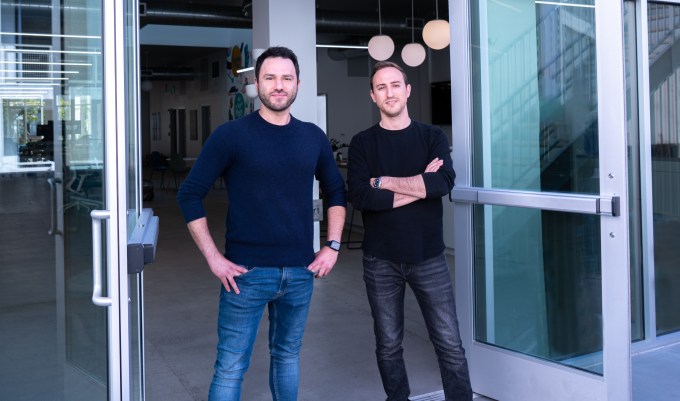
Tapcart’s founders Sina Mobasser and Eric Netsch at their Santa Monica HQ

“Now, you can launch an app on our platform in a matter of weeks, where historically it would take up to a year if you wanted to custom build an app,” explains Mobasser. “And you can do it for a low monthly fee.”

Tapcart’s platform itself offers a simple drag-and-drop builder that allows anyone to create a mobile app for their existing Shopify store using tools to design their layout, customize the product detail pages, integrate checkout options, include product reviews, and even optionally add other branded content, like blogs, lookbooks, videos (including live video) and more. Everything is synced directly from Shopify to the app in real-time, so the merchant’s inventory, products and collections are all kept up-to-date. That’s a big differentiator from some rivals, which require duplicate sets of data and data transformation.

Tapcart, meanwhile, leverages all of Shopify’s APIs and SDKs to create a native application that works with Shopify’s existing data structures.
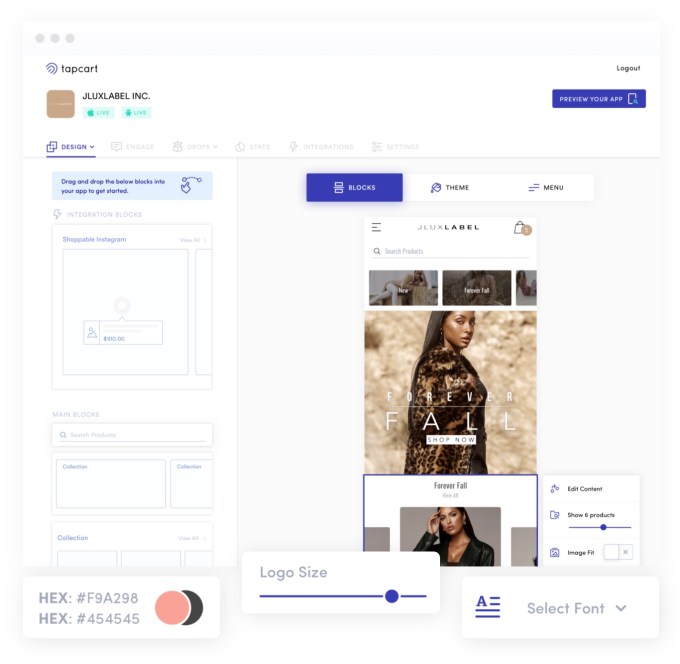
Image Credits: Tapcart


This tight integration with Shopify helps Tapcart because it doesn’t have to focus on the e-commerce infrastructure, as the way things are structured around inventory and collections are roughly 90% the same across brands. Instead, Tapcart focuses on the 10% that makes brands stand out from one another, which includes things like branding, content and design. Its CMS allows merchants to create exclusive content, change the colors and fonts, add videos and more to make the app look and feel fully customized.

Beyond the mobile app creation aspect to its business, Tapcart also helps merchants automate their marketing. Through the Tapcart platform, merchants can communicate with their customers in real-time using push notifications that can alert them to new sales, to encourage them to return to abandoned carts, or any other promotions. The marketing campaigns can be automated, as well, which helps merchants schedule their upcoming launches and product drops ahead of time. The company claims these push notifications deliver click-through rates that are 72% higher than a traditional email or SMS text because of their interactivity and branding.

Image Credits: Tapcart

The platform has quickly found traction with SMB to mid-market enterprise customers who have reached the stage of their business where it makes sense for them to double down on customer retention and conversion and optimize their mobile workflow.

“Our sweet spot is when you have maybe a couple hundred customers in your database,” notes Netsch. “That’s a perfect time to now focus less on the paid acquisition portion of your business and more on how to retain and engage those existing customers, [so they’ll] shop more and have a better experience,” he says.

During the past 12 months, over $1.2 billion in merchant sales have flowed through Tapcart’s platform. And in 2020, Tapcart’s recurring revenue increased by 3x, as mobile apps grew even faster during the pandemic, which had increased consumer mobile screen time by 20% year-over-year from 2019. Mobile commerce spending also grew 55% year-over-year, topping $53 billion globally during the holiday shopping season, the company says. Tapcart’s own merchants saw mobile app orders at a rate of more than once-per-second during this time, and it believes these trends will continue even as the pandemic comes to an end.

Today, Tapcart generates revenue by charging a flat SaaS (software-as-a-service) fee, which differentiates it from a number of competitors who charge a percent of the merchant’s total sales.

Image Credits: Tapcart

With the additional funding, Tapcart plans to focus on its goal of becoming a vertically integrated mobile commerce suite of tools, which more recently includes support for iOS App Clips. It will also soon release an upgraded version of its insights analytics platform and will offer scripts that merchants can install on their mobile websites to compare what works on the site versus what works in the app.

Later this year, Tapcart plans to launch a full marketing automation product that will allow brands to automate and personalize their notifications even further. And it plans to invest in market expansions to make its product better designed for mobile, global commerce.

The funding will allow Santa Monica-based Tapcart to hire another 200 people over the next 24 months, up from the 70 it has currently. These will include new additions across time zones and even in markets like Australia and Europe as it moves toward global expansion.

Shopify’s investment will open up a number of new opportunities as well, including on product, engineering, business strategy and partnerships. It will also help to get Tapcart in front of Shopify’s 1.7 million global merchants.

“There’s still quite a lot of merchants that need better mobile experiences, but have yet to really double down on the mobile effort and get something like a native app,” notes Netsch. “There’s a lot of different ways and methods that merchants are experimenting with mobile growth, and we’re trying to offer all of the best parts of that in a single platform. So there’s tons of expansion for Tapcart to do just that with the existing target addressable market,” he says.

“We believe brands must be where their customers are, and today that means being on their phones,” said Satish Kanwar, VP of product acceleration at Shopify, in a statement. “Tapcart helps merchants create mobile-first shopping experiences that customers love, reinforcing Shopify’s mission to make commerce better for everyone. We look forward to seeing Tapcart expand its success on Shopify with the more than 1.7 million merchants on our platform today.”


 

28 Jun 2021

Pittsburgh’s mayor on the city’s startup community and the difficulty of attracting venture capital

This week, TechCrunch is turning its spotlight on Pittsburgh, Pennsylvania with interviews, profiles, and an event featuring the outgoing mayor, CMU’s President, and local startups.

The Rust Belt city has spent much of the past decade working to shed the image that arrived in the wake of the deindustrialization of the 1970s and 80s. Courtesy of world class universities like Carnegie Melon and the University of Pittsburgh, the Steel City has transformed itself into a vibrant startup ecosystem and a world class environment for robotics, AI, autonomous driving and other high-tech companies.

Ahead of tomorrow’s event, TechCrunch spoke to Bill Peduto, who has served as Pittsburgh’s Mayor since 2014, a role that has involved overseeing much of that transformation. The Mayor spoke on his efforts over the past half-dozen years, which will culminate in January when he leaves office.

Peduto will also be speaking at our City Spotlight event Tuesday, June 29, 2021. He’ll be joining Karin Tsai, director of engineering at Duolingo, and Carnegie Mellon University President Farnam Jahanian. Register for the free event here.


TechCrunch: What are the biggest initiatives that the city government is doing in order to really help foster the startup community?

Mayor Bill Peduto: We’ve been a partner throughout the past seven years, whether it was with the autonomous vehicle industry, the expansion of robotics or artificial intelligence, predictive analytics, we have engaged directly with the startup community, got them involved in city government and also opened up and provided access to public right of ways in order to see those industries expanding. Working with our universities, we’ve been able to recruit international companies to Pittsburgh: Bosch, Tata, Google, Facebook, Intel, Amazon. They have provided parallel advancements in the tech industry. Pittsburgh has become an innovation hub that people will come to not just for one job but because they know there is opportunity to advance in their careers here in specialized fields.

Many of these companies are coming out of CMU, in industries like robotics, automation and self-driving cars. What is your sense of how varied and diverse the startup community is. What is the breakdown of robotics and automation on one side and all of the other tech categories on the other?

I would say that the robotics and autonomous industries have positioned themselves much more visible on the global stage. But the other industries – especially within the startup industry – are competitive for a share of Pittsburgh’s economy. Obviously the partnership we created with Uber, Aurora and Argo AI – they all garnered attention as Pittsburgh became the first city in the world to have autonomous rideshare. But the fact is that CMU had already been testing their vehicles on our streets for a decade before. We became a city that was one of the first to be able to expand upon that. The competitive advantage that we have here is we don’t have to draw the talent here to build out the industries. We produce the talent.

It seems like there has historically been a problem keeping the talent in Pittsburgh. People often move themselves or their companies to a New York or Silicon Valley. Has that shifted? What initiatives have to made to ensure that people not only come to Pittsburgh, but that they stay in Pittsburgh?

It’s incumbent upon local government to create an environment where people want to live. Quality of life matters and is a key indicator in building out a 21st century urban economy. All the different amenities that we add into city government matter. People want to live in a place that provides them with opportunities that don’t involve being at home or being at work. They want to have a place that has free and plentiful open spaces and areas that they can enjoy. Young people want to be around other young people. For decades, Pittsburgh lacked all three. It was a direct result of deindustrialization and disinvestment. We’ve worked very hard as a city government to build up all three and support locally built companies, whether they’re restaurants, stages or theaters, as a critical part not only of the arts and culture of the city, but also as a critical part of our economic development strategy.

I recently spoke to some startups around Detroit and it was kind of a mixed bag when it comes the legacy of having had the automotive industry based in the city. In 2021, what benefits are there to being a legacy industrial city as it pertains to building a startup ecosystem.

It depends on the company itself, not simply the industry. There are companies that have been around for over 100 years that are some of the most cutting edge within our city. They’ve diversified their portfolios and recognized the direction the world is moving and they have decided to become a competitive part of it. Other companies are more reliant on their success in the past as a model of their future development. As you look at cities like Pittsburgh and Detroit, you understand that their industrial past is something they take great pride in and they build of off.

Is there a sense when speaking to fossil fuel companies that they see the writing on the wall when it comes to pivoting to something more green?

Again, it doesn’t get defined by industry. It’s defined by company and, in most cases, CEO. In many cases in Pittsburgh, absolutely, yes. Everything from the creation to the transfer of energy, long established companies are looking to find a way to put Pittsburgh on the map when it comes to transferring to green hydrogen. The leaders in this are not just the universities, but the companies that have been long established in gas and, in some cases, oil.

What is your sense of how long term an impact Covid-19 will have when it comes to decentralizing some of these tech communities.

You used the exact term. I believe that post-Covid will be a decentralization from the coasts to the cities that have been able to create an environment where they would want to locate. When we’re looking at competition, we’re looking at Charlotte, Austin, Nashville. We’re putting ourselves up against those cities and what they can offer to the startup industry. We’re not as much concerned with the New Yorks and the San Franciscos – or even the Bostons. What we see is that we can be highly competitive against any other area that has research and development that is fueled by the education and medical industries.

What is the biggest hurdle when it comes to being an entrepreneur in Pittsburgh? And what are you doing to help address that?

I think the biggest hurdle remains access to venture capital, especially in this stage. I think we’ve been able to convince investors from the coast that the companies don’t need to leave Pittsburgh in order to be highly successful and see their investment pay off. However, I believe if we had more venture capital arriving here to help to take early stage companies into that critical next stage of expansion, it would build off itself and it would excel growth in all of the industry cluster, significantly.

Specifically what is the city doing to attract the attention [and money] of venture capitalists?

It’s more a partnership with the established intitutions like universities and hospital and our local VC community that have been at the forefront. The city provides the critical backing. I should also mention our corporate and philanthropic communities are also key partners, as well. Working together, we created the Pittsburgh Innovation District. It was a direct results of the Brookings report that came out a few years ago. It is a structural partnership between the city and county government, the philanthropic community, the universities and the UPMC. It is created not only to recruit startup companies, but also to recruit the funding and to be partners in the funding of our startup community.


28 Jun 2021

SpaceX aiming for first orbital test launch of Starship in July

SpaceX is hoping to attempt to fly its in-development spacecraft Starship to orbit for the first time in July, according to company president Gwynne Shotwell. Shotwell shared the timeline at the International Space Development conference during a virtual speaking engagement.

Starship has been in development for the past several years, and it has been making shorter test flights, but remaining within Earth’s atmosphere, since last year. Its most recent flight also included its first fully successful landing, which is a key ingredient in the development of the Starship launch system, which is designed to be SpaceX’s first that is fully reusable.

July (aka next month) is an ambitious timeline for making the first orbital flight attempt of Starship, but in May SpaceX filed its planned course for the flight, which would lift off from the company’s Starship development site in south Texas near Brownsville (known as ‘Starbase’) and then eventually return to Earth with a splash down in the Pacific Ocean somewhere off the cost of Hawaii.

This first flight won’t end with a controlled landing, and the focus will be on reaching orbit and testing the spacecraft component through that part of the flight. Later tests will include a controlled landing of the Starship spacecraft, with the goal of eventually making the entire system, including the Super Heavy booster that will help propel it to orbit, fully reusable.

While Shotwell seemed to indicate high confidence that SpaceX is pretty much technically ready to begin orbital test flights of Starship, the company still needs to secure a license from the Federal Aviation Administration (FAA) in order to perform orbital launches, since its existing license only covers suborbital flights. The FAA is currently in process on reviewing the requirements for that license, including an environmental impact review of what it would mean for the surrounding area.

28 Jun 2021

SpaceX aiming for first orbital test launch of Starship in July

SpaceX is hoping to attempt to fly its in-development spacecraft Starship to orbit for the first time in July, according to company president Gwynne Shotwell. Shotwell shared the timeline at the International Space Development conference during a virtual speaking engagement.

Starship has been in development for the past several years, and it has been making shorter test flights, but remaining within Earth’s atmosphere, since last year. Its most recent flight also included its first fully successful landing, which is a key ingredient in the development of the Starship launch system, which is designed to be SpaceX’s first that is fully reusable.

July (aka next month) is an ambitious timeline for making the first orbital flight attempt of Starship, but in May SpaceX filed its planned course for the flight, which would lift off from the company’s Starship development site in south Texas near Brownsville (known as ‘Starbase’) and then eventually return to Earth with a splash down in the Pacific Ocean somewhere off the cost of Hawaii.

This first flight won’t end with a controlled landing, and the focus will be on reaching orbit and testing the spacecraft component through that part of the flight. Later tests will include a controlled landing of the Starship spacecraft, with the goal of eventually making the entire system, including the Super Heavy booster that will help propel it to orbit, fully reusable.

While Shotwell seemed to indicate high confidence that SpaceX is pretty much technically ready to begin orbital test flights of Starship, the company still needs to secure a license from the Federal Aviation Administration (FAA) in order to perform orbital launches, since its existing license only covers suborbital flights. The FAA is currently in process on reviewing the requirements for that license, including an environmental impact review of what it would mean for the surrounding area.

28 Jun 2021

SpaceX aiming for first orbital test launch of Starship in July

SpaceX is hoping to attempt to fly its in-development spacecraft Starship to orbit for the first time in July, according to company president Gwynne Shotwell. Shotwell shared the timeline at the International Space Development conference during a virtual speaking engagement.

Starship has been in development for the past several years, and it has been making shorter test flights, but remaining within Earth’s atmosphere, since last year. Its most recent flight also included its first fully successful landing, which is a key ingredient in the development of the Starship launch system, which is designed to be SpaceX’s first that is fully reusable.

July (aka next month) is an ambitious timeline for making the first orbital flight attempt of Starship, but in May SpaceX filed its planned course for the flight, which would lift off from the company’s Starship development site in south Texas near Brownsville (known as ‘Starbase’) and then eventually return to Earth with a splash down in the Pacific Ocean somewhere off the cost of Hawaii.

This first flight won’t end with a controlled landing, and the focus will be on reaching orbit and testing the spacecraft component through that part of the flight. Later tests will include a controlled landing of the Starship spacecraft, with the goal of eventually making the entire system, including the Super Heavy booster that will help propel it to orbit, fully reusable.

While Shotwell seemed to indicate high confidence that SpaceX is pretty much technically ready to begin orbital test flights of Starship, the company still needs to secure a license from the Federal Aviation Administration (FAA) in order to perform orbital launches, since its existing license only covers suborbital flights. The FAA is currently in process on reviewing the requirements for that license, including an environmental impact review of what it would mean for the surrounding area.

28 Jun 2021

Summer Sale: Save 10% on Extra Crunch membership

From now until July 5th, we are offering 10% off annual Extra Crunch membership. This offer is valid for readers in the U.S., Canada, Europe, UK, and Israel.

Claim the deal by navigating here.

Extra Crunch is a membership program from TechCrunch that helps startup teams get ahead. Benefits include:

  • Discover how successful startups operate through deep-dive interviews with founders and investors.
  • Spot trends and opportunities with market analysis, investor surveys, and topical newsletters.
  • Get expert advice on fundraising, growth, and management from experienced entrepreneurs.
  • Improve your pitch skills with live weekly coaching and Q&A sessions, and watch replays on demand.
  • Browse TechCrunch distraction-free with a lighter ad experience.

Committing to an annual plan will allow you to save 20% on TechCrunch event tickets. Annual members can also access the Partner Perks program, which includes discounts on services from Crunchbase, AWS, Zendesk, Typeform, DocSend and more.

If you are a current monthly member and want to upgrade to annual, please reach out to customer support at extracrunch@techcrunch.com.

You can sign up for Extra Crunch and claim this deal here.