Year: 2021

25 Jun 2021

LinkedIn formally joins EU Code on hate speech takedowns

Microsoft-owned LinkedIn has committed to doing more to quickly purge illegal hate speech from its platform in the European Union by formally signing up to a self-regulatory initiative that seeks to tackle the issue through a voluntary Code of Conduct.

In statement today, the European Commission announced that the professional social network has joined the EU’s Code of Conduct on Countering Illegal Hate Speech Online, with justice commissioner, Didier Reynders, welcoming LinkedIn’s (albeit tardy) participation, and adding in a statement that the code “is and will remain an important tool in the fight against hate speech, including within the framework established by digital services legislation”.

“I invite more businesses to join, so that the online world is free from hate,” Reynders added.

While LinkedIn’s name wasn’t formally associated with the voluntary Code before now it said it has “supported” the effort via parent company Microsoft, which was already signed up.

In a statement on its decision to formally join now, it also said:

“LinkedIn is a place for professional conversations where people come to connect, learn and find new opportunities. Given the current economic climate and the increased reliance jobseekers and professionals everywhere are placing on LinkedIn, our responsibility is to help create safe experiences for our members. We couldn’t be clearer that hate speech is not tolerated on our platform. LinkedIn is a strong part of our members’ professional identities for the entirety of their career — it can be seen by their employer, colleagues and potential business partners.”

In the EU ‘illegal hate speech’ can mean content that espouses racist or xenophobic views, or which seeks to incite violence or hatred against groups of people because of their race, skin color, religion or ethnic origin etc.

A number of Member States have national laws on the issue — and some have passed their own legislation specifically targeted at the digital sphere. So the EU Code is supplementary to any actual hate speech legislation. It is also non-legally binding.

The initiative kicked off back in 2016 — when a handful of tech giants (Facebook, Twitter, YouTube and Microsoft) agreed to accelerate takedowns of illegal speech (or well, attach their brand names to the PR opportunity associated with saying they would).

Since the Code became operational, a handful of other tech platforms have joined — with video sharing platform TikTok signing up last October, for example.

But plenty of digital services (notably messaging platforms) still aren’t participating. Hence the Commission’s call for more digital services companies to get on board.

At the same time, the EU is in the process of firming up hard rules in the area of illegal content.

Last year the Commission proposed broad updates (aka the Digital Services Act) to existing ecommerce rules to set operational ground rules that they said are intended to bring online laws in line with offline legal requirements — in areas such as illegal content, and indeed illegal goods. So, in the coming years, the bloc will get a legal framework that tackles — at least at a high level — the hate speech issue, not merely a voluntary Code. 

The EU also recently adopted legislation on terrorist content takedowns (this April) — which is set to start applying to online platforms from next year.

But it’s interesting to note that, on the perhaps more controversial issue of hate speech (which can deeply intersect with freedom of expression), the Commission wants to maintain a self-regulatory channel alongside incoming legislation — as Reynders’ remarks underline.

Brussels evidently sees value in having a mixture of ‘carrots and sticks’ where hot button digital regulation issues are concerned. Especially in the controversial ‘danger zone’ of speech regulation.

So, while the DSA is set to bake in standardized ‘notice and response’ procedures to help digital players swiftly respond to illegal content, by keeping the hate speech Code around it means there’s a parallel conduit where key platforms could be encouraged by the Commission to commit to going further than the letter of the law (and thereby enable lawmakers to sidestep any controversy if they were to try to push more expansive speech moderation measures into legislation).

The EU has — for several years — had a voluntary a Code of Practice on Online Disinformation too. (And a spokeswoman for LinkedIn confirmed it has been signed up to that since its inception, also through its parent company Microsoft.)

And while lawmakers recently announced a plan to beef that Code up — to make it “more binding”, as they oxymoronically put it — it certainly isn’t planning to legislate on that (even fuzzier) speech issue.

In further public remarks today on the hate speech Code, the Commission said that a fifth monitoring exercise in June 2020 showed that on average companies reviewed 90% of reported content within 24 hours and removed 71% of content that was considered to be illegal hate speech.

It added that it welcomed the results — but also called for signatories to redouble their efforts, especially around providing feedback to users and in how they approach transparency around reporting and removals.

The Commission has also repeatedly calls for platforms signed up to the disinformation Code to do more to tackle the tsunami of ‘fake news’ being fenced on their platforms, including — on the public health front — what they last year dubbed a coronavirus infodemic.

The COVID-19 crisis has undoubtedly contributed to concentrating lawmakers’ minds on the complex issue of how to effectively regulate the digital sphere and likely accelerated a number of EU efforts.

 

25 Jun 2021

Loom spins up a pregnancy and postpartum education program

Erica Chidi, the co-founder of Loom and a first-generation Nigerian-American, learned how to wrap the language of self-care around her body from an early age. She spent the early part of her life in South Africa, then the epicenter of the HIV and AIDS pandemic, watching her father work as an endocrinologist and infectious disease specialist. That exposure was supplemented by Chidi’s mother, a registered nurse, who made “talking about the body something that was pretty commonplace in our house.” Her childhood seeded an understanding of the women’s body, a conversation that can be stigmatized in many immigrant households.

Eventually, Chidi became a Doula, a trained person who guides mothers through the process toward motherhood. “As a doula, I really focused on individual care and helping people be able to advocate for themselves…in order for them to optimize their healthcare experience wherever they were within their sexual reproductive health journey,” she said. “When I flashforward to what I’ve been doing now, 10 years later, I know back then what I was really focusing on was user experience.”

That’s the seeding Loom, a digital learning platform about women’s health, with an explicit focus on the sexual and reproductive health journey. Chidi founded it in 2017 alongside Quinn Lundberg, a women’s healthcare policy advocate. After the duo raised $3 million in seed financing last year, Loom is now officially launching its first course to the public: a Pregnancy and Postpartum program.

The program, which costs $90 for 12 months of access, includes asynchronous and synchronous learning components.

The video repository, which Chidi describes as a “Masterclass, but for sexual reproductive health,” includes videos about medicated, unmedicated, and cesarean birth, as well as advice on choosing a care provider. The live components include weekly small pods, led by mostly by clinicians, going into specific issues and concerns that mothers might be facing, such as postpartum care or trimester tips. There’s also a monthly talk hosted by Chidi, in which the entire community is invited to dive into a singular topic within the pregnancy and postpartum world. For now, these sessions are held over Zoom, but Loom is in the process of developing its own video platform.

Chidi said that the company is more interested in giving users instantaneous and actionable value from content, instead of getting them to view or complete all of the content. However, that’s easier said than done. The company needs to balance engaging material with nuanced, clinician-approved medical advice. Right now, Chidi teaches much of the content, and despite her upbringing and experience, Doulas are not considered medical professionals. Loom is working with research institutions, community organizations, and the Reproductive Justice Framework – an anti-racist movement about reproductive rights and social justice – to develop its content.

Expectful, a company similar in mission to Loom, raised $3 million this year. Expectful is a meditation and sleep app for women, and is now expanding into a community and marketplace for new and expecting mothers. The startup’s new chief executive Nathalie Walton joins Chidi in being two of the few dozen Black female founders to raise millions in venture capital.

Chidi, a Black LGBTQ+ founder, used to think that she was an “untraditional founder” in a lot of ways: “I didn’t go to Stanford, I don’t have an MBA, and I don’t have a technical background,” she said. “But what I’ve realized over the past year is that I’ve always been a deep systems thinker. I’m a rigorous writer, and a very kind of tactical educator, and all of those skills really transferred well into the product building process.” That “deeply emotion-centered, deeply-humanistic framework” that she brings is a strategic fit in the world of women’s healthcare.

25 Jun 2021

5 companies doing growth marketing right

What do all companies, regardless of industry, say they want? Growth. Lighting-fast, continuous growth. The good news is you can quickly learn which growth marketing strategies work by studying other companies’ success and adapting it to your own business.

Most technophiles remember Dropbox’s referral program — the one that helped it grow 3,900% in 15 months. Its philosophy was simple: reward customers with free storage space for referring other customers. In 2008, it was an absolute revelation. A golden ticket.

Tell a story with your business’ proprietary data. You’re the only one with this information, and that makes it valuable.

In 2021, you’d be hard-pressed to find a company without a formal referral program. It’s a standard growth marketing trick. If you study other companies’ tactics, you’re going to be able to shortcut growth — it’s as simple as that.

The race to grow faster is more pressing than ever before. When you consider the speed with which venture capital funds need to return dollars to their investors and that consumer acquisition costs have increased by 55% over the last three years, forward-thinking entrepreneurs and growth marketers simply must make time to study their competition, learn best practices and apply them to their own business growth.

Of course, you should still run your own experiments, but it’s just more capital-efficient to emulate than to trial-and-error from scratch. Here are five companies with growth strategies worth emulating — including the most important lessons you can begin applying to your business today.


Have you worked with an individual or agency who helped you find and keep more users?
Help us identify the best startup growth marketing experts!


1. Doing SEO right: Flo

SEO is going to spend this summer shaking in its boots. Google began rolling out a two-week core algorithm update on June 2, and it’s unleashing a page experience update through August. These updates usually come with significant volatility that makes organic Google rankings jump all over the place.

However, one clear winner of the 2021 SEO footrace is Flo, a women’s ovulation calendar, period tracker and pregnancy app. According to GrowthBar, a SEO tool I co-founded, Flo’s organic traffic has soared 192% over the past two months and it ranks on page one for some staggeringly competitive women’s health keywords.

If SEO is a strategy you’re pursuing, there are two key growth lessons to take away from Flo’s recent success.

1. Authority matters now more than ever. Healthcare websites fall into a category of sensitive sites that Google classifies as Your Money, Your Life (YMYL). Because of oodles of fake news and suspect web content, Google has rightfully raised its bar for expertise and factuality. Go to any one of Flo’s more than 1,000 blog posts (yes, content is still king) and you’ll see that nearly all of them are reviewed by gynecologists, primary care physicians or some other type of women’s health expert. Its site also has pages devoted to its writers and medical reviewers, content guidelines and peer-review specifications. Flo takes its information seriously. From the 2020 election to QAnon to vaccination side effects, Google is on high alert. Whatever your niche, you need to establish credibility to win Google searches.

25 Jun 2021

Only two more weeks until TC Early Stage 2021: Marketing & Fundraising

TC Early Stage 2021: Marketing & Fundraising kicks off in just two weeks and we “see you shiver with antici…pation” (two points for the “Rocky Horror Picture Show” reference). And who can blame you? We sure don’t.

On July 8-9, this two-day virtual bootcamp will deliver leading startup gurus, mavens and masters serving up choice, actionable advice on essential topics designed to help you build a stronger startup.

Action Item: If you haven’t registered yet, buy your pass right here and get on board.

Bonus: Your pass includes a free, three-month subscription to Extra Crunch, our members-only program featuring exclusive daily articles for founders and startup teams.

Let’s take a quick run through what you’ll experience in July at TC Early Stage 2021.

Day one is all about highly interactive sessions on topics such as marketplace positioning, growth marketing, content development and — everyone’s favorite subject — fundraising.

Here are just two prime examples of the topics and talent on tap.

Growth Marketing 101: “Growth” is a concept that is inconsistently defined and operationalized across startups. Greylock Partner, Mike Duboe has built growth teams at early-stage and growth/IPO-stage companies and will talk about how companies should think about organization design for growth, best practices in scaling performance marketing practices, and how investors deconstruct healthy vs unhealthy growth.

How Founders Can Think Like a VC: Though there is more capital flowing through the market than ever before, the world of fundraising can still feel like a black box to many founders. Hear Norwest Venture Partners’ Lisa Wu explain how founders can get in the mind of a VC, framing their company’s narrative in terms that VCs love. Be the ball, as they say.

Don’t miss the boffo breakout sessions from Dell Technologies, UserTesting, Movile, Pilot and oVice. You’ll find topic descriptions and times (specific to your location) in the event agenda.

Day two is all about the pitch-off. Tune in as 10 early-stage startups take the virtual stage and deliver their best five-minute pitch to a global audience of investors, TC editors, press and event attendees. A five-minute Q&A with the judges follows that pitch.

Our crackerjack judges — Ben Sun, Primary Venture Partners; Leah Solivan, Fuel Capital and Shardul Shah, Index Ventures — will provide invaluable feedback. Who knows? You might hear tips that help turn your pitch deck into a fundraising machine.

Only two more weeks until TC Early Stage 2021: Marketing & Fundraising. Don’t miss out on the kind of education, inspiration and connection that drives startups to a new and improved level. Buy your pass today and get on board the antici…pation express.

Is your company interested in sponsoring or exhibiting at Early Stage 2021 – Marketing & Fundraising? Contact our sponsorship sales team by filling out this form.

25 Jun 2021

Edge Delta raises $15M Series A to take on Splunk

Seattle-based Edge Delta, a startup that is building a modern distributed monitoring stack that is competing directly with industry heavyweights like Splunk, New Relic and Datadog, today announced that it has raised a $15 million Series A funding round led by Menlo Ventures and Tim Tully, the former CTO of Splunk. Previous investors MaC Venture Capital and Amity Ventures also participated in this round, which brings the company’s total funding to date to $18 million.

“Our thesis is that there’s no way that enterprises today can continue to analyze all their data in real time,” said Edge Delta co-founder and CEO Ozan Unlu, who has worked in the observability space for about 15 years already (including at Microsoft and Sumo Logic). “The way that it was traditionally done with these primitive, centralized models — there’s just too much data. It worked 10 years ago, but gigabytes turned into terabytes and now terabytes are turning into petabytes. That whole model is breaking down.”

Image Credits: Edge Delta

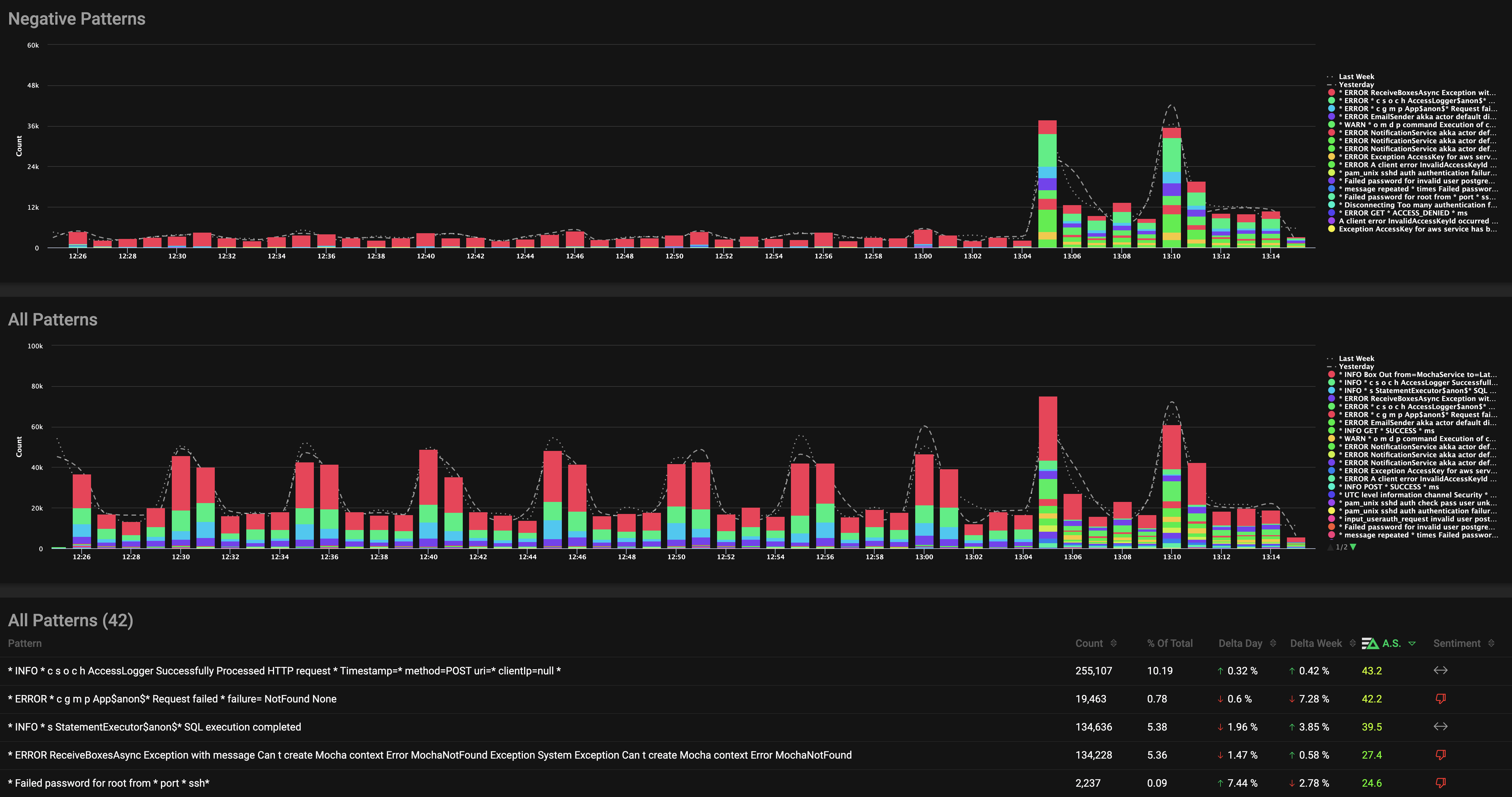
He acknowledges that traditional big data warehousing works quite well for business intelligence and analytics use cases. But that’s not real-time and also involves moving a lot of data from where it’s generated to a centralized warehouse. The promise of Edge Delta is that it can offer all of the capabilities of this centralized model by allowing enterprises to start to analyze their logs, metrics, traces and other telemetry right at the source. This, in turn, also allows them to get visibility into all of the data that’s generated there, instead of many of today’s systems, which only provide insights into a small slice of this information.

While competing services tend to have agents that run on a customer’s machine, but typically only compress the data, encrypt it and then send it on to its final destination, Edge Delta’s agent starts analyzing the data right at the local level. With that, if you want to, for example, graph error rates from your Kubernetes cluster, you wouldn’t have to gather all of this data and send it off to your data warehouse where it has to be indexed before it can be analyzed and graphed.

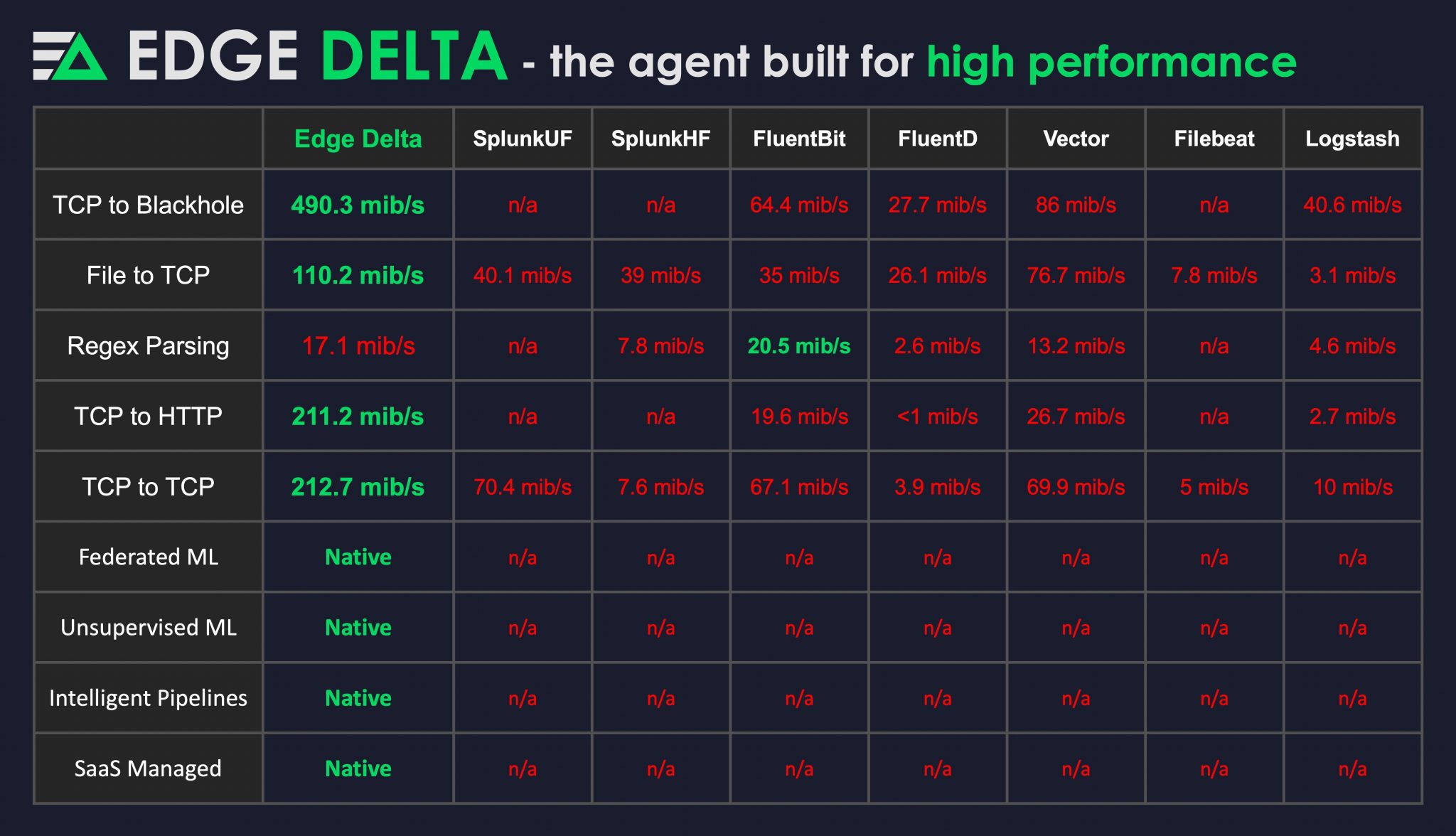
With Edge Delta, you could instead have every single node draw its own graph, which Edge Delta can then combine later on. With this, Edge Delta argues, its agent is able to offer significant performance benefits, often by orders of magnitude. This also allows businesses to run their machine learning models at the edge, as well.

Image Credits: Edge Delta

“What I saw before I was leaving Splunk was that people were sort of being choosy about where they put workloads for a variety of reasons, including cost control,” said Menlo Ventures’ Tim Tully, who joined the firm only a couple of months ago. “So this idea that you can move some of the compute down to the edge and lower latency and do machine learning at the edge in a distributed way was incredibly fascinating to me.”

Edge Delta is able to offer a significantly cheaper service, in large part because it doesn’t have to run a lot of compute and manage huge storage pools itself since a lot of that is handled at the edge. And while the customers obviously still incur some overhead to provision this compute power, it’s still significantly less than what they would be paying for a comparable service. The company argues that it typically sees about a 90 percent improvement in total cost of ownership compared to traditional centralized services.

Image Credits: Edge Delta

Edge Delta charges based on volume and it is not shy to compare its prices with Splunk’s and does so right on its pricing calculator. Indeed, in talking to Tully and Unlu, Splunk was clearly on everybody’s mind.

“There’s kind of this concept of unbundling of Splunk,” Unlu said. “You have Snowflake and the data warehouse solutions coming in from one side, and they’re saying, ‘hey, if you don’t care about real time, go use us.’ And then we’re the other half of the equation, which is: actually there’s a lot of real-time operational use cases and this model is actually better for those massive stream processing datasets that you required to analyze in real time.”

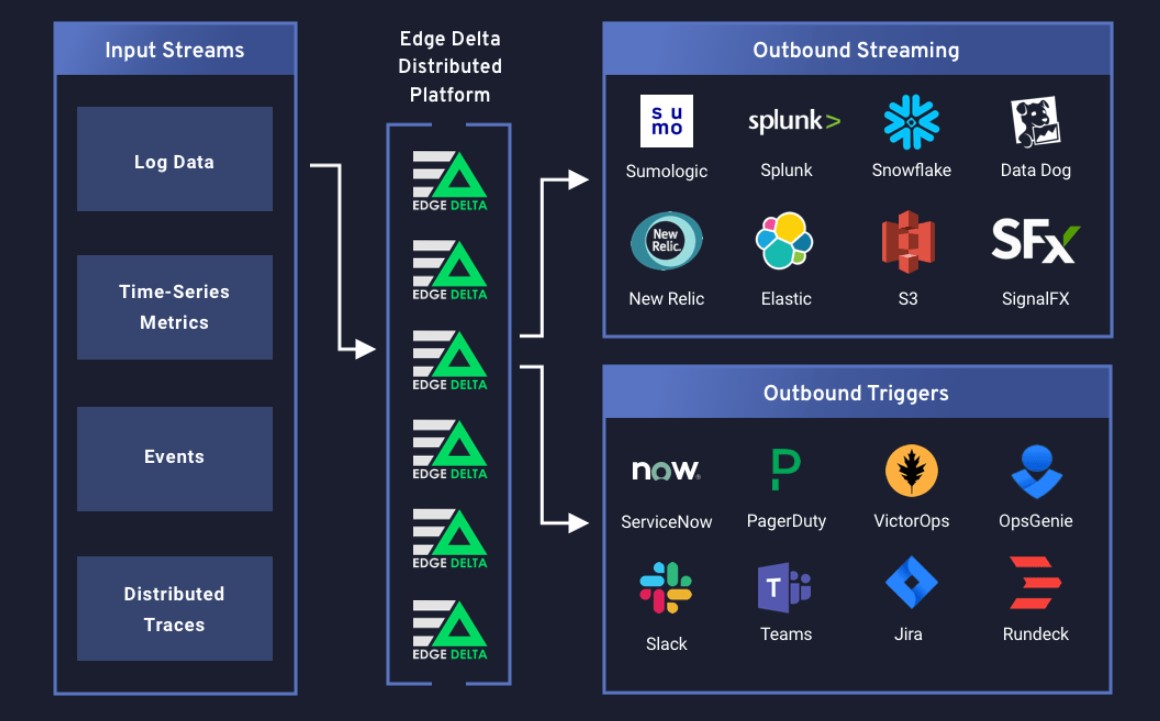
But despite this competition, Edge Delta can still integrate with Splunk and similar services. Users can still take their data, ingest it through Edge Delta and then pass it on to the likes of Sumo Logic, Splunk, AWS’s S3 and other solutions.

Image Credits: Edge Delta

“If you follow the trajectory of Splunk, we had this whole idea of building this business around IoT and Splunk at the Edge — and we never really quite got there,” Tully said. “I think what we’re winding up seeing collectively is the edge actually means something a little bit different. […] The advances in distributed computing and sophistication of hardware at the edge allows these types of problems to be solved at a lower cost and lower latency.”

The Edge Delta team plans to use the new funding to expand its team and support all of the new customers that have shown interest in the product. For that, it is building out its go-to-market and marketing teams, as well as its customer success and support teams.


25 Jun 2021

Equity Live: This is what leadership smells like

Hello and welcome back to Equity, TechCrunch’s venture capital-focused podcast, where we unpack the numbers behind the headlines.

This week we did something fun and different and good: a live show! A good number of people came, and asked questions, and altogether, it was a blast.

Danny, Natasha, and Alex had a lovely time with the regular work, while Grace and Chris and Kevin made the whole operation function. We’ll likely post a bonus episode of the Q&A on Saturday if people are interested in Equity After Hours.

That aside, what did we talk about in a longer-than-usual episode? Here’s the rundown:

It’s always fun to play around with our show, and thank you to everyone who came out and supported us in our first-ever, but probably not last-ever, virtual live show. We are back to regular, however, starting Monday.

Equity drops every Monday at 7:00 a.m. PST, Wednesday, and Friday morning at 7:00 a.m. PST, so subscribe to us on Apple PodcastsOvercastSpotify and all the casts.

25 Jun 2021

AWS is buying encrypted messaging service Wickr

Amazon’s cloud services giant Amazon Web Services (AWS) is getting into the encrypted messaging business. The company has just announced that it’s buying secure communications service Wickr — a messaging app that has geared itself towards providing services to government and military groups and enterprises. It claims to be the only “collaboration service” that meets security criteria set out by the NSA.

AWS will continue operating Wickr as is, and offer its services to AWS customers, “effective immediately,” notes a blog post from Stephen Schmidt, the VP and CISO for AWS, announcing the news.

Financial terms were not disclosed in the short announcement. Wickr had raised just under $60 million in funding according to PitchBook data (it also notes a valuation of under $30 million but that seems to be a very old estimate).

Amazon’s purchase of a messaging product geared at providing secure services to government bodies is coming at a time when the company continues to be embroiled in a dispute around the JEDI contract, a $10 billion deal to provide services to the U.S. that Microsoft was granted during the Trump administration. It’s unclear if this is part of Amazon’s effort to build out more infrastructure and services to flesh out its own offerings, or simply a sign that it will continue to court that merket, with or without JEDI in its pocket.

The move also suggests that Amazon could be planning to make a bigger push into the messaging space — some might say a long-awaited move from the company.

The AWS division currently offers communications service Chime, which enables organizations to meet, chat, and place business calls. But it’s a little-known product that’s failed to have the impact of rival services Slack or Microsoft Teams.

Amazon was reportedly working on a messaging product as far back as 2017, although that appeared to be geared more to consumers. The company also owns a number of social media patents.

Fast forward to 2021, and there are a million other considerations around messaging that wouldn’t have been key factors in 2017, such as encryption and other privacy-saving features. And messaging in general has grown increasingly sophisticated. There are our areas in particular where Amazon might be playing here: (1) to offer Wickr as a business service, continuing how it is used today; (2) building “messaging-as-a-service” for other companies to use in their apps a la other AWS services; (3) build a consumer messaging app on top of the Wickr infrastructure; (4) more services connected to Echo, expanding more features around a bigger social commerce/interactive play. Or, all of the above.

Commenting on the surprise acquisition, Stephen Schmidt, AWS CISO, said: “The need for this type of secure communications is accelerating. With the move to hybrid work environments, due in part to the Covid-19 pandemic, enterprises and government agencies have a growing desire to protect their communications across many remote locations. Wickr’s secure communications solutions help enterprises and government organizations adapt to this change in their workforces and is a welcome addition to the growing set of collaboration and productivity services that AWS offers customers and partners.”

In a notice on its website, Wickr said: “From our founding ten years ago, we have grown to serve organizations across a wide range of industries, all over the world. Together with AWS, we look forward to taking our solutions to the next level for our customers and partners.”

Wickr, which was founded in 2011 and is based in San Fransisco, California, describes itself as the “most secure” video conferencing and collaboration platform. Unlike other collaboration tools, which encrypt messages as they travel from a user’s device to a company’s servers but store those communications in an unencrypted state, Wickr uses end-to-end encryption which means that only people on either end of a conversation can decrypt and read messages.

It also offers users an ephemeral messaging feature, which allows users to set self-destruction timers for as short as a few seconds.

The company has recently made a big push into the enterprise as a result of the mass shift to online communications. In February this year Wickr launched ‘Global Federation’, a feature that enables enterprise and government entities to securely communicate using end-to-end encryption with mission-critical partners outside of their network. 

25 Jun 2021

Indian healthcare startup PharmEasy to acquire majority stake in listed firm Thyrocare for over $600 million

API Holdings, which operates the giant healthcare startup PharmEasy, said on Friday it has reached an agreement to acquire 66.1% stake in Thyrocare, which runs a diagnostic lab chain, for about $613 million in what is the first ever acquisition of a listed firm by an unicorn startup.

The transaction is subject to regulatory and other applicable customary approvals. Docon Technologies Pvt Ltd, a 100% subsidiary of API, will be the acquirer and shall make an open offer for an additional 26% stake, the firm said in a statement.

“We are delighted to be partnering Thyrocare. We will provide world class customer experience in diagnostics, rivalling our pharmacy experience by leveraging technology, and building on top of the massive scale & truly pan-India presence of Thyrocare. It is our aim to deliver all outpatient healthcare products & services to every Indian within 24 hours,” Siddharth Shah, CEO of API Holdings, said in a statement.

This is a developing story. More to follow…

25 Jun 2021

Veo CEO Candice Xie has a plan for building a sustainable scooter company, and it’s working

Startups are the embodiment of frenetic action. The rush to grow, outrun, and disrupt runs in the lifeblood of today’s entrepreneurs, driving their fervor and enabling them to capture markets from giants of industries too big to maneuver in a quickly changing landscape.

That has been truer for the mobility landscape than most other industries. Companies like electric scooter providers Lime and Bird have raised tons of capital to change how the urban population gets around, but that growth has come at the cost of a bottom line still in the red.

So it’s striking to see electric scooter company Veo take a different approach to the business. Rather than raising venture capital and scaling quickly, the company does business the old-fashioned way: Proving the model works in one market before moving to the next. This slower, more methodical approach has worked in Veo’s favor — it might be the only company in its industry that has been consistently profitable.

Veo’s approach reflects its co-founder and CEO Candice Xie’s belief that transportation is not an industry that allows companies to scale rapidly and turn a big profit within a year, and especially not if it’s going to make sense for a city. Electric scooters aren’t just a business to Xie — they’re a utility, a tool that can be best implemented through patient collaboration between public and private partners. The CEO has taken this ethos and executed Veo’s business model with the expectation that it will make the company the most impactful in the industry.

A former financial planner for automation solutions company, Schneider Electric, in Chicago, Xie launched Vue in 2017, partly inspired by the bike-share boom in Asia. She was decidedly against the poor quality bikes many operators were deploying at the time, and was also frustrated by the lack of affordable, safe and convenient transportation in Chicago. After some market research, Xie and her co-founder, Yanke (Edwin) Tan, a bike engineer, discovered the gap in last-mile transportation in the United States.

The following interview, part of an ongoing series with founders who are building transportation companies, has been edited for length and clarity. 

In your Medium post titled “Sorry, Boys. The First Profitable Micromobility Company Was Veo, Not Lime,” you fired some shots at Lime and the tech bro-ey micromobility industry at large. That was pretty bold. 

Thank you! I think because of the VC money and also the hype in the industry, a lot of people just forget how easy and simple the business should be. That’s why I put out the post. It was just time to say something in the industry and help people to understand.

What made you write it?

That was actually the time when Lime announced they were the first ones to achieve profitability, and that’s through EBITDA, and a lot of people were clapping for them. I was compelled to write because many people who follow the industry asked me, “Hey, it seems their approach is working? Should we follow suit? Why are you taking a different approach?”

I felt like that statement from Lime was quite misleading for a lot of people, and I don’t think that was a responsible statement, either. So that made me feel like I should use my insight and just explain things a bit more openly with our information.

25 Jun 2021

Kaszek Ventures leads a $15 million round in Chilean asset management startup, Fintual

Like other financial sectors in Latin America, the retail investing space is getting a facelift by local tech startups that are cashing in on the untapped potential for democratizing asset management in the region. One of those startups is Chilean-based Fintual, which today announced a $15 million round led by Kaszek Ventures, the largest fund in Latin America.

Fintual is an automated passive investment platform that allows the average person in Chile or Mexico to invest in mutual funds containing ETFs (Exchange Traded Funds), investment vehicles that aren’t as well known, or as readily accessible in Latin America.

“The idea that got to me was that we were allowing people to invest in the long term, we enable them to invest in instruments they didn’t have access to before,” said Pedro Pineda, co-founder and CEO of Fintual.

Before starting Fintual in 2018 with his three co-founders, Pineda was an astronomer and an entrepreneur, who built and sold a Groupon copycat company in Chile called “Queremos Descuentos” (We Want Discounts) for just over $1 million when he was 28. 

After the exit, he admits he was a bit lost in life. 

“One day I decided that I wanted to do only the things that I wanted to do and with the people I wanted to do it with,” he said.

He traveled for a couple of years, and learned to code, among other things, until Omar Larré, Fintual’s current CIO, presented him with the idea for the business. 

Larré had been a portfolio manager at Banco Itau, Brazil’s biggest bank by total assets, and he saw the gap in the market: investing was not set up for the average person. The annual fees were too high, the minimum amount required to invest was too high, and there was a penalty when you removed your money. Additionally, the transaction takes a certain amount of financial know-how that most people don’t possess.

For Pineda, disrupting the financial sector also seemed like a lot of fun, he thought.

“I liked the idea of challenging the financial banks, and you can’t do that without technology. We have this super tool that my parents didn’t have, and you can disrupt an entire industry,” Pineda told TechCrunch.

While traditional mutual funds in Chile and Mexico charge up to 6.45% and 5% annually, Fintual charges 1% annually of assets managed. Additionally, Fintual doesn’t require a minimum investment nor a minimum amount of time invested, and users can take their money out any time with no penalties. 

“It’s different than the U.S.; we invest way less than you do; by a factor of 10 maybe,” Pineda said, comparing the investment rate in Chile.

In 2018, the company was accepted into Y Combinator and became the first Chilean startup to go through the prestigious accelerator. It has been growing exponentially ever since and today it serves 57,000 clients in Chile and Mexico.

Below is a table that shows their growth including money managed and percent growth each year since launch.

Assets Under Management (USD)* Annual Growth
May 2018              1.2 M
May 2019              12.9 M 1075%
May 2020               87.6 M 679%
May 2021               480.7 m 548%

    *Each figure corresponds to the end of each month.

The current raise will be used to grow the company’s operations in Mexico, expand to other countries — namely Colombia and Peru — and grow its tech team. 

In addition to Kaszek, other investors to date include YC, ALLVP, and angel investors such as Plaid’s CTO, Jean-Denis Greze, and Cornershop’s founder Oskar Hjertonsson. To date, the company has raised about $15.2 million.

Fintual’s impressive growth speaks for itself, but Kaszek’s co-founder and managing partner, Nicolas Szekasy, said the fund has been following Fintual since its early days, and he was impressed with the niche market the team identified and even more impressed with the user experience the company had developed which has, in turn, fueled its growth.