Year: 2021

21 Jun 2021

Revolut revenue grew by 57% in 2020

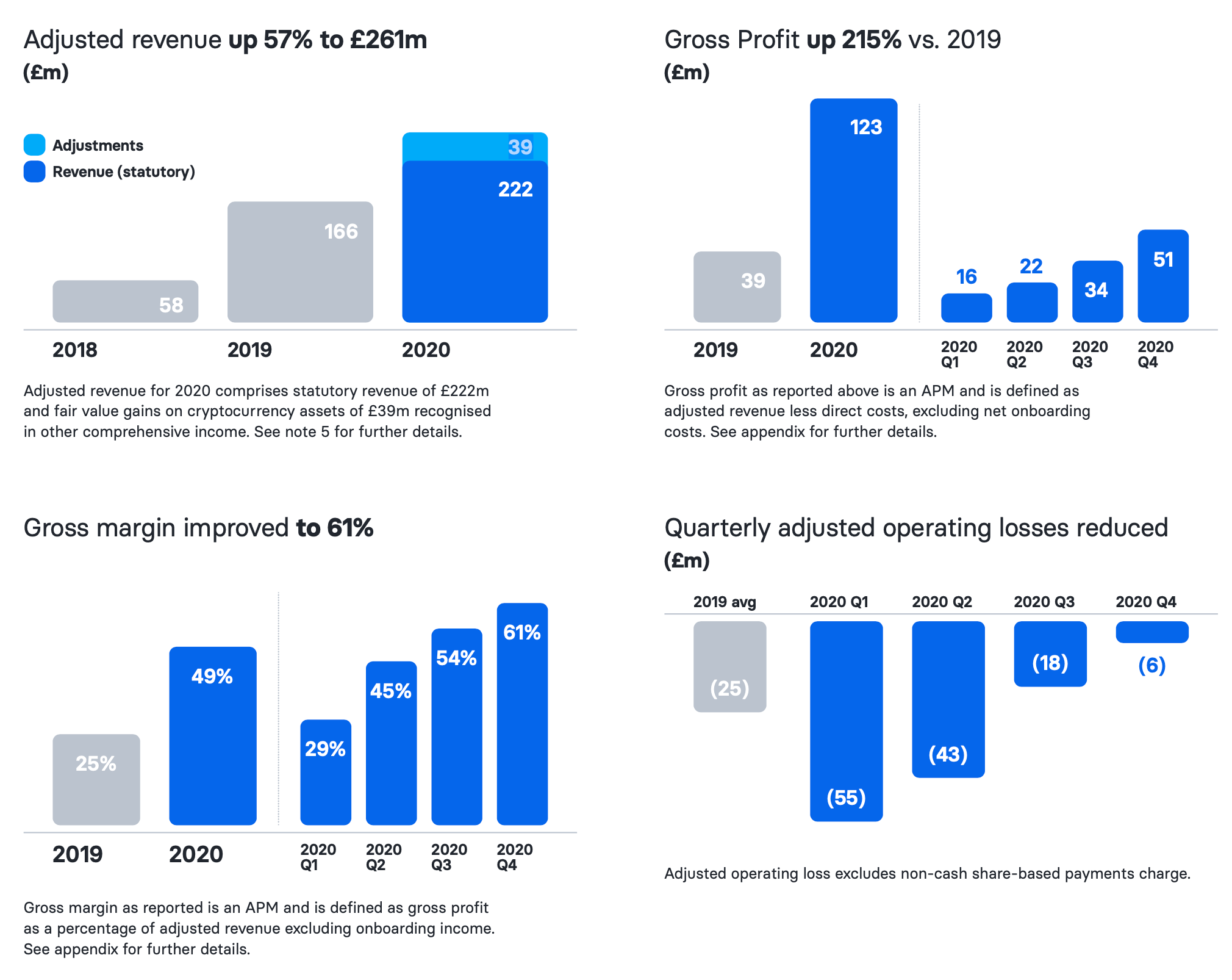
Fintech startup Revolut has filed some financial results and is sharing details with the press. In 2020, the company reported $361 million in revenue (£261 million) — that’s a 57% increase compared to 2019 revenue of $229 million (£166 million).

Interestingly, those revenue figures have been adjusted to include fair value gains on cryptocurrency assets — it means that Revolut holds some crypto assets on its balance sheet. Revolut made $54 million (£39 million) in fair value gains on cryptocurrency assets.

Gross profit reached $170 million (£123 million) last year. At the same time, the company still reports operating losses. In particular, Q1 2020 was a particularly bad quarter with $76 million (£55 million) in adjusted operating loss.

In 2020, total non-adjusted operating loss reached $277 million (£200.6 million). Like many tech companies, administrative expenses are responsible for this loss. With a staff of 2,200 people, the company spent $367 million (£266 million) on administrative costs alone. But things seem to be improving as you can see:

Image Credits: Revolut

These trends aren’t that surprising as I reported that fintech startups spent most of 2020 focusing on profitability and improving their margins. At the end 2020, Revolut had 14.5 million personal customers and 500,000 companies using Revolut Business.

“As the extraordinary circumstances of 2020 drove the trend towards digital financial management we continued to innovate for customers to make their financial lives easier and accelerate daily use. We launched 24 new retail and business products, expanded into the US, Japan and Australia and launched banking services in Lithuania, all while significantly improving our profitability,” founder and CEO Nikolay Storonsky said in a statement. “We began 2021 with a more resilient and productive business that will enhance our trajectory towards rapid growth.”

When you compare Q1 2020 to Q1 2021, things are radically different for the fintech company. Revenue increased by 130% year-over-year and gross profit grew by 300% between Q1 2020 and Q1 2021.

Revolut has been launching a ton of products to diversify its sources of revenue. It is increasingly becoming a financial super app with current accounts, debit cards, trading services, insurance products, premium subscriptions, cryptocurrency trading and more.

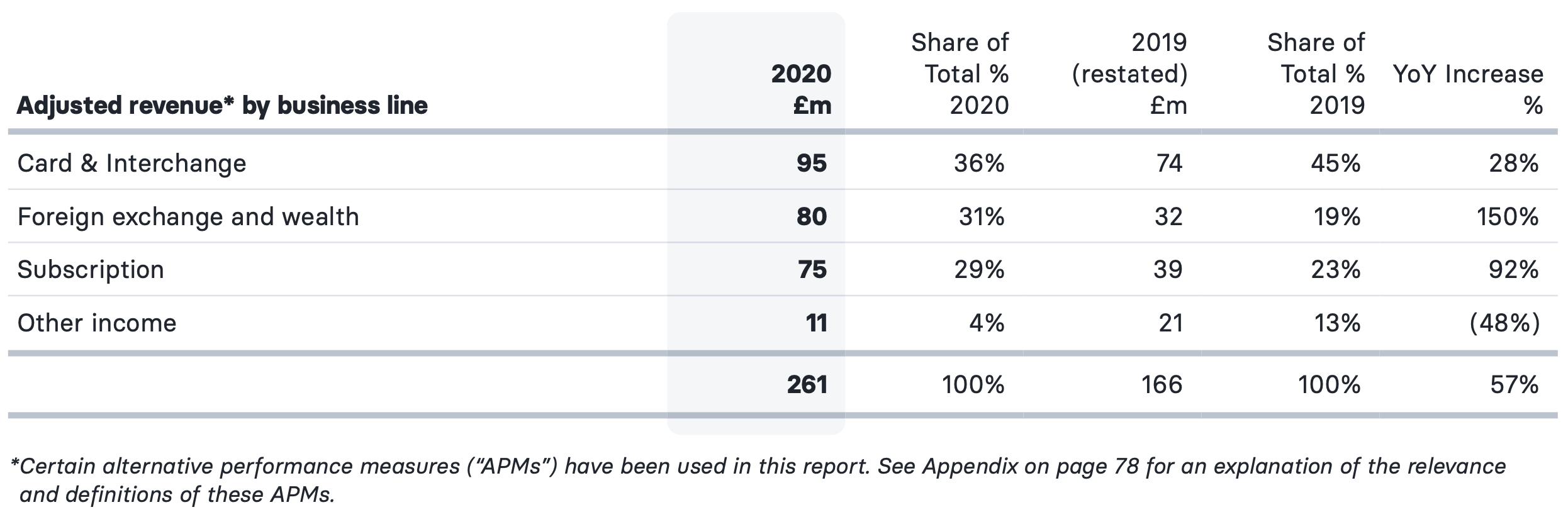
Interestingly, interchange revenue from card transactions represents a good chunk of the company’s revenue. In 2020, cards and interchange generated $131 million (£95 million) in revenue. Every time a Revolut customer makes a card purchase, the card scheme (Visa or Mastercard) gives back some fees to Revolut. It’s an incredibly small percentage-based fee, but it can add up when you generate millions of purchases.

Foreign exchange and wealth generated $111 million (£80 million) in revenue. That’s another big one. And finally, subscriptions, such as Revolut Plus, Revolut Premium and Revolut Metal, accounted for $104 million (£75 million) in revenue.

Those are three strong pillars that all contribute to the company’s bottom line. They all represent a bit less or a bit more than a third of the company’s overall revenue.

Image Credits: Revolut

While the company has expanded aggressively over the years, the U.K. is still by far its biggest market. In 2020, 88.4% of the company’s (non-adjusted) revenue was related to its activities in the U.K. The European Economic Area without the U.K. represented 10.2% of revenue. The U.S., Japan, Australia and other markets were nearly negligible.

Revolut has also raised a mega round of funding in 2020 — a $500 million Series D round that was extended to $580 million in total. I wouldn’t be surprised if the company launches an initial public offering within the next 12 months.

21 Jun 2021

Facebook officially launches Live Audio Rooms and podcasts in the U.S.

In April, Facebook announced a series of planned investments in new audio products, including a Clubhouse live audio competitor as well as new support for podcasts. Today, Facebook is officially rolling these products with the launch of Live Audio Rooms in the U.S. on iOS, starting with public figures and select Facebook Groups, and the debut of an initial set of U.S. podcast partners.

The company tells us Live Audio Rooms will become available to any verified public figure or creator in the U.S. who’s in good standing with Facebook and is using either a profile or the new Facebook Pages experience on iOS. For Facebook Groups, the feature is launching with “dozens of groups,” we’re told.

Both products will become more broadly available in the weeks and months ahead, as more people, podcasts, and Groups are brought on board. Meanwhile, 100% of Facebook users in the U.S. will be able to listen to Live Audio Rooms and podcasts as of this week.

Image Credits: Facebook

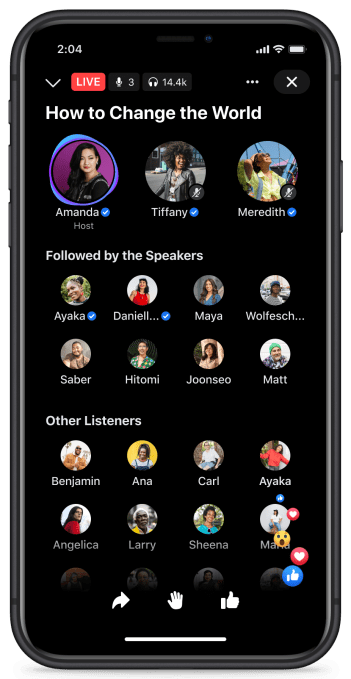
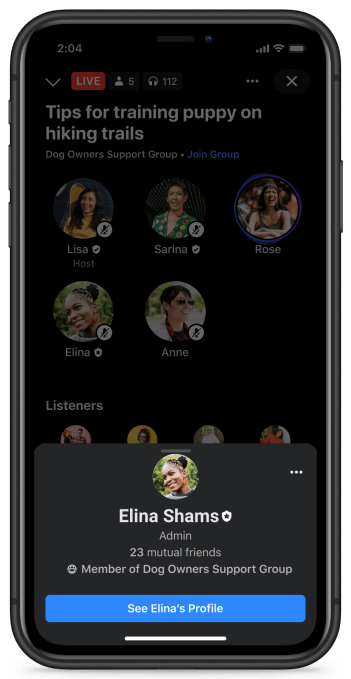
Much like Clubhouse or similar audio apps, Facebook’s Live Audio Rooms offer a standard set of features.

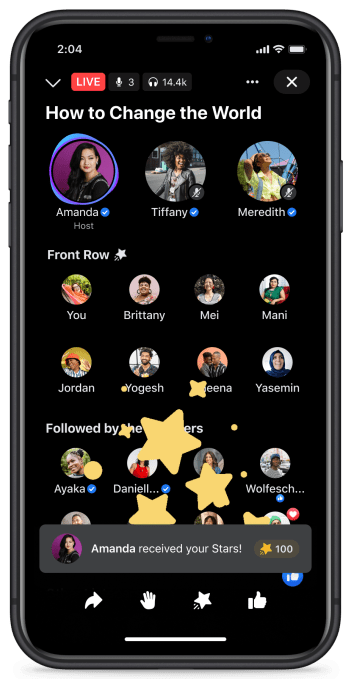
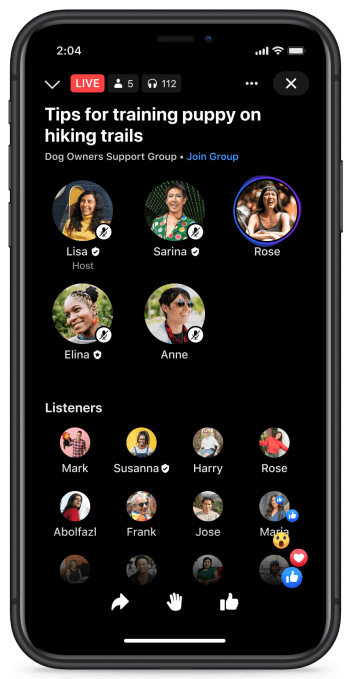
The event’s hosts appear in rounded profile icons at the top of the screen, while the listeners appear in the bottom half of the screen, as smaller icons. The active speaker is indicated with a glowing ring. If verified, a check appears next to their name, as well.

There are also options for enabling live captions, a “raise hand” tool to request to speak, and tools to share the room with others on Facebook, through things like News Feed or Group posts.

Image Credits: Facebook

Facebook does things a little differently than others in some places. For instance, hosts are able to invite people to join them as a speaker in advance of the session, or they can choose listeners during the stream to join them. In each session, there can be up to 50 speakers and there’s no limit on the number of listeners, Facebook says.

During the session, users will be notified when friends or followers join the chat, too.

While listening, users can “Like” or react to the content as it streams using the “Thumbs Up” button at the bottom of the screen which connects you to Facebook’s set of emoji reactions. And with today’s official launch, listeners can also now show support to the public figure of the Live Audio Room by sending “Stars.” These Stars can be purchased during the conversation and used at any time, similar to how they work with other Facebook Live content.

By sending Stars, the listener is bumped up to the “Front Row,” a special section that highlights the people who sent the Stars. This allows the event’s hosts to easily recognize their supporters and even give them a shout out during the event, if they choose.

Image Credits: Facebook

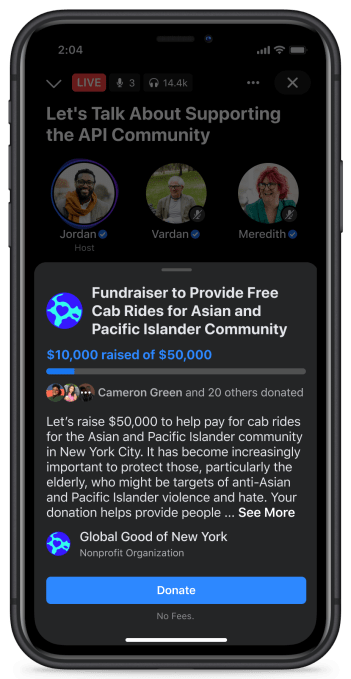
Another new feature allows hosts to select a nonprofit or fundraiser to support during their conversation, and listeners and speakers can directly donate. A progress bar will show how much has been raised during the show.

Image Credits: Facebook

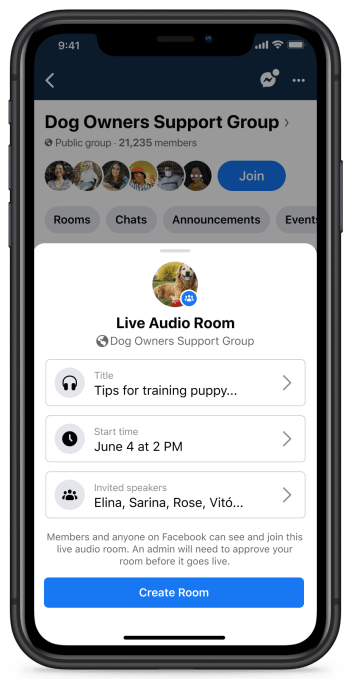
Meanwhile, for Facebook Groups, admins can control whether moderators, group members or other admins can create a Live Audio Room. Both members and visitors can listen to the rooms in public groups, but in private groups, the rooms are limited to Group members.

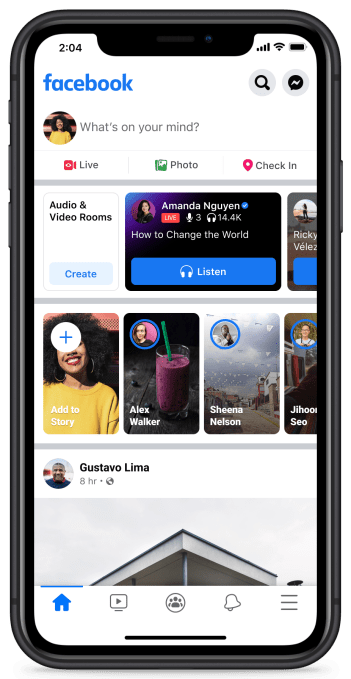
Facebook users are alerted to all the new Live Audio Rooms via the News Feed and Notifications, and can sign up to be reminded when a room they’re interested in goes Live. Live Audio Rooms will also be discoverable within Facebook Groups, where available.

Image Credits: Facebook

Among the initial set of early adopters for Facebook Live Audio Rooms are Grammy-nominated electronic music artist TOKiMONSTA; American football quarterback Russell Wilson; organizer, producer and independent journalist Rosa Clemente; streamer and digital entertainer Omareloff; and social entrepreneur Amanda Nguyen. Others planned for the near future include D SmokeKehlaniReggie Watts, and Lisa Morales Duke, to Dr. JessBobby BerkTina Knowles-LawsonJoe Budden (notably Spotify’s first big podcast star who it lost last year), and DeRay Mckesson.

Image Credits: Facebook


Facebook Groups trying the new format include Dance Accepts Everyone, Vegan Soul Food, Meditation Matters, Pow Wow Nation, OctoNation – The Largest Octopus Fan Club!, and Space Hipsters.

Image Credits: Facebook

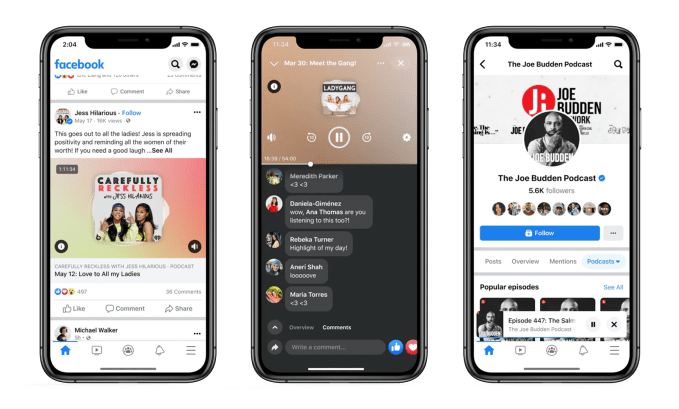
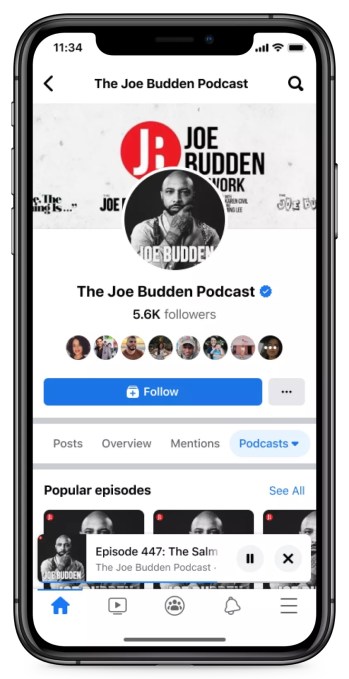
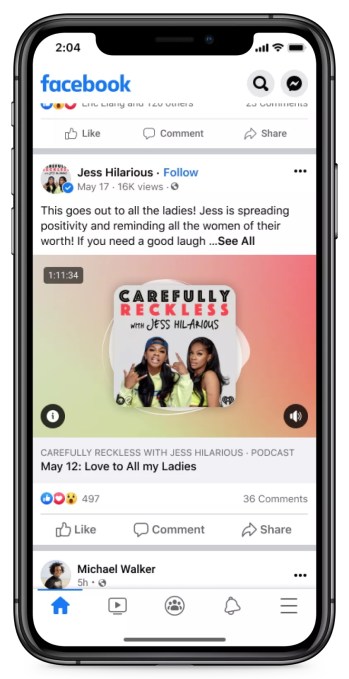
Alongside the launch of Live Audio Rooms, Facebook is also beginning to roll out its planned podcast support with a few select creators. These include Joe Budden of The Joe Budden Podcast; “Jess Hilarious” of Carefully Reckless from The Black Effect Podcast Network and iHeartRadio; Keltie Knight, Becca Tobin, and Jac Vanek of The LadyGang; and Nicaila Matthews Okome of Side Hustle Pro. Facebook will open up to other podcasters this summer.

Image Credits: Facebook

To be clear, this new podcasts service is different from the recently launched music and podcasts player in partnership with Spotify, which lets users share content from Spotify to the social network. The new feature instead involves podcasts that are streamed via public RSS feeds directly on Facebook, not delivered by Spotify. However, the miniplayer for podcasts on Facebook will look like the miniplayer for the Spotify listening integration (also known as Project Boombox), and they will behave similarly. But they are not the same.

The new podcast listening experience lets users listen to podcasts as they browse Facebook, either in a miniplayer or fullscreen player with playback options, and even if the phone’s display is turned off. This makes Facebook, in a way, a native podcast streaming app because it allows people to listen to audio without needing another service — like Spotify or Apple Podcasts, for example.

Facebook had earlier said there are over 170 Facebook users who are connected to a Page for a podcast, demonstrating user interest in podcasts on its social network.

Image Credits: Facebook

With the launch of the Facebook Podcast service, the company is asking podcast creators to give it permission to cache their content on Facebook’s servers, which we’re told is being done to ensure the content doesn’t violate Facebook’s Community Standards. However, because the podcasts are still being streamed via RSS feeds, they will be represented in the metrics provided by a podcaster’s hosting provider.

Last week, Facebook emailed podcast page owners details on how to set up their show on Facebook, noting they can link their podcast’s RSS feed to automatically generate News Feed posts for their episodes. These are also featured on a “podcasts” tab on their Page. According to Facebook’s Podcast Terms of Service, creators are granting Facebook the right to create “derivative works,” which likely refers to an upcoming clips feature.

Facebook says later this summer, it will add the ability to create and share short clips from a podcast, along with other features, like captions. Longer-term, it will create social experiences around podcasts, as well. It’s also working with creators to develop and launch its new product, Soundbites, which are short-form, creative audio clips. This will launch later in 2021.

Image Credits: Facebook

Other audio products in the works include a central listening destination and background audio listening for videos.

Facebook says this new destination will be a place where all the different audio formats across Facebook are available, not just podcasts, and will help users find to new things and people to listen to. More details on this project will become available later this summer.

Prior to today, Facebook quietly tested Live Audio Rooms in Taiwan and internally with Facebook employees Those tests will continue. Last week, Facebook CEO Mark Zuckerberg hosted the first trial of the new service in the U.S., where he was joined by other Facebook execs and a few Facebook Gaming creators.

Zuckerberg has been bullish on the potential for audio across the social networking platform. He even appeared on Clubhouse a couple of times to discuss the topic ahead of announcing what is, essentially, Facebook’s own Clubhouse competitor.

“I think the areas where I’m most excited about it on Facebook are basically in the large number of communities and groups that exist,” Zuckerberg had told Platformer, at the time of the original announcement. “I think that you already have these communities that are organized around interests, and allowing people to come together and have rooms where they can talk is — I think it’d be a very useful thing,” he added.

Facebook expects to expand its audio products globally in the months ahead.

21 Jun 2021

Apple’s App Store to face scrutiny in Germany as FCO opens ‘market power’ proceeding

Germany’s competition authority, the FCO, has completed its Big Tech GAFA ‘bingo’ card by opening a proceeding against Apple.

As with similar investigations already opened this year — into Amazon, Facebook and Google — the proceeding will determine whether or not the iPhone maker meets the threshold of Germany’s updated competition law.

The 10th amendment to the law, which came into force in January, enables the Bundeskartellamt to intervene proactively against the practices of large digital companies — if they are determined to have “paramount significance for competition across markets” and in order to prevent them from engaging in anti-competitive practices.

Discussing the key new provision to the Competition Act (aka, the GWB Digitalisation Act and specifically Section 19a) — in a panel discussion last week, the FCO’s president, Andreas Mundt, explained that the competition law update had been influenced by its experience with a long running (and pioneering) case against Facebook’s superprofiling of Internet users.

The upshot is that German competition law now has a theory of harm which entwines competition law and data protection — albeit, in the case of Apple, its tech empire is typically associated with defence (rather than abuse) of user privacy.

But the comprehensive amendments to German antitrust law are broadly targeted at Big Tech, with the goal of keeping markets open, fostering innovation and putting a stop to any abusive behavior, via provisions the FCO will be able to order — such an banning or restricting self-preferencing and bundling; or stopping giants tying products together to try to muscle into adjacent markets; or preventing them blocking interoperability and data access to try to lock out rivals, to name a few.

A mix of provisions are likely to be deployed, as tech giants are designated as addressable under the law, depending on the specifics of each case and the particular ecosystem business. So how it will operate in practice remains to be seen. So far the FCO is still in the process of determining (in each case) whether it can apply the law against GAFA.

For the Apple proceeding, Mundt said in a statement today that its operation of the App Store will be a “main focus” for the investigation because he said it “enables Apple in many ways to influence the business activities of third parties”.

“We will now examine whether with its proprietary operating system iOS, Apple has created a digital ecosystem around its iPhone that extends across several markets,” he added. “Apple produces tablets, computers and wearables and provides a host of device-related services. In addition to manufacturing various hardware products, the tech company also offers the App Store, iCloud, AppleCare, Apple Music, Apple Arcade, Apple TV+ as well as other services as part of its services business. Besides assessing the company’s position in these areas, we will, among other aspects, examine its extensive integration across several market levels, the magnitude of its technological and financial resources and its access to data.”

The FCO also noted that it has received a number of complaints against Apple “relating to potentially anti-competitive practices” — such as one from the advertising and media industry against Apple restricting user tracking with the introduction of its iOS 14.5 operating system; and a complaint against the exclusive pre-installation of the company’s own applications as a possible type of self-preferencing prohibited under Section 19a GWB.

“App developers also criticise the mandatory use of Apple’s own in-app purchase system (IAP) and the 30% commission rate associated with this,” it added in a press release. “In this context, the marketing restrictions for app developers in Apple’s App Store are also addressed. The latter complaint has much in common with the European Commission’s ongoing proceeding against Apple for imposing restrictions on the streaming service Spotify and accordingly preferencing its own services. Where necessary, the Bundeskartellamt will establish contact with the European Commission and other competition authorities in this regard. So far, no decision on initiating a further proceeding has been taken.”

Apple was contacted for comment on the FCO’s proceeding and it sent us this statement, attributed to a spokesperson:

Apple is proud to be an engine for innovation and job creation, with more than 250,000 jobs supported by the iOS app economy in Germany. The App Store’s economic growth and activity have given German developers of all sizes the same opportunity to share their passion and creativity with users around the world while creating a secure and trusted place for customers to download the apps they love with the privacy protections they expect. Germany is also home to Apple’s largest engineering hub in Europe, and a new €1BN investment in our European Silicon Design Center in Munich. We look forward to discussing our approach with the FCO and having an open dialogue about any of their concerns.”

Once issued by the FCO, a ‘paramount significance’ finding lasts for five years — while any legal challenges to orders made under Section 19a are intentionally expedited, with appeals going direct to Germany’s Federal Court of Justice (which is given exclusive competence). The goal being to avoid long drawn out litigations, as has occurred in the FCO’s case against Facebook’s superprofiling — which had legal questions referred to the CJEU back in March, some five years after the Bundeskartellamt began looking into Facebook’s data practices.

The coming months and years could be highly significant to how GAFA is able to operate in Europe’s largest economy — and, likely by extension, further afield in Europe and beyond as a number of jurisdictions are now paying active attention to how to regulate Big Tech.

Back in March, for example, the UK’s Competition and Markets Authority opened its own probe into Apple’s App Store. Simultaneously it’s working on reforming national law to create a ‘pro-competition’ for regulating tech giants.

While, last December, European Union lawmakers proposed the Digital Markets Act — also aiming to tackle the power market of so-called ‘gatekeeper’ platforms.

The FTC appointing Lina Khan as chair also appears to signify a change of direction on tech antitrust over in the US.

21 Jun 2021

Vietnamese financial services app MFast gets $1.5M pre-Series A led by Do Ventures

MFast founders Phan Thanh Long and Phan Thanh Vinh

MFast founders Phan Thanh Long and Phan Thanh Vinh

MFast, a mobile app that lets Vietnamese users in remote areas access financial services, announced it has raised a $1.5 million pre-Series A today. The round was led by Do Ventures, with participation from JAFCO Asia. 

Launched in 2019 by fintech company Digipay, MFast says it has been used by 600,000 people to date. It partners with financial institutions who provide services like loans and insurance, and says it has been used to distribute more than 50 billion VND (about $2.2 million USD) worth of products so far.

The majority, or about 75% to 80% of MFast’s users are in remote provinces or rural areas, which the company says often limits their access to banking and credit-related services. 

The funding will be used to expand MFast to more cities and provinces in Vietnam, develop its technology and partner with more institutions. MFast also plans to enter other markets in the future. 

MFast’s consumer credit partners include Mirae Asset, CIMB, Mcredit and Easy Credit, and its insurance partners include PVI, PTI and BSH. It claims to have a network of more than 350,000 advisors, who offers their services through the app, and that its data analysis tools are able to reduce bad debt and fraud rates. 

21 Jun 2021

GrowSari, a B2B platform for small stores in the Philippines, adds investors like Temasek’s Pavilion Capital and Tencent

Sari-sari stores are neighborhood stores in the Philippines that usually sell daily necessities and sometimes serve as community hubs, too. Today GrowSari, a startup that is digitizing sari-sari stores with features like pricing tools, inventory management and working capital loans, announced it has raised a Series B from several notable investors that brings its total funding to $30 million.

The company’s Series B is at a rolling close, so it has not announced a final amount. The $30 million total it has raised include its seed funding and Series A, which according to a July 2020 profile in Esquire Philippines was $14 million. Participants in its Series B included Temasek Holdings’ private equity unit Pavilion Capital, Tencent, International Finance Corporation (IFC), ICCP SBI Venture Partners and Saison Capital, and returning investors Robinsons Retail Holdings (which is part of the Gokongwei Group), JG Digital Equity Ventures and Wavemaker Partners.

GrowSari was founded in 2016, and says its B2B platform is currently used by more than 50,000 stores in over 100 municipalities on Luzon, the Philippines’ largest and most populated island. Its ultimate goal is to serve one million sari-sari stores.

According to GrowSari, there are more than 1.1 million sari-sari stores in the Philippines, and they account for 60% of fast-moving consumer goods (FMCG) sold in the country, making them a valuable distribution channel for wholesalers. In addition to its supplier marketplace, GrowSari says it is able to give sari-sari store operators better pricing for products from about a thousand FMCG brands, including Unilever, P&G and Nestle, which it claims can help stores double their earnings. Other services in the app include online telecom and utility bill payments, remittance and microfinancing for working capital loans.

GrowSari’s founding tDeam includes Reymund Rollan, Shiv Choudhury, Siddhartha Kongara and Andrzej Ogonowski, who first launched the platform as a backend system for sari-sari stores to manage their logistics and inventory.

A screenshot of product categories in GrowSari's app

A screenshot of product categories in GrowSari’s app

Since most sari-sari stores are run individually, their margins are smaller than large retailers that can negotiate deals with FMCG wholesalers. GrowSari’s supplier marketplace addresses this issue by giving sari-sari stores access the Distributor List Prices seen by large stores and wholesalers. GrowSari’s marketplace does not require a minimum order, and it allows sari-sari stores on the platform to pay with cash on delivery, GrowCoins (or cash credits that can be topped up through GrowSari’s shippers, online transfers, banks or over-the-counter at convenience stores) or E-Lista, GrowSari’s seven-day loan product.

GrowSari’s new capital will be used to expand its userbase to 300,000 new stores in the Philippines, especially in Visayas and Mindanao, increase the size of its supplier marketplace and launch more financial products for sari-sari stores. The startup is part of a new crop of B2B platforms in Asia focused on serving micro to small-enterprises, including BukuWarung and BukuKas in Indonesia and Khatabook in India.

20 Jun 2021

Crypto finance startup Amber Group raises $100M at $1B valuation

More mainstream venture capital firms are jumping on the crypto bandwagon as investors increasingly consider bitcoin an investable asset, despite the recent massive price drops of a few major cryptocurrencies. Amber Group, a Hong Kong-based cryptocurrency trading startup, said on Monday it has raised $100 million in a Series B funding round at a pre-money valuation of $1 billion.

The latest valuation is ten times that of the company’s Series A closed in 2019, a $28 million round that counted Coinbase Ventures as one of its investors. Also notably, Amber’s Series B financing was bankrolled by a list of high-profile financial and VC firms, including China Renaissance, which led the round, and Tiger Brokers, Tiger Global Management, Arena Holdings, Tru Arrow Partners, Sky9 Capital, DCM Ventures, and Gobi Partners.

Its past investors Pantera Capital, Coinbase Ventures, and Blockchain.com also participated in the round.

In May, Babel Finance, another crypto asset manager based out of Hong Kong, secured $40 million in funding from a number of big-name institutional investors, including Amber’s investor Tiger Global.

Founded by a group of former investment bankers in their twenties, Amber initially set out to apply machine learning algorithms to quantitative trading but pivoted in 2017 to crypto when the team saw spikes in virtual currency’s trading volumes. The startup now serves both institutional and individual investors, offering them algorithmic trading, electronic market-making, high-frequency trading, OTC trading, borrowing and lending, derivatives, among other products.

The firm launched its mobile app in the third quarter of 2020, widening its scope from institutional clients to retail consumers. It said the trading app has so far accumulated over 100,000 registered users.

Amber has been profitable since its inception, according to its co-founder and CEO Michael Wu, with annualized revenues of $500 million based on figures from January to April 2021.

The startup has seen “record months over the past quarter across both client flow and on-exchange market-making volumes,” said Wu, and it now accounts for “2-3% of total trading volumes in major spot and derivative markets.” Its cumulative trading volumes have doubled from $250 billion since the beginning of the year to over $500 billion. Altogether, it manages around $1.5 billion in trading capital that varies based on BTC and ETH prices.

Amber has over 330 employees worldwide across Hong Kong, Taipei, Seoul, and Vancouver. The proceeds from its Series B will go towards global expansion.

19 Jun 2021

Dollars, deals and the importance of nondilutive capital

Today, on Juneteenth, we recognize the efforts this nation still needs to put toward addressing structural racism and disparities, including in the world of tech.

This week, HBCUvc, a nonprofit that aims to diversify the world of venture capital, launched a million-dollar fund. Founder Hadiyah Mujhid told me that the capital would provide nondilutive financing to overlooked founders, which they define as Black, Indigenous and LatinX entrepreneurs, replacing the traditional angel round. But she also admitted that supporting founders wasn’t the only primary goal. Instead, she explained to me the importance of what she defines as “teaching capital.”

Similar to how teaching hospitals give aspiring doctors a way to practice and learn their craft before formally entering the field, the fund wants to do that for their some 230 aspiring investors that they already work with, many stemming from historically Black colleges and universities. Notably, nondilutive capital provides entrepreneurs with funding sans equity and a learning experience with lower stakes.

There are a lot of organizations right now that are starting funds [with] the primary goal of supporting founders. And that’s a goal of ours, but we’re hoping to have a ripple effect of training and really providing on-ramps for the next best-in-class investors … and in order to do that, they have to have a training vehicle.

While I’m not always a fan of rebranded names for capital, “teaching capital” is certainly a compelling framing. Track record is everything in this industry, and underrepresented folks often don’t have the benefit or privilege of access on their side — from a dollar or deals perspective. Scout programs have long existed to fill this gap, but I think that there is still a lacking of intentionality around who feels empowered to write an investment memo, ask questions and be new. This week, BLCK VC launched its scout program and Google for Startups launched a nondilutive financing instrument for Black founders, underscoring a growing focus in seeding diverse entrepreneurs.

HBCUvc’s fund was announced nearly one year after it almost shut down due to a lack of capital. Mujhid explained how the unjust killing of George Floyd led to the biggest one-day donation in her nonprofit’s lifetime, which “changed the trajectory of programming.” She also said that a lot of interest was a knee-jerk reaction, urging people to view this work as a long-term commitment.

Down the creative capital rabbit hole we go:

In the rest of this newsletter, we’ll get into Waymo’s latest raise, the Nubank EC-1 and a Pittsburgh event that I can’t wait to nerd out about.

Waymo gets way more

Image Credits: Bryce Durbin

Waymo, Alphabet’s self-driving arm, raised $2.5 billion in its second-ever institutional round. Investors include Alphabet, Andreessen Horowitz, AutoNation, Canada Pension Plan Investment Board, Fidelity Management & Research Company, Temasek and, of course, Tiger Global.

Here’s what to know: Waymo is going external after some internal shuffling. The funding comes only months after CEO John Krafcik stepped down from his title after spending five years in that position. Last month, Waymo lost its CFO and head of partnerships.

For more, here are my favorite recaps of TC Sessions: Mobility:

The Nubank EC-1

Image Credits: Nigel Sussman

Another week, another EC-1! Marcella McCarthy wrote about Nubank, a Brazillian credit card and banking fintech company that just last week raised at a $30 billion valuation. It’s one of the most valuable startups in the world, with over 40 million users.

Here’s what to know: As McCarthy puts it in the piece, Nubank started by trying to solve a massive challenge: “How to rebuild the concept of a bank in a country where banking is widely hated, all while the incumbents heavily entrenched with the state worked to block every move.” Maybe, the story goes on to tell, it would start with California Street.

Check out each installment of the series below:

Around TC

In May, thousands of you read my Duolingo EC-1, a deep dive into Pittsburgh’s favorite edtech unicorn. Now, we’re taking you to Pittsburgh to hear from Karin Tsai, the head of engineering there, as well as Carnegie Mellon University President Farnam Jahanian, Mayor Bill Peduto and a smattering of local startups.

Our TC City Spotlight: Pittsburgh event will be held on June 29, so make sure to register here (for free) to listen to these conversations, enjoy the pitch-off and network with local talent.

Also, a friendly reminder that we’re making a list of the best growth marketers for startups. You can help us by nominating your favorites into this survey.

Across the week

Seen on TechCrunch

Seen on Extra Crunch

Thanks for reading, as always. Take care everyone!

N

19 Jun 2021

This Week in Apps: Spotify debuts a Clubhouse rival, Facebook tests Audio Rooms in US, Amazon cuts Appstore commissions

Welcome back to This Week in Apps, the weekly TechCrunch series that recaps the latest in mobile OS news, mobile applications and the overall app economy.

The app industry continues to grow, with a record 218 billion downloads and $143 billion in global consumer spend in 2020. Consumers last year also spent 3.5 trillion minutes using apps on Android devices alone. And in the U.S., app usage surged ahead of the time spent watching live TV. Currently, the average American watches 3.7 hours of live TV per day, but now spends four hours per day on their mobile devices.

Apps aren’t just a way to pass idle hours — they’re also a big business. In 2019, mobile-first companies had a combined $544 billion valuation, 6.5x higher than those without a mobile focus. In 2020, investors poured $73 billion in capital into mobile companies — a figure that’s up 27% year-over-year.

This week we’re looking at more Clubhouse competitors, including Facebook’s first test of its Live Audio Rooms in the U.S. and Spotify’s launch of its Greenroom app for live discussions across an array of topics. Also, Amazon is reducing its Appstore fees, after similar moves by Apple and Google.

This Week in Apps will soon be a newsletter! Sign up here: techcrunch.com/newsletters

Top Stories

Spotify launches its Clubhouse competitor

Image Credits: Spotify

In March, Spotify announced it was acquiring the company behind the sports-focused audio app Locker Room to help speed its entry into the live audio market. This week, the company made good on that deal with the launch of Spotify Greenroom, a new mobile app and likely Clubhouse rival, that allows Spotify users worldwide to join or host live audio rooms, and optionally turn those conversations into podcasts.

The Spotify Greenroom app itself is based on Locker Room’s existing code, with the earlier Locker Room app basically updating to become Greenroom. To join the new app, Spotify users sign in with their current Spotify account information. They’re then walked through an onboarding experience designed to connect them with their interests. Spotify considers the app a soft launch, as it has plans to announce shows later this summer. It’s also funding shows through a new Creator Fund, whose details have not yet been revealed at this time.

Longer-term, the company believes it will be able to take advantage of its personalization tech to make smart recommendations about live shows, based on what music or podcasts a user listens to, and could notify users when favorite creators go live.

The bigger advantage Spotify has here is that its Greenroom sessions are recorded. After a show wraps, the creator can request an audio file which they can then turn into a podcast episode. This ability to straddle both worlds of live and recorded audio could prove to be more useful as the post-COVID world opens up, and users are no longer stuck at home, bored, able to tune in at any time to audio programs.

Amazon lowers its cut of app developer revenues

Amazon this week quietly announced it would follow in the footsteps of app store giants Apple and Google with its introduction of the Amazon Appstore Small Business Accelerator Program. The new program will reduce the commissions Amazon takes on app developer revenues for qualifying smaller businesses. Previously, Amazon’s Appstore took a 30% cut of revenue, including that from in-app purchases. Now, it will take only 20% from developers who earned up to $1 million in the prior calendar year. The company also said developers with less than $1 million in Appstore revenue in a calendar year will receive 10% of their revenue as promotional credit for AWS services, bringing the total program benefits up to an equivalent of 90% of revenue.

The program’s overall structure is similar to Apple’s App Store Small Business Program, announced in late 2020, which reduced Apple’s cut to 15% for developers who earn up to a $1 million threshold, after which they’re moved to the higher 30% standard rate. This rate then continues as they enter the following year. Google, more recently, took a slightly different course, by lowering the commissions to 15% on the first $1 million of developer revenue earned through the Play billing system each year.

The lack of attention to Amazon’s announcement, both in the developer community and by press, demonstrates how inconsequential Amazon’s own Appstore has become in the greater app ecosystem.

Weekly News

Platforms: Google

Android announced several new features which will roll out this summer, including starring text messages to easily find them later, getting contextual Emoji Kitchen suggestions depending on what you’re typing, as well as updates that emphasize security, safety and accessibility. The latter include updates to Google Assistant, Android Auto and Google’s Gaze detection feature.

A teardown of the newly released Google Play Services app (v.21.24.13) suggests Google is working on a “Find My Device” network that would allow Android users to locate your phone and other devices, similar to Apple’s “Find My.”

Google apps will return to Honor devices with the launch of the Honor 50 series devices. The company had not been able to ship Google apps, including the Play store, on its phones due to parent company Huawei’s placement on the U.S.’s entity list, which forced Google to pull its license. But Huawei sold off Honor last year, allowing it to work with Google again.

Google introduced AppSearch in Jetpack, which is now available in Alpha. AppSearch is an on-device search library that provides high-performance and feature-rich full-text search functionality, said Google, and lives completely on-device, allowing for offline search.

E-commerce/Marketplaces

Mobile-first marketplace OfferUp, which connects local buyers and sellers, hired a new CEO. The company brought on former Booking.com managing director Todd Dunlap as CEO, while co-founder and former CEO Nick Huzar will remain as chief product officer.

Social

After lawsuits, injuries and deaths, Snapchat finally removed its controversial “speed filter” which displays how fast a user was going at the time of posting. Critics argued the sticker encouraged reckless driving, as teens would try to post themselves traveling at excess speeds.

Snapchat launched Creative Kit for Spotlight, which will allow third-party apps to publish directly to Snap’s TikTok rival, Spotlight, similar to TikTok’s SDK. Early adopters include Videoleap, Beatleap by Lightricks, Splice, Powder and Pinata Farms.

ByteDance revenues more than doubled in the past year thanks to TikTok. According to an internal memo, ByteDance saw a 111% increase in revenues, to $34.3 billion, and a 93% increase in gross profit, to $19 billion in 2020.

Instagram’s TikTok rival, Reels, is rolling out ads worldwide. The ads will be up to 30 seconds in length, like Reels themselves, and vertical in format, similar to ads found in Instagram Stories. Also like Reels, the new ads will loop, and people will be able to like, comment on, and save them, the same as other Reels videos.

Twitter said it’s considering a new feature that would allow users to untag themselves from tweets, in order to control unwanted attention, like harassment and abuse. The feature could be useful when troll armies attack at scale before a user can block and report attacks or Twitter has a chance to respond.

Messaging

WhatsApp for iOS is making it easier for users to search for stickers. With a coming update, already live on TestFlight, users will be able to type a word or emoji and WhatsApp will animate the sticker button if a matching sticker is found.

Streaming & Entertainment

Image Credits: Apple

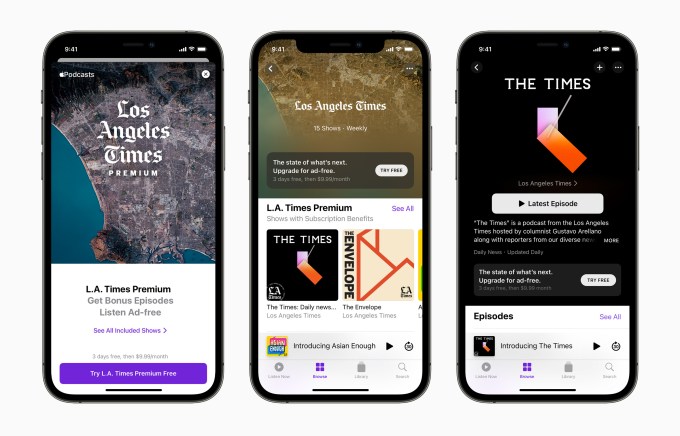
Apple Podcasts Subscriptions went live across more than 170 countries and regions this week. First unveiled this spring, subscriptions allow listeners to unlock additional benefits for their favorite podcasts, including things like ad-free listening, early access to new episodes, bonus material, exclusives or whatever else the podcast creator believes will be something their fans will pay for.

✨ Facebook CEO Mark Zuckerberg this week hosted the first test of Facebook’s Clubhouse competitor, Live Audio Rooms, in the U.S. The exec was joined by Facebook VP and Head of Facebook Reality Labs Andrew “Boz” Bosworth, Head of Facebook App Fidji Simo and three Facebook Gaming creators. It’s pretty incredible that Zuckerberg only months ago was appearing on Clubhouse to talk about the future of audio-based networking before essentially cloning the Clubhouse experience for Facebook’s own platform.

Streaming app Deezer launched a new iOS app, Deezer for Creators, which allows musicians and podcasters to track trends, audience insights and more, similar to Spotify for Artists.

An app for pirated movies and TV that disguised itself as a Sudoku game climbed up the App Store charts this week, before being pulled by Apple. The app, Zoshy+, seems to have circumvented App Review by taking advantage of server-side controls.

In a change that represents a significant shift underway in the creators economy, TikTok signed on as creator conference VidCon’s title sponsor for 2021, taking the spot formerly held by YouTube. The latter will still be involved as a secondary sponsor.

Apple-owned music identification and discovery app Shazam announced this week it had surpassed 1 billion Shazams per month. The company noted it took 10 years for Shazam to reach its first billion tags. Less than 10 years after that, Shazam has crossed 1 billion monthly recognitions and has successfully matched over 50 billion tags with over 51 million songs. At WWDC, Apple announced its plans for Shazam’s future with the launch of ShazamKit, which brings Shazam’s audio identification capabilities to third-party apps.

Gaming

Popular mobile game PUBG Mobile returned to India after being banned more than nine months ago. The game was banned as part of the country’s decision to boot out over 200 apps with links to China due to national security concerns. The new game has been rebranded to Battlegrounds Mobile India, but is largely the same same as before, but “with data compliance, green blood, and a constant reminder that you’re in a ‘virtual world’ with such messaging present as you start a game and when you’re in menus,” said IGN India editor Rishi Alwani.

Pokémon Go creator Niantic is working with Hasbro on a new AR game. Transformers: Heavy Metal, is being built by Very Very Spaceship for Niantic, and is scheduled for a 2021 release. The company has around a dozen games in development, including a collaboration with Nintendo to adapt its Pikmin game, and a game based on the board game Settlers of Catan.

An upcoming Apple Arcade update will bring a new, special edition of Alto’s Odyssey, a new Angry Birds title called Angry Birds Reloaded and a remastered Doodle God Universe. The update will be the largest since April.

Amazon’s cross-platform cloud gaming service Luna will open up priority access during Prime Day, June 21-22, meaning all Prime members will be able to access the service without an invite.

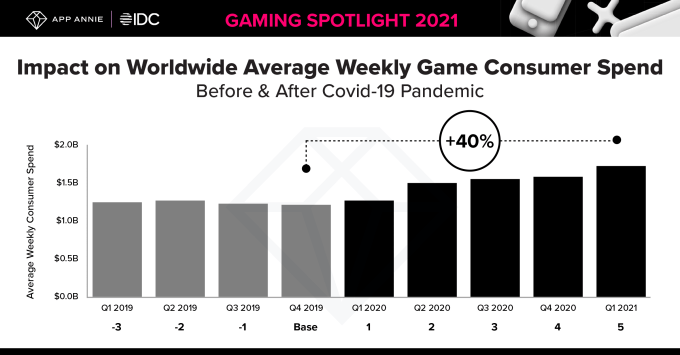
Mobile users worldwide downloaded 30% more games in the first quarter of 2021 than in the fourth quarter of 2019, and spent a record-breaking $1.7 billion per week in mobile games in Q1 2021, up 40% from pre-pandemic levels, per a new App Annie/IDC report.

Image Credits: App Annie

Productivity

An email that surfaced during the Epic trial discussed the issue of Apple’s Files app ranking first when users searched for a competitor’s app, Dropbox, for 11 months. The app had been manually boosted, the emails seemed to reveal. But Apple this week stated the issue was due to the Files app having a Dropbox integration. Apple put Dropbox in the metadata, causing it to rank higher — an explanation that doesn’t match up with the internal emails.

Home Automation

Third-party Alexa devices can now incorporate setup for their products in the Alexa app, thanks to an update to Alexa Voice Services.

Although Samsung’s SmartThings is no longer making its own smart home hardware, the company this week launched a new SmartThings mobile app on Android, which aims to make it simpler to get to actions and automations. The app includes a new Favorites section to replace the existing home screen, a Life section where users can explore new SmartThings services, plus pages for Devices, Automations and a Menu. The iPhone version will arrive soon.

An update to the Wyze mobile app added support for Google Home and Google Assistant, allowing users to control smart home devices with voice commands.

Government & Policy

A report published this week by U.S. advocacy group Fight for the Future and China-based GreatFire highlighted government censorship of LGBTQ+ apps around the world, due to government restrictions. It documented 1,377 cases of app access restrictions across 152 App Stores. However, the study contained several inaccuracies, Apple pointed out. For example, Grindr and Scruff are both available worldwide in the App Store, despite what the report said. Also, none of the 27 apps mentioned in the report with regard to China had been removed by Apple. Of the total 64 apps monitored, only four had been removed by a particular country because of legal issues.

Security & Privacy

A security bug in Google’s Android app, installed over 5 billion times, could have allowed attackers to steal personal data from a user’s device. Google says it fixed the vulnerability last month and found no evidence it had ever been exploited.

Funding and M&A

? Messaging social network IRL raised $170 million in a Series C round led by SoftBank’s Vision Fund 2, valuing the social events calendar and group chat app at $1.17 billion. New investor Dragoneer also participated in the oversubscribed round, alongside returning investors Goodwater Capital, Founders Fund and Floodgate. To date, IRL has raised over $200 million.

? Delivery service Gopuff, which is available on web and mobile, acquired fleet management platform rideOS for $115 million. This acquisition comes a few months after the delivery startup announced a $1.15 billion funding round at a $8.9 billion valuation.

? Spotify acquired Podz, a podcast delivery platform focused on solving issues around podcast discovery. Podz has been using machine learning to choose clips that can help introduce shows to new listeners. The startup had raised $2.5 million in pre-seed funding ahead of its acquisition. Deal terms weren’t disclosed.

?  PUBG Mobile maker Krafton is preparing to raise $5 billion in a South Korean IPO, expected to be the country’s largest ever. The company will sell more than 10 million shares at 458,000 won to 557,000 won apiece, a filing said. It will finalize the price July 9 and list on July 22.

? Mobile banking app Novo, which targets an SMB customer base, raised $40.7 million in Series A funding, after growing its user base to 100,000 businesses.

? Mobile banking app FamPay, aimed at Indian teens, raised $38 million in Series A funding. Investors include Elevation Capital, General Catalyst, Rocketship VC, Greenoaks Capital, and others, and makes for one of India’s largest Series A rounds to date.

? Apna, a jobs app built by an Apple alum, raised $70 million in Series B funding co-led by Insight Partners and Tiger Global, valuing the business at $570 million. The app aims to help blue and gray-collar workers upskill themselves, find communities, and land jobs.

? WordPress.com owner Automattic acquired popular journaling app Day One. The app has been downloaded more than 15 million times since its March 2011 launch on the Mac and iTunes App Store, offering users a private place to share their thoughts. Since then, it’s been awarded the App Store Editor’s Choice, App of the Year and the Apple Design Award, along with praise from various reviewers. Deal terms were not disclosed. Day One had been bootstrapped and self-funded for 10 years. The app will further integrate with other Automattic-owned writing platforms, including WordPress.com and Tumblr.

Recommended Reading

19 Jun 2021

Investors say Eindhoven poised to become Netherlands’ No. 2 tech hub

Eindhoven might not immediately spring to mind as a high-tech hub, but the Netherlands city is keen to position itself as a center for deep tech in Europe.

The Technical University of Eindhoven, High Tech Campus Eindhoven, and locally based corporates like ASML and Philips have been eyeing initiatives across Europe and applying what they’ve learned to the region’s strategy. Philips launched in Eindhoven in 1891 and played no small part in the municipality’s ambitions to become a tech hub.

Eindhoven produces a high number of patents per year considering its small population and has been home to an inordinate number of hardware startups. The local High Tech Campus has a high hardware focus, for instance.

Our survey respondents consider the city strong in areas like photonics, robotics, medical devices, materials science, deep tech, automotive tech, sustainability tech, medtech, Big Data, hardware and precision engineering. They are looking for more mature startups and scaleups focused on AI and hard tech.

Eindhoven is considered weaker in fintech and consumer products, and it exists in a small region with limited global visibility.

Over the next five years, one respondent said, “Eindhoven will have evolved to the Netherlands’ second-largest tech ecosystem, behind Amsterdam. On a European scale, Eindhoven will have entered the top 10.”

To learn more about Eindhoven, we queried the following investors:


Robert AL, Systema Circularis

What industry sectors is your tech ecosystem strong in? What are you most excited by? What is it weak in?

High-tech systems, photonics, robotics, medical devices.

Which are the most interesting startups in your city?

Lightyear, Bio-TRIP, EFFECT photonics, Nemo Healthcare, Sorama.

What are the tech investors like? What is the investment scene like in your city? What’s their focus?

Fully dedicated.

Who are the key startup people in your city (e.g., investors, founders, lawyers, designers, etc.)?

Steef Blok, Harm de Vries, Piet van der Wielen, Andy Lurling, Mark Cox.

Where do you see your city’s tech scene in five years’ time?

More mature, more focused on inclusive development, less quality coming from university spinoffs.

Nathan van den Dool, CEO, Space4Good

What industry sectors is your tech ecosystem strong in? What are you most excited by? What is it weak in?

High-tech systems and materials, the real high-tech and deep tech stuff that either leads to scientific breakthroughs or turns scientific breakthroughs into companies. Lithography makes a major contribution to that, as well as medical devices and production technologies.

Which are the most interesting startups in your city?

Nearfield Instruments, Optiflux, Dynaxion, AlphaBeats, Incooling.

What are the tech investors like? What is the investment scene like in your city? What’s their focus?

They focus mainly on high-tech machine building and software development, AI.

With the shift to remote working during the COVID-19 pandemic, will people stay in your city, move out or will others move in?

Largely unaffected.

Where do you see your city’s tech scene in five years’ time?

More integrated between AI and hard tech and production.

Pepijn Herman, venture builder, Brabantse Ontwikkelings Maat schappij

What industry sectors is your tech ecosystem strong in? What are you most excited by? What is it weak in?

The pros are high-tech systems, collaboration culture and excellent startup ecosystem; The cons are that it’s a small region with limited visibility globally.

Which are the most interesting startups in your city?

LionVolt, DENS, Lightyear, Morphotonics.

What are the tech investors like? What is the investment scene like in your city? What’s their focus?

They focus mainly on high-tech machine building and software development, AI.

With the shift to remote working during the COVID-19 pandemic, will people stay in your city, move out or will others move in?

Others will move in! Housing is extremely expensive but the demand for a skilled workforce is extremely high. If people move to surrounding areas, within 30 km, housing prices skyrocket all over.

Who are the key startup people in your city (e.g., investors, founders, lawyers, designers, etc.)?\

BOM (that’s us!), Braventure, Brainport Development, TNO.

Where do you see your city’s tech scene in five years’ time?

Leading worldwide in several technology areas, mainly, high-precision, roll-to-roll processing atomic layer deposition, material handling, industry 4.0, silicon processing equipment.

Betsy Lindsey, CFO, Aircision

What industry sectors is your tech ecosystem strong in? What are you most excited by? What is it weak in?

The region is strong in deep tech, automotive tech, sustainability tech, medtech, Big Data, hardware and precision engineering. Most excited by sustainability tech and deep tech. The region is weak in fintech.

Which are the most interesting startups in your city?

Lightyear, Incooling.

What are the tech investors like? What is the investment scene like in your city? What’s their focus?

Conservative, non-risk-taking — there are so many subsidies they don’t need to take risks, so once the tech risk is gone, they are good, but they are not global enough; hardware.

With the shift to remote working during the COVID-19 pandemic, will people stay in your city, move out or will others move in?

Hardware is hands-on — people are still moving in! We have a housing “crisis!”

Who are the key startup people in your city (e.g., investors, founders, lawyers, designers, etc.)?

Innovation Industries.

Where do you see your city’s tech scene in five years’ time?

More mature startups and scaleups on the scene!

Andy Lurling, founding partner, LUMO Labs

What industry sectors is your tech ecosystem strong in? What are you most excited by? What is it weak in?

The region is strong in sustainable cities, health and well-being, and education.

Which are the most interesting startups in your city?

FruitPunch AI, AlphaBeats, Vaulut, Lightyear, Serendipity.

What are the tech investors like? What is the investment scene like in your city? What’s their focus?

Mainly hardware; LUMO Labs has an early-stage software focus.

With the shift to remote working during the COVID-19 pandemic, will people stay in your city, move out or will others move in?

Stay.

Who are the key startup people in your city (e.g., investors, founders, lawyers, designers, etc.)?

Nard Sintenie, Frank Claassen, Hans Bloemen.

Where do you see your city’s tech scene in five years’ time?

Competing on a global scale.

Han Dirkx, CEO and co-founder, AlphaBeats

What industry sectors is your tech ecosystem strong in? What are you most excited by? What is it weak in?

The region is strong in deep tech and health. I’m excited about opportunities for cooperation between different companies. It’s weak in seed investment.

Which are the most interesting startups in your city?

Lightyear, AlphaBeats, Carbyon, FruitPunch, Serendipity.

What are the tech investors like? What is the investment scene like in your city? What’s their focus?

Tech investors are mainly government-regulated constitutions or angels. Focus on scaleup.

With the shift to remote working during the COVID-19 pandemic, will people stay in your city, move out or will others move in?

They will stay; working from home has some benefits but meeting people in an inspiring environment gives the best synergy.

Who are the key startup people in your city (e.g., investors, founders, lawyers, designers, etc.)?

LUMO Labs, HighTechXL, Andy Lurling, Sven Bakkes, John Bell, Guus Frericks, Bert-Jan Woertman.

Where do you see your city’s tech scene in five years’ time?

Leading in the world.

Jonas Onland, managing partner, Serendipity

What industry sectors is your tech ecosystem strong in? What are you most excited by? What is it weak in?

The region is strong in building sustainable and resilient cities and a platform between cities/society and tech market.

Which are the most interesting startups in your city?

Digital Toolbox (a Serendipity spinoff), Amber (mobility), Active Esports Arena and other portfolio companies of LUMO Labs.

What are the tech investors like? What is the investment scene like in your city? What’s their focus?

Through LUMO Labs, there is a focus on societal investments; the rest is investment in high tech due to the big industries (VDLK, ASML, NXP, Phillips).

With the shift to remote working during the COVID-19 pandemic, will people stay in your city, move out or will others move in?

Work at home or mix in the office and at home.

Who are the key startup people in your city (e.g., investors, founders, lawyers, designers, etc.)?

A combination of accelerators (LUMO Labs, HighTechXL, Braventure) and Brainport (ecosystem management) supported by the Eindhoven University of Technology and big corporates.

Where do you see your city’s tech scene in five years’ time?

Leading in the world on societal/systemic change — moving from high-tech toward impact (more software and digitization).

Daan A.J. Kersten, CEO, PhotonFirst

What industry sectors is your tech ecosystem strong in? What are you most excited by? What is it weak in?

It’s strong in high-tech equipment, hardware, photonics, additive manufacturing, lighting, electronics, semiconductor technology and health tech, and weak in consumer products and apps.

Which are the most interesting startups in your city?

Lightyear, ELEO Technologies, EFFECT Photonics, SMART Photonics, PhotonFirst, Amber.

What are the tech investors like? What is the investment scene like in your city? What’s their focus?

There is a relatively low number of investors in early stage.

With the shift to remote working during the COVID-19 pandemic, will people stay in your city, move out or will others move in?

They will stay. Eindhoven is a hot spot with many cultures, international tech community and great infrastructure, while it feels like a village.

Who are the key startup people in your city (e.g., investors, founders, lawyers, designers, etc.)?

Nard Sintenie, startup founders, HighTechXL.

Where do you see your city’s tech scene in five years’ time?

Worldwide dominance in high-tech hardware scaleups.

Daniel den Boer, CEO and co-founder, Vaulut

What industry sectors is your tech ecosystem strong in? What are you most excited by? What is it weak in?

The Eindhoven ecosystem is really strong in the sectors of mobility, smart city and energy. I’m most excited about smart city. This is our focus sector and it is the embodiment of ecosystem collaboration with impact solutions.

Which are the most interesting startups in your city?

Vaulut, Roseman Labs, FruitPunch AI, Amber, Sendcloud, Lightyear.

What are the tech investors like? What is the investment scene like in your city? What’s their focus?

The investment scene is getting better. They are increasingly realizing that deep tech takes time and needs to be nurtured, but the potential impact is massive and can have a dramatic effect on the entire ecosystem. There are still relatively few early-stage impact drive investors. LUMO Labs is leading the pack on that front.

With the shift to remote working during the COVID-19 pandemic, will people stay in your city, move out or will others move in?

I think more people will stay as the need to move to Amsterdam as the tech hub of the Netherlands diminishes, giving Eindhoven a boost to strengthen its own ecosystem, which will in turn make even more people stay and attract people to move in the city. As a result, COVID-19 will have a positive effect on Eindhoven’s tech ecosystem, I believe.

Who are the key startup people in your city (e.g., investors, founders, lawyers, designers, etc.)?

LUMO Labs, the Eindhoven University of Technology, High Tech Campus, Amber, Brainport Eindhoven.

Where do you see your city’s tech scene in five years’ time?

In five years, I believe Eindhoven will have evolved to Netherlands’ second-largest tech ecosystem, behind Amsterdam. On a European scale, Eindhoven will have entered the top 10.


18 Jun 2021

Daily Crunch: Spotify and Ford make acquisitions

To get a roundup of TechCrunch’s biggest and most important stories delivered to your inbox every day at 3 p.m. PDT, subscribe here.

Welcome back to the Daily Crunch for Friday, June 18. Congratulations! You’ve made it to the end of the week without Alexander, who will return bright-eyed on Monday.

TechCrunch has the day off for Juneteenth, so this will be a tad pared down. And by “a tad pared down” I mean a lot pared down.

To start off, how about you have a listen to the latest episode of our award-winning podcast, Equity. Natasha and Danny managed to fill the half hour even sans Alex, so check it out.

TechCrunch Top 3

Speaking of podcasts, Spotify announced it acquired Podz, a podcast discovery app. With more and more podcasts popping up in various categories, it’s getting harder and harder to settle on ones you love, let alone find them. Spotify is hoping this will help shore up its platform by providing short clips that apparently give you enough information to subscribe, or not, and keep using the platform for your podcast listening purposes.

Spotify logo illustration

Image Credits: TechCrunch

Ford is enjoying its EV moment. The company just announced its E-Transit cargo van and F-150 Lightning Pro. The automaker has added to its EV stable with the acquisition of Electriphi, a battery management and fleet monitoring software startup.

And speaking of fleets! Gopuff, an on-demand goods, food and alcohol delivery service, acquired rideOS, a fleet-management platform. The $115 million acquisition should help the company with its plans to expand into New York.

Startups and VC

Indian fintech startup BharatPe is in advanced stages of talks to raise about $250 million in a new financing round led by Tiger Global. The Series E round gives the firm a pre-money valuation of $2.5 billion. The round hasn’t closed, so terms may change, sources cautioned.

More fleet action is afoot! KeepTruckin, a hardware and software developer that helps trucking fleets manage vehicle, cargo and driver safety, raised $190 million in a Series E round. The company, now valued at over $2 billion, hopes to invest the dough into its AI-powered products (GPS tracking, ELD compliance and dispatch and workflow) and improve its smart dashcam, which it claims instantly detects unsafe driving behaviors like cell phone distraction and close following and alerts drivers in real time.

Mediflash is a new French startup that wants to improve temp staffing in healthcare facilities, such as nursing homes, clinics and mental health facilities. The company acts as a marketplace that connects health facilities with caregivers who, it says, can expect more revenue — up to 20% — while facilities end up paying less.

Big Tech Inc.

The London-based Centre for Economic Policy Research organized a couple of panel discussions to examine the need for markets-focused competition watchdogs and consumer-centric privacy regulators to think outside their respective “legal silos” and find creative ways to work together to tackle the challenge of Big Tech market power. Read analysis by Natasha Lomas about the conversations, which brought together key regulatory leaders from Europe and the U.S. She says the discussions provided a glimpse into what the future shape of digital markets oversight might look like at a time when fresh blood has just been injected to chair the FTC.

The U.K.’s chief data protection regulator has warned over reckless and inappropriate use of live facial recognition in public places. The information commissioner, Elizabeth Denham, noted that a number of investigations already undertaken by her office into planned applications of the tech have found problems in all cases.

Revisiting EC-1s

Since it’s an off day for us here, now’s a perfect time for you to catch up on the EC-1s we have published so far this year. Grab a few buckets of popcorn and your beverage of choice and settle into some weekend reading.

Tonal

Tonal is a unique entrant in the upscale fitness market, using a proprietary blend of hardware, software and content to bring comprehensive strength training to the home in as small and efficient of a package as possible. (Written by JP Mangalindan)

StockX

StockX sits at the nexus of two radical transitions that isn’t just redefining markets, but our culture as well. StockX’s online-only marketplace is used for buying and selling sneakers, streetwear, electronics, collectibles, handbags and watches that are primarily sneaker and streetwear culture-adjacent. Now valued at $2.8 billion, StockX has facilitated over 10 million transactions. (Written by Rae Witte)

Klaviyo

Klaviyo helps marketers personalize and automate their email messaging to customers. It may not be a household name to consumers (at least, not yet), but in many ways, this startup has become the standard by which email marketers are judged today, triangulating against veterans Mailchimp and Constant Contact and riding the e-commerce wave to new heights. (Written by Chris Morrison)

Duolingo

Duolingo is a language-learning app that is used by 500 million people across the world to learn Spanish, English, French and more, all while generating bookings of $190 million in 2020. It’s a smashing success, but a success that was hard earned after a years-long effort of product and revenue experimentation to find its current niche in the edtech space. (Written by Natasha Mascarenhas)

Expensify

If expense management is about avoiding corporate plunder, then letting the pirates and hackers run the ship is probably the best approach. And now, Expensify is plundering the corporate spend world one travel ticket and business meal at a time just as the world is rebuilding in the wake of COVID-19. (Written by Anna Heim)

Nubank

Brazil’s banking system is a massive market, and one ill-served by incumbents. If someone could thread the needle of product development, strategy and political horse trading required to build a bank in a country where it is nearly impossible for foreigners to own or invest in a bank, it would be one of the great startup and economic success stories of this century. Nubank is on its way to realizing that objective. (Written by Marcella McCarthy)