Year: 2021

15 Jun 2021

BookClub checks out a shiny new $20 million Series A

Serial edtech entrepreneur David Blake, who co-founded Degreed and launched LearnIn, is living the dream of any book worm. He reads at least one book a week, talks to the authors behind it and unpacks his biggest questions around the subtlest of passages.

And it’s all thanks to his latest startup, BookClub, which first launched in September to bring author-led book clubs to readers. “With Degreed, it’s big, it’s enterprise and it’s structural. It brought a deep sense of fulfillment, it felt rigorous and challenging” he said. “BookClub has felt joyful, a lot of fun, and like a blessing in my life.”

The platform gives authors a chance to hold book groups, share exclusive video-based interviews and engage in questions readers might have. And months after announcing its existence and $6 million seed raise, BookClub is back to announce a $20 million Series A round, led by Signal Peak Ventures. Other investment firms that participated in the round include GSV Ventures, Maveron, Backstage Capital​ and Pelion Venture Partners​.

Blake often describes BookClub as “MasterClass meets Goodreads.” It’s fitting that he got the founders of both of those companies on his cap table as well, with Aaron Rasmussen, co-founder of MasterClass and founder of Outlier.org, and Otis Chandler, co-founder and previous CEO of Goodreads, joining the Series A round.

The capital comes as BookClub prepares to open its private beta, which includes thousands of readers, to the public by July. Along with opening up for business, BookClub is investing heavily in adding more authors to its platform. So far, there are 11 books featured on BookClub’s website from writers such as Emily Chang, Lara Prescott, Colin Bryar and Bill Carr.

Blake declined to give specifics for how many books are in production, but said that BookClub’s plan is to hit 200 books for its service by the end of 2021.

The startup is currently experimenting with two services to bring author-led discussions to readers. One service is that users can find a book and then click through videos as they progress through the book. When BookClub was recording with Emily Chang, the author of “Brotopia,” it produced eight to 12 hours of content, which ranges from Q&A to readings to behind-the-scenes musings on writing the book, Blake explained.

“A lot of that sounds simple, but in a lot of ways it is special in its own way,” Blake said. “If you grew up in most places in America, there weren’t New York Times best-sellers coming to your local indie bookstore and just doing readings…in a lot of ways, this is able to democratize a lot of what authors do to engage the big cities [on book tours] but for everyone else,” he said.

The other service is similar to Oprah’s Book Club, a long-existent discussion series where Oprah interviews a different author behind a book each month. BookClub’s version of this is picking an author to discuss their book, as well as a series of books with similar themes, in an interview-style format. For example, Barbara Corcoran is discussing her book, “Shark Tales,” as well as five other books in an entrepreneurship-featured club.

One limitation for BookClub is figuring out how to generate enthusiasm through its platform. Book clubs often start off with the best of intentions, but then fall apart due to lack of accountability or limited interest among members to invest in deeper conversations. The startup will have to find a way, beyond author appeal, to integrate excitement without being overly prescriptive in its prompts. Another limitation might be the authors themselves. Because the startup’s products only work with living authors, it is missing out on a chunk of classical text.

The company might need to figure out a different way to represent authors, the non-living or camera shy, to reach what Blake views as its ultimate goal.

“Right now, statistically, the chance that we’ve covered one of the books on your nightstand is pretty low,” he said. “We want to get there, fast.”

15 Jun 2021

Robotic landscaping startup Scythe emerges from stealth with $13.8M raise

Founded in 2018, Scythe Robotics is emerging from stealth today by announcing an $13.8 million Series A raise. The round was led by Inspired Capital and features True Ventures, Zigg Capital and Lemnos. It brings the Boulder, Colorado-based landscaping robotics company’s total funding up to $18.6 million, including a $4 million seed, also led by True Ventures.

The startup’s first product is an autonomous mower, offered to customers through a Robot-as-a-Service (RaaS) model. The method is becoming increasingly popular in the enterprise and industrial space, essentially offering clients robotics through a rental model that includes regular updates and maintenance. Interestingly, the company’s charging customers based on acres mowed.

The mower features eight HDR cameras and a variety of sensors designed to help avoid people, animals and various obstacles it might encounter on the job. Naturally, all of those sensors also come with a wealth of data collection aimed at — among other things — increasing the robot’s efficiency. Landscaping is a relatively low-hanging fruit for robotics. There’s certainly a lot to be said for automating the process for those with large swaths of land. Toro, notably, recently acquired Left Hand Robotics, and iRobot has announced its own (since delayed) robotic mower.

“To date, commercial landscape contractors haven’t had a technology partner who enables them to keep up with demand and to operate emissions-free. We are that partner,” said co-founder and CEO Jack Morrison in a release. “Our autonomous mower gives them the ability to grow their business, while staying green. It’s designed from the ground up to be an order of magnitude more reliable, more productive, and safer than any existing machine by incorporating state of the art autonomy with a rugged, all-electric design.”

Funding will go toward increasing headcount in its Colorado, Texas and Florida offices, R&D on further products and getting the mower in front of new customers.

15 Jun 2021

Mobile game spending hits record $1.7B per week in Q1 2021, up 40% from pre-pandemic levels

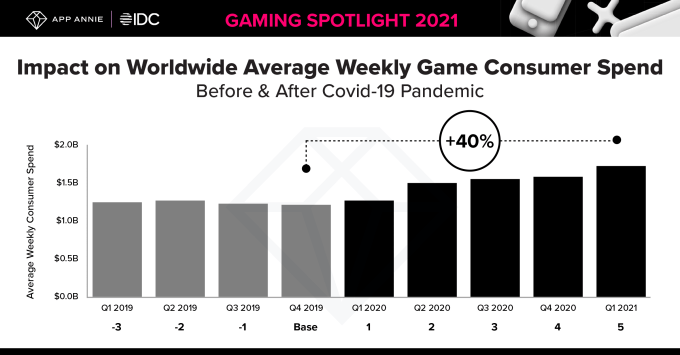
The Covid-19 pandemic drove increased demand for mobile gaming, as consumers under lockdowns looked to online sources of entertainment, including games. But even as Covid-19 restrictions are easing up, the demand for mobile gaming isn’t slowing. According to a new report from mobile data and analytics provider App Annie in collaboration with IDC, users worldwide downloaded 30% more games in the first quarter of 2021 than in the fourth quarter of 2019, and spent a record-breaking $1.7 billion per week in mobile games in Q1 2021.

That figure is up 40% from pre-pandemic levels, the report noted.

Image Credits: App Annie

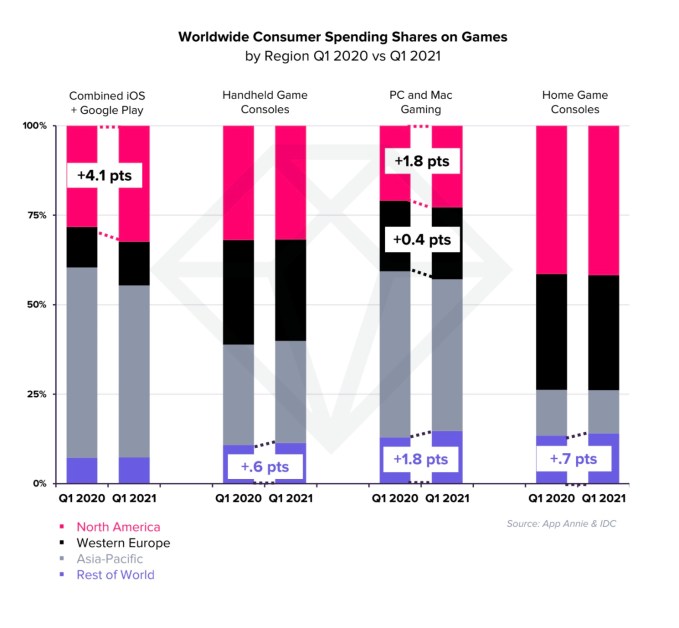
The U.S. and Germany led other markets in terms of growth in mobile game spending year-over-year as of Q1 2021 in the North American and Western European markets, respectively. Saudi Arabia and Turkey led the growth in the rest of the world, outside the Asia-Pacific region. The latter made up around half of the mobile game spend in the quarter, App Annie said.


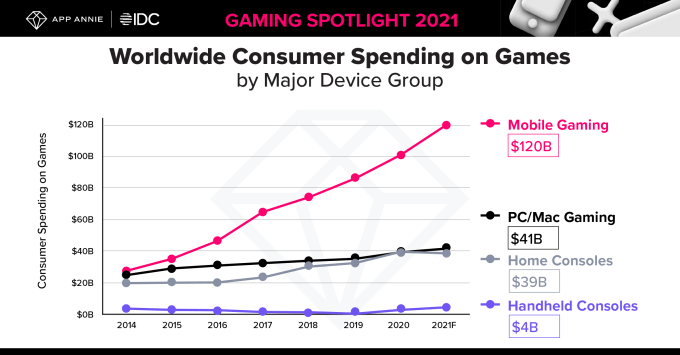
The growth in mobile gaming, in part accelerated by the pandemic, also sees mobile further outpacing other forms of digital games consumption. This year, mobile gaming will increased its global lead over PC and Mac gaming to 2.9x and will extend its lead over home games consoles to 3.1x.

Image Credits: App Annie

However, this change comes at a time when the mobile and console market is continuing to merge, App Annie notes, as more mobile devices are capable of offering console-like graphics and gameplay experiences, including those with cross-platform capabilities and social gaming features.

Games with real-time online features tend to dominate the Top Grossing charts on the app stores, including things like player-vs-player and cross-play features. For example, the top grossing mobile game worldwide on iOS and Google Play in Q1 2021 was Roblox. This was followed by Genshin Impact, which just won an Apple Design Award during the Worldwide Developer Conference for its visual experience.

Image Credits: App Annie

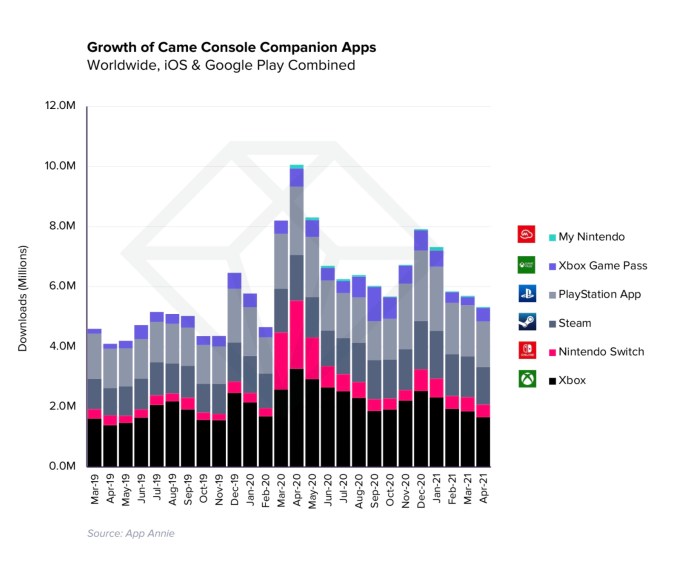
The report also analyzed the ad market around gaming and the growth of mobile companion apps for game consoles, including My Nintendo, Xbox Game Pass, PlayStation App, Steam, Nintendo Switch, and Xbox apps. Downloads for these apps peaked under lockdowns in April 2020 in the U.S., but continue to see stronger downloads than pre-pandemic.

Image Credits: App Annie

On the advertising front, App Annie says user sentiment towards in-game mobile ads improved in Q3 2020 compared with Q3 2019, but rewarded video ads and playable ads were preferred in the U.S.

15 Jun 2021

Rocket Lab to design two orbital spacecraft for NASA to study Mars

Rocket Lab is developing two spacecraft based on its Photon platform to orbit Mars, studying the planet’s magnetosphere in order to gain a better understanding of the ways in which Mars’ climate has changed over time. The science mission was awarded through NASA’s Small Innovative Missions for Planetary Exploration (SIMPLEx) program, and will fly to Mars in 2024, aboard a yet-to-be-identified commercial lunch vehicle contracted by NASA as a rideshare rocket.

This is a noteworthy development for a few reasons, including that Rocket Lab will realize its earlier announced vision of using Photon as a platform for satellites that travel beyond Earth’s orbit. It’s also interesting because it will ostensibly mark the first decoupling of Rocket Lab’s launch and spacecraft services businesses.

Rocket Lab’s Photon is a satellite platform that includes the company’s Curie in-space propulsion system, and they’ll also be outfitted for this mission with star trackers and reaction wheels to make up a situational control system, as well as a deep space navigation system or way finding. The appeal of Photon is meant to be deep space exploration capability in a small, affordable and relatively low mass for launch package that could broaden access to interplanetary science for more organizations and institutions.

Next up for the Rocket Lab-supported Escapate mission that will use these two Mars-bound Photos is a design review in June, which will be followed up by a final confirmation review in July as a last check before the Photons are built, equipped and readied for their eventual flight.

15 Jun 2021

Andreessen Horowitz goes into publishing with Future

Today, venture firm Andreessen Horowitz is officially launching its media property, called Future. I’m on vacation today but couldn’t resist covering this fascinating new project. 

The publication will initially focus on topics related to areas that the firm invests in but will expand over time using a mix of full-time staff, paid contributors and industry operators like founders, academics and entrepreneurs. And yes, they did get the dot com. 

The Future.com that is launching today is an MVP version of what the firm hopes the publication will be eventually, says Margit Wennmachers, Operating Partner, Marketing and Future at Andreessen Horowitz. 

The content will be created by a mixture of staff and outside contributors that run the gamut from big names to up-and-comers says Wennmachers. The publication will cover topics that they find compelling with a broad theme of ‘rational optimism’ — something that the firm feels there isn’t enough of in coverage of tech at large. 

This isn’t a news operation, Wennmachers says, and they will focus on future-focused informational and editorial content, rather than day-to-day tech occurrences. Though when the news dovetails with subject matter that they feel they have expertise to cover either from contributors, staff or A16z partners, there will be topical coverage.

The initial leadership staff includes Wennmachers, Editor in Chief Sonal Chokshi, Executive Editor Maggie Leung and Managing Editor Amelia Salyers. 

The contributors and topics that are set for launch sketch out an idea of the scope that Future is shooting for. A short list of some of them was provided, to give an impression:

  • Betül Kaçar is a professor at the University of Arizona. She directs a NASA research consortium exploring the origins, evolution, and distribution of life in the Universe. Betül is contributing to Future on paleobiology and how the past can help build the future.
  • Dr. Vanessa Tolosa of Mavato Engineering LLC, an engineering consulting firm dedicated to helping research groups and startups develop neurotechnologies for medical applications. She is contributing to Future on the topic of Brain Computer Interfaces.
  • Marvin Ammori, Chief Legal Officer of Uniswap Labs and advisor to the Harvard Law School Blockchain & Fintech Initiative. Marvin is writing the definitive Defi explainer for Future.
  • Jade Raymond is a Canadian video game creator, best known for helping create the Assassin’s Creed and Watch Dogs franchises, and for building the Ubisoft Toronto and EA Motive Studios. Jade will contribute on the subject of big company IP, gaming, and creators
  • Piers Kick of BITKRAFT on the metaverse and how crypto will enable it

The focus with the initial wave of establishing content will be to produce explainers, how-to content and cohort learning by experienced founders in and outside of the A16z portfolio.

“We want to write about stuff we know and that we invest in,” says Wennmachers. This includes topics like crypto, biotech, fintech and real-estate, which all have dedicated partners at the firm. 

They also want to bring in people who know an extremely technical space particularly well, something like nuclear energy, for instance. They will contextualize and explain these arenas for the hoped-for audience of ‘tech enthusiasts’ as well as founders and entrepreneurs. 

They’re not starting from zero, here. A16z already has a strong reputation for producing content via its popular podcast and company blog posts that outlines the intricacies of a nascent technology, especially those related to deep tech or coalescing out of research.

The firm is prepared to invest in this publication long-term, and they are prepared to take the time to set a baseline for success metrics, says Wennmachers. The success of the publication will be tracked on some hard and soft metrics related to engagement. Traffic to the site will be considered, for instance, but also whether the targeted audience is ‘sending us around’ or ‘talking about the topics we raise’, says Wennmachers. 

Metrics like time on page or whether people are finishing the articles or podcast episodes will take precedent. One big advantage that Future has over other publications in the tech space, Wennmachers admits, is that they don’t have to monetize. A16z will be footing the bill for the buildout and talent here. This, of course, allows more freedom to choose what kinds of metrics are a part of the success rubric.

Video isn’t initially a focus but eventually YouTube or other video platforms could be on the docket. 

The content, overall, is aiming to be action-oriented with information that is helpful in defining legislation, charting the course of your company or bringing a good point to your next meeting, says Wennmachers. Usability of information, basically, is a key sight line. 

Future will be writing ‘to tech people’ and to ‘the tech curious’. It will ideally, Wennmachers acknowledges, also help A16z win deals in the spaces where it demonstrates interest and understanding through publishing. The firm, she says, often wins deals at the intersection of two areas where they have expertise. Partners that specialize in biotech and consumer can come together, for instance, to support firms like Levels, which have a consumer-facing biotech footprint. Future can help to put those ideas out into the world, creating a sense that the firm knows what they’re talking about there and can add value.

Some other overall goals are to boost nascent tech communities like those around crypto and other edge tech endeavors. 

Future, says Wennmachers, should ideally provide content that doesn’t currently exist in the market that can be created from a ‘unique, interesting perch’ that the firm has. The audience, she says, is people who are curious, have an open mind and want to understand complex tech topics from the point of view of operators. People in consumer tech that want to cross-pollinate their ideas with deep tech arenas, for instance. With a sub-line of information about how new companies are built and grown.

The combination of full-time writers, paid contributors, entrepreneurs who probably have more ideas than days behind a pen and a wide array of external voices means that the editors have their work ahead of them. A voice will need to coalesce, as well as a reputation for signal and domain expertise. 

Future isn’t expected to win just because it’s backed by A16, though. 

“We have to win in the market,” Wennmachers acknowledges, “people’s attention is all over.”

Since Future is about, well, the future, I was curious whether they were pursuing any alternative structures. Co-ops, DAOs or distributed contribution systems that reflected the diaspora of talent out of the silos of traditional publishers and into other framing devices like Substack.

Not for now, says Wennmachers, as they want to establish Future as a thing that even exists and to make sure its voice is crisp. This will be a ‘traditional’ publication in all of the major ways that count, for now.

The MVP is launching today, and the team is willing to build in public, rather than continue to polish in private. Given the audience, that will likely attract some of the exact people that they want reading — as well as some of the expected critics.

Future launches into a very interesting time in media. There are a variety of different currents that are shifting the shorelines of publishing, renegotiating the relationships between individuals, organizations and audiences. At the same time, in tech, there is an increasing desire to control and shape the narrative around the next wave of world-altering technologies and companies without the involvement of the journalistic apparatus — or at least in counter to.

There is also a trend by media at large away from the same ‘rational optimism’ that Future is leaning into. Instead, the prevailing attitude seems to align more with ‘collective cynicism’. Many scalar entities in tech have enabled harm, therefore any similarly momentum-driven technologies and companies are to be viewed with a Precog’s eye for future crimes. 

How the media apparatus reacts to a publication like Future will probably say a lot about how the balance is currently being struck between narrative encapsulation and intellectual rigor. The media business is not easy, but the backing is here and the initial editorial hires say that they’re taking this endeavor pretty seriously.

There has already been chatter about conflict as it relates to the content being produced by efforts like Future — a huge deal for a journalistic enterprise where you are ostensibly acting as the avatar for the reader. But, if A16z is openly talking their own book with the content on Future then the conflict discussion is really already over. They have a point of view and it is going to be colored by their worldview, deal flow and network. End of story.

Whether the majority of media becomes conflicted ad nauseam and what that means is really another discussion.

I’d also look to see a lot of other firms scrambling to construct a media apparatus out of thin air — shout out to the comms strategists who will have figure out where to begin that discussion with their clients this week.

Whether you view Future as a marketing exercise, a necessary evolution or an immune reaction of the tech ecosystem, it’s doubtful that it will be boring. 

Ok, I’m out. I look forward to the hot takes. 

15 Jun 2021

Messaging social network IRL hits unicorn status with SoftBank-led $170M Series C

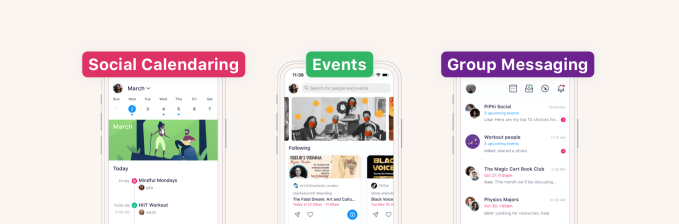
Social calendar app IRL has been busy building a messaging-based social network, or what founder and CEO Abraham Shafi calls a “WeChat of the West.” Following its pandemic-fueled growth and further push into the social networking space with group chat and other features, IRL is today announcing a sizable $170 million Series C growth round, led by SoftBank’s Vision Fund 2. The fundraise also mints IRL as a new unicorn with a $1.17 billion valuation.

Besides SoftBank, new investor Dragoneer also participated in the oversubscribed round, alongside returning investors Goodwater Capital, Founders Fund and Floodgate. To date, IRL has raised over $200 million.

The startup began its life as a tool for discovering real-world events — an industry that went to zero almost overnight due to the COVID-19 pandemic. That could have been the end for IRL, but the startup quickly pivoted to prioritize discovery of online events instead. Under COVID lockdowns, users could turn to the app to find things like livestreamed concerts, esports events, Zoom parties and more.

Image Credits: IRL

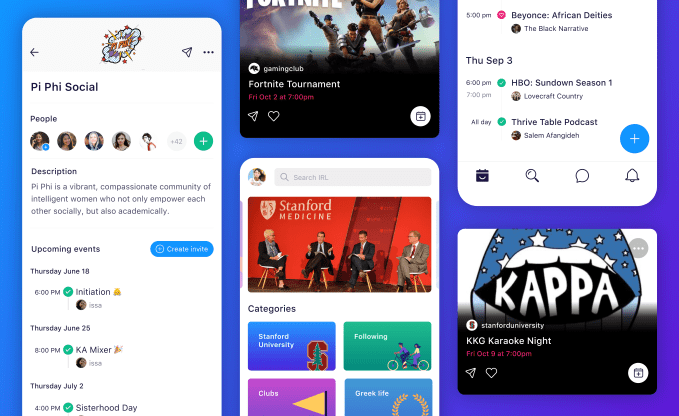
IRL focused on pulling in popular online events from places like Live Nation, Twitch, YouTube, TikTok and others.

As a result, IRL became more accessible because its audience was no longer limited only to those who had time and money to travel to real-world events.

That focus also helped the app to attract a crowd of younger users who are of the generation that doesn’t use Facebook.

“They essentially use Snapchat, Instagram and TikTok,” explains Shafi. “But there is no groups and events product for that generation,” he points out.

Earlier this year, the company doubled down on its social networking features with the launch of a new site that added things like user profiles, support for group chats, the ability to join group events, personalized recommendations and more. As users could now network with friends across both web and mobile, IRL began to feel more like a social network, not just an event-discovery engine.

Image Credits: IRL

Today, IRL has 20 million users and 12 million who use the app monthly, which are not startling numbers in comparison to major social networks and their billions of users. But the numbers are representative of a steady approach that helped IRL grow 400% over the past 15 months, despite COVID’s impact to real-world events.

But as of recently, things are starting to change. In-person events are starting to return. California, the home state for San Francisco-based IRL, is today re-opening, for example. That opens up IRL to once again focus on connecting people not just online, but also “in real life,” as its name implies.

That could mean helping people better connect around events with not just their own friend group, as is often the case today, but helping them discover new groups in their local area or on campus. The company is even planning to use a portion of its fundraise to help fuel the new events economy by allocating a certain amount of money per city that will go toward helping people put on real-world events. The exact details are still being worked out, Shafi says, but says the idea is that IRL wants to help “bring culture back in cities that are opening up again.”

IRL also plans to expand its international footprint by finding ways to bring in non-U.S. users to its platform — possibly beginning with the events focused on watching the Olympics. (If the Games are not again delayed or canceled due to a COVID surge.)

Shafi says IRL hadn’t been planning to fundraise, but they decided to take the meetings when they were approached.

“The philosophy is not to raise when you have to, but to raise when it makes sense. And we were scaling like crazy to the point where our servers were melting. It made sense to take those discussions very seriously when they came to us,” he says.

The addition of SoftBank and Dragoneer brings some expertise in scaling large social networks to the IRL team. SoftBank’s other notable social networking investment is with TikTok owner’s Bytedance, while Dragoneer has backed Snap. IRL has already has a close relationship with TikTok as it’s worked with the video app to pull in interesting events for discovery. It more recently integrated with TikTok’s new “Login Kit,” too, allowing TikTok users to authenticate with IRL using their TikTok credentials.

Now, IRL plans to add an even deeper TikTok integration — something that caught SoftBank’s attention.

Shafi is cagey on the details, but says more will be announced in the “coming weeks.”

“But what I can say is that we’ve seen a ton of growth of TikTok users linking to IRL group chats and IRL events through their TikTok profiles as a way to communicate and go deeper in relationships,” he says. “If you think about it, right now Instagram has really great messaging…whereas TikTok is still developing that,” he hints.

Image Credits: IRL

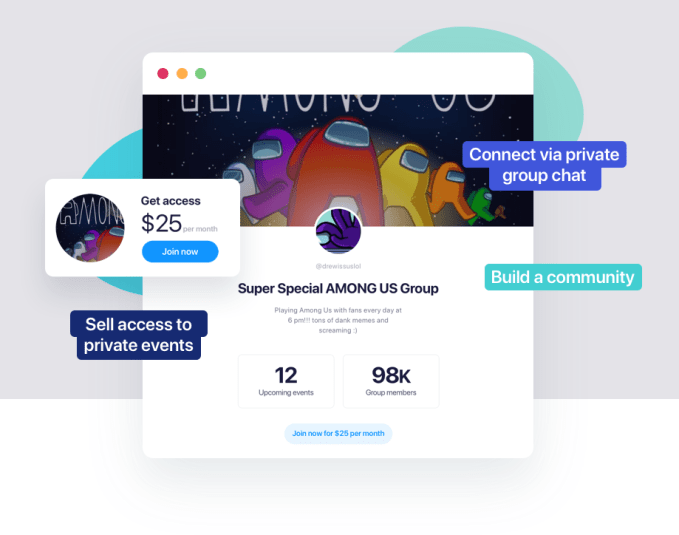
Beyond its value to growing social networks for the younger, Facebook-less generation, IRL is thinking about how to build a profitable business without ad revenue. On this front, it sees potential in helping people connect through paid events — although these wouldn’t have to be influencer-driven as on other platforms. In fact, when IRL recently piloted paid group chats, users were willing to pay for access to things like a calc homework help group, for example.

IRL also sees demand for tools that help groups and clubs collect membership dues and other fees, as well as for events that are too small for Ticketmaster or Eventbrite.

“Whether we succeed or fail will be based on our ability to execute on our opportunity,” says Shafi, adding that most social networks today are focused on media more so than helping users make connections. “What we’re building isn’t the media part of social, it’s the real human interaction part of social, because that hasn’t been paid attention to as much.”

“We’re building a messaging social network,” he continues, comparing it to the biggest messaging social network in the world, WeChat. “The big vision that we’re going for is building the WeChat of the West — a messaging super social network. And it starts with people organizing groups and doing things together,” he says.

With the additional funding, IRL will invest in product growth, international expansion and its Creator and Culture Fund, and will grow its now 25-person remotely distributed team to 100 by year-end.

“People are increasingly seeking more in-person social connections and are looking to share meaningful experiences together. As an innovative event-based social network, IRL sits at the intersection of group and event discovery, social calendaring, and group messaging, enabling people to do more together,” added Serena Dayal, director at SoftBank Investment Advisers, in a statement about its investment. “We are excited to partner with Abraham and the IRL team to support their ambition of helping everyone deepen their connections to friends and family.”

15 Jun 2021

Carbyne raises $20M more so when death knocks, you don’t answer the door

Chaos and crisis are sisters, and none more so than when you dial for emergency help. A call to 911 in the United States and urgent numbers globally spins off a number of additional calls to emergency response teams, ambulances, hospitals and other actors who need to coordinate action to save your life. Theoretically, everyone should be working off the same data, but also theoretically, I should be able to eat ice cream without getting fat.

Israel-based Carbyne’s software platform coordinates these calls so that critical details — say, location or medical allergies — don’t get lost from the 911 call taker to the paramedic in the field.

Now, it’s taking a second scoop on its capital cone in the form of a $20 million new round, following a $25 million Series B that my colleague Ingrid Lunden reported on in January. The new funding was led by Global Medical Response, one of the world’s largest emergency medical providers who operates fleets of vehicles, trucks, helicopters and planes to get patients to hospital facilities expeditiously. GMR was founded in 2018 from a rollup of emergency services led by private equity giant KKR.

This new round was in the form of a convertible note that will convert into Carbyne’s next fundraise according to CEO and co-founder Amir Elichai. Also joining the round was Hanaco VC, Intercap VC, Elsted Capital and others. Elichai said that the round took about three weeks to fundraise and close, and was held to $20 million given the company’s earlier funding this year, which at the time we reported was “over $100 million” in valuation.

Carbyne and GMR have been partners since late 2020, and their ties are deepening. GMR COO Edward Van Horne will join Carbyne’s board of directors.

In addition to offering more advanced location services for emergency callers, Carbyne’s technology allows for callers to activate a video channel, giving emergency response personnel more live information about what’s happening. That’s critical in GMR’s business, where first responders need the most up-to-date information to increase their effectiveness.

“The ability to get smarter information, and to increase situational awareness to each case whatever it is, will give emergency medical services the ability to better triage and to make faster and smarter responses to events that occur within their jurisdiction,” Elichai explained. “So basically the entire ecosystem is becoming much more reliable and efficient, thanks to the Carbyne ecosystem that we’re putting together with GMR.”

My colleague wrote a great deep dive into the company in January, so read that for some background on the company’s founding and product and how it weathered the pandemic. A few more updates though in the past few months bear mentioning.

Elichai said that the company has doubled the recurring revenues of its business since the beginning of 2021, although wouldn’t provide those ever elusive absolute figures. The company has also expanded its employee base by 30% over the same period. Among the success stories is New Orleans, which is moving its emergency centers to Carbyne, as well as centers in Texas, Georgia and Florida. Elichai said that much of this transition was prompted by additional federal investment in 911 infrastructure appropriated in recent COVID-19 stimulus bills.

The company’s CTO and co-founder, Alex Dizengof, will move from Israel to the United States to start an R&D center.

Last week, the company announced a new “Ultra Emergency Network” that it is building with Israel Aerospace Industries that will allow phones to communicate emergency location information in post-disaster scenarios where commercial mobile services degrade or disappear entirely.

The company’s newest investment is in line with growing interest from venture capitalists in the disaster space, with more data, investments in communications infrastructure, and more dollars flowing into the space than ever before.

15 Jun 2021

CJEU ruling could open big tech to more privacy litigation in Europe

A long running privacy fight between Belgium’s data protection authority and Facebook — over the latter’s use of online trackers like pixels and social plug-ins to snoop on web users — has culminated in a ruling by Europe’s top court today that could have wider significance on how cross-border cases against tech giants are enforced in the region.

The Court of Justice of the European Union has affirmed that, in certain circumstances, national DPAs can pursue action even when they are not the lead data supervisor under the General Data Protection Regulation (GDPR)’s one-stop-shop mechanism (OSS) — opening up the possibility of litigation by watchdogs in Member States which aren’t the lead regulator for a particular company but where the local agency believes there is an urgent need to act.

The OSS was included in the GDPR with the idea of simplifying enforcement for businesses operating in more than one EU market — which would only need to deal directly with one ‘lead’ data protection authority. However the mechanism has been criticized for contributing to a bottleneck effect whereby multiple GDPR complaints are stacking up on the desks of a couple of DPAs (most notably Ireland and Luxembourg) — EU Member States which attract large numbers of multinationals (typically for tax reasons, such as Ireland’s 12.5% corporate tax rate).

Enforcement of the EU’s flagship data protection regime against tech giant has thus been hampered by a perception of ‘forum shopping’ — whereby a handful of EU DPAs have a disproportionately large number of major, cross-border cases to deal with vs the (inevitably limited) resources provided for them by their national governments. The resulting bottleneck looks convenient for those companies that face delayed GDPR enforcement.

Some EU DPAs are also considered more active in enforcement of the bloc’s privacy rules than others — and it’s fair to say that Ireland is not among them. (Albeit, it defends the pace of its investigations and enforcement record by saying that it must do due diligence to ensure decisions stand up to any legal challenges.)

Indeed, Ireland has been criticized for (among other things) the length of time it’s taken to investigate GDPR complaints; for procedural issues (how it’s gone about investigating or indeed not investigating complaints); and for its enforcement record against tech giants — which to date is limited to just one $550k penalty issued against Twitter issued at the end of last year.

The Irish Data Protection Commission (DPC) had originally wanted to give Twitter an even lower fine but other EU DPAs disputed its draft decision — forcing it to increase the penalty slightly.

As it stands, scores of cases remain open on the DPC’s desk, including major complaints against Facebook and Google — which are now over three years old.

This has led to calls for the Commission to step in and take action over Ireland’s perceived inaction. Although, for now, the EU’s executive has limited its intervention to a few words urging Ireland to, essentially, hurry up and get on with the job.

Today’s CJEU ruling may alleviate a little of the blockage around GDPR enforcement — in some narrow situations — by enabling national DPAs to take up the baton to litigate over users’ rights when a lead agency isn’t acting on complaints.

However the ruling does not look set to completely unblock the OSS mechanism, per Luca Tosoni, a research fellow at the Norwegian Research Center for Computers and Law at the University of Oslo who has been following the case closely — and whose work was cited by the CJEU’s advocate general in an earlier opinion on the case.

“The Court has essentially confirmed the views that the Advocate General had expressed in his opinion: Under the GDPR’ one-stop-shop system, those data protection authorities that are not the ‘lead authority’ may start enforcement actions against big tech companies only in very limited circumstances, including in case of urgency,” he told TechCrunch.

“However, unfortunately, the Court’s ruling does not elaborate on the criteria to be followed to assess the urgency of an enforcement action. In particular, the Court has not expressly seconded the advocate general’s view that a failure to act promptly from the part of the lead authority may justify the adoption of interim urgent measures by other data protection authorities. Thus, this important point remains partially unclear, and further litigation might be necessary to clarify this issue.

“Therefore, today’s ruling is unlikely to completely settle the ‘Irish issue’.”

Article 56 of the GDPR allows for non-lead DPAs to pursue action at a national level in the case of complaints that relate to an issue that substantially affects only users under their jurisdiction, and where they believe there is a need to act urgently (as a lead authority has not). So it does seem fairly narrow.

One recent example of a non-lead DPA intervention is the Italian DPA’s emergency action against TikTok — related to child safety on the platform after the death of a local girl who had been reported to have participated in a challenge on the platform.

“An authority’s wish to adopt a ‘go-it-alone’ approach… with regard to the (judicial) enforcement of the GDPR, without cooperating with the other authorities, cannot be reconciled with either the letter or the spirit of that regulation,” runs one paragraph of today’s judgement, underlining the court’s view that the GDPR requires careful and balanced joint-working between DPAs.

The ruling does go into some detailed discussion of the “dangers” of under-enforcement of the GDPR — as the concern was raised with the CJEU — but the court takes the view that it’s too soon to say whether such a concern affects the regulation or not.

“If, however, [under-enforcement were to] be evidenced by facts and robust arguments – then I do not believe that the Court would turn a blind eye to any gap which might thereby emerge in the protection of fundamental rights guaranteed by the Charter and their effective enforcement by the competent regulators,” the CJEU goes on. “Whether that would then still be an issue for a Charter-conform interpretation of provisions of secondary law, or an issue of validity of the relevant provisions, or even sections of a secondary law instrument, is a question for another case.”

The ruling, while narrow, may at least unblock the Belgian DPA’s long-running litigation against Facebook’s tracking of non-users via cookies and social plug-ins which was the route for the referral of questions over the scope of the OSS to the CJEU.

Although the court also notes that it will be for a Belgian court to determine whether the DPA’s intervention meets the GDPR’s bar for starting such proceedings or not.

Contacted for comment on the CJEU judgement, Facebook welcomed the ruling.

“We are pleased that the CJEU has upheld the value and principles of the one-stop-shop mechanism, and highlighted its importance in ensuring the efficient and consistent application of GDPR across the EU,” said Jack Gilbert, associate general counsel at Facebook in a statement.

15 Jun 2021

Home services platform Thumbtack raises $275M on a $3.2B valuation to double down on home management

On the heels of making an acquisition in December of home management startup Setter, Thumbtack — one of the pioneers in the home services gig economy — has raised a big round to double down on the model. The company has raised a fresh $275 million, money that the company plans to use to built out a home management and maintenance business alongside its network of home services professionals. Co-founder and CEO Marco Zappacosta confirmed that the round values Thumbtack at $3.2 billion.

For some context, this is nearly double the valuation Thumbtack had when it last raised money, a $150 million round led by Sequoia in 2019. It also comes on the heels of a strong 2020, where its revenue grew more than 50%. Thumbtack’s gross revenue (what’s paid in service fees, not Thumbtack’s cut) is now on track, it says, to cross $2 billion this year.

This latest funding is being led by the Qatar Investment Authority (QIA), with participation also from Blackstone Alternative Asset Management (BAAM) as well as G Squared. Previous backers Ballie Gifford, CapitalG, Founders Circle Capital, Sequoia Capital, and Tiger Global Management also invested.

The funding and shifting focus of the company underscore some of the changes we have seen among consumers in the last year.

In large part, because of Covid-19, most of us have been staying home — which has often included also moving to new homes to accommodate spending so much more time in them — and, as Thumbtack sees it, that has led many more people to paying more attention to how to make those homes better places, and to keep them in better shape overall, and why it sees a big opportunity — alongside being a marketplace to find pro’s for one- off jobs you might need done around the house — in providing a “home management” platform to cater to that new attention.

“It’s pretty wild that people’s homes their biggest assets, the most complicated thing you’re responsible for, but it doesn’t come with a manual,” Zappacosta said in an interview. “When you think about your car, you need to do regular service. Otherwise, you may have to pay a big emergency bill [to fix something]. That same concept applies to the home. But there’s never been an easy way to know what you should do, how much to pay for it, and then easily get it done. So that’s what we’re doing.” The services include emergency repairs of electrics in the home, plus preventative maintenance that you may need to do to on your property, he said.

The move into home management is an interesting turn for another reason, too: it’s a sign of how Thumbtack is playing into a bigger change in how many consumers engage with services overall, and that is by way of subscriptions. That is to say, while many of us will still go out and shop for items, or go to a cinema, we are all also subscribing to at least one video-on-demand service, many of us may well also have Prime accounts to get Amazon’s various perks, and so on. If we are subscribing everywhere else, why not throw home maintenance into the mix?

Thumbtack, now over ten years old, is thought by many as one of the earliest movers in the gig economy space to focus on home services. That has not come without challenges, however. As we reported back in 2019, the last round was a tough one for the company and looked like it might come in at a flat valuation. That was on the heels of many others in the space — competitors of Thumbtack’s that included not just other startups but also heavy hitters like Amazon and Google — also fizzling out in their own efforts in home services.

And Covid-19 proved to be a huge challenge for Thumbtack, too, which laid off 250 people in March last year.

Yeah, look, it was a roller coaster of a year,” Zappacosta said. “In the early phases of COVID, there was so much fear that many just shut it all down. People said, ‘I’m not going to have anybody in my home.’ And so those months were really scary — March, April — because it was unclear how long that was going to last. And so we made adjustments to ensure that we sort of would stand the test of time.”

However that changed later in the year, he continued. “Once people began getting more comfortable with masking up, and all the precautions, you know, demand did start to come back. And so by June, July, we saw ot get back to normal levels. And then you know, what happened is the big investments that we’ve been making in the platform in the last few years to make the hiring experience, much more e-commerce, like really began to pay more and more dividends.”

He said that 2020 was Thumbtack’s third year of accelerating growth, “which is sort of surprising given that Covid was in the middle of that. And so the momentum that we’re carrying out, is we’ve never been in a stronger position.”

The company now is focusing on where it might best use technology to get the upper hand with its platform, which competes not just with other home services provider marketplaces, but also a growing number of upstart and incumbent “home management” providers like Super, which raised $50 million last month. One interesting idea that Zappacosta described to me, which may well be part of a later phase of development, involved providing a way for customers to “tour” their homes so that Thumbtack could get a better idea of the space and what needs attention to better personalize its home management to the home and user in question.

That will keep the company working also in the U.S. he said. Globally the home services and repair market is estimated to be worth some $500 billion annually, and amazingly the U.S. represents a massive 40% of that value.


15 Jun 2021

Klaxoon introduces whiteboard-focused conference room for hybrid work

French startup Klaxoon is announcing a product update for its whiteboard collaboration platform as well as a new hardware product. With Hybridity, the company is going to sell ready-to-use conference rooms that optimize hybrid meetings between people currently in the office and people on the go.

Let’s start with the software update. Last year, the company unveiled Board, a visual interface that lets you work together during a video call. It lets you share ideas and collaborate using a whiteboard interface. You can create sticky notes, add text, insert images, move things around and start a video call from there.

Other people on the calls are represented through tiny thumbnails so that you can remain focused on the digital whiteboard. You can also connect Board with your existing video-conferencing tool.

This week, the company is updating Board and renaming it to Board Hybrid. “It’s the new version of Board that isn’t only designed for remote work, but also for hybrid work,” founder and CEO Matthieu Beucher said in a press conference.

Board Hybrid users can now add any type of file to their whiteboard. This way, they don’t have to upload files to a shared drive, create a link and paste the link in the whiteboard. Users can preview PowerPoint presentations, Word files, spreadsheets and more directly from Klaxoon’s interface.

There are some new drawing tools including some new connectors. For instance, you can create mindmaps from there. You can now also share your screen from Klaxoon’s own video-conferencing solution.

Image Credits: Klaxoon

The new product is something quite different — it’s a meeting room called Hybridity. It looks like a hexagon-shaped space capsule. There’s no window and it feels like a black box from the outside.

Inside, you’ll find three seats, three screens, three cameras and three Klaxoon Box devices. “Everyone can see everyone perfectly well and everybody can immerse themselves in content,” Beucher said.

If you’ve joined a hybrid meeting from your home, you’re well aware of the issues involved with that setup. Part of the team is sitting in the same room. They look like tiny action figures and you can’t figure out who’s talking.

With this setup, Klaxoon hopes it’ll be easier to run meetings with people in the office and people at home. A Klaxoon Hybridity conference room requires 5 square meters. You can put it down in a corner and move it to another location a couple of years later. It’s not secured in the ground.

Pre-orders will start this week. The company expects to sell Hybridity with a subscription model with prices starting at €2,000 per month. It’s going to be interesting to see whether Klaxoon has found a new revenue stream of it it’s just a fun experiment. But it could replace those tiny phone booths in your office.

Image Credits: Klaxoon