Cybersecurity giant FireEye has agreed to sell its products business to a consortium led by private equity firm Symphony Technology Group for $1.2 billion.
The all-cash deal will split FireEye, the maker of network and email cybersecurity products, from its digital forensics and incident response arm Mandiant.
FireEye’s chief executive Kevin Mandia said the deal unlocks its “high-growth” Mandiant business, allowing it to stand alone as a separate business running incident response and security testing.
The move to split the two companies comes almost a decade after FireEye acquired Mandiant, and made Mandia chief executive.
Mandia said: “STG’s focus on fueling innovative market leaders in software and cybersecurity makes them an ideal partner for FireEye Products. We look forward to our relationship and collaboration on threat intelligence and expertise.”
STG managing partner William Chisholm said there is an “enormous untapped opportunity for the business that we are excited to crystallize by leveraging our significant security software sector experience and our market leading carve-out expertise.”
The company said the deal is expected to close by the end of the fourth quarter.
FireEye has become one of the more prominent names in cybersecurity, known for its research into hacking groups — some linked to governments — and its Mandiant unit for responding to major security incidents. Mandiant was called in to help Colonial Pipeline recover from a recent ransomware attack.
FireEye becomes the latest cybersecurity giant to STG’s portfolio. In March, Symphony bought McAfee’s enterprise business for $4 billion and bought RSA for $2 billion.
Twitter is looking to crowdsource its way out of misinformation woes with its new product Birdwatch which taps a network of engaged tweeters to add notes to misleading tweets. Today, Twitter announced that they are starting to roll out the Birdwatch notes to pilot participants across iOS, Android and desktop.
The company launched a pilot version of the program back in January, describing the effort as a way to add context to misinformation in real time.
“We believe this approach has the potential to respond quickly when misleading information spreads, adding context that people trust and find valuable” Product VP Keith Coleman wrote in a blog post at the time. “Eventually we aim to make notes visible directly on Tweets for the global Twitter audience, when there is consensus from a broad and diverse set of contributors.”
That time is apparently now for an early set of Birdwatch pilot participants.
Hey there! Exciting news . Now, when you’re browsing Twitter on Android, iOS, or https://t.co/lEjTtR4BGM, you may see Tweets with Birdwatch notes. Notes will appear in a card on the Tweet. Right now, this feature is only visible to pilot participants. pic.twitter.com/dyMHgawLUl
Twitter says that once Birdwatch notes are added to a tweet, users will have the opportunity to rate whether the feedback is helpful or not. If none of the replies are deemed helpful, the Birdwatch card itself will disappear, but if any notes are deemed helpful they’ll pop up directly inside the tweet.
There have been an awful lot of questions about how and whether Birdwatch will work inside the current social media framework. Using community feedback differs from more centralized efforts used by platforms like Facebook that have tapped independent fact-checking organizations. Twitter is clearly aiming to decentralize this effort as much as it can and put power in the hands of Birdwatch contributors, but with audiences of individual tweeters currently responsible for deeming the helpfulness and visibility of fact checks, it’s clear this is going to be a pretty messy solution at times.
When Cloudera announced its sale to a pair of private equity firms yesterday for $5.3 billion, along with a couple of acquisitions of its own, the company detailed a new path that could help it drive back towards relevance in the big data market.
When the company launched in 2008, Hadoop was in its early days. The open source project developed at Yahoo three years earlier was built to deal with the large amounts of data that the Internet pioneer generated. It became increasingly clear over time that every company would have to deal with growing data stores, and it seemed that Cloudera was in the right market at the right time.
And for a while things went well. Cloudera rode the Hadoop startup wave, garnering a cool billion in funding along the way, including a stunning $740 million check from Intel Capital in 2014. It then went public in 2018 to much fanfare.
But the markets had already started to shift by the time of its public debut. Hadoop, a highly labor-intensive way to manage data, was being supplanted by cheaper and less complex cloud-based solutions.
“The excitement around the original promise of the Hadoop market has contracted significantly. It’s incredibly expensive and complex to get it working effectively in an enterprise context,” Casey Aylward, an investor at Costanoa Ventures told TechCrunch.
The company likely saw that writing on the wall when it merged with another Hadoop-based company, Hortonworks in 2019. That transaction valued the combined entity at $5.2 billion, almost the same amount it sold for yesterday, two years down the road. The decision to sell and go private may also have been spurred by Carl Icahn buying an 18% stake in the company that same year.
Looking to the future, Cloudera’s sale could provide the enterprise unicorn room as it regroups.
Patrick Moorhead, founder and principal analyst at Moor Insight & Strategies sees the deal as a positive step for the company. “I think this is good news for Cloudera because it now has the capital and flexibility to dive head first into SaaS. The company invented the entire concept of a data life cycle, implemented initially on premises, then extended to private and public clouds,” Moorhead said.
Adam Ronthal, Gartner Research VP agrees that it at least gives Cloudera more room to make necessary adjustments its market strategy as long as it doesn’t get stifled by its private equity overlords. “It should give Cloudera an opportunity to focus on their future direction with increased flexibility — provided they are able to invest in that future and that this does not just focus on cost cutting and maximizing profits. Maintaining a culture of innovation will be key,” Ronthal said.
Which brings us to the two purchases Cloudera also announced as part of its news package.
If you want to change direction in a hurry, there are worse ways than via acquisitions. And grabbing Datacoral and Cazena should help Cloudera alter its course more quickly than it could have managed on its own.
“[The] two acquisitions will help Cloudera capture some of the value on top of the lake storage layer — perhaps moving into different data management features and/or expanding into the compute layer for analytics and AI/ML use cases, where there has been a lot of growth and excitement in recent years,” Alyward said.
Chandana Gopal, Research Director for the future of intelligence at IDC agrees that the transactions give Cloudera some more modern options that could help speed up the data wrangling process. “Both the acquisitions are geared towards making the management of cloud infrastructure easier for end-users. Our research shows that data prep and integration takes 70%-80% of an analyst’s time versus the time spent in actual analysis. It seems like both these companies’ products will provide technology to improve the data integration/preparation experience,” she said.
The company couldn’t stay on the path it was on forever, certainly not with an activist investor breathing down its neck. Its recent efforts could give it the time away from public markets it needs to regroup. How successful Cloudera’s turnaround proves to be will depend on whether the private equity companies buying it can both agree on the direction and strategy for the company, while providing the necessary resources to push the company in a new direction. All of that and more will determine if these moves pay off in the end.
For the past several months or so, I’ve been writing an accompanying post to editions of the Gillmor Gang. Due to production issues, I’m usually at least a week behind the recording session for the target show. This originally seemed like an impediment to the process of enhancing the impact of the show, but over time and various attempts to solve the out-of-sync timing problem, I began to see the delay actually produced some interesting context to the original recording. First and foremost, what seemed important weeks earlier became more nuanced as things developed — or often didn’t. Politics seemed loud and unprecedented in the moment; 10 days later, the ups and downs of the graph smoothed out the drama and accentuated the relative stability of intuitive analysis.
This in turn isolated some of the conflicts and pressure the media perceived as central to its ability to fund journalism, or more accurately nonfictional novelistic engagement and eyeball maintenance. And produced a wave of antagonism toward this repetitive ginned-up sawtooth of anger and despair. As the vaccines began to take root, we slowly but surely confirmed that we really didn’t have to live that way. Streaming and notifications are now in the process of moving into the mainstream, with media companies climbing into bed with tech giants and hybrid venture catalysts.
Cracks in this new infrastructure threaten to slow down the requisite belief that these changes will stick. Clubhouse seems to be going through a bloating effect on its gateway page; what once was a short list of 5 or 6 rooms now balloons to 20 or more entries. Topics, never my favorite mechanism for discovery, nail many of these conversations to the wall and move away from the underlying name intersections that suggest emergent themes rather than sandblasting them into the stage. Release notes of updates suggest the analytics are being mined for improvements to the differentiation with vanilla podcasts, but how they are surfaced is time sensitive to the momentum of the platform. The good news is that healthy injections from the founder and venture team will keep things afloat while we see the impact of the Android client. Competitive pressure, particularly from Kara Swisher on Twitter Spaces, will also help integrate mainstream and newsletter media with streaming audio innovation.
At a broader level, acquisitions and merger/alliances are recasting media companies as hybrid gorillas. Although AT&T is positioned by many as backing out of their foray into content, a more interesting dynamic is the combination of WarnerMedia scripted assets with Discovery’s sports and reality programming in an ad-supported streaming bundle. It’s reminiscent of the formation of MGM in the early days of Hollywood, blending a small beleaguered studio, Metro Pictures, with Sam Goldwyn’s independent near-bankrupt studio, firing Goldwyn but keeping the name, and installing a third studio’s Louis B. Mayer and his production head Irving Thalberg as executives of the bundled company. Not so coincidentally, it was Metro-Goldwyn-Mayer who was acquired by Amazon a few days later, bringing its library of the James Bond franchise, more than 4,000 classic films, and 17, 000 television properties to Prime’s 175 million active subscribers.
At various times, MGM and its United Artists acquisition have been bought and resold as power switched first from theaters to television and then to cable. Ted Turner famously bought the library and played it off on its Turner Classic Movies channel. Now the pandemic’s call to action has propelled digital transformation to the fore, and tossed yet another mix of the puzzle pieces into play. But MGM’s collapse in the 60’s and 70’s and the auctioning off of its backlot to real estate developers suggests something similar might be happening today with broadcast television networks losing out one by one when the music stops playing in this corporate game of musical chairs. Cable news may be blocked out if antitrust regulators refuse attempts to merge the new Warners Discovery with Comcast, the former now home for CNN and the latter MSNBC. Regulators will likely frown on two of the remaining 3 broadcast networks merging with a Viacom/CBS and Comcast /NBC/Universal deal.
Instead, the tech networks and their burgeoning social audio/newsletter platforms will virtualize the big studio model. Cable news will move from podcasts through Clubhouse and Spaces to newsletter brands, building tentpole events around technology news, innovations coverage, and startup deal flow. The scale of big incumbents like Netflix, Disney, and Amazon will produce 5,000+ executive interviews, with independent analysis from break-away blogs and newsletters looking a lot like a merger of MSNBC and CNBC. Apple and Spotify will emulate the ad-supported free tiers of their streaming networks to unbundle the music companies from their captive back catalogues and create a hybrid live performance promotional Top Forty for the play-from-anywhere crowd. The Marvel, DC, Star Wars cinematic universes will use the digital tier to promote theatrical experiences as the pandemic moves overseas and hopefully is suppressed globally over 2022. Politics, a trailing indicator, will be the arbiter of how quickly we can rearchitect in infrastructure, health care, and an equitable working majority rule of law. By then, maybe I can take a 3D VR trip through the MGM backlot and dream that this could be the start of a beautiful friendship.
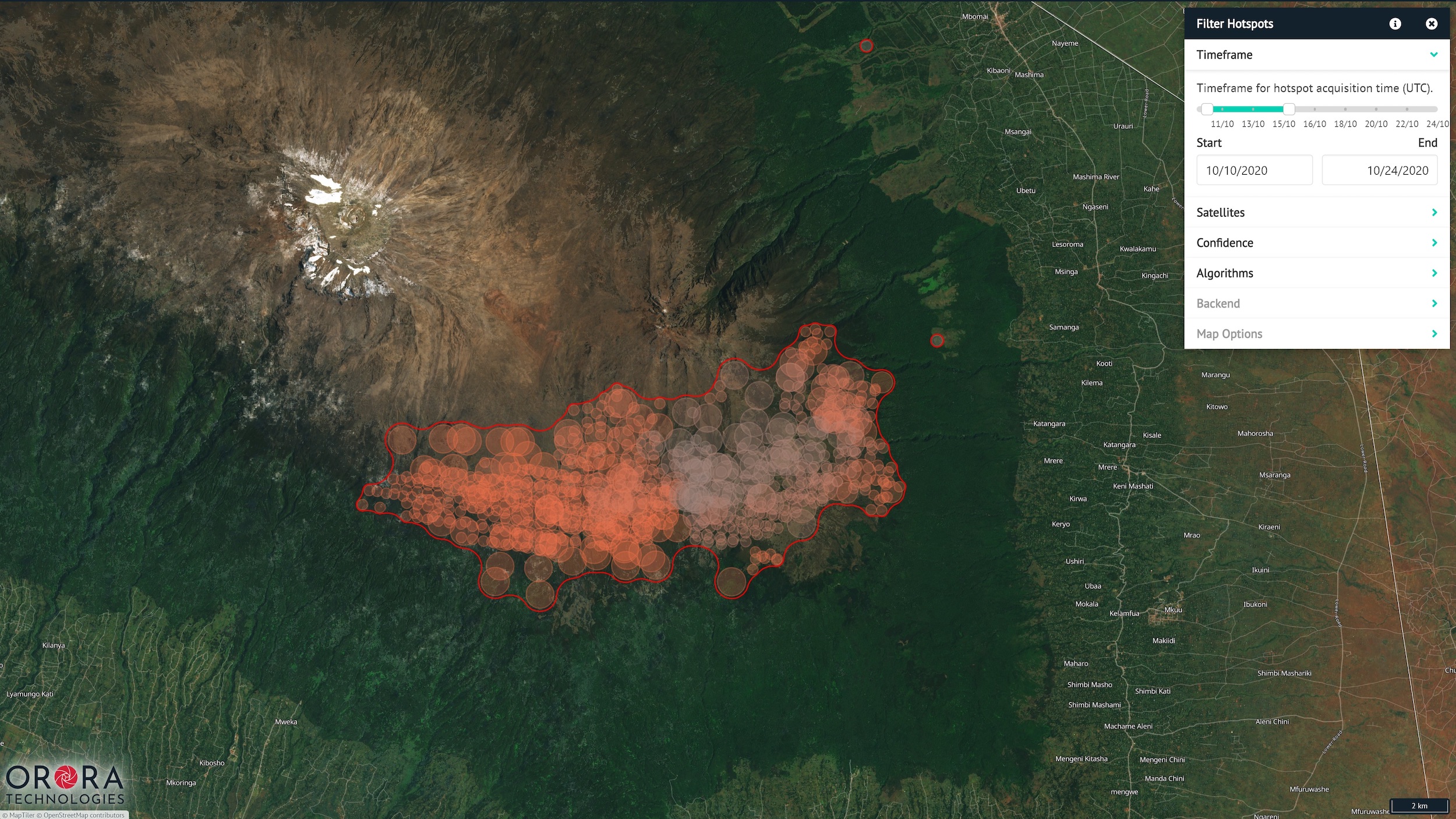
With wildfires becoming an ever more devastating annual phenomenon, it is in the whole planet’s interest to spot them and respond as early as possible — and the best vantage point for that is space. OroraTech is a German startup building a constellation of small satellites to power a global wildfire warning system, and will be using a freshly raised €5.8M (~$7M) A round to kick things off.
Wildfires destroy tens of millions of acres of forest every year, causing immense harm to people and the planet in countless ways. Once they’ve grown to a certain size, they’re near impossible to stop, so the earlier they can be located and worked against, the better.
But these fires can start just about anywhere in a dried out forest hundreds of miles wide, and literally every minute and hour counts — watch towers, helicopter flights, and other frequently used methods may not be fast or exact enough to effectively counteract this increasingly serious threat. Not to mention they’re expensive and often dangerous jobs for those who perform them.
OroraTech’s plan is to use a constellation of about 100 satellites equipped with custom infrared cameras to watch the entire globe (or at least the parts most likely to burst into flame) at once, reporting any fire bigger than ten meters across within half an hour.
Image Credits: OroraTech
To start out with, the Bavarian company has used data from over a dozen satellites already in space, in order to prove out the service on the ground. But with this funding round they are set to put their own bird in the air, a shoebox-sized satellite with a custom infrared sensor that will be launched by Spire later this year. Onboard machine learning processing of this imagery simplifies the downstream process.
14 more satellites are planned for launch by 2023, presumably once they’ve kicked the proverbial tires on the first one and come up with the inevitable improvements.
“In order to cover even more regions in the future and to be able to give warning earlier, we aim to launch our own specialized satellite constellation into orbit,” said CEO and co-founder Thomas Grübler in a press release. “We are therefore delighted to have renowned investors on board to support us with capital and technological know-how in implementing our plans.”
Those renowned investors consist of Findus Venture and Ananda Impact Ventures, which led the round, followed by APEX Ventures, BayernKapital, Clemens Kaiser, SpaceTec Capital and Ingo Baumann. The company was spun out of research done by the founders at TUM, which maintains an interest.
“It is absolutely remarkable what they have built up and achieved so far despite limited financial resources and we feel very proud that we are allowed to be part of this inspiring and ambitious NewSpace project,” APEX’s Wolfgang Neubert said, and indeed it’s impressive to have a leading space-based data service with little cash (it raised an undisclosed seed about a year ago) and no satellites.
It’s not the only company doing infrared imagery of the Earth’s surface; SatelliteVu recently raised money to launch its own, much smaller constellation, though it’s focused on monitoring cities and other high-interest areas, not the vast expanse of forests. And ConstellR is aimed (literally) at the farming world, monitoring fields for precision crop management.
With money in its pocket Orora can expand and start providing its improved detection services, though sadly, it likely won’t be upgrading before wildfire season hits the northern hemisphere this year.
Beware! There isn’t much time left to apply for Startup Alley. Take advantage of this opportunity before it’s too late.
When you purchase a ticket for Startup Alley, you can opt into being considered for a spot in our inaugural Startup Alley+ cohort. This very cool and downright extraordinary business development opportunity kicks off in July and takes you through TechCrunch Disrupt 2021 (September 21-23).
TechCrunch will select 50 startups to participate in Startup Alley+ and the only cost involved is the price you paid for your exhibitor’s pass. Here’s what Startup Alley+ delivers.
It all begins at TechCrunch Early Stage: Marketing & Fundraising in July, which you’ll attend for free. From there, you’ll receive three months of business development support. That support includes these three masterclasses on essential entrepreneurial topics:
Key Principles of the Lean Startup Methodology with John Lynn, founder of CELA Innovation
Outreach Strategies for Contacting VCs and Press with Annie Kadavy of Redpoint Ventures and TechCrunch editor Danny Crichton
You also get to perfect your pitch so you’re ready to impress potential customers at TC Disrupt. How? By pitching at one of our our weekly Extra Crunch Live events in the run-up to Disrupt.
And don’t forget — all Startup Alley exhibitors get two minutes to pitch live to the global Disrupt audience. This means you showcase your product to investors, media reps, corporate innovation teams and other attendees interested in your vertical.
What else? How about warm introductions to select VCs from the TechCrunch community? Check — we’ve got you covered on that front. Startup Alley+ cohort members will be introduced to relevant investors before Disrupt kicks off. Have your pitch deck ready and be prepared to give a product demonstration.
Times running out. Your chance to potentially join the Startup Alley+ cohort will not be around for too much longer. Buy a Startup Alley Pass now. Take advantage of this opportunity and make the most of TechCrunch Disrupt 2021.
Is your company interested in sponsoring or exhibiting at Disrupt 2021? Contact our sponsorship sales team by filling out this form.
“Game of Thrones” might be over, but HBO Max is still breaking new ground, and even breaking the internet – this past weekend, HBO Max blacked out right before the finale of “Mare of Easttown,” likely due to traffic. But if you haven’t hopped aboard the HBO Max train yet, it might be time to try it out. Today, the streaming platform premieres an ad-supported subscription at $9.99 per month. Its existing service – which features no ads – costs $14.99 per month. Subscribers can save 15% on their subscription, no matter which version they choose, if they pre-pay for an entire year.
The advertisements aren’t the only drawback of the more affordable subscription option. The ad-supported tier offers a maximum quality of 1080p, which is still pretty good for most consumers, unless you’re watching “Friends: The Reunion” in your 4k home theater. But, lower-tier subscribers won’t be able to download content to view offline, nor will they have access to same-day film premieres of Warner Bros.’s newest theatrical releases. However, these films will become available to stream months after release. On the bright side, ads will not appear on original HBO programming.
With just four minutes of ad time per hour, the ad-supported tier “launches with a commitment” to maintaining the lowest volume of commercials among popular streaming services. HBO Max follows in the footsteps of Hulu, which also offers a discounted subscription with ads for $5.99 per month, as opposed to $11.99 per month. But on Hulu, a half-hour show can contain almost five minutes of unskippable ad time. Meanwhile, Netflix offers its most basic plan – which allows streaming on one screen at a time without HD – for $8.99 per month. Its standard plan is $13.99 a month. Now that HBO Max has a more competitively priced option, it might give these other platforms a run for their money.
What kinds of ads can you expect to see on HBO Max? The company says that subscribers can expect “a greater personalization in the ads they see” over time, with “more innovation in formats to come.” This could resemble the ad experience on Hulu, which has experimented with viewer-friendly binge-watch ads.
As of April 2021, HBO Max and HBO reached a combined 44.2 million subscribers, and in Q1 of the year, added 2.7 million domestic subscribers. By comparison, Netflix reported an increase of 4 million subscribers in the same period, bringing them to about 207 million global subscribers. However, only 450,000 of those new subscribers come from the US and Canada.
On June 29, HBO Max will launch in 39 Latin American markets. Later in the year, the streaming service is expected to roll out in Europe. This will only further the platform’s rapid growth – in 2019, AT&T, which owns HBO Max, set the modest goal to attain 50 million subscribers by 2025. Now, HBO Max expects it will reach between 120 million and 150 million subscribers by the same date.
The ad-supported subscription option for HBO Max is available now.
Confluent became the latest company to announce its intent to take the IPO route, officially filing its S-1 paperwork with the U.S. Securities and Exchange Commission this week. The company, which has raised over $455 million since it launched in 2014, was most recently valued at just over $4.5 billion when it raised $250 million last April.
What does Confluent do? It built a streaming data platform on top of the open-source Apache Kafka project. In addition to its open-source roots, Confluent has a free tier of its commercial cloud offering to complement its paid products, helping generate top-of-funnel inflows that it converts to sales.
Kafka itself emerged from a LinkedIn internal project in 2011. As we wrote at the time of Confluent’s $50 million Series C in 2017, the open-source project was designed to move massive amounts of data at the professional social network:
At its core, Kafka is simply a messaging system, created originally at LinkedIn, that’s been designed from the ground up to move massive amounts of data smoothly around the enterprise from application to application, system to system or on-prem to cloud — and deal with extremely high message volume.
Confluent CEO and co-founder Jay Kreps wrote at the time of the funding that events streaming is at the core of every business, reaching sales and other core business activities that occur in real time that go beyond storing data in a database after the fact.
“[D]atabases have long helped to store the current state of the world, but we think this is only half of the story. What is missing are the continually flowing stream of events that represents everything happening in a company, and that can act as the lifeblood of its operation,” he wrote.
That’s where Confluent comes in.
But enough about the technology. Is Confluent’s work with Kafka a good business? Let’s find out.
What does an electric vehicle sound like when it goes from 0 to 60, when it signals a turn, when it’s powered down for the night? EV motors have fewer parts and are therefore incredibly silent, which presents safety concerns for drivers who recognize speed by sound and pedestrians who can’t hear an approaching vehicle.
Sound designer Yuri Suzuki, a partner at design consultancy firm Pentagram, recently conducted a research project into the crucial role electric car sound has on a user’s safety, enjoyability, communication and brand recognition, out of which he developed a range of car sounds. Suzuki says that while some automakers have chosen beautiful and interesting car sound designs, chasing celebrity clout is not the way to go when designing the sound behind serious machines.
“We really have to design carefully based on the psychological effects on a human,” Suzuki told TechCrunch. “It’s all about the relation between the human being and the machine itself.”
Suzuki says smart sound design can help ease the difference between human and car by providing a shared language. Based on surveys he conducted, Suzuki came up with two new skeuomorphic electric engine sounds as well as adaptive sounds that reflect the time of day and the location of the drive.
His engine sounds are reminiscent of internal combustion engine revs, providing both drivers and pedestrians with a recognizable indication of speed increasing and decreasing. The sounds are placed at different pitches: one quite low, like a spaceship taking off; the other a bit higher, like a hovercraft vertically ascending. Audi, Ford and Jaguar Land Rover have also chosen to make futuristic copies of gasoline engines for some of their new electric vehicles.
Suzuki’s sound design also includes in-car sounds, like powering on, turn signals or horn honking, that use AI to adapt to the time of day. In the morning, there’s a higher pitch and a sunnier energy to the sounds, which get progressively lower in pitch as the day wears on.
A lot of manufacturers allow the driver to choose the sounds their vehicle will make, but Suzuki doesn’t think that’s the best idea because people will likely choose what sounds coolest to them, not necessarily what is most useful. Not to mention what a strange cacophony of noises cities would sound like if everyone could choose their own sounds. It would be like when people started choosing their own cellphone ringtones, but on a larger, more anxiety-inducing scale.
“We suggest a pre-set sound that gradually changes as it shifts to your life and activity pattern,” he said. “Our AI can slowly adjust its sound to the driver’s behavior.”
Suzuki’s AI-based car sounds are designed so that they’re not repetitive. So if you’re on a long road trip, rather than constantly listening to the same sound, Suzuki’s sounds are capable of creating real-time generation of bespoke sounds, a task that’s nearly impossible for a human to do. He says the constantly progressing and shifting sounds use the same data as the original engine sound, but it can stretch for hours without repetition.
Pentagram hasn’t yet produced a commercial application for Suzuki’s sounds, as it is more interested in sharing its research with the EV and sound design communities, as well as finding the right automaker partner to develop this project further.
“There are no strong sound guidelines yet, so that’s something we’re interested in,” said Suzuki. “The first step for us is sharing the kinds of things we can do with AI and sound design.”
At today’s F8 developer conference, Facebook announced new capabilities for Spark AR, its flagship AR creation software. Since Spark AR was announced at F8 2017, more than 600,000 creators from 190 countries have published over 2 million AR effects on Facebook and Instagram, making it the largest mobile AR platform, according to Facebook. If you’ve ever posted a selfie on your Instagram story with an effect that gave you green hair, or let you control a dog’s facial expression by moving your own face, then you’ve used Spark AR.
Soon, these AR effects will be available for video calling on Messenger, Instagram, and Portal with the introduction of a Multipeer API. Creators can develop effects that bring call participants together by using a shared AR effect. As an example, Spark AR shared a promo video of a birthday party held over a video call, in which an AR party hat appears on each of the participants’ heads.
Creators can also develop games for users to play during their video calls. This already exists on Facebook video calls – think of the game where you compete to see who can catch the most flying AR hamburgers in their mouth in a minute. But when the ability to make new, lightweight games opens to developers, we’ll see some new games to challenge our friends with on video calls.
These video call effects and multipeer AR games will be bolstered by Spark’s platform exclusive multi-class segmentation capability. This lets developers augment multiple segments of a user’s body (like hair or skin) at once within a single effect.
Facebook also discussed its ongoing ambition to build AR glasses. Chris Barber, Director of Partnerships for Spark AR, said that this goal is still “years away” – but, Barber did tease some potential features for the innovative, wearable tech.
“Imagine being able to teleport to a friend’s sofa to watch a show together, or being able to share a photo of something awesome you see on a hike,” Barber said. Maybe this won’t sound so dystopian by the time the product launches, years down the road.
Last October, Spark AR launched the AR Partner Network, a program for the platform’s most advanced creators, and this year, Spark launched an AR curriculum through Facebook’s BluePrint Platform to help creators learn how to improve their AR effects. Applications for the Spark Partner Network will open again this summer. For now, creators and developers can apply to start building effects for video calling through the Spark AR Video Calling Beta.

 . Now, when you’re browsing Twitter on Android, iOS, or