Year: 2021

02 Jun 2021

Iterative raises $20M for its MLOps platform

Iterative, an open-source startup that is building an enterprise AI platform to help companies operationalize their models, today announced that it has raised a $20 million Series A round led by 468 Capital and Mesosphere co-founder Florian Leibert. Previous investors True Ventures and Afore Capital also participated in this round, which brings the company’s total funding to $25 million.

The core idea behind Iterative is to provide data scientists and data engineers with a platform that closely resembles a modern GitOps-driven development stack.

After spending time in academia, Iterative co-founder and CEO Dmitry Petrov joined Microsoft as a data scientist on the Bing team in 2013. He noted that the industry has changed quite a bit since then. While early on, the questions were about how to build machine learning models, today the problem is how to build predictable processes around machine learning, especially in large organizations with sizable teams. “How can we make the team productive not the person? This is a new challenge for the entire industry,” he said.

Big companies (like Microsoft) were able to build their own proprietary tooling and processes to build their AI operations, Petrov noted, but that’s not an option for smaller companies.

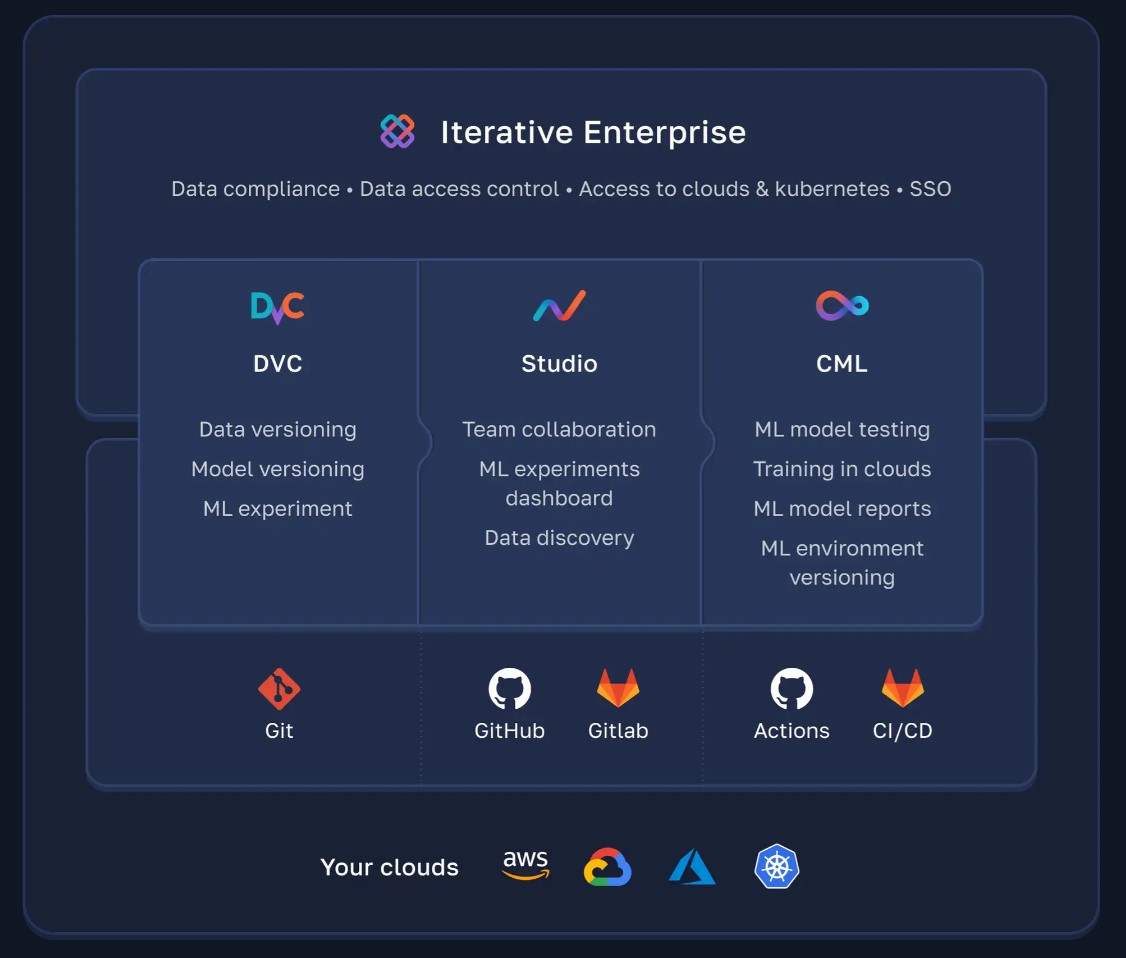
Currently, Iterative’s stack consists of a couple of different components that sit on top of tools like GitLab and GitHub. These include DVC for running experiments and data and model versioning, CML, the company’s CI/CD platform for machine learning, and the company’s newest product, Studio, its SaaS platform for enabling collaboration between teams. Instead of reinventing the wheel, Iterative essentially provides data scientists who already use GitHub or GitLab to collaborate on their source code with a tool like DVC Studio that extends this to help them collaborate on data and metrics, too.

Image Credits: Iterative

“DVC Studio enables machine learning developers to run hundreds of experiments with full transparency, giving other developers in the organization the ability to collaborate fully in the process,” said Dmitry Petrov, CEO and founder of Iterative. “The funding today will help us bring more innovative products and services into our ecosystem.”

Petrov stressed that he wants to build an ecosystem of tools, not a monolithic platform. When the company closed this current funding round about three months ago, Iterative had about 30 employees, many of which were previously active in the open-source community around its projects. Today, that number is already closer to 60.

“Data, ML and AI are becoming an essential part of the industry and IT infrastructure,” said Leibert, general partner at 468 Capital. “Companies with great open source adoption and bottom-up market strategy, like Iterative, are going to define the standards for AI tools and processes around building ML models.”

02 Jun 2021

Facebook opens its Messenger API for Instagram to all businesses

F8 Refresh, Facebook’s annual developer conference with a new twist — it’s more pared down than in years past, and virtual — is going to be kicking off later today, and ahead of that Facebook is unveiling some news: all businesses can now use the Messenger API to interact with users on Instagram.

The feature was first announced as a closed beta in October with select businesses — 30 developers and 700 brands in all. Now, any brand or organization using Instagram to interact with customers can use it.

The key point with this tool is that this integration represents a significant step forward in how companies can leverage the wider Facebook platform.

In the past, a brand that wanted to interact with customers either needed to do so directly through Instagram, or via Facebook’s unified business inbox, which are limited how they can be used, especially by companies that might be handling large volumes of traffic, or keen to be able to link up those customer interactions with wider customer service databases.

The Messenger API, by contrast, can be integrated into any third-party application that a company or brand might be using to manage communication, whether it’s a social media management platform like Hootsuite or Sprinklr, or a CRM application that can bring in other kinds of customer data, for example warranty information or loyalty card numbers.

Facebook noted that one of the key takeaways from the closed beta was that brands and companies wanted better ways of managing communications from one place; and another was that many of them are making more investments in software to better manage their communications and workflows. So extending the Messenger API to Instagram was a feature that was long needed in that regard.

The move to expand the Messenger API to Instagram makes sense in a couple of different ways. For starters, Facebook has been turning up the volume for some time on how it leverages Instagram’s commercial potential, starting with advertising but expanding into areas like conversation between brands or businesses and users, and most recently, enhanced shopping features. Facebook also notes that 90% of Instagram users today follow at least one business, so creating a better route for managing those conversations is a logical move.

At the same time, Facebook has been working on ways of better linking up its various apps and platforms — which include Facebook itself, Messenger, WhatsApp, Instagram and Oculus, not just for users to interact across them but to help businesses leverage them in a more unified social strategy. Rolling out the Messenger API — created originally to help brands interact with bots and manage conversations on Messenger — to include support for Instagram fits into both of those bigger strategies.

And for those wondering why it’s being announced ahead of F8 Refresh? Perhaps it’s a hint of what is the social network’s bigger priorities for this year’s event: partnerships to enable more business to take place on the social networking giant’s platforms.

02 Jun 2021

Dear Sophie: How does International Entrepreneur Parole work for startup founder immigration?

Here’s another edition of “Dear Sophie,” the advice column that answers immigration-related questions about working at technology companies.

“Your questions are vital to the spread of knowledge that allows people all over the world to rise above borders and pursue their dreams,” says Sophie Alcorn, a Silicon Valley immigration attorney. “Whether you’re in people ops, a founder or seeking a job in Silicon Valley, I would love to answer your questions in my next column.”

Extra Crunch members receive access to weekly “Dear Sophie” columns; use promo code ALCORN to purchase a one- or two-year subscription for 50% off.


Dear Sophie,

I’ve been hearing a lot about International Entrepreneur Parole lately. I’m wondering if both my co-founder, who is currently on an H-1B that we’re in the process of transferring to our startup, and an employee on STEM OPT, who we’re making a co-founder, would be eligible to apply. How does parole work and how long does it take?

Also, we are close to securing $200,000 in investments. Do we have to raise another $50,000 to sponsor someone for parole?

— Looking for Answers in Los Altos

Dear Looking,

Thanks for reaching out to me with your International Entrepreneur Parole (IEP) questions! What makes IEP so exciting is its flexibility: Up to three co-founders of a startup can self-petition for IEP, which means they don’t need an employer sponsor. Unlike an H-1B or another work visa, this is great because the applicant can be the boss of the company. Moreover, if your startup has raised less than $250,000, your team can still qualify for IEP by submitting evidence of your startup’s potential for rapid growth and job creation. Take a listen to my podcast episode on IEP, which goes over the process for applying and answers some of the most frequently asked questions that I receive.

If your co-founders pursue IEP, I highly recommend, as usual, that they work with an immigration attorney. It’s especially important here because the stakes are so high for your company and because this is a new program, and U.S. Citizenship and Immigration Services (USCIS) officers have little experience reviewing IEP applications. Additionally, your startup’s fundraising falls short of $250,000 from U.S. investors, so you’ll need strong legal arguments about your qualifications.

How new is this program? Well, it already has a lot of history. Even though IEP has been available since 2017, the previous administration had unsuccessfully tried to eliminate it. Only recently did the Department of Homeland Security withdraw the proposal to rescind the IEP program, which has been available since 2017, and the the Biden administration announced it would fully implement it.

A 2020 Congressional Research Report on “Immigration Parole” noted that USCIS had received 28 IEP applications from the time it began them through February 10, 2020. Of those, only one was approved, 22 were denied, three were withdrawn and two were pending.

We don’t know exactly how long USCIS will take to make a determination on IEP applications — and USCIS said in a recent stakeholder meeting that there is no processing time yet. My law firm is in the process of submitting several applications on behalf of clients and hope to have decisions soon. We’ll keep you posted!

A composite image of immigration law attorney Sophie Alcorn in front of a background with a TechCrunch logo.

Image Credits: Joanna Buniak / Sophie Alcorn (opens in a new window)

How parole works

The secretary of Homeland Security and agencies within Homeland Security, including USCIS and Customs and Border Patrol, have the ability to grant parole, which allows entry to and a temporary stay in the United States. Parole has traditionally been granted for urgent humanitarian reasons, such as to persecuted refugees or those seeking medical treatment in the U.S., or to serve a public benefit, such as providing disaster assistance, cooperating with law enforcement or testifying at a trial.

Created by the Obama administration after Congress failed to create a startup visa, IEP allows entrepreneurs who provide a “significant public benefit” by creating jobs for American workers and expanding the U.S. economy to temporarily stay in the U.S. to grow their startup. If USCIS approves an IEP application, the entrepreneur will receive a parole document that is valid initially for 30 months.

Parole is not a non-immigrant (temporary) visa status, which means your co-founders cannot simply file to change their status from an H-1B or F-1 to IEP while living in the U.S. To be granted parole, your founders must leave the U.S. and re-enter and get a stamp by a border officer to be “paroled” into the U.S.

If an entrepreneur is approved for IEP, then her/his spouse and dependent children (unmarried and under 21 years) are also eligible for parole during that same period. Once they arrive in the U.S., spouses are eligible to file for a work permit that would allow them to get a job or start their own business.

IEP eligibility requirements

To qualify for IEP, each of your co-founders will need to show that:

  • Your startup is a U.S. corporation that is less than five years old.
  • She/he has at least a 10% ownership stake in the startup.
  • She/he is central to and plays an active role in the startup. I recommend that your co-founders have a C-suite title, such as chief executive officer, chief operations officer or chief technology officer, and/or a senior-level title, such as president.
  • Your startup has received at least $250,000 from qualified U.S. investors or at least $100,000 in grants or awards from federal, state or local governments.

If your startup has only received $200,000, your co-founders will need to provide compelling evidence of your company’s potential for rapid growth and job creation, such as its users or customers, revenue, social impact, far reaching or national scope, or positive local or regional effects. Your attorney can support you with these legal arguments.

To extend IEP for another 30 months, your co-founders will need to show that:

  • She/he continues to play a central and active role with the company.
  • She/he has at least a 5% ownership stake.

And one of the following:

  • Your startup has received at least $500,000 from qualified investments and/or qualified government grants or awards.
  • Your startup has created at least five full-time jobs with the startup entity during the initial parole period.
  • Your startup has at least $500,000 in annual revenue in the United States and averaged 20% in annual revenue growth during the initial parole period.

If your startup entity partially meets funding, job creation or annual revenue criteria, your co-founders must provide compelling evidence that the startup entity continues to show substantial potential for rapid growth and job creation with the support of your attorney.

Although there is no wage requirement under the IEP program (like there is for H-1B visa), each of your co-founders will need to have a household income that is greater than 400% of the federal poverty line for his or her household size as defined by the Department of Health and Human Services. For example, based on today’s requirements, a family of four would need to have a household income of more than $106,000.

My hope is that by the time your co-founders are ready to extend their IEP, there will already be new laws in place for a startup visa and green card pathway for startup founders. I was honored to work on this draft legislation with Jeff Farrah of the National Venture Capital Association, and hopefully we’ll see some announcements soon!

Good luck!

Sophie


Have a question for Sophie? Ask it here. We reserve the right to edit your submission for clarity and/or space.

The information provided in “Dear Sophie” is general information and not legal advice. For more information on the limitations of “Dear Sophie,” please view our full disclaimer. You can contact Sophie directly at Alcorn Immigration Law.

Sophie’s podcast, Immigration Law for Tech Startups, is available on all major platforms. If you’d like to be a guest, she’s accepting applications!


02 Jun 2021

SpaceX will launch four private astronaut missions to the Space Station through 2023

SpaceX is going to be providing more rides to private astronauts to the International Space Station, on top of the previously announced mission set to take place as early as next January. All four of these flights will be for Axiom, a private commercial spaceflight and space station company, and they’re set to take place between early next year through 2023.

SpaceX’s Crew Dragon and Falcon 9 spacecraft make up the first commercial launch system certified for transporting humans to the ISS, and they’ve already delivered three groups of NASA astronauts to the orbital lab, including one demo crew for its final qualification test, and two operational crews to live and work on the station. In May, Axiom and NASA revealed the details of their AX-1 mission, the first all-private launch to the ISS, which will carry four passengers to the station on a Crew Dragon to live and work in space for a duration of eight days in total.

NASA and SpaceX will be providing training to all four of the Axiom crews set to make the trip to the station. And while neither SpaceX or Axiom has shared more details yet  on what the other three missions will entail, or when they’re set to take place, four missions in two years technically absorbs all the existing capacity NASA has allocated for private astronaut missions, which is set at 2 per year, for 2022 and 2023.

One private astronaut flight to the ISS is already set for 2021: Japanese billionaire Yusaku Maezawa booked a ride to the station aboard a Russian Soyuz rocket for early December. Maezawa booked through Space Adventures, which has already provided a handful of trips for deep-pocketed private astronauts over the course of the past couple of decades.

Axiom meanwhile envisions a somewhat less niche, and more continually active future for commercial orbital space stations. The company is already working on a commercial module to be added to the existing ISS, and has designs on building a fully private successor to the station in future. Booking four trips with multiple crew members in two years goes a long way towards showing there’s more than just very sporadic demand from eccentric rich people for this kind of offering.

02 Jun 2021

Faction raises $4.3M to deploy 3-wheeled EVs for driverless delivery

Faction Technology founder and CEO Ain McKendrick didn’t have the $1 billion or the time that a typical automotive program might need to design and manufacture an EV that could be used for driverless delivery.

So, he turned to power sports to fulfill his vision of a micro-logistics service that can be used for driverless delivery or rented and operated by a human for jaunts around the city. Now, with prototypes built and an ambition to scale, McKendrick has raised $4.3 million in seed funding led by Trucks VC and Fifty Years.

“We keep doing the same things over and over again,” said McKendrick, who was previously vp of engineering at the now shuttered self-driving truck startup Starsky Robotics. “We keep taking legacy vehicles and trying to retrofit them for driverless technologies. Rather than do the same stuff over and over again, how about we do it a little bit differently?”

Faction, which launched last year and graduated this winter from the Y Combinator accelerator program, started with a three-wheel motorcycle platform. While the company is building the chassis from the ground up, McKendrick says it can be accomplished at a fraction of the cost of manufacturing an automobile. The vehicle costs about $30,000 in all, which McKendrick said has a payback period of two years.

These are motorcycle class vehicles, which means they are legal for city streets and highways but don’t have some of the same requirements that passenger vehicles do.

The vehicles can deliver cargo, which is accomplished through a combination of autonomy and a remote worker using teleoperations to assist. Faction, which is about a 10-person team, is working with other companies for the autonomous vehicle stack. However, it has developed a core platform with safety features that will step in if the autonomous system fails.

“The core technology that we’re building for these vehicles is actually something we aspire to bring to other vehicle formats, as the company grows over time,” he said, adding that they have developed a digital vehicle architecture and a teleoperation system, which work together.

Image Credits: Faction Technology

Delivery, or micro-logistics as McKendrick calls it, is the first focus of the company. However, the founder also sees an opportunity to build out fleets of its 3-wheeled vehicles and rent them out to people who want to use them for three- to five-mile trips around cities, or even longer distance from a city to a nearby suburb. These vehicles would be nearly the same with a few key differences like a glass canopy for the human operator versions. The delivery vehicles would have an opaque canopy.

McKendrick envisions users being able to hail one of its vehicles through an app. The vehicle would then drive itself to the user. Once they step inside, it would be manually operated by the human driver.

McKendrick’s pitch is that users get all the convenience of a scooter or bike share, but have weather protection and highway capability.

“So if you need to run from say, San Francisco down to San Francisco Airport, this is the perfect format of vehicle to do it for you, as opposed to trying to do more four-door sedans and larger format vehicles.”

Under the driverless delivery applications, the user would be charged on a per-mile basis. McKendrick said they may charge by the hour for the vehicle rentals.

The company is working now to form partnerships with manufacturers of light electric vehicles to scale operational fleets and plans to announce the first customer trials later this year. McKendrick said the goal is to deploy a small fleet of about 50 vehicles for the micro-logistics pilot and start some early rider trials by the fourth quarter.

02 Jun 2021

Joby Aviation targets parking garages for its aerial ridesharing network

Joby Aviation is partnering with one of the country’s largest parking garage operators and a real estate acquisition company to build out its network of vertiports, with an initial focus on Los Angeles, Miami, New York and the San Francisco Bay Area, the company said Wednesday.

The partnership with REFF Technology and Neighborhood Property Group will give Joby “access to an unparalleled range of rooftop locations across all key metropolitan areas in the US, as well as a mechanism to fund the acquisition and development of new skyport sites,” Joby said in a statement.

Building out a convenient, accessible and large network of locations to hitch a ride on an air taxi will likely be a key factor determining which companies succeed in attracting would-be riders to their service. The current infrastructure to support helicopters is limited, especially in urban areas, where electric vertical take-off and landing (eVTOL) companies intend to launch.

The deal will give Joby exclusive access to the sites for a period, during which it said it can secure long-term leases within REEF’s real estate network.

Until now little has been known about the electric aircraft giant’s intentions regarding its aerial ridesharing network, although founder and CEO JoeBen Bevirt has publicly talked about the benefits of using existing parking garages.

Such structures are typically in dense areas, they’re large, and they’re built out of robust material that can support multiple small aircraft. But perhaps most importantly, parking garages already house cars, another form of transportation that will likely work hand-in-hand with air taxis in serving first- and last-mile segments of a journey.

REEF, which began as parking lot management and servicing company ParkJockey, now operates around 4,500 mobility and logistics hubs that it says reaches 70% of the North American urban population. REEF raised $700 million from SoftBank, the Mubadala Corp. and others last November.

In addition to the new partnership, Joby said its vertiport network will use existing heliport and regional airport locations.

“This is a landmark deal on Joby’s path to building a transformational ridesharing service in our skies,” Bevirt said in a statement. “NPG and REEF have an unbeatable network of sites across the US and we’re excited to be working with them to identify sites that will become the backbone of our future service.

02 Jun 2021

How Expensify hacked its way to a robust, scalable tech stack

Take a close look at any ambitious startup and you’ll find pugnacity nestled in its core. Stubbornness and a bullheaded belief in the worth of what a company wants to bring to fruition is often the biggest driver of its success, and the people at such companies also tend to share this quality.

So it wouldn’t be too far off the mark to say the people at Expensify are a stubborn lot — to the company’s ultimate benefit. This group of P2P pirates/hackers that set out to build an expense management app stuck to their gut, made their own rules. They asked questions few thought of, like: Why have lots of employees when you can find a way to get work done and reach impressive profitability with a few? Why work from an office in San Francisco when the internet lets you work from anywhere, even a sailboat in the Caribbean?

It makes sense in a way: If you’re a pirate, to hell with the rules, right? And even more so when nobody can explain the rules in the first place.

With that in mind, one could assume Expensify decided to ask itself: Why not build our own totally custom tech stack? Indeed, Expensify has made several tech decisions that were met with disbelief — from having an open-source frontend and cross-platform mobile development to hiring contractors to train its AI and recruiting open-source contributors — but its belief in its own choices has paid off over the years, and the company is ready to IPO any day now.

How much of a tech advantage Expensify enjoys owing to such choices is an open question, but one thing is clear: These choices are key to understanding Expensify and its roadmap. Let’s take a look.

Built on Bedrock

I think another question Expensify also decided to ask in its early days was something like: Why not have our database on top of a technology that’s built for small-scale application software?

It may sound incredible, but Expensify actually runs on a custom database built on top of SQLite. This is surprising, because despite being one of the most widely deployed database engines, SQLite is known for running on small, embedded systems like smartphones and web browsers, not powering enterprise-scale databases.

It may sound incredible, but Expensify actually runs on a custom database built on top of SQLite.

This custom database is called Bedrock, and its architecture is as unique as they come. Expensify explains it as an “RDBMS optimized for self-healing replication across relatively slow, relatively unreliable WAN (internet) connections, enabling extremely high availability/high performance multi-datacenter deployments without any single point of failure.” RDBMS means relational database management system, describing SQLite and other row-based databases where entries are interconnected with each other.

But why would Expensify build this instead of going for any number of widely available enterprise database solutions?

To answer that question, we need to go back to the early days of the company, which was originally a side project for its founder and CEO, David Barrett. His initial idea was to develop a prepaid card for the homeless, but this required putting a server on the Visa network, which brought several strict requirements and challenges. “I would say one of the most difficult [parts] was that I needed the ability to automatically replicate and failover,” Barrett told TechCrunch when we interviewed him a couple of months ago.

This was no easy feat in 2007, but Barrett was up for the challenge. “I just hit a moment where the technology available off the shelf just wasn’t that good. And I happened to be a peer-to-peer software developer who had tons of spare time and really wanted to build this thing to put on the Visa backend,” he said. The P2P aspect was important, as Barrett had the skills to make it work. His first hires for Expensify, P2P engineers he had worked with at Red Swoosh and Akamai, were also unusually suited for the job.

02 Jun 2021

JOKR launches in New York with a different take on on-demand delivery

For years now, the world of retail has been evolving. Whether it’s next-day delivery with Amazon Prime or subscription D2C services or on-demand delivery from Postmates, we’re growing increasingly accustomed to being able to buy something and have it arrive at our door relatively quickly.

Today, a new startup is launching in New York with a fresh take on on-demand delivery.

JOKR, founded by Ralf Wenzel (the same guy who founded FoodPanda, which later merged with DeliveryHero) promises delivery in 15 minutes or less, with no order minimums, and a selection of products that you might find in the local deli or convenience store.

The approach is centered around what JOKR calls micro-hubs, which are really just various storefronts on side streets in denser areas. The company uses data to forecast what customers will want, when, and where, to strategically organize these micro-fulfillment centers for speed.

For end users, there are no order minimums and no delivery fees.

data is the key ingredient of how we build the business to identify what customers need and put an emphasis of also on only what they need, but also when they need it. And what point of time, which day, which week which month, whether it’s in the morning or in the evening, and built a dynamic inventory and catalog management system is able to rotate inventory, provide inventory and pre forecast in suggests for customers, those type of consumer goods, and the corresponding time and if you presented and forecast the time.

JOKR procures the goods sold on the app directly from brands, manufacturers and wholesalers. In other words, you can think of the service as a sort of ghost kitchen for groceries and every day items.

“We are a platform that is not relying on any type of consumer charges,” said Wenzel. “Hence, the business is predominantly a business that generates revenue out of the respective product costs. Our ability to procure directly, and cut out middlemen in terms of wholesalers, distributors, supermarkets themselves, allows us to tap into a margin pool that is higher than that of traditional online marketplaces, which would only pick a product from existing stores, supermarkets, and then need to apply a delivery fee in order to make their proposition work.”

The company is working to increase its inventory, which currently includes more than 1,500 items.

In terms of the workforce, JOKR delivery people are full time employees.

JOKR has been operating in Latin America (Brazil, Lima, and Mexico City) and is now expanding into the U.S. market with its NYC launch.

According to TheRealDeal, JOKR has funding from SoftBank, as well as HV Capital and Tiger Global. It’s unclear how much the startup has raised.

02 Jun 2021

Stemma launches with $4.8M seed to build managed data catalogue

As companies increasingly rely on data to run their businesses, having accurate sources of data becomes paramount. Stemma, a new early stage startup, has come up with a solution, a managed data catalogue that acts as an organization’s source of truth.

Today the company announced a $4.8 million seed investment led by Sequoia with assorted individual tech luminaries also participating. The product is also available for the first time today.

Company co-founder and CEO Mark Grover says the product is actually built on top of the open source Amundsen data catalogue project that he helped launch at Lyft to manage its massive data requirements. The problem was that with so much data, employees had to kludge together systems to confirm the data validity. Ultimately manual processes like asking someone in Slack or even creating a Wiki failed under the weight of trying to keep up with the volume and velocity.

“I saw this problem first-hand at Lyft, which led me to create the open source Amundsen project with a team of talented engineers,” Grover said. That project has 750 users at Lyft using it every week. Since it was open sourced, 35 companies like Brex, Snap and Asana have been using it.

What Stemma offers is a managed version of Amundsen that adds additional functionality like using intelligence to show data that’s meaningful to the person who is searching in the catalogue. It also can add metadata automatically to data as it’s added to the catalogue, creating documentation about the data on the fly, among other features.

The company launched last fall when Grover and co-founder and CTO Dorian Johnson decided to join forces and create a commercial product on top of Amundsen. Grover points out that Lyft was supportive of the move.

Today the company has five employees, in addition to the founders and has plans to add several more this year. As he does that, he is cognizant of diversity and inclusion in the hiring process. “I think it’s super important that we continue to invest in diversity, and the two ways that I think are the most meaningful for us right now is to have early employees that are from diverse groups, and that is the case within the first five,” he said. Beyond that, he says that as the company grows he wants to improve the ratio, while also looking at diversity in investors, board members and executives.

The company, which launched during COVID is entirely remote right now and plans to remain that way for at least the short term. As the company grows, they will look at ways to build camaraderie like organizing a regular cadence of employee offsite events.

02 Jun 2021

Reading the IPO market’s tea leaves

Although it’s a truncated holiday week here in the United States, there’s been a bushel of IPO news. This morning, we’re going to sort through the updates and come up with a series of sentiment calls regarding these public offerings.


The Exchange explores startups, markets and money. 

Read it every morning on Extra Crunch or get The Exchange newsletter every Saturday.


Here’s what’s in our basket of news items this morning:

  • Marqeta‘s first IPO price range (fintech)
  • 1st Dibs‘ first IPO price range (e-commerce)
  • Zeta Global‘s IPO pricing (martech)
  • The start of SoFi trading post-SPAC (fintech)
  • The latest from BarkBox (e-commerce)

A brief note on why we care to do all this work:

We care because it’s worth knowing what current demand is for venture-backed shares on the public markets. The third quarter is expected by many in the private markets to be an active period for exits. So, for founders, investors, and a host of technology startup employees, we’re gearing up for a busy period.

And today’s IPO climate could be the on-ramp to that rush of unicorn liquidity. So let’s understand where we’re starting through the prism of debut updates en masse.

Marqeta

  • First IPO price range: $20 to $24 per share
  • Max IPO raise: $1,254,545,448
  • Implied simple valuation range: $10.6 billion to $12.7 billion

The last known private-market value of Marqeta was set in May 2020, when the company raised $150 million at what PitchBook estimates was a $4.3 billion valuation. From that perspective, the company could up to triple its final private valuation in its public debut. There was some other money sloshing around the company since that May round, however, so its pricing could have shifted some in the intervening months.

Our read is that even if Marqeta does not raise its IPO range, its pricing is bullish, and if it does raise its range, it could become even more so. At a flat $12 billion price, the company’s Q1 2021 run rate puts it on a 27.8x revenue multiple. That’s rich.

1st Dibs