Year: 2021

29 May 2021

This Week in Apps: Poparazzi hype, Instagram drops Likes, Epic trial adjourns

Welcome back to This Week in Apps, the weekly TechCrunch series that recaps the latest in mobile OS news, mobile applications and the overall app economy.

The app industry continues to grow, with a record 218 billion downloads and $143 billion in global consumer spend in 2020. Consumers last year also spent 3.5 trillion minutes using apps on Android devices alone. And in the U.S., app usage surged ahead of the time spent watching live TV. Currently, the average American watches 3.7 hours of live TV per day, but now spends four hours per day on their mobile devices.

Apps aren’t just a way to pass idle hours — they’re also a big business. In 2019, mobile-first companies had a combined $544 billion valuation, 6.5x higher than those without a mobile focus. In 2020, investors poured $73 billion in capital into mobile companies — a figure that’s up 27% year-over-year.

This Week in Apps will soon be a newsletter! Sign up here: techcrunch.com/newsletters

Top Stories

Facebook and Instagram apps will let you hide the “Like” counts

Image Credits: Instagram

Facebook this week will begin to publicly roll out the option to hide Likes on posts across both Facebook and Instagram, following earlier tests beginning in 2019. The project, which puts the decision about Likes in the hands of the company’s global user base, had been in development for years, but was deprioritized due to the COVID-19 pandemic and the response work required on Facebook’s part. When the company tested how people felt about Like counts, it got pushback from both sides — some wanted to see this information and others felt it was leading to a negative, competitive experience.

The company decided to split the difference and put the decision in its users’ hands. Via new settings, users can choose to disable Like counts on the posts they make and those that appear when they browse the social apps’ feeds.

The decision, however, indicates not one of user empowerment, but rather one representative of a company that’s so large (and intent on remaining the largest), it declines to have its own point of view on controversial matters for fear of causing a mass exit. You can see this in other areas of the business as well, like how it wanted to downplay its responsibility with regard to the misinformation it recirculated by leaving it to fact-checkers to handle, or how it offloaded hard decisions about takedowns to an advisory board. While it’s one thing to not want to piss off a large number of users, turning every toggle and setting into a user choice is just another way at shrugging off responsibility while claiming that something has been done.

Poparazzi hypes and growth hacks to the top

Image Credits: Poparazzi

Meanwhile, a new app with its own point of view has made it to the top. Recently launched anti-selfie app Poparazzi sees itself as a referendum on the Instagram age of performative and self-obsessed social media. The app turns the “tag your friends in photos” feature from Instagram into a standalone, excellently marketed and growth-hacked app experience.

Your Poparazzi profile can only be added to by your friends, which makes the app feel more authentic as it captures casual, unpolished moments, not those you’ve rehearsed and filtered to perfection. But the viral app favors giving up some user privacy protections for network effects, which could potentially be harmful. In the end, it also overlooks why people use social media today: self-expression. Posting pictures to other profiles doesn’t fulfill that desire. That means the app either become an additive experience to be used alongside your existing preferred social app, or one that’s risking a bet on a future where people are actually less self-involved. We can only hope.

Apple-Epic trial officially adjourns

Image credit: Andrew Harrer/Bloomberg via Getty Images

As the Apple-Epic App Store antitrust trial adjourns, the judge seemed leaning more to Epic’s point of view on specific matters, including the 30% cut Apple takes and its decision to ban companies from telling their customers where they could get a better deal on an in-app purchase. (Tim Cook taking the stand only to claim ignorance of certain key aspects of the App Store business didn’t help matters, either.)

At its core, the case is about whether or not Apple is a monopoly and could set the tone for later lawsuits and government regulation. Epic believes Apple has a monopoly over distribution to the iPhone, but Apple argued there were plenty of other places for a company like Epic to sell its games — including those that Epic pays a cut to without complaint, like Microsoft and Sony. Epic, meanwhile, argued that its metaverse is more than just a game, it’s a social place to hang out.

The judge pointed out both Epic’s plain-as-day ulterior motives (hint: $$$$), but also the extent to which mobile games — games that make up the lion’s share of App Store revenue — seem to be subsidizing the platform for others. That includes apps where Apple doesn’t take a cut of IAPs.

Still, for the judge to rule for Epic, she would have to find that Apple leveraged its market power as a monopoly. And that means Apple has to actually have a monopoly in the first place. But does it? There are other places to buy apps (Google’s Android devices, e.g.) and games, like console platforms. Epic wants the definition of a monopoly here narrowed to the market for apps on Apple devices, and that may not work. Though the trial has adjourned, a decision will still be months out, so don’t worry about prepping your in-app credit card forms and PayPal buttons yet.

Weekly News

Platforms: Apple

Image Credits: Apple

Apple released its agenda for WWDC 2021, which will still be virtual. The keynote address will air June 7 at 10 AM PDT, followed by the Platform State of the Union at 2 PM PDT. The schedule also includes the Apple Design Awards on June 10 at 2 PM PDT. Plus, there will be more than 200 sessions and labs, as well as special activities and events. New this year is “Pavilions,” which will better organize event sessions, labs and activities around a given topic.

With iOS 14.6’s public launch, Apple released Apple Card Family and Apple Podcast subscriptions, Spatial Audio and lossless audio for Apple Music, added enhanced support for AirTags (you can now add emails for lost AirTags), and made Shortcuts actions run faster on both iPhone and iPad, among other features.

Apple’s watchOS 7.5 update brings the ECG app and its irregular heart rhythm notification features to more countries, as well as support for Apple Card Family, Podcast subscriptions, and more.

Apple’s new M1-powered iPad Pro can download entire iPadOS updates over cellular, a support document confirms. That means more devices will likely have new OS updates sooner than before.

Apple updated age ratings setting in App Store Connect. The Gambling and Contests setting is now split into two settings, allowing app developers to indicate these content types separately. They’re also indicated separately on the App Store. If your setting was previously yes or no, it will remain across both content types now if you don’t make any adjustments.

App Annie analyzed the top Apple SDKs by iOS installs globally following the release of iOS 14.5. The top six were all in the tools and utilities categories, indicting many developers are looking for SDKs to add functionality to create better user experiences.

ATT opt-in update. According to new data form AppsFlyer, there were 78M instances were users saw an ATT prompt and allowed tracking. The advertiser side opt-in rates remain consistent at 35%-40%. In addition, spend in iOS apps increased 20% since ATT was enforced. Android budgets, by comparison, remained mostly the same (+2%).

Apple pulled an app from the App Store that forced users to leave a good review. The scammy app was yet another that developer Kosta Eleftheriou highlighted as an example of Apple dropping the ball on App Store fraud protection, user safety and security.


Platforms: Google

Image Credits: Emojigraph

Emojigraph took a deep dive into the new emoji in the Android 12 beta and its more than 389 updated designs.

The games teams at Google announced the return of the Google for Games Developer Summit 2021 on July 12th-13th. The event will feature experts from Google who will speak about new game solutions, best practices, connecting with players and scaling your games business. The event is free and open to all game developers.

E-commerce + Food delivery

Instagram adds a new section called Drops in its Shopping tab that will feature current and upcoming drops — a newer type of online flash sale where sellers create buzz in advance and often only have limited quantities available for a short period of time. Users can browse drops and be notified about those of interest to them, then check out in the app at time of purchase.

Image Credits: screenshot of Drops on Instagram

Amazon’s ad revenue is now 2.4x as large as Snap, Twitter, Roku and Pinterest combined, and is growing 1.7x more quickly, a report from Loop Capital (via CNBC) found. Amazon’s “Other” unit, which is mostly its ads business, grew revenue 77% YoY to reach more than $6.9 billion in the quarter.

Amazon is shutting down its Prime Now fast delivery app, and will instead integrate the faster, two-hour grocery and household essentials delivery service into its main app.

Instacart rolls out a speedier Priority Delivery service in select markets. For smaller, less complex orders, Instacart may be able to deliver within 30 minutes for a small upcharge, it says. The app will show the faster delivery option with a lightning bolt icon.

Despite restaurants’ re-opening, DoorDash was the No. 1 food and drink app in April 2021 in the U.S., App Annie noted, and received 2.1 million new downloads, a continuation of their No. 1 ranking in Q1 2021 by downloads in the U.S.

Image Credits: App Annie

Fintech

PayPal expands its crypto plans. The company recently announced its PayPal and Venmo app users would be able to buy, hold and sell Bitcoin and other cryptocurrencies using the apps, but now it’s adding support for third-party wallets. That means users will soon be able to send Bitcoin to each other and to other platforms.

Square’s app revealed the company’s plans to offer checking and savings accounts in a future version. Code in the iOS app showed the accounts would integrate with Square’s debit card for businesses and would have no monthly service fees or overdraft fees.

Robinhood rival Public is launching its own Clubhouse-like audio programming feature in its app. Public Live, as it’s being called, won’t be a free-for-all, but will instead be moderated chats from paid hosts who will speak about financial-focused topics, like earnings. At launch, users can’t ask questions or go onstage, but can react with emoji instead.

Image Credits: Public

Social

Instagram added new Insights to its TikTok rival, Reels, as well as Instagram Live. The tools previously focused on public metrics, like views, likes or comments. Now, creators can see more detailed metrics, like Accounts Reached, Saves and Shares for their Reels, as well as Peak Concurrent Viewers for Live videos.

Instagram is exploring new ideas, including subscriptions, NFTs and a creator fund that’s similar to what YouTube and Snap are offering, reports The Information.

ByteDance’s video editor CapCut, a companion app to TikTok, rocketed to the top of the U.S. App Store and Google Play. The app allows users to access an array of features, like stickers and effects, that they can use to create videos that are published to TikTok and elsewhere. The app has increased advertising on TikTok but was benefitting from a viral trend where TikTok users used CapCut to make 3D Photos.

ByteDance rival Kuaishou, which makes the second most popular short-form video app after ByteDance’s Douyin (the Chinese version of TikTok), saw its shares tumble after livestreaming sales fell 20% — almost three times faster than a year earlier.

TikTok’s hugely popular text-to-speech voice has been changed. The voice actor involved had sued the company saying she never agreed to having her voice recordings appear in the app like this — her recordings were only authorized for translations. The new voice TikTok has now added is more upbeat, which doesn’t work as well in some videos where the point was to use a monotone.

Photos

Google Photos’ free unlimited storage tier is going away. Conveniently, the company rolled out a new feature that lets you now save photos from Gmail messages directly to Google Photos.

Dating

Tinder announced it will be using an AI algorithm to scan private messages and then compare those against messages that had previously been flagged by users for inappropriate language. If the scan determines the message may be inappropriate, the app will show users a prompt that asks them to reconsider before hitting Send.

The Biden administration is working with dating app makers to add new features that will encourage users to get vaccinated. The apps will let users promote their vaccination status and locate a nearby vaccination site, among other things. Tinder, OkCupid, Hinge, BLK, Chispa, Plenty of Fish and Badoo will be working on these efforts.

Messaging

India’s government said WhatsApp’s lawsuit challenging the new local IT ruling was a “clear act of defiance.” WhatsApp says it’s fighting rules that would allow people’s private messages to become traceable by the government authorities, and would open the app to mass surveillance.

Streaming & Entertainment

SiriusXM partnered with TikTok on a range of new initiatives. The music company will launch a TikTok channel on SiriusXM across all platforms (including mobile), will roll out hosted TikTok playlists on Pandora’s app and will stream re-airings of Pandora LIVE events on TikTok.

Clubhouse rolled out payments to all iOS users, allowing anyone to send monetary support to favorite creators. Android will soon follow. The company also this week poached a longtime Google engineer, Justin Uberti, who had been an engineering lead for Google Stadia’s cloud gaming service and led the team that made the Stadia for iOS’ web app.

Apple delayed the launch of Apple Podcast Subscriptions until June and made some tweaks to the revamped Podcasts app, following user feedback with iOS 14.6.

Gaming

Verizon began offering customers free Apple Arcade or Google Play Pass subscriptions for up to a year as part of a new promotion. The length of the deal will depend on your mobile plan.

Netflix is expanding its gaming efforts, The Information reported. The streamer has been approaching gaming industry vets about joining the company. Netflix already launches a Stranger Things game from a third-party developer, which is available across several platforms, including mobile.

The U.S. share of consumer spending in mobile gaming reached an all-time high of 28% last year, reports Sensor Tower. That’s higher than Japan (22%) and China (18%, excluding third-party Android app stores).
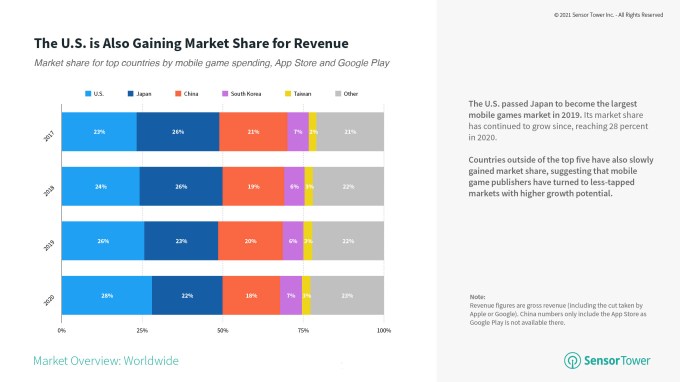
Image Credits: Sensor Tower

Health & Fitness

A thinly sourced report indicates Apple may be planning to sherlock MyFitnessPal in an upcoming version of iOS. Reportedly, iOS 15’s Health app may include a food tracking feature that would allow users to log food items they consume to get nutritional details and calorie tracking data.

Productivity + Utilities

Navigation app Waze gets a new CEO. The company named former Hotwire president and Carvana board member Neha Parikh as its CEO, replacing Noam Bardin, who stepped down in April after 12 years at Google.

Reading

Amazon rolled out a new feature in India that allows consumers to read magazine articles inside its shopping app. The quietly launched “Featured Articles” appeared on its shopping app and website, offering feature articles, commentary and analysis on a wide range of topics, including politics, governance, entertainment, sports, business, finance, health, fitness, books and food.

Government & Policy

The Cyberspace Administration of China (CAC) ordered 105 apps to stop improperly collecting and using people’s personal data. Among the apps listed are Microsoft’s LinkedIn and Bing, Chinese TikTok Douyin, video sharing app Kuaishou, music streaming service Kugou and apps from local search engines Sogou and Baidu.

Funding and M&A

? RevenueCat raised $40 million in Series B funding for its in-app subscription platform. The funding was led by Y Combinator’s Continuity Fund and values the startup at $300 million. The company has more than 6,000 apps live on its platform, with over $1 billion in subscription revenue being managed by its tools. That’s double the number of apps that were using its service as of last August.

? Newly launched Poparazzi app raised $20 million in new funding from Benchmark shortly after its app shot to the top of the App Store. The company behind the app, TTYL, is also backed by Floodgate, Dream Machine, Shrug Capital and Weekend Fund.

? Yalo raised $50 million to build c-commerce services for chat apps. The company offers a suite of tools that allow businesses to better use WhatsApp to interact and sell to their customers. The Series C round was led by B Capital. Yalo counts Unilever, Nestlé, Coca-Cola and Walmart among its customers.

? Indian Twitter rival Koo raised $30 million in a new round led by Tiger Global Management, valuing the startup at over $100 million. The app was launched last year and has fewer than 6.5 million MAUs.

? Weight-loss app Noom raised $540 million in Series F funding in a round led by Silver Lake. The app, which has 45 million global installs, saw increased demand during the pandemic, generating $400 million in revenues in 2020.

? Whatnot raised $50 million to let people sell Pokémon cards, Funko Pops and more via livestreams. The Series B was led by Anu Hariharan of Y Combinator Continuity fund, and backed by Andreessen Horowitz, Animal Capital and a number of angels.

? Bad Robot Games, raised more than $40 million in Series B funding to create cross-platform video games. The studio leverages its connection to Bad Robot’s film, animation and TV creative departments, but has not announced its first project or where and when it will be available.

? Mental health app Wysa raised $5.5 million in Series A funding from Boston’s W Health Ventures, the Google Assistant Investment Program, pi Ventures and Kae Capital. The app, which claims 3 million users, leverages AI to converse with users, categorize statements and assign a type of therapy.

? Investing app Acorns filed to go public in a $2.2 billion SPAC deal. The company is merging with Pioneer Merger Corp., a public blank-check company. Acorns CEO Noah Kerner and “Pioneer’s sponsor” are each giving 10% of their equity to select customers. The entity will trade on the Nasdaq under the ticker symbol OAKS.

? Relationship care app Paired raised $3.6 million in seed funding led by Eka Ventures, after growing its user base to over 5,000 users in couples, who use the app for quizzes, tips from experts and relationship tracking.

? Penfold raised $8.5 million for its app that offers a full stack pension to its mobile customers. The round was led by Bridford Group, the Family Office of Jorg Mohaupt, allegedly the only Angel investor in Adyen.

? Greg, an app for plant lovers, raised $5.4 million in seed funding. The app uses machine learning to help people care for their plants by telling them when to water based on plant species, location, sun exposure and more.

This Week’s Downloads

Cardhop

Image Credits: Flexibits

Flexibits, the company behind the popular productivity app Fantastical, updated its contacts management app Cardhop for Mac and iOS. This second major update to Cardhop brings several new features, including business card scanning, iOS widgets for your favorite Cardhop actions, organizational charts and family trees, and improved integrations with Fantastical. For example, you can now create an event with everyone in a Cardhop group. The updated app and premium version of Fantastical is being bundled in a single Flexibits Premium subscription ($4.99/mo or $39.99/yr), but a free version with fewer features is also available.

Hoptale

Image Credits: Hoptale

Recently launched from public beta, Hoptale is ready to kick off the post-Covid summer travel season with its travel journal and discovery app. The startup uses smart technology to organize trip plans and your photos, and users metadata to create trips as well as “hops” within your trips — meaning the individual stops you made during trips at different locations. This creates a travel journal of sorts where you itinerary, points of interest, map and, optionally, your own commentary are organized for you.

You can also share trips publicly with the Hoptale community or privately with friends and family. That could make it easier for sharing your favorite recommendations with someone who wants to know what to do and see from a place you’ve already visited. The beta version had hundreds of users who cataloged thousands of trips, and the app is now open to the wider public.

Poparazzi

Image Credits: Poparazzi

Well, you have to see what all the hype is about, right? The new social app for iOS and Android offers Instagram-like photo profiles with one big difference: you can’t post pictures yourself. Instead, the app only allows users to post photos to their friends’ profiles, arguing against the self-absorbed nature of today’s social media. After a lot of pre-launch hype on TikTok, the app shot to the top of the App Store at launch where it sits poised to be the viral trendy app of the post-COVID summer.

Reading Recommendations

Tweets

29 May 2021

6 investors and founders forecast hockey-stick growth for Edinburgh’s startup scene

Scotland is slowly but surely drawing attention in the UK’s startup space. In 2020, Scottish startups collectively raised £345 million, according to Tech Nation, and with nearly 2,500 startups, it has the highest number of budding tech companies outside London. Venture capital fundraises are also consistently on the rise every year.

Scotland’s capital Edinburgh boasts a beautiful, hilly landscape, a robust education system and good access to grant funding, public and private investment. It’s also one of the top financial centers in the U.K., making it a great place to begin a business.

So to find out what the startup scene in Edinburgh looks like, we spoke to six founders, executives and investors. The city’s tech ecosystem appears to have a robust space for machine learning, artificial intelligence, biomedicine, fintech, travel tech, oil, renewables, e-commerce, gaming, health tech, deep tech, space tech and insurtech.


Use discount code SCOTLANDSURVEY to save 25% off an annual or two-year Extra Crunch membership.
This offer is only available to readers in the UK Europe and expires on June 30, 2021.


However, the city’s tech scene is apparently lackluster when it comes to legal tech, blockchain and consumer-facing technology.

Breakout companies that were founded in Edinburgh include Skyscanner and FanDuel. Notable among the current crop are Desana, Continuum Industries, Parsley Box, Current Health, Boundary, Zumo, Appointedd, Criton, Mallzee, TravelNest, TVSquared, Care Sourcer, Stampede, For-Sight, Vistalworks, Reath, InfraCost, Speech Graphics and Cyan Forensics.

The Edinburgh business-angel community appears to be quite strong, but it seems local founders find it difficult to get London-based investors to take an interest. Scottish investors are said to be “pretty conservative and risk-adverse” with some notable exceptions.

We surveyed:


Wendy Lamin, managing director, Holoxica

Which sectors is your tech ecosystem strong in? What are you most excited by? What does it lack?
It’s strong in space, biomedicine, fintech/insurtech, AI.

What are the tech investors like in Edinburgh? What’s their focus?
The Scottish business-angel community is said to be the largest in Europe. It’s difficult to get London-based investors take an interest in Scotland — investors can tend to look at where companies are based. It is hard for “underrepresented founders” to get investments in Scotland and beyond.

With the shift to remote working, do you think people will stay in Edinburgh or will they move out? Will others move in?
Stay. Not always easy to get people to come and live in Scotland. Edinburgh, there are lots of prejudices, despite it being one of the best cities to live in in the whole of the U.K.

Who are the key startup people in the city (e.g., investors, founders, lawyers, designers)?
Good to see more focus on impact investing. Par Equity is one of Edinburgh’s biggest investors, whereas Archangels is one of the biggest angel investors. Poonam Malik is great for diversity and female entrepreneurs, and she is on the board of Scottish Enterprise, and is a social entrepreneur and investor. Garry Bernstein is also an investor — he leads the Scottish chapter of Tech London Advocates and Global Tech Advocates, and as such is the founder of Tech Scot Advocates.

Where do you think the city’s tech scene will be in five years?
Thriving. The government is doing its best for the tech sector. Education in tech is currently an issue, though. Hope Brexit won’t be too much of an issue.

Andrew Noble, partner, Par Equity

Which sectors is your tech ecosystem strong in? What are you most excited by? What does it lack?
Strong in fintech, health tech, data science, deep tech. Excited by quantum computing, advanced materials, AI in Edinburgh. Weak in blockchain and consumer.

Which are the most interesting startups in Edinburgh?
Current Health, InfraCost, Speech Graphics and Cyan Forensics.

What are the tech investors like in Edinburgh? What’s their focus?
Good at seed stage up to £1 million, okay for pre-series A (£1 million to £3 million) and non-existent for Series A (£3 million-£10 million). Quality of investors is improving. Par Equity is leading the way.

With the shift to remote working, do you think people will stay in Edinburgh, or will they move out? Will others move in?
Experiencing influx of new talent due to COVID-19. Edinburgh is a highly desirable city to live in. Recent new residents include Aaron Ross (Predictable Revenue) and Jules Pursuad (early employee at Airbnb and now VP at Omio).

Who are the key startup people in the city (e.g., investors, founders, lawyers, designers)?
Par Equity (investor), Paul Atkinson, Alistair Forbes, Mark Logan, Lesley Eccles, Chris McCann, CodeBase.

Where do you think the city’s tech scene will be in five years?
One to two new unicorns. Promising number of high-growth tech companies. A much more sophisticated investor scene in the Series A space.

Danae Shell, co-founder and CEO, Valla

Which sectors is your tech ecosystem strong in? What are you most excited by? What does it lack?
Edinburgh is strong in fintech because of our proximity to so many financial services companies and banks. Also, there are some exciting games tech companies because of our history of games companies. We’re pretty weak in law tech, Valla’s area.

Which are the most interesting startups in Edinburgh?
Vistalworks for consumer tech; Sustainably for fintech; Reath for sustainable tech.

What are the tech investors like in Edinburgh? What’s their focus?
As a rule, Scottish investors are pretty conservative and risk-averse. The only real exception is Techstart Ventures, in my experience.

With the shift to remote working, do you think people will stay in Edinburgh, or will they move out? Will others move in?
I think more people will come to Edinburgh from London because the quality of life and cost of living are both so much better here.

Who are the key startup people in the city (e.g., investors, founders, lawyers, designers)?
Calum Forsyth and Mark Hogarth at Techstart Ventures; Janine Matheson at CodeBase; Jackie Waring from the Investing Women angel syndicate; Jim Newbury is a very well-respected developer and coach, and my co-founder Kate Ho is also well known. Also Danny Helson who runs the EIE event with the Bayes Centre.

Where do you think the city’s tech scene will be in five years?
We’ve had a few exits in the past few years (Skyscanner, FreeAgent), which means that talent is spreading out across the ecosystem here and we’re getting some fantastic new startups kicking off. In five years, that first crop should be coming into the Series A stage so we could see a lot of super exciting businesses!

Allan Nelson, co-founder and CEO, For-Sight

Which sectors is your tech ecosystem strong in? What are you most excited by? What does it lack?
Strong in fintech, travel tech, health, oil, renewables, e-commerce, gaming (both video game and gambling tech). Excited by all bar oil (great driver of revenue, but not the future).

Which are the most interesting startups in Edinburgh?
Boundary, Parsley Box, Appointedd, Criton, Mallzee, TravelNest, TVSquared, Care Sourcer, Stampede, For-Sight.

What are the tech investors like in Edinburgh? What’s their focus?
Big fintech scene here. Travel tech is growing too, with Skyscanner’s influence strong.

With the shift to remote working, do you think people will stay in Edinburgh, or will they move out? Will others move in?
Most will stay, as it’s a very attractive city to live and work in. It’s a globally recognized and unique city. Very international flavor as evidenced by the makeup of our team.

Who are the key startup people in the city (e.g., investors, founders, lawyers, designers)?
Ex-Skyscanner people including Gareth Williams, Mark Logan, etc. Ian Ritchie, Alistair Forbes, the FanDuel’s founders and the CodeBase founders.

Where do you think the city’s tech scene will be in five years?
A lot bigger, as tech is a key growth target of the Scottish government and is underpinned/influenced/inspired by Skyscanner and FanDuel.

Lysimachos Zografos, founder, Parkure

Which sectors is your tech ecosystem strong in? What are you most excited by? What does it lack?
Strong in machine learning/AI/digital. Weak in deep tech discovery, especially in biotech/therapeutics. Excited by the rise in adoption of AI in drug discovery — all these ideas that were sci-fi 20 years ago are now adopted in £B deals.

Which are the most interesting startups in Edinburgh?
Pheno Therapeutics.

What are the tech investors like in Edinburgh? What’s their focus?
Conservative angels and a few tech seed VCs.

With the shift to remote working, do you think people will stay in Edinburgh, or will they move out? Will others move in?
Move in.

Who are the key startup people in the city (e.g., investors, founders, lawyers, designers)?
Investors: Archangels, Techstart Ventures and Epidarex.

Where do you think the city’s tech scene will be in five years?
Growing.

Bertie Wilson, co-founder, “Stealth mode”

Which sectors is your tech ecosystem strong in? What are you most excited by? What does it lack?
I don’t think there are any sectors that stand out — it’s fairly evenly split. A good strength of the city is the talent that comes from the universities. There are some really good engineers that come from Edinburgh, Heriot Watt and Edinburgh Napier. The main weakness is that the ecosystem doesn’t favor the most ambitious founders. Most investors in the region are angels and aren’t interested in finding outliers that could grow 1000x and are more interested in backing companies that are less risky but might 5x their money. If you want to find investors that will back risky (but very ambitious) plans, it’s easier to find that elsewhere.

Which are the most interesting startups in Edinburgh?
Desana, Continuum Industries, Parsley Box, Current Health, Boundary, Zumo.

What are the tech investors like in Edinburgh? What’s their focus?
I would say it’s getting better, but there are still a lot of issues with the ecosystem. It is being helped in Scotland by the likes of Techstart investing at the earliest stages with high conviction and term sheets that are more similar to London VCs. Outside of this, though, it’s easy for founders to end up with a messy cap table due to the number of angels and lack of VCs looking for VC-type returns — the messiness of these cap tables can then make it hard to raise venture funding down the line. This is fine for a lot of companies that aren’t aiming for a venture-scale return (which admittedly is a lot), but it can hurt those that are.

With the shift to remote working, do you think people will stay in Edinburgh, or will they move out? Will others move in?
I imagine and hope others will move in. It is a great place to live with a very high quality of life, and this should be a natural attraction for people who want a good standard of living but want to remain in a city.

Who are the key startup people in the city (e.g., investors, founders, lawyers, designers)?
SEP (investor), Techstart Ventures (investor), Gareth Williams (founder/investor), MBM Commercial (lawyers), Pentech, Bill Dobbie (investor), Jamie Coleman.

Where do you think the city’s tech scene will be in five years?
Optimistically, I hope that there will be a good number of companies that are at the Series B/Series C stage, which will invite a lot more interest from investors outside of Edinburgh (London, Berlin, Paris, New York, San Francisco, etc.) to start investing more actively in the city at the earliest stages as well as these stages.

29 May 2021

Alibaba is making its cloud OS compatible with multiple chip architectures

Alibaba’s cloud computing unit is making its Apsara operating system compatible with processors based on Arm, x86, RISC-V, among other architectures, the company announced at a conference on Friday.

Alibaba Cloud is one of the fastest-growing businesses for the Chinese e-commerce giant and the world’s fourth-largest public cloud service in the second half of 2020, according to market research firm IDC.

The global chip market has mostly been dominated by Intel’s x86 in personal computing and Arm for mobile devices. But RISC-V, an open-source chip architecture competitive with Arm’s technologies, is gaining popularity around the world, especially with Chinese developers. Started by academics at the University of California, Berkeley, RISC-V is open to all to use without licensing or patent fees and is generally not subject to America’s export controls.

The Trump Administration’s bans on Huawei and its rival ZTE over national security concerns have effectively severed ties between the Chinese telecom titans and American tech companies, including major semiconductor suppliers.

Arm was forced to decide its relationships with Huawei and said it could continue licensing to the Chinese firm as it’s of U.K. origin. But Huawei still struggles to find fabs that are both capable and allowed to actually manufacture the chips designed using the architecture.

The U.S. sanctions led to a burst in activity around RISC-V in China’s tech industry as developers prepare for future tech restrictions by the U.S., with Alibaba at the forefront of the movement. Alibaba Cloud, Huawei and ZTE are among the 13 premier members of RISC-V International, which means they get a seat on its Board of Directors and Technical Steering Community.

In 2019, the e-commerce company’s semiconductor division T-Head launched its first core processor Xuantie 910, which is based on RISC-V and used for cloud edge and IoT applications. Having its operating system work with multiple chip systems instead of one mainstream architecture could prepare Alibaba Cloud well for a future of chip independence in China.

“The IT ecosystem was traditionally defined by chips, but cloud computing fundamentally changed that,” Zhang Jianfeng, president of Alibaba Cloud’s Intelligence group, said at the event. “A cloud operating system can standardize the computing power of server chips, special-purpose chips and other hardware, so whether the chip is based on x86, Arm, RISC-V or a hardware accelerator, the cloud computing offerings for customers are standardized and of high-quality.”

Meanwhile, some argue that Chinese companies moving towards alternatives like RISC-V means more polarization of technology and standards, which is not ideal for global collaboration unless RISC-V becomes widely adopted in the rest of the world.

28 May 2021

GM, Palantir-backed Wejo to go public via SPAC

Wejo, the connected vehicle data startup backed by GM and Palantir, plans to go public through a merger with special purpose acquisition company Virtuoso Acquisition Corp. The agreement, announced in a regulator filing Friday, will give the combined company an enterprise valuation of $800 million, which includes debt.

The deal raises $330 million in proceeds for Wejo, including a $230 million cash contribution from Virtuoso and a $100 million in private investment in public equity, or PIPE. Previous strategic investors Palantir and GM anchored the transaction, according to Wejo. The company did not disclose the amounts of those investments. Current shareholders will retain 64% ownership of the company, according to its investor deck.

Once the transaction closes, which is expected to occur in the third quarter, Wejo will be listed on the Nasdaq public exchange.

Wejo works with automakers and tier 1 suppliers to collect data in real-time from sensors integrated in vehicles. The company’s cloud platform aggregates and normalizes data, and then shares those insights customers. By 2030, Wejo estimates a connected vehicle data market of $500 billion and a serviceable addressable market of $61 billion driven by projections of more than 600 million connected vehicles worldwide.

Wejo said the cash proceeds will fully  from the transaction will fully fund its five-year plan and help it achieve several growth goals such as onboarding automakers and other OEMs more quickly, continuing to rollout services and expanding into new markets.

28 May 2021

3 views on the future of meetings

More than a year into the coronavirus pandemic, early-stage startups across the world are re-inventing how we work. But founders aren’t flocking to build just another SaaS tool or Airtable copycat — they’re trying to disrupt the only thing possibly more annoying than e-mail: the work meeting.

On an episode of this week’s podcast, Equity hosts Alex Wilhelm, Danny Crichton and Natasha Mascarenhas discussed a flurry of funding rounds related to the future of work.

Rewatch, which makes meetings asynchronous, raised $20 million from Andreessen Horowitz, AnyClip got $47 million in a round led by JVP for video search and analytics technology, Interactio, a remote interpretation platform, landed $30 million from Eight Roads Ventures and Silicon Valley-based Storm Ventures, and Spot Meetings got Kleiner Perkins on board in a $5 million seed.

We connected the dots between these funding rounds to sketch out three perspectives on the future of workplace meetings. Part of our reasoning was the uptick of investment as mentioned above, and the other is that our calendars are full of them. We all agree that the traditional meeting is broken, so below you’ll find each of our arguments on where they go next and what we’d like to see.

  • Alex Wilhelm: Faster information throughput, please
  • Natasha Mascarenhas: Meetings should be ongoing, not in calendar invites
  • Danny Crichton: Redesign meetings for flow

Alex Wilhelm: Faster information throughput, please

I’ve worked for companies that were in love with meetings, and for companies where meetings were more infrequent. I prefer the latter by a wide margin. I’ve also worked in offices full-time, half-time and fully remote. I immensely prefer the final option.

Why? Work meetings are often a waste of time. Mostly you don’t need to align, most folks taking part are superfluous and as accidental team-building exercises they are incredibly expensive in terms of human-hours.

I am not into wasting time. The more remote I’ve been and the less time I’ve spent in less-formal meetings — the usual chit-chat that pollutes productive work time, making the days longer and less useful — the more I’ve managed to get done.

But I’ve been the lucky one, frankly. Most folks were still trapped in offices up until the pandemic shook up the world of work, finally giving more companies a shot at a whole-cloth rebuild of how they toil.

The good news is that CEOs are taking note. Chatting with Sprout Social CEO Justyn Howard this week, he explained how we have a unique, new chance to not live near where we work in 2021, but to instead bring work to where we live. He’s also an introvert, which meant that as a pair we’ve found a number of positives in some of the changes to how tech and media companies operate. Perhaps we’re a little biased.

A number of startups are rushing to fill the gap between the new expectations that Howard noted and our old digital and IRL realities.

Tandem.chat might be one such company. The former Y Combinator launch-day darling has spent its post-halo period building. Its CEO sent me a manifesto of sorts the other day, discussing how his company approaches the future of work meetings. Tandem is building for a world where communication needs to be both real-time and internal; it leaves asynchronous internal communication to Slack, real-time external communications to Zoom and asynchronous external chats to email. I agree, I think.

28 May 2021

Daily Crunch: Tesla switches on camera-based driver monitoring for Autopilot users

To get a roundup of TechCrunch’s biggest and most important stories delivered to your inbox every day at 3 p.m. PDT, subscribe here.

Welcome to the Daily Crunch for May 28, the last edition before a long weekend here in the United States. But impending holiday or not, there’s plenty to catch up on, not the least of which today is Elon Watch in our top-three rundown. Let’s get into it! — Alex

The TechCrunch Top 3

Startups and VC

Let’s wrap this week with startups that are challenging the status quo, shall we?

Penfold just raised $8.5 million to keep pensions alive: In your part of the world the pension may be dead, but Penfold wants to keep the retirement plan alive in the U.K. With a mobile app. Sure, your company has probably given up on the idea that it should materially provide for workers’ post-work existence, but Penfold is betting that its freelancer-friendly pension system will find purchase in its market.

Kitt put together a $5 million round to build out your next office: Parts of the world are slowly circling back to the idea of going to the office. Kitt wants to take advantage of the trend by “a ‘fully customizable’ workspace solution to tenants via its landlord partners,” TechCrunch reports. Everyone seems to agree that post-COVID office life will look different. Here’s a startup trying to help design that future.

Anthropic pulls together $124 million to make AI more steerable: Some of the folks behind GPT-3 have a pile of new money for their AI-focused startup. But unlike most AI-centered startups, the company appears to be working on model tuning over building something to, say, do one particularly focused task.

“Today [in AI] the general rule is: The more powerful the system, the harder it is to explain its actions,” Devin reports, adding that that’s “not exactly a good trend.” Perhaps Anthropic can build the AI tuning dials we’ve long needed. It certainly now has the money to pursue its vision.

Dismantling the myths around raising your first check

The growing complexity of fundraising has the opportunity to make tech either inclusive or exclusive. For new founders looking to raise money, let’s dismantle the myths about raising your first check and instead focus on how investors and other successful founders describe the nuance needed to secure money.

Natasha Mascarenhas spoke to Elizabeth Yin, founding partner of Hustle Fund, and Leslie Feinzaig, founder of Female Founders Collective, to get their candid thoughts about the challenges first-time founders face when fundraising.

According to Yin, all startups should be able to reach one of two goals: by the fifth year, achieve $100 million ARR or a $1 billion valuation.

“This is hard to do,” she said. “And most businesses will never get there — not for a lack of trying — but there’s a lot of luck whether your idea has that much demand that quickly.”

(Extra Crunch is our membership program, which helps founders and startup teams get ahead. You can sign up here.)

Big Tech Inc.

Closing this week with a mote of Big Tech news, once again centered around the rising tension between technology companies and the Indian government. Our own Manish Singh reports that “Google, Facebook, Telegram, LinkedIn and Tiger Global-backed Indian startups ShareChat and Koo have either fully or partially complied with the South Asian nation’s new IT rules, according to two people familiar with the matter and a government note obtained by TechCrunch.”

Singh goes on to note that “Twitter has yet to comply with the rules.” We saw earlier this week how Twitter is pushing back against the Indian government after it tried to use force to intimidate the American social network into going against its own policies in defense of its party’s political goals.

American social networks born in an environment where they had plenty of room to experiment and maneuver have a history of running afoul of foreign governments with either rising autocratic tendencies or a fondness for full-blown control. This is no exception. The question is whether Twitter will wind up a cautionary tale in its argument with the Indian government, or a guiding light.

TechCrunch Experts: Email Marketing

Intellect illustration

Image Credits: Getty Images

We’re thrilled with the responses to our survey about the top email marketers. It’s not too late to weigh in: Fill out the survey here.

If you’re a growth marketer, pass the survey on to your clients — we’d love to hear from them!

To find out more details about this project and how we plan to use it to shape our editorial coverage, visit techcrunch.com/experts.

28 May 2021

Once a buzzword, digital transformation is reshaping markets

The notion of digital transformation evolved from a buzzword joke to a critical and accelerating fact during the COVID-19 pandemic. The changes wrought by a global shift to remote work and schooling are myriad, but in the business realm they have yielded a change in corporate behavior and consumer expectation — changes that showed up in a bushel of earnings reports this week.

TechCrunch may tend to have a private-company focus, but we do keep tabs on public companies in the tech world as they often provide hints, notes and other pointers on how startups may be faring. In this case, however, we’re working in reverse; startups have told us for several quarters now that their markets are picking up momentum as customers shake up their buying behavior with a distinct advantage for companies helping customers move into the digital realm. And public company results are now confirming the startups’ perspective.

The accelerating digital transformation is real, and we have the data to support the point.

What follows is a digest of notes concerning the recent earnings results from Box, Sprout Social, Yext, Snowflake and Salesforce. We’ll approach each in micro to save time, but as always there’s more digging to be done if you have time. Let’s go!

Enterprise earnings go up

Kicking off with Yext, the company beat expectations in its most recent quarter. Today its shares are up 18%. And a call with the company’s CEO Howard Lerman underscored our general thesis regarding the digital transformation’s acceleration.

In brief, Yext’s evolution from a company that plugged corporate information into external search engines to building and selling search tech itself has been resonating in the market. Why? Lerman explained that consumers more and more expect digital service in response to their questions — “who wants to call a 1-800 number,” he asked rhetorically — which is forcing companies to rethink the way they handle customer inquiries.

In turn, those companies are looking to companies like Yext that offer technology to better answer customer queries in a digital format. It’s customer-friendly, and could save companies money as call centers are expensive. A change in behavior accelerated by the pandemic is forcing companies to adapt, driving their purchase of more digital technologies like this.

It’s proof that a transformation doesn’t have to be dramatic to have pretty strong impacts on how corporations buy and sell online.

28 May 2021

Extra Crunch roundup: first-check myths, Miami relocation checklist, standout SaaSy startups

This may seem like a great time to launch a SaaS startup, but the landscape is crowded with well-designed applications that promise “blazingly fast and delightfully simple” experiences, according to seed-stage investor John Chen of Fika Ventures.

Most SaaS startups will fail, but not because of a sour marketing campaign or server downtime. The majority of these companies will fall victim to what Chen calls “the myth of frictionless onboarding.”

Despite the hype about ease of use, enterprise companies always ask customers to abandon familiar tools so they can learn something new.

“Just like with a new fitness program, participants feel good after completing the workout, but it takes a lot of activation energy to start and hard work to get there,” Chen notes.


Full Extra Crunch articles are only available to members
Use discount code ECFriday to save 20% off a one- or two-year subscription


Instead of putting the onus on customers to roll up their sleeves, he suggests that SaaS startups learn from cryptocurrency culture and find ways to “incentivize users to do the necessary work to have the right experience.”

But how do you encourage users to put in the time and effort required to produce an optimal customer experience?

“In a world where there is a surplus of alternatives for every job to be done, the scarce resource is not content, tooling, or hacks and tricks,” says Chen. “It’s attention.”

We’re off on Monday, May 31 in observance of Memorial Day; I hope you have a relaxing weekend!

Walter Thompson
Senior Editor, TechCrunch
@yourprotagonist

Dismantling the myths around raising your first check

Full length side view of young woman carrying large pink block against white background

Image Credits: Klaus Vedfelt (opens in a new window) / Getty Images

As startups and venture capital grow in tandem, fundraising has gone from a formal affair on Sand Hill Road to a process that can happen anywhere from Twitter to Zoom.

While fundraising may no longer require a trip to California, it might depend on whether you got an invite to a private audio app. And while you may not need to be an insider, second-time founders — largely male and white — still have a competitive advantage.

The growing complexity of fundraising has the opportunity to make tech either inclusive or exclusive.

VC is the flashy gold medal, but the rapid growth of emerging fund managers means that a first check can be piecemealed together from a variety of different sources. The options for financing are seemingly endless: syndicates, public crowdfunding, VC firms, accelerators, debt financing, rolling funds, and, for the profitable few, bootstrapping.

Doximity’s S-1 may explain why healthcare exits are heating up

Telehealth startup Doximity filed to go public earlier today. Notably, the company has not fundraised since 2014, a year in which it attracted just under $82 million at a valuation of $355 million, per PitchBook data.

How has it managed to not raise money for so long? By generating lots of cash and profit over the years. Healthtech communications, it turns out, can be a lucrative endeavor.

What Vimeo’s growth, profits and value tell us about the online video market

Image Credits: Avishek Das/SOPA Images/LightRocket via Getty Images

The spin-out of video platform Vimeo from IAC completed this week, and the smaller company is now trading as an independent entity under the ticker ‘VMEO’.

If you missed the news that the internet conglomerate was spinning out the video service, don’t feel bad; it slipped past many radars. But with the company now trading, our access to its historical results, and our minds still enthralled by YouTube’s recent financial performance for Alphabet, it’s worth taking a moment to digest the company’s health.

Flywire’s flotation suggests the IPO slowdown is behind us

The Flywire IPO is neat from a financial perspective and notable in that it’s a Boston exit as opposed to yet another New York or San Francisco-based flotation. It’s nice to see some other cities put points on the board.

But more than that, this IPO is a useful measuring stick for keeping tabs on the IPO market as a whole. This year and the last are shaping up to be key exit periods for startups and unicorns of all shapes and sizes; many a venture capital fund return rests on these public debuts.

Dear Sophie: Any unique immigration strategies for quick hiring?

lone figure at entrance to maze hedge that has an American flag at the center

Image Credits: Bryce Durbin/TechCrunch

Dear Sophie,

I do recruitment for tech startups. With a surge of VC investing, many startups are urgently hiring.

Which visas offer the quickest options for international talent? Are there any unique strategies that you would recommend we explore?

— Maverick in Milpitas

7 questions to ask before relocating your startup to Florida

a photo of an art deco style building in Miami with pastel gradient colors

Image Credits: Artur Debat (opens in a new window) / Getty Images

Cities like Miami, Pittsburgh and Austin have been drawing talent and wealth from Silicon Valley for years, but the COVID-19 pandemic accelerated the trend.

In recent months, many investors and entrepreneurs have noisily departed for Miami, citing the region’s favorable business climate and quality of life.

It’s always good to consider one’s options, but before booking a moving van for the Sunshine State — or any emerging tech hub, for that matter — here are some basic questions entrepreneurs should ask themselves.

Vise CEO Samir Vasavada and Sequoia’s Shaun Maguire break down the art of the pitch

Image Credits: Sequoia Capital / Wolfe + Von / TechCrunch

In just a few short years, Vise has gone from launching on the Disrupt Battlefield stage to a unicorn. Co-founders Samir Vasavada and Runik Mehrotra met Sequoia’s Shaun Maguire at an after-party at the event, and Maguire ended up leading a seed and Series A round while Sequoia led the Series B.

Last week, Vise raised its Series C of $65 million and was officially valued at $1 billion post-money.

We spoke to the pair about the early fundraising process for Vise, what Vasavada has learned about delivering a good fundraising pitch, and what stood out about the pitch and the product for Maguire.

Acorns’ SPAC listing depicts a consumer fintech business with a SaaSy revenue mix

Another day, another unicorn public offering.

On Thursday, it was Acorns, a consumer fintech service that blends saving and investing into a freemium product.

Acorns fits inside the larger savings-and-investing boom seen over the last four or five quarters as consumers buffeted by the economic changes brought on by COVID-19 turned to stashing cash and boosting their equities investing cadence.

By now this is old news, but we haven’t had a clear picture of the economics of consumer fintech startups accelerated by the pandemic. Now that Acorns has decided to list via a SPAC — more on that in a moment — we do.

Poor onboarding is the enemy of good hiring

Image of a person talking to two colleagues via videoconferencing.

Image Credits: Olga Strelnikova (opens in a new window) / Getty Images

The world of hybrid work is here, and the usual 10-minute intro call, swag bag and first-day team lunch are just not enough to make your new employee feel welcome.

While many companies have found a way to interview and select candidates in a fully remote environment, few have spent time and resources on aligning the “pre-boarding” and onboarding process for the new hybrid world of work. Many employers still rely on old ways of welcoming new hires, despite our totally changed work environment.

It’s important to capitalize on candidates’ enthusiasm and eagerness from the moment the offer is signed instead of when they log in on Day One, because first impressions can make or break a candidate’s chances of staying at a company.


28 May 2021

Extra Crunch roundup: first-check myths, Miami relocation checklist, standout SaaSy startups

This may seem like a great time to launch a SaaS startup, but the landscape is crowded with well-designed applications that promise “blazingly fast and delightfully simple” experiences, according to seed-stage investor John Chen of Fika Ventures.

Most SaaS startups will fail, but not because of a sour marketing campaign or server downtime. The majority of these companies will fall victim to what Chen calls “the myth of frictionless onboarding.”

Despite the hype about ease of use, enterprise companies always ask customers to abandon familiar tools so they can learn something new.

“Just like with a new fitness program, participants feel good after completing the workout, but it takes a lot of activation energy to start and hard work to get there,” Chen notes.


Full Extra Crunch articles are only available to members
Use discount code ECFriday to save 20% off a one- or two-year subscription


Instead of putting the onus on customers to roll up their sleeves, he suggests that SaaS startups learn from cryptocurrency culture and find ways to “incentivize users to do the necessary work to have the right experience.”

But how do you encourage users to put in the time and effort required to produce an optimal customer experience?

“In a world where there is a surplus of alternatives for every job to be done, the scarce resource is not content, tooling, or hacks and tricks,” says Chen. “It’s attention.”

We’re off on Monday, May 31 in observance of Memorial Day; I hope you have a relaxing weekend!

Walter Thompson
Senior Editor, TechCrunch
@yourprotagonist

Dismantling the myths around raising your first check

Full length side view of young woman carrying large pink block against white background

Image Credits: Klaus Vedfelt (opens in a new window) / Getty Images

As startups and venture capital grow in tandem, fundraising has gone from a formal affair on Sand Hill Road to a process that can happen anywhere from Twitter to Zoom.

While fundraising may no longer require a trip to California, it might depend on whether you got an invite to a private audio app. And while you may not need to be an insider, second-time founders — largely male and white — still have a competitive advantage.

The growing complexity of fundraising has the opportunity to make tech either inclusive or exclusive.

VC is the flashy gold medal, but the rapid growth of emerging fund managers means that a first check can be piecemealed together from a variety of different sources. The options for financing are seemingly endless: syndicates, public crowdfunding, VC firms, accelerators, debt financing, rolling funds, and, for the profitable few, bootstrapping.

Doximity’s S-1 may explain why healthcare exits are heating up

Telehealth startup Doximity filed to go public earlier today. Notably, the company has not fundraised since 2014, a year in which it attracted just under $82 million at a valuation of $355 million, per PitchBook data.

How has it managed to not raise money for so long? By generating lots of cash and profit over the years. Healthtech communications, it turns out, can be a lucrative endeavor.

What Vimeo’s growth, profits and value tell us about the online video market

Image Credits: Avishek Das/SOPA Images/LightRocket via Getty Images

The spin-out of video platform Vimeo from IAC completed this week, and the smaller company is now trading as an independent entity under the ticker ‘VMEO’.

If you missed the news that the internet conglomerate was spinning out the video service, don’t feel bad; it slipped past many radars. But with the company now trading, our access to its historical results, and our minds still enthralled by YouTube’s recent financial performance for Alphabet, it’s worth taking a moment to digest the company’s health.

Flywire’s flotation suggests the IPO slowdown is behind us

The Flywire IPO is neat from a financial perspective and notable in that it’s a Boston exit as opposed to yet another New York or San Francisco-based flotation. It’s nice to see some other cities put points on the board.

But more than that, this IPO is a useful measuring stick for keeping tabs on the IPO market as a whole. This year and the last are shaping up to be key exit periods for startups and unicorns of all shapes and sizes; many a venture capital fund return rests on these public debuts.

Dear Sophie: Any unique immigration strategies for quick hiring?

lone figure at entrance to maze hedge that has an American flag at the center

Image Credits: Bryce Durbin/TechCrunch

Dear Sophie,

I do recruitment for tech startups. With a surge of VC investing, many startups are urgently hiring.

Which visas offer the quickest options for international talent? Are there any unique strategies that you would recommend we explore?

— Maverick in Milpitas

7 questions to ask before relocating your startup to Florida

a photo of an art deco style building in Miami with pastel gradient colors

Image Credits: Artur Debat (opens in a new window) / Getty Images

Cities like Miami, Pittsburgh and Austin have been drawing talent and wealth from Silicon Valley for years, but the COVID-19 pandemic accelerated the trend.

In recent months, many investors and entrepreneurs have noisily departed for Miami, citing the region’s favorable business climate and quality of life.

It’s always good to consider one’s options, but before booking a moving van for the Sunshine State — or any emerging tech hub, for that matter — here are some basic questions entrepreneurs should ask themselves.

Vise CEO Samir Vasavada and Sequoia’s Shaun Maguire break down the art of the pitch

Image Credits: Sequoia Capital / Wolfe + Von / TechCrunch

In just a few short years, Vise has gone from launching on the Disrupt Battlefield stage to a unicorn. Co-founders Samir Vasavada and Runik Mehrotra met Sequoia’s Shaun Maguire at an after-party at the event, and Maguire ended up leading a seed and Series A round while Sequoia led the Series B.

Last week, Vise raised its Series C of $65 million and was officially valued at $1 billion post-money.

We spoke to the pair about the early fundraising process for Vise, what Vasavada has learned about delivering a good fundraising pitch, and what stood out about the pitch and the product for Maguire.

Acorns’ SPAC listing depicts a consumer fintech business with a SaaSy revenue mix

Another day, another unicorn public offering.

On Thursday, it was Acorns, a consumer fintech service that blends saving and investing into a freemium product.

Acorns fits inside the larger savings-and-investing boom seen over the last four or five quarters as consumers buffeted by the economic changes brought on by COVID-19 turned to stashing cash and boosting their equities investing cadence.

By now this is old news, but we haven’t had a clear picture of the economics of consumer fintech startups accelerated by the pandemic. Now that Acorns has decided to list via a SPAC — more on that in a moment — we do.

Poor onboarding is the enemy of good hiring

Image of a person talking to two colleagues via videoconferencing.

Image Credits: Olga Strelnikova (opens in a new window) / Getty Images

The world of hybrid work is here, and the usual 10-minute intro call, swag bag and first-day team lunch are just not enough to make your new employee feel welcome.

While many companies have found a way to interview and select candidates in a fully remote environment, few have spent time and resources on aligning the “pre-boarding” and onboarding process for the new hybrid world of work. Many employers still rely on old ways of welcoming new hires, despite our totally changed work environment.

It’s important to capitalize on candidates’ enthusiasm and eagerness from the moment the offer is signed instead of when they log in on Day One, because first impressions can make or break a candidate’s chances of staying at a company.


28 May 2021

Meet Justos, the new Brazilian insurtech that just got backing from the CEOs of 7 unicorns

Here in the U.S. the concept of using driver’s data to decide the cost of auto insurance premiums is not a new one.

But in markets like Brazil, the idea is still considered relatively novel. A new startup called Justos claims it will be the first Brazilian insurer to use drivers’ data to reward those who drive safely by offering “fairer” prices.

And now Justos has raised about $2.8 million in a seed round led by Kaszek, one of the largest and most active VC firms in Latin America. Big Bets also participated in the round along with the CEOs of seven unicorns including Assaf Wand, CEO and co-founder of Hippo Insurance; David Velez, founder and CEO of Nubank; Carlos Garcia, founder and CEO Kavak; Sergio Furio, founder and CEO of Creditas; Patrick Sigris, founder of iFood and Fritz Lanman, CEO of ClassPass. Senior executives from Robinhood, Stripe, Wise, Carta and Capital One also put money in the round.

Serial entrepreneurs Dhaval Chadha, Jorge Soto Moreno and Antonio Molins co-founded Justos, having most recently worked at various Silicon Valley-based companies including ClassPass, Netflix and Airbnb.

“While we have been friends for a while, it was a coincidence that all three of us were thinking about building something new in Latin America,” Chadha said. “We spent two months studying possible paths, talking to people and investors in the United States, Brazil and Mexico, until we came up with the idea of creating an insurance company that can modernize the sector, starting with auto insurance.”

Ultimately, the trio decided that the auto insurance market would be an ideal sector considering that in Brazil, an estimated more than 70% of cars are not insured. 

The process to get insurance in the country, by any accounts, is a slow one. It takes up to 72 hours to receive initial coverage and two weeks to receive the final insurance policy. Insurers also take their time in resolving claims related to car damages and loss due to accidents, the entrepreneurs say. They also charge that pricing is often not fair or transparent.

Justos aims to improve the whole auto insurance process in Brazil by measuring the way people drive to help price their insurance policies. Similar to Root here in the U.S., Justos intends to collect users’ data through their mobile phones so that it can “more accurately and assertively price different types of risk.” This way, the startup claims it can offer plans  that are up to 30% cheaper than traditional plans, and grant discounts each month, according to the driving patterns of the previous month of each customer. 

“We measure how safely people drive using the sensors on their cell phones,” Chadha said. “This allows us to offer cheaper insurance to users who drive well, thereby reducing biases that are inherent in the pricing models used by traditional insurance companies.”

Justos also plans to use artificial intelligence and computerized vision to analyze and process claims more quickly and machine learning for image analysis and to create bots that help accelerate claims processing. 

“We are building a design driven, mobile first and customer experience that aims to revolutionize insurance in Brazil, similar to what Nubank did with banking,” Chadha told TechCrunch. “We will be eliminating any hidden fees, a lot of the small text and insurance specific jargon that is very confusing for customers.”

Justos will offer its product directly to its customers as well as through distribution channels like banks and brokers.

“By going direct to consumer, we are able to acquire users cheaper than our competitors and give back the savings to our users in the form of cheaper prices,” Chadha said.

Customers will be able to buy insurance through Justos’ app, website, or even WhatsApp. For now, the company is only adding potential customers to a waitlist but plans to begin selling policies later this year..

During the pandemic, the auto insurance sector in Brazil declined by 1%, according to Chadha, who believes that indicates “there is latent demand rearing to go once things open up again.”

Justos has a social good component as well. Justos intends to cap its profits and give any leftover revenue back to nonprofit organizations.

The company also has an ambitious goal: to help make insurance become universally accessible around the world and the roads safer in general.

“People will face everyday risks with a greater sense of safety and adventure. Road accidents will reduce drastically as a result of incentives for safer driving, and the streets will be safer,” Chadha said. “People, rather than profits, will become the focus of the insurance industry.”

Justos plans to use its new capital to set up operations, such as forming partnerships with reinsurers and an insurance company for fronting, since it is starting as an MGA (managing general agent).

It’s also working on building out its products such as apps, its back end and internal operations tools as well as designing all its processes for underwriting, claims and finance. Justos’ data science team is also building out its own pricing model. 

The startup will be focused on Brazil, with plans to eventually expand within Latin America, then Iberia and Asia.

Kaszek’s Andy Young said his firm was impressed by the team’s previous experience and passion for what they’re building.

“It’s a huge space, ripe for innovation and this is the type of team that can take it to the next level,” Young told TechCrunch. “The team has taken an approach to building an insurance platform that blends being consumer centric and data driven to produce something that is not only cheaper and rewards safety but as the brand implies in Portuguese, is fairer.”