Year: 2021

27 May 2021

mmhmm, the video conferencing software, kicks off summer with a bunch of new features

mmhmm, the communications platform developed by Phil Libin and the All Turtles team, is getting a variety of new features. According to Libin, there are parts of communication today that can not only match what we get in the real world, but exceed it.

That’s how this next iteration of mmhmm is meant to deliver.

The new headline feature is mmhmm Chunky, which allows the presenter to break up their script and presentation into ‘chunks’. Think of the presenter the same way you think of slides in a deck. Each one gets the full edit treatment and final polish. With Chunky, mmhmm users can break up their presentation into chunks to perfect each individual bit of information.

A presenter can switch between live and pre-recorded chunks in a presentation. So you can imagine a salesman making a pitch and switching over to his explanation of the pricing as a pre-recorded piece of his pitch, or a teacher who has a pre-recorded chunk on a particular topic can throw to that mid-class.

But mmhmm didn’t just think about the creation side, but the consumption side. Folks in the audience can jump around between chunks and slides to catch up, or even view in a sped up mode to consume more quickly. Presenters can see where folks in the audience are as they present or later on.

Libin sees this feature as a way to supercharge time.

“At mmhmm, we stopped doing synchronous updates with our fully distributed team,” said Libin. “We don’t have meetings anymore where people take turns updating each other because it’s not very efficient. Now the team just sends around their quick presentations, and I can watch it in double speed because people can listen faster than people can talk. But we don’t have to do it at the same time. Then, when we actually talk synchronously, it’s reserved for that live back-and-forth about the important stuff.”

mmhmm is also announcing that it has developed its own video player, allowing folks to stream their mmhmm presentations to whatever website they’d like. As per usual, mmhmm will still work with Zoom, Google Meet, etc.

The new features list also includes an updated version of Copilot. For folks who remember, Copilot allowed one person to present and another person to ‘drive,’ or art direct, the presentation from the background. Copilot 2.0 lets two people essentially video chat side by side, in whatever environment they’d like.

Libin showed me a presentation/conversation he did with a friend where they were both framed up in Libin’s house. He clarified that this feature works best with one-on-one conversations, or, one-on-one conversations in front of a large audience, such as a fireside chat.

Alongside mmhmm Chunky, streaming, and Copilot 2.0, the platform is also doing a bit of spring cleaning with regards to organization. Users will have a Presentation Library where they can save and organize their best takes, and organizations can also use ‘Loaf’ to store all the best videos and presentations company wide for consumption later. The team also revamped Presets to make it easier to apply a preset to a bunch of slides at once or switch between presets more easily.

A couple other notes: mmhmm is working to bring the app to both iOS and Android very soon, and launch out of beta on Windows.

Libin explained that not every single feature described here will launch today, but rather you’ll see features trickle out each week as we head into summer. He’ll be giving a keynote on the new features here at 10am PT/1pm ET.

27 May 2021

Australian startup Pyn raises $8M seed to bring targeted communication in-house

Most marketers today know how to send targeted communications to customers, and there are many tools to help, but when it comes to sending personalized in-house messages, there aren’t nearly as many options. Pyn, an early stage startup based in Australia wants to change that, and today it announced an $8 million seed round.

Andreesen Horowitz led the investment with help from Accel and Ryan Sanders, the co-founder of BambooHR and Scott Farquar, co-founder and co-CEO at Atlassian.

That last one isn’t a coincidence as Pyn co-founder and CEO Joris Luijke used to run HR at the company and later at Squarespace and other companies, and he saw a common problem trying to provide more targeted messages when communicating internally.

“I’ve been trying to do this my entire professional life, trying to personalize the communication that we’re sending to our people. So that’s what Pyn does. In a nutshell, we radically personalize employee communications,” Luijke explained. His co-founder Jon Williams was previously a co-founder at Culture Amp, an employee experience management platform he helped launch in 2011 (and which raised over $150 million), so the two of them have been immersed in this idea.

They bring personalization to Pyn by tracking information in existing systems that companies already use such as Workday, BambooHR, Salesforce or Zendesk, and they can use this data much in the same way a marketer uses various types of information to send more personalized messages to customers.

That means you can cut down on the company-wide emails that might not be relevant to everyone and send messages that should matter more to the people receiving them. And as with a marketing communications tool, you can track how many people have opened the emails and how successful you were in hitting the mark.

David Ulevitch, general partner at a16z, and lead investor in this deal points out that Pyn also provides a library of customizable communications materials to help build culture and set policy across an organization.”It also treats employee communication channels as the rails upon which to orchestrate management practices across an organization [by delivering] a library of management playbooks,” Ulevitch wrote in a blog post announcing the investment.

The startup, which launched in 2019, currently has 10 employees with teams working in Australia and the Bay Area in California. Williams says that already half the team is female and the plan is to continue putting diversity front and center as they build the company.

“Joris has mentioned ‘radical personalization’ as this specific mantra that we have, and I think if you translate that into an organization, that is all about inclusion in reality, and if we want to be able to cater for all the specific needs of people, we need to understand them. So [diversity is essential] to us,” Williams said.

While the company isn’t ready to discuss specifics in terms of customer numbers, it cites Shopify, Rubrik and Carta as early customers, and the founders say that there was a lot of interest when the pandemic hit last year and the need for more frequent and meaningful types of communication became even more paramount.


27 May 2021

Acorns’ SPAC listing depicts a consumer fintech business with a SaaSy revenue mix

Another day, another unicorn public offering.

Today it’s Acorns, a consumer fintech service that blends saving and investing into a freemium product. It’s a company that TechCrunch has covered extensively since its birth, including through the pandemic’s impact on its business, both good and bad.


The Exchange explores startups, markets and money. 

Read it every morning on Extra Crunch or get The Exchange newsletter every Saturday.


Acorns fits inside the larger savings-and-investing boom seen over the last four or five quarters as consumers buffeted by the economic changes brought on by COVID-19 turned to stashing cash and boosting their equities investing cadence.

By now this is old news, but we haven’t had a clear picture of the economics of consumer fintech startups accelerated by the pandemic. Now that Acorns has decided to list via a SPAC — more on that in a moment — we do.

So this morning, we’re unpacking the Acorns deal and its investor deck, but we’re also trying to better understand why venture capitalists have poured so very much money into the space and the resulting economic picture that arises from the companies that they have funded. Acorns is our test subject, then.

We’ll start with a quick overview of its SPAC-led deal before getting into its results. Into the breach!

The Acorns SPAC deal

If your eyes are blurring as we review yet another SPAC transaction’s details, I get you. Let’s be brief. Here’s what you need to know:

  • Acorns is merging with Pioneer Merger Corp., a public blank-check company
  • Acorns CEO Noah Kerner and “Pioneer’s sponsor” are each giving 10% of their equity to select customers
  • When combined, the entity will trade on the Nasdaq under the ticker symbol OAKS

You know, the thing you plant acorns to grow. Har har.

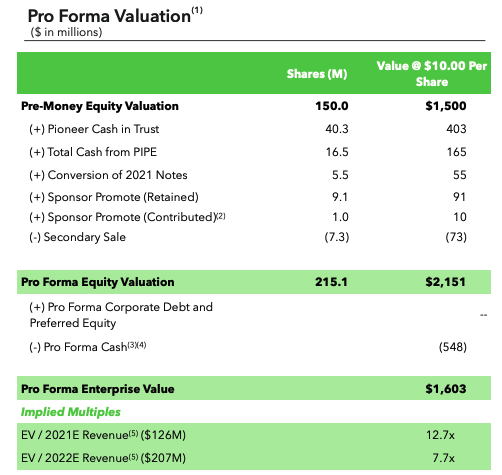
Here are the financial details of the transaction, via the company’s investor deck:

Image Credits: Acorns investor deck

27 May 2021

EU bodies’ use of US cloud services from AWS, Microsoft being probed by bloc’s privacy chief

Europe’s lead data protection regulator has opened two investigations into EU institutions’ use of cloud services from U.S. cloud giants, Amazon and Microsoft, under so called Cloud II contracts inked earlier between European bodies, institutions and agencies and AWS and Microsoft.

A separate investigation has also been opened into the European Commission’s use of Microsoft Office 365 to assess compliance with earlier recommendations, the European Data Protection Supervisor (EDPS) said today.

Wojciech Wiewiórowski is probing the EU’s use of U.S. cloud services as part of a wider compliance strategy announced last October following a landmark ruling by the Court of Justice (CJEU) — aka, Schrems II — which struck down the EU-US Privacy Shield data transfer agreement and cast doubt upon the viability of alternative data transfer mechanisms in cases where EU users’ personal data is flowing to third countries where it may be at risk from mass surveillance regimes.

In October, the EU’s chief privacy regulator asked the bloc’s institutions to report on their transfers of personal data to non-EU countries. This analysis confirmed that data is flowing to third countries, the EDPS said today. And that it’s flowing to the U.S. in particular — on account of EU bodies’ reliance on large cloud service providers (many of which are U.S.-based).

That’s hardly a surprise. But the next step could be very interesting as the EDPS wants to determine whether those historical contracts (which were signed before the Schrems II ruling) align with the CJEU judgement or not.

Indeed, the EDPS warned today that they may not — which could thus require EU bodies to find alternative cloud service providers in the future (most likely ones located within the EU, to avoid any legal uncertainty). So this investigation could be the start of a regulator-induced migration in the EU away from U.S. cloud giants.

Commenting in a statement, Wiewiórowski said: “Following the outcome of the reporting exercise by the EU institutions and bodies, we identified certain types of contracts that require particular attention and this is why we have decided to launch these two investigations. I am aware that the ‘Cloud II contracts’ were signed in early 2020 before the ‘Schrems II’ judgement and that both Amazon and Microsoft have announced new measures with the aim to align themselves with the judgement. Nevertheless, these announced measures may not be sufficient to ensure full compliance with EU data protection law and hence the need to investigate this properly.”

Amazon and Microsoft have been contacted with questions regarding any special measures they have applied to these Cloud II contracts with EU bodies.

The EDPS said it wants EU institutions to lead by example. And that looks important given how, despite a public warning from the European Data Protection Board (EDPB) last year — saying there would be no regulatory grace period for implementing the implications of the Schrems II judgement — there hasn’t been any major data transfer fireworks yet.

The most likely reason for that is a fair amount of head-in-the-sand reaction and/or superficial tweaks made to contracts in the hopes of meeting the legal bar (but which haven’t yet been tested by regulatory scrutiny).

Final guidance from the EDPB is also still pending, although the Board put out detailed advice last fall.

The CJEU ruling made it plain that EU law in this area cannot simply be ignored. So as the bloc’s data regulators start scrutinizing contracts that are taking data out of the EU some of these arrangement are, inevitably, going to be found wanting — and their associated data flows ordered to stop.

To wit: A long-running complaint against Facebook’s EU-US data transfers — filed by the eponymous Max Schrems, a long-time EU privacy campaigners and lawyer, all the way back in 2013 — is slowing winding toward just such a possibility.

Last fall, following the Schrems II ruling, the Irish regulator gave Facebook a preliminary order to stop moving Europeans’ data over the pond. Facebook sought to challenge that in the Irish courts but lost its attempt to block the proceeding earlier this month. So it could now face a suspension order within months.

How Facebook might respond is anyone’s guess but Schrems suggested to TechCrunch last summer that the company will ultimately need to federate its service, storing EU users’ data inside the EU.

The Schrems II ruling does generally look like it will be good news for EU-based cloud service providers which can position themselves to solve the legal uncertainty issue (even if they aren’t as competitively priced and/or scalable as the dominant US-based cloud giants).

Fixing U.S. surveillance law, meanwhile — so that it gets independent oversight and accessible redress mechanisms for non-citizens in order to no longer be considered a threat to EU people’s data, as the CJEU judges have repeatedly found — is certainly likely to take a lot longer than ‘months’. If indeed the US authorities can ever be convinced of the need to reform their approach.

Still, if EU regulators finally start taking action on Schrems II — by ordering high profile EU-US data transfers to stop — that might help concentrate US policymakers’ minds toward surveillance reform. Otherwise local storage may be the new future normal.

27 May 2021

Greg, an app for plant-lovers, grows $5.4 million in seed funding

Before the pandemic rendered us homebound, the houseplant industry was already in bloom. One year sequestered in our homes later, and our living spaces have flourished into our personal indoor gardens. 

An app that uses machine learning to help people care for their plants, Greg announced today that it has received $5.4 million in seed funding. This round is led by Index with participation from First Round Capital. Greg is also backed by a team of expert angels and advisors, including Elie Seidman (previous CEO of Tinder), Eliza Blank (founder of The Sill, a plant delivery service), and Darryl Cheng (a “plant-stagrammer” with 600k followers). Currently, Greg’s remote team has 11 members and plans to hire a Head of Brand and at least five more engineers, including a Senior Android Engineer (so far, the app is only available on iOS). 

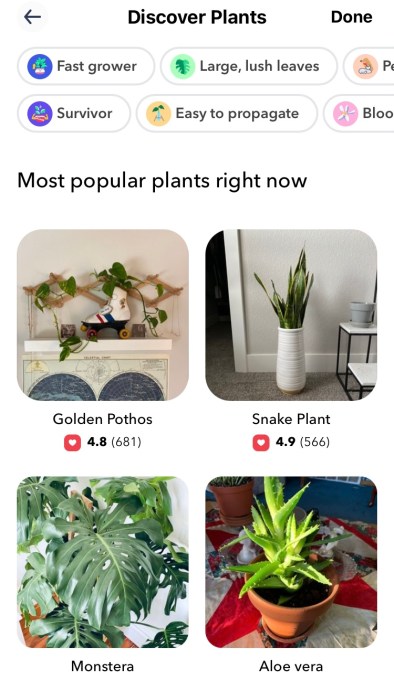
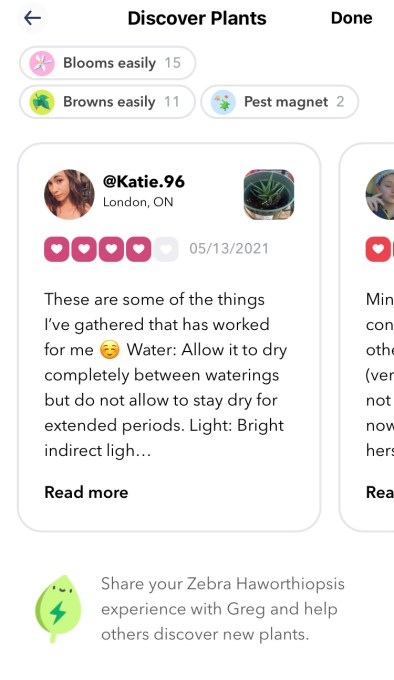
Primarily, Greg works by telling people when to water their plants – that’s not something you can just set a weekly reminder for, since every plant is a bit different. Greg’s recommendations are tailored to each plant’s species, geographic location, sun exposure, and proximity to a window. This makes it easy for anyone to keep their greenery thriving in any circumstance. There’s also a discover feed built into the app, where users can share photos of their plants, which have names like “Keanu Leaves” and “Michelle Branch.”

For CEO, co-founder, and engineer Alex Ross, plant care is more than just a pandemic hobby. Gregarious, Inc. – the company behind Greg – was founded as a public benefit corporation. In a legally-binding public statement, the team promises to produce a positive effect (“or a reduction of negative effects” – that’s where we’re at with climate change) within Earth’s ecosystems. The company’s charter outlines three goals: developing original technology and research to deepen our understanding of plant life; acting as stewards of the planet’s health; and creating opportunities for all forms of life to thrive. 

“Plants are a really great vehicle for understanding how the planet works,” said Ross. “That’s one of our core reasons for starting Greg. We believe that more people need to understand how ecosystems work, how plants work, and how our food system works in order for us to make better decisions as a society in the next 10 or 20 years.”

This isn’t Ross’s first experience with mission-driven entrepreneurship. As a Director of Engineering at Tinder, he created the Trust & Safety team, which is responsible for keeping the dating app’s users safe from abuse. There, he saw the potential for consumer mobile apps to build an audience. 

“Tinder was actually on the leading edge of trust and safety products,” said Ross. “I wanted to work on the part of Tinder that had a clear public benefit. Now [with Greg], the public benefit is the point.”

Since its public launch on the app store in October 2020, Greg has sprouted 50,000 monthly active users. These green thumbs have added 350,000 plants across 4,000 different species, which they’ve interacted with over 2 million times. The app’s methodology is based on the UN Food & Agriculture Organization’s algorithm for estimating crop water use. Every interaction helps Greg’s AI get smarter – whether that’s taking photos, watering a plant, or even snoozing watering recommendations. The more data that Greg’s AI interprets, the more it learns about the most effective and efficient ways to grow plants.

“We hope within a number of years to be contributing back to that UN Food & Agriculture Organization algorithm to make it easier for farmers in developing countries to be able to take that algorithm and grow higher yield produce for their food systems,” said Ross. “That’s why we started as a public benefit corporation.”

Ross says that the biggest challenge facing Greg is that people don’t know about it yet. So, the app partnered with plant retailers like House Plant Shop and American Plant Exchange to share promotion codes for its subscription tier, Super Greg. Subscribers pay $6.50 per month, $2.50 per month annually, or $49.99 for lifetime access, which allows them to add unlimited plants to Greg – the free version only lets you add five plants, which may not be sufficient for the budding botanists among us. 

“That’s been a great source of user acquisition,” Ross says. Once on the app, they can better understand the fickle ecosystems of their plants. “We think Greg can play a role in onboarding people. Coinbase onboards people into crypto, Greg onboards people into plants.”

Ross also compared Greg’s model to an app like Waze – as more users report traffic patterns, the app can increasingly benefit other drivers in their area. In the same vein, as Greg learns more about plant maintenance, the company can use that data to fulfill its eco-friendly mission. The company hopes to eventually build an “extremely scaled out platform” that understands more about how plants work than any existing technology.

In the meantime, Greg is benefitting its users on a smaller scale, especially as many parts of the world remain in lockdown. 

“I do believe plants are almost objectively good for mental wellness,” Ross said. “I’ve never seen somebody go from having plants to not having plants.” 

27 May 2021

Airspace Link raises $10m to make drones safer for both operators and communities

Airspace Link is today announcing it raised a $10 million Series A from Altos Ventures, Thales, and others. The Detroit, Michigan-based startup anticipates using the additional funds to expand its domestic offering and expand overseas.

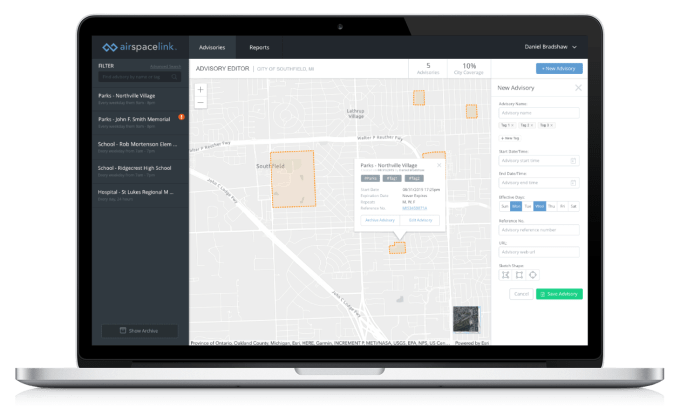
CEO Michael Healander explains to TechCrunch that the company sees airspaces as digital infrastructure lacking critical regulations. “Today you have rules and regulations on the road,” he says, explaining that the company is building digital roads and management for drones. Airspace Link’s novel platform addresses drone operators’ and communities’ concerns, enabling pilots to safely fly while complying with local airspace restrictions.

Airspace Link’s AirHub™ is the first cloud-based drone platform focused exclusively on merging the needs of state & local government with the operational planning tools pilots already use.

Airspace Links offers drone operation planning tools, including API access that allows developers to incorporate Airspace Link’s data into third-party platforms. The company’s system complies with the FAA’s Low Altitude Authorization and Notification Capability (LAANC), enabling drone pilots to submit operations while flying in controlled airspace. The company is one of seven FAA-approved companies to provide this service.

With the Series A funding, Healander says the goal is to integrate with as many transportation groups as possible.

Founded in 2018 by Michael Healander, Daniel Bradshaw, and Ana Healander, the Detroit-based startup employs 20 full-time staff. The company says in a press release that it has partnerships with over 40 government agencies and municipalities in the United States. Going forward, the company is looking to expand to Australia and Canada.

According to Healander, what distinguishes Airspace Link from the other competitors in the market is its integration with mapping tools used by municipal governments to provide information on ground-based risk.

“Our core purpose is to safely integrate drones into the national airspace and our communities at scale,” said Healander. “We thank Altos Ventures and Thales for joining our vision of paving the way for the drone economy with shared, neutral, and affordable UAS infrastructure.”

For Healander, Airspace Link is only the latest entrepreneurial venture. He previously founded GeoMetri, an indoor GPS tracking company, which was acquired by Acuity Brands.

Altos Ventures led Airspace Link’s Series A round, with participation from Thales, a global leader of air traffic management systems.

“As Unmanned Aircraft Systems (UAS) usage continues to grow, for safe, low altitude operations around communities, airspace management must combine both air and ground insights,” said Todd Donovan, Thales Vice President, Airspace Mobility Solutions Americas. “Our deep knowledge of airspace management and Airspace Link’s expertise in geospatial intelligence are the perfect combination to address this complex challenge.”

27 May 2021

Next-gen Bird Three scooter comes with bigger battery and better software

Bird is rolling out a next-generation scooter with a bigger, longer-range battery and a diagnostic monitoring system to New York and Berlin this summer, as the micromobility startup seeks out ways to improve its margins and ultimately become profitable.

The Bird Three, which is already available in Tel Aviv, is designed to last longer and require less maintenance as well as improve comfort and safety for customers, according to the company. The launch comes just a week after Bird announced a merger with special-purpose acquisition company Switchback II. The regulatory filings that accompanied the announcement demonstrated just how difficult it is to turn a profit given the unit economics of shared scooters.

The cost of building and servicing vehicles is one of the biggest barriers to profitability, which explains why Bird has invested in developing a scooter with a longer-lasting vehicle and battery as well as the software needed to monitor the device’s health.

Bird writes its own proprietary operating system, called Bird OS, as well as its motor controller IoT system, according to Scott Rushforth, Bird’s chief vehicle officer. The self-diagnostics system allows the battery to communicate with the backend and internally within the connected vehicle network. That means if, for example, the machine gets too warm, it’ll send the server an alert and will also automatically correct itself by riding at a slower speed to keep cool.

“There’s tons of health monitoring and data that comes off the battery,” Rushforth told TechCrunch. “Every individual cell is monitored. There’s probably about 75 different diagnostics that we track within the battery system itself.”

Superpedestrian, which recently lost a bid for New York City’s first e-scooter pilot to Bird, Lime and Veo, has touted its self-diagnostics software and in-house written OS as one of its USPs for years. The company boasts that its LINK scooters, which are powered by its Vehicle Intelligent Safety (VIS) system, run 1,000 vehicle health checks every second a ride is taking place, checking for things like battery cell temperature imbalances, water penetration and brake issues.

Bird’s batteries are encased in “hermetically sealed, tamper-proof, industry-leading IP68-rated protection to keep [them] safe from dust, water and theft,” according to the company, which also claims the battery on the Bird Three is the largest in the industry at 1kWh capacity. Superpedestrian, a company that shares Bird’s aversion to swappable batteries, has just about the same battery capacity at .986kWh, according to a spokesperson for the company. Lime, Bird’s biggest competitor, has gone the small, swappable battery route, and thus its battery capacity is .460kWh, according to a Lime spokesperson.

Lime and other companies that use swappable batteries argue this strategy generates less emissions because the scooters can be serviced by gig economy workers on ebikes. Scooters have traditionally been rounded up, charged and then redistributed to public streets by gig economy workers driving around in gas-powered vans.

With its latest scooter, Bird is doubling down on the big, static battery strategy.

“The battery is so big that we don’t really need to charge it very often, and it can go 15,000 to 20,000 miles before it has any type of serviceability event,” said Rushforth, who noted in major markets, Bird’s scooters are being charged roughly once a week. “We spend less time charging, less time rebalancing, less time going out and having to do maintenance and chase these vehicles around, which means we’re actually using less cars than you would generally when you have swappable batteries and have to go out all the time to swap them.”

So far it’s not clear which strategy is the most eco-friendly, but a sustainable scooter isn’t all about the battery. Rushforth says the Bird Three is designed to last 24 to 36 months on the street.

“We’re trying to make the most green vehicle in the world, and to accomplish that, the system needs to be extremely durable,” he said. “As long as the vehicles last longer, we need less vehicles overall.”

Because Bird Three is built on the same platform as Bird Two, many of the parts are the same which makes it easier to reduce, reuse and recycle at the end of the vehicle’s life. Once a battery reaches the end of its life, Bird turns to partners like ITAP to be responsibly recycled.

Other updates on the Bird Three revolve around comfortability and safety, including a new braking system with front and rear brakes and an automatic emergency braking that detects a fault in the mechanical braking system and digitally stops the vehicle using the motor.

Rushforth also noted that the vehicle ergonomics feel sturdier, with a longer wheelbase, wider handlebars and antimicrobial grips. The Bird Three has a new headlight and taillight that are globally certified so they can be used in places like Germany where scooters have more stringent requirements. Just in time for Bird to expand outward into Europe.

27 May 2021

Next-gen Bird Three scooter comes with bigger battery and better software

Bird is rolling out a next-generation scooter with a bigger, longer-range battery and a diagnostic monitoring system to New York and Berlin this summer, as the micromobility startup seeks out ways to improve its margins and ultimately become profitable.

The Bird Three, which is already available in Tel Aviv, is designed to last longer and require less maintenance as well as improve comfort and safety for customers, according to the company. The launch comes just a week after Bird announced a merger with special-purpose acquisition company Switchback II. The regulatory filings that accompanied the announcement demonstrated just how difficult it is to turn a profit given the unit economics of shared scooters.

The cost of building and servicing vehicles is one of the biggest barriers to profitability, which explains why Bird has invested in developing a scooter with a longer-lasting vehicle and battery as well as the software needed to monitor the device’s health.

Bird writes its own proprietary operating system, called Bird OS, as well as its motor controller IoT system, according to Scott Rushforth, Bird’s chief vehicle officer. The self-diagnostics system allows the battery to communicate with the backend and internally within the connected vehicle network. That means if, for example, the machine gets too warm, it’ll send the server an alert and will also automatically correct itself by riding at a slower speed to keep cool.

“There’s tons of health monitoring and data that comes off the battery,” Rushforth told TechCrunch. “Every individual cell is monitored. There’s probably about 75 different diagnostics that we track within the battery system itself.”

Superpedestrian, which recently lost a bid for New York City’s first e-scooter pilot to Bird, Lime and Veo, has touted its self-diagnostics software and in-house written OS as one of its USPs for years. The company boasts that its LINK scooters, which are powered by its Vehicle Intelligent Safety (VIS) system, run 1,000 vehicle health checks every second a ride is taking place, checking for things like battery cell temperature imbalances, water penetration and brake issues.

Bird’s batteries are encased in “hermetically sealed, tamper-proof, industry-leading IP68-rated protection to keep [them] safe from dust, water and theft,” according to the company, which also claims the battery on the Bird Three is the largest in the industry at 1kWh capacity. Superpedestrian, a company that shares Bird’s aversion to swappable batteries, has just about the same battery capacity at .986kWh, according to a spokesperson for the company. Lime, Bird’s biggest competitor, has gone the small, swappable battery route, and thus its battery capacity is .460kWh, according to a Lime spokesperson.

Lime and other companies that use swappable batteries argue this strategy generates less emissions because the scooters can be serviced by gig economy workers on ebikes. Scooters have traditionally been rounded up, charged and then redistributed to public streets by gig economy workers driving around in gas-powered vans.

With its latest scooter, Bird is doubling down on the big, static battery strategy.

“The battery is so big that we don’t really need to charge it very often, and it can go 15,000 to 20,000 miles before it has any type of serviceability event,” said Rushforth, who noted in major markets, Bird’s scooters are being charged roughly once a week. “We spend less time charging, less time rebalancing, less time going out and having to do maintenance and chase these vehicles around, which means we’re actually using less cars than you would generally when you have swappable batteries and have to go out all the time to swap them.”

So far it’s not clear which strategy is the most eco-friendly, but a sustainable scooter isn’t all about the battery. Rushforth says the Bird Three is designed to last 24 to 36 months on the street.

“We’re trying to make the most green vehicle in the world, and to accomplish that, the system needs to be extremely durable,” he said. “As long as the vehicles last longer, we need less vehicles overall.”

Because Bird Three is built on the same platform as Bird Two, many of the parts are the same which makes it easier to reduce, reuse and recycle at the end of the vehicle’s life. Once a battery reaches the end of its life, Bird turns to partners like ITAP to be responsibly recycled.

Other updates on the Bird Three revolve around comfortability and safety, including a new braking system with front and rear brakes and an automatic emergency braking that detects a fault in the mechanical braking system and digitally stops the vehicle using the motor.

Rushforth also noted that the vehicle ergonomics feel sturdier, with a longer wheelbase, wider handlebars and antimicrobial grips. The Bird Three has a new headlight and taillight that are globally certified so they can be used in places like Germany where scooters have more stringent requirements. Just in time for Bird to expand outward into Europe.

27 May 2021

Homeward secures $371M to help people make all-cash offers on houses

Trying to buy a house in a competitive market is perhaps one of the most stressful things an adult can go through.

Competing with a bunch of people all putting offers on a house that fly off the market in a matter of days is not fun. One startup that is trying to give home buyers a competitive edge by giving them a way to offer all cash on a home has just raised a boatload of money to help it keep growing.

Austin-based Homeward, which aims to help people buy homes faster, announced today it has raised $136 million in a Series B funding round led by Norwest Venture Partners at a valuation “just north of $800 million.” The company has also secured $235 million in debt.

Blackstone, Breyer Capital and existing backers Adams Street, Javelin and LiveOak Venture Partners also participated in the equity financing, which brings Homeward’s total equity raised since inception to $160 million. 

Homeward’s model seems to be appealing to both home buyers (including first time ones) and agents alike, with lots of growth occurring since May 2020 when it raised $105 million in debt and equity. The company declined to reveal hard revenue figures but noted that its GMV (gross merchandise value) run rate is up over 600%+ year over year.

Also, as of March, Homeward says it had experienced a 5x increase in the volume of homes transacted and 9x year over growth in the number of new customers. Plus, It’s hired 161 employees since January alone, and currently has a headcount of 203, up from about 33 at this time last year. 

CEO Tim Heyl founded the real estate startup in late 2018 on the premise that in most cases, sellers prefer to receive all cash offers because they are more likely to close. Loans can fall through, but cash is cash.

Heyl started the company after having worked in the industry for the previous decade, first as a broker then as the owner of a title company. During that time, he saw firsthand many of the problems in the industry. And one conundrum he frequently ran into was people not wanting to make an offer on a home without knowing for sure their current house would sell in a certain amount of time. This is a dilemma many are facing during the COVID-19 pandemic as demand outweighs supply in many major U.S. cities.

“The pandemic has greatly increased demand for our product,” Heyl told TechCrunch. “It’s a historic seller’s market with unprecedented demand from buyers and the lowest inventory levels in decades.”

The company plans to use its new capital to “double down” on its offering, scale up to meet “outsized demand” and open additional markets. Currently, Homeward operates in Texas, Colorado and Georgia.

“Right now, we have a waiting list in every market across the country, so this growth capital will enable us to meet that demand,” Heyl said. Its ultimate goal is to open its offering to agents nationwide.

Homeward also plans to double the size of its title and mortgage teams in the latter half of the year so it can offer its clients and partner agents “a single streamlined experience.” It’s also planning to integrate its consumer and internal software systems for approvals, offers and closing “so everyone can be on a single platform and we can eliminate confusion and waste,” Heyl added.

So, how does it work exactly? Homeward will make an all-cash offer on behalf of a customer wanting to buy a house. Meanwhile, that customer can hire an agent (from brokerages such as Redfin or Keller Williams) to list their home with less pressure to sell it in a certain amount of time or at a discounted price. Once Homeward buys a home, it will lease the property back to its customer until they sell their house, get a mortgage, and can buy the property back from Homeward, plus a 2 percent to 3 percent convenience fee. During the process, Homeward offers a predetermined guaranteed price for its customer’s home with the promise that if it’s unable to sell the house for at least that amount, it’ll buy the house from them.

Heyl believes Homeward’s “alternative iBuyer” model is a better deal for customers since it doesn’t purchase a customer’s old home for below market value. The company also works with agents, and not against them, he said. For example, its offerings are available to any agent, but the company “strategically” partners with top brokerages and teams, providing them with what it describes as “dedicated support, white-label branding, and digital marketing tools to help them stand out from the crowd and attract more clients.”

“Most alternatives to traditional real estate minimize or replace the agent,” Heyl said. “But we are agents ourselves, and we’ve built this for agents.”

Homeward is profitable on a per unit basis if you count transaction revenue minus costs to acquire and complete each transaction, according to Heyl. However, it is not yet profitable on a net income basis.

Jeff Crowe, managing partner at Norwest Venture Partners, will join Homeward’s board as part of the funding.

“Homeward is innovating at the intersection of real estate and fintech — that’s the next frontier,” he said. “Homeward’s cash offer addresses real problems for homebuyers in all market conditions, and the team has identified a winning strategy by partnering with agents and their clients.”

Jim Breyer of Breyer Capital describes Homeward as one of Austin’s most innovative companies.

“We are inspired by the company’s mission to build home finance solutions to overcome the limitations of the traditional mortgage and we are proud to support them as they continue to scale rapidly and efficiently,” he said.

27 May 2021

Homeward secures $371M to help people make all-cash offers on houses

Trying to buy a house in a competitive market is perhaps one of the most stressful things an adult can go through.

Competing with a bunch of people all putting offers on a house that fly off the market in a matter of days is not fun. One startup that is trying to give home buyers a competitive edge by giving them a way to offer all cash on a home has just raised a boatload of money to help it keep growing.

Austin-based Homeward, which aims to help people buy homes faster, announced today it has raised $136 million in a Series B funding round led by Norwest Venture Partners at a valuation “just north of $800 million.” The company has also secured $235 million in debt.

Blackstone, Breyer Capital and existing backers Adams Street, Javelin and LiveOak Venture Partners also participated in the equity financing, which brings Homeward’s total equity raised since inception to $160 million. 

Homeward’s model seems to be appealing to both home buyers (including first time ones) and agents alike, with lots of growth occurring since May 2020 when it raised $105 million in debt and equity. The company declined to reveal hard revenue figures but noted that its GMV (gross merchandise value) run rate is up over 600%+ year over year.

Also, as of March, Homeward says it had experienced a 5x increase in the volume of homes transacted and 9x year over growth in the number of new customers. Plus, It’s hired 161 employees since January alone, and currently has a headcount of 203, up from about 33 at this time last year. 

CEO Tim Heyl founded the real estate startup in late 2018 on the premise that in most cases, sellers prefer to receive all cash offers because they are more likely to close. Loans can fall through, but cash is cash.

Heyl started the company after having worked in the industry for the previous decade, first as a broker then as the owner of a title company. During that time, he saw firsthand many of the problems in the industry. And one conundrum he frequently ran into was people not wanting to make an offer on a home without knowing for sure their current house would sell in a certain amount of time. This is a dilemma many are facing during the COVID-19 pandemic as demand outweighs supply in many major U.S. cities.

“The pandemic has greatly increased demand for our product,” Heyl told TechCrunch. “It’s a historic seller’s market with unprecedented demand from buyers and the lowest inventory levels in decades.”

The company plans to use its new capital to “double down” on its offering, scale up to meet “outsized demand” and open additional markets. Currently, Homeward operates in Texas, Colorado and Georgia.

“Right now, we have a waiting list in every market across the country, so this growth capital will enable us to meet that demand,” Heyl said. Its ultimate goal is to open its offering to agents nationwide.

Homeward also plans to double the size of its title and mortgage teams in the latter half of the year so it can offer its clients and partner agents “a single streamlined experience.” It’s also planning to integrate its consumer and internal software systems for approvals, offers and closing “so everyone can be on a single platform and we can eliminate confusion and waste,” Heyl added.

So, how does it work exactly? Homeward will make an all-cash offer on behalf of a customer wanting to buy a house. Meanwhile, that customer can hire an agent (from brokerages such as Redfin or Keller Williams) to list their home with less pressure to sell it in a certain amount of time or at a discounted price. Once Homeward buys a home, it will lease the property back to its customer until they sell their house, get a mortgage, and can buy the property back from Homeward, plus a 2 percent to 3 percent convenience fee. During the process, Homeward offers a predetermined guaranteed price for its customer’s home with the promise that if it’s unable to sell the house for at least that amount, it’ll buy the house from them.

Heyl believes Homeward’s “alternative iBuyer” model is a better deal for customers since it doesn’t purchase a customer’s old home for below market value. The company also works with agents, and not against them, he said. For example, its offerings are available to any agent, but the company “strategically” partners with top brokerages and teams, providing them with what it describes as “dedicated support, white-label branding, and digital marketing tools to help them stand out from the crowd and attract more clients.”

“Most alternatives to traditional real estate minimize or replace the agent,” Heyl said. “But we are agents ourselves, and we’ve built this for agents.”

Homeward is profitable on a per unit basis if you count transaction revenue minus costs to acquire and complete each transaction, according to Heyl. However, it is not yet profitable on a net income basis.

Jeff Crowe, managing partner at Norwest Venture Partners, will join Homeward’s board as part of the funding.

“Homeward is innovating at the intersection of real estate and fintech — that’s the next frontier,” he said. “Homeward’s cash offer addresses real problems for homebuyers in all market conditions, and the team has identified a winning strategy by partnering with agents and their clients.”

Jim Breyer of Breyer Capital describes Homeward as one of Austin’s most innovative companies.

“We are inspired by the company’s mission to build home finance solutions to overcome the limitations of the traditional mortgage and we are proud to support them as they continue to scale rapidly and efficiently,” he said.