Year: 2021

21 May 2021

Politics and personal time: Making room for both at work

We have a monthly company book club at our company. It’s in the evening and our whole team attends (yes, we’re really into book clubs), so it made sense that a few minutes before our book club on the evening of April 20, a team member let us all know that he’d be missing it.

He lives in Minnesota, the verdict for the trial of Derek Chauvin was about to be announced, and the atmosphere was tense. He wasn’t able to focus and was giving the rest of the team a heads up on Slack that he’d be absent. There were a few thumbs up emojis and then we started the book club.

A few days later, I was talking with our executive team and several of them mentioned that people on their teams had brought up the book club situation. Something felt off about it. Should we have canceled it? Reminded everyone that they were free to take personal time for whatever reason? No one had the right answer, but it felt like an opportunity to reflect and arrive at a more thoughtful approach, which is especially important as our team rapidly grows and we continue to be remote.

This past year, we’ve had so many moments when a massively important event is happening as we work, entering our collective conscience and forcing us to acknowledge that the boundary between work and life is thin and porous. Companies are grappling with how, or whether, to talk about these events with their teams.

Most companies have taken the view that to develop an inclusive company, there has to be space for what’s happening in the world. A few have gone in the opposite direction, saying companies should exist separate and apart from “politics,” which is an admittedly fuzzy term.

I’m familiar with the “shut up do your job” mentality because I spent years in the Army. About a political issue, for example, salty soldiers would say things like, “If the Army wanted you to have an opinion, they would have issued one to you.” (Side note: There were still plenty of opinions.)

But that’s not how I think about company-building. I believe that our “work selves” and what’s going on in the world are inextricably connected. And while I don’t know exactly how to navigate the choppy waters, this recent experience helped my team crystallize a few lessons.

Make space for when “politics” impacts your team

Months ago, I was listening to “The Daily” while getting ready for work. The episode was about the murder of Vanessa Guillen, an Army soldier who had been the victim of sexual harassment while in uniform. It was heartbreaking to hear her mother talk about how the Army had failed Vanessa. I cried. My own experiences in uniform came flooding back and I needed to take time that morning to think and write. I moved around some things on my schedule and didn’t start the workday until I was ready.

I do not think it’s the role of a company to dictate acceptable reasons to need personal time. Instead, a company should hire smart, motivated people and give them a framework to help them make the right decisions.

I needed time that morning. I do not think it’s the role of a company to dictate what is and is not an acceptable reason to need personal time. Instead, a company should hire smart, motivated people and give them a framework to help them make the right decisions.

Our working framework (and I say “working” because culture building, for us, is a work in progress) is borrowed heavily from Netflix: It’s the dual concepts of freedom and responsibility. Ethena employees have the freedom to take time off for whatever reason and they don’t need to give a justification to managers. They also have the responsibility to do their jobs well. If they’ll be missing a meeting, they need to ensure there is coverage, for example.

Listen when colleagues tell you something’s wrong

While the founder mythology is strong, CTO Anne Solmssen and I don’t subscribe to it. We believe that two things can be true: We are smart, driven and resourceful founders and we are better with our team. We hire the smartest people we can find precisely because we want them to make our company better.

We have weekly feedback meetings between direct reports and the feedback is always bilateral, meaning managers get feedback from their direct reports. Feedback Fridays are where issues tend to surface first. I’m so glad there are pressure release valves for feedback, especially with a remote team, because otherwise I sit in a bubble thinking everything is fine, when it isn’t. I’m also glad we built feedback early into our culture because it’s incredibly hard to bolt it on later.

An important but often neglected part of listening to employee feedback is being honest about how decisions get made. For example, my co-founder and I want to hear dissent and criticism because it makes us better. But listening intently is different than being a direct democracy. As the CEO, I make decisions; I just want them to be as informed and inclusive as possible.

Invest early in people ops

We didn’t have a proactive approach to attendance at our recent company book club in part because we don’t yet have a people operations leader. Our team is about 20 employees and rapidly growing. We’ve prioritized a people ops hire because it’s a crucial function and if we don’t invest in it early, we’ll continue to have issues fall through the cracks.

Yes, co-founders should be personally invested in company culture, but people ops is a craft and requires expertise. Experienced people ops leaders have lots of practice navigating complex issues. (Side note: We’re hiring for many roles, including people ops. If you’d like to be part of a company that intentionally invests in company culture, come work with us.)

I want to build a highly functional team where everyone can bring themselves to work and excuse themselves when they need a minute. I’m undeniably making mistakes along the way, but the best way to learn about where we stumble is to let our smart and capable team tell us, listen when they do and be intentional in building our company culture.

21 May 2021

5 predictions for the future of e-commerce

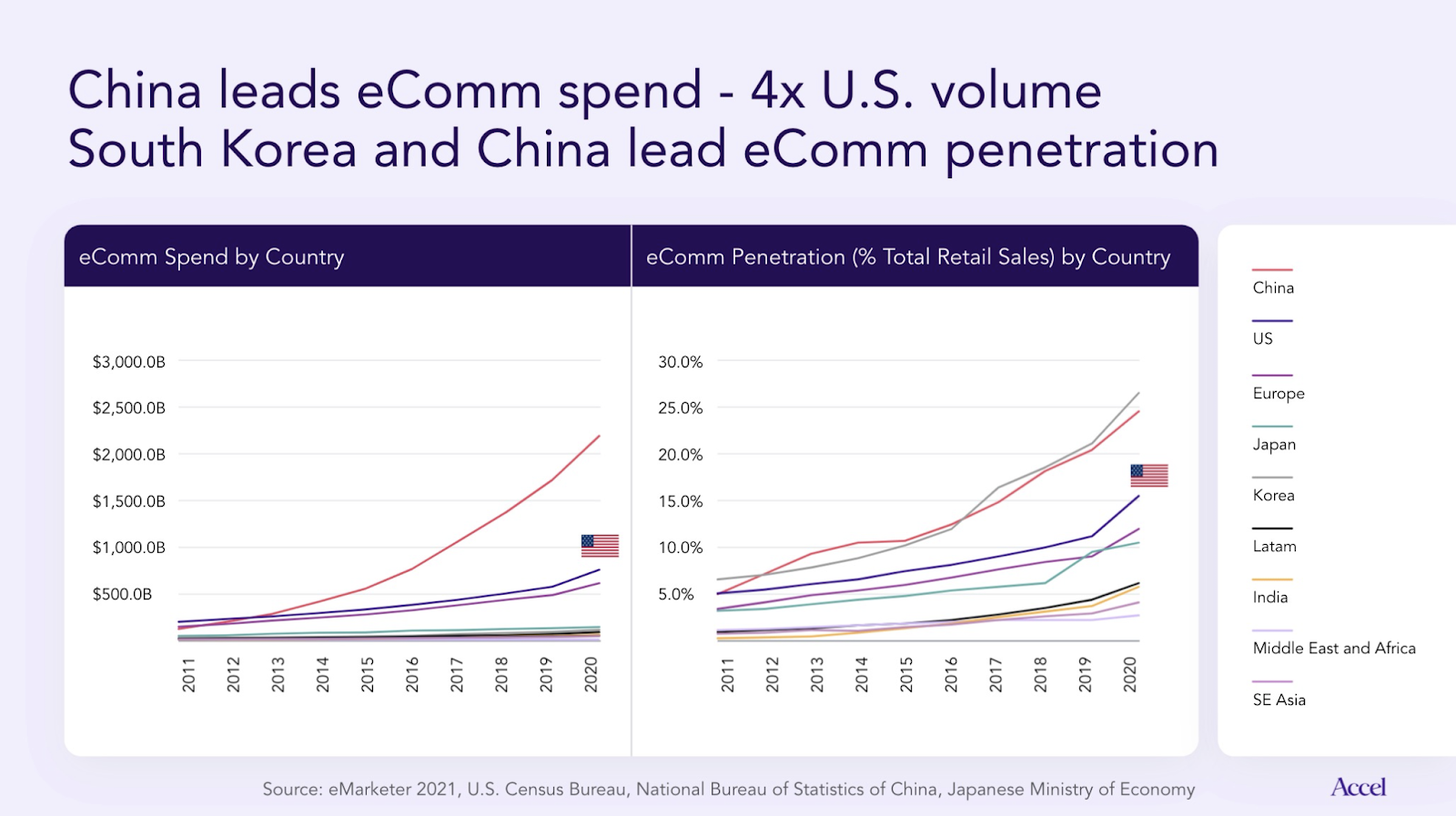
In 2016, more than 20 years after Amazon’s founding and 10 years since Shopify launched, it would have been easy to assume e-commerce penetration (the percentage of total retail spend where the goods were bought and sold online) would be over 50%.

But what we found was shocking: The U.S. was only approximately 8% penetrated — only 8% for arguably the most advanced economy in the world!

We’ve had a close eye on the rate of e-commerce penetration globally ever since. Despite e-commerce growth skyrocketing over the past year, the reality is the U.S. has still only reached an e-commerce penetration rate of around 17%. During the last 18 months, we’ve closed the gap to South Korea and China’s e-commerce penetration of more than 25%, but there is still much progress to be made.

Image Credits: Accel

It’s clear that we are still in the early days of this megatrend and it is our strong conviction that it is inevitable that we will get to a point where at least half of every retail dollar is spent online over the next decade.

Below are five key predictions for what this road to further penetration will hold.

D2C retail will accelerate as merchants seek independence

Marketplaces have forged the path for e-commerce adoption among merchants of all sizes. They have raised significant capital and made the necessary investments in payments and logistics infrastructure, often subsidizing the consumer experience with free shipping or discounts to get them comfortable buying online.

The balance of power has shifted toward merchants, who previously didn’t have the picks and shovels to build their own e-commerce capabilities.

In recent years, merchants have pursued options aside from these marketplace aggregators. They have sought independence, opting to pay 5%-10% of their gross merchandise value (GMV) on their own technology infrastructure rather than paying the 6% to 45% (average of about 15%) in marketplace fees. Most importantly, they have prioritized owning the relationship with their end customers, given that customer loyalty and lifetime value is becoming ever more important in a hypercompetitive online market.

21 May 2021

Mental health app Wysa raises $5.5M for ’emotionally intelligent’ AI

It’s hard enough to talk about your feelings to a person; Jo Aggarwal, the founder and CEO of Wysa, is hoping you’ll find it easier to confide in a robot. Or, put more specifically, “emotionally intelligent” artificial intelligence.

Wysa is an A.I powered mental health app designed by Touchkin eServices, Aggarwal’s company that currently maintains headquarters in Bangalore, Boston and London. Wysa is something like a chatbot that can respond with words of affirmation, or guide a user through one of 150 different therapeutic techniques.

Wysa is Aggarwal’s second venture. The first was an elder care company that failed to find market fit, she says. Aggarwal found herself falling into a deep depression, from which, she says, the idea of Wysa was born in 2016. 

In March, Wysa became one of 17 apps in the Google Assistant Investment Program, and in May, closed a Series A funding round of $5.5 million led by Boston’s W Health Ventures, the Google Assistant Investment Program, pi Ventures and Kae Capital. 

Wysa has raised a total of $9 million in funding, says Aggarwal, and the company has 60 full-time employees and about three million users. 

The ultimate goal, she says, is not to diagnose mental health conditions. Wysa is largely aimed at people who just want to vent. Most Wysa users are there to improve their sleep, anxiety or relationships, she says. 

“Out of the 3 million people that use Wysa, we find that only about 10% actually need a medical diagnosis,” says Aggarwal. If a user’s conversations with Wysa equate with high scores on traditional depression questionnaires like the PHQ-9 or the anxiety disorder questionnaire GAD-7 Wysa will suggest talking to a human therapist. 

Naturally, you don’t need to have a clinical mental health diagnosis to benefit from therapy. 

Wysa isn’t intended to be a replacement, says Aggarwal  (whether users view it as a replacement remains to be seen) but an additional tool that a user can interact with on a daily basis. 

“60 percent of the people who come and talk to Wysa need to feel heard and validated, but if they’re given techniques of self help, they can actually work on it themselves and feel better,” Aggarwal continues. 

Wysa’s approach has been refined through conversations with users and through input from therapists, says Aggarwal. 

For instance, while having a conversation with a user, Wysa will first categorize their statements and then assign a type of therapy, like cognitive behavioral therapy or acceptance and commitment therapy, based on those responses. It would then select a line of questioning or therapeutic technique written ahead of time by a therapist and begin to converse with the user. 

Wysa, says Aggarwal, has been gleaning its own insights from over 100 million conversations that have unfolded this way. 

“Take for instance a situation where you’re angry at somebody else. Originally our therapists would come up with a technique called the empty chair technique where you’re trying to look at it from the other person’s perspective. We found that when a person felt powerless or there were trust issues, like teens and parents, the techniques the therapists were giving weren’t actually working,” she says. 

“There are 10,000 people facing trust issues who are actually refusing to do the empty chair exercise. So we have to find another way of helping them. These insights have built Wysa.”

Although Wysa has been refined in the field, research institutions have played a role in Wysa’s ongoing development. Pediatricians at the University of Cincinnati helped develop a module specifically targeted towards COVID-19 anxiety. There are also ongoing studies of Wysa’s ability to help people cope with mental health consequences from chronic pain, arthritis, and diabetes at The Washington University in St. Louis, and The University of New Brunswick. 

Still, Wysa has had several tests in the real world. In 2020, the government of Singapore licensed Wysa, and provided the service for free to help cope with the emotional fallout of the coronavirus pandemic. Wysa is also offered through the health insurance company Aetna as a supplement to Aetna’s Employee Assistance Program. 

The biggest concern about mental health apps, naturally, is that they might accidentally trigger an incident, or mistake signs of self harm. To address this, the UK’s National Health Service (NHS) offers specific compliance standards. Wysa is compliant with the NHS’  DCB0129 standard for clinical safety, the first AI-based mental health app to earn the distinction. 

To meet those guidelines, Wysa appointed a clinical safety officer, and was required to create “escalation paths” for people who show signs of self harm.

Wysa, says Aggarwal, is also designed to flag responses to self-harm, abuse, suicidal thoughts or trauma. If a user’s responses fall into those categories Wysa will prompt the user to call a crisis line.

In the US, the Wysa app that anyone can download, says Aggarwal, fits the FDA’s definition of a general wellness app or a “low risk device.” That’s relevant because, during the pandemic, the FDA has created guidance to accelerate distribution of these apps. 

Still, Wysa may not perfectly categorize each person’s response. A 2018 BBC investigation, for instance, noted that the app didn’t appear to appreciate the severity of a proposed underage sexual encounter. Wysa responded by updating the app to handle more instances of coercive sex. 

Aggarwal also notes that Wysa contains a manual list of sentences, often containing slang, that they know the AI won’t catch or accurately categorize as harmful on its own. Those are manually updated to ensure that Wysa responds appropriately. “Our rule is that [the response] can be 80%, appropriate, but 0% triggering,” she says. 

In the immediate future, Aggarwal says the goal is to become a full-stack service. Rather than having to refer patients who do receive a diagnosis to Employee Assistant Programs (as the Aetna partnership might) or outside therapists, Wysa aims to build out its own network of mental health suppliers. 

On the tech side they’re planning expansion into Spanish, and will start investigating a voice-based system based on guidance from the Google Assistant Investment Fund. 


21 May 2021

Check out the top-notch founders and investors joining us on Extra Crunch Live in June

In the past month, we’ve gotten a look at Poshmark’s early fundraising pitch deck with CEO Manish Chandra and Mayfield’s Navin Chaddha, heard where the biggest opportunities lie in the proptech space with Fifth Wall’s Brendan Wallace and Orchard’s Court Cunningham, and heard how to nail your pitch from Sequoia’s Shaun Maguire and Vise AI’s Samir Vasavada.

The Extra Crunch Live party carries on into June, with new episodes connecting you with some of tech’s biggest names.

For those who are new to ECL, the show also features a pitch-off, allowing folks in the audience to virtually “raise their hand” and jump on the stream to pitch their startup to our founder and investor guests.

Who might those guests be?

Take a look at our June slate below:

Extra Crunch Live: Madrona and Coda.io

June 2 – 3pm ET/12pm PT

Soma Somasegar spent 27 years at Microsoft before getting into venture. He currently serves as managing director at Madrona, where he focuses on machine learning, robotic process automation, and future of work, and led investments in Snowflake and UiPath. He also invested in Coda.io, which is reinventing the doc, and has raised $140 million. Hear from Somasegar and Shishir Mehrotra, co-founder and CEO of Coda, as they walk us through the fundraising process and beyond.

REGISTER HERE FOR FREE!


Extra Crunch Live: MaC Venture Capital and Wonderschool

June 16 – 3pm ET/12pm PT

Marlon Nichols is the founding partner at MaC Venture Capital and has invested in companies like Gimlet Media, MongoDB, Thrive Market, PlayVS, Fair, LISNR, Mayvenn, Blavity and Wonderschool. Chris Bennett, Wonderschool founder, will join Nichols on this episode of Extra Crunch Live to tell us about the Series A fundraising process and give feedback on live pitches from the audience.  REGISTER HERE FOR FREE!


Extra Crunch Live: Emergence and Retail Zipline

June 23 – 3pm ET/12pm PT

Lotti Siniscalco has experience across the fintech landscape as both an operator and investor. She’s held positions at NerdWallet, Goldman Sachs, Ribbit Capital and now at Emergence, where she invests in early-stage software companies. One of those investments is Retail Zipline, founded by Melissa Wong. The company has raised nearly $40 million. The duo will walk us through Zipline’s early pitch deck and give their own feedback on startup pitches from the audience. REGISTER HERE FOR FREE!


Extra Crunch Live: Maverick Ventures and Cityblock Health

June 30 – 3pm ET/12pm PT

Maverick Ventures managing partner Ambar Bhattacharyya can boast 11 IPOs and acquisitions across his investment career, which includes stints at Bessemer and Bain. When it comes to health tech, there are few VCs with such a notable portfolio, which includes Artemis Health, Caribou Biosciences, hims and hers and Cityblock Health. Cityblock recently reached unicorn status, and co-founder and CEO Iyah Romm will sit down with Bhattacharyya and TechCrunch to discuss how to be successful fundraising in health tech. The investor/founder duo will also give their feedback on live startup pitches from the audience.

REGISTER HERE FOR FREE! 

As a reminder, Extra Crunch Live is free for anyone to attend, but only Extra Crunch members get access to on-demand episodes. And that is but one of the many perks included with an Extra Crunch membership. Join here!

21 May 2021

Check out the top-notch founders and investors joining us on Extra Crunch Live in June

In the past month, we’ve gotten a look at Poshmark’s early fundraising pitch deck with CEO Manish Chandra and Mayfield’s Navin Chaddha, heard where the biggest opportunities lie in the proptech space with Fifth Wall’s Brendan Wallace and Orchard’s Court Cunningham, and heard how to nail your pitch from Sequoia’s Shaun Maguire and Vise AI’s Samir Vasavada.

The Extra Crunch Live party carries on into June, with new episodes connecting you with some of tech’s biggest names.

For those who are new to ECL, the show also features a pitch-off, allowing folks in the audience to virtually “raise their hand” and jump on the stream to pitch their startup to our founder and investor guests.

Who might those guests be?

Take a look at our June slate below:

Extra Crunch Live: Madrona and Coda.io

June 2 – 3pm ET/12pm PT

Soma Somasegar spent 27 years at Microsoft before getting into venture. He currently serves as managing director at Madrona, where he focuses on machine learning, robotic process automation, and future of work, and led investments in Snowflake and UiPath. He also invested in Coda.io, which is reinventing the doc, and has raised $140 million. Hear from Somasegar and Shishir Mehrotra, co-founder and CEO of Coda, as they walk us through the fundraising process and beyond.

REGISTER HERE FOR FREE!


Extra Crunch Live: MaC Venture Capital and Wonderschool

June 16 – 3pm ET/12pm PT

Marlon Nichols is the founding partner at MaC Venture Capital and has invested in companies like Gimlet Media, MongoDB, Thrive Market, PlayVS, Fair, LISNR, Mayvenn, Blavity and Wonderschool. Chris Bennett, Wonderschool founder, will join Nichols on this episode of Extra Crunch Live to tell us about the Series A fundraising process and give feedback on live pitches from the audience.  REGISTER HERE FOR FREE!


Extra Crunch Live: Emergence and Retail Zipline

June 23 – 3pm ET/12pm PT

Lotti Siniscalco has experience across the fintech landscape as both an operator and investor. She’s held positions at NerdWallet, Goldman Sachs, Ribbit Capital and now at Emergence, where she invests in early-stage software companies. One of those investments is Retail Zipline, founded by Melissa Wong. The company has raised nearly $40 million. The duo will walk us through Zipline’s early pitch deck and give their own feedback on startup pitches from the audience. REGISTER HERE FOR FREE!


Extra Crunch Live: Maverick Ventures and Cityblock Health

June 30 – 3pm ET/12pm PT

Maverick Ventures managing partner Ambar Bhattacharyya can boast 11 IPOs and acquisitions across his investment career, which includes stints at Bessemer and Bain. When it comes to health tech, there are few VCs with such a notable portfolio, which includes Artemis Health, Caribou Biosciences, hims and hers and Cityblock Health. Cityblock recently reached unicorn status, and co-founder and CEO Iyah Romm will sit down with Bhattacharyya and TechCrunch to discuss how to be successful fundraising in health tech. The investor/founder duo will also give their feedback on live startup pitches from the audience.

REGISTER HERE FOR FREE! 

As a reminder, Extra Crunch Live is free for anyone to attend, but only Extra Crunch members get access to on-demand episodes. And that is but one of the many perks included with an Extra Crunch membership. Join here!

21 May 2021

Spotify brings offline listening to the Apple Watch, at last

The relationship between Spotify and Apple has been…understandably contentious at times. After all, Apple runs the streaming service’s biggest competitor. At the end of the day though, the Apple Watch and Spotify maintain the No. 1 spot in their respective categories by a wide margin. And playing nice ultimately benefits a wide swath of users in that overlapping Venn diagram.

Today Spotify announced that it’s finally bringing to the smartwatch what’s no doubt been one of its most requested features. Starting today, Premium subscribers can download music and podcasts to the wearable for offline listening. That means users will be able to leave their phone at home when they go for a jog.

The new feature works more or less like standard downloading and sharing. Users click the three ellipses next to an album, playlist or podcast and click “Download to Apple Watch.” Once downloaded, green arrows will populate next to the title. With headphones paired, you’ll be able to stream directly from the watch.

Samsung has already offered the feature on some of the competition, including Samsung’s Galaxy Watch line. The service is also coming to Google Wear OS watches soon, per an announcement at I/O. Apple Music, of course, has offered offline listening on the Watch for a while, as has Pandora. Deezer also beat Spotify to the popular wearable by a matter of days.

21 May 2021

As Zynga impresses, rival mobile-gaming shop Jam City looks to list via SPAC

While it would be nice to write about something other than yet another tech company looking to list via a SPAC, the deals keep dropping, so our more traditional fare of covering startup trends will remain on hold for at least one day more.

This morning, we’re looking at the Jam City deal to merge with DPCM Capital. Jam City is a bit like Zynga, but unless you are a mobile-gaming aficionado, you might not have heard of it.


The Exchange explores startups, markets and money. 

Read it every morning on Extra Crunch or get The Exchange newsletter every Saturday.


You likely have not heard of DPCM Capital, either, but you know more about it than you’d think.

As Jam City notes in a release, the SPAC is “led by Emil Michael.” Michael is most famous for his time at Uber, where he served as chief business officer. He left the firm, as The New York Times wrote in 2014, after a board-called “investigation into [the company’s] culture and business practices” led to a “recommendation for Mr. Michael to exit Uber.”

He’s the gentleman who floated the idea of funding a team to “dig up dirt” of Uber’s “critics in the media,” as Buzzfeed News reported in late 2014.

Regardless, we’re not here to go back through Uber and its various cultural messes. We’re here to dig into the Jam City SPAC deck to see if the company is similar to Zynga. Why do we want to know that? Because Zynga has done great in recent quarters, including posting record revenue and bookings in the first three months of 2021.

With lots of folks stuck at home in the last year, gaming has done well in aggregate. And mobile gaming is a huge chunk of the larger gaming world.

More broadly, why do we care about Jam City’s SPAC transaction? Because the mobile gaming concern has raised more than $300 million, including a $145 million round in 2019 that TechCrunch covered here.

The company attracted capital from Austin Ventures, Netmarble, Bank of America Merrill Lynch and JP Morgan Chase while private, per Crunchbase, so we’re very curious if Jam City has enjoyed a Zynga-like last few years and how it’s being valued as part of the SPAC deal. Let’s find out.

Jam City’s SPAC transaction

When Jam City raised that huge 2019 round, co-founder and CEO Chris DeWolfe said that the “global mobile games market [is] consolidating.” At the time, the company intended to use some of its new funding to acquire other mobile gaming companies.

21 May 2021

European Parliament amps up pressure on EU-US data flows and GDPR enforcement

European Union lawmakers are facing further pressure to step in and do something about lackadaisical enforcement of the bloc’s flagship data protection regime after the European Parliament voted yesterday to back a call urging the Commission to start an infringement proceeding against Ireland’s Data Protection Commission (DPC) for not “properly enforcing” the regulation.

The Commission and the DPC have been contacted for comment on the parliament’s call.

Last summer the Commission’s own two-year review of the General Data Protection Regulation (GDPR) highlighted a lack of uniformly vigorous enforcement — but commissioners were keener to point out the positives, lauding the regulation as a “global reference point”.

It’s now nearly three years since the regulation begun being applied and criticism over weak enforcement is getting harder for the EU’s executive to ignore.

The parliament’s resolution — which, while non-legally binding, fires a strong political message across the Commission’s bow — singles out the DPC for specific criticism given its outsized role in enforcement of the General Data Protection Regulation (GDPR). It’s the lead supervisory authority for complaints brought against the many big tech companies which choose to site their regional headquarters in the country (on account of its corporate-friendly tax system).

The text of the resolution expresses “deep concern” over the DPC’s failure to reach a decision on a number of complaints against breaches of the GDPR filed the day it came into application, on May 25, 2018 — including against Facebook and Google — and criticises the Irish data watchdog for interpreting ‘without delay’ in Article 60(3) of the GDPR “contrary to the legislators’ intention – as longer than a matter of months”, as they put it.

To date the DPC has only reached a final decision on one cross-border GDPR case — against Twitter.

The parliament also says it’s “concerned about the lack of tech specialists working for the DPC and their use of outdated systems” (which Brave also flagged last year) — as well as criticizing the watchdog’s handling of a complaint originally brought by privacy campaigner Max Schrems years before the GDPR came into application, which relates to the clash between EU privacy rights and US surveillance laws, and which still hasn’t resulted in a decision.

The DPC’s approach to handling Schrems’ 2013 complaint led to a 2018 referral to the CJEU — which in turn led to the landmark Schrems II judgement last summer invalidating the flagship EU-US data transfer arrangement, Privacy Shield.

That ruling did not outlaw alternative data transfer mechanisms but made it clear that EU DPAs have an obligation to step in and suspend data transfers if European’s information is being taken to a third country that does not have essentially equivalent protections to those they have under EU law — thereby putting the ball back in the DPC’s court on the Schrems complaint.

The Irish regulator then sent a preliminary order to Facebook to suspend its data transfers and the tech giant responded by filing for a judicial review of the DPC’s processes. But the Irish High Court rejected Facebook’s petition last week. And a stay on the DPC’s investigation was lifted yesterday — so the DPC’s process of reaching a decision on the Facebook data flows complaint has started moving again.

However a final decision could still take several months more — as we’ve reported before — as the DPC’s draft decision will also need to be put to the other EU DPAs for review and the chance to object.

The parliament’s resolution states that it “is worried that supervisory authorities have not taken proactive steps under Article 61 and 66 of the GDPR to force the DPC to comply with its obligations under the GDPR”, and — in more general remarks on the enforcement of GDPR around international data transfers — it states that it:

Is concerned about the insufficient level of enforcement of the GDPR, particularly in the area of international transfers; expresses concerns at the lack of prioritisation and overall scrutiny by national supervisory authorities with regard to personal data transfers to third countries, despite the significant CJEU case law developments over the past five years; deplores the absence of meaningful decisions and corrective measures in this regard, and urges the EDPB [European Data Protection Board] and national supervisory authorities to include personal data transfers as part of their audit, compliance and enforcement strategies; points out that harmonised binding administrative procedures on the representation of data subjects and admissibility are needed to provide legal certainty and deal with crossborder complaints;

The knotty, multi-year saga of Schrems’ Facebook data-flows complaint, as played out via the procedural twists of the DPC and Facebook’s lawyers’ delaying tactics, illustrates the multi-layered legal, political and commercial complexities bound up with data flows out of the EU (post-Snowden’s 2013 revelations of US mass surveillance programs) — not to mention the staggering challenge for EU data subjects to actually exercise the rights they have on paper. But these intersecting issues around international data flows do seem to be finally coming to a head, in the wake of the Schrems II CJEU ruling.

The clock is now ticking for the issuing of major data suspension orders by EU data protection agencies, with Facebook’s business first in the firing line.

Other US-based services that are — similarly — subject to the US’ FISA regime (and also move EU users data over the pond for processing; and whose businesses are such they cannot shield user data via ‘zero access’ encryption architecture) are equally at risk of receiving an order to shut down their EU-US data-pipes. Or else having to shift data processing for these users inside the EU.

US-based services aren’t the only ones facing increase legal uncertainty, either.

The UK, post-Brexit, is also classed as a third country (in EU law terms). And in a separate resolution today the parliament adopted a text on the UK adequacy agreement, granted earlier this year by the Commission, which raises objections to the arrangement — including by flagging a lack of GDPR enforcement in the UK as problematic.

On that front the parliament highlights how adtech complaints filed with the ICO have failed to yield a decision. (It writes that it’s concerned “non-enforcement is a structural problem” in the UK — which it suggests has left “a large number of data protection law breaches… [un]remedied”.)

It also calls out the UK’s surveillance regime, questioning its compatibility with the CJEU’s requirements for essential equivalence — while also raising concerns about the risk that the UK could undermine protections on EU citizens data via onward transfers to jurisdictions the EU does not have an adequacy agreement with, among other objections.

The Commission put a four year lifespan on the UK’s adequacy deal — meaning there will be another major review ahead of any continuation of the arrangement in 2025.

It’s a far cry from the ‘hands-off’ fifteen years the EU-US ‘Safe Harbor’ agreement stood for, before a Schrems challenge finally led to the CJEU striking it down back in 2015. So the takeaway here is that data deals that allow for people’s information to leave Europe aren’t going to be allowed to stand unchecked for years; close scrutiny and legal accountability are now firmly up front — and will remain in the frame going forward.

The global nature of the Internet and the ease with which data can digitally flow across borders of course brings huge benefits for business — but the resulting interplay between different legal regimes is leading to increasing levels of legal uncertainty for businesses seeking to take people’s data across borders.

In the EU’s case, the issue is that data protection is regulated within the bloc and these laws require that protection stays with people’s information, no matter where it goes. So if the data flows to countries that do not offer the same safeguards for — be that the US or indeed China or India (or even the UK) — then that risk is that it can’t, legally, be taken there.

How to resolve this clash between data protection laws based on individual privacy laws and data access mandates driven by national security priorities has no easy answers.

For the US, and for the transatlantic data flows between the EU and the US, the Commission has warned there will be no quick fix this time — as happened when it slapped a sticking plaster atop the invalidated Safe Harbor, hailing a new ‘Privacy Shield’ regime; only for the CJEU to blast that out of the water for much the same reasons a few years later. (The parliament resolution is particularly withering in its assessment of the Commission’s historic missteps there.)

For a fix to stick, major reform of US surveillance law is going to be needed. And the Commission appears to have accepted that’s not going to come overnight, so it seems to be trying to brace businesses for turbulence…

The parliament’s resolution on Schrems II also makes it clear that it expects DPAs to step in and cut off risky data flows — with MEPs writing that “if no arrangement with the US is swiftly found which guarantees an essentially equivalent and therefore adequate level of protection to that provided by the GDPR and the Charter, that these transfers will be suspended until the situation is resolved”.

So if DPAs fail to do this — and if Ireland keeps dragging its feet on closing out the Schrems complaint — they should expect more resolutions to be blasted at them from the parliament.

MEPs emphasize the need for any future EU-US data transfer agreement “to address the problems identified by the Court ruling in a sustainable manner” — pointing out that “no contract between companies can provide protection from indiscriminate access by intelligence authorities to the content of electronic communications, nor can any contract between companies provide sufficient legal remedies against mass surveillance”.

“This requires a reform of US surveillance laws and practices with a view to ensuring that access of US security authorities to data transferred from the EU is limited to what is necessary and proportionate, and that European data subjects have access to effective judicial redress before US courts,” the parliament adds.

It’s still true that businesses may be able to legally move EU personal data out of the bloc. Even, potentially, to the US — depending on the type of business; the data itself; and additional safeguards that could be applied.

However for data-mining companies like Facebook — which are subject to FISA and whose businesses rely on accessing people’s data — then achieving essential equivalence with EU privacy protections looks, well, essentially impossible.

And while the parliament hasn’t made an explicit call in the resolution for Facebook’s EU data flows to be cut off that is the clear implication of it urging infringement proceedings against the DPC (and deploring “the absence of meaningful decisions and corrective measures” in the area of international transfers).

The parliament says it wants to see “solid mechanisms compliant with the CJEU judgement” set out — for the benefit of businesses with the chance to legally move data out of the EU — saying, for example, that the Commission’s proposal for a template for Standard Contractual Clauses (SCCs) should “duly take into account all the relevant recommendations of the EDPB“.

It also says it supports the creation of a tool box of supplementary measures for such businesses to choose from — in areas like security and data protection certification; encryption safeguards; and pseudonymisation — so long as the measures included are accepted by regulators.

It also wants to see publicly available resources on the relevant legislation of the EU’s main trading partners to help businesses that have the possibility of being able to legally move data out of the bloc get guidance to help them do so with compliance.

The overarching message here is that businesses should buckle up for disruption of cross-border data flows — and tool up for compliance, where possible.

In another segment of the resolution, for example, the parliament calls on the Commission to “analyse the situation of cloud providers falling under section 702 of the FISA who transfers data using SCCs” — going on to suggest that support for European alternatives to US cloud providers may be needed to plug “gaps in the protection of data of European citizens transferred to the United States” and “reduce the dependence of the Union in storage capacities vis-à-vis third countries and to strengthen the Union’s strategic autonomy in terms of data management and protection”.


21 May 2021

Embedded finance will help fill the life insurance coverage gap

An estimated 41 million Americans say they need life insurance but have yet to purchase coverage. Despite this awareness among consumers, the Life Insurance Marketing and Research Association estimates a $12 trillion coverage gap, with about 50% of millennials planning to purchase coverage within the next year.

There’s latent demand for life insurance currently unaddressed by much of the financial services industry, and embedded finance can be the solution. It’s imperative for companies to consider product lines and partnerships to expand markets, create new revenue streams and provide added value to their customers.

There’s latent demand for life insurance currently unaddressed by much of the financial services industry, and embedded finance can be the solution.

Connecting consumers with products they need through channels they already know and trust is both a massive revenue opportunity and a social good, providing financial resilience to families at a time when they need it most.

Why bundle life insurance?

The concept of digitally bundling financial products in a packaged offering to a customer is certainly not new — but it is for the life insurance space.

Embedded finance uses technology and operations infrastructure to offer products and services through entities that may not be financial institutions at all. Think of embedded finance like on-demand shopping; customers benefit from both the transaction (buying financial protection for their families) and the convenience it provides (from whatever platform they are currently engaging with).

Similar to how Amazon saves shoppers 75 hours a year, bundling life insurance gives consumers back time in their day and can improve their financial health.

21 May 2021

Snap acquires AR startup WaveOptics, which provides tech for Spectacles, for over $500M

Snap yesterday announced the latest iteration of its Spectacles augmented reality glasses, and today the company revealed a bit more news: it is also acquiring the startup that supplied the technology that helps power them. The Snapchat parent is snapping up WaveOptics, an AR startup that makes the waveguides and projectors used in AR glasses. These overlay virtual images on top of the views of the real world someone wearing the glasses can see, and Snap worked with WaveOptics to build its latest version of Spectacles.

The deal was first reported by The Verge, and a spokesperson for Snap directly confirmed the details to TechCrunch. Snap is paying over $500 million for the startup, in a cash-and-stock deal. The first half of that will be coming in the form of stock when the deal officially closes, and the remainder will be payable in cash or stock in two years.

This is a big leap for WaveOptics, which had raised around $65 million in funding from investors that included Bosch, Octopus Ventures and a host of individuals, from Stan Boland (veteran entrepreneur in the UK, most recently at FiveAI) and Ambarish Mitra (the co-founder of early AR startup Blippar). PitchBook estimates that its most recent valuation was only around $105 million.

WaveOptics was founded in Oxford, and it’s not clear where the team will be based after the deal is closed — we have asked.

We have been covering the company since its earliest days, when it displayed some very interesting, early, and ahead-of-its-time technology: waveguides based on hologram physics and photonic crystals. The important and key thing is that its tech drastically compresses size and load of the hardware needed to process and display images, meaning a much wider and more flexible range of form factors for AR hardware based on WaveOptics tech.

It’s not clear whether WaveOptics will continue to work with other parties post-deal, but it seems that one obvious advantage for Snap would be making the startup’s technology exclusive to itself.

Snap has been on something of an acquisition march in recent times — it’s made at least three other purchases of startups since January, including Fit Analytics for an AR-fuelled move into e-commerce, as well as Pixel8Earth and StreetCred for its mapping tools.

This deal, however, marks Snap’s biggest acquisition to date in terms of valuation. That is not only a mark of the premium price that foundational artificial intelligence tech continues to command — in addition to the team of scientists that built WaveOptics, it also has 12 filed and in-progress patents — but also Snap’s financial and, frankly, existential commitment to having a seat at the table when it comes not just to social apps that use AR, but hardware, and being at the centre of not just using the tech, but setting the pace and agenda for how and where that will play out.

That’s been a tenacious and not always rewarding place for it to be, but the company — which has long described itself as a “camera company” — has kept hardware in the mix as an essential component for its future strategy.