
Year: 2021

19 May 2021

Daily Crunch: India gives WhatsApp one week to revoke its updated privacy policy

To get a roundup of TechCrunch’s biggest and most important stories delivered to your inbox every day at 3 p.m. PDT, subscribe here.

Happy Wednesday, friends! It was another super-busy day in the tech world. I had my sights on Squarespace’s public debut, as well as the value of Coinbase’s stock, which may be tracking the price of bitcoin a bit more literally than some folks expected. And if you are a long-term crypto holder, congrats on the buying opportunity. If you are a short-term crypto holder, yes, you can have a drink now regardless of what time it is. — Alex

The TechCrunch Top 3

  • Whatsapp v. India: The scrap between Facebook’s Whatsapp service and the Indian government continued today as the nation-state “once again directed the Facebook-owned company to withdraw the planned update.”
  • Telehealth + fertility: Famous for its initial men’s health products, Ro (née Roman) purchased Modern Fertility today, a fertility-focused startup founded in 2017. Our question is how Ro’s telehealth approach will fit with reproductive health.
  • Squarespace flops: Squarespace’s direct listing set a reference price of $50, valuing the company sharply lower than its final private price ($10 billion, set earlier this year). Then its stock fell further.

From the TechCrunch Events side of things, Tess Hatch, a vice president and partner at Bessemer Venture Partners, is coming to Disrupt. Which is very hype.

Startups and VC

We’re shaking things up today and talking about product first and venture capital rounds second. Sound good?

First up is Otter.ai’s new product: Otter Assistant. It can transcribe your Zoom calls. For reporters, this is huge as a note-taking tool. But it will likely find even broader remit in the business world. Don’t forget that Otter raised $50 million just a few months ago. (For more on the voice transcription space, check out Deepgram’s 2020-era funding round.)

Second in the product category, Liquid Instruments has raised $13.7 million to bring its Moku:Go product to classrooms and labs everywhere. What does the Go do? It “combines several commonly used tools into one compact package, saving room on your workbench or classroom while also providing a modern, software-configurable interface,” TechCrunch reported.

Moving onto some purely financial coverage from startup-land, here are four neat rounds we dug into more deeply:

$20M for Assignar: Construction tech is a busy sector, not merely because the construction sector is itself rather active; the digital transformation push that we’ve seen around the business is also touching down in the world of mortar and bricks. Its software helps contractors and subcontractors “connect to the field and vice versa,” according to its CEO Sean McCreanor.

  • Why do we care? Fellow construction tech player Procore is going public as we speak. So the market that Assignar is playing in is active in both early- and late-stage terms.

$150M for Formlabs: 3D printing has come of age, it appears, as Massachusetts-based Formlabs closed a nine-figure round for its printing tech. SoftBank’s Vision Fund 2 led the round, which values the company at around $2 billion.

  • Why do we care? Formlabs wants to improve 3D printing machines while also making them cheaper. If it can pull that off, whole sectors could be shaken up.

$50M for Super: If you own a home, you are familiar with how rapidly entropy will ensure that you have a regular stream of repair bills. Why not convert those into a monthly subscription? That’s what Super is working to do, and now it has cash to pursue its vision after growing 7x since last April.

  • Why do we care? The subscription push is far more than merely an enterprise-software affair, or something related to consumer entertainment. Anything as a service is where we are in 2021.

$250M for Pipe: Pipe is a platform that allows companies to sell their future, predictable revenue streams to investors. It’s best known for working with SaaS companies, but is expanding into other business types as well.

  • Why do we care? Pipe has been growing at a torrid pace, and raising capital at a similar clip. It’s either onto something super huge, or the market for financial products is just bonkers for now. Either way, it’s an interesting option for software startups hunting for cash.

5 innovative fundraising methods for emerging VCs and PEs

According to David Teten, founder of Versatile VC, five new strategies are gaining traction among fund managers looking to raise capital from family offices and high-net-worth individuals:

  • Online communities and virtual events.
  • Platforms that help other investors access your fund.
  • Soliciting under the 506(c) designation.
  • Launching a rolling fund.
  • Crowdfunding from retail investors into a general partnership.

In a summary of a class he taught for the Oper8r VC fund accelerator, Teten offers actionable advice for anyone who wants to connect with pre-qualified investors.

(Extra Crunch is our membership program, which helps founders and startup teams get ahead. You can sign up here.)

TechCrunch Experts: Email Marketing

Intellect illustration

Image Credits: Getty Images

Extra Crunch is looking to founders for recommendations on email marketers to help us build a short list of top growth marketers in tech!

If you’re a founder and have an email marketer you enjoyed working with, we want to hear from you! If you’re a growth marketer, please pass this along to your clients.

Fill out the survey here.

We’ll share great recommendations publicly so more startups can find the help they need. Find more details at techcrunch.com/experts.

Big Tech Inc.

Today from the world of Big Tech, we’re pausing to listen to our own Editor in Chief Matthew Panzarino discuss the new iPad Pro, which he thinks has amazing hardware:

  • Screen: “The mini-LED-driven Liquid Retina XDR display is probably the best display that’s ever shipped on a mobile computer. It’s just fantastic.”
  • Speed: “The M1 chip is absolutely blistering.”
  • Imaging: “The new iPad Pro cameras are pretty fantastic; both front and back are now very usable and the new front camera especially benefits from an increase in resolution and new wide-angle optics.”
  • Keyboard: “The overall feel of the keyboard is still great, a really nice typing experience.”

But then there’s the software. Which Panzarino is not stoked about. It’s aging, he argues:

The other side of this coin that isn’t so shiny is the iPad’s aging software. It’s just as good as it was when I wrote my review of the iPad Pro in 2020 — at which point my conclusions were “you can adapt to it but it could be better.” That was a year ago. As someone who has used it as my only portable machine for the last two and a half years, I can tell you that this is a very long time to wait for a big leap forward in capability.

I have a very simple ask for the iPad’s software: I want to feel the same energy, vivacity and pure performance for the sake of peak performance that the hardware side exhibits.

Apple has now come to the crossroad that Microsoft tried to meet with Windows 8 and failed; how do you build an OS that serves either two form factors (touch and mobile, and desktop) well, or two OSs that can share enough third-party software so that neither is neglected? We’ll know more at WWDC.

Community

Turns out nothing announced this week will get you to move over to Android from iOS. Fair enough. Now we ask … what do you think is going on with cryptocurrency?

Have some thoughts to share? A story idea? Looking for a new gig? Come hang out with us on the Discord server.

19 May 2021

Arrival’s Denis Sverdlov on the new era of car manufacturing

Electric vehicle company Arrival wants to break the current auto manufacturing model. Instead of one giant factory and an assembly line, Arrival’s commercial electric vans, buses and cars are robotically built in small, regional microfactories, of which the company wants to open 31 by the end of 2025.

If you want to achieve something radically more efficient, you have to go deeper, into complex, high-level computational algorithms that are not normally used in consumer-facing products.

The London-based company, founded in 2015, joined the ranks of EV companies going public via SPAC, merging with blank-check company CIIG Merger Corp. in March. UPS has already ordered 10,000 of Arrival’s robotically engineered vans, and the company recently signed a deal with Uber to create purpose-built EVs for ride-hail drivers.

Arrival founder Denis Sverdlov has been at the intersection of technological advancement and societal change before. Born in the nation of Georgia, Sverdlov founded his first company at 22 selling IT consulting software to enterprise customers. Since then, he has built and exited multiple companies, most notably telecommunications operator Yota Group. Founded in 2007, the same year the iPhone came out, Yota eventually launched a 4G network across Russia, coupling it with an HTC smartphone that would facilitate the use of the network. Sverdlov sold the company in 2012 for $1.5 billion, did a brief stint as the Russian deputy communications and mass media minister, and then went on to start Arrival. Oh, and he founded electric autonomous car race Roborace in 2015, too, just ‘cause.

With the same sense that fast, mobile internet and big screens would change the telecoms industry back in 2007, Sverdlov began to see a perfect storm brewing in the EV world over the last decade. In 2015, he founded Arrival in anticipation of a switch to electric as well as advancements happening in material, research and development in the robotics industry. He predicts this will have an even bigger impact on the automotive industry than 4G had on telecommunications.

TechCrunch: Denis, your first company was a telecom operator and you were behind the creation of Roborace. Now you’re trying to change the way the auto industry makes cars with Arrival. Are you a serial entrepreneur who is already thinking about the next thing? Or are you pretty involved in this one?

Dennis Sverdlov: Yeah, I’m quite involved with Arrival, and I expect to see many new technologies and enablers come out of this journey. For example, if you take our robotic technologies, which we use for microfactories, you can easily see how that will be used in other industries, as well, so it’s not going to be used only for automotive.

But as a company, we need to focus on what we do today because we need to achieve a lot here, and I think it’s important to focus on that. But, yeah, I would also count myself as a serial entrepreneur because I’ve been doing this for more than 20 years.

How do you think that your past business decisions have informed your current strategy with Arrival?

19 May 2021

Wisk Aero files injunction in trade secret lawsuit against Archer Aviation

Electric aviation company Wisk Aero filed a motion for a preliminary injunction Wednesday in its ongoing lawsuit with rival electric air travel startup Archer Aviation. The injunction could put a serious wrench in Archer’s operations should the courts approve it.

Wisk has asked the court immediately prohibit Archer from using 52 trade secrets that it alleges were stolen by former employees who were later hired by Archer. The trade secrets “span the gamut of systems within the aircraft and processes for development,” a Wisk spokesperson told TechCrunch.

Archer did not respond to a request for comment by press time. TechCrunch will update the story if they do.

Given the widespread subject matter of the trade secrets, an injunction would likely limit Archer’s operations. The courts have not yet ruled on whether Archer misappropriated trade secrets, as Wisk alleged in its original filing on April 6. Wisk says it discovered the trade secret theft after it sent the work laptops of a departing employee to an outsider investigator, who discovered that the employee had downloaded nearly 5,000 files. This employee is now a senior power electronics engineer at Archer.

The Federal Bureau of Investigation and the U.S. Department of Justice is conducting a separate federal investigation into Archer based on Wisk’s trade secret allegations.

Archer said in a filing with the U.S. Security and Exchange Commission that it had “placed an employee on paid administrative leave in connection with a government investigation and a search warrant issued to the employee.”

The injunction hearing has not been scheduled. It will likely to occur within the next few days due to the nature of the request. The suit was filed in the U.S. District Court for the Northern District of California under case no. 5:21-cv-2450.

19 May 2021

Dear Sophie: What’s happening with visa application receipt notices?

Here’s another edition of “Dear Sophie,” the advice column that answers immigration-related questions about working at technology companies.

“Your questions are vital to the spread of knowledge that allows people all over the world to rise above borders and pursue their dreams,” says Sophie Alcorn, a Silicon Valley immigration attorney. “Whether you’re in people ops, a founder or seeking a job in Silicon Valley, I would love to answer your questions in my next column.”

Extra Crunch members receive access to weekly “Dear Sophie” columns; use promo code ALCORN to purchase a one- or two-year subscription for 50% off.


Dear Sophie,

Our startup employs several individuals who are on work visas or have employment authorization. Many of them have been waiting for quite a while for the government to tell them their applications have been received.

Why? When will things be back on track? We have a few employees who are waiting for green cards, and a few F-1 visa holders who will be extending their OPT to STEM OPT.

Is there anything we can do?

— Patient in Pasadena

Dear Patient,

Thanks for your questions. Last September, an increase in applications submitted to U.S. Citizenship and Immigration Services (USCIS) amid COVID-19-related staff reductions created a substantial backlog and subsequent delay in USCIS sending out receipt notices.

My law firm partner, Anita Koumriqian, and I provided an update on receipt notices on a recent podcast. Dedicating an entire episode to receipt notices was unthinkable a year ago because applicants usually received receipt notices within one to three weeks after USCIS received their application.

For those who don’t know, USCIS sends a letter called a receipt notice to applicants when it receives an application. The receipt notice — also known as a Notice of Action or Form I-797 — contains information about:

  • Whether the application was accepted, in which case you will be notified of how it will be processed, or rejected if it was not filed appropriately, such as not using the latest form or forgetting to check a box on the application form.
  • A receipt number, which can be used to check the status of your case either online or by phone.
  • The date your application was received, which for most green card applications is the priority date. (Priority dates for the EB-2 and EB-3 green cards are when the Labor Department received the PERM Labor Certification application.) A priority date determines your place in line for a green card number to become available based on the green card category and the green card candidate’s country of birth.

What caused the backlog?

Before the pandemic, applicants would typically be notified in less than one month after USCIS received their application. Currently, applicants are receiving their receipt notice as long as eight to nine weeks after USCIS received their application, and sometimes longer.

As I mentioned earlier, coronavirus-related staffing reductions at USCIS coupled with a substantial jump in the number of applications submitted prompted huge delays that began in September. Application submissions surged primarily due to:

  • Anticipation of fee hikes that were slated to go into effect on October 2, 2020, before being blocked by a federal court judge.
  • Rapid forward movement in the monthly Visa Bulletin for some green card categories, which meant green card numbers became available to many waiting in line.
19 May 2021

Dear Sophie: What’s happening with visa application receipt notices?

Here’s another edition of “Dear Sophie,” the advice column that answers immigration-related questions about working at technology companies.

“Your questions are vital to the spread of knowledge that allows people all over the world to rise above borders and pursue their dreams,” says Sophie Alcorn, a Silicon Valley immigration attorney. “Whether you’re in people ops, a founder or seeking a job in Silicon Valley, I would love to answer your questions in my next column.”

Extra Crunch members receive access to weekly “Dear Sophie” columns; use promo code ALCORN to purchase a one- or two-year subscription for 50% off.


Dear Sophie,

Our startup employs several individuals who are on work visas or have employment authorization. Many of them have been waiting for quite a while for the government to tell them their applications have been received.

Why? When will things be back on track? We have a few employees who are waiting for green cards, and a few F-1 visa holders who will be extending their OPT to STEM OPT.

Is there anything we can do?

— Patient in Pasadena

Dear Patient,

Thanks for your questions. Last September, an increase in applications submitted to U.S. Citizenship and Immigration Services (USCIS) amid COVID-19-related staff reductions created a substantial backlog and subsequent delay in USCIS sending out receipt notices.

My law firm partner, Anita Koumriqian, and I provided an update on receipt notices on a recent podcast. Dedicating an entire episode to receipt notices was unthinkable a year ago because applicants usually received receipt notices within one to three weeks after USCIS received their application.

For those who don’t know, USCIS sends a letter called a receipt notice to applicants when it receives an application. The receipt notice — also known as a Notice of Action or Form I-797 — contains information about:

  • Whether the application was accepted, in which case you will be notified of how it will be processed, or rejected if it was not filed appropriately, such as not using the latest form or forgetting to check a box on the application form.
  • A receipt number, which can be used to check the status of your case either online or by phone.
  • The date your application was received, which for most green card applications is the priority date. (Priority dates for the EB-2 and EB-3 green cards are when the Labor Department received the PERM Labor Certification application.) A priority date determines your place in line for a green card number to become available based on the green card category and the green card candidate’s country of birth.

What caused the backlog?

Before the pandemic, applicants would typically be notified in less than one month after USCIS received their application. Currently, applicants are receiving their receipt notice as long as eight to nine weeks after USCIS received their application, and sometimes longer.

As I mentioned earlier, coronavirus-related staffing reductions at USCIS coupled with a substantial jump in the number of applications submitted prompted huge delays that began in September. Application submissions surged primarily due to:

  • Anticipation of fee hikes that were slated to go into effect on October 2, 2020, before being blocked by a federal court judge.
  • Rapid forward movement in the monthly Visa Bulletin for some green card categories, which meant green card numbers became available to many waiting in line.
19 May 2021

‘It’s almost like placing an IV’: Brain monitoring electrode receives FDA 510(k) clearance

An FDA pathway that’s greased the gears for COVID-19 vaccines and drugs has paved the way for something else: a new take on electroencephalography (EEG), the established brain-monitoring technique in which metallic electrodes are placed on the scalp to measure the brain’s electrical activity. 

On May 17, DC-based startup iCE Neurosystems announced a version of FDA approval for a subcutaneous electrode called iCE-SG, designed to monitor the brain’s electrical activity from beneath the skin of the scalp. That electrode comes on the back of a 2020 Emergency Use Authorization (EUA) for iCE Neurosystems’ software platform called iCEWav, which was used in a D.C. area hospital to monitor the brain activity of patients in medically-induced comas during the Covid-19 pandemic. 

iCE Neurosystems electrode and software are, essentially, a new take on traditional EEG. The electrode is designed to sit beneath the scalp for days and analyze brain activity, and the software component is designed to integrate that data with vital signs like heart rate or blood pressure. 

“For the first time we’ve got this massive, high-fidelity, continuous, integrated data set from both brain and body,” says Alan Waziri, a neurosurgeon and company co-founder. “That allows us to really understand what’s happening in the brain to drive timely clinical decisions, and fundamentally change outcomes for these patients.” 

iCE was founded by Waziri and colleagues from his time as a resident at Columbia University Medical Center in 2017. As of 2021, the company has nine fulltime employees, and has raised a total of $4.5 million, including a recent round of $2.95 million from private investors in April 2021. 

The subcutaneous electrode and software combination is part of iCE Neurosystems bigger picture: to create a full platform for continuous monitoring of the brain. 

There are examples of use cases where continuous monitoring may prove beneficial. For instance, a 2019 New England Journal of Medicine study suggested that specialized EEG monitoring might detect signs of consciousness in otherwise unresponsive patients. That study was authored by Jan Claassen the director of Critical Care Neurology at Columbia who is also co-founder and minority shareholder at iCE Neurosystems. 

Another 2019 paper suggests that continuous monitoring via EEG was associated with fewer deaths in hospitals. But only 22,728 of the over 7 million people analyzed in the study had access to continuous EEG. 

Waziri’s aim is to increase that number. Subcutaneous electrodes, he’s betting, are a first step. The iCE-SG electrodes should be easy to install and don’t require the technical expertise usually required to prepare and administer an EEG, explains Waziri. Other scientists have also noted technical expertise needed to use and interpret traditional EEG is cumbersome and has stood in the way of long-term EEG monitoring. 

FDA approval documents note that the iCE-SG devices are approved to remain beneath the skin for 14 days, but Waziri says he’s obtained continuous monitoring of brain activity for up to 35 days. A long-term EEG analysis, by comparison, might last several days. 

“It’s almost like placing an IV,” Waziri says. “Basically a routine clinician at the bedside can place these in under five minutes.”

On the other hand, the platform alone can’t address the need for expertise to interpret this data. Waziri’s answer to that question is to make this data shareable.

Within a hospital, data collected by platform is stored on the cloud. However, a hospital could opt into sharing data on another platform iCECloud Knowledge with other medical institutions. 

“From participating institutions, all the data we collect gets put in there and is made available to anyone who is using our system,” he says. “Our goal is to almost kind of crowdsource the analysis of the data.”

So far, iCENeurosystems has pursued two forms of FDA approval for the software and the electrode. 

The electrode and the full platform have received FDA premarket approval through the 510(k) pathway – a type of pre-market approval that allows a medical device to go to market without additional FDA review because it’s substantially similar to other products already on the market (In this case, that tech is a traditional EEG). The iCEWav system was granted 510(k) approval in March 2020 and the electrode received it in March 2021

This pathway is one of the most expedient ways to get a medical device onto the market, but has also faced criticism because it doesn’t require a device to be tested for safety or efficacy through clinical trials. Waziri says there “haven’t been any complications” from the devices. 

Additionally, iCEWave has done time in the clinical setting in a major D.C. hospital, though Waziri won’t disclose which one. 

In early 2020, the DC based startup iCE Neurosystems was in the midst of testing iCEWav when the pandemic hit. Some Covid-19 patients required intense cardiopulmonary support that required use of medically induced comas. Technicians typically use EEG to monitor these patients, but iCE Neurosystems also received a trial run, says Waziri, as the hospital was looking for long-term methods of monitoring patients brain activity without having technicians visit multiple times per day. 

“They had our system in place because we were running a clinical trial in patients with cardiac arrest, and they asked us if they could use the system for monitoring their critically ill COVID patients. They actually applied to the FDA and the FDA granted emergency use authorization for the software,” Waziri says. 

So far Waziri and iCENeurosystems hasn’t published any peer-reviewed data from that trial at the D.C. area hospital, but he says the company has two forthcoming manuscripts. 

Meanwhile, Waziri says that iCE Neurosystems is working towards getting more devices into more hospitals. He says they’re in talks with an additional five hospitals, with the goal of beginning a Series A funding raise in mid 2022. 

19 May 2021

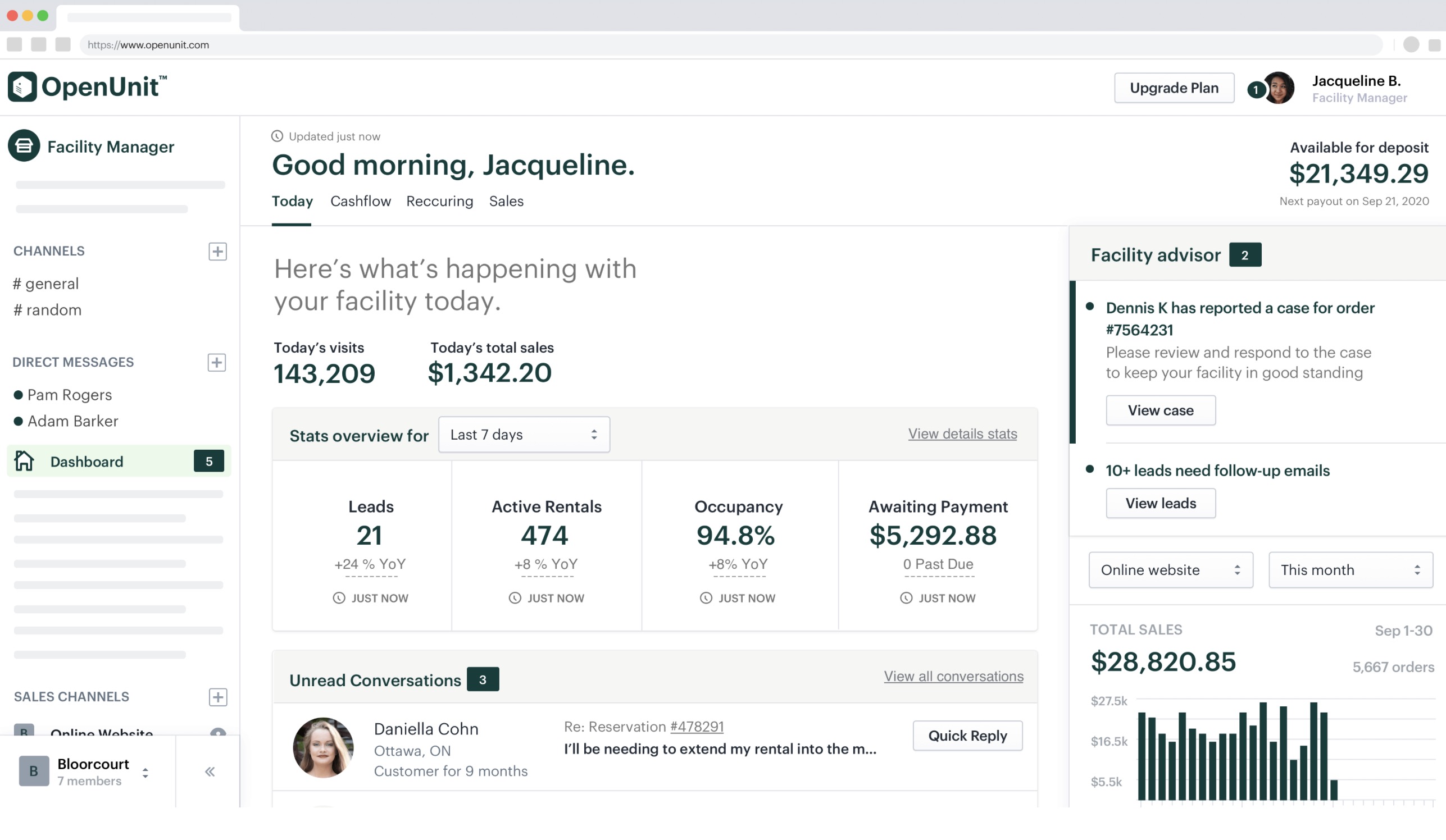
OpenUnit raises a $1M seed round to be the online face of self-storage

How are mom-and-pop self-storage facilities meant to keep up with the tech offered by the massive, ever-growing chains?

That’s a key part of the idea behind OpenUnit, a team I first wrote about in August of last year. You bring the storage units, they bring the website, payment processing, and backend tools you need to manage them. They don’t charge facility owners a monthly subscription fee, instead taking a cut of each payment as the payments processor.

OpenUnit has now raised a $1M seed round, and acquired the IP of a fellow YC company along the way.

Since we last heard from OpenUnit, they’ve been expanding to locations around the US and Canada and now have a waitlist over 800 facilities deep, the team tells me.

Image Credits: OpenUnit

OpenUnit co-founder Taylor Cooney was quick to point out that this seed round is as much about strategic partnerships as it is about the money. Neither Taylor nor co-founder Lucas Playford had much to do with the storage industry until a knock at the door led them down a rabbit hole. As I wrote back in August:

“…Taylor’s landlords came to him with an offer: they wanted to sell the place he was renting, and they’d give him a stack of cash if he could be out within just a few days. Pulling that off meant finding a place to keep all of his stuff while he looked for a new home, which is when he realized how antiquated the self-storage process could be.”

Of the 20+ investors participating in the round, 6 are from the self-storage industry, from prior/current facility owners to the Director of the Canadian Self Storage Association. For some of them, it’s their first time investing in a tech or software company — but all potentially bring something to the table beyond money.

Of course, that’s not to say they’re just letting that money sit around. They’ve grown the team from just Taylor and Lucas up to five, and are still looking to grow. Meanwhile, Taylor tells me that the company has acquired the IP of fellow Y Combinator W20 batchmate Affiga, a product that aimed to automatically provide insights about a new customer after a transaction is made.

Writes Taylor: “As self-storage companies move services like rentals, leases, and payments online, it’s becoming increasingly difficult for them to ‘know’ their customers. We see the integration into our product as a way to help self-storage operators bridge the gap between their online and in-store customer experiences, where the personal touch tends to be lost.”

Affiga initially shutdown its operations back in 2020. After OpenUnit realized they wanted something similar in their product, they set out to buy rather than build. “With a decade in e-commerce under their belt,” Taylor tells me, “their founder had a much better approach to this then we would’ve come up with.”

So what’s next? Besides getting more people off the waitlist and onto the platform, they’re exploring other opportunities, including potentially providing loans to facilities looking to expand or renovate. Because OpenUnit is both the management platform and the payments provider, they have deep insights on how a facility is doing; they know how much a location makes, how punctual their customers are with payments, etc. Take that data and mash it up with insights on what improvements can increase revenue, and it seems like a pretty straightforward formula.

This round includes investment from Garage Capital, Advisors Fund, Insite Property Group, SquareFoot co-founder Jonathan Wasserstrum, and a number of angel investors.

19 May 2021

5 innovative fundraising methods for emerging VCs and PEs

Approaching institutions to raise capital for your venture capital or private equity fund is relatively transparent, but what if you’re targeting family offices and high-net-worth individuals? I see five innovative new methods for raising capital that emerging managers such as Versatile VC are using, which I’ve ranked in roughly descending order of popularity:

  1. Join online communities and virtual conferences where investors participate.
  2. Use a platform that helps other investors access your fund.
  3. Generally solicit under the 506(c) designation.
  4. Launch a rolling fund.
  5. Crowdfund from retail investors into your general partnership.

Will Stringer, CEO of Chisos, feels most family offices won’t respond to cold outreach. “You need to build a true relationship with family office investors or other general partners that can make warm intros to family office decision-makers,” he says. “Family offices, more than any other allocator, rely on trust. [It’s] not always the case (and always changing), but today it’s still the majority.”

When you’re raising capital for a fund, you’re fundamentally selling a luxury good, which is seen as more valuable because it’s scarce. That’s part of the secret of the hedge fund industry’s success in gathering assets.

The obvious solution therefore is to get in touch with your friends who have earlier raised or pitched to the family offices. You may also find professional intermediaries who are willing to make an introduction to family offices.

That said, the five methods I outline below may be faster and more efficient.

Join online communities and virtual conferences where investors participate

To meet other VCs (some of which may become LPs), among your options are Confluence, Gen Z Mafia, InnovatorsRoom (European focus) and TechAviv (Israeli focus). To find others, see: How to find the right online communities. I maintain a proprietary database of the communities I’ve found most valuable, which I share with other members of the Versatile team.

These venues allow you to efficiently get in front of many pre-qualified investors and follow up with those who seem like a tight fit. Unsurprisingly, the best online communities are limited strictly to LPs. Ideally, you’d partner with an anchor/friendly LP who can pass the word on your fund to other potential investors.

In general, at virtual conferences, I recommend first fill out your online profile with all possible keywords and your photo. Side-channeling is powerful and is the equivalent of going into a corner at a conference and talking privately. Look up the profiles of all the people attending a conference or in an online community and send the relevant folks a customized message introducing yourself.

This is one of the primary advantages of virtual events versus traditional face-to-face conferences, where people do not conveniently wear a hat with their LinkedIn profile visible.

19 May 2021

Apple Watch gets a motion-controlled cursor with ‘Assistive Touch’

Tapping the tiny screen of the Apple Watch with precision has certain level of fundamental difficulty, but for some people with disabilities it’s genuinely impossible. Apple has remedied this with a new mode called “Assistive Touch” that detects hand gestures to control a cursor and navigate that way.

The feature was announced as part of a collection of accessibility-focused additions across its products, but Assistive Touch seems like the one most likely to make a splash across the company’s user base.

It relies on the built-in gyroscope and accelerometer, as well as data from the heart rate sensor, to deduce the position of the wrist and hand. Don’t expect it to tell a peace sign from a metal sign just yet, but for now it detects “pinch” (touching the index finger to the thumb) and “clench” (make a loose fist), which can act as basic “next” and “confirm” actions. Incoming calls, for instance, can be quickly accepted with a clench.

Most impressive, however, is the motion pointer. You can activate it either by selecting it in the Assistive Touch menu, or by shaking your wrist vigorously. It then detects the position of your hand as you move it around, allowing you to “swipe” by letting the cursor linger at the edge of the screen, or interact with things using a pinch or clench.

Needless to say this could be extremely helpful for anyone who only has the one hand available for interacting with the watch. And even for those who don’t strictly need it, the ability to keep one hand on the exercise machine, cane, or whatever else while doing smartwatch things is surely an attractive possibility. (One wonders about the potential of this control method as a cursor for other platforms as well…)

Memoji featuring new accessibility-focused gear.

Image Credits: Apple

Assistive Touch is only one of many accessibility updates Apple shared in this news release; other advances for the company’s platforms include:

  • SignTime, an ASL interpreter video call for Apple Store visits and support
  • Support for new hearing aids
  • Improved VoiceOver-based exploration of images
  • A built-in background noise generator (which I fully intend to use)
  • Replacement of certain buttons with non-verbal mouth noises (for people who have limited speech and mobility)
  • Memoji customizations for people with oxygen tubes, cochlear implants, and soft helmets
  • Featured media in the App Store, Apple TV, Books, and Maps apps from or geared towards people with disabilities

It’s all clustered around Global Accessibility Awareness Day, which is tomorrow, May 20th.

19 May 2021

A new tip line invites anyone to name and shame companies for dark pattern designs

You may not be familiar with the term “dark patterns” but the manipulative design phenomenon is ubiquitous in the apps and services we use every day.

Dark patterns nudge consumers to make choices that enrich companies, usually at their own expense. That can look like misleading wording that leads someone to sign their personal data away or a hidden button that results in a renewed subscription they’d probably rather cancel.

If you run across a sketchy dark pattern design, you can now report it on Darkpatternstipline.org, a dedicated site hosted by Consumer Reports. The new tip line is a joint project from the EFF, PEN America, Consumer Reports and Access Now, among other digital rights advocates.

Collecting dark pattern reports is an effort that could actually have teeth now, thanks to new laws taking aim at the manipulative design practice.

In March, California modified its landmark privacy law, the California Consumer Privacy Act (CCPA), to ban dark patterns in tech’s own backyard. “These protections ensure that consumers will not be confused or misled when seeking to exercise their data privacy rights,” California Attorney General Xavier Becerra said of the new regulations.

Even Congress is worried about dark patterns. In 2019, a bipartisan bill called the DETOUR Act sought to outlaw user interfaces “obscuring, subverting, or impairing user autonomy” for large companies with more than 100 million users. While that legislation didn’t go anywhere, coercive design choices are one of the many concerns that lawmakers have on their radar as they seek to implement new federal regulations for big tech companies.

For the tip line’s creators, flagging concerns for the regulators shaping tech policy is a priority. “If we want to stop dark patterns on the internet and beyond, we first have to assess what’s out there, and then use these examples to influence policymakers and lawmakers,” EFF Designer Shirin Mori said.

“We hope the Dark Patterns Tip Line will help us move towards more fair, equitable, and accessible technology products and services for everyone.”