Year: 2021

17 May 2021

Amazon makes its its lossless music streaming service a free upgrade

On the heels of this morning’s announcement of Apple’s next-generation music service featuring lossless audio and spatial audio with support for Dolby Atmos, Amazon is making a move likely aimed at retaining its own streaming music subscribers. The company says that going forward, its high-quality streaming tier, Amazon Music HD, will be made available to all eligible Amazon Music Unlimited subscribers at no extra cost.

Amazon first announced Amazon Music HD in fall 2019 with access to over 50 million songs that would stream in what Amazon is calling HD, with a bit depth of 16 bits, and a sample rate of 44.1kHz (around CD-quality). It also promised “millions” more songs that would stream in Ultra HD, or 24-bit, with a sample rate of up to 192kHz (or better than CD quality).

Today, Amazon Music’s HD catalog has grown to over 70 million songs and there are over 7 million Ultra HD tracks available. Amazon Music HD customers can also access a growing catalog of songs remixed in 3D Audio formats such as Dolby Atmos and Sony 360RA, which can be played back on Amazon’s own high-fidelity speaker, the Echo Studio.

Music in 360RA can also be streamed via Amazon Music HD on Sony’s RA5000 and RA3000 speakers by using Alexa Cast, the company notes.

The launch of HD streaming was seen as a way to counteract the threat from the music streaming service Tidal, which had been catering to audiophiles with higher quality streams, as well as a way to differentiate its service from larger streaming rivals, like Apple and Spotify — the latter which recently announced a high-end subscription of its own, Spotify HiFi, whose pricing and launch date is yet unknown.

Before today, Amazon Music HD was priced at $12.99 per month for Amazon Prime subscribers and $14.99 per month for anyone else. Now, Amazon says that new and existing subscribers to the Amazon Music Unlimited Individual Plan ($7.99/month for Prime members and $9.99/month otherwise) or the Family Plan ($14.99/month) can upgrade to Amazon Music HD at no additional cost — essentially a $5 per month savings.

The changes will kick in at the next billing cycle, and are supported in the U.S., U.K., Germany, Canada, France, Italy, and Spain.

“When we first launched Amazon Music HD, our goal was to lead the industry by enabling music fans around the world to stream the best quality recording, the way artists intended their music to be heard,” said Steve Boom, VP of Amazon Music, in a statement about today’s news. “We’re thrilled now to make Amazon Music HD available to everyone at no extra cost. All music fans should have access to this quality of music, and now they do,” he added.

The move by Amazon to make its HD catalog a free upgrade follows this morning’s announcement from Apple that it will add lossless audio to Apple Music at no additional cost, starting next month. The upgrade will also bring spatial audio with support for Dolby Atmos. Given the shift in the market, the pressure is on Spotify to make its HiFi music service competitively priced, as well.

17 May 2021

Equity Monday: Elon Musk Elon Musk’s the crypto markets, while Indian startups raise huge rounds

Hello and welcome back to Equity, TechCrunch’s venture capital-focused podcast where we unpack the numbers behind the headlines.

This is Equity Monday, our weekly kickoff that tracks the latest private market news, talks about the coming week, digs into some recent funding rounds and mulls over a larger theme or narrative from the private markets. You can follow the show on Twitter here and myself here.

There was lots to get through today, so, in order, here’s the rundown:

Equity drops every Monday at 7:00 a.m. PST, Wednesday, and Friday at 6:00 AM PST, so subscribe to us on Apple PodcastsOvercastSpotify and all the casts!

17 May 2021

Apple to add lossless audio to Apple Music at no additional cost

Apple has announced that it is adding some new features to its music streaming service Apple Music. Starting next month, users will find some new options, such as spatial audio with support for Dolby Atmos as well as lossless audio files.

Spotify recently announced a new high-end subscription tier with CD-quality, lossless audio files. But Spotify HiFi isn’t included in Spotify Premium by itself. You’ll have to pay a bit more money to stream lossless audio. Pricing hasn’t been disclosed yet.

Apple’s move is a bit different as lossless audio is going to be included in the basic Apple Music subscription tier. For $9.99 per month, you’ll be able to choose between various audio quality settings. By default, Apple and other streaming services compress audio files so that it doesn’t require a lot of bandwidth.

You can also choose CD-quality, lossless streaming — 16 bit at 44.1 kHz. In that case, you’ll receive lossless audio files. Behind the scenes, Apple uses its own lossless audio format (ALAC, Apple Lossless Audio Codec). But that shouldn’t have an impact as FLAC, WAV or ALAC files sound exactly the same — it’s lossless audio.

If you have a truly unlimited mobile plan, you can even choose 24 bit at 48 kHz or 24 bit at 192 kHz. In that case, the average weight of a song should be around 250MB — yep, that’s a lot of bytes. Apple says you have to use an external, USB digital-to-analog converter to take advantage of the hi-resolution lossless tier. Plugging a pair of headphones with your iPhone won’t cut it.

The entire Apple Music catalog of 75 million songs will support lossless audio. Music distributors already upload lossless audio files when they submit a song to streaming services. Adding lossless audio is all about surfacing those files to the end users.

As for spatial audio, it’ll be enabled by default on hardware that supports Dolby Atmos, such as AirPods and Beats headphones with an H1 or W1 chip. The most recent iPhone, iPad and Mac models also support Dolby Atmos. But it sounds like songs have to be remastered for Dolby Atmos specifically.

At first, only “thousands of songs” will support spatial audio. Artists include J Balvin, Gustavo Dudamel, Ariana Grande, Maroon 5, Kacey Musgraves and The Weeknd. You’ll be able to identify those tracks with a badge in the user interface.

17 May 2021

Gucci brings digital items and experiences to Roblox in new partnership

As gaming platforms capitalize on pandemic-fueled traffic to their digital worlds, brands that drive culture in the physical world are fighting to ensure they don’t miss any new opportunities. A new partnership between Roblox and Gucci brings digital items from the fashion house into the platform’s metaverse alongside a new limited-run digital experience.

Guccis new experience teams a set of virtual spaces with a set of digital branded items in an effort to immerse Roblox users inside a world that feels unique to the Gucci brand and Roblox platform. The new space, called Gucci Garden, debuts today for a two-week run on the Roblox platform.

The environment takes advantage of recent advances in the game engine powering Roblox, bringing users a high-dynamic set of environments that they can traverse as blank mannequins, which evolve visually as users move through different spaces. Different rooms in the experience draw influence from different Gucci campaigns of the past several years. The digital event’s rollout accompanies a real-world multimedia event in Florence.

The rollout follows an early pilot with creator Rook Vanguard in releasing Gucci-branded digital items to the platform this past December.

In an interview with TechCrunch, Gucci CMO Robert Triefus details how the luxury fashion brand has been redefining its approachability as it extends its reach to digital platforms like Roblox — which the company sees as an opportunity that’s growing too quickly to ignore.

“Hats off to Roblox, scale came quickly,” Triefus tells TechCrunch. “Gucci is scale, though it’s taken us 100 years, and it took Roblox about 100 days.”

For high-fashion brands, the digital sphere has presented plenty of challenges when it comes to preserving exclusivity on a medium that begs for mass adoption. Triefus says Gucci has aimed to lean into the access offered by digital platforms as a way of promoting a more inclusive brand.

“There’s so much talk today about the metaverse,” Triefus says. “In the last 6 years, [Creative Director Alessandro Michele] has created a Gucci Metaverse but it’s not necessarily a digital manifestation, it’s a narrative.”

Luxury and authenticity have been some of the central sells of blockchain-based NFTs, something Triefus still sees opportunities for down the road. “It’s astonishing to me how fast the conversation around NFTs has exploded,” Triefus says. “We’ve been studying blockchain for a long time as you might imagine, authenticity of product and of experience is extremely important.”

In addition to experiments with Roblox, late last year Gucci partnered with startup Genies to outfit user avatars.

Virtual items from real world retailers have been relatively slow to pop up inside digital worlds, though as user perceptions of paying for digital goods have shifted, platforms are moving to capitalize.

“We don’t partner with very many brands,” Roblox exec Christina Wootton tells TechCrunch. “One thing that was very special when we started speaking with Gucci is that they took the time to understand our platform and what works well for designers and creators in our community.”

17 May 2021

AT&T confirms deal to combine its WarnerMedia subsidiary with Discovery Inc in ‘pure play’ $43B deal

Another major telco in the US is making a big move away from being a full player in media services, and specifically content creation. Today AT&T said that it is combining its WarnerMedia division with Discovery Inc.

The deal is being structured as a “Reverse Morris Trust” transaction that will give AT&T $43 billion in a combination of cash, debt securities, and WarnerMedia’s retention of certain debt. The deal will see AT&T shareholders receive stock representing 71% of the new company, while Discovery shareholders will have 21%, the companies said in an announcement.

Discovery President and CEO David Zaslav will lead the new, combined company. Not clear what role Jason Kilar, the CEO of WarnerMedia currently, will have, but his name is not mentioned in the press release… He is currently the CEO now of Warner Media, AT&T CEO John Stankey confirmed in a press conference today..

The deal confirms rumors over the weekend, and it comes weeks after Verizon Communications announced that it would be selling off its own non-telecoms interests, Verizon Media, in a deal with Apollo Management in a $5 billion deal. (TechCrunch is a part of Verizon Media.) Zaslav said in a press conference with Stankey that the deal was hammered out in secret in “my Greenwich Village townhouse.”

In a press conference, executives from both firms said they expect the deal to be completed by mid-2022. They said they will be announcing a new name in due course, too.

At a time when streaming the name of the game in media — this is where consumers are watching, and they are watching in more ways than ever before such as phones and tablets, and that means not just classic media companies, but also a wide range of technology companies are also investing big here — this is creating nothing short of a content colossus.

It will include some 200,000 hours of iconic programming with more than 100 of the “most cherished, popular and trusted brands in the world”. These include HBO, Warner Bros., Discovery, DC Comics, CNN, Cartoon Network, HGTV, Food Network, the Turner Networks, TNT, TBS, Eurosport, Magnolia, TLC and Animal Planet. The companies confirmed that they plan to include news in the largely-entertainment focused group. They say it will have annual revenues of approximately $52 billion, with adjusted EBITDA of approximately $14 billion, and Free Cash Flow conversion rate of around 60% and “at least $3 billion in expected cost synergies.” (That will be a tough one to see play out… that is a lot of cuts.)

On the other side, it’s something of a retreat for AT&T, which spent years building out (and fighting regulators own) its Warner empire, which had been intended to be the telco’s big play to not just provide the network for people to interact with services — be it voice, broadband or mobile — but the content itself.

Yes, AT&T shareholders will still keep in 71% of the company, but this deal indicates that the company sees more value in building that body of content creation as its own entity independent of it. Not least, it will likely give those individual content companies significantly more empowerment for striking deals with other network providers without any vested interests in those deals. But in addition to that, it will free the media companies to explore which channels might be best for what they are producing, even when those channels might compete directly with AT&T.

In media and communications, there was a time when all people could talk about was “triple play” (TV, broadband and voice) and then “quad play” (adding in mobile) as the ideal suite of services to capture consumers and their entertainment and information appetites (and by association their media/advertising appetites). That’s proven to be a much more complicated dream to realise, however, so it’s no surprise to see the companies today touting what a great “pure play” deal this is for everyone.

“This agreement unites two entertainment leaders with complementary content strengths and positions the new company to be one of the leading global direct-to-consumer streaming platforms,” said AT&T CEO John Stankey in a statement. “It will support the fantastic growth and international launch of HBO Max with Discovery’s global footprint and create efficiencies which can be re-invested in producing more great content to give consumers what they want. For AT&T shareholders, this is an opportunity to unlock value and be one of the best capitalized broadband companies, focused on investing in 5G and fiber to meet substantial, long-term demand for connectivity. AT&T shareholders will retain their stake in our leading communications company that comes with an attractive dividend. Plus, they will get a stake in the new company, a global media leader that can build one of the top streaming platforms in the world.”

Zaslav and Discovery may have been a one-time competitor to the Warner empire but it’s a different tune now:

“During my many conversations with John, we always come back to the same simple and powerful strategic principle: these assets are better and more valuable together,” Zaslav said in a statement. “It is super exciting to combine such historic brands, world class journalism and iconic franchises under one roof and unlock so much value and opportunity. With a library of cherished IP, dynamite management teams and global expertise in every market in the world, we believe everyone wins…consumers with more diverse choices, talent and storytellers with more resources and compelling pathways to larger audiences, and shareholders with a globally scaled growth company committed to a strong balance sheet that is better positioned to compete with the world’s largest streamers. We will build a new chapter together with the creative and talented WarnerMedia team and these incredible assets built on a nearly 100-year legacy of the most wonderful storytelling in the world. That will be our singular mission: to focus on telling the most amazing stories and have a ton of fun doing it.”

17 May 2021

Reface now lets users face-swap into pics and GIFs they upload

Buzzy face-swapping video app Reface is expanding its reality-shifting potential beyond selfies by letting users upload more of their own content for its AI to bring to life.

Users of its iOS and Android apps still can’t upload their own user generated video but the latest feature — which it calls Swap Animation — lets them upload images of humanoid stuff (monuments, memes, fine art portraits, or — indeed — photos of other people) which they want animated, choosing from a selection of in-app song snippets and poems for the AI-incarnate version to appear to speak/sing etc.

Reface’s freemium app has, thus far, taken a tightly curated approach to the content users can animate, only letting you face swap a selfie into a pre-set selection of movie and music video snippets (plus memes, GIFs, red carpet celeb shots, salon hair-dos and more).

But the new feature — which similarly relies on GAN (generative adversarial network) algorithms to work its reality-bending effects — expands the expressive potential of the app by letting users supply their own source material to face swap/animate.

Some rival apps do already offer this kind of functionality — so there’s an element of Reface catching up to apps like Avatarify, Wombo and Deep Nostalgia.

But it’s also going further as users can also swap their own face into their chosen source content. So you could, for example, get to see yourself as a singing Venus de Milo, or watch your visage recite a poem from the middle of a pop-art painting like Andy Warhol’s Marilyn.

The Andreessen Horowitz-backed startup is still being cautious as it expands what users can do with its high tech face-shifting tool — saying it will be manually moderating all uploads from the new feature.

Rivals in the deepfake space are arguably pushing its hand to open up functionality faster, though, with apps like Avatarify already letting users animate their own snaps. And — notably — a Reface spokeswoman told us it’s planning to make user generated video uploads available “in the near future”.

Pro users are getting a little taster — as they can upload their own GIFs to face swap into with this latest feature release too.

“We’re really excited to see what Reface users do with swap-reenactment, which is a major technical milestone in terms of the machine learning technology inside of the app,” said CEO Dima Shvets in a statement. “Reface content creators have been clamoring for more tools for personalized content and self-expression – and this feature delivers, dramatically extending the opportunities for realizing their vision and creativity.” 

The still young app has proved popular over its short run, garnering viral buzz via social media shares as users were keen to show off their funny face swaps.

As of March 2021 Reface said it had 100M installs some 14 months since going live. 

17 May 2021

Fresh out of YC, Houm raises $8M to improve the home rental and sales market in LatAm

As a longtime real estate developer based in Chile, Benjamin Labra was able to spot gaps in the buying and renting markets in Latin America. To meet demands, he started Houm, an all-in-one platform that helps homeowners rent and sell their properties in the region.

Fresh out of Y Combinator’s W21 cohort, today Houm announced an $8 million seed round. 

If you think the concept sounds like Brazil’s unicorn, QuintoAndar, it’s because Houm is very similar. While QuintoAndar dominates the Brazilian market, Houm operates in Chile, Mexico and Colombia, and aims to capture the rest of Spanish-speaking LatAm.

Think of Houm as a homeowner-run Zillow meets TaskRabbit. The company offers a marketplace run by the property owners themselves and cuts out the realtor by employing 200 freelancers who prepare the property for sale or to manage it.

Houmers, as they are called, go to the owner’s home, take photos and then help possible buyers or renters view the property. For their work, Houmers are compensated each time a home they worked on sells or gets rented.

However, Houm’s selling proposition isn’t just the ease of use it provides; instead, it also serves as a guarantor in my ways, making the buying process more accessible.

“In Colombia and Mexico, for someone to be your guarantor, they have to have a property that’s free of mortgage so it can be used as collateral,” Labra told TechCrunch.

On the flip side, the company also guarantees that renters will get paid every month, and if a tenant falters, Houm covers the cost. “You really have nothing to lose if you use Houm,” Labra said.

You can imagine that a company like Houm now has all sorts of data on the real estate market, especially around sales and rental prices. As a result, Houm uses this data in an algorithm that helps the homeowner determine a fair price for their property, but the listed price remains up to the owner.

The company, which was founded in 2018 and is based in Chile, now has about 200 full-time employees, in addition to their freelance team. While Labra declined to say how many active users it has, he said Houm is now showing a property every eight minutes.

The current funding round had no lead investor but includes Y Combinator, Goodwater Ventures, OneVC, Vast VC, Liquid2 and Myelin. The company plans to use the money to expand within the region, perfect its algorithm and generally speed up growth.


17 May 2021

Sequoia leads $5M pre-seed in Egypt’s 1-month-old digital bank Telda

Egypt has a population of over 100 million people. The country has a high mobile and internet penetration vital to a young and tech-savvy population with 61% below 30. But despite its youthful population, two out of every three individuals are currently unbanked in Egypt. It’s the same situation in MENA, where only 40% of the population have access to a bank account.

Digital banks have enormous potential in the region. Today, a newly launched one, Telda is announcing a $5 million pre-seed round to digitize how Egyptians save, send, and spend money.

Two weeks ago, we reported that Egyptian e-commerce fulfillment startup Flextock had raised the largest pre-seed in MENA. But that has changed today with Telda’s fundraise surpassing that record with a considerable margin in both MENA and Africa (Autochek’s $3.4 million) for now.

Telda was launched last month by CEO Ahmed Sabbah and CTO Youssef Sholqamy. Before Telda, Sabbah was the co-founder and CTO of Egypt’s ride-hailing company Swvl, and Sholqamy, a former senior engineer in Uber’s infrastructure team. Sabbah said he and his co-founder had been looking at the fintech space at their former workplaces. However, after his experience using N26 while visiting a friend in Berlin in 2015, his eyes opened to the possibilities of digital banking in Egypt.

“I was fond of the idea, and it was coming from a huge pain of payments we had in Egypt and the region. And for me, I was kind of like waiting for this to happen in Egypt, or if not, I thought I’ll tap into the opportunity someday,” he told TechCrunch. “Youcef and I have been like watching out the space for a while when the first digital bank started like six years ago, and watching how they grew in markets where we think banking is more mature than this region. So imagine an opportunity in a region like Egypt where banking is even way, way less mature.”

The North African country is one of the highest consumer spending markets in Africa. Its private consumption accounts for nearly 85% of its nominal GDP, and only 4% of its overall GDP is cashless. In essence, Egypt is heavily cash reliant, and card usage in the country is very much in its infancy. Disheartened by the non-customer-centric banking experiences, Telda was launched to provide an alternative.
Telda

Image Credits: Telda

Like any digital bank globally, Telda enables customers to create a free account to send and receive money. And also a card to use online, in stores, make withdrawals and pay bills. But while the service is currently live, Telda cards are yet to be distributed to existing and new customers.

Telda affirmed that it is the first company to receive a license from the Central Bank of Egypt (CBE) under its new regulations to issue cards and onboard customers digitally. And by doing so, the one-month-old company has made major progress in a relatively short time, even though obtaining that license took lengthy dialogue with regulators.

“First movers will usually have to make all the effort with the regulators and with the bank and try to pave the way. So this was one of the hardest parts — convincing regulators to trust and regulate our banking business and to provide payment financial services to our consumers,” the CEO said. But because Telda’s proposition aligns with the CBE’s vision of digitizing payments in the country, it had little choice but to grant them the license.

A different issue the company has faced was finding a partner bank to provide these services. And to do that, Telda had to convince the bank that their services were complementary and wouldn’t entirely overlap.

“That means basically trying to be as much independent as possible from the infrastructure of the bank. This was quite crucial for us to be able to move right and as fast as a startup, not as slow and pretty much tied to the pace of the bank’s technology and operations,” he continued.

Due to the founders’ experience in Swvl and Uber, the importance of building a great team cannot be overemphasized. There’s barely any blueprint to look at in launching a digital bank in Egypt, so Telda is building how it knows best: hiring exceptional talent. According to the CEO, the team comprises Egyptians who returned to the North African country to build Telda after working for corporations like Facebook, Microsoft, Uber, Noon, and McKinsey.

MENA appears to be ripe for a digital banking experience. Per GSMA Intelligence, 280 million people in the region are mobile internet users, and growth is not slowing down. The frustration with traditional banks is particularly acute with the younger generation, who crave a simple, user-friendly, and transparent experience. Telda has been able to onboard an impressive list of investors, including Sequoia Capital, for this reason.

The giant US VC firm led the pre-seed round as Berlin-based Global Founders Capital (GFC) and emerging markets-focused fund Class 5 Global participated.

Although Sequoia has made a few Sub-Saharan African investments in startups like Healthlane and OPay, Telda is its first venture into North Africa and the wider GCC region. Eight years ago, the VC giant led an infamous seed investment in Latin American digital bank Nubank before it began to go full throttle. Now with more than 38 million customers, Nubank is the world’s largest digital bank with a valuation of $25 billion. Sequoia will be looking for a similar success story in Telda.

“There are many parallels between Brazil and Egypt. Both countries boast a large, young, talented, and tech-savvy population with a strong appetite to innovate,” said Sequoia Partner George Robson of the investment. “We are delighted to partner with Telda and earmark our first investment in the region.”

Telda intends to fast-track its card production and distribution with this new funding. The company said it currently has more than 30,000 signups already, with half of that already requesting cards. It also plans to capitalize on Sequoia’s name for hiring and expansion, the CEO continued.

I think hiring is key for us. We want to scale the team into a world-class team that’s willing to tap into the opportunity. What we aspire for is basically growing in Egypt, start to deliver cards for the early adopters, and we see ourselves reaching close to a million cards in our first year.”

Investments in Egypt have been growing in leaps and bounds over the past three years, accompanied by a growing, vibrant ecosystem. Egypt recorded the largest number of investment deals last year per Partech Africa. With 86 deals completed, the country contributed 24% to the total number of deals made on the continent

GFC partner Roel Janssen referring to the budding ecosystem in his statement, said: “We are highly impressed by Sabbah and Sholqamy and love their vision for building the region’s leading digital banking app, and we are proud to be part of their journey. It is GFC’s first investment in Egypt, and we see that Egypt has the potential to become an important hub in the global tech ecosystem.”

Class 5 global managing partner Youcef Oudjane said, Money has become a medium of self-expression — a form of identity — not solely a store of value. Telda has done a remarkable job of embedding their culture and values in the product, in both functionality and design.

17 May 2021

JD Logistics, China’s answer to Amazon’s logistics ambitions, to raise $3.4B from IPO

After operating in the red for 14 years, JD.com’s logistics subsidiary is getting ready for an initial public offering in Hong Kong. JD Logistics will price its share between HK$39.36 and HK$43.36 apiece, which could see the firm raise up to about HK$26.4 billion or $3.4 billion, according to its new filing.

JD.com, Alibaba’s e-commerce rival in China, began building its own logistics and transportation network from the ground up in 2007 and spun out the unit in 2017, following a pattern where major segments of the tech giant became independent, such as JD.com’s health and fintech units. JD.com is currently the largest shareholder of JD Logistics with an aggregate stake of 79%.

Unlike Alibaba, which relies on a network of third-party partners to fulfill orders, JD.com takes a heavy-asset approach like Amazon, building up warehouse centers and keeping its own army of courier staff. As of 2020, JD Logistics had over 246,800 employees working in delivery, warehouse operations among other customer services. Its total headcount was 258,700 last year.

A major strategic decision JD Logistics made once it became independent was opening its technologies to external customers beyond the scope of JD.com’s own demand, helping retailers like Skechers optimize their logistics operations. As a result, the share of its revenue from external customers rose from 29.9% in 2018 to 38.4% in 2019, and to 43.4% in the nine months ended September 2020.

“Our growth strategy is partially based on the assumption that the trend toward outsourcing of supply chain services will continue,” the firm said in its prospectus.

“Third-party service providers like us are generally able to provide such services more efficiently than otherwise could be provided ‘in-house,’ primarily as a result of our expertise, technology and lower and more flexible employee cost structure.”

But retailers may switch to in-house supply chain operations themselves if they see risks in relying on third-party providers, the company added.

The main selling point of JD Logistics is its same- or next-day delivery, thanks to warehouses it keeps close to end consumers. It said about 90% of the total orders it processed were delivered on the same or next day in 2020.

Such user experience comes at a substantial cost for JD Logistics, though losses are shrinking. The firm posted a net loss of 2.8 billion yuan, 2.2 billion yuan and 11.7 million yuan in 2018, 2019 and for the nine months ended September 30, 2020, respectively.

Its gross profit margin improved from 8.5% during the nine months ended September 30, 2019 to 10.9% for the same period in 2020, primarily due to economies of scale, better operational efficiency, and government subsidies for reductions in social security funds contributed by employers and waivers of toll charges during COVID-19.

JD Logistics reached into instant delivery by partnering with Dada, a Chinese last-mile delivery service, to form JDDJ, short for “JD Arrives Home” in Chinese. JDDJ has been Walmart’s on-demand delivery service provider in China since 2016.

17 May 2021

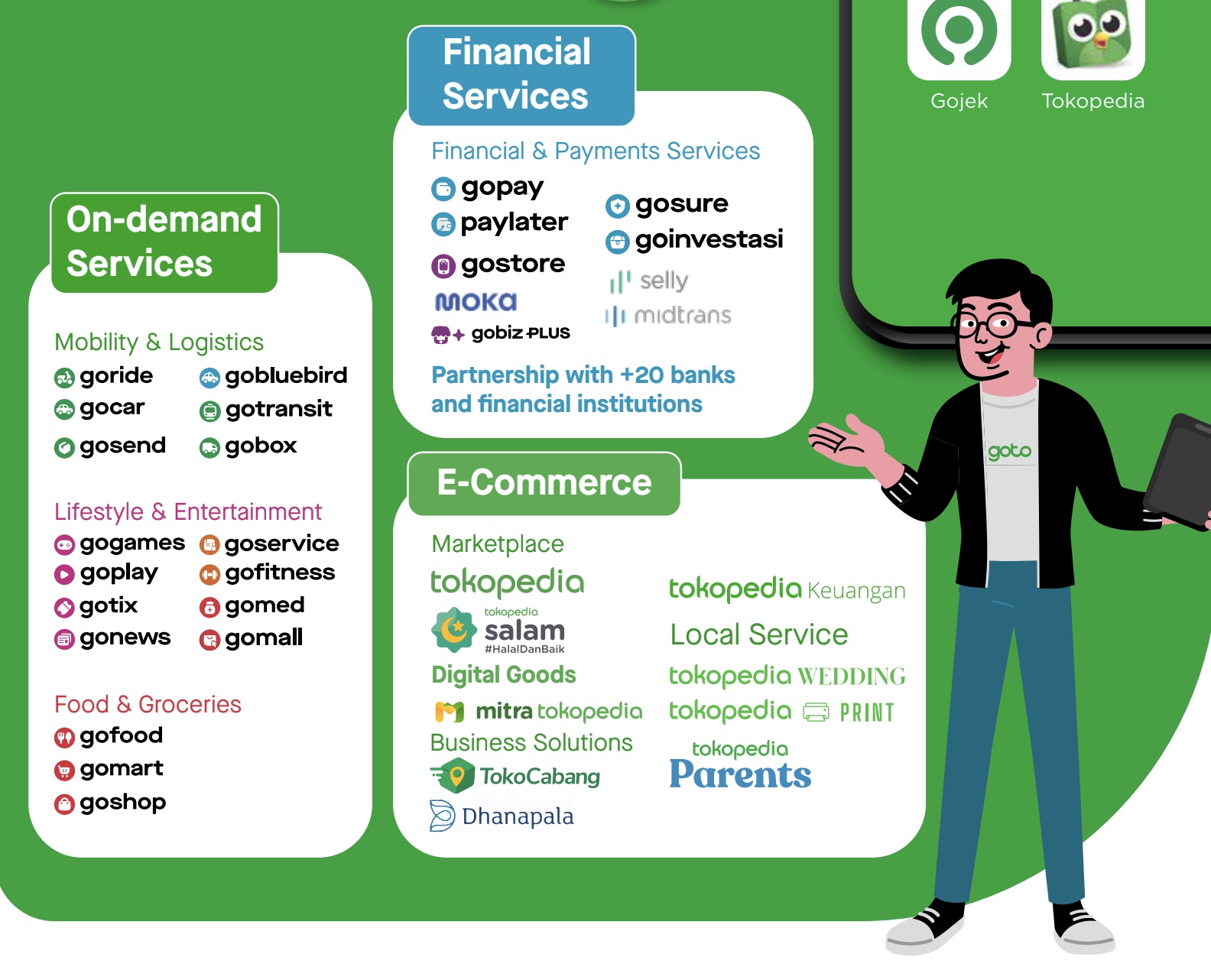
Gojek and Tokopedia merge to form GoTo Group

Ride-hailing giant Gojek and marketplace Tokopedia said on Monday they have combined their businesses to form GoTo Group, the largest technology group in Indonesia.

Gojek’s Andre Soelistyo will lead the combined business as GoTo Group CEO, with Tokopedia’s Patrick Cao serving as GoTo Group President. Kevin Aluwi will continue as CEO of Gojek and William Tanuwijaya will remain CEO of Tokopedia, the two firms said in a joint announcement.

The combined entity, valued at about $18 billion, is “a globally unique and highly complementary ecosystem,” the two firms said. It features:

  • Total Group Gross Transaction Value (GTV) of over US$22 billion in 2020
  • Over 1.8 billion transactions in 2020
  • Total registered driver fleet of over two million as of December 2020
  • Over 11 million merchant partners as of December 2020
  • Over 100 million monthly active users (MAU)
  • An ecosystem that encompasses 2% of Indonesia’s GDP

The deal, which has been in the works for several months, comes after Gokek spent several quarters exploring a merger with its chief Southeast Asian rival Grab.

“Today is a truly historic day as we mark the beginning of GoTo and the next phase of growth for Gojek, Tokopedia and GoTo Financial. Gojek drivers will deliver even more Tokopedia packages, merchant partners of all sizes will benefit from strengthened business solutions and we will use our combined scale to increase financial inclusion in an emerging region with untapped growth potential. For the consumer, GoTo Group will continue to reduce frictions and provide best in class delivery of goods and services. This is the next step of an exciting journey and I am humbled and proud to lead the GoTo movement,” said Andre Soelistyo, CEO of GoTo Group, in a statement.

Tokopedia’s Co-founder and CEO William Tanuwijaya said, “The establishment of GoTo Group proves that you can believe in an ‘Indonesian dream’ and make it a reality. Our goal has always been to build a company that creates social impact at scale, levelling the playing field for small businesses and giving consumers equal access to goods and services across the country. In addition to accelerating the growth of Indonesia’s digital economy, GoTo Group will make it easier for people from all walks of life to access quality products and services, anytime and anywhere. We still have a long way to go to achieve our goals, but today is about starting that journey together.”

This is a developing story. More to follow…