
Year: 2021

13 May 2021

Software subscriptions are eating the world: Solving billing and cash flow woes simultaneously

Although recurring revenue businesses have been around for a long time, the trend toward a subscription economy has escalated rapidly in the last few years. IDC expects that by 2022, 53% of all software revenue will be purchased with a subscription model. Even the car subscription market is set to grow by 71% by 2022.

Many types of businesses are looking for ways to earn recurring revenue — and it has gone beyond business-to-consumer companies like Netflix and Dollar Shave Club. Business-to-business companies are also joining in, even those with products that last a long time. For instance, elevator-maker Otis offers Otis ONE, a subscription-connected elevator solution that offers predictive maintenance insights.

Subscription billing options should make it easy to manage all types of subscriptions, including integrating analytics to provide a more complete picture of the subscriptions landscape.

Promising, but there are pitfalls

Subscription business models are attractive, but there are two major pitfalls. At the top of the list is payment. Regardless of company size, there’s an ongoing need to convince customers to sign up long term.

Companies also need to accommodate new payment methods and ensure ongoing compliance with interstate and international tax laws. As a result, the payment process can quickly become painful.

As any company with recurring revenue scales, it becomes increasingly challenging to manage subscriptions, especially with homegrown systems, changing subscription offers and the complexities of converting customers from free trials to paid subscriptions. Subscription billing options should make it easy to manage all types of subscriptions, including integrating analytics to provide a more complete picture of the subscriptions landscape.

Businesses also have to keep in mind that every time they add more product categories or expand into new geographies, they need to tack on extra software code to change their operations and stay sales-tax-compliant. As they expand globally, this can become an obstacle to rapid growth and flexibility.

To keep the company focused and maintain growth without having to expend resources, subscription businesses need a specialized billing system so they can focus on customer acquisition and revenue growth rather than staying on top of billing complexity.

The CAC payback gap constrains growth

The second issue: How do businesses cover the funding gap between when customers sign up and when they pay? In the subscription economy, companies that would previously receive a customer’s payments all at once now earn revenue spread across a monthly or quarterly subscription fee.

13 May 2021

China’s autonomous vehicle startups AutoX, Momenta and WeRide are coming to TC Sessions: Mobility 2021

As the autonomous vehicle industry in the United States marches towards consolidation, a funding spree continues to exhilarate China’s robotaxi industry. Momenta, Pony.ai, WeRide, and Didi’s autonomous vehicle arm have all raised hundreds of millions of dollars over the past year. 21-year-old search engine giant Baidu competes alongside the startups with a $1.5 billion fund launched in 2017 to help cars go driverless.

Their strategies are similar in some regards and diverge elsewhere. The biggest players have deployed small fleets of robotaxis, manned with safety drivers, onto certain urban roads and are diligently testing driverless vehicles inside pilot zones. Some companies embrace lidars to detect the cars’ surroundings while others agree with Elon Musk on a vision-only future.

The industry is still years from being truly driverless and operational at scale, so some contestants are seeking easier cases to tackle and monetize first, putting self-driving software inside buses, trucks and tractors that roam inside industrial parks.

Will investors continue to back the lofty dreams and skyrocketing valuations of China’s robotaxi leaders? And how is China’s autonomous driving race playing out differently from that in the U.S.?

We hope to find out at the upcoming TC Sessions: Mobility 2021, where we speak to three female leaders from Chinese autonomous vehicle startups that have an overseas footprint: Jewel Li from AutoX, which is backed by Chinese state-owned automakers Dongfeng Motor and SAIC Motor; Huan Sun from Momenta, which attracted Bosch, Daimler and Toyota in its $500 million round closed in March; and Jennifer Li from WeRide, of which valuation jumped to $3 billion after a financing round in May.

We can’t wait to hear from this panel! Among the growing list of speakers at this year’s event are GM’s VP of Global Innovation Pam Fletcher, Scale AI CEO Alexandr Wang, Joby Aviation founder and CEO JoeBen Bevirt, investor and LinkedIn founder Reid Hoffman (whose special purpose acquisition company just merged with Joby), investors Clara Brenner of Urban Innovation Fund, Quin Garcia of Autotech Ventures and Rachel Holt of Construct Capital, Starship Technologies co-founder and CEO/CTO Ahti Heinla, Zoox co-founder and CTO Jesse Levinson, community organizer, transportation consultant and lawyer Tamika L. Butler, Remix co-founder and CEO Tiffany Chu and Revel co-founder and CEO Frank Reig.

Stay tuned for more announcements in these final weeks. Book your general admission pass for $125 today and join this year’s deep dive into the world of all things transportation at TC Sessions: Mobility.

13 May 2021

Google Analytics prepares for life after cookies

As consumer behavior and expectations around privacy have shifted — and operating systems and browsers have adapted to this — the age of cookies as a means of tracking user behavior is coming to an end. Few people will bemoan this, but advertisers and marketers rely on having insights into how their efforts translate into sales (and publishers like to know how their content performs as well). Google is obviously aware of this and it is now looking to machine learning to ready its tools like Google Analytics for this post-cookie future.

Last year, the company brought several machine learning tools to Google Analytics already. At the time, the focus was on alerting users to significant changes in their campaign performance, for example. Now, it is taking this a step further by using its machine learning systems to model user behavior when cookies are not available.

headshot of Vidhya Srinivasan, VP/GM, Advertising at Google

Vidhya Srinivasan, VP/GM, Advertising at Google

It’s hard to underestimate the importance of this shift, but according to Vidhya Srinivasan, Google’s VP and GM for Ads Buying, Analytics and Measurement who joined the company after a long stint at Amazon two years ago (and IBM before that), it’s also the only way to go.

“The principles we outlined to drive our measurement roadmap are based on shifting consumer expectations and ecosystem paradigms. Bottom line: the future is consented. It’s modeled. It’s first-party. So that’s what we’re using as our guide for the next gen of our products and solutions,” she said in her first media interview after joining Google.

It’s still early days and a lot of users may yet consent and opt in to tracking and sharing their data in some form or another. But the early indications are that this will be a minority of users. Unsurprisingly, first-party data and the data Google can gather from users who consent becomes increasingly valuable in this context.

Because of this, Google is now also making it easier to work with this so-called ‘consented data’ and to create better first-party data through improved integrations with tools like the Google Tag Manager.

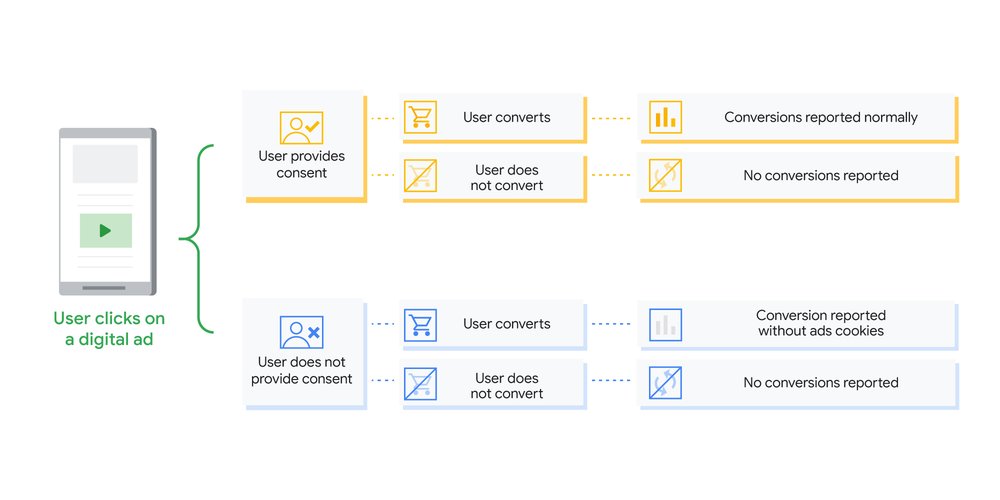
Last year, Google launched Consent Mode, which helps advertisers manage cookie behavior based on local data-protection laws and user preferences. For advertisers in the EU and in the U.K., Consent Mode allows them to adjust their Google tags based on a user’s choices and soon, Google will launch a direct integration with Tag Manager to make it easier to modify and customize these tags.

How Consent Mode works today.

What’s maybe more important, though, is that Consent Mode will now use conversion modeling for users who don’t consent to cookies. Google says this can recover about 70% of ad-click-to-conversion journeys that would otherwise be lost to advertisers.

In addition, Google is also making it easier for bring in first-party data (in a privacy-forward way) to Google Analytics to improve measurements and its models.

“Revamping a popular product with a long history is something people are going to have opinions about – we know that. But we felt strongly that we needed Google Analytics to be relevant to changing consumer behavior and ready for a cookie-less world – so that’s what we’re building,” Srinivasan said. “The machine learning that Google has invested in for years — that experience is what we’re putting in action to drive the modeling underlying this tech. We take having credible insights and reporting in the market seriously. We know that doing the work on measurement is critical to market trust. We don’t take the progress we’ve made for granted and we’re looking to continue iterating to ensure scale, but above all we’re prioritizing user trust.”


13 May 2021

These are the 25 companies presenting at Alchemist Accelerator’s 27th Demo Day today

Enterprise-focused Alchemist Accelerator is back with another one. Today marks its 27th Demo Day, with over two dozen companies expected to take the (virtual) stage.

Coming in at 25 companies, this is Alchemist’s largest cohort so far. Meanwhile, Alchemist Director Ravi Belani tells me that applications to the accelerator have grown by over 100%, and that their portfolio has raised a collective $1.4B to date.

In addition to debuting its Demo Day teams, Alchemist also shared some news: it has launched a new endeavor called “AlchemistX“, which will tap the tools/network of the accelerator to help corporations (beginning with Japan’s NEC) develop spinout companies from their in-house R&D. AlchemistX will be led by Rachel Chalmers, who was most recently a Director at Autodesk and a Venture Partner at Merian Ventures.

As with the last few Alchemist demo days, today’s event is entirely virtual; you can find a livestream of it here beginning at 10:30 AM Pacific.

Here are the companies that will debut today, in the order they’re expected to present:

  • Metabob: An AI tool meant to help you figure out where bugs could be in Python code. As a spinout of NEC, this is the first company to go through as part of the aforementioned AlchemistX program.
  • Laundris: A platform meant to help hotels better manage their linens, predict needs, and handle procurement.
  • Utrust: Helps businesses more easily accept and manage cryptocurrency payments
  • EVE: A dashboard to help companies take their vehicle fleets electric, outlining charging status and costs.
  • Measurecare: Building a dataset of radiology imaging meant for use with AI/Machine Learning. They’ve built a ReCaptcha-style system wherein their partner radiologists help to authenticate and label radiology images through “peer review” to further improve the data.
  • Eunimart Crossborder: Automated tools to help small-to-medium sized businesses expand into new regions, determine the right pricing, and identify popular competing products in a region.
  • Growfitter: An “incentivized wellness” platform for India. Growfitter works with local fitness centers to encourage users to become members, then gives them rewards/cashback incentives for physical activity.
  • Bitreel: Builds customizable 3D showrooms to showcase products, effectively aiming to turn that IKEA trip into a more video game-like experience. The company says its 3D viewer works in any modern browser.
  • Ahura AI: Ahura says it “recreates the one-to-one tutoring experience with machine learning”; more specifically, it aims to adapt employee training programs for each employee’s learning style in real time.
  • Ant Media: A low latency (~0.5 seconds) streaming platform meant to be easily deployed on AWS, Azure, etc.
  • In-Pipe Robot: As the name suggests, it’s a robot that goes in pipes. Focusing on industrial/utility/chemical companies, their robots are built to navigate complex pipe structures to more efficiently handle inspections, 3d mapping, etc.
  • Refactr: An automation platform meant to help a company’s cybersecurity and DevOps teams work together more easily.
  • Stargazr: AI-heavy tools meant to help finance teams with forecasting
  • Inanna Fertility: Applies machine learning algorithms to a patient’s data with the goal of improving the success rate in in vitro fertilization.
  • Chatalytic: Building AI to automatically gauge success in customer support conversations (voice/chat), and automatically identify “trending” support topics to potentially flag issues more quickly.
  • Bloom Behaviours: A platform meant to help teams work better together, and to help team leaders identify what team members see as each other’s strongest traits
  • Sif Homes: Combining the concept of Powerline adapters and mesh networking to build Wifi hotspots that communicate over your home’s existing electrical wiring.
  • Verdi: Platform and irrigation hardware to help farmers water/fertilize based on an individual plant’s needs, meant to reduce water waste and improve crop yield.
  • Geecko: Building “programming games” meant to be incorporated into the hiring process.
  • Delight: A platform meant to simplify the process of adding a referral program to your e-commerce shop.
  • VIPFicated: “Verification as a service”, aiming to handle product authentication for the increasing number of second-hand resale platforms.
  • Siro: A tool meant to help sales managers more actively and efficiently coach their sales reps by automatically identifying “coachable moments” in client conversations.
  • Stratodyne: Builds high-resolution aerial images from blimps; can help, for example, farmers identify issues that are more easily spotted from above.
  • Navvisa: A telehealth concierge, paid for as an employee benefit, meant specifically to help those diagnosed with cancer navigate the care process.
  • Neuronix AI: Aiming to reduced the cost and power consumption of computer vision-based AI.
13 May 2021

Busy day at VMware ended yesterday with Ragurham as CEO and COO Poonen exiting

They say for every door that opens another closes and the executive shuffle at VMware is certainly proving that old chestnut true. Four months after Pat Gelsinger stepped down as CEO to return to run Intel, the virtual machine pioneer announced yesterday that long-time exec Raghu Raghuram was taking over that role.

That set in motion another change when COO Sanjay Poonen, whom some had speculated might get the CEO job, announced yesterday afternoon on Twitter that he was leaving the company after 7 years.

Coincidence? We think not.

Holger Mueller, an analyst at Constellation Research says that he was surprised that Poonen didn’t get the job, but perhaps the VMware board valued Raghuram’s product focus more highly. “At 50, he [would have been] a long term solution, and he did a great job on the End User Computing (EUC) side of the product before becoming COO. I guess that it is still not VMware’s core business,” he said.

Regardless, Mueller still liked the choice of Raghuram as CEO, saying that he brought stability and reliability to the position, but he sees him likely as a solid interim solution for several years as the company spins out from Dell and becomes an fully independent organization again.

“Obviously the board wanted to have someone who knows product, and has been there a long time, and is associated with the VMware core success — so that creates relatability [and stability].” He added, “At 57 he is the transitional candidate, and a good choice, a veteran who is happy to run this 2-3 or maybe 5 years and won’t go anywhere [in the interim]. And the board has time to find a long-term solution,” Mueller told me.

Mark Lockwood, lead analyst on VMware at Gartner sees Raghuram as the right man for the job with no reservations, one who will continue to implement the current strategy while putting his own stamp on the position.

“That the VMware board chose someone in Raghu Raghuram who has been the technical strategy executive inside the company for years speaks volumes about the board’s comfort level with the existing strategy trajectory of the company. Mr. Raghuram will most certainly steer the company slightly differently than Mr. Gelsinger did, but at least from the outside, the CEO appointment appears to be a stamp of approval on the company’s broad portfolio,” Lockwood said.

As for Poonen, he says that the writing was on the wall when he didn’t get the promotion. “Although Sanjay Poonen has indeed been a valuable executive for VMware, it was always unlikely that he would remain if not chosen for the CEO role,” Lockwood said.

Stephen Elliot, an analyst at IDC, was also bullish on the Raghuram appointment, saying he brings a broad understanding of the company, and that’s important to VMware right now. “He understands VMware customers, the technologies, M&A, and the importance of execution and its impact on profitable growth. He has been central to almost every successful strategy the company has created, and been a leader for product strategy and execution. He has a very good balance of making tactical and strategic moves to anticipate the value VMware can deliver for customers in a 1-3 year horizon,” Elliot said.

Elliot thinks Poonen will be just fine and will find a landing spot pretty quickly. “He is another very talented executive; he will become a CEO elsewhere, and another company will be very lucky,” he said. He says that it will take time to see if there is any impact from that, but he believes that VMware shouldn’t have trouble attracting other executive talent to fill in any gaps.

For every every executive move, there are choices for replacements, and subsequent fall-out from those choices. We saw a full-fledged example of that yesterday on display at VMware. If these industry experts are right, the company chose stability and reliability and a deep understanding of product. That would seem to be solid enough reasoning on the part of the board, even though Poonen leaving seems to be collateral damage from the decision, and a big loss for the company.

13 May 2021

Google Cloud Run gets committed use discounts and new security features

Cloud Run, Google Cloud’s serverless platform for containerized applications, is getting committed use discounts. Users who commit to spending a given amount on using Cloud Run for a year will get a 17% discount on the money they commit. The company offers a similar pre-commitment discount scheme for VM-based Compute Engine instances, as well as automatic ‘sustained use‘ discounts for machines that run for more than 25% of a month.

In addition, Google Cloud is also introducing a number of new security features for Cloud Run, including the ability to mount secrets from the Google Cloud Secret Manager and binary authorization to help define and enforce policies about how containers are deployed on the service. Cloud Run users can now also now use and manage their own encryption keys (by default, Cloud Run uses Google-managed keys) and a new Recommendation Hub inside of Cloud Run will now offer users recommendations for how to better protect their Cloud Run services.

Aparna Sinha, who recently became the director of product management for Google Cloud’s serverless platform, noted that these updates are part of Google Cloud’s push to build what she calls the “next generation of serverless.’

“We’re really excited to introduce our new vision for serverless, which I think is going to help redefine this space,” she told me. “In the past, serverless has meant a certain narrower type of compute, which is focused on functions or a very specific kind of applications, web services, etc. — and what we are talking about with redefining serverless is focusing on the power of serverless, which is the developer experience and the ease of use, but broadening it into a much more versatile platform, where many different types of applications can be run, and building in the Google way of doing DevOps and security and a lot of integrations so that you have access to everything that’s the best of cloud.”

She noted that Cloud Run saw “tremendous adoption” during the pandemic, something she attributes to the fact that businesses were looking to speed up time-to-value from their applications. IKEA, for example, which famously had a hard time moving from in-store to online sales, bet on Google Cloud’s serverless platform to bring down the refresh time of its online store and inventory management system from three hours to less than three minutes after switching to this model.

“That’s kind of the power of serverless, I think, especially looking forward, the ability to build real-time applications that have data about the context, about the inventory, about the customer and can therefore be much more reactive and responsive,” Sinha said. “This is an expectation that customers will have going forward and serverless is an excellent way to deliver that as well as be responsive to demand patterns, especially when they’re changing so much in today’s uncertain environment.”

Since the container model gives businesses a lot of flexibility in what they want to run in these containers — and how they want to develop these applications since Cloud Run is language-agnostic — Google is now seeing a lot of other enterprises move to this platform as well, both for deploying completely new applications but also to modernize some of their existing services.

For the companies that have predictable usage patterns, the committed use discounts should be an attractive option and it’s likely the more sophisticated organizations that are asking for the kinds of new security features that Google Cloud is introducing today.

“The next generation of serverless combines the best of serverless with containers to run a broad spectrum of apps, with no language, networking or regional restrictions,” Sinha writes in today’s announcement. “The next generation of serverless will help developers build the modern applications of tomorrow—applications that adapt easily to change, scale as needed, respond to the needs of their customers faster and more efficiently, all while giving developers the best developer experience.”

13 May 2021

Chef Robotics raises $7.7M to help automate kitchens

A year and a half’s worth of global pandemic has had a profound impact on virtually every sector of the workforce. When it comes to future automation food prep isn’t quite at the top of the list (that distinction likely goes to warehouse fulfillment, for the time being), but it’s certainly up there. And it’s easy to see why the events of 2020 and beyond have left many kitchens looking for alternative sources of labor.

San Francisco-based Chef Robotics today announced that it has raised a combined $7.7 million pre-seed and seed round, with the goal of helping automate certain aspects of food preparation. The list of investors is pretty long on this one (with seed and pre-seed rolled up into one), including Kleiner Perkins, Promus Ventures, Construct, Bloomberg Beta, BOLD Capital Partners, Red and Blue Ventures, Gaingels, Schox VC, Stewart Alsop and Tau Ventures, among others.

The product team includes ex-employees of Cruise, Google, Verb Surgical, Zoox, and Strateos. Chef’s team isn’t quite ready to show off its robot just yet (hence generic kitchen stock photo #8952 up top) – not entirely unusual for a robotics company still in the early stages. What it has outlined, thus far, is a robotics and vision system destined to increase production volume and enhance consistency, while removing some food waste from the process. Fast casual restaurants appear to be a key focus for this sort of tech.

The company describes it thusly,

Chef is designed to mimic the flexibility of humans, allowing customers to handle thousands of different kinds of food using minimal hardware changes. Chef does this using artificial intelligence that can learn how to handle more and more ingredients over time and that also improves. This allows customers to do things like change their menu often. Additionally, Chef’s modular architecture allows customers to quickly scale up just as they would by hiring more staff (but unlike humans, Chef always shows up on time and doesn’t need breaks).

More details on the underlying tech soon, no doubt.


13 May 2021

Legionfarm, pairing pro gamers with amateurs, raises $6 million Series A

Legionfarm, the gaming platform that lets gamers play with pro players in their favorite games, has today announced the close of a $6 million Series A round. Investors in the round include SVB, Y Combinator, Scrum VC, Kevin Lin, Altair Capital, Ankur Nagpal and more.

Legionfarm launched out of Y Combinator at the beginning of last year with a mission to give pro players a way to generate income and amateur players the chance to get better by playing with a pro coach. It started out with an a la carte business model but has since added a subscription product.

It either costs $12/hour to play on an individual session basis (one hour of play) or you can pay $25 or $50/month. That gives gamers access to discounted prices for pros and unlimited sessions with pros who are brand new to the platform, which Legionfarm calls ‘rookies’.

The company was founded by Alex Belyankin, who is a former pro gamer and was once in the top .01 percent of World of Warcraft players. There are many, many pro caliber players out in the world who can’t necessarily make a living off of gaming. They either have to be signed by an org (super limited supply) or play in as many tournaments as possible (unreliable) or stream on Twitch.

Legionfarm gives these pros the opportunity to earn a living playing the games they love.

Meanwhile, gamers are always looking to get better but don’t often have the environments in a game to do so, particularly in Battle Royale games. Legionfarm, which supports a couple of the biggest BRs (Call of Duty: Warzone and Apex Legends), allows these players to team up with pros and learn from them.

The startup is also running a hardware support program, which lets pros on the platform effectively rent gear by paying for it over time in installments that come directly out of their earnings each month.

“Recently, we’ve learned that one pro player can acquire seven or more new customers to the platform if we work with the pro properly,” said Belyankin. “That’s the biggest growth point for us and the biggest challenge. We don’t need to demand in the performance channels, but through existing supply. If we manage to build some sustainable processes here, I think we’re going to skyrocket because we see some huge potential here.”

13 May 2021

Short seller says Lemonade website bug exposed insurance customers’ account data

An activist short seller has written a letter to the chief executive of insurance giant Lemonade with details of an “accidentally discovered” security flaw that exposes customers’ account data.

Carson Block, founder of investment research firm Muddy Waters Research, sent the letter to Lemonade co-founder and chief executive Daniel Schreiber on Thursday, describing the bug that allowed anyone to inadvertently access personally identifiable data from customers’ accounts as “unforgivably negligent.”

Block’s letter said: “By clicking on search results from public search engines, we shockingly found ourselves logged in to and able to edit Lemonade customers’ accounts without having to provide any user credentials whatsoever.”

Lemonade launched in 2015 and offers renters’, homeowners’ and pet insurance policies across the U.S. and Europe. The company went public last year and saw its shares rocket by more than 130% on the day of its initial public offering. Lemonade this week reported a $49 million quarterly loss, deeper than what Wall Street was expecting.

The bug was co-discovered by Muddy Waters Research and Wolfpack Research, Block said. In a tweet, Wolfpack lead analyst Reed Sherman said one of Muddy Waters’ security experts “was able to send me a PDF of my renter’s insurance policy less than 15 minutes after this was first discovered.”

Block told TechCrunch that his firm is shorting the company’s stock, per his letter, “because it is clear Lemonade does not give a fuck about securing its customers’ sensitive personal information.” Block said in his letter that Lemonade should “shut down its website, APIs, and mobile application” until the issue is fixed, which he says may date back to July 2020.

Block published his letter to Lemonade with redactions as to not give away specific details of the bug. In a call, Block provided more details about the bug to TechCrunch in order to verify the vulnerability. One indexed search result let us log into a person’s Lemonade account and view their name, address, and quote details without ever asking for the user’s password.

A short time later, some of the indexed results stopped working. TechCrunch asked Lemonade for comment but did not hear back prior to publication. We’ll update when we do.

13 May 2021

Sylvera grabs seed backing from Index to help close the accountability gap around carbon offsetting

UK-based startup Sylvera is using satellite, radar and lidar data-fuelled machine learning to bolster transparency around carbon offsetting projects in a bid to boost accountability and credibility — applying independent ratings to carbon offsetting projects.

The ratings are based on proprietary data sets it’s developed in conjunction with scientists from research organisations including UCLA, the NASA Jet Propulsion Laboratory, and University College London.

It’s just grabbed $5.8M in seed funding led by VC firm Index Ventures. All its existing institutional investors also participated — namely: Seedcamp, Speedinvest and Revent. It also has backing from leading angels, including the existing and former CEOs of NYSE, Thomson Reuters, Citibank and IHS Markit. (It confirms it has committed not to receive any investment from traditional carbon-intensive companies when as ask.) And it’s just snagged a $2M research contract from Innovate UK.

The problem it’s targeting is that the carbon offsetting market suffers from a lack of transparency.

This fuels concerns that many offsetting projects aren’t living up to their claims of a net reduction in carbon emissions — and that ‘creative’ carbon accountancy is rather being used to generate a lot of hot air: In the form of positive sounding PR which sums to meaningless greenwashing and more pollution as polluters get to keep on pumping out climate changing emissions.

Nonetheless the carbon offset markets are poised for huge growth — of at least 15x by 2030 — as large corporates accelerate their net zero commitments. And Sylvera’s bet is that that will drive demand for reliable, independent data — to stand up the claimed impact.

How exactly is Sylvera benchmarking carbon offsets? Co-founder Sam Gill says its technology platform draws on multiple layers of satellite data to capture project performance data at scale and at a high frequency.

It applies machine learning to analyze and visualize the data, while also conducting what it bills as “deep analytical work to assess the underlying project quality”. Via that process it creates a standardised rating for a project, so that market participants are able to transact according to their preferences.

It makes its ratings and analysis data available to its customers via a web application and an API (for which it charges a subscription).

“We assess two critical areas of a project — its carbon performance, and its ‘quality’,” Gill tells TechCrunch. “We score a project against these criteria, and give them ratings — much like a Moody’s rating on a bond.”

Carbon performance is assessed by gathering “multi-layered data” from multiple sources to understand what is going on on the ground of these projects — such as via multiple satellite sources such as multispectral image, Radar, and Lidar data.

“We collate this data over time, ingest it into our proprietary machine learning algorithms, and analyse how the project has performed against its stated aims,” Gill explains.

Quality is assessed by considering the technical aspects of the project. This includes what Gill calls “additionality”; aka “does the project have a strong claim to delivering a better outcome than would have occurred but for the existence of the offset revenue?”.

There is a known problem with some carbon offsets claimed against forests where the landowner had no intention of logging, for example. So if there wasn’t going to be any deforestation the carbon credit is essentially bogus.

He also says it looks at factors like permanence (“how long will the project’s impacts last?”); co-benefits (“how well has the project incorporated the UN’s Sustainability Development Goals?); and risks (“how well is the project mitigating risks, in particular those from humans and those from natural causes?”).

Clearly it’s not an exact science — and Gill acknowledges risks, for example, are often interlinked.

“It is critical to assess these performance and quality in tandem,” he tells TechCrunch. “It’s not enough to simply say a project is achieving the carbon goals set out in its plan.

“If the additionality of a project is low (e.g. it was actually unlikely the project would have been deforested without the project) then the achievement of the carbon goals set out in the project does not generate the anticipated carbon goals, and the underlying offsets are therefore weaker than appreciated.”

Commenting on the seed funding in a statement, Carlos Gonzalez-Cadenas, partner at Index Ventures, said: “This is a phenomenally strong team with the vision to build the first carbon offset rating benchmark, providing comprehensive insights around the quality of offsets, enabling purchase decisions as well as post-purchase monitoring and reporting. Sylvera is  putting in place the building blocks that will be required to address climate change.”