Year: 2021

10 May 2021

This founder raised millions to build Fair, a neobank for immigrants

Fair, a multilingual digital bank and financial services platform, is launching to the public after raising $20 million in 40 days earlier this year.

Founder Khalid Parekh raised the capital primarily from the very demographic that Houston-based Fair aims to serve: from a group consisting of a number of immigrants, many of whom were first-time investors.

“There was not a single check from a VC or bank or from a family office,” Parekh told TechCrunch. “Ninety percent of our investors are minorities or are immigrants like myself that believed in the concept of Fair.”

One could say that it’s also fitting that Fair’s headquarters are in Houston, which at the time of the last census was the most ethnically diverse city in the United States.

Parekh is not your traditional fintech founder. He doesn’t have banking or financial services experience, although he does have experience founding and running a successful company: AMSYS Group, which is valued at nearly $350 million. His mission with Fair is largely personal. Upon arriving in the U.S. from India with just $100 in his pocket 22 years ago, he struggled to not only get a loan but also to open a bank account. 

Image Credits: Founder and CEO Khalid Parekh / Fair

“I was an engineer by background, but was very confused with the American banking system. There is not a lot of help for immigrants who don’t understand it well,” Parekh recalls. “My biggest challenge was sending money back home. There was just a lack of welcome.”

In 2020, he used his own cash to build out the technology behind Fair, which is designed to be an option to those who are new to the country, have no credit or need access to interest-free loans. Fair operates with Coastal Community Bank as its sponsor bank. Parekh’s goal with Fair is to provide “ethical, transparent banking” – to anyone – via a membership model that eliminates all banking fees. Members can pay a one-time membership fee of $99 (paid in full or in installments) to have access to all of Fair’s online banking and financial services.

“Another challenge that I saw is that there were hardly any options for insurance and retirement services for immigrants and low-income people,” Parekh said. “All big institutions catered to people with a lot of money. But we want to create an institution where we are fair to everybody, regardless of religion, race, color, net worth or how much is in their bank account. We want everyone to be treated the same.”

Over the past year, the nation has seen a surge of neobanks emerge aimed at specific demographics, including Greenwood, First Boulevard and Cheese. Welcome Technologies is also aimed at serving the immigrant population. 

Fair aims to differentiate itself, according to Parekh, by offering interest-free lending, as well as the ability to invest, get insurance and plan for retirement in one platform that is available in English, Arabic and Spanish (with more languages to come). Ultimately, his goal in Fair is to help address the “longstanding racial income inequalities and widening wealth disparities in the U.S.” He won’t get a salary for his role as CEO.

Among Fair’s features are free international transfer, early access to paycheck funds, “instant, interest-free” microloans — essentially buy now, pay later at the register — an annual dividend account, debit card accounts for kids and interest-free loans for home, auto and business that are equity-based. Those equity-based loans are Sharia compliant, meaning that it’s not kosher to take interest. They also comply with Jewish law.

Instead, if a member wants to buy a home, they can put 20% down, and Fair will provide 80% via an LLC, of which the member and bank will be co-owners.

“The members will have the option of buying out our shares on whatever schedule they wish,” Parekh said.

In partnership with Avibra, Fair is offering free supplemental life, accident medical and AD&D insurance to all members as part of its banking services.

Fair aims to practice socially responsible investing (SRI), an approach to investing that reduces exposure to companies that are deemed to have a negative social impact. The fintech also practices ESG investing, which measures the sustainability of an investment and its overall impact in three specific categories: environmental, social and corporate governance. And, it’s also working with the United Nations High Commissioner for Refugees and World Relief, and will donate 2.5% of profits to refugee missions globally, as well as racial economic empowerment initiatives.

Among Fair’s advisors are Manolo Sánchez, a director at Fannie Mae and Stewart Information Systems and former chair & CEO of BBVA Compass, and Samuel Golden, managing director at management consulting firm Alvarez & Marsal and founder of A&M’s Financial Industry practice.

10 May 2021

Crypto asset manager Babel raises $40M from Tiger Global, Bertelsmann and others

Three years after its inception, crypto financial service provider Babel Finance is racking up fundings and partnerships from major institutional investors. The startup said Monday that it has closed a $40 million Series A round, with lead investors including Zoo Capital, Sequoia Capital China, Dragonfly Capital, Bertelsmann and its Asian fund BAI Capital, and Tiger Global Management.

For years, traditional investors were reluctant to join the cryptocurrency fray. But in 2020, Babel noticed that many institutions and high net worth individuals began to consider crypto assets as an investment class.

Babel, with offices in Hong Kong, Beijing, and Singapore, wanted to capture the window of opportunity and be one of the earliest to help allocate crypto assets in investors’ portfolios. But first, it needed to win investors’ trust. One solution is to have reputable private equity and venture capital firms on its cap table.

“It’s more of a brand boost so we can attract more institutions and build up credibility,” Babel’s spokesperson Yiwei Wang said of the firm’s latest financing, which is a strategic round as Babel had “reached profitability” and “wasn’t actively looking for funding.”

To vie for institutional customers and wealthy individuals, Babel plans to spend its fresh proceeds on product development, compliance and talent acquisition, seeking especially banking professionals and lawyers to work on regulatory requirements. It currently has a headcount of 55 employees.

Mainstream investors are jumping into the crypto scene partly because many see bitcoin as a way to hedge against “solvency and credibility risks” amid global economic uncertainties caused by Covid-19, said Wang. “Bitcoin is not something controlled by the government.”

The other trigger, Wang explained, was what shock the industry in February: Elon Musk bought $1.5 billion in bitcoin and declared Tesla would begin accepting the digital token as payments. That sparked a massive rally around bitcoin, sending its price to over $40,000.

Babel’s evolution has been in line with the trajectory of the industry. In its early days, the startup was a “crypto-native” company offering deposit and loan products to crypto miners and traders. These days, it also runs a suite of asset management products and services tailored to enterprise clients around the world. It’s applying for relevant financial licenses in North America and Asia.

As of February, Babel’s crypto lending business had reached an outstanding balance of $2 billion in equivalent cryptocurrency, the firm says. It has served more than 500 institutional clients and sees about $8 billion in direct trading volume each month. 80% of its revenues are currently derived from institutions. The goal is to manage one million bitcoins within four years.

10 May 2021

4 lessons I learned about getting into Y Combinator (after 13 applications)

For many founders, Y Combinator is a coveted milestone on the entrepreneurial road. As of January 2021, the accelerator has helped create 60,000 jobs, has 125 companies valued over $150 million, and has facilitated top exits totaling more than $300 billion. Past alumni include Airbnb, DoorDash and Coinbase — all of which are now publicly traded.

Unsurprisingly, the program has a strict selection process — with rumors claiming that less than 5% of startups are accepted, making Y Combinator one of the most prestigious accelerators out there. Competition may be fierce, but it’s not impossible, and jumping through some hoops is not only worth the potential payoff but is ultimately a valuable learning curve for any startup.

Y Combinator isn’t bluffing when it says it wants founders to make “something people want.”

The entrepreneurs trying to get into Y Combinator are often at an early point in their journeys and haven’t yet built up the experience to know exactly what kind of business can hit the ground running. This is where a harsh journey of trial and error helps entrepreneurs face the reality of their business model. Going through the Y Combinator program’s rigorous vetting gives founders a sense-check of what they’re missing, and who they’re missing. Take it from someone who applied to the program 13 times before getting in.

Of course, 13 applications require a degree of time and money that startups don’t always have, so I’ve condensed my four biggest takeaways from the experience. Here’s how to work toward landing in the small percentage of startups successfully accepted to the Y Combinator program:

Put your business value before your personal vanity

In a sea of applications, it’s easy to feel like you have to distinguish yourself and your startup in a striking way. For me, I made my mark through an encounter with Paul Graham, one of the founders of Y Combinator — although not in the way I had hoped for.

Graham had written a lot of online essays and resources for startups. In 2012, I thought it would be great to download Graham’s essays, browse by most-used words and publish my findings on Hacker News. However, Hacker News is the social news website run by Y Combinator, and the morning after I shared my work I woke up to an email from Graham asking me to swiftly take it down.

10 May 2021

Blind raises $37M to double down on workplace gossip and career advice

Blind has carved out a unique niche in the social-networking world. It’s an app of verified, pseudonymous employees talking to each other about what’s going on at their employers, trading notes on everything from layoffs, to promotions, to policies. Part LinkedIn, part Reddit, part Slack — it’s become widely popular among tech workers at Silicon Valley companies and even outside the tech industry, with 5 million verified users.

Workplaces have changed dramatically post-COVID-19, with remote work becoming more of a norm, and that has made Blind indispensable for many workers who feel increasingly alienated from their companies and their colleagues.

The company announced this morning a $37 million Series C funding round led by South Korean venture firm Mainstreet Investment along with Cisco Investments and Pavilion Capital, a subsidiary of Singapore sovereign wealth fund Temasek. The company had filed a Form D in late March for roughly $20.5 million, and the $37 million represents the final total fundraised.

We last did a deep dive in the company back in 2018, so what’s changed? Well, first, there’s the pandemic. Co-founder and general manager Kyum Kim says that Blind’s users are now coming to the app all throughout the day. “Usage used to peak during the commute times,” he said. “8-10 AM before COVID and then after work, 7 PM-10 PM was another timeframe that people used to use Blind a lot. But now, it has kind of flattened out [throughout the day].” The new peak is 2 PM, and according to Kim, users are logging in 30 times per month over about 13-15 days.

This gets to the first of two areas where Blind is experimenting with revenue generation. As remote work has taken hold, particularly at tech companies, internal messaging channels have become less valuable as sources for clear information from executive leadership. Blind believes it has a better pulse on how employees are feeling about policies and their employers, and is building tools around, for example, pulse surveys to give HR teams better insight than they might get from other services.

“People are just more honest on our platform versus these company-sponsored channels,” Kim said. We’re “probably the only platform where people are coming voluntarily, have visibility into their intentions, how they feel about their company’s policies.” Blind wants to protect the identities of its users, while also offering aggregate insights to companies.

To that end, last week the company brought on Young Yuk as chief product officer. Yuk had been an advisor to Blind for the past four years, while daylighting in senior product roles at Intuit, Yelp, and Glassdoor. Kim believes that Yuk’s experience across consumer and enterprise will fit the unique needs of Blind’s business, which combines a consumer social network with B2B products.

For its own users though, the second area of attention is perhaps the most interesting: recruiting. Blind users are obsessed with career paths and compensation, and Kim said that “80% of our search keywords on Blind are company names or company names attached to levels, locations, or teams.” People want to know how to move their careers forward, an area companies are notoriously bad about explaining, and so “people come to Blind to find information from these verified employees.”

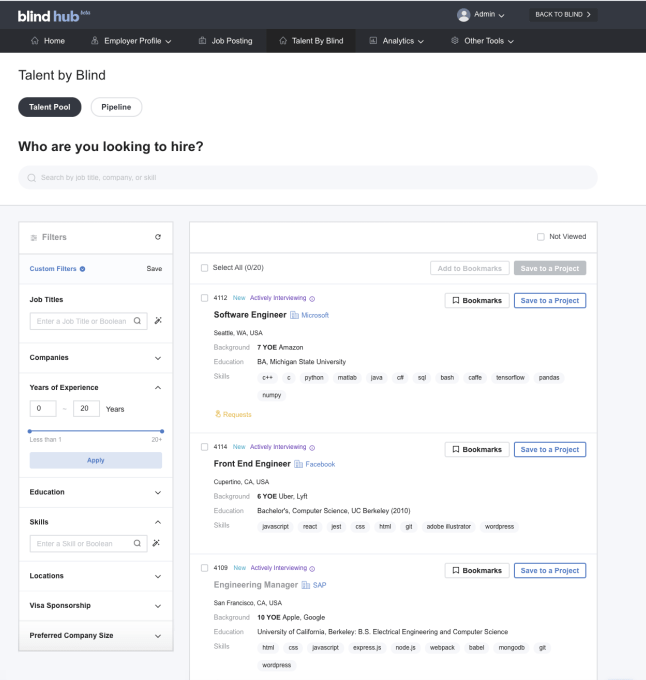
Blind is building what it calls “Talent by Blind,” a platform for capturing this hiring intentionality and selling it to recruiters. The goal is to transfer people whose intentions might be, say, L5 engineer at a big tech company in Seattle to a separate platform that can be used as a top-of-funnel for company recruitment efforts. Blind says a couple of companies are currently using this platform.

“Talent by Blind” is a platform to help transfer potential recruits into the top of the recruiting funnel at companies. Image Credits: Blind

Ultimately, Blind’s path has been one of slow and steady growth. The company claims to be deliberate in that approach, noting that pseudonymous communities often falter when they grow too fast and norms aren’t established early. Unlike more notorious anonymous communities from years past like Secret or YikYak, the company says that its network tends to be quite safe, since employees verify their identities and know that they are speaking directly to their colleagues.

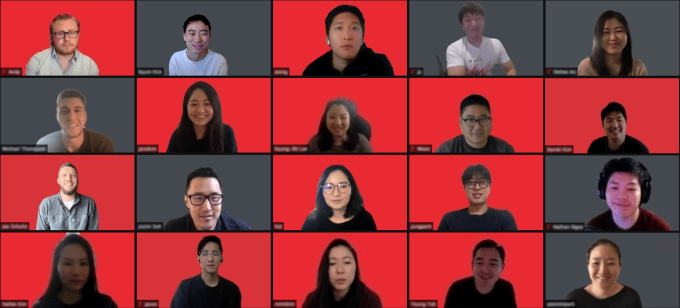
Blind’s team has expanded in recent years. Image Credits: Blind.

Revenue approaches remain experimental, but ultimately, the key is that it has the users that companies want to hear from: their own employees and potential future employees. We want to “maintain that integrity with users,” Kim said. “‘Ally to employees and advisor to companies’ is the phrase we are trying to go for.”

“It’s been eight years we have been doing this business, [and] we have been focused on the longness,” he said. “There’s a lot of optimism in the company.” He would know — he probably checked Blind.

10 May 2021

The Station: Einride preps for a US expansion, Argo AI reveals its lidar specs and a Tesla Autopilot reality check

The Station is a weekly newsletter dedicated to all things transportation. Sign up here — just click The Station — to receive it every weekend in your inbox.

Hello and welcome back to The Station, a weekly newsletter dedicated to all the ways people and packages move (today and in the future) from Point A to Point B.

What a week! It’s too much to cover everything that happened in world of transportation, so here are some of the highlights. Oh, and yes, I know that the big story this weekend was Elon Musk’s appearance on SNL. Since there’s no shortage of hot — and tepid — takes on Twitter and the rest of the interwebs, I think I’ll pass on any commentary.

Instead, it’s worth noting that what Musk says publicly about Tesla Autopilot and the company’s progress on a fully autonomous driving system directly contradicts with reality — and what his own employees are telling regulators.

A memo that summarizes a meeting between California regulators and employees at the automaker shows that Musk has inflated the capabilities of the Autopilot advanced driver assistance system in Tesla vehicles, as well the company’s ability to deliver fully autonomous features by the end of the year. The memo was released by transparency site Plainsite, which obtained it via a Freedom of Information Act request. You can read the whole story here.

My email inbox is always open. Email me at kirsten.korosec@techcrunch.com to share thoughts, criticisms, offer up opinions or tips. You can also send a direct message to me at Twitter — @kirstenkorosec.

Micromobbin’

News and announcements this week demonstrated how micromobility businesses are evolving and merging with other forms of mobility.

No company embodies this better than Revel, the company that began with shared electric mopeds and, since the start of 2021, has evolved into an e-bike subscription service, an EV charging hub and an all-Tesla, all-employee ride-hailing service.

What, one might ask, is founder and CEO Frank Reig up to? Well, we did ask it, and we published our interview so our readers could learn more about Revel’s journey and plans for the future.

“If we’re talking about electrifying mobility in major cities, it starts with infrastructure. And we’re the company rolling up our sleeves and doing it now by building that infrastructure and operating fleets. Because in a city like New York, the infrastructure does not exist for electric mobility.”

Another company that’s diving straight into the subscription model is the Australian startup Zoomo. The startup — which connects the gig economy, subscription services, electric mobility and big business — has a business model that wouldn’t have seemed possible more than a decade ago. Zoomo offers monthly e-bike subscriptions to gig economy bike delivery workers and corporate partners with bike delivery fleets. The startup announced it raised $12 million, only a few months after an $11 million Series A. Zoomo said it will use the fresh cash to expand its service into more of the U.S. and into continental Europe, as well as to further develop its consumer subscription offerings.

Betting on e-mopeds

Micromobility charging infrastructure company Swiftmile is partnering with European e-moped manufacturer GOVECS Group to deploy Mobility Hubs to charge and organize e-mopeds in shared and commercial fleets. With included parking stations, this model, which we’re starting to see with e-bikes and e-scooters, could be a great way to eliminate the use of vans to swap batteries. Germany is expected to see the first of these hubs in Q1 2022.

A small win for JOCO

Last week, I wrote about NYC Department of Transportation’s cease-and-desist order to the new e-bike-sharing platform JOCO. The company ignored the order, maintaining that since its bikes are stationed in private garages, the city doesn’t have the authority to control its operations. To that, the city replied with a lawsuit, demanding a halt in operations and penalties for violations.

On May 7, the court denied the city’s request for a temporary restriction on JOCO’s operations. The case is very much still open, but it’s a small win for JOCO and will allow the company to continue operating and expanding as scheduled. The hearing is scheduled for June 16, during which time the city is likely to drive home its exclusive partnership with Lyft-owned Citi Bike.

#BatteriesForBirds

As a recent transplant to New Zealand, I can tell you that this country really loves its native birds (and therefore, often hates cats, which are not native). Because of the isolation of New Zealand’s ecosystem, mammalian life never arrived or evolved, meaning the country has only native birds, insects and reptiles and amphibians — and not much in the way of predators, allowing the birdlife to flourish.

I say all of this so you understand the significance of Lime’s plan to give its old scooter and bike batteries a second life powering tools designed to save these precious birds. The project, done in partnership with The Cacophony Project and 2040 Limited, will use damaged Lime e-bike battery cells to power thermal cameras that are used to identify bird predators.

Bike launches

CERO, the LA-based ebike startup, has launched its CERO One electric cargo bike for preorders. The bike, with a small front tire, a big back tire and racks over each one, is designed to carry loads up to 77 pounds. Customers can choose between a Platform, Small Basket, and Big Basket variant. The starting price (including a front platform) is $3,799, and first deliveries can be expected around August or September.

Aventon has also announced the launch of the newest model of its Aventure e-bike, complete with fat tires and a color display screen that syncs with your smartphone to handle functions like turning the bike on, tracking mileage, powering on and off the lights and planning trips.

— Rebecca Bellan

Deal of the week

money the station

It’s not all acquisitions and SPAC rumors in the world of autonomous vehicles. There are still traditional VC raises taking place, even in the midst of continued consolidation.

Einride, the Swedish startup known for its unusual-looking electric and autonomous pods that are designed to carry freight, raised $110 million to help fund its expansion in Europe and into the United States. The Series B round, which far exceeds its previous raises of $10 million in 2020 and $25 million in 2019, included new investors Temasek, Soros Fund Management LLC, Northzone and Maersk Growth. Existing investors EQT Ventures, Plum Alley, Norrsken VC, Ericsson and NordicNinja VC also participated in the round.

Einride has raised a total of $150 million to date. The company didn’t share its post-money valuation.

Einride is an interesting case study in the AV world. It has a present-day business of human-driven electric trucks, which carry freight for customers like Coca Cola and Oatly. It’s also developing, testing and eventually planning to deploy its Pod vehicles, which are designed without a cab. These Pods are meant to operate autonomously, although it should be noted that they are also supported with teleoperations, which means a human monitors and can control the vehicle remotely.

Einride had planned to expand into the U.S. but COVID-19 interrupted the move. Now, with fresh capital co-founder and CEO Robert Falck told me that the company is planning to have operations up and running in the U.S. before the end of the year. The plan is to set up headquarters in Austin, Texas, and open additional offices in New York and Silicon Valley. Global agreements are in place with brands such as Oatly, which includes U.S. operations, with more to be announced soon.

Einride’s presence in the United States, and specifically Texas, brings yet another AV company focused on freight into the region. Middle-mile delivery is getting more attention, interest and investment as 2021 unfolds. Another competitor in the region promises to spice things up, particularly on the hiring front.

Other deals that got my attention …

Firefly Aerospace raised $175 million, across a $75 million Series A round that valued the company north of $1 billion, and a $100 million secondary transaction which consisted of the sale of holdings held by primary Firefly investor Noosphere Ventures. The launch startup also announced that it intends to raise another $300 million later in 2021, after its forthcoming inaugural Alpha rocket launch, which is currently targeting a June take-off.

Kneron, a startup that develops semiconductors to give devices artificial intelligence capabilities by using edge computing, received a $7 million boost in capital from Delta Electronics, a Taiwanese supplier of power components for Apple and Tesla. The $7 million investment pushes Kneron’s total financing to more than $100 million to date. As part of the deal, Kneron also agreed to buy Vatics, a part of Delta Electronics’ subsidiary Vivotek, for $10 million in cash, TechCrunch’s Rita Liao reported.

Reinvent Technology Partners X, a new special purpose acquisition company created by Reid Hoffman and Mark Pincus, filed for an IPO. The filing states that the SPAC is looking at merging with a late-stage company in a “technology sector or subsector, including consumer internet, online marketplaces, ecommerce, payments, gaming, artificial intelligence, SaaS, digital healthcare, autonomous vehicles, transportation, and others.” The duo’s previous SPAC announced earlier this year it agreed to merge with Joby Aviation.

Solid Power, Louisville, Colorado-based developer of solid-state batteries, raised $130 million in Series B funding round led by Ford and BMW, the latest signal that the two OEMs see SSBs powering the future of transportation. Under the investment, Ford and BMW are equal equity owners, and company representatives will join Solid Power’s board. Solid Power received additional investment in the round from Volta Energy Technologies, the venture capital firm spun out of the U.S. Department of Energy’s Argonne National Laboratory.

Youibot, a four-year-old startup that makes autonomous mobile robots for a range of scenarios, raised 100 million yuan ($15.47 million) in its latest funding round led by SoftBank Ventures Asia, the Seoul-based early-stage arm of the global investment behemoth. Youibot’s previous investors BlueRun Ventures and SIG also participated in the round. Also, it’s worth noting that Softbank Ventures Asia led a financing round back in December for another Chinese robotics startup called KeenOn, which focuses on delivery and service robots.

Policy corner

the-station-delivery

President Joe Biden isn’t the only person in Washington with his eyes on electrifying transportation. Two separate pieces of legislation were introduced in Congress this week aimed at boosting zero-emission vehicle use in the country.

First, we have a $73 billion proposal introduced May 4 by Senate Majority Leader Charles Schumer (D-N.Y.) and Sen. Sherrod Brown (D-Ohio). Their plan, “Clean Transit for America,” would replace more than 150,000 diesel buses, vans, ambulances and other publicly-owned vehicles with zero-emission models, as well as building out charging infrastructure to support the new fleet.

The following day, Reps. Andy Levin (D-Mich.) and Alexandria Ocasio-Cortez (D-N.Y.) re-introduced a revised version of the “Electric Vehicles Freedom Act” to build out a network of EV charging stations across the country. Democrats supported a version of this bill last year. Although that bill failed, Biden’s outspoken support for EVs and his $2 trillion climate plan may give this new bill a more optimistic fate.

On the same day that Reps. Levin and Ocasio-Cortez announced their bill, a House subcommittee on Commerce and Energy held a hearing to discuss yet another bill that was introduced back in March. This bill, known as the CLEAN Futures Act, is the Democrats’ comprehensive climate legislation to reduce greenhouse gas emissions nationally by 50% by 2030. It would also earmark billions for EV infrastructure and to spurn domestic manufacturing of EV parts, like batteries. (Are you keeping all of this straight?)

Not every lawmaker at the hearing was so enthusiastic on the terms of the CLEAN Futures Act. There was particular pushback from Republicans. Rep. Fred Upton (R-Mich) said that the bill would “push” EVs on Americans “whether they are ready for them or not.”

“I have concerns that the CLEAN Future Act puts the cart before the horse by mandating electric vehicles, because there is no consideration for American workers or car buyers, our growing reliance on China for critical materials and minerals to make batteries, and certainly the strain that EVs will place on our grid,” he said.

Rep. Greg Pence (R-Indiana) added that the future of the transportation industry should not be a “one-size-fits-all made by Washington.” He said that hydrogen and renewable diesel should also be considered alongside battery electric.

During that same House subcommittee on Commerce and Energy meeting, most of which was spent on the CLEAN Future Act, several other proposed bills were mentioned, including the “NO EXHAUST Act,”  the “Electric Vehicles for Underserved Communities Act of 2021” and the “Advanced Technology Vehicles Manufacturing Future Act of 2021” or the “ATVM Future Act.”

The NO EXHAUST Act promotes the electrification of the transportation sector to improve air quality and electric vehicle infrastructure access — especially in rural, urban, low-income,and minority communities, according to Rep. Bobby Rush (D-Ill.), who introduced the bill.

— Aria Alamalhodaei

A little bird

blinky cat bird green

We hear things; and we’re here to share them with you.

Remember waaaaayyyyy back in April when a report from The Information said that Argo AI CEO and co-founder Bryan Salesky told employees in an all-hands meeting that the autonomous vehicle startup was planning for a public listing later this year? At the time, and right here in The Station, I provided a bit more context, noting that while Salesky did indeed mention the prospect of an IPO during the company’s regular weekly all-hands meeting, there was more to the story.

The comments were made as the CEO discussed upcoming important milestones in 2021 that will lead to an IPO or a significant raise of some kind. The upshot: apparently all fundraising options are on the table, including a merger with a special acquisition company, or SPAC. (Argo has raised $2 billion to date.)

Now, it appears that Argo is leaning towards a more traditional investment path — at least, at first. In an interview with Bloomberg’s Ed Ludlow, Salesky said the company is going to be raising money this summer. His public comments support what I’ve heard from folks in the know.

“We’re really excited about doing that,” Salesky said in the interview. “We’ll be taking money from some of the capital markets and we’ll be looking at, you know, an IPO in the in the future as well. I think that it’s one of those things where you know we don’t know the exact source that we’re going to take the funding from next. We’re looking at a bunch of options, but we’re really excited about how that’s going to keep us going for the future to really be able to scale out autonomous vehicles.”

Speaking of Argo, the company revealed new details on a long-range lidar sensor that it claims has the ability to see 400 meters away with high-resolution photorealistic quality and the ability to detect dark and distant objects with low reflectivity. The technology, which is the product of Argo’s acquisition of lidar company Princeton Lightwave, is poised to help it deliver autonomous vehicles that can operate commercially on highways and in dense urban areas starting next year.

The company said  the first batch of these lidar sensors are already on some of Argo’s test vehicles, which today is comprised of Ford Fusion Hybrid sedans and Ford Escape Hybrid SUVs. By the end of the year, Argo’s test fleet will transition to about 150 Ford Escape Hybrid vehicles, all of which will be equipped with the in-house lidar sensor. Ford, an investor in and customer of Argo, plans to deploy autonomous vehicles for ride-hailing and delivery in 2022. Argo’s other investor and customer, Volkswagen, said it will launch commercial operations in 2025.

TC Sessions: Mobility 2021

The TC Sessions: Mobility 2021 event, which is scheduled for June 9, is approaching in about a month. We recently released a “mostly” final agenda.

Now two more announcements. Pam Fletcher, who is leading innovation efforts at GM, will be interviewed at the event. And, for all those AV fans out there … we’re putting Karl Iagnemma, an co-founder who now heads up Motional, and Aurora co-founder and CEO Chris Urmson on our “virtual” stage together. Have a question for either of these folks? Email me.

Other guests to TC Sessions: Mobility 2021, includes Joby Aviation founder and CEO JoeBen Bevirt, investor and LinkedIn founder Reid Hoffman, whose SPAC merged with Joby, investors Clara Brenner of Urban Innovation Fund, Quin Garcia of Autotech Ventures and Rachel Holt of Construct Capital, as well as Starship Technologies co-founder and CEO/CTO Ahti Heinla. We also plan to bring together community organizer, transportation consultant and lawyer Tamika L. Butler, Remix co-founder and CEO Tiffany Chu and Revel co-founder and CEO Frank Reig to talk about equity, accessibility and shared mobility in cities.

See y’all next week. 

10 May 2021

Signalling that privacy is coming to DeFi, Sienna Network raises $11.2M for its platform

Last week we saw some major backing of the Secret Network blockchain, as significant blockchain players Arrington Capital and Blocktower Capital invested in the privacy-first smart contract platform. What this is signaling is the rise of privacy-oriented financial blockchain projects, which are crucial if “DeFi” (decentralized finance) is to have any kind of future. We have come to expect privacy in our ’normal’ financial lives, so we will expect it in the blockchain world.

Today there’s a new signal that this privacy movement in DeFi is taking off with the announcement from privacy decentralized finance company Sienna Network that it has raised $11.2 million from institutional investors and its public supporters. Of that raise, the private token sale raised $10 million from investors including NGC, Inclusion Capital, Lotus Capital, FBG, Skyvision Capital and others. It also raised $1.2 million on the DaoMaker and Polkastarter exchanges.

Sienna Network is built on the afore-mentioned Secret Network, and pitches itself as a privacy-first and cross-chain decentralized finance platform allowing asset holders to switch to privacy-oriented tokens.

Sienna is one of an increasing number of blockchain startups tackling the industry-wide problem of ‘front-running’. This – says Sienna – is where bad actors hijack future trades on public DeFi blockchains.

Monty Munford, chief evangelist and core contributor to Sienna Network said: “Sienna helps access to the privacy-preserving blockchain in a user-friendly way due to the blockchain’s inherent privacy design. Sienna saves no login information, no wallet data, no transaction data, or anything else. It does not even track its website or give any information to any Third Party.”

Here’s how a front-running scam works: A transaction on Ethereum can be preempted by someone else simply by them paying a higher transaction fee. It’s the close equivalent in the real world of trumping a trade on the stock market, just because you paid a higher fee to a broker. In other words, it’s a disaster if it continues to happen, and the entire infrastructure of decentralized finance is threatened because of this threat.

Commenting, Tor Bair, CEO Secret Network said: “We believe Sienna will be a key pillar of Secret DeFi and help drive mass adoption of a more secure decentralized financial ecosystem.”

10 May 2021

Google begins surfacing vaccine centers, hospital beds, oxygen info in India

Google, which reaches more than half a billion people in India, is turning its services into tools to help the world’s second largest internet market fight the pandemic.

Google said on Monday it has rolled out a range of updates to its Search, Maps, YouTube, and Google Pay services in India to display and boost authoritative and credible information about the coronavirus to help people in the South Asian nation find vaccination centers and other resources to navigate the crisis.

Google Search, which has been offering updates on the virus for more than a year, now also displays information panels with vaccine registration details in India and highlights the official Indian government website for the vaccine at the top.

Search and Maps that have been showing 2,500 testing centers in India now similarly also show locations of over 23,000 vaccination centers across the country in English and eight Indian languages. The company said it is working with India’s Ministry of Health and Family Welfare to source this information.

Google, which identifies India as its biggest market by users, said it is also testing a Q&A function in Google Maps in India to enable people to ask about and share local information on the availability of beds and medical oxygen in select locations in the country.

The new features rollout comes as India reports over 350,000 infections and over 3,500 fatalities everyday. The nation’s healthcare infrastructure is struggling to serve patients, having largely run out of beds and medical supplies.

In recent weeks, scores of firms, startups, entrepreneurs and investors have stepped up to fill this gap. And Twitter, Facebook, and WhatsApp have become the real-time helpline as people exchange leads with one another.

Google said it is also using its various channels to help extend the reach of health information campaigns in India. This “includes the ‘Get the Facts’ around vaccines campaign, to encourage people to focus on authoritative information and content for vaccines. We’re also surfacing important safety messages through promotions on the Google homepage, Doodles and reminders within our apps and services,” it wrote in a blog post.

On YouTube, Google has curated a set of playlists with videos that offer authoritative information about the vaccine, the spread of the virus, and facts from experts. The company said it has also rolled out a COVID Aid campaign on Google Pay to enable users to donate to non-profit organizations such as GiveIndia, Charities Aid Foundation, Goonj, Save the Children, Seeds, UNICEF India (National NGOs) and United Way.

The company said a similar campaign to support several other foundations has raised over $4.6 million.

“As India battles this devastating wave, we’ll keep doing all we can to support the selfless individuals and committed organizations on the front lines of the response. There’s a long way to go—but standing together in solidarity, working together with determination, we can and will turn the tide,” read a blog post signed by Covid Response team at Google India.

10 May 2021

Telkomsel invests an additional $300 million in Gojek

Telkomsel, a unit of Indonesia’s largest telecom operator Telkom, has invested an additional $300 million in ride-hailing and payments firm Gojek, the two firms said Monday, just months after the network provider wrote a $150 million check to the Southeast Asian firm.

The announcement comes amid Gojek working to seal a proposed merger with e-commerce platform Tokopedia. The $18 billion deal would result in a new entity called GoTo, according to media reports. Telkomsel’s investment today likely makes it one of GoTo’s top eight investors.

Gojek — which has raised over $3.45 billion to date from high-profile investors including Google, Facebook, PayPal, Visa, and Tencent — and Telkomsel said their strategic partnership will “open up new synergies as the two companies scale up digital services and deliver new, innovative solutions.”

The two firms have maintained a deal since 2018 to subsidize the cost of mobile data consumed by the ride-hailing firm’s driver partners.

With more than 170 million subscribers, Telkomsel is the largest telecom operator in Indonesia. In addition to ride-hailing, Gojek has expanded to several additional businesses, including digital payments and food delivery in Indonesia.

Today’s news follows a $150 million investment Telkomsel made in Gojek in November last year. The two firms have since integrated several aspects of their services to accelerate digitization of micro, small and medium enterprises and bringing greater cost savings for driver partners.

Some of these include integration of Telkomsel MyAds with GoBiz, which enables Gojek’s MSME partners to use MyAds to efficiently expand their outreach to Telkomsel users, and easy onboarding for Gojek MSME partners to become Telkomsel reseller partners through the DigiPOS Aja! Application.

The two firms also co-market gaming services through Telkomsel’s Dunia Games and GoPay in collaboration with Tencent, providing greater value for PUBGM users, they said.

“Telkomsel is optimistic that this latest investment will open more opportunities for society to access advanced digital technology-based innovations developed by homegrown companies,” said Telkomsel chief executive Setyanto Hantoro in a statement.

10 May 2021

StuDocu raises $50M as its note-sharing network for college students passes 15M users

Whether learning online or taking a class in person, every student knows all too well how important it is to have good notes from your classes as a key way to remember and apply what you’ve been taught. Now, an Amsterdam-based startup called StuDocu, which has built a big and profitable business by way of a platform to help source and share the best student-created class notes, is announcing $50 million in funding on the heels of huge growth — a sign of demand and opportunity in the space.

The Series B is coming from Partech, the French VC, and it comes as StuDocu is gaining some critical mass: the startup says it now reaches 15 million users across 2,000 universities in 60 countries. What’s notable about that scale is not just the size but the fact that it had been achieved while the company was previously largely bootstrapped: Both PitchBook and Crunchbase note only about $1.5 million raised before now, but in fact CEO Marnix Broer tells me that it had quietly raised just under $10 million before now with previous investors including Piton Capital, Peak Capital and Point Nine Capital.

A lot of the focus in edtech in the last year of Covid-19 living has been on technology that helps people learn remotely as well (or maybe even better) than they might have done in more traditional, physical environments: improved streaming experiences, better approaches for teaching via a screen, tools for managing the experience, and so on. StuDocu both fits that mold, but also, in a way, is a throwback to the more basic approach we associate with learning: sitting in a class and taking notes during the lessons.

That was the environment in which four students came together and first formed StuDocu.

In the Netherlands, where StuDocu is based, a large amount of one’s evaluation in an undergraduate class is based on how you do in the final exams, and so the notes have perhaps even more disproportionate value.

CEO Marnix Broer, along with his friends Jacques Huppes, Lucas van den Houten and Sander Kuijk, saw an opportunity while still students back in 2013 to leverage the power of the internet and crowdsourcing, to make it easier for people who were studying the same course at university to connect together online and help each other by uploading notes from their courses and exchanging them with each other — the power of many being one way of better covering your bases in the knowledge department.

(Huppes has stepped away from the company in an active role but remains an advisor, the other two are still there, Broer said.)

Initially the product was “completely free,” he said, and was organically a popular enough concept that it not only picked up users at their university in Delft, but also a number of other schools. Then, as the founders approached graduation, “we decided we needed to earn some money,” and with the concept still going strong, they turned their attention to making their tool into a business.

Through a couple of iterations, “We finally came up with trying to keep as much free as we can in a freemium model,” Broer said. In StuDocu’s case, using the data they had amassed about how much certain documents were viewed, downloaded and recommended over others, they created a top 20% of all documents, which were labelled premium, “so you either upload your own docs or pay a small subscription fee to access them.” Conversely, this also means that 80% of documents on the site are all still free.

StuDocu also built a few pieces of technology into its platform to help fight against scammers or people trying to game it: the only users who it now measures to determine what is premium content are premium users themselves, who do not get any indication of what is premium content on the site and what is not, and are more likely more serious and heavier users of StuDocu.

“We want the best quality documents to stay up and the rest to drift down the pile, so that our users only experience great notes,” he said. “But we know if a few upload garbage we haven’t lost money on it. We just gave access for free and should not have. At the end of the day, it’s a community and we believe that will ensure the quality stays high.” They also incentivise people to review documents with lottery tickets and other rewards.

And it has increasingly been adding in more ways of scanning materials to determine that what people are submitting are actual notes about the subject at hand, rather than blank documents or random unrelated writing. A recent search partnership with Algolia, Broer said, should also help with more granualar document searches, rather than simply searching by university and course to find materials.

It’s a compelling business model that helps square the issue that a lot of user-generated content sites have, which is that the vast majority are consumers rather than creators. Broer said that currently some 15% of its users pay for the service, 15% access it by uploading content, and 70% of its base are using it free and not uploading anything.

Through its gradual building up of a business from a tool that they built to help themselves, StuDocu went, Broer said, from “working in a squat“, to taking a small and cheap space with interns, to what Broer describes “a normal office.”

There are a number of other edtech companies that have identified the potential of providing platforms for students to help each other with learning. Brainly, another big one out of Europe (specifically Poland) built its concept not around notes but students helping each other answer homework questions, similar to Chegg. NexusNotes out of Australia also has built a platform aimed at amassing notes; Academia includes not just notes but also research papers; Docsity also focuses on both class notes and papers. StudySmarter also out of Europe also brings in notes but also applies AI to shape a person’s learning progress.

Perhaps the most similar and StuDocu’s biggest competitor of all is Course Hero out of the U.S., which is now valued at around $1.1 billion (a notable number here too, since StuDocu is not disclosing valuation).

“We consider ourselves the leading global player,” Broer noted, with more than 30 local languages supported across its catalog of courses and notes.

“We help millions of students and have millions of documents, but at the same time we consider ourselves a hyper-local marketplace,” he added. “Three hundred people who are on the same law course can now communicate and share knowledge with each other.”

This funding will be an interesting test of both extending that hyper-local concept to more places, but also tapping into opportunities where the help that might come could have a much bigger impact.

In the UK, for example, going down another age bracket younger than university to students of high school age (14 and up), the majority of them are studying to prepare for two sets of tests, GCSEs that you take in year 11 (aged 16/17 usually) and A-Levels you take in year 13 (18/19 years old), both based around very specific subjects and thus based on very particular curriculums that literally the whole country studies together. That is to say, even if individual schools or teachers might have different approaches or teach better or worse, at the end of the day, all the students will be taking the same examinations in their specified subjects.

This presents an interesting opportunity to a company like StuDocu, which could build a much bigger network of users as a result on an even smaller proportion of contributed, strong notes (since more of the users will all be needing the same materials). This is also a model used in other places, and Broer said StuDocu is well on its way to testing and slowly expanding in specifically these kinds of markets at the moment.

And you could argue that even if standardized tests were not a part of the equation, students will want better notes to use for other kinds of coursework, such as essay writing, or simply to help retain knowledge as they continue to learn. With some 200 million people currently in university education, there are a lot of opportunities to find variations on the premise.

There might also be possibilities down the line to work more closely also with universities to build out the course materials — also a big area considering that a lot of professors already provide notes for their lectures to students — although Broer said that for now its focus is remaining on students and their needs, since in many cases professors still do not do this.

It’s for all of these reasons that investors are there for StuDocu’s funding.

“StuDocu is a platform already helping millions of students around the world, and we’re excited to partner with this talented team in their mission to make education more accessible to all.” comments Bruno Crémel, a general partner at Partech, in a statement. “When we met the team at StuDocu, we were wildly impressed with their data-driven culture and by how much students really love using their services. We look forward to working closely with Marnix and his team as they accelerate StuDocu’s global expansion and develop even more innovative ways to support students in meeting their learning goals.”

09 May 2021

Clubhouse finally launches its Android app

Clubhouse finally has an Android app that you can download from the Play Store — provided you live in the U.S.

The voice social network launched its beta Android app on Play Store users in the U.S. on Sunday, and said it will gradually make the new app available in other English-speaking countries and then the rest of the world.

The social network, valued at about $4 billion in its most recent fundraise, first launched its app on iOS last year and until now has been exclusively available to iPhone users. The startup, which still requires new users to be invited by existing Clubhouse members, recently began testing the Android app.

“Our plan over the next few weeks is to collect feedback from the community, fix any issues we see and work to add a few final features like payments and club creation before rolling it out more broadly,” the team wrote.

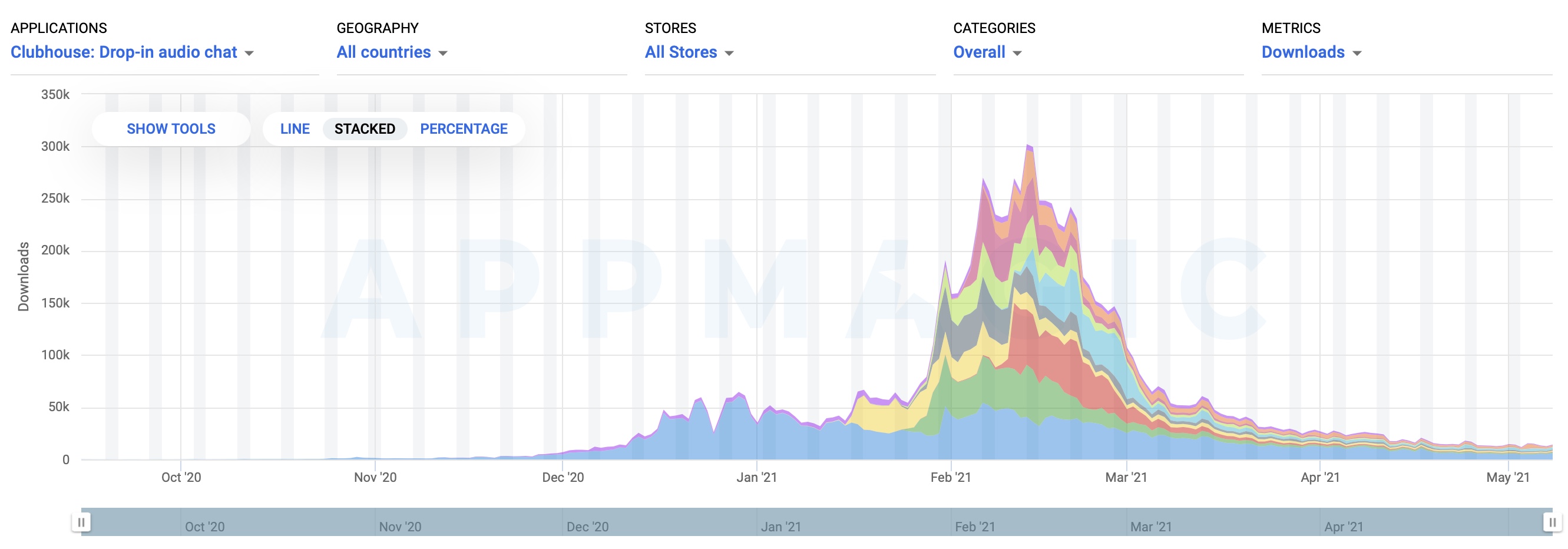
Clubhouse download figures across some of its popular markets, according to estimates by mobile insight firm AppMagic. (Though precise download estimates from other mobile insight firms vary, they all suggest Clubhouse app’s popularity has dropped in recent months.)

Clubhouse’s launch on Android comes at a time when scores of technology giants including Facebook, Twitter, Discord, Spotify, and Reddit, have either launched their similar offerings — or announced plans to do so.

Twitter’s clone of Clubhouse, called Spaces, has emerged as one of the biggest competitors to the A16z and Tiger Global-backed-startup. An unplanned Twitter Spaces, available on Android as well, hosted by a high-profile Indian startup founder on earlier Sunday attracted hundreds of listeners within a few minutes, for instance.

“As a part of the effort to keep the growth measured, we will be continuing the waitlist and invite system, ensuring that each new community member can bring along a few close friends. As we head into the summer and continue to scale out the backend, we plan to begin opening up even further, welcoming millions more people in from the iOS waitlist, expanding language support, and adding more accessibility features, so that people worldwide can experience Clubhouse in a way that feels native to them,” Clubhouse team wrote.

Clubhouse’s beta Android app currently lacks a number of features such as the ability to follow a topic, in-app translations, localization, ability to create or manage a club, link Twitter and Instagram profiles, payments, as well as the ability to change the profile name or user name.

More to follow…