
Year: 2021

26 Apr 2021

Blockchain startup S!NG wants creators to lean on NFTs to protect their intellectual property

After a years-long crypto winter, it been the spring of NFTs, but as digital art prices sober up after an explosion in sales, blockchain founders are looking to find more stable opportunities in the space that can grow over time even as speculative interest in NFTs shifts.

One particular interest has been using NFTs to reshape the creator economy in a manner that actually benefits artists more than the platforms that host their work. A new flavor of this pursuit comes from the recently launched S!NG (pronounced sing) which has built a platform around simply letting user upload files to their servers and time-stamp those uploads on the Ethereum blockchain. It’s a dead-simple mechanic with an ambitious framing, ensuring that artists maintain credit for their work as they create it.

The team behind the app sees a future where artists use the platform as an autosave for their intellectual property during the creative process, enabling them to scribble down notes or upload a quick demo and save those moments on the blockchain, a step that they hope can eliminate or expedite rights disputes for creators that can point to a clearly time-stamped breadcrumbs trail. By virtue of the app’s name, it’s clear that they are aiming to attract songwriters and musicians in particular but the company’s onboarding also showcases wider ambition in the creator world, enabling users to designate if they are a photographer, writer or programmer as well.

“You have the best of both worlds with very public witnesses to a very private event,” says CEO Geoff Osler. “Your content is never out there, but you can have this massive attestation to the fact that it exists at a certain point in time.”

The app itself is pretty straightforward. After uploading a piece of media, be it a photo, video, audio or text file, users can tack on additional files, make note of additional collaborators or add notes before submitting it and christening the work on the blockchain. The file itself is private with a hash hosted on the blockchain while the encrypted files are stored on S!NG’s AWS servers, so creators don’t need to worry about their early ideas being served up to a public audience. A concern here for early adopters is what happens if the blockchain startup eventually goes under and those servers go with it, but that’s an issue facing plenty of startups that are backing the underlying media files of NFTs on centralized servers.
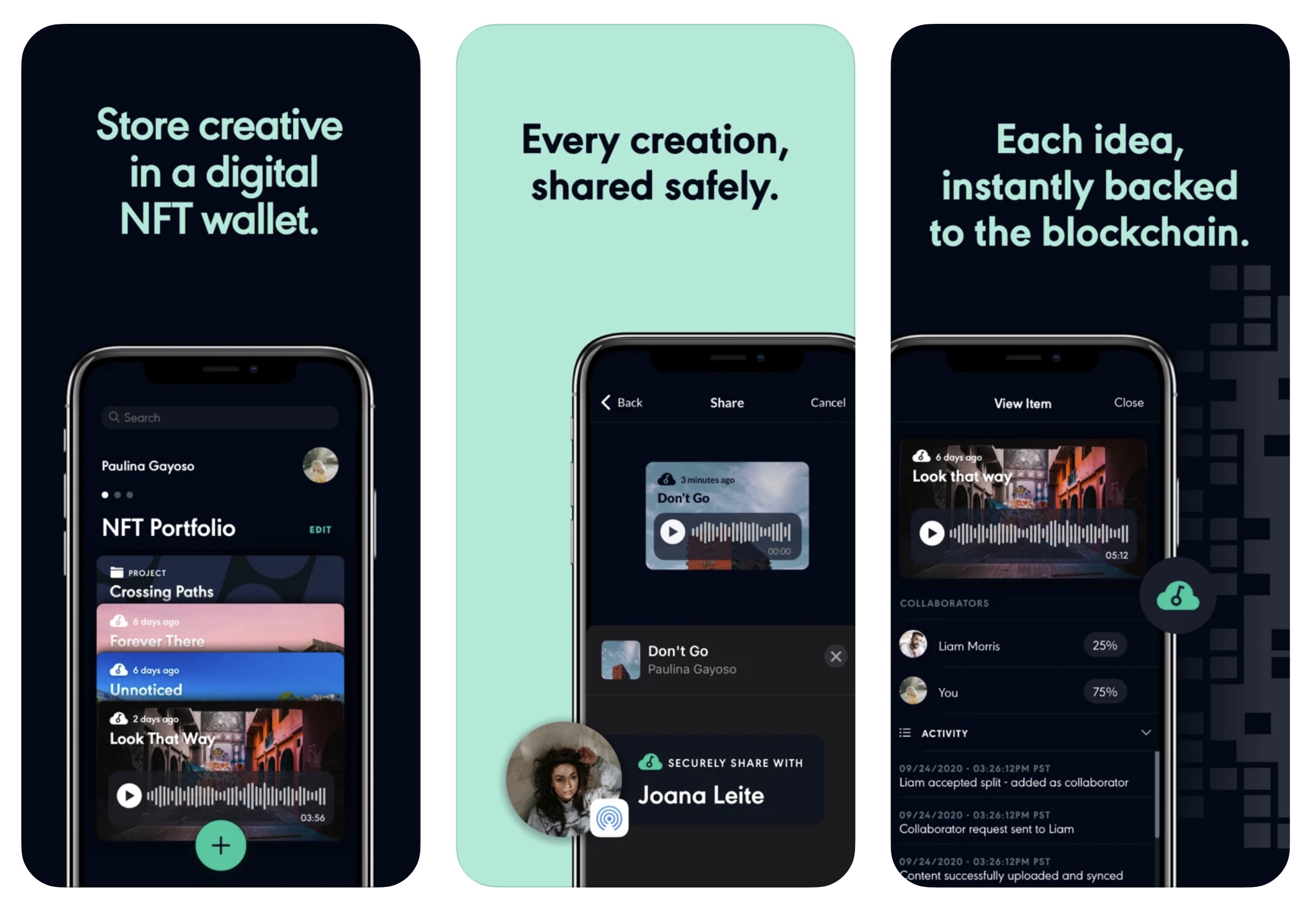
Image via S!NG

Rights disputes might be something more top-of-mind to those who have spent substantial time in their specific creative industry, compared to to budding artists who are likely wholly concerned with getting their work seen in the first place. While public links allow a work’s origins to be tracked down once it’s complete and ready for public consumption, S!NG’s aim is to develop those moments earlier in the development of a work and aid artists who might be involved with more collaborative creative processes where ownership of ideas can appear more obfuscated from a legal standpoint.

“If I get something stolen from me, I’ve got a team that’s going to defend me and they’re probably going to win or settle any claims, but if you’re a 16-year-old kid, you don’t have that ability so that’s what we want to provide, but more as a deterrent,” musician and advisor Raine Maida tells TechCrunch. “I think when you see the S!NG watermark or you see that it’s saved and shared through the wallet.. you don’t have to understand blockchain but you’ll know S!NG is that company that protects you.”

For the time being, non-fungible token-based legal defenses are probably a bit unusual, but the team’s founders believe that blockchain-based ownership proofs will be entering case law organically just as technology like DocuSign has been accepted.

If the company can successfully push creators to weave the S!NG platform into their toolkits, the startup will have plenty of ripe opportunities to capitalize on in the incredibly young blockchain creator space. While many artists may see the NFT space as a speculative cash grab, the company’s founders seem wholly focused on sidestepping hype for the time being and building something that artists can find lasting value in.

“Frankly I don’t give a shit about all of this crazy NFT stuff with things selling for a bazillion dollars,” Osler says. “I’m interested in the small artist who has 1,000 fans who will eagerly pay up $15 to keep that person in business.”
26 Apr 2021

Blockchain startup S!NG wants creators to lean on NFTs to protect their intellectual property

After a years-long crypto winter, it been the spring of NFTs, but as digital art prices sober up after an explosion in sales, blockchain founders are looking to find more stable opportunities in the space that can grow over time even as speculative interest in NFTs shifts.

One particular interest has been using NFTs to reshape the creator economy in a manner that actually benefits artists more than the platforms that host their work. A new flavor of this pursuit comes from the recently launched S!NG (pronounced sing) which has built a platform around simply letting user upload files to their servers and time-stamp those uploads on the Ethereum blockchain. It’s a dead-simple mechanic with an ambitious framing, ensuring that artists maintain credit for their work as they create it.

The team behind the app sees a future where artists use the platform as an autosave for their intellectual property during the creative process, enabling them to scribble down notes or upload a quick demo and save those moments on the blockchain, a step that they hope can eliminate or expedite rights disputes for creators that can point to a clearly time-stamped breadcrumbs trail. By virtue of the app’s name, it’s clear that they are aiming to attract songwriters and musicians in particular but the company’s onboarding also showcases wider ambition in the creator world, enabling users to designate if they are a photographer, writer or programmer as well.

“You have the best of both worlds with very public witnesses to a very private event,” says CEO Geoff Osler. “Your content is never out there, but you can have this massive attestation to the fact that it exists at a certain point in time.”

The app itself is pretty straightforward. After uploading a piece of media, be it a photo, video, audio or text file, users can tack on additional files, make note of additional collaborators or add notes before submitting it and christening the work on the blockchain. The file itself is private with a hash hosted on the blockchain while the encrypted files are stored on S!NG’s AWS servers, so creators don’t need to worry about their early ideas being served up to a public audience. A concern here for early adopters is what happens if the blockchain startup eventually goes under and those servers go with it, but that’s an issue facing plenty of startups that are backing the underlying media files of NFTs on centralized servers.

Image via S!NG

Rights disputes might be something more top-of-mind to those who have spent substantial time in their specific creative industry, compared to to budding artists who are likely wholly concerned with getting their work seen in the first place. While public links allow a work’s origins to be tracked down once it’s complete and ready for public consumption, S!NG’s aim is to develop those moments earlier in the development of a work and aid artists who might be involved with more collaborative creative processes where ownership of ideas can appear more obfuscated from a legal standpoint.

“If I get something stolen from me, I’ve got a team that’s going to defend me and they’re probably going to win or settle any claims, but if you’re a 16-year-old kid, you don’t have that ability so that’s what we want to provide, but more as a deterrent,” musician and advisor Raine Maida tells TechCrunch. “I think when you see the S!NG watermark or you see that it’s saved and shared through the wallet.. you don’t have to understand blockchain but you’ll know S!NG is that company that protects you.”

For the time being, non-fungible token-based legal defenses are probably a bit unusual, but the team’s founders believe that blockchain-based ownership proofs will be entering case law organically just as technology like DocuSign has been accepted.

If the company can successfully push creators to weave the S!NG platform into their toolkits, the startup will have plenty of ripe opportunities to capitalize on in the incredibly young blockchain creator space. While many artists may see the NFT space as a speculative cash grab, the company’s founders seem wholly focused on sidestepping hype for the time being and building something that artists can find lasting value in.

“Frankly I don’t give a shit about all of this crazy NFT stuff with things selling for a bazillion dollars,” Osler says. “I’m interested in the small artist who has 1,000 fans who will eagerly pay up $15 to keep that person in business.”

26 Apr 2021

Fifth Wall’s Brendan Wallace and Hippo’s Assaf Wand discuss proptech’s biggest opportunities

What is the biggest opportunity for proptech founders? How should they think about competition, strategic investment versus top-tier VC firms, and how to build their board? What about navigating regulation?

We sat down last week with Brendan Wallace, co-founder and general manager of Fifth Wall, and Hippo CEO Assaf Wand for an episode of Extra Crunch Live to discuss all of the above.

Extra Crunch Live goes down every Wednesday at 3 p.m. ET/noon PT. Our next episode is with Forerunner’s Eurie Kim and Oura CEO Harpreet Rai, and you can check out the upcoming schedule right here.

In the meantime, dive into the wide-ranging conversation we had with Wallace and Wand. You can find the full video, including the ECL Live pitch-off, below.

Investing in the board

The first step in running a useful and beneficial board is determining who should be on that board, and that starts with the first round of capital investment and carries on forever.

One of the strategic benefits of Fifth Wall as an investor, according to Wallace, is that the firm was built specifically with strategic LPs in the real estate realm, allowing the firm to connect portfolio companies with massive incumbent players in the industry. Incumbents get access to new tools and software, portfolio companies get big customers, and Fifth Wall gets to reap the benefits of both. It’s a rare win-win-win.

We asked Wand about how he chose his investors, and how to weigh the value of a top-tier VC firm and a strategic angel investor, for example.

He explained that there is no right answer to a question like that, but it should always be thoroughly discussed by the team. One of the benefits of having a top-tier VC firm on board is that it has a signaling effect, helping you to recruit early team members and open doors.

26 Apr 2021

The next tech hearing targets social media algorithms — and YouTube, for once

Another week another big tech hearing in Congress. With a flurry of antitrust reform bills on the way, Democratic lawmakers are again bringing in the some of the world’s most powerful tech companies for questioning.

In the next hearing, scheduled for Tuesday, April 27 at 10 AM ET, the Senate Judiciary’s subcommittee on privacy and technology will zero on concerns about algorithmic amplification. Specifically, the hearing will explore how algorithms amplify dangerous content and shape user behavior on social platforms.

The subcommittee’s chair Sen. Chris Coons previously indicated that he would bring in tech CEOs, but Tuesday’s hearing will instead feature testimony from policy leads at Facebook, Twitter and YouTube.

The hearing might prove a unique opportunity to hold YouTube’s feet to the fire. In spite of being one of the biggest social networks in the world — one without much transparency about its regular failures to control extremism and misinformation — YouTube seldom winds up under the microscope with Congress. The company will be represented by Alexandra Veitch, YouTube’s regional director of public policy.

In past big tech hearings that manage, Google CEO Sundar Pichai has generally appeared on behalf of YouTube’s parent company. But Google is a massive entity and concerns specific to YouTube and its policies generally get lost in the mix as lawmakers go after Pichai for concerns around Google’s search and ads businesses.

In a stylistic repeat of last week’s adversarial app store hearing, which featured Apple as well as some of its critics, misinformation researcher Dr. Joan Donovan and ex-Googler and frequent big tech critic Tristan Harris will also testify Tuesday. That tension can create deeper questioning, providing outside expertise that can fill in some lapses in lawmakers’ technical knowledge.

Policy leads at these companies might not make the same flashy headlines, but given their intimate knowledge of the content choices these companies make every day, they do provide an opportunity for more substance. Tech CEOs like Mark Zuckerberg and Jack Dorsey have been dragged in to so many hearings at this point that they begin to run together, and the top executives generally reveal very little while sometimes playing dumb about the day-to-day decision making on their platforms. The subcommittee’s ranking member Ben Sasse (R-NE) emphasized that point, stating that the hearing would be a learning opportunity and not a “show hearing.”

Democrats have been sounding the alarm on algorithms for some time. While Republicans spent the latter half of the Trump administration hounding tech companies about posts they remove, Democrats instead focused on the violent content, extremism and sometimes deadly misinformation that gets left up and even boosted by the secretive algorithms tech companies rarely shed light on.

We haven’t seen much in the way of algorithmic transparency, but that could change. One narrowly-targeted Section 230 reform bill in the House would strip that law’s protections from large companies when their algorithms amplify extremism or violate civil rights.

Twitter CEO Jack Dorsey has also hinted that a different approach might be on the horizon, suggesting that users could hand-pick their preferred algorithms in the future, possibly even selecting them from a kind of third-party marketplace. Needless to say, Facebook didn’t indicate any plans to give its own users more algorithmic control.

With any major changes to the way platforms decide who sees what likely a long ways off, expect to see lawmakers try to pry open some black boxes on Tuesday.

26 Apr 2021

Tesla grows 74% in the first quarter, besting expectations as its shares ease after-hours

Today after the bell American electric car company Tesla reported its Q1 2021 financial performance. The company lost modest ground on the stock market after its news broke.

For the broader electric vehicle and battery startup market that has pursued many SPAC-led combinations in recent months, the generally positive Tesla trailing results could prove a boon, underscoring continued market demand for their category’s hardware.

Turning to the numbers, in the first three quarters of the year, Tesla generated revenues of $10.389 billion, gross profit of $2.215 billion, and net income of $438 million.

Tesla earned adjusted net income of $1.052 billion, leading to diluted, non-GAAP earnings per share of $0.93. The street had expected the company to report $10.29 billion in revenue and adjusted earnings per share of $0.79. Shares of Tesla are off around 1% in after-hours trading, after the company reported its top and bottom-line beat.

Tesla grew sharply compared to its year-ago period, in which the company generated $5.985 billion in top-line revenue, leading to just $68 million worth of net income. Compared to that year-ago period, Tesla’s Q1 2021 saw its revenues expand by 74%, its automotive gross margin improve by just under 1% (95 basis points), its aggregate gross margins better themselves by slightly less (70 basis points), and its net income explode 1,850% while its adjusted net income grew by an also-impressive 304%.

In the same period four month period, Tesla’s operating cash flow came to $1.641 billion. The company can comfortably self-fund at that pace of cash generation. That’s underscored by the fact that Tesla closed its first quarter with cash and cash equivalents worth a total of $17.1 billion.

Tracking neatly with its 75% revenue growth was automotive production growth of 76% in the first quarter, with the company producing 180,338 cars, far above its year-ago Q1 tally of 102,672 units. Deliveries of vehicles rose 109%, to 184,877, over the same timeframe.

The company’s solar, and energy storage businesses also posted material growth: Solar deployments rose 163% to 92 megawatts, while storage deployment rose 71% to 445 megawatt hours.

Turning to outlook, Tesla told investors in its deck that “over a multi-year horizon, [the company expects] to achieve 50% average annual growth in vehicle deliveries.” The company added that it anticipates Tesla Semi deliveries to commence this year, adding another revenue line to the company’s product mix.

Looking ahead, investors expect Tesla adjusted net income to rise to $0.99 per diluted share this quarter, off of revenues totalling $11.39 billion.

26 Apr 2021

Founders who don’t properly vet VCs set up both parties for failure

There’s a disconnect between reality and the added value investors are promising entrepreneurs. Three in five founders who were promised added value by their VCs felt duped by their negative experience.

While this feels like a letdown by investors, in reality, it shows fault on both sides. Due diligence isn’t a one-way street, and founders must do their homework to make sure they’re not jumping into deals with VCs who are only paying lip service to their value-add.

Looking into an investor’s past, reputation and connections isn’t about finding the perfect VC, it’s about knowing what shaking certain hands will entail — and either being ready for it or walking away.

Entrepreneurs are increasingly demanding more than a blank check: They want mentorship, product understanding and emotional support, as well as industry connections and expertise. If VCs can’t bring that value, founders now have plenty of other funding routes to choose from, like crowdfunding, angel syndicates, tokenization and SPACs.

To stay competitive, VCs have to at least advertise that they have more than deep pockets. But what if it stops there? Founders have to know exactly what they’re looking for in a VC, which means looking past the front page and vetting their investors.

The ideal investor for modern startups is an operator VC — someone who was a founder or operator at a company before becoming an investor. But even then, ticking boxes isn’t enough to ensure the investor won’t come with their own challenges, like being too hands-on or less strategically minded.

Looking into an investor’s past, reputation and connections isn’t about finding the perfect VC, it’s about knowing what shaking certain hands will entail — and either being ready for it or walking away. There is no single solution to this issue, but here are my recommendations to founders seeking a successful investor relationship in 2021.

Have a guiding framework

No founder-investor relationship can survive misalignment. Because you share responsibility on so many processes, both parties have to be on the same page. So before you even start fundraising, nail down the expectations you need your future investor to meet. What do you need the most? What does your dream investor look like?

26 Apr 2021

Lyft sells self-driving unit to Toyota’s Woven Planet for $550M

Ride-hailing company Lyft has sold off its autonomous vehicle unit to Toyota’s Woven Planet Holdings subsidiary for $550 million, the latest in a string of acquisitions spurred by the cost and lengthy timelines to commercialize the technology that have occurred within the autonomous vehicle industry.

Under the acquisition agreement announced Tuesday, Lyft’s so-called Level 5 division will be folded into Woven Planet Holdings. Lyft will receive $550 million in cash with $200 million paid upfront. The remaining $350 million will be made in payments over five years. About 300 people from Lyft Level 5 will be integrated into Woven Planet. The Level 5 team, which in early 2020 numbered more than 400 people in the U.S., Munich and London, will continue to operate out of its office in Palo Alto, California.

The transaction, which is expected to close in the third quarter of 2021, officially ends Lyft’s nearly four-year effort to develop its own self-driving system.

The transaction will remove a costly annual expense from Lyft’s budget. The ride-hailing company said that by offloading Level 5 it expects to be able to remove $100 million of annualized non-GAAP operating expenses on a net basis. Those savings will be critical for Lyft as it pursues profitability — a point co-founder and president John Zimmer made special note of in the announcement.

“Assuming the transaction closes within the expected timeframe and the COVID recovery continues, we are confident that we can achieve Adjusted EBITDA profitability in the third quarter of this year,” Zimmer said in a statement.

Free from this annual expense, Lyft will dedicate its resources to what the company says it was really was aiming for all along: to become the go-to ride-hailing network and fleet management platform used by any and all commercial robotaxi services. Lyft already has partnerships with AV developers, notably the $4 billion Hyundai-Aptiv joint venture known as Motional as well as  Waymo. The intent is to lock up the rest. As part of the acquisition agreement, Woven Planet signed commercial agreements to use the Lyft platform and fleet data.

Lyft said that the agreement with Woven Planet is not exclusive and it will continue its partnership with Motional and others. Motional and Lyft have been partners for more than three years, a relationship that kicked off with what was supposed to be a weeklong pilot program to offer rides in autonomous vehicles on the Lyft network in Las Vegas during the 2018 CES tech trade show. (The partnership actually predated the joint venture with Hyundai.) That temporary experiment, which has always included a human safety driver, was extended and still exists today. As of February 2020, the program had given more than 100,000 paid self-driving rides in Aptiv’s — now Motional’s — self-driving vehicles, per the Lyft app. Motional announced in December plans to launch fully driverless robotaxi services in major U.S. cities in 2023 using the Lyft ride-hailing network.

Lyft is making some structural — and accompanying name changes — to reflect this renewed focus. Lyft will take its team of engineers, product managers, data scientists and UX designers that have been working on the consumer experience of hailing and then riding in an autonomous vehicle since 2016 will be headed up by Jody Kelman. This team, now known as Lyft Autonomous, will be folded into the company’s fleet division that manages more than 10,000 vehicles via its rental and express drive programs. Lyft Fleet, which was founded in 2019 and is led by Cal Lankton, is also the group  spearheading the company’s transition to 100% electric vehicles on the network by 2030. The idea is to bring all of these efforts — shared, electric and self-driving — under one roof.

Other strategic shuffling is happening over at Toyota’s Woven Planet. The Level 5 workforce, researchers from Toyota Research Institute and Woven Planet will be combined into one team of about 1,200 employees. The company said the acquisition of Level 5 is a carve-out of Lyft’s self-driving division focusing on accelerating safety of the automated driving technology and does not directly affect Toyota’s relationship with other partnerships such as AV startup Aurora.

Woven Planet Holdings is a new entity that has already made a splash. The holding company, which folded in Toyota Research Institute — Advanced Development Inc. or TRI-AD, also includes an investment arm known as Woven Capital and Woven City, a testing ground for new technologies set in an interconnected smart city prototype. In February, Toyota broke ground at the Higashi-Fuji site in Susono City, Japan, at the base of Mount Fuji.

Earlier this year, Woven Capital kicked off off its new $800 million strategic fund by announcing an investment into autonomous delivery vehicle company Nuro.


26 Apr 2021

Dating app S’More bets on celebrity content with S’More TV

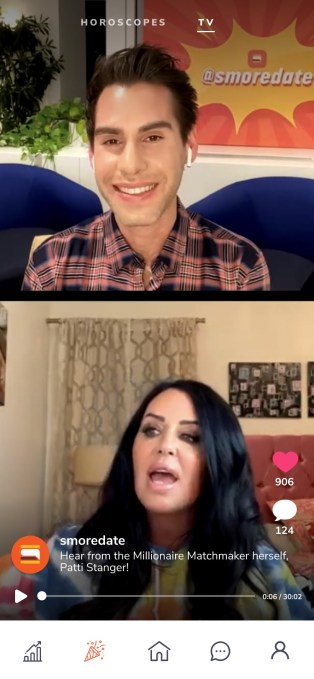
Dating startup S’More has launched a new feature called S’More TV, which CEO Adam Cohen-Aslatei said could give users new ways to talk to each other. It also bringing the startup closer to his goal of becoming not just a dating app, but “a lifestyle brand.”

The videos on S’More TV may be familiar to people who follow the company on Instagram, where Cohen-Aslatei has hosted dating-related interviews with celebrities like WWE stars Chelsea Green and Leah Van Dale, models Nichole Holms and Sarah Miller and Mary Fitzgerald of “Selling Sunset.” Now, however, these videos are getting a home in the S’More app itself.

Cohen-Aslatei said this wasn’t the initial plan when he started filming videos for S’More Live, but eventually he and his team decided to do more with their “nearly 50 hours of exclusive celebrity content,” seeing them as “the first organic way to have content not related to a dating profile” in the app. He suggested that this isn’t just giving users another reason to open the app, but also a crucial conversation starter.

After all, anyone who’s had to start a conversation in a dating app will probably remember moments when you’ve struggled to come up with something better than “Hey” or “How’s it going?” — and S’More presents unique challenges on that front, since the app blurs all user photos until you’ve had some real interaction. So Cohen-Aslatei said these videos can spur a more natural conversation, allowing users to “really talk about topics that they care about.”

S'More TV

Image Credits: S’More

The S’More app now includes prompts directing users to watch S’More TV, where anyone can watch and comment on the videos. If you post a particularly scintillating comment, that may help to attract potential matches, and it will give them an easy starting point for the conversation.

In fact, Cohen-Aslatei claimed that since releasing S’More TV in beta testing, the app has seen Day 1 retention (the number of users who open the app one day after installation) increase by 15% to the “mid 60s,” while time in the app has doubled.

He also said S’More Live is quickly approaching its 100th episode, but you won’t see all of those episodes the app right away. Instead, the company will be adding 15 new videos to the S’More app each month.

In addition, S’More has launched a new feature called cover photos. This is basically the one exception to the blurred photos rule (although it sounds like even this photo is subtly warped), allowing users to showcase a single image of their friends, their life or their personality even before they start a conversation.

26 Apr 2021

Early bird ends Friday. Buy now and save $100 on TC Early Stage 2021: Marketing and Fundraising

Save $100 and learn how to build a stronger startup — that’s what we’re talking about! The crème de la crème of the startup ecosystem will gather on July 8-9 to share their expertise and impart their hard-won wisdom at TC Early Stage 2021: Marketing and Fundraising.

Here’s where the saving money bit comes in. Early-bird pricing is still in play, for just a few more days. Save $100 — but only if you purchase your pass before Friday, April 30 at 11:59 p.m. (PT).

We’re building a veritable hit parade of investors, founders and top subject-matter experts to deliver highly interactive and engaging sessions focused on essential entrepreneurial skills. Learn best practices, avoid pitfalls and walk away with a realistic view of what to expect on the road to building a startup.

Chloe Leaaetoa, the founder of Socicraft, attended Early Stage 2020 and shared this takeaway with us.

You learn from industry leaders and seasoned founders — people who’ve already been there and done that. They were genuine and honest about industry expectations. Plus, they shared first-hand accounts, which made them more relatable.

We’ve already announced that Mike Duboe, Sarah Kunst and Rahul Vohra will join us at TC Early Stage 2021: Marketing and Fundraising, and we’ll be announcing more speakers every week. Keep checking back!

You’re a smart bunch so you’ve no doubt noticed that Early Stage 2021 (the July edition) will include a lot of information on every startup founder’s favorite topic: fundraising. Take a look at just some of the many top-flight financial experts who will be in the house and on the stage. We can’t wait to share the specific topics they’ll discuss. Again, stay tuned!

  • Arvind Purushotham: Managing Director & Global Head Venture Investing, Citi Ventures
  • Rebecca Reeve Henderson: Founder & CEO, Rsquared Communication
  • Benjamin Sun: Co-founder & General Partner, Primary Venture Partners
  • Adina Tecklu: Principal, Khosla Ventures

And don’t forget about the TC Early-Stage Pitch-off that takes place on day two. We’ll start accepting applications soon, and that’s when Team TechCrunch gets busy and chooses 10 early-stage startup founders to throw down in front of a panel of VC judges. Prizes, glory, exposure and fun! Be sure to check out Nalagenetics — winner of the April Early Stage 2021 pitch-off.

TC Early Stage 2021: Marketing and Fundraising takes place July 8-9. Ready to learn everything you can to build a successful startup empire? Ready to save $100 in the process? Then buy your pass before the early-bird deadline shuts off the savings on April 30, at 11:59 p.m. (PT).

Is your company interested in sponsoring or exhibiting at Early Stage 2021 – Marketing & Fundraising? Contact our sponsorship sales team by filling out this form.

26 Apr 2021

Early bird ends Friday. Buy now and save $100 on TC Early Stage 2021: Marketing and Fundraising

Save $100 and learn how to build a stronger startup — that’s what we’re talking about! The crème de la crème of the startup ecosystem will gather on July 8-9 to share their expertise and impart their hard-won wisdom at TC Early Stage 2021: Marketing and Fundraising.

Here’s where the saving money bit comes in. Early-bird pricing is still in play, for just a few more days. Save $100 — but only if you purchase your pass before Friday, April 30 at 11:59 p.m. (PT).

We’re building a veritable hit parade of investors, founders and top subject-matter experts to deliver highly interactive and engaging sessions focused on essential entrepreneurial skills. Learn best practices, avoid pitfalls and walk away with a realistic view of what to expect on the road to building a startup.

Chloe Leaaetoa, the founder of Socicraft, attended Early Stage 2020 and shared this takeaway with us.

You learn from industry leaders and seasoned founders — people who’ve already been there and done that. They were genuine and honest about industry expectations. Plus, they shared first-hand accounts, which made them more relatable.

We’ve already announced that Mike Duboe, Sarah Kunst and Rahul Vohra will join us at TC Early Stage 2021: Marketing and Fundraising, and we’ll be announcing more speakers every week. Keep checking back!

You’re a smart bunch so you’ve no doubt noticed that Early Stage 2021 (the July edition) will include a lot of information on every startup founder’s favorite topic: fundraising. Take a look at just some of the many top-flight financial experts who will be in the house and on the stage. We can’t wait to share the specific topics they’ll discuss. Again, stay tuned!

  • Arvind Purushotham: Managing Director & Global Head Venture Investing, Citi Ventures
  • Rebecca Reeve Henderson: Founder & CEO, Rsquared Communication
  • Benjamin Sun: Co-founder & General Partner, Primary Venture Partners
  • Adina Tecklu: Principal, Khosla Ventures

And don’t forget about the TC Early-Stage Pitch-off that takes place on day two. We’ll start accepting applications soon, and that’s when Team TechCrunch gets busy and chooses 10 early-stage startup founders to throw down in front of a panel of VC judges. Prizes, glory, exposure and fun! Be sure to check out Nalagenetics — winner of the April Early Stage 2021 pitch-off.

TC Early Stage 2021: Marketing and Fundraising takes place July 8-9. Ready to learn everything you can to build a successful startup empire? Ready to save $100 in the process? Then buy your pass before the early-bird deadline shuts off the savings on April 30, at 11:59 p.m. (PT).

Is your company interested in sponsoring or exhibiting at Early Stage 2021 – Marketing & Fundraising? Contact our sponsorship sales team by filling out this form.