Year: 2021

22 Apr 2021

Newly-christened Percent wants to make it easier to securitize corporate debt

Debt is the new equity. As founders run around trying to fend off prying VCs from their cap tables, they are increasingly turning to debt products like revenue-based securities in order to get the capital they need today while protecting them from dilution they don’t want tomorrow. It’s a huge business, with leading company Pipe just valued at $2 billion and others like CapChase cashing in on founders’ newly-found love of debt.

All those new securities creates a dilemma for potential investors: how do they evaluate every single new debt product from every single company? It’s a problem they face not just in the startup world, but also private debt in general as companies borrow hundreds of billions of dollars per year. The solution is securitization and syndication, aggregating the small debts from multiple companies and fusing them together into one consistent new security. It’s a major component of capital markets, but one that remains mired in legacy business practices.

Percent is building an end-to-end technology securitization platform for debt originators to connect with a much wider network of investors than traditional institutions to get the best rates at the fastest speeds. When we last checked in a year ago with the company, previously known as Cadence, it had just raised $4 million and had processed $125 million through its platform in its short lifetime.

Well, it has now structured more than $400 million across its platform, an eye-popping performance that has attracted new VC interest, this time from Sep Alavi at White Star Capital and Karen Page at B Capital. The two firms are investing $12.5 million in a Series A into Percent, with previous backers Revel Partners and Recharge Capital participating.

For CFOs, Percent’s pitch is that it can offer a wider spectrum of private debt buyers to originators, therefore lowering the cost of capital. The traditional corporate debt world remains quite clubby, with major institutional holders being connected to originators through investment banks. High fees and a limited investor base can raise expenses significantly. Through its platform, Percent can break that clubbiness and open the debt world to a wider range of buyers.

Furthermore, Percent also acts as the deal origination and transaction platform, allowing companies to easily put together debt offerings, process requests for information, and avoid the sort of “attach Excel financials to email or upload to cloud” workflow that remains a mainstay in these processes.

Percent’s business model is to take a percentage fee on the dollars originated on its platform as well as an additional percentage fee if it is the underwriter itself. In this way, it has essentially a recurring-revenue model — the more debt that is transacted on its platform, the more continuous revenue the company generates over time.

Percent scored one of its biggest wins to date with the securitization of $144 million in debt originated by FAT Brands, the owners of popular restaurant franchises like Fatburger and Johnny Rockets. Precent acted as co-lead bookrunner with lead Jefferies for the debt announced yesterday, and FAT noted that its cost of capital was significantly lower than its previous two securitizations from last year. Given the changing macro environment and the radically shifting fortunes in the foods service business in the wake of COVID-19 though, it is hard to precisely identify what changed the cost of capital and what extent a modern technology stack helped the company’s debt performance. Outside of FAT Brands, Percent has a list of many of its other originators available.

Nelson Chu, the founder and CEO of Percent, noted that he was particularly interested in finding investors with knowledge of capital markets and the enterprise sales cycle. He observed in an interview that as more and more VCs in recent years have tended to come from product and growth roles at startups rather than the traditional path through an investment bank, there are fewer VCs with knowledge or interest in the capital markets space.

Alavi at White Star has invested in a range of financial services and blockchain companies, while Page at B Capital has long been in the enterprise space at Apple and as an early employee at cloud provider Box.
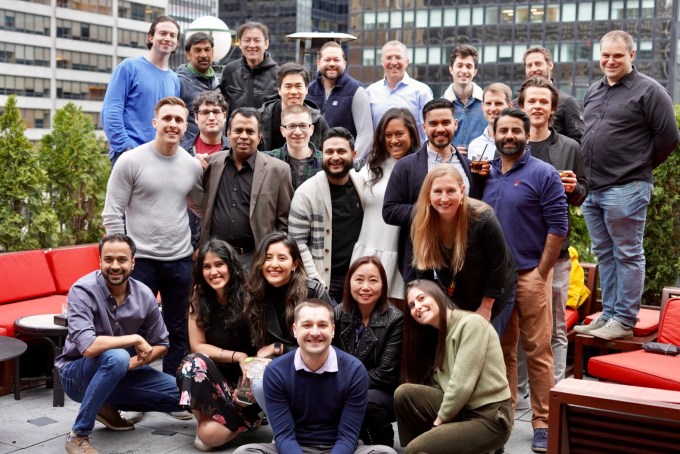
Percent’s team in New York City this week. Image Credits: Percent

Percent, which is headquartered in New York City and was founded in 2018, has expanded its team by double over the past year as it scales up its engineering and sales teams.


22 Apr 2021

Queenly raises $2.3M for its dress marketplace

One of our favorite companies from the most recently Y Combinator batch has closed a seed round. This morning Quenly announced that it has closed a $2.262 million round, following its $800,000 pre-seed raise. TechCrunch covered the company in February, noting that the company was building something akin to the StockX for women’s formal wear.

Queenly runs a marketplace that allows individuals and small stores to resell dresses after they’ve been worn, allowing for more women to access the items they want to wear to a prom, quinceanera, or pageant at a lower price point. And as the service could help reduce net clothing waste, it could have a positive environmental impact as well.

The model has continued to find backers. According to co-founder Trisha Bantigue, the biggest check in Queenly’s seed round came from Dragon Capital, an investing group that she said quickly saw her startup’s potential, investing the day after they met. Notably, the seed round, which Bantigue had roughly half-filled even before its Y Combinator cohort’s launch event, did not have a lead investor. Instead, she described her most recent backers as more of a collection of investors that can bring different strategic value-adds to Queenly.

Brightlane Ventures put capital in, for example. Bantigue said that they provide candidate sourcing help. She also cited Amino Capital’s analytics knowledge, which will help her company’s technical co-founder Kathy Zhou. NextView Ventures also invested, an investor that Bantigue said had deep experience in resale marketplaces and commerce. Interlace Ventures and Shakti Capital also took part.

Queenly, long a team of two, intends to expand its staff to six full-time workers with its new funds. That means that Zhou will be supplemented by two more engineers, and Bantigue will be backed up by a head of growth, and a head of opps. Six full-time staff isn’t many, unless you’re starting from a base of two. Then it’s a trebling.

Queenly had set out to raise $1.5 million, but wound up raising $2.1 million, a number that grew to $2.262 million by the time that TechCrunch caught up with the company earlier this week.

Notably, Bantigue turned down a larger, $1.5 million check after closing around $1.1 million of the round. Why not on as much capital as possible? She said that Y Combinator and its managing director Michael Seibel had warned her startup cohort against raising too much money too early. And, she explained, her team is more focused on building long-term more “sustainable” growth than short-term “hypergrowth.” She cited startups that raised lots of capital quickly only to later burn out as a cautionary tale.

The new capital was raised using a simple agreement for future equity, or SAFE at a single cap.

Queenly’s model of allowing individuals and partner stores resale dresses provides it with two distinct supply sources. TechCrunch asked which is its key driver of growth. Per Bantigue, the partner selling model is still new, but thus far has yielded a simpler, and lower-friction supply source for her company.

TechCrunch was also curious about how the company handles quality, fraud and returns, especially in light of our recent, and illustrative dive into StockX which has a related set of hurdles to clear.

Bantigue explained that her firm has two main ways that dresses are vetted. For those priced at $300 or less, they ship directly from sellers to buyers, after submitting proof photos of the condition of the dress’s components. Those that cost more than $300 are routed through the company’s own operation, where it can provide stricter quality control.

With more capital than it has ever had, a growing team, and a large market that is largely offline today, the startup should have plenty of room to grow. Let’s see how far it can get with this new investment.


22 Apr 2021

As ExxonMobil asks for handouts, startups get to work on carbon capture and sequestration

Earlier this week, ExxonMobil, a company among the largest producers of greenhouse gas emissions and a longtime leader in the corporate fight against climate change regulations, called for a massive $100 billion project (backed in part by the government) to sequester hundreds of millions of metric tons of carbon dioxide in geologic formations off the Gulf of Mexico.

The gall of Exxon’s flag-planting request is matched only by the grit from startup companies that are already working on carbon capture and storage or carbon utilization projects and announced significant milestones along their own path to commercialization even as Exxon was asking for handouts.

These are companies like Charm Industrial, which just completed the first pilot test of its technology through a contract with Stripe. That pilot project saw the company remove 416 tons of carbon dioxide equivalent from the atmosphere. That’s a small fraction of the hundred million tons Exxon thinks could be captured in its hypothetical sequestration project located off the Gulf Coast, but the difference between Exxon’s proposal and Charm’s sequestration project is that Charm has actually managed to already sequester the carbon.

The company’s technology, verified by outside observers like Shopify, Microsoft, CarbonPlan, CarbonDirect and others, converts biomass into an oil-like substance and then injects that goop underground — permanently sequestering the carbon dioxide, the company said.

Eventually, Charm would use its bio-based oil equivalent to produce “green hydrogen” and replace pumped or fracked hydrocarbons in industries that may still require combustible fuel for their operations.

While Charm is converting biomass into an oil-equivalent and pumping it back underground, other companies like CarbonCure, Blue Planet, Solidia, Forterra, CarbiCrete and Brimstone Energy are capturing carbon dioxide and fixing it in building materials. 

“The easy way to think about CarbonCure we have a mission to reduce 500 million tons per year by 2030. On the innovation side of things we really pioneered this area of science using CO2 in a value-added, hyper low-cost way in the value chain,” said CarbonCure founder and chief executive Rob Niven. “We look at CO2 as a value added input into making concrete production. It has to raise profits.”

Niven stresses that CarbonCure, which recently won one half of the $20 million carbon capture XPrize alongside CarbonBuilt, is not a hypothetical solution for carbon dioxide removal. The company already has 330 plants operating around the world capturing carbon dioxide emissions and sequestering them in building materials.

Applications for carbon utilization are important to reduce the emissions footprints of industry, but for nations to achieve their climate objectives, the world needs to move to dramatically reduce its reliance on emissions spewing energy sources and simultaneously permanently draw down massive amounts of greenhouse gases that are already in the atmosphere.

It’s why the ExxonMobil call for a massive project to explore the permanent sequestration of carbon dioxide isn’t wrong, necessarily, just questionable coming from the source.

The U.S. Department of Energy does think that the Gulf Coast has geological formations that can store 500 billion metric tons of carbon dioxide (which the company says is more than 130 years of the country’s total industrial and power generation emissions). But in ExxonMobil’s calculation that’s a reason to continue with business-as-usual (actually with more government subsidies for its business).

Here’s how the company’s top executives explained it in the pages of The Wall Street Journal:

The Houston CCS Innovation Zone concept would require the “whole of government” approach to the climate challenge that President Biden has championed. Based on our experience with projects of this scale, we estimate the approach could generate tens of thousands of new jobs needed to make and install the equipment to capture the CO2 and transport it via a pipeline for storage. Such a project would also protect thousands of existing jobs in industries seeking to reduce emissions. In short, large-scale CCS would reduce emissions while protecting the economy.

These oil industry executives are playing into a false narrative that the switch to renewable energy and a greener economy will cost the U.S. jobs. It’s a fact that oil industry jobs will be erased, but those jobs will be replaced by other opportunities, according to research published in Scientific American.

“With the more aggressive $60 carbon tax, U.S. employment would still exceed the reference-case forecast, but the increase would be less than that of the $25 tax,” write authors Marilyn Brown and Majid Ahmadi. “The higher tax causes much larger supply-side job losses, but they are still smaller than the gains in energy-efficiency jobs motivated by higher energy prices. Overall, 35 million job years would be created between 2020 and 2050, with net job increases in almost all regions.”

ExxonMobil and the other oil majors definitely have a role to play in the new energy economy that’s being built worldwide, but the leading American oil companies are not going to be able to rest on their laurels or continue operating with a business-as-usual mindset. These companies run the risk of going the way of big coal — slowly sliding into obsolescence and potentially taking thousands of jobs and local economies down with them.

To avoid that, carbon sequestration is a part of the solution, but it’s one of many arrows in the quiver that oil companies need to deploy if they’re going to continue operating and adding value to shareholders. In other words, it’s not the last 130 years of emissions that ExxonMobil should be focused on, it’s the next 130 years that aim to be increasingly zero-emission.

22 Apr 2021

Ex.co acquires video adtech company Cedato

Ex.co is announcing its very first acquisition — it’s buying Cedato, a video monetization startup founded in 2015.

Previously known as Playbuzz, Ex.co is short for The Experience Company, and it provides publishers and other customers with an easy way to add interactive and visual elements (such as polls and product recommendations) to their content. The company says its publisher business grew revenue by 300% between 2018 and 2020.

According to co-founder and CEO Tom Pachys, over the past year, he’s become convinced that artificial intelligence is “taking over everything we do.”

“We started searching for companies that did video in a sophisticated way, meaning using [machine learning] as part of their core engines,” Pachys said. “When I say that, I mean things like choosing the right content, choosing the right ad, knowing how to manage an [ad] auction in the right way.”

He said Cedato stood out because it’s able to do all of this without affecting page load time, this will be increasingly important to Google’s Core Web Vitals measurements, and therefore to search rankings.

“It’s always a tradeoff between efficiencies and revenues in general,” Pachys said. “But for [Cedato], in a very surprising way, they can increase speed and increase revenues.”

By adding Cedato’s technology, Ex.co will be able to offer its customers things like predictive recommendations for video content, header bidding for video ads and improved support for connected TVs. Conversely, the company will continue to support existing Cedato customers while also offering them additional products.

“We’re not taking anything away, we’re just adding more solutions,” Pachys said.

The financial terms of the acquisition were not disclosed, but the entire Cedato team (based in New York and Israel) will be joining Ex.co.

“Since the company’s inception, Cedato has been laser-focused on creating the most advanced video tools with a simple, customer-first approach,” said Cedato founder and CEO Ron Dick in a statement. “Ex.co has a similar vision, powerful technology, and a large, loyal clientele base. Working together enables us to offer cutting-edge technology to our range of global partners, continuing to lead the way with product innovation that supports the market’s primary needs.”

Pachys added that Ex.co is looking to make another AI-related acquisitions, with the next one likely coming on the commerce side.

22 Apr 2021

RapidSOS and Axon ink deal to give better real-time information to emergency responders

Every time an emergency responder or police officer responds to a 911 dispatch, they enter an unknown terrain. What’s the incident? Who’s involved? Is anyone dangerous or holding a weapon? Is someone injured and perhaps has an underlying health condition that the responders need to know about? As prominent news stories this week and over the last few years constantly remind us, having the right context while responding can turn a potential tragedy into a much more positive story.

RapidSOS is a startup I’ve been watching for years. The company raised an $85 million Series C round this February to bring real-time location information from all sorts of devices — from Apple and Android smartphones to Sirius XM satellite radios — into the hands of 911 call centers when users make an emergency call. Accurate location can help dispatchers send responders to exactly the right place, offering faster assistance and therefore saving lives.

The company announced this morning a new partnership with Axon, the company behind Taser, the electroshock weapon designed as a non-lethal alternative to traditional firearms, and a variety of body cams and other technologies for public safety officials. In recent years, Axon has increasingly emphasized a suite of cloud offerings that can fuse data from its devices with software to creates operations systems for public safety agencies.

Through the partnership, Axon will integrate the data that its devices generate such as body cam footage and Taser discharge alerts into RapidSOS’s Jurisdiction Review, which is used by dispatchers to place a location and relevant information from a caller a visual map. For instance, a dispatcher might now know the location of police or medical responders, and be able to update a 911 caller on the estimated time of arrival or whether they need help getting access to a location.

Likewise, RapidSOS’s location, medical, and other information that it pulls in from user devices during an emergency call will be sent to Axon Respond devices. Frontline responders will therefore have direct access to a 911 caller’s location information or medical information if they have a profile setup, without having to wait for a dispatcher to route those facts to them.

Josh Pepper, VP of product management at Axon, said “What we’re always trying to do is how can we get [first responders] the right information about the incident, the right information about the people involved, the right information about the location and all of the disposition of the units involved, as fast and as accurately as we can … so that they can have situational awareness of what’s happening.” RapidSOS’s data will augment other information streams, helping first responders make those critical split-second decisions.

Michael Martin, CEO and co-foudner of RapidSOS, said “for the first time now, your smartphone, your 911 responder and the police officer in the field can all simultaneously and transparently share data with each other.”

In tech, we are used to having comprehensive information about our products through data analytics. In the emergency space — even today — first responders can lack even the most rudimentary information like location when responding to a call. RapidSOS, Axon and a slew of other companies are trying to bridge that digital divide.

A UI mockup of how Axon’s information will display within RapidSOS’s Jurisdiction View. Image Credits: RapidSOS

This is the Jurisdiction View from RapidSOS’s platform, with a few elements added to mockup how Axon’s information will be integrated into the product. The two starred badges represent the locations of responding police officers in the field, converging on the location (green pin) of a 911 caller. In the bottom-right corner, a live body cam feed from a police officer can be routed straight to a 911 dispatcher, giving them a real-time look at what is transpiring on the ground. Meanwhile in the info box to the left, we can see that a Taser weapon was fired (noted under “Device Alerts”) and the 911 dispatcher can text to the responding officer directly through the platform.

The companies said the partnership will bear fruit this year as both platforms integrate the data streams into their respective products.

22 Apr 2021

Westward plans a $30M debut fund to take Chinese indie games global

In Hefei, a Chinese city known for its relics from the Three Kingdoms period and its manufacturing industry today, Maxim Rate was thrilled to find a small studio crafting a Western role-playing game, a genre that attracts lovers of gritty aesthetics and dark storylines.

“The design and computer graphics are really good. You can’t tell they are a Chinese team,” said Rate.

Rate’s mission is to find Chinese studios like the bootstrapped Hefei team and help them woo international players. As Chinese regulators tighten rules on game publishing and make licenses hard to obtain in recent years, small studios find themselves struggling. Since last year, Apple has pulled thousands of unlicensed games from its Chinese App Store at the behest of local authorities. Small-time developers begin to look beyond their home turf.

“The problem is these startups have no experience in overseas expansion,” said Rate.

An avid gamer himself, Rate quit his job at a Chinese cross-border payment firm last year and launched a part-incubator, part-investment vehicle to take Chinese games abroad. The firm, called Westward Gaming Ventures, took inspiration from Zheng He, a Chinese diplomat and explorer who embarked on state-sponsored naval expeditions to the “Western Oceans” during the Ming Dynasty.

Westward plans to raise 200 million yuan ($30 million) for its debut fund, Rate told TechCrunch in an interview. It plans to deploy the capital over the next three years with an intended check size of 2-4 million yuan per studio. It’s currently in talks with 20-30 teams that span a wide range of genres.

The Chinese fund being established is a so-called Qualified Foreign Limited Partners Fund, which, for the first time, will enable foreign investors (USD and EUR) to invest directly in Chinese gaming firms. Only a few institutions own a license for QFLP, and while Westward itself doesn’t hold one, it gains legitimacy for direct foreign investment by partnering with the private equity arm of a major Chinese financial conglomerate, which declined to be named at this stage.

To navigate such regulatory complications, Westward also seeks help from its advisors, including one that oversaw the legal and financial process of one of the largest joint ventures established between Chinese and foreign gaming firms in recent years. The partnership, which can’t be named, was also the first time a foreign entity has become the majority shareholder in a gaming joint venture in China.

China limits foreign investments in areas it considers sensitive, such as value-added services, so many companies resort to setting up elaborate offshore entities to receive overseas funding. The restriction makes it difficult for resource-strapped studios to land foreign investors, who could help them venture into global markets. They are left with the option of getting backed or bought by Chinese giants like Tencent or ByteDance.

Rise of Chinese plays

The idea of Westward is not just to lower the barriers for independent Chinese games to secure foreign capital but also better prepare them for overseas expansion.

“Chinese gaming studios, big or small, used to rely heavily on ads for user acquisition when they went abroad,” said Rate. “Sometimes a game would take off, but the team had no idea why, so they continued to test. Those who failed may just give up.”

But taking a game abroad is not as simple as translating it, hitting the publish button and launching an ad campaign on Facebook.

Westward’s plan is to get involved in a game’s early development phase and help them position: Is it an RPG? Is the targeted user a casual or serious player? What’s the graphic style? In addition, the firm also plans to supply developers with workspace, technical assistance, marketing and localization expertise, connection to publishers, and overseas operation help.

Image Credits: Westward Gaming Ventures

To provide post-investment support, Westward has partnered up with V+ Gaming Society, an incubator for games headquartered Shenzhen, which Westward also calls home.

Chinese tech companies are facing mounting challenges in the West as geopolitical tensions rise. Many now prefer calling themselves “global firms” and even deny their Chinese roots outright.

But for Westward, the games it helps doesn’t need to pretend they are non-Chinese. “Most players don’t consider where a game is from if it is a really good game,” said Rate.

“We actually hope to see elements of Chinese culture in these games that can be understood by overseas players.”

Amy Ho, a partner at Westward along with Rate and Edward He, said one of the few Chinese games that have managed to be both “Chinese” and transcend cultural boundaries is Chinese Parents. The simulation game became a global hit by letting users experience what it is like to raise a child in China.

The benchmark Rate gave was the generation of Japanese games that began exporting 20-30 years ago, which he described as “Japanese” in spirit but “globalized” in graphics and game design.

There have already been globally successful titles from Chinese makers like Tencent and rising studios Lilith and Mihoyo. In the past, many Chinese users on Steam would be asking foreign titles to rush out Chinese versions. Now, it’s not uncommon to see Western users demanding English editions of Chinese games, Rate observed.

Rather than politics, the bigger challenge, especially for small studios, is how to “collect key data for product iteration while complying with local privacy laws,” said Ho.

50-70% of Westward’s capital will come from Chinese institutions. The presence of Chinese investments inevitably leads to questions around censorship. Ho said while Westward provides resources and capital to studios, it will work to ensure their independence from investor influence.

If things go well, Westward could help facilitate cultural exchange between China and the rest of the world. Beijing has been trying to export the country’s soft power, and games may be a suitable conduit, suggested Rate. Amid the ongoing trade war, having foreign fundings in Chinese companies may also do good to China’s “brand”, he said.

22 Apr 2021

Medchart raises $17M to help businesses more easily access patient-authorized health data

Electronic health records (EHR) have long held promise as a means of unlocking new superpowers for caregiving and patients in the medical industry, but while they’ve been a thing for a long time, actually accessing and using them hasn’t been as quick to become a reality. That’s where Medchart comes in, providing access to health information between businesses, complete with informed patient consent, for using said data at scale. The startup just raised $17 million across Series A and seed rounds, led by Crosslink Capital and Golden Ventures, and including funding from Stanford Law School, rapper Nas and others.

Medchart originally started out as more of a DTC play for healthcare data, providing access and portability to digital health information directly to patients. It sprung from the personal experience of co-founders James Bateman and Derrick Chow, who both faced personal challenges accessing and transferring health record information for relatives and loved ones during crucial healthcare crisis moments. Bateman, Medchart’s CEO, explained that their experience early on revealed that what was actually needed for the model to scale and work effectively was more of a B2B approach, with informed patient consent as the crucial component.

“We’re really focused on that patient consent and authorization component of letting you allow your data to be used and shared for various purposes,” Bateman said in an interview. “And then building that platform that lets you take that data and then put it to use for those businesses and services, that we’re classifying as ‘beyond care.’ Whether those are our core areas, which would be with your, your lawyer, or with an insurance provider, or clinical researcher — or beyond that, looking at a future vision of this really being a platform to power innovation, and all sorts of different apps and services that you could imagine that are typically outside that realm of direct care and treatment.”

Bateman explained that one of the main challenges in making patient health data actually work for these businesses that surround, but aren’t necessarily a core part of a care paradigm, is delivering data in a way that it’s actually useful to the receiving party. Traditionally, this has required a lot of painstaking manual work, like paralegals poring over paper documents to find information that isn’t necessarily consistently formatted or located.

“One of the things that we’ve been really focused on is understanding those business processes,” Bateman said. “That way, when we work with these businesses that are using this data — all permissioned by the patient — that we’re delivering what we call ‘the information,’ and not just the data. So what are the business decision points that you’re trying to make with this data?”

To accomplish this, Medchart makes use of AI and machine learning to create a deeper understanding of the data set in order to be able to intelligently answer the specific questions that data requesters have of the information. Therein lies their longterm value, since once that understanding is established, they can query the data much more easily to answer different questions depending on different business needs, without needing to re-parse the data every single time.

“Where we’re building these systems of intelligence on top of aggregate data, they are fully transferable to making decisions around policies for, for example, life insurance underwriting, or with pharmaceutical companies on real world evidence for their phase three, phase four clinical trials, and helping those teams to understand, you know, the the overall indicators and the preexisting conditions and what the outcomes are of the drugs under development or whatever they’re measuring in their study,” Bateman said.”

According to Ameet Shah, Partner at co-lead investor for the Series A Golden Ventures, this is the key ingredient in what Medchart is offering that makes the company’s offering so attractive in terms of long-term potential.

“What you want is you both depth and breadth, and you need predictability — you need to know that you’re actually getting like the full data set back,” Shah said in an interview. “There’s all these point solutions, depending on the type of clinic you’re looking at, and the type of record you’re accessing, and that’s not helpful to the requester. Right now, you’re putting the burden on them, and when we looked at it, we were just like ‘Oh, this is just a whole bunch of undifferentiated heavy lifting that the entire health tech ecosystem is trying to like solve for. So if [Medchart] can just commoditize that and drive the cost down as low as possible, you can unlock all these other new use cases that never could have been done before.”

One recent development that positions Medchart to facilitate even more novel use cases of patient data is the 21st Century Cures Act, which just went into effect on April 5, provides patients with immediate access, without charge, to all the health information in their electronic medical records. That sets up a huge potential opportunity in terms of portability, with informed consent, of patient data, and Bateman suggests it will greatly speed up innovation built upon the type of information access Medchart enables.

“I think there’s just going to be an absolute explosion in this space over the next two to three years,” Bateman said. “And at Medchart, we’ve already built all the infrastructure with connections to these large information systems. We’re already plugged in and providing the data and the value to the end users and the customers, and I think now you’re going to see this acceleration and adoption and growth in this area that we’re super well-positioned to be able to deliver on.”

22 Apr 2021

Forget the piggy bank, Till Financial’s kids’ spend management app gets Gates’ backing

Today’s children and teens want more power and control over their spending.

And while there are a number of financial services and apps out there aimed at helping this demographic save and invest money (Greenlight being among the most popular and well-known), one startup is coming at the space from another angle: helping younger people also better manage their spend.

Till Financial describes itself as a collaborative family financial tool that aims to empower kids to become smarter spenders. The New York-based company’s banking platform is designed to encourage “open and honest” discussions between parents and their kids. And it has just raised $5 million to help it advance on that goal.

A slew of investors put money in the round, including Elysian Park Ventures, Melinda Gates’ venture fund Pivotal Ventures with Magnify Ventures, Afore Capital, Luge Capital, Alpine Meridian Ventures, The Gramercy Fund, SM Ventures (the family office of the founders/CEOs of Stadium Goods) and Lightspeed Venture Partners’ Scout Fund. Also participating were angel investors such as the founders of fintech Petal, the founders of alcohol marketplace Drizly, the president of Transactis, and the president of 1800Flowers.

Part of Till’s goal is to help kids “learn by doing” and gain confidence in spending decisions. It arms them with a bank account, digital and physical debit card and goal-based savings. For example, say a teen wants to buy an iPad, they can set up an account that they can save toward that iPad and give family members (such as grandparents, for example) the opportunity to pitch in the same amount, or more. They can also set up recurring payments for things like Netflix or Spotify subscriptions so they can get a taste of what it’s like to pay regular bills.

“Parents and the current banking options miss the point when they just focus on savings. We need to first prepare kids to be Smarter Spenders, supported by savings and investing,” said Taylor Burton, who founded the company with Tom Pincince. “On Till, kids learn to spend with intention and purpose, while parents gain confidence and trust based on transparency and accountability.”

To Pincince, the market is clearly underserved.

“The legacy banks really don’t care about this young person and the early digital players are really missing the mark,” he said. 

And despite the plethora of apps targeting the demographic, Pincince believes there’s plenty of room for the right players.

“The reality is you’re talking about a swath of kids under the age of 18 and over the age of eight that is the single largest unbanked population,” he said. “We’re not fighting to be the top of your son’s wallet. We’re fighting to be the first product into that wallet.”

Indeed, it’s a big market — the average middle-class family in the U.S. spends $284,570 per child by the time they turn 18.

The platform is free to all families and, early on, attracted the attention of Peggy Mangot, operating partner/COO of PayPal Ventures. She invested personally in Till in its pre-seed rounds. Prior to PayPal, Mangot ran development of Greenhouse, Well Fargo’s fee-free mobile banking app that aimed to help younger users build responsible spending habits.

Mangot has three kids and recalls that when they were shopping online, she’d give them her credit card. Or, if they were going to the corner store or meeting with friends, she’d give them cash.

“But that way, the money is meaningless to them. They didn’t really know how to understand what things cost and there was no sense of ownership,” she said. “It was just me handing over cash or a card.”

What attracted her the most about Till, Mangot said, was the team’s approach to treat younger people “with respect and agency.”

She also believes that by helping children and teens understand important financial lessons at a younger age, the world will ultimately be full of more responsible adults.

“By putting these tools in the hands of these young people early, they’ll have years and years of experience before they’re more independent and have to manage their paycheck and bills,” Mangot told TechCrunch. “Once you have mass adoption, it’s going to create a much more financially literate, confident and in control set of young adults than we’ve ever had.”

Besides making money on interchange fees, Till aims to earn revenue by partnering with merchants to offer rewards to users. It also plans to earn referral fees by referring the teens to other financial institutions when they get older and have different needs.

“It’s not our intention to be your son or daughter’s forever bank. It’s our intention to be the first bank,” Pincince said. “So, they hit the age of maturity, we’re actually giving them a high-five off of our platform and introducing them to maybe their first college loan or their first credit card.”

22 Apr 2021

With $30M extension, BigID boosts Series D to $100M at $1.25B valuation

When we last heard from BigID at the end of 2020, the company was announcing a $70 million Series D at a $1 billion valuation. Today, it announced a $30 million extension on that deal valuing the company at $1.25 billion just 4 months later.

This chunk of money comes from private equity firm Advent International, and brings the total raised to over $200 million across 4 rounds, according to the company. The late stage startup is attracting all of this capital by building a security and privacy platform. When I spoke to CEO Dimitri Sirota in September 2019 at the time of the $50 million Series C, he described the company’s direction this way:

“We’ve separated the product into some constituent parts. While it’s still sold as a broad-based [privacy and security] solution, it’s much more of a platform now in the sense that there’s a core set of capabilities that we heard over and over that customers want.”

Sirota says he has been putting the money to work, and as the economy improves he is seeing more traction for the product set. “Since December, we’ve added employees as we’ve seen broader economic recovery and increased demand. In tandem, we have been busy building a whole host of new products and offerings that we will announce over the coming weeks that will be transformational for BigID,” he said.

He also said that as with previous rounds, he didn’t go looking for the additional money, but decided to take advantage of the new funds at a higher valuation with a firm that he believes can add value overall. What’s more, the funds should allow the company to expand in ways it might have held off on.

“It was important to us that this wouldn’t be a distraction and that we could balance any funding without the need to over-capitalize, which is becoming a bigger issue in today’s environment. In the end, we took what we thought could bring forward some additional product modules and add a sales team focused on smaller commercial accounts,” Sirota said.

Ashwin Krishnan, a principal on Advent’s technology team in New York says that BigID was clearly aligned with two trends his firm has been following. That includes the explosion of data being collected and the increasing focus on managing and securing that data with the goal of ultimately using it to make better decisions.

“When we met with Dimitri and the BigID team, we immediately knew we had found a company with a powerful platform that solves the most challenging problem at the center of these trends and the data question,”Krishnan said.

Past investors in the company include Boldstart Ventures, Bessemer Venture Partners and Tiger Global. Strategic investors include Comcast Ventures, Salesforce Ventures and SAP.io.

22 Apr 2021

Will Budweiser brew eggs and will Post cereal make meat?

Corporations are quickly waking up to the market potential of alternative proteins with the nation’s biggest consumer brands continuing to make investments and create partnerships with startup companies helping consumers transition to healthier and more environmentally sustainable diets.

As Earth Week draws to a close (thankfully) new partnerships announced over the past week show the potential for new technologies to transform old businesses.

Yesterday the New York-based ZX Ventures, the investment and innovation arm of AB InBev, said that it would be partnering with Clara Foods, a developer of protein production technologies including (but not limited to), brewing egg substitutes. That’s right, the makers of Budweiser are hatching a scheme to make other kinds of liquids that are less potable and more poachable.

In that case, the yolk would definitely be on you, future consumer.

“Since day one, Clara has been on a mission to accelerate the world’s transition to animal-free protein, starting with the egg. More than one trillion eggs are consumed globally every year and corporate commitments for cage-free aren’t enough,” said Arturo Elizondo, the chief executive and co-founder of Clara Foods. “We’re thrilled to be partnering with the world’s largest fermentation company to work together to enable a kinder, greener, and more delicious future. This partnership is a major step towards realizing our vision.”

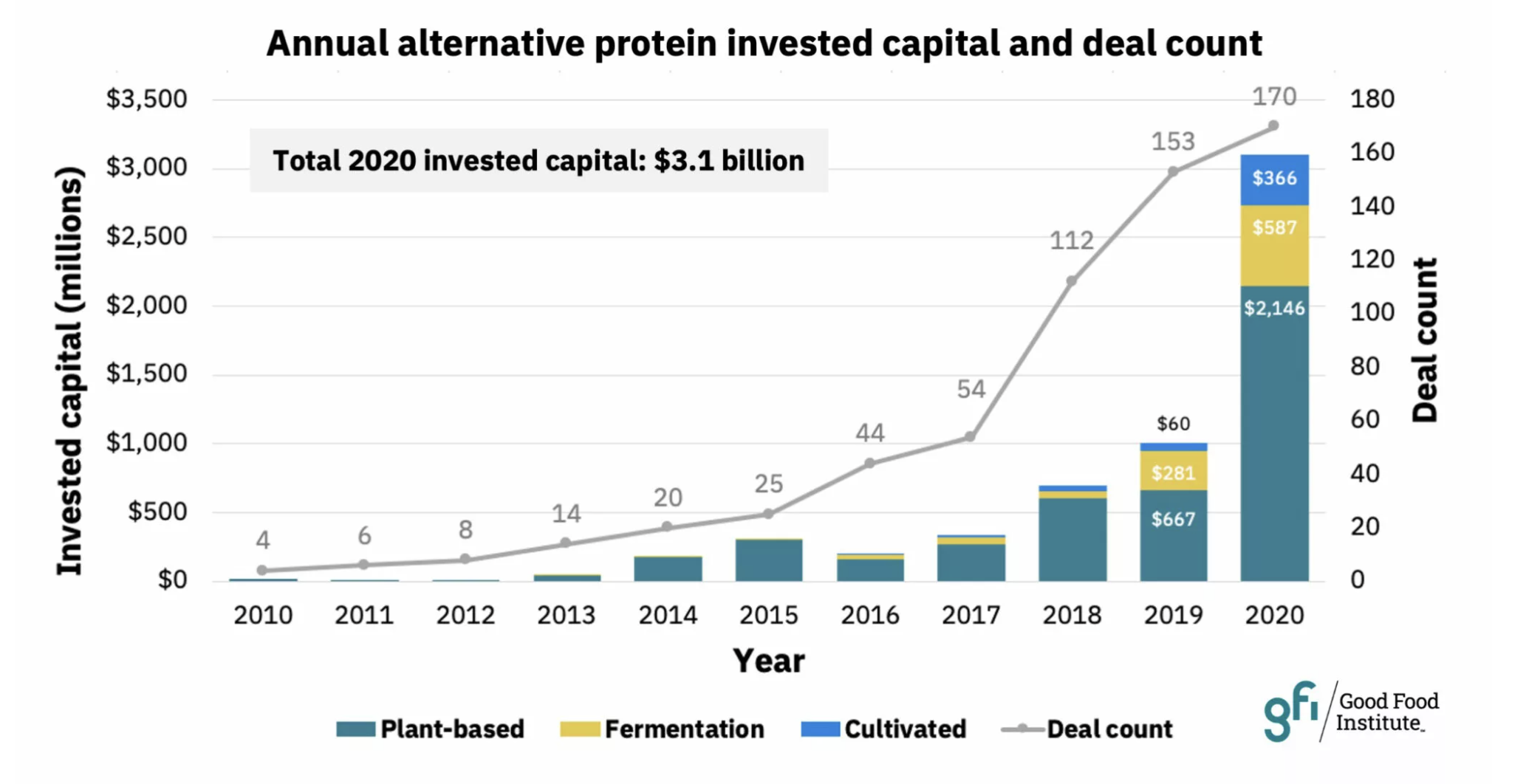
Graph showing the increasing size of investments into alternative proteins in 2020. From 2019 to 2020 investments in alternative proteins soared from just over $1 billion to $3 billion led by investments in plant protein products. Image Credit: Good Food Institute

There are market-driven reasons for the partnership. Demand for high quality proteins is expected to jump up to 98% by 2050, according to research cited by the two companies.

“Meeting the increased demand for food requires breakthrough solutions built on collaboration and innovation that spans several industry domains – both old and new. The ancient and natural process of fermentation can be further harnessed to help meet future demands in our global food system,” said Patrick O’Riordan, founder & CEO at BioBrew, ZX Ventures’ new business line trying to apply large-scale fermentation and downstream processing expertise beyond beer. “We look forward to exploring the development of highly-functional, animal-free egg proteins with Clara Foods in a scalable, sustainable and economically viable manner.”

Meanwhile, there’s a meeting of the minds happening in St. Louis where cereal giant Post is investing in Hungry Planet, a startup making meat a range of meat replacements.

Formed from the same Seventh Day Adventist focus on plant-based diet and health as a core of spirituality that launched the Kellogg’s cereal empire, Post has long been a rival to the corn flake king with its grape nuts cereal and other grain-based breakfast offerings.

Now the company has led a $25 million investment in Hungry Planet, which aims to provide meat-based replacements for crab cakes, lamb burgers, chicken, pork, and beef. Additional investors included the Singapore-based environmentally sustainable holding company, Trirec.

Alternative proteins are a big business. Last year, companies developing technologies and businesses to commercialize alternative sources of protein raised over $3 billion, according to the industry tracker, the Good Food Institute.

“Over the past year, the alternative protein industry has demonstrated not only resilience but acceleration, raising significantly more investment capital in 2020 than in prior years,” said GFI director of corporate engagement Caroline Bushnell, in a statement. “These capital infusions and the funding still to come will facilitate much-needed R&D and capacity building to enable these companies to scale and reach more consumers with delicious, affordable, and accessible alternative protein products.”

It’s all part of a push to provide more plant-based alternatives to animal proteins in a bid to halt planetary deforestation and reduce the greenhouse gas emissions associated with animal husbandry.

“Humanity needs solutions that match the scale and urgency of our problems,” said Elizondo. “