Year: 2021

20 Apr 2021

BlaBlaCar raises $115 million to build all-in-one travel app

French startup BlaBlaCar has raised a new $115 million funding round (€97 million). While the company is better known for its long distance carpooling marketplace, BlaBlaCar has also added a bus marketplace with the acquisition of Ouibus and an online bus ticketing platform with the acquisition of Busfor.

Existing investor VNV Global is leading the round. Two new investors are also participating — Otiva J/F AB and FMZ Ventures. Otiva J/F AB is a fund created by Avito founders Jonas Nordlander and Filip Engelbert. If you’re not familiar with Avito, they specialize in classified ads for the Russian market. Classified giant and global tech investor Naspers acquired Avito. As for FMZ Ventures, it’s a growth fund created by Michael Zeisser, who previously led investments for Alibaba and was a board member at Lyft and Tripadvisor.

It’s a convertible note, which means that the valuation will depend on the next financial event, such as another fundraising round or an initial public offering. But BlaBlaCar co-founder and CEO Nicolas Brusson consider it as a “pre-IPO convertible” round as BlaBlaCar still has a ton of cash on its bank account.

“We already had a lot of cash before this round and we still have more than €200 million in cash following this funding round,” Brusson told me.

Even if BlaBlaCar doesn’t go public right away (or doesn’t raise), there’s a clause with a time frame. After a while, those $115 million will convert into BlaBlaCar shares at a $2 billion valuation in case there’s no financial event.

BlaBlaCar’s strategy and goal with today’s funding round could be summed up with three pillars — carpooling, buses and aggregation.

Let’s start with carpooling, BlaBlaCar’s core business. The company started 15 years ago with a simple goal — matching empty car seats with passengers going in the same direction. While last year’s lockdown has impacted carpooling, it shouldn’t be compared with trains or flights.

“With our carpooling network, there’s no fixed costs,” Brusson said. So BlaBlaCar isn’t paying to put empty cars on the road as everything is community-powered. But, of course, as BlaBlaCar takes a cut from each transaction, revenue took a hit during last year’s lockdown.

Activity bounced back last summer and it’s been up and down ever since depending on current restrictions. “Car is and will be the universal connector that doesn’t rely on train stations or bus stops,” Brusson said.

The carpooling marketplace will always remain a strong revenue generator. In 2020 alone, BlaBlaCar had 50 million passengers across 22 markets overall. In other words, never bet against carpooling.

For the past few years, BlaBlaCar’s second pillar has been buses. In particular, buses represent a huge opportunity in emerging markets and Eastern Europe.

There are already a ton of buses on the road, you simply can’t buy tickets online. BlaBlaCar’s total addressable market in this category is huge and the company is mostly focused on moving offline supply to its online marketplace.

That’s why the company is also acquiring Octobus, a Ukrainian company working on an inventory management system for bus supply. “It consolidates our tech stack in the region,” Brusson said.

Finally, BlaBlaCar’s third pillar is all about creating loyal users that keep coming back to the platform. The company wants to build a multimodal app where you can find all shared travel — carpooling, buses and soon trains.

The startup will add train operators on its marketplace by the end of 2021 or early 2022. I asked Brusson whether he wanted to build an Omio competitor. Formerly known as GoEuro, Omio lets you book train tickets, bus tickets and flights on a single platform.

BlaBlaCar wants to follow a different strategy. It wants to focus first on a handful of countries so that it can sell everything a local would expect.

Eventually, you could imagine opening the BlaBlaCar app to find the best way to go from A to B. It could involve a train ticket followed by a carpooling ride to reach a tiny town. Or it could mix carpooling with bus rides. Thanks to BlaBlaCar’s reach, the French startup is uniquely positioned to connect two small cities through shared transportation.
20 Apr 2021

Report: Discord walked away from Microsoft talks, may pursue an IPO

A month after reports that Microsoft sought to buy the hot voice chat app Discord, those talks appear to be off. The Wall Street Journal and Reuters both report that Discord now plans to stay independent, possibly charting a path to its own IPO in the not-too-distant future.

Microsoft was reportedly in “advanced” talks to purchase the company for around $10 billion before Discord walked away. According to the WSJ, Microsoft was just one of three companies in acquisition talks. Neither publication cited named sources in their reports that any deal was off.

Discord’ valuation doubled in less than six months last year and its stock is only looking hotter in 2021. A well-loved voice chat app originally built for gamers, Discord was in the right place well ahead of the current voice chat trend that Clubhouse ignited. As companies from Facebook to Twitter scramble to build their own voice-based community tools, Discord rolled out its own support for curated audio events last month.

Discord’s decision to veer away from a sale makes sense for a company keen to keep its unique DNA rather than being rolled into an existing product at a bigger company. The choice could also keep the company distant from a protracted antitrust headache, as lawmakers mull legislation that could block big tech deals to prevent further consolidation in the industry.

20 Apr 2021

Report: Discord walked away from Microsoft talks, may pursue an IPO

A month after reports that Microsoft sought to buy the hot voice chat app Discord, those talks appear to be off. The Wall Street Journal and Reuters both report that Discord now plans to stay independent, possibly charting a path to its own IPO in the not-too-distant future.

Microsoft was reportedly in “advanced” talks to purchase the company for around $10 billion before Discord walked away. According to the WSJ, Microsoft was just one of three companies in acquisition talks. Neither publication cited named sources in their reports that any deal was off.

Discord’ valuation doubled in less than six months last year and its stock is only looking hotter in 2021. A well-loved voice chat app originally built for gamers, Discord was in the right place well ahead of the current voice chat trend that Clubhouse ignited. As companies from Facebook to Twitter scramble to build their own voice-based community tools, Discord rolled out its own support for curated audio events last month.

Discord’s decision to veer away from a sale makes sense for a company keen to keep its unique DNA rather than being rolled into an existing product at a bigger company. The choice could also keep the company distant from a protracted antitrust headache, as lawmakers mull legislation that could block big tech deals to prevent further consolidation in the industry.

20 Apr 2021

Belarusian regime’s thugs shut down Imaguru, the country’s key startup hub

After visits by unnamed masked intruders and the cancellation of its lease, Imaguru – the country’s key startup hub, event, and co-working space in Minsk – has effectively been shut down by the Lukashenko regime, which has led a brutal crackdown on its own people in recent months. But the company behind the space says it will defy the authorities and continue its activities online.

Since 2013, Imaguru had become known as being the birthplace of a large number of startups from Belarus, including MSQRD, acquired by Facebook in 2017 – as well as a landing pad for international investors visiting the country. Startups that have emerged from the space have attracted over $100M in investments in recent years.

The “Imaguru Startup HUB” leased the space from “Horizon Holding” in 2013, when it took over a dilapidated building from a state-owned company. But on April 16, 2021, Horizon told Imaguru it was unilaterally terminating its lease and the startup space has been given until April 30 to vacate.

Imaguru says there has been no reason given for the lease termination, despite Horizon calling Imaguru a “flagship” leasehold for its property business.

To outside observers, it looks like Horizon has come under pressure because of Imaguru’s active support of the pro-democracy protests inside the country.

In early March, unidentified men wearing masks broke into the office “blocked the exit, put young event attendees against the wall, and brought them to the police station” said the company.

In a statement, Imaguru said it is “not silent about lawlessness, repressions and persecution against civilians who defend their rights to an honest and fair choice… Not silent about the regime shutting down the business, investment and startup environment… Not silent about the massive relocation of startups from Belarus, about the catastrophe of this for the country and the role of the HTP in this process.”


Named after the phrase “I’m a guru,” and transcribed literately by Belarusian entrepreneurs, Imaguru held countless conferences, events, startup pitches, and courses. It also organised the Venture Day Minsk (which will still be run online on April 29).


Since 2013 Imaguru says it has helped over 300 Belarusian startups, including Splitmetrics, MSQRD, PingFin, DEIP, TrackDuck; created 250+ jobs; educated over 12,000+ people; held over 3500+ events; organised study tours to the US, UK, Finland, Spain and, most recently, launched the TechMinsk accelerator program.

In recent months, the startup hub came out in solidarity with the protests inside the country following last year’s tainted elections, recorded videos of solidarity with PandaDoc, who’s employees have been jailed; supported the General strike on October 26, 2020.

The Global Entrepreneurship Week Belarus, which was organized by the Imaguru team, was opened by the Belarusian Leader Sviatlana Tsikhanouskaya.

Imaguru was founded by Belarusian businesswoman Tania Marinich (Twitter, Linkedin, Telegram) whose husband died in jail after standing at elections in opposition to the Lukashenko regime.

The below is a statement by Marinich on the closer of the Imaguru space:

A startup hub in Minsk was a totally new idea in Belarus in 2013, but Marinich has championed the ecosystem ever since.

After the protest last year, Marinich joined the core team of the Opposition party’s Coordination Council, leading the business group.

If you’d like to help Imaguru you can subscribe to their newsFacebook, LinkedinTwitterInstagram and Youtube.

You can buy Imaguru’s merchandise and order their services, which they will continue to provide online.

You can also attend Venture Day Minsk Online, on April 29th. You can register here

20 Apr 2021

Belarusian regime’s thugs shut down Imaguru, the country’s key startup hub

After visits by unnamed masked intruders and the cancellation of its lease, Imaguru – the country’s key startup hub, event, and co-working space in Minsk – has effectively been shut down by the Lukashenko regime, which has led a brutal crackdown on its own people in recent months. But the company behind the space says it will defy the authorities and continue its activities online.

Since 2013, Imaguru had become known as being the birthplace of a large number of startups from Belarus, including MSQRD, acquired by Facebook in 2017 – as well as a landing pad for international investors visiting the country. Startups that have emerged from the space have attracted over $100M in investments in recent years.

The “Imaguru Startup HUB” leased the space from “Horizon Holding” in 2013, when it took over a dilapidated building from a state-owned company. But on April 16, 2021, Horizon told Imaguru it was unilaterally terminating its lease and the startup space has been given until April 30 to vacate.

Imaguru says there has been no reason given for the lease termination, despite Horizon calling Imaguru a “flagship” leasehold for its property business.

To outside observers, it looks like Horizon has come under pressure because of Imaguru’s active support of the pro-democracy protests inside the country.

In early March, unidentified men wearing masks broke into the office “blocked the exit, put young event attendees against the wall, and brought them to the police station” said the company.

In a statement, Imaguru said it is “not silent about lawlessness, repressions and persecution against civilians who defend their rights to an honest and fair choice… Not silent about the regime shutting down the business, investment and startup environment… Not silent about the massive relocation of startups from Belarus, about the catastrophe of this for the country and the role of the HTP in this process.”


Named after the phrase “I’m a guru,” and transcribed literately by Belarusian entrepreneurs, Imaguru held countless conferences, events, startup pitches, and courses. It also organised the Venture Day Minsk (which will still be run online on April 29).


Since 2013 Imaguru says it has helped over 300 Belarusian startups, including Splitmetrics, MSQRD, PingFin, DEIP, TrackDuck; created 250+ jobs; educated over 12,000+ people; held over 3500+ events; organised study tours to the US, UK, Finland, Spain and, most recently, launched the TechMinsk accelerator program.

In recent months, the startup hub came out in solidarity with the protests inside the country following last year’s tainted elections, recorded videos of solidarity with PandaDoc, who’s employees have been jailed; supported the General strike on October 26, 2020.

The Global Entrepreneurship Week Belarus, which was organized by the Imaguru team, was opened by the Belarusian Leader Sviatlana Tsikhanouskaya.

Imaguru was founded by Belarusian businesswoman Tania Marinich (Twitter, Linkedin, Telegram) whose husband died in jail after standing at elections in opposition to the Lukashenko regime.

The below is a statement by Marinich on the closer of the Imaguru space:

A startup hub in Minsk was a totally new idea in Belarus in 2013, but Marinich has championed the ecosystem ever since.

After the protest last year, Marinich joined the core team of the Opposition party’s Coordination Council, leading the business group.

If you’d like to help Imaguru you can subscribe to their newsFacebook, LinkedinTwitterInstagram and Youtube.

You can buy Imaguru’s merchandise and order their services, which they will continue to provide online.

You can also attend Venture Day Minsk Online, on April 29th. You can register here

20 Apr 2021

Who’s funding privacy tech?

Privacy isn’t dead, as many would have you believe. New regulations, stricter cross-border data transfer rules and increasing calls for data sovereignty have helped the privacy startup space grow thanks to an uptick in investor support.

This is how we got here, and where investors are spending.

The rise of privacy tech

With strict privacy laws such as GDPR and CCPA already listing big-ticket penalties — and a growing number of countries following suit — businesses have little option but to comply. It’s not just bigger, established businesses offering privacy and compliance tech; brand-new startups are filling in the gaps in this emerging and growing space.

“For the last decade, privacy tech was trumpeted as one of the next ‘big things’ for investors, but never delivered. Startup business models were too academic, complex and did not appeal to VCs, or crucially, consumers were used to getting free web services,” Gilbert Hill, chief executive at Tapmydata, told Extra Crunch.

Some privacy companies — including privacy hardware companies — are chasing profits and less focused on hustling for outside investment.

Today, privacy is big business. Crunchbase lists 207 privacy startups (as of April 2021) that have together raised more than $3.5 billion over hundreds of individual rounds of funding. The number of privacy companies rockets if you take into account enterprise privacy players. Crunchbase currently has 809 listed under the wider “privacy” category.

The latest Privacy Tech Vendor Report 2021 names 356 companies exclusively dealing in enterprise privacy technology solutions, up from 304 companies a year earlier.

“Since 2017, the privacy landscape underwent a metamorphosis,” the report said. “The emergence of the California Consumer Privacy Act, Brazilian General Data Protection Law and other privacy laws around the world have forced organizations to adhere to a new array of compliance requirements, and in response, the demand for privacy tech grew exponentially.”

That also presents an opportunity for investors.

Increasing investments

Privacy tech was catching the attention of investors even before the recent wave of new privacy laws came into effect. The sector amassed nearly $10 billion in investment in 2019, according to Crunchbase, compared to just $1.7 billion in 2010. Investments remained active in 2020, despite the pandemic.

Case in point: In December, enterprise privacy and compliance firm OneTrust announced a $300 million Series C funding. The deal valued the 4-year-old privacy tech firm at $5.1 billion, making it one of the first modern privacy unicorns. Three months later, it extended its Series C funding, with SoftBank Vision Fund 2 and Franklin Templeton pumping in another $210 million.

20 Apr 2021

Who’s funding privacy tech?

Privacy isn’t dead, as many would have you believe. New regulations, stricter cross-border data transfer rules and increasing calls for data sovereignty have helped the privacy startup space grow thanks to an uptick in investor support.

This is how we got here, and where investors are spending.

The rise of privacy tech

With strict privacy laws such as GDPR and CCPA already listing big-ticket penalties — and a growing number of countries following suit — businesses have little option but to comply. It’s not just bigger, established businesses offering privacy and compliance tech; brand-new startups are filling in the gaps in this emerging and growing space.

“For the last decade, privacy tech was trumpeted as one of the next ‘big things’ for investors, but never delivered. Startup business models were too academic, complex and did not appeal to VCs, or crucially, consumers were used to getting free web services,” Gilbert Hill, chief executive at Tapmydata, told Extra Crunch.

Some privacy companies — including privacy hardware companies — are chasing profits and less focused on hustling for outside investment.

Today, privacy is big business. Crunchbase lists 207 privacy startups (as of April 2021) that have together raised more than $3.5 billion over hundreds of individual rounds of funding. The number of privacy companies rockets if you take into account enterprise privacy players. Crunchbase currently has 809 listed under the wider “privacy” category.

The latest Privacy Tech Vendor Report 2021 names 356 companies exclusively dealing in enterprise privacy technology solutions, up from 304 companies a year earlier.

“Since 2017, the privacy landscape underwent a metamorphosis,” the report said. “The emergence of the California Consumer Privacy Act, Brazilian General Data Protection Law and other privacy laws around the world have forced organizations to adhere to a new array of compliance requirements, and in response, the demand for privacy tech grew exponentially.”

That also presents an opportunity for investors.

Increasing investments

Privacy tech was catching the attention of investors even before the recent wave of new privacy laws came into effect. The sector amassed nearly $10 billion in investment in 2019, according to Crunchbase, compared to just $1.7 billion in 2010. Investments remained active in 2020, despite the pandemic.

Case in point: In December, enterprise privacy and compliance firm OneTrust announced a $300 million Series C funding. The deal valued the 4-year-old privacy tech firm at $5.1 billion, making it one of the first modern privacy unicorns. Three months later, it extended its Series C funding, with SoftBank Vision Fund 2 and Franklin Templeton pumping in another $210 million.

20 Apr 2021

Tile bashes Apple’s new AirTag as unfair competition

Now that Apple’s lost item finder AirTag has officially been introduced, competitor Tile is going on record ahead of its testimony in front of Congress tomorrow about how it perceives Apple’s latest product. The company says it will be asking Congress on Wednesday to take a closer look into Apple’s business practices, and specifically its entry in this lost item tracking category.

Tile has been a strong Apple critic since it learned that Apple would soon launch its own device to take on Tile’s leading lost item finder beacons. Tile had successfully carved out a market for its Bluetooth-powered keychain dongles which allow consumers to find the lost items Tile attaches to — like purses, luggage, keys, bikes, wallets, and more. It also introduced the idea of a “finding network,” where everyone with the Tile app installed on their phone could help to locate someone else’s Tile, in the case that a lost item was out of Bluetooth range of its owner.

With AirTag, Apple is reproducing these capabilities, while also adding support for more precise ultra-wideband technology, integrating AirTag into its first-party “Find My” app, and leveraging its larger iPhone install base to help find missing items. This presents significant competition to Tile, which is not only expected to face off with Apple’s AirTag across Apple’s own devices, but also share a portion of its subscription revenues from in-app purchases with Apple thanks to App Store policies.

Ahead of AirTag’s launch, Apple moved to head off any sort of anti-competitive claims by opening up access to its “Find My” app to third parties. It even partnered with a Tile competitor, the Chipolo ONE Spot, to serve as proof that it’s giving other lost item finders that compete with AirTag equal footing on its iPhone platform. But Tile’s argument to date has been that it doesn’t want to give up the direct relationship it has with customers via its own iOS app to instead support Apple’s “Find My” users, and that Apple’s mere decision to enter this market with its own item-locating tracker will allow it to easily dominate because of its first-party advantage and ecosystem power.

Tile had previously testified before Congress about Apple’s alleged anti-competitive behavior back in 2020, and will now do so again on Wednesday alongside other Apple critics, including Match and Spotify.

The companies are arguing against Apple’s in-app commissions, the so-called “Apple tax,” which Apple recently reduced for smaller businesses. Many larger companies do not want to pay Apple at all — they want to process their own payments directly to retain all the revenue collected. They also want a more direct relationship with customers, not one where Apple is the middleman. And in some cases like Tile and Spotify, the companies don’t feel it’s fair that they’re paying money to Apple when Apple directly competes with their business through its own first-party apps.

In a statement released today following Apple’s event, Tile CEO CJ Prober again publicly criticized Apple’s move into a market Tile created, saying:

Our mission is to solve the everyday pain point of finding lost and misplaced things and we are flattered to see Apple, one of the most valuable companies in the world, enter and validate the category Tile pioneered.

The reason so many people turn to Tile to locate their lost or misplaced items is because of the differentiated value we offer our consumers. In addition to providing an industry leading set of features via our app that works with iOS and Android devices, our service is seamlessly integrated with all major voice assistants, including Alexa and Google. And with form factors for every use case and many different styles at affordable prices, there is a Tile for everyone.

Tile has also successfully partnered with top brands like HP, Intel, Skullcandy, and fitbit to enable our finding technology in mass market consumer categories like laptops, earbuds, and wearables. With over 30 partners, we look forward to extending the benefits of Tile to millions of customers and enabling an experience that helps you keep track of all your important belongings.

We welcome competition, as long as it is fair competition. Unfortunately, given Apple’s well documented history of using its platform advantage to unfairly limit competition for its products, we’re skeptical. And given our prior history with Apple, we think it is entirely appropriate for Congress to take a closer look at Apple’s business practices specific to its entry into this category. We welcome the opportunity to discuss these issues further in front of Congress tomorrow.

20 Apr 2021

Tile bashes Apple’s new AirTag as unfair competition

Now that Apple’s lost item finder AirTag has officially been introduced, competitor Tile is going on record ahead of its testimony in front of Congress tomorrow about how it perceives Apple’s latest product. The company says it will be asking Congress on Wednesday to take a closer look into Apple’s business practices, and specifically its entry in this lost item tracking category.

Tile has been a strong Apple critic since it learned that Apple would soon launch its own device to take on Tile’s leading lost item finder beacons. Tile had successfully carved out a market for its Bluetooth-powered keychain dongles which allow consumers to find the lost items Tile attaches to — like purses, luggage, keys, bikes, wallets, and more. It also introduced the idea of a “finding network,” where everyone with the Tile app installed on their phone could help to locate someone else’s Tile, in the case that a lost item was out of Bluetooth range of its owner.

With AirTag, Apple is reproducing these capabilities, while also adding support for more precise ultra-wideband technology, integrating AirTag into its first-party “Find My” app, and leveraging its larger iPhone install base to help find missing items. This presents significant competition to Tile, which is not only expected to face off with Apple’s AirTag across Apple’s own devices, but also share a portion of its subscription revenues from in-app purchases with Apple thanks to App Store policies.

Ahead of AirTag’s launch, Apple moved to head off any sort of anti-competitive claims by opening up access to its “Find My” app to third parties. It even partnered with a Tile competitor, the Chipolo ONE Spot, to serve as proof that it’s giving other lost item finders that compete with AirTag equal footing on its iPhone platform. But Tile’s argument to date has been that it doesn’t want to give up the direct relationship it has with customers via its own iOS app to instead support Apple’s “Find My” users, and that Apple’s mere decision to enter this market with its own item-locating tracker will allow it to easily dominate because of its first-party advantage and ecosystem power.

Tile had previously testified before Congress about Apple’s alleged anti-competitive behavior back in 2020, and will now do so again on Wednesday alongside other Apple critics, including Match and Spotify.

The companies are arguing against Apple’s in-app commissions, the so-called “Apple tax,” which Apple recently reduced for smaller businesses. Many larger companies do not want to pay Apple at all — they want to process their own payments directly to retain all the revenue collected. They also want a more direct relationship with customers, not one where Apple is the middleman. And in some cases like Tile and Spotify, the companies don’t feel it’s fair that they’re paying money to Apple when Apple directly competes with their business through its own first-party apps.

In a statement released today following Apple’s event, Tile CEO CJ Prober again publicly criticized Apple’s move into a market Tile created, saying:

Our mission is to solve the everyday pain point of finding lost and misplaced things and we are flattered to see Apple, one of the most valuable companies in the world, enter and validate the category Tile pioneered.

The reason so many people turn to Tile to locate their lost or misplaced items is because of the differentiated value we offer our consumers. In addition to providing an industry leading set of features via our app that works with iOS and Android devices, our service is seamlessly integrated with all major voice assistants, including Alexa and Google. And with form factors for every use case and many different styles at affordable prices, there is a Tile for everyone.

Tile has also successfully partnered with top brands like HP, Intel, Skullcandy, and fitbit to enable our finding technology in mass market consumer categories like laptops, earbuds, and wearables. With over 30 partners, we look forward to extending the benefits of Tile to millions of customers and enabling an experience that helps you keep track of all your important belongings.

We welcome competition, as long as it is fair competition. Unfortunately, given Apple’s well documented history of using its platform advantage to unfairly limit competition for its products, we’re skeptical. And given our prior history with Apple, we think it is entirely appropriate for Congress to take a closer look at Apple’s business practices specific to its entry into this category. We welcome the opportunity to discuss these issues further in front of Congress tomorrow.

20 Apr 2021

Here’s everything Apple announced at its ‘Spring Loaded’ event today

It’s Apple event day!

From tweaks to the Apple Card to all new iMacs and iPads, Apple crammed this one-hour event with news. Don’t have time to sit down and click through every last announcement? We’ve slimmed it down to just the key points for maximum skimmability. Enjoy!

Apple Card

Apple Card

Image Credits: Apple

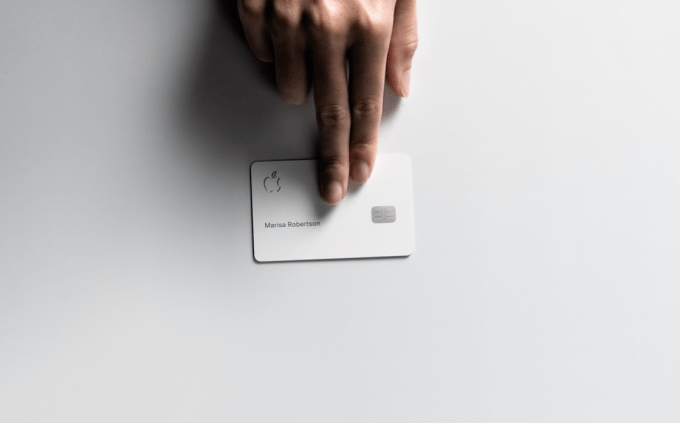
Apple kicked things off with a quick but key mention outlining a shift in how Apple Card works. “Apple Card Family” will allow you to share your card with anyone in your family over the age of 13, with customizable spending limits for each added user. You’ll also now be able to “co-own” an Apple card with another adult, with both owners building up their credit equally.

Apple Podcasts

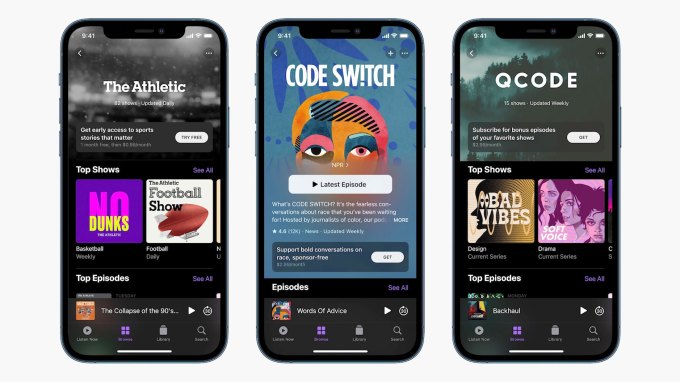
apple podcasts 2021

Image Credits: Apple

Apple will launch a redesigned Podcast app, including an option for paid subscriptions (monthly or annual) to individual podcasts.

Purple iPhones

purple iphone

Image Credits: Apple

No new iPhone this time (those come later in the year, generally), but the existing iPhone 12 and iPhone 12 mini are getting a new color option: purple. They used a song from Willy Wonka to announce it, because… well, purple.

AirTag

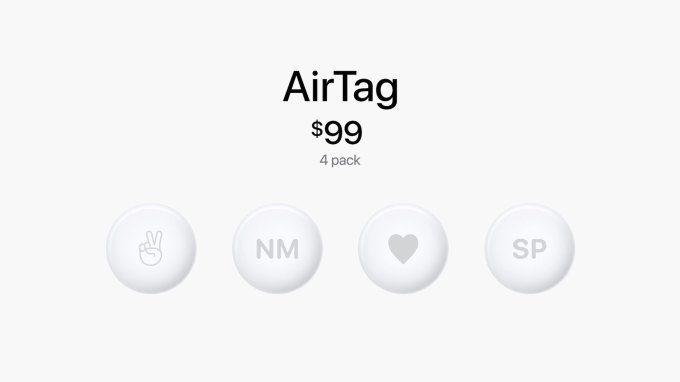
apple airtag $99 4 pack

Image Credits: Apple

After literal years of rumors and leaks, Apple has at long last officially announced its accessory for tracking things like keys, wallets, and bags through the same “Find My” app you use to find your various Apple devices when you lose them in the couch.

Called “AirTag” (curiously, not ‘AirTags’), Apple says they’ll cost $29 each or $99 for a four pack, and launch on April 30th. They’ll have user-replaceable batteries but, oddly, no built-in attachment loop; if you want to attach it to something like a keyring, you’ll need to add a case. Which, of course, they’ll be making and selling.

Next-gen Apple TV 4K

Image Credits: Apple

Apple announced a big refresh to the Apple TV 4K it first launched back in 2017. Here’s the breakdown:

  • Powered by Apple’s A12 Bionic chip
  • You can use an iPhone to calibrate the picture. Start the calibration, point your iPhone’s camera at your display, and Apple TV 4K will automatically optimize its own output accordingly.
  • They’ve redesigned the remote! They’ve moved away from the much lamented touchpad remote, building this new remote around a five-way click pad complete with iPod-esque scroll wheel. There’s a Siri button on the side, in case you feel like talking to your TV instead of pushing buttons. Word is (via WSJ’s Joanna Stern) they’ll also be selling this remote separately for $59.
  • $179 for 32GB model or $199 for 64GB.

New iMacs

back and side views of red 2021 Apple iMacTime for the iMac to shift over to M1! Apple announced a new lineup of iMacs — and in a throwback to the iMacs of yesteryear, these new ones will come in an array of fancy colors. Here are the highlights:
  • Built around the absurdly zippy M1 chipset Apple first introduced into its laptops last year
  • 24-inch “4.5K” display
  • At last, a decent webcam! These new iMacs will ship with a 1080p FaceTime camera
  • Pre-orders start April 20th, shipping in late May
  • $1299 gets you an 8-core CPU/7-core GPU setup, while $1499 will bump it up to 8-core CPU/8-core GPU.
  • It’ll come in seven colors: green, yellow, pink, orange, blue, purple, and silver. Some colors will only be available in the more expensive model.
  • Both models come with a 256GB SSD, and two thunderbolt ports. The $1499 model adds two USB 3 ports
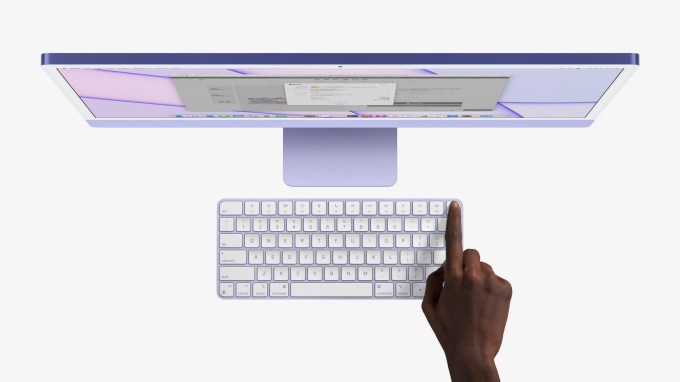
  • Apple will ship a new version of its Bluetooth Magic Keyboard, now complete with a Touch ID fingerprint sensor.

    Apple Touch ID on magic keyboard in front of 2021 iMac

    Image Credits: Apple

New iPad Pros

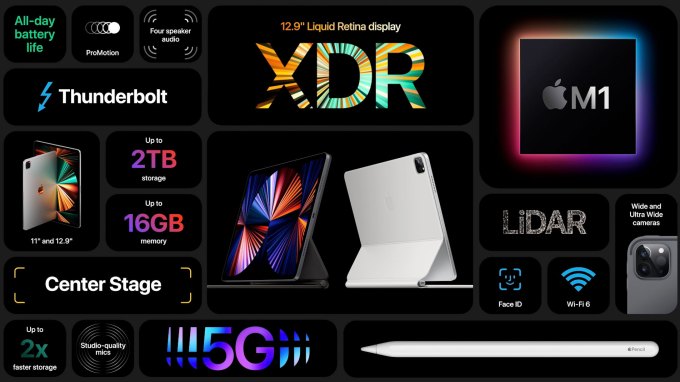
Apple 2021 iPad Pro overview

Image Credits: Apple

The iPad Pro is going M1, too! Apple says this shift brings a 50 percent performance improvement over the previous iPad Pro. Here’s whats new:

  • 8-core GPU/8-core CPU
  • The 11-inch model will start at $799, while the 12.9-inch model will start at $1,099.
  • Cellular models will now have 5G support
  • Thunderbolt and USB 4 support through the USB-C port
  • The 12.9-inch model will have “Liquid Retina XDR” display that Apple says packs 1000 nits of full-screen brightness, or 1600 nits of peak brightness.
  • A feature Apple calls “Center Stage” will automatically keep your face in the center of the frame during FaceTime calls, even as you move about the room.
  • Up to 2TB of built-in storage, and 16GB of RAM