Year: 2021

20 Apr 2021

Apple officially unveils its lost item finder, AirTag

Apple today officially unveiled AirTag, its location tracking beacons that can help Apple device owners find lost items through Apple’s “Find My” application. The AirTags themselves are small, rounded tracking devices that can be attached to personal items, like purses, bags or keys. Pre-orders start this Friday, and the product goes on sale April 30th, for $30. A pack of three runs $99.

The item tracking uses the company’s proprietary U1 ultra-wideband chip for what it calls “Precision Tracking.” This will work with Apple’s newer iPhones (iPhone 11, 11 Pro and the newer iPhones 12 devices).

In addition to assets found in Apple’s code referencing the new product last year and a mistake in an official Apple YouTube video, AirTags had also been brought up as an example of Apple’s anticompetitive behavior before U.S. regulators.

Last year, for example, Tile spoke about AirTags before a panel of the House of Representatives Judiciary Committee, saying that Apple’s decision to launch its own version of the lost-item finder gave Apple’s new product a first-party advantage over its competitors. Apple’s devices, Tile explained, would be able operate in the background without having to continually popping up requests asking users to agree to background tracking, like Tile’s app has to do. Apple’s devices would also be integrated with “Find My,” but other tags would not be.

Following the regulatory scrutiny, Apple at its developer conference WWDC in June said it would extend “Find My” to third-party companies. However, a report by The Washington Post indicated that olive branch may not have been what it seemed — companies would have to sign an NDA and said Apple customers would be barred from using competing devices simultaneously.

Ahead of today’s event, Apple announced the launch of its Find My Network Accessory program, which officially opened the doors to third-party manufacturers who wanted access to the Find My app. Early adopters included VanMoof’s S3 and X3 e-bikes, Belkin’s SOUNDFORM Freedom True Wireless Earbuds, and an AirTags competitor, the Chipolo ONE Spot — but not Tile. We understand Tile doesn’t want to participate in Find My because it has a direct relationship with customers through its own iOS app that it doesn’t want to give up.

Apple’s entry in this “lost item finder” space means competitors, like Tile, will have more serious competition even with the concessions Apple has made with the opening up of “Find My.” Tile so far has responded to Apple’s plans by pre-announcing its plans to launch its own UWB-powered tracker, arriving this year. Apple’s tight hold over its ecosystem benefits its launch of new products, like AirTags, forcing Tile to focus on touting its advantages, like its wider variety of form factors and cross-platform support.

Developing…

 

20 Apr 2021

Apple unveils podcast subscriptions and a redesigned Apple Podcasts app

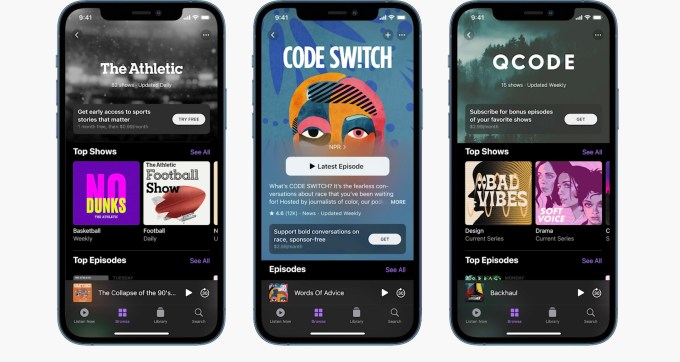
After years of increased competition from Spotify, Apple today announced its own expansion into podcast subscriptions. At the company’s spring event this afternoon, Apple unveiled its plans for a podcasts subscription service which would allow listeners to unlock “additional benefits,” like ad-free listening, early access to episodes and the ability to support favorite creators. The service will be available as part of Apple’s newly updated Podcasts app where free podcasts are also found.

The announcement of the new service follows shortly after an industry report suggested that Spotify’s podcast listeners would top Apple’s for the first time in 2021.

Apple CEO Tim Cook briefly introduced the subscription at the launch of today’s event, noting that this was “the biggest change to Apple Podcasts since its debut.” He didn’t get into the details around pricing or functionality.

Cook also noted the Apple Podcasts app had been updated, with newly redesigned show and episode pages that make it easier to listen, follow and share podcasts. The app will also include a new “Channels” feature that lets you find shows from favorite creators and get recommendations.

Apple said the new service will be available in May to listeners in more than 170 countries and regions.

In a press release, Apple said the first premium subscriptions would come from both “independent voices and premier studios,” including Tenderfoot TV, Pushkin Industries, Radiotopia from PRX, and QCODE, as well as larger brands like NPR, the Los Angeles Times, The Athletic, Sony Music Entertainment, and others.

Apple’s plans for a podcast subscription service was previously scooped by The Wall St. Journal, which said the company was preparing to add a paid subscription option to its product, as well as by Vox Media’s Peter Kafka, who said he believed Apple would introduce a paywalled podcast subscription product at today’s event. There were also hints found in the iOS 14.5 beta, which showed a redesigned Podcasts app featuring an account button on the Listen Now tab. MacRumors had reported that show notifications had been relocated here, and suggested that managing paid subscriptions may also be found in this new area in the future.

The move to enter the subscription podcast space follows years of significant investment by the Apple Podcasts and Apple Music competitor, Spotify, also a chief Apple critic.

Spotify in February noted it had tripled the number of podcasts on its platform, year-over-year, to 2.2 million. It has also forged a variety of exclusive deals over the years with big names like Joe Rogan, Kim Kardashian, DC Comics, Michelle Obama and The Duke and Duchess of Sussex, among others. And it has acquired podcast startups, ad tech and studios, including hosting and ad company Megaphone, creation tools from Anchor, content producers like Gimlet, The Ringer, and Parcast.

More recently, Spotify announced plans for its own podcast subscriptions via an Anchor feature and invested in live audio through its acquisition of live chat app Locker Room by Betty Labs. Spotify had said it would share subscription revenue with podcast creators, who would keep the majority of their earnings.

20 Apr 2021

Injective Protocol raises $10M from Pantera Capital, Mark Cuban for its ‘DeFi Robinhood’

Back in December last year Injective Protocol, launched the testnet for its DeFi protocols for cross-chain derivatives trading, with backing from giant crypto exchange Binance. It has now raised $10 million in a “party” funding round. Participating in the round was Pantera Capital, BlockTower, Hashed, Cadenza Ventures (formerly BitMex Ventures), CMS, and QCP Capital. Billionaire NBA team owner and Shark Tank judge Mark Cuban has also made a strategic investment into Injective, according to my sources.

Injective’s main competitors (centralized and decentralized exchanges) include CME Group, BitMEX, LedgerX and OKEx, among others. The advantage of the approach used by Injective (it says) combines the advantages of decentralized exchanges: resistance to front running, scams, and hacks, with the speed, low transaction fees, and no gas fees associated with centralized platforms. Developers can also create their own derivatives and markets to trade.

Eric Chen, CEO of Injective Protocol said in a statement: “Legacy institutions and practices create a number of artificial delays and middlemen that prevent innovation in the financial markets ecosystem. At Injective, our goal is to enable an unparalleled decentralized trading experience, whereby retail traders globally can for the first time access limitless markets without the typical predatory fees and slow transaction times”.

The background to this is that Injective is essentially trying to build a decentralized competitor to Robinhood, because their platform allows the creation of synthetic tokens that represent stock in public companies like Apple and indices like S&P 500. This means meaning trading can happen 24/7 with instant finalization, as DeFi promises.

“Why do I invest in Injective: the whole stop out because of the capital requirements, Robinhood didn’t do it on purpose to hurt traders, they just didn’t have enough equity and they would have gone bankrupt because they had too many customers. But if you’re doing it in a decentralized manner every investor gets to see how much Injective has of all of this, there’s no hiding it and that creates an opportunity”, said Mark Cuban on his investment in Injective.

The potential here is that brokers wouldn’t be able to block trades on certain stocks, as they did with GameStop, as pointed out by Cuban above.

Injective’s team is drawn from Stanford University, came up with its project in 2018, and Chen was working at hedge funds and worked in cryptographic research at a blockchain-focused fund.

20 Apr 2021

Announcing our TC Sessions: SaaS virtual event happening October 27

Software-as-a-Service (SaaS) is now the default business model for most B2B and B2C software startups. And while it’s been around for a while now, its momentum keeps accelerating and the ecosystem continues to expand as technologists and marketers are getting more sophisticated about how to build and sell SaaS products. For all of them, we’re pleased to announced TechCrunch Sessions: SaaS 2021, a one-day virtual event that will examine the state of SaaS to help startup founders, developers and investors understand the state of play and what’s next.

The single-day event will take place 100% virtually on October 27 and will feature actionable advice, Q&A with some of SaaS’s biggest names, and plenty of networking opportunities. $75 Early Bird Passes are now on sale. Book your passes today to save $100 before prices go up.

We’re not quite ready to disclose our agenda yet, but you can expect a mix of superstars from across the industry, ranging from some of the largest tech companies to up-and-coming startups that are pushing the limits of SaaS.

The plan is to look at a broad spectrum of what’s happening in with B2B startups and give you actionable insights into how to build and/or improve your own product. If you’re just getting started, we want you to come away with new ideas for how to start your company and if you’re already on your way, then our sessions on scaling both your technology and marketing organization will help you to get to that $100 million annual run rate faster.

In addition to other founders, you’ll also hear from enterprise leaders who decide what to buy — and the mistakes they see startups make when they try to sell to them.

But SaaS isn’t only about managing growth — though ideally, that’s a problem founders will face sooner or later. Some of the other specific topics we will look at are how to keep your services safe in an ever-growing threat environment, how to use open source to your advantage and how to smartly raise funding for your company.

We will also highlight how B2B and B2C companies can handle the glut of data they now produce and use it to build machine learning models in the process. We’ll talk about how SaaS startups can both do so themselves and help others in the process. There’s nary a startup that doesn’t want to use some form of AI these days, after all.

And because this is 2021, chances are we’ll also talk about building remote companies and the lessons SaaS startups can learn from the last year of working through the pandemic.

Don’t miss out. Book your $75 Early Bird pass today and save $100.

20 Apr 2021

Catch&Release raises $14M to help marketers find and license content from across the web

Catch&Release founder and CEO Analisa Goodin told me that she wants to help brands break free from the limitations of stock photography — and that her startup has raised $14 million in Series A funding to achieve that goal.

Goodin explained that the company started out as an image research firm before becoming a product-focused, venture-backed startup in 2015. The Series A was led by Accel (with participation from Cervin Ventures and other existing investors), and it brings Catch&Release’s total funding to $26 million.

Stock media and video services are moving in this direction themselves, for example by introducing their own libraries of user-generated content. Goodin applauded this, and she said Catch&Release isn’t opposed to the use of stock photos — it integrates with these stock marketplaces. At the same time, she suggested that she has a much bigger vision.

“This isn’t just about UGC, this is about tapping into the creative potential of the internet,” she said.

After all, you can now find pretty much any kind of content you can imagine somewhere online, but “a lot of advertising agencies and brands have been trained that if a piece of content comes form internet, avoid it,” because it’s just “too hard” to figure out how to license it. (And indeed, that’s why I went with a stock photo for the lead image of this post.)

Catch&Release screenshot

Image Credits: Catch&Release

Catch&Release aims to make that process as simple as possible, first with a browser extension that allows marketers to save any media that they find on the web, anytime they think they might want to use in their own campaigns (this is the “catch” part of the process). It even presents a “licensability score,” which is a rating based on factors like the person who posted the content, the description and the comments, indicating how likely it is that a marketer will actually be able to license this content.

Then, when someone from a brand or advertising agency decides that they want to use a piece of content, they can send a licensing request with a push of a button (this is the “release”). Catch&Releases also analyzes the content for anything else that needs to be cleared or obscured, such as a company logo.

While we’ve written about other tools for licensing online content, Goodwin emphasized that Catch&Release isn’t just about finding photos for a social media campaign. Part of the goal, she said, is to erase the “stigma” around UGC, which now “represents the entire spectrum of culturally relevant content.”

For example, she showed me a Red Lobster commercial that looks like a normal TV ad, but was in fact assembled entirely from footage found online — something that’s been even more useful in the past year, with pandemic-related safety concerns around large shoots. (Catch&Release has also been used to license content for ads promoting TechCrunch’s parent company Verizon.)

Goodwin added that the new funding will allow Catch&Release to continue investing in product, engineering and marketing.

“No one has defined the commercial licensing layer for the web,” she said. “What’s got me really excited to build this product is being that layer for the internet, not just for photos and videos, but for writing, art, graphics, and building the commercial licensing engine of the web.”

20 Apr 2021

IBM breaks latest revenue losing streak as cloud revenue shows modest growth

For IBM, much of the last 8 years simply posting positive revenue growth was a challenge. In fact, the company had a period between 2013 and 2018 when it experienced an astonishing 22 straight quarters of negative revenue growth. So when Big Blue reported yesterday that revenue was up slightly, I’m sure the company took that as a win. Investors appear to be happy with the results with the stock up 4.73% this morning as of publication.

Consider that over the last 8 quarters encompassing FY2019 and FY2020, the company had only one positive revenue quarter when it was up 0.1% in Q42019. It had had five losing quarters prior to that one. When you look at yesterday’s report in that light, and combine it with growth in the Cloud and Cognitive Services group, it adds up to a decent quarter for IBM, one it badly needed after another negative report in the prior quarter.

Looking back at the January report, the company reported Cloud and Cognitive Services revenues down 4.5% at $6.8 billion, which was a big blow considering the company has been betting much of its future on those very areas, fueled in large part by the $34 billion Red Hat acquisition in 2018.

Its most recent quarterly report proved much better with the company reporting Cloud and Cognitive Services revenues of $5.4 billion, up 3.8% YoY. Interestingly quarter-on-quarter revenue for the segment was down, but rose on a year-over-year basis. Perhaps a year-end enterprise revenue push could account for the difference between Q4 2020 and Q1 2021.

At any rate, IBM CEO Arvind Krishna saw today’s report as a positive sign that his attempts to push the company toward a future focused on hybrid computing and AI were starting to take root. He also saw enough in the report to predict some growth this year.

“In our last call, we shared our financial expectations for the year, revenue growth and $11 billion to $12 billion of adjusted free cash flow. While it’s still early in the year and a lot remains to be done, we are confident enough to say that we are on track,” Krishna said in the earnings call with analysts yesterday.

The company has made a number of smaller acquisitions over the last year including a couple of consulting companies, which should help as they try to work with customers around the transition to hybrid computing and artificial intelligence, both of which tend to require a lot of hand-holding to get done.

At the same time of course, the company is continuing apace with its spin out of the legacy infrastructure services division, which it announced last year. The plan at this point is to rename the company Kyndryl (an unfortunate choice) and complete the spin out by year’s end.

CFO Jim Kavanaugh also sees the modestly positive quarter as something the company can build on. “…in fact we are even more confident in the position we put in place with regards to our two most important measures, one, revenue growth, and second, adjusted free cash flow, which is going to provide the fuel for the investments needed for us to capture that hybrid cloud $1 trillion TAM,” Kavanaugh said in the earnings call with analysts.

All of this is being pushed by Red Hat, which grew revenue 15% in the most recent quarter, something the company is banking will continue to advance it deeper into positive territory throughout the rest of 2021.

Krishna is not looking for booming growth by any means. He just wants growth, and even sustained single digit top line expansion will make him happy. “Our systems if I take a two-year to three-year view kind of flattish, but in any given year it might increase or decrease but not by a whole lot. It doesn’t impact the topline a lot and that’s how sort of we get to the mid-single-digit sustainably,” Krishna said in the call.

The CEO simply wants to bring some long-term stability back to the company it has been sadly lacking in recent years. Of course, it’s hard to know if this quarter was a temporary upward blip on IBM’s earnings chart, one of those fluctuations up or down he spoke of, or if it is the corner the company has been looking to turn for years. Only time will tell whether IBM can sustain the modest revenue goals Krishna has set for the organization, or if it will fall back into the revenue doldrums that have plagued the company for the last eight years.

20 Apr 2021

Insurtech startups are leveraging rapid growth to raise big money

The investment landscape for insurtech startups is off to a hot start in Q2 2021. Since the end of the first quarter, we’ve seen several players in the broad startup category announce new capital, including Clearcover, Alan, Next Insurance and The Zebra.

But, as anyone who’s familiar with startups that offer insurance-related products and services knows, the sector is enough of a mixed bag that one needs to segment down to get clarity on how constituent companies are performing. So while Clearcover’s $200 million round from last week, Next Insurance’s $250 million round from the first of the month and Alan’s $220 million round from yesterday are interesting, this morning we’re going to focus a bit more on The Zebra’s side of the insurtech house. 


The Exchange explores startups, markets and money. 

Read it every morning on Extra Crunch or get The Exchange newsletter every Saturday.


The Exchange divides insurtech startups into three categories: neo-insurance providers, insurtech marketplaces and insurtech enablers. (You can see why we need to segment the insurtech genre!)

Briefly, neo-insurance providers are companies like Root, Metromile and Next Insurance, which use technology to underwrite and sell insurance in an updated manner; these companies also often have optimized mobile experiences.

Marketplaces like The Zebra, Gabi, Insurify and others provide a way for consumers to better identify their insurance options. And, finally, there are companies like AgentSync, which fit neatly into our third category of firms that help other companies in the insurance business digitize their operations or otherwise modernize. 

Insurtech marketplaces came back into our view when The Zebra put together a $150 million Series D earlier this month and released a host of metrics regarding its growth, and Insurify dropped the news that it is partnering with Toyota.

This morning, let’s discuss insurtech’s 2020 as a whole, peek at some preliminary 2021 venture data and then dive deep into what we’ve collected regarding growth among insurtech marketplace players. The Exchange has data and other details from The Zebra, Insurify, Wefox and more. 

Covering longitudinal progress of specific startup categories is one of our favorite things to do. So, please, walk with us!

2020 to today

PitchBook data regarding the insurtech category in 2020 underscores how large the startup niche has grown. Per the data company, $18.3 billion was spent last year on insurtech startups across venture capital, private equity and M&A activity. That was a billion dollars under its 2019 result, but given the pandemic’s onset, 2020’s final result is somewhat impressive — who expected insurance investing to hold up during an unprecedented global catastrophe?

This year is proving lucrative for the insurtech market, at least from a venture capital perspective. Normally I’d make a joke about how unprofitable some neo-insurance providers are at this juncture, but because our focus is elsewhere, bringing up the fact that, say, Lemonade’s adjusted losses in the final quarter of 2020 were around 150% of its revenue is kind of irrelevant. So we won’t!

20 Apr 2021

WayUp’s new dashboard helps employers see where their recruiting process loses diverse candidates

WayUp started out as a platform to help college graduates find jobs and internships, but over time, it has increasingly focused on helping employers find diverse job candidates. And it recently introduced a new feature to help employers see exactly where their diversity and inclusion efforts may be falling short.

Co-founder and CEO Liz Wessel explained that when companies aren’t hiring enough employees from diverse backgrounds, recruiters and executives often assume “we’re not getting enough of those candidates at the top of our funnel.” That idea, she suggested, is exemplified by Wells Fargo CEO Charles Schlarf’s controversial remarks last fall, when he said the company wasn’t reaching its diversity goals because there simply aren’t enough qualified candidates.

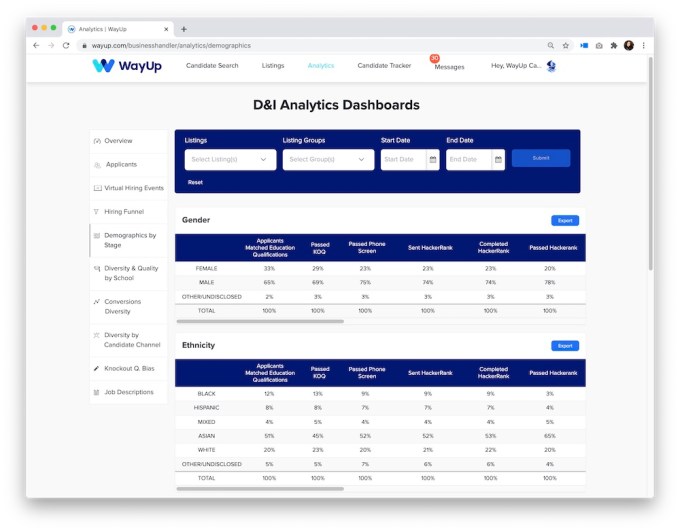
Wessel suggested that when you take a look closer look at the data, you find that the initial outreach and recruiting is only part of the problem. WayUp’s new dashboard allows employers to tracks this, because it shows the demographic (race and gender) breakdown of the candidate pool at each part of the funnel.

For example, Wessel said that many employers hiring for technical roles discover that they’re reaching a relatively diverse candidate pool during their initial outreach, and that the pool stays diverse during the first interviews — only to become much more white and male after the technical assessments/programming tests.

WayUp demographics dashboard

Image Credits: WayUp

“Similar to the SATs, many technical assessments have high correlation to socioeconomics status,” she said.

Upon discovering this, some recruiters may choose to stop requiring these tests. Others may choose to keep them — but thanks to WayUp, at least they know where the breakdown is really happening.

After Wessel showed me the dashboard, I wondered why other hiring platforms didn’t offer something similar. In a follow-up email, she suggested that many platforms don’t realize that reaching these goals requires about more than just getting a diverse diverse pool of candidates. Plus, she said WayUp is “one of the only sourcing/job platforms that I know of that has candidates self-report their race/ethnicity, gender and veteran status (in an EEOC/OFCCP compliant way).”

She added, “We really are focusing on having our platform make it so your entire hiring process is equitable and optimizes for employers hiring a diverse workforce, [versus] putting a Band-Aid or quick fix on the issue by just sourcing more diverse candidates at the top of your funnel.”

20 Apr 2021

Hustle Fund backs Fintor, which wants to make it easier to invest in real estate

Farshad Yousefi and Masoud Jalali used to drive through Palo Alto neighborhoods and marvel at the outrageous home prices. But the drives sparked an idea. They were not in a financial position to purchase a home in those neighborhoods (to be clear, not many people are) either for investment or to live. But what if they could invest in homes in up and coming cities throughout the U.S.?

Then they realized that even that might be a challenge considering that with all their student debt, affording a down payment would be impossible.

“There was nothing available out there besides a crowdfunding platform, which when we first signed up, took away $1,000 from our account that we didn’t have, and then our capital would be locked up for 3 to 10 years,” recalls Yousefi.

So the pair started doing research and spoke to 1,000 individuals under the age of 35. Eight out of 10 said they would like to invest in real estate but were deterred by all the barriers to entry.

“There is clearly a large demand for access to real estate,” Yousefi said. “And we wanted to give people a way to invest in it like they can in stocks, via a mobile app.”

And so the idea for Fintor was born.

Yousefi and Jalali founded the company in 2020 with the goal of purchasing homes via an LLC, and turning each into shares through a SEC-approved broker dealer. Individuals can then buy shares of the homes via Fintor’s platform. Its next step is to sign agreements with individual real estate investors or bigger real estate development firms to list their properties on the platform and give people the opportunity to buy shares.

And now Fintor has raised $2.5 million in seed money to continue building out its fractional real estate investing platform. The startup aims to “fractionalize” houses and other residential property, giving people in the U.S. access to investment opportunities “starting with as little as $5.” The company attracted the interest of investors such as 500 Startups, Hustle Fund, Graphene Ventures, Houston-based real estate investor Manny Khoshbin, Mana Ventures and other angel investors such as Cindy Bi, Skyler Fernandes, VU Venture Partners, Minal Hasan, Andrew Zalasin, Alluxo CEO and Founder Safa Mahzari, SquareFoot CEO and founder Jonathan Wasserstrum and Teachable CEO and founder Ankur Nagpal.

Image Credits: Fintor

Fintor is eying markets such as Kansas City, South Carolina, and Houston, Texas, where it already has some properties. It’s looking for homes in the $80,000 to $350,000 price range, and millennials and GenZers are its target demographic.

“Fintor can give the same return as the stock market, but at half the risk,” Yousefi said. “As two [Iranian] immigrants, we’ve seen how much this country has to offer and how real estate sits at the top of everything, yet is so inaccessible.”

The pair had originally set out to raise just $1 million but the round was quickly “way oversubscribed,” according to Yousefi, and they ended up raising $2.5 million at triple the original valuation.

Jalali said the company will use machine learning technology to filter and rate properties as it scales its business model.

“We’ll use ML to categorize neighborhoods and to come up with the price of properties to offer to potential sellers,” he added. “Our ultimate goal is to create indexes so that people can invest in multiple properties in a given city. That creates diversification right away.”

.Elizabeth Yin, co-founder and general partner of Hustle Fund, believes that Fintor is solving a generational problem with real estate.

“Retail investors have almost no access to great real estate investments today and the best opportunities are reserved for the select few,” she told TechCrunch. “Not to mention that in addition to access, retail investors often need a lot of capital in order to have a diversified portfolio or be accredited to join funds.”

Fintor’s approach to securitize real estate assets will give millions of investors who are not accredited investors access they would otherwise not have had, Yin added. 

“Simultaneously, it provides increased liquidity to property owners, while improving the user experience for both parties,” she said. “Effectively this becomes a new asset class, because it’s entirely turnkey and is fractionalized, which opens up many new pockets of investors.”

20 Apr 2021

Leo AR, user-facing marketplace for 3D objects, raises $3 million seed round

Apple’s introduction of ARKit changed the game for entrepreneurs, not unlike the App Store did on a much, much larger scale back in 2008.

One entrepreneur, Dana Loberg, has capitalized on the launch of ARKit with her startup Leo AR.

Leo is the result of a few pivots. The company first started out as MojiLala, which launched out of betaworks. It was a hassle-free sticker marketplace that allowed artists to upload their stickers and sell them through the platform for end-users to use in a number of locations.

In 2017, MojiLala released a new app called Surreal, which allowed artists to sell virtual objects to end users and lay them over their camera to record fun content. Now as Leo AR, the company is focused on 3D augmented reality objects without losing focus on giving artists an easy-to-use outlet for their virtual wares.

Today, Leo is announcing the raise of a $3 million seed round led by Great Oaks Ventures, with participation from Dennis Phelps of IVP, betaworks, Deutsch Telekom, Quake Capital, and other angel investors.

Image Credits: Leo AR

The app operates on a freemium basis, letting end users subscribe to certain artists they like on the platform. Leo takes a 30 percent cut on those purchases, but Loberg said that her main priority beyond generating revenue is ensuring that artists get paid well and are incentivized to create and sell through her platform.

Loberg also shared that the app has exploded in popularity among children, who enjoy creating videos with dinosaurs or dragons in them.

In fact, Leo users have created more than 8 million videos on the platform, and active users add more than 85 3D objects to their scenes and average 10+ minutes in the app when they use it.

Leo not only lets users distribute their content out to other platforms like Instagram, but it also has a feed of the best videos created in Leo for others to check out.