Year: 2021

19 Apr 2021

Facebook now lets users export posts and notes to Google Docs, Blogger and WordPress.com

Facebook today announced a new feature that will allow users to export their Facebook posts and notes to a number of third-party services. Although the company has long since offered tools that let you download the information you’ve posted to Facebook, the tool launching today offers a more practical way of saving that data — by allowing you to export your notes and posts to popular services like Google Docs, Blogger, or WordPress.com.

Facebook users will find this latest feature under the “Your Facebook Information” menu in Settings, where you’ll then click “Transfer Your Information.” A series of prompts will walk you through the process to transfer you data to the one of the available destinations.

To protect the data, Facebook says it will ask users to re-enter their password before the transfer begins, which it also does with other exports. The process will encrypt the data as it moves between Facebook and the other service, the company notes.

The move to support the export of text-based content is interesting, as it’s been reported Facebook is developing a competitor to newsletter platform Substack. The social network aims to capitalize on the growing momentum in the newsletter industry, which has recently seen a number of top writers leave larger publications in order to connect with their audience directly, via paid newsletters. Twitter also acquired a newsletter business, Revue, to pursue the same goals. While Facebook didn’t say if it’s upcoming product would be included in the export procedure announced today, it makes for a good hedge against any sort of anti-competitive claims if and when Facebook rolls out the new service.

Today’s addition is part of Facebook’s larger Data Transfer Project, a collaboration between tech giants designed to give users more ways to move their content between services. Last year, for example, Facebook added a feature that gave users a way to export their Facebook photos and videos to Google Photos, as a result of the team-up. Users can now also export photos and videos to Backblaze, Dropbox, and Koofr, as well.

Alongside news of its announcement, Facebook argued for regulation in the area of data portability. It said there should be laws that determine which data should be made portable, and who is responsible for protecting the data once it has been transferred. The company also pointed to comments it filed with the FTC last year as well as a white paper that explored the privacy questions that surround the development of data portability tools.


19 Apr 2021

Detroit VCs weigh in on fundraising and building startups in Michigan and the Midwest

TechCrunch just hosted a small virtual meetup with Detroit startups and venture capitals. Like the one we held last month in Miami, the event was a blast and featured a talk with two local VCs on what startups work in Detroit and how to raise money from local investors.

All about Detroit


In case you missed it, the video of this talk is below. Jonathon Triest from Ludlow Ventures and Patti Glaza from Invest Detroit Ventures spoke extensively on the wide-ranging types of startups that call Detroit home. They point to Bloomscape (houseplants) to StockX (sneakers) to the numerous medical and security startups in Detroit, nearby Ann Arbor, and the surrounding metro area. Both firms invest in early stage startups, but do so in radically different ways.

The 20-minute conversation covers the types of founders who can find success in Detroit and other Midwestern areas.

This event was part of TechCrunch’s growing series of City Spotlights, where we focus on a growing startup ecosystem and highlight what makes the area attractive for startups. We’re going to Pittsburgh next and hope you can join us.

19 Apr 2021

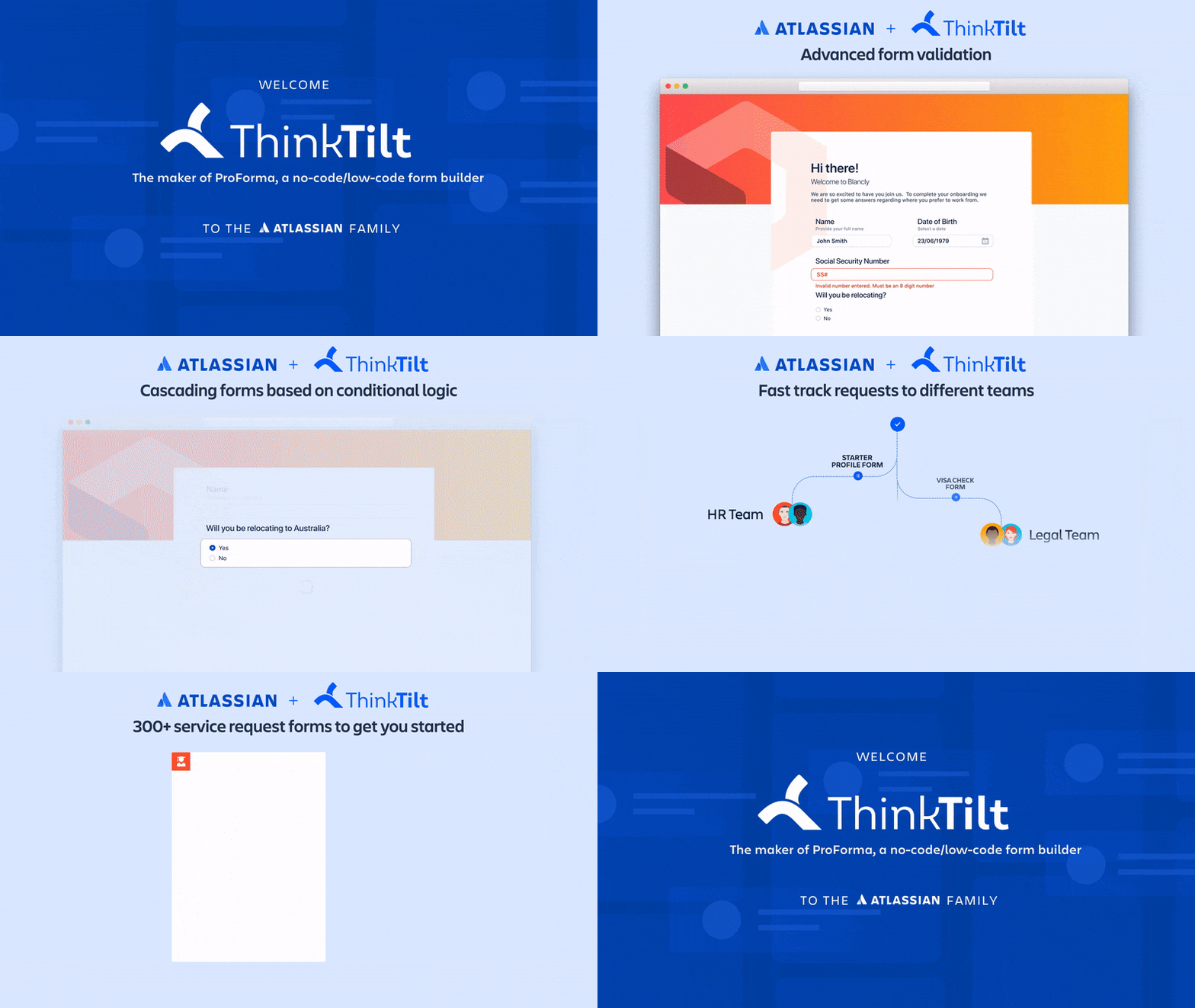
Atlassian acquires ThinkTilt

Atlassian today announced that it has acquired Brisbane, Australia-based ThinkTilt, the company behind the popular Jira-centric no-code/low-code form builder ProForma. The two companies did not disclose the price of the acquisition.

The acquisition is meant to help strengthen Jira Service Management, Atlassian’s version of Jira that focuses on IT service management (ITSM). Launched in November 2020, Jira Service Management is meant to remove the barriers between development and IT operations and provide them with a unified platform, but it also enables other teams (think HR, legal or finance) to set up their own service operations.

Edwin Wong, Atlassian’s head of product, IT, tells me that the company already has over 30,000 customers who use Jira Service Management (though to be fair, Jira Service Management is in part a rebrand of Jira Service Desk with additional ITSM functionality, so a lot of these users were previous Jira Service Desk customers).

“One thing that I keep hearing from our customers when we speak to them, is that what makes us different is that Jira Service Management really helps them deliver value quickly, without the cost and complexity of some of the other ITSM solutions that they’ve used in the past. It’s just easier to set up, get going and maintain,” Wong said.

Image Credits: Atlassian

And while at launch, the company’s focus was very much on bringing developers and IT together, Wong stressed that today’s announcement is very much about how IT can help other business teams develop services as well — and cope with the reality of remote and hybrid work.

“Employees now expect digital experiences from the employers and their colleagues as much as they expect them in every aspect of their consumer lives, as these two things blend together,” Wong noted. “Fact is, you can’t really walk up to the HR team anymore when you’re working remote and say, ‘hey, I’ve got someone coming in.’ You can’t go tap on their shoulder and say, ‘hey, upgrade that campaign for me.’ That’s not really going to work anymore.” But ThinkTilt, Wong argues, helps businesses “create amazing customer and employee experiences, and allows anyone to do that really quickly and easily.”

Unsurprisingly, ProForma comes with all the tools you would need to create forms (and there are a lot of them) and it is already deeply integrated with Jira and Jira Service Management. It also features over 300 templates for often used business flows like candidate approval tracking in an HR system, for example. “What we’re really providing for our customers is not just the features and saying, ‘hey, figure it out yourselves,’ but really that practice and the [ThinkTilt] team really brings with them an amazing amount of knowledge with that,” Wong said about ProForma’s set of templates.

One neat tool more companies should offer: ProForma features a fully functional demo mode that lets you try out the product before even signing up for its free trial.

Jira Service Management, of course, can already build all these workflows, too. That is, after all, what the product is all about. But with ProForma, an HR team could capture all the information they need to capture for a given workflow, with Jira Service Management becoming the backend for those operations. Or they can easily create forms based on existing workflows, too, and enhance the user experience that way.

Over the course of the last five years, Atlassian regularly acquired a company or two per year. Currently, though, it feels like this pace is picking up a bit. Indeed, the acquisition of ThinkTilt marks the company’s fourth acquisition in the last twelve months. In February, it acquired visualization and analytics company Chartio, while in 2020, it acquired helpdesk tool Halp and the asset management company Mindville. If anything, I would expect this pace to increase in the next year as Atlassian aims to capitalize on current trends.

19 Apr 2021

Zoom launches $100M Zoom Apps investment fund

When Zoom launched Zoom Apps and the Marketplace as a place to sell them last year, it was a big signal that the company wanted to be more than just a popular video conferencing application. It wanted to be a platform, which developers could use to build applications on top of Zoom.

Today the company announced a $100 million investment fund to encourage the most promising startups using the Zoom toolset to launch a business by giving them funding, while using that as a springboard to encourage other developers to take advantage of the tooling on the platform.

“We’re looking for companies with a viable product and early market traction, and a commitment to developing on and investing in the Zoom ecosystem,” Zoom’s Colin Born wrote in a blog post announcing the new program.

The company’s corporate development team with heavy involvement from the Zoom executive team will be in charge of selecting and managing the portfolio companies. The company plans to invest between $250,000 and $2.5 million in each startup in the portfolio.

“A big part of this is helping facilitate those early companies and giving them the access to resources and connections within Zoom, so that they can grow and succeed,” Zoom CTO Brendan Ittelson told me.

While the company wants to invest successfully, a big part of this is using the fund to encourage developers to take advantage of the platform offerings from Zoom. “We feel we’ll help [these startups] build these valuable and engaging experiences and by having that and by investing, we’re helping bring solutions and further expand the ecosystem and our customers should benefit from that,” he said.

Zoom has a number of developer tools that budding entrepreneurs can use to build applications that take advantage of Zoom functionality. In March the company introduced an SDK (software development kit) designed to help programmers embed Zoom functionality inside other applications.

The company also provides tools for embedding an application inside of Zoom, such as one designed for a specific purpose like education or healthcare, and it has created a centralized place to learn about all of them at developer.zoom.us.

Zoom is not alone in investing in companies building applications on its platform. Firms like Sequoia, Maven Ventures and Emergence Capital have already started investing in startups building companies on top of Zoom including Mmhmm, Docket and ClassEdu.

The fund gives startup founders one more option to get some funding to get their idea off the ground. Ittelson says all of the investments will be seed level investments for starters and they will be providing developer and business resources to help the young startups build and distribute their products.

While he says that the company will be on the lookout for promising startups to bring into the portfolio, interested entrepreneurs can apply directly at zoom.com/fund.

19 Apr 2021

An interview with Andrew Yang

A lawyer and veteran of the startup world (but don’t call him a VC), Andrew Yang rose to national prominence during his 2020 campaign for president. A hard-fought battle in a crowded field, Yang made a name for himself as an outsider candidate, heavily favoring a technocratic approach to policy that reflected his entrepreneurial background.

His approach earned a sizable following through a self-stylized Yang Gang of supporters. In particular, his “Freedom Dividend” proposal helped reintroduce concepts of universal basic income (UBI) back into mainstream American discourse.

Yang dropped out of the race in February 2020, after failing to crack 3% in the New Hampshire primary. At the time, he told supporters, “we’re just getting started.” In January of this year, he announced his candidacy for mayor of New York in a bid to succeed fellow 2020 presidential candidate Bill de Blasio. Once again, Yang has entered a crowded field. This time, however, he does so with national name recognition that has helped propel him to the top of polls.

Like the presidential election before it, the New York City mayoral race comes at an unprecedented time. More than a year after becoming the epicenter of the pandemic, the city is still reeling from the impact of COVID-19. It has made for a unique campaign, with candidates relying on social media more than ever — to sometimes mixed results.

As the United States’ largest city looks to reopen, the next mayor will face unique challenges — and, perhaps, opportunities. We spoke with Yang over Zoom to discuss his hopes for the city and the role technology might play in getting there.

You are on record as being supportive of the Amazon Union. They were dealt a big blow recently with the vote. In 2021, what do you think is the best course of action for blue-collar and gig workers going forward?

Anyone who’s been keeping up with me knows I am deeply concerned about the impact of technology on blue-collar workers, in particular. If you look at anything from trucking to retail, to even things like butchering and meatpacking, we’re automating them away, much more quickly.

There are some instances where unions can help, but if you look at the macro-environment, the proportion of American workers who are unionized has gone down by about half. And so, we should do much more for workers who right now don’t have benefits in terms of portable benefits programs.

I think versions of freelancing and the gig economy are here to stay. And a lot of those workers don’t have meaningful benefits in terms of healthcare or retirement or other provisions. We essentially are running an industrial-era economy that has transformed, but our institutions haven’t caught up, and we need to try and get them to catch up as quickly as possible.

We’ve been seeing a lot of union movement in tech. Kickstarter is a good example. Do you think unions should play a role in both blue and white-collar tech jobs?

I was for the union drive in the Amazon warehouse, because I think it would have created really positive pressure on Amazon to treat workers better in many different environments. I’m for really rethinking a lot of the things we’re doing right now, where if you look at top-line, Keynes predicted that by now we’d be so wealthy that we’d be working only 15 hours a week. And he was right about the top-line growth. We are as wealthy as he predicted, but our work weeks are getting longer, not shorter. And that’s having adverse consequences for people of every background, white collar, blue collar.

I think we should be exploring bigger modifications, like a four-day work week, which studies have shown that we can get the same amount done in four days in many, many environments. And then our mental health would improve. Our outlooks would improve. So I think we should be thinking bigger. And right now unions have been a path of the middle class for many, many Americans, but I don’t think it’s going to be unions alone that can solve some of these problems, particularly in many environments where unions aren’t terribly prevalent.

You recently said that letting Amazon and its 26,000 jobs walk away from New York City was not a good thing in reference to HQ2. But you, along with other Democratic politicians, have criticized the fact that they don’t pay federal taxes. If a company like Amazon were to relocate or bring a substantial number of jobs in New York City, how would you hold them accountable?

I guess there’s a difference between the local impact and the federal impact. I don’t think it’s a good thing that a trillion-dollar company doesn’t pay any federal taxes, but if you are a locality and someone comes along and it’s going to be good for your community, then you say, “yes.” I want to make the case that New York City loves business. It loves businesses big and small that are based here. And it wants more companies to know that New York City is the best place to build a world-class company and culture. So, that would be my stance as mayor, if a large tech company wanted to come to New York, and if there’s a large tech company that’s reading this right now or a small one or an entrepreneur, come to New York! Early next year, if I’m mayor, I’m going to be doing everything I can to help you.

A lot of the pushback that they were getting were around incentives. Is there a way to bring a company like Amazon into New York without offering that?

I don’t think it’s good when localities end up bidding against each other to try and bring in various companies. One of my proposals when I was running for national office was that we should actually make it impossible to do so by making any benefits that are provided to a company in that manner themselves taxable, at a rate of a 100%.

So, the entire thing becomes a non-starter and companies then would be based where they think it’s most advantageous to their organization to be based, not by pitting cities against each other as to who’s going to bend over backwards the most. I think that would be a better system and people were upset about the level of subsidies that were supposed to be directed to Amazon with HQ2, and that was legitimate concern.

And some of the local impacts were also of legitimate concern. But again, big picture, you cannot let an employer that’s going to create 26,000 high-paying jobs and probably an additional 100,000 or so service jobs walk away. You have to say New York City is the place for you.

Among U.S. politicians, you’re probably the most closely associated with the concept of UBI. Is that something you see being implemented on a city level?

There’ve been dozens of cities at this point that have either already rolled out some kind of basic income trial or are exploring doing so. And I’ve committed to making New York City the home for perhaps the biggest basic income trial outside of our federal government, sending everyone stimulus checks (which by the way I loved). And I think that cash relief and other measures are the future. So of course, I’m going to make New York City the site for one of the biggest basic income programs and in the country. And I think people are increasingly recognizing that it’s the best way to give many people a chance to be healthier, mentally healthier, more stable, more enterprising, more creative, more nurturing.

Some of the pushback against UBI is around the loss of a social safety net. Do you think that there’s a way to implement it in New York City without getting rid of some of these existing benefits?

Yeah. The program we’re looking to roll out in New York targets the extreme poor, and would have no interaction with existing social safety nets. And I think that, again, cities around the country have made this work. And in no case that I’m aware of, has it actually interfered with someone’s ability to aid get from an existing program.

Can and should government effectively regulate against the implementation of robotics and automation when it comes to job loss?

I think economy-wide, that would be a completely ineffective strategy. It’d be almost impossible to implement. There might be an isolated case where you could do something that would make sense, but even then, I don’t think it’s the best way to go. I think the better approach is to try and speed up the evolution of our economy so that it works for more and more people, even as technology is advancing. And I do believe cash relief and universal basic income are the first big step. And we all know the pandemic has accelerated many of these trends. Anyone that reads TechCrunch knows that automation technologies have been elevated in terms of corporate priorities.

You tweeted that you would invest in making the city a hub for BTC and other cryptocurrencies. You’ve also been pretty vocal about climate change. Is that a hard square to circle?

Most of the cryptocurrencies that are out there, frankly, have already been mined. And so it’s not like you necessarily are looking at consuming tons of energy, if you say that the world’s financial capital in New York City is going to be very friendly to cryptocurrencies. And we’re talking about a trillion-dollar asset class at this point. If you are the financial capital, you have to make sure that your city is among the leaders in developing applications. I’ve been in touch with various people from the cryptocurrency community about ways that we can make New York City a proving ground for some of the applications that people have been working on.

Beyond cryptocurrency, what role do you see technology playing in bringing people and businesses back to the city, following the pandemic?

I was talking to my friend, Eliot Horowitz, who is one of the co-founders of MongoDB, and he’s starting a new company around robotics. He says that when he’s trying to recruit people for his new company and says, “we’re headquartered in New York City and you would be based here” they are excited about it. A lot of people want to live in New York City.

New York City has the potential to be number one in technology, in part because I think the next generation of technologies will very much interact hand in hand with other industries, like the way that Peloton is a tech company, but it’s also a fitness and a exercise equipment company. You can see that New York City remains the hub for finance, but also for culture and branding and tourism and fashion and art and other industries.

This is going to be an incredible time for New York City to take advantage of its stature and the breadth of diversity of our economy to be competitive for any tech company.

For a lot of companies working from home is becoming the standard. When so many tech companies in particular are opening up to remote work, how do you keep people excited about coming to a place like New York when they could potentially work from anywhere?

I think right now a lot of people are still adapting. If, let’s say, you’ve worked remotely for a year (and that can mean a lot of different things), but a lot of people want to be able to go outside and experience the food, the culture, the nightlife, the companionship of a place like New York. And one thing that I know that tech companies prize is the ability to innovate and create. And studies have shown very consistently that workers are more creative and innovative when they’re together in the same office. That’s even true for academics producing research, that academics in the same physical proximity produce higher-level research.

And technology is the kind of industry where if you have even a tiny, competitive edge, it can be worth an incredible amount. And so if you imagine that Zoom is essentially like an equalizer, like a place like New York City will be a competitive edge and Eliot Horowitz is already experiencing that. I think that there are a lot of other companies that already know that. I talk to CEOs who are champing at the bit to get people back into the office for this reason.

Does that mean some form of incentivizing businesses to bring people physically together into offices?

I wouldn’t rule anything out where New York City is concerned, because that is going to be central to our case. New York City is a premium environment, and there are ways that we can help establish that premium by helping people understand just what we can do for companies that are trying to grow and compete.

What are your top cybersecurity priorities for New York?

It’s tough because, the fact is a lot of these systems are vulnerable right now. A lot of public agencies haven’t really properly invested in cybersecurity. So my priority would be to identify, frankly, the elements of New York’s infrastructure, that if they were hacked, it would be especially crippling and devastating, and invest in countermeasures trying to protect those assets as quickly as possible. Frankly, recognizing that it’s impossible to be a hundred percent secure in a lot of these arenas, but we can control our risks better than what we’re doing right now, I’m sure.

You got pushback against the food cart comments on Twitter earlier this week. Do you have any regrets about the ways in which you’ve used social media during the campaign?

If you look at my social media, the vast, vast majority of it is promoting being out and about New York City, whether it’s a restaurant that my wife and I are having dinner at, or attending a Yankee’s game at Yankee Stadium (though I am a Mets fan). when I walked the streets of New York City, people are really excited to see me most all the time. And then I’ll often take a picture with them, and I posted one today that I think made that person very happy.

So I think that my use of social media is hopefully giving people a glimpse into where New York is heading, and the fact that frankly, we can activate a news cycle based upon social media is something that I think is very positive, generally. And it’s something that I hope to use to benefit New York when I’m mayor.


19 Apr 2021

General Motors leads $139 million investment into lithium-metal battery developer, SES

General Motors is joining the list of big automakers picking their horses in the race to develop better batteries for electric vehicles with its lead of a $139 million investment into the lithium-metal battery developer, SES.

Volkswagen has QuantumScape; Ford has invested in SolidPower (along with Hyundai and BMW); and now with SES’ big backing from General Motors most of the big American and European automakers have placed their bets.

“We are beyond R&D development,” said SES chief executive Hu Qichao in an interview with TechCrunch. “The main purposes of this funding is to, one, mprove the key material, this lithium metal electrolyte on the anode side and the cathode side, and, two, to improve the scale of the current cell from the iPhone battery size to the size that can be used in cars.”

There’s a third component to the financing as well, Hu said, which is to increase the company’s algorithmic capabilities to monitor and manage cell performance. “It’s something that we and our OEM partners care about,” said Hu.

The investment from GM s the culmination of nearly six years of work with the big automaker, said Hu. “We started working with them in 2015. For the next three years we will go through the standard automation approval processes. Going from ‘A’ sample to ‘B’ sample all the way through ‘D’ sample,” which is the final testing phase before commercial availability of SES’ batteries in cars.

While Tesla, the current leader in electric vehicle sales in America, is looking to improve the form factors of its batteries to make them more powerful and more efficient, Hu said that the chemistry isn’t that different. Solid state batteries represent a step change in battery technology that makes batteries more powerful, easier to recycle, and potentially more stable.

As Mark Harris wrote in TechCrunch earlier earlier this year:

There are many different kinds of SSB but they all lack a liquid electrolyte for moving electrons (electricity) between the battery’s positive (cathode) and negative (anode) electrodes. The liquid electrolytes in lithium-ion batteries limit the materials the electrodes can be made from, and the shape and size of the battery. Because liquid electrolytes are usually flammable, lithium-ion batteries are also prone to runaway heating and even explosion. SSBs are much less flammable and can use metal electrodes or complex internal designs to store more energy and move it faster — giving higher power and faster charging.

What SES is doing has brought the company attention not just from General Motors, but from previous investors including the battery giant SK Innovation; the Singapore-based, government-backed investment firm, Temasek; the venture capital arm of semiconductor manufacturer, Applied Materials, Applied Ventures; the Chinese automaking giant, Shanghai Auto; and investment firm, Vertex.

“GM has been rapidly driving down battery cell costs and improving energy density, and our work with SES technology has incredible potential to deliver even better EV performance for customers who want more range at a lower cost,” said Matt Tsien, GM executive vice president and chief technology officer and president, GM Ventures. “This investment by GM and others will allow SES to accelerate their work and scale up their business.”


19 Apr 2021

Gwyneth Paltrow invests in The Expert, a video marketplace for high-end interior designers

The pandemic-induced lockdowns halted many a home decoration project, but the irony was that our homes became even more important. But where to get ideas to decorate? Home decor experts could no longer visit. Now an LA-based startup is addressing this digitization of the interior design market, but kicking off with a typically LA-oriented, high-end clientele.

The LA-based The Expert – a platform for video consultations with interior designers – has raised a $3 million seed funding round led by Forerunner Ventures, with participation from Sweet Capital, Promus Ventures, Golden Ventures, Jeffrey Katzenberg’s WndrCo, AD 100 designer Brigette Romanek, and movie star Gwyneth Paltrow.

The Expert offers 1:1 video consultations with leading interior designers, it says.

The founders consist of Jake Arnold, a celebrity interior designer (who has worked with John Legend, Rashida Jones, and Cameron Diaz among, others) and YC-alumni, Leo Seigal, who previously founded and sold Represent.com to CustomInk for $100m in 2015.

After being “inundated” with DMs during lockdown asking for his advice, Arnold says he realized he didn’t have the business model to help non-retainer clients. So he joined Seigal to create The Expert.

The Expert features 85 designers, so far. CLients click on their profiles to see rates and availability and then click to book. Clients can upload any relevant floor plans, images of the home, inspiration ideas etc for the designer to review ahead of time. They then join a zoom link (the platform uses the Zoom API) to meet with an interior designer and can leave a review afterward.

The company claims it has 700 designers on its waitlist and will hit $1m of bookings after its first quarter, after launching in early February this year.

The startup has some competition in the form of Modsy and Havenly, but The Expert says it is going for a more high-end experience, where clients are willing to pay $300-$2,500 for an hour of a designers’ time. The startup takes a 20% cut of the transaction.

Co-founder Leo Seigal said: “We were able to attract a crazy roster of designers partly thanks to co-founder Jake who is so highly regarded in the industry, and partly due to a timeliness of offering which is far above anything that has been tried in the home space.”

In a statement, Gwyneth Paltrow said: “I’ve always felt that access to great design – and those who create it – is too rare of a commodity. It’s a game-changer for someone without the budget for a full-time designer to have this roster of talent on speed dial.”

Nicole Johnson, Partner at Forerunner said: “We’ve been thinking through new models for the interior design sector for years at Forerunner, observing room for improvement for the trade and consumers alike. Interior design is arguably the ultimate, best-suited source of home inspiration and commerce enablement for consumers, but the trade is a famously walled garden. The Expert solves for this, connecting anyone, anywhere with the world’s leading interior designers via video consultation—allowing Experts to broaden their reach and monetization in a predictable, rewarding, and low-friction way.”

19 Apr 2021

HDS, from the Borders and Webvan founder, raises $3M as it gears up to launch its robot-run grocery and general merchandise play

The online grocery market is poised to get a little more crowded in the next several months, with the launch of a startup led by a veteran founder who has taken big hits from Amazon in the past, but now hopes to come back swinging with the help of an army of robots.

Home Delivery Services, a delivery startup founded by Louis Borders that plans to sell groceries and general merchandise online using a massive, automated system to power the fulfillment and logistics, is today announcing funding of $3 million to finalize the finishing touches on an AI-based robotic demonstration center outside of Indianapolis.

The plan is for the center to showcase the technology that HDS Global has been building over the last several years (plans first emerged as long ago as 2014), robots and other automation under the name RoboFS, that will power a wide fulfillment system extending from stocking, sorting and picking items that will then be delivered, mostly by humans, to consumers, to take on what Borders describes as a $1 trillion grocery market in the US.

“The $1 trillion grocery in the US is not well penetrated,” he said, comparing the opportunity to the one that Walmart seized 20 years ago in physical stores. “We want to offer a complete selection of groceries and general merchandise in one order.” The idea is to build warehouses that cover some 150,000 square feet to do $200 million in revenue over millions of SKUs for one-hour deliveries.

A funding round of $3 million — which is coming from Bob DiRumauldo, the chairman of Ulta and CEO of Naples Ventures — might sound a little modest, especially considering the hundreds of millions of dollars that have been collectively raised by online grocery players in the last several months — all of them racing to scale up their businesses in the wake of huge consumer demand for online shopping alternatives to visiting stores in person in the wake of the Covid-19 pandemic.

Borders said in an interview that this small round is primarily to kick off the demo center to show off RoboFS to help bring on new investors and new partners with the proof of concept. It already has a few investor partners, Ingram Micro and Toyota, and the idea will be to add more.

And he confirmed that HDS — which will unveil a different name when it launches commercially, he added — is also working on a much bigger round of funding, likely to close in the next 15 months, to fuel that wider commercial launch. It has raised $38 million to date, he said.

Borders’ name will ring a bell to many in the worlds of retail and technology: he was the founder and head of the Borders book superstores and later started Webvan, a very early mover in the world of online grocery ordering and delivery. Both companies crashed hard in their times and became case studies, and more specifically cautionary tales, around how to build businesses in the digital era: beware the specter of Amazon, of innovating too early or too late, of being less agile, too inefficient, and of not correctly identifying where the puck was going and skating to it.

This time around, the idea is that he’s focusing first and foremost on technology to try to head those problems off in ways that his previous ventures did not. This is one reason why HDS has spent so many years on building the technology: automation, specifically in areas like picking groceries, is one area that has foxed a lot of companies to date — Amazon continues to work on this, and Ocado, a leader in the space, has yet to launch robotic picking although it says this is coming soon. Borders estimates that bringing in automation can bring down the cost of labor by two-thirds, with people instead focused on delivering and selling at people’s doors.

“When we went out to buy the tech we didn’t see what we wanted,” Borders said. “We’re tryin to be smart about technology but the tech was just not there when we decided to build this 5 years ago. So we started with building that system. This became our opportunity.”

The interesting opportunity is not just to build services that don’t quite exist yet, but to provide a set of infrastructure that can be a viable alternative and supply chain to Amazon — a common goal that brings together players from a lot of disparate yet interconnected areas in the grocery value chain. This is one reason why companies like Toyota and Ingram have come on board to work with the startup.

Given that it’s been so many years in the making and has yet to see the proof of concept, there will continue to be a lot of factors that could not come together, but it’s a play that HDS, Borders and their partners are willing to make.

“Ecommerce has become an essential component in people’s daily lives but what many don’t realize is that it can be exponentially better than what is offered today,” said DiRumauldo in a statement. “I was attracted to working with Louis again and to the company’s big idea approach – an all-new robotic fulfillment system purpose-built for ecommerce – which can deliver a vastly improved experience at lower cost. I am excited to be a part of bringing this vision to life.”

19 Apr 2021

NASA makes history by flying a helicopter on Mars for the first time

NASA has marked a major milestone in its extraterrestrial exploration program, with the first powered flight of an aircraft on Mars. The flight occurred very early this morning, and NASA received telemetry confirming that the ‘Ingenuity’ helicopter it sent to Mars with its Perseverance rover. This is a major achievement, in no small part because the atmosphere is so thin on Mars that creating a rotor-powered craft like Ingenuity that can actually use it to produce lift is a huge challenge.

This first flight of Ingenuity was an autonomous remote flight, with crews on Earth controlling it just by sending commands through at the appropriate times to signal when it should begin and end its 40-second trip through the Martian ‘air.’ While that might seem like a really short trip, it provides immense value in terms of the data collected by the helicopter during the flight. Ingenuity actually has a much more powerful processor on board than even the Perseverance rover itself, and that’s because it intends to gather massive amounts of data about what happens during its flight test so that it can transmit that to the rover, which then leapfrogs the information back to Earth.

As mentioned, this is the first ever flight of a powered vehicle on Mars, so while there’s been lots of modelling and simulation work predicting how it would go, no one knew for sure what would happen before this live test. Ingenuity has to rotate its rotor at a super-fast 2,500 RPM, for instance, compared to around 400 to 500 RPM for a helicopter on Earth, because of how thin the atmosphere is on Mars, which produced significant technical challenges.

What’s the point of even flying a helicopter on Mars? There are a few important potential applications, but the first is that it sets up future exploration missions, making it possible for NASA to use aerial vehicles for future science on the red planet. It can explore things like caves and peaks that rovers can’t reach, for instance. Eventually, NASA is also hoping to see if there’s potential for use of aerial vehicles in future human exploration of Mars, too — martian explorers would benefit significantly from being able to use aircraft as well as ground vehicles when we eventually get there.

19 Apr 2021

Clubhouse closes an undisclosed $4Bn valuation Series C round, as tech giants’ clones circle

Buzzy ‘social audio’ app Clubhouse has raised a Series C funding round, reportedly valuing the company at $4 billion. Clubhouse said the new round of financing was led by Andrew Chen of Andreessen Horowitz, with participation from DST Global, Tiger Global and Elad Gil. This round means Clubhouse has tripled the valuation it attained in January when Andreessen Horowitz led its Series B funding round.

The funding comes as Twitter, Spotify, Facebook, Telegram, Discord and LinkedIn are all prepping similar features to Clubhouse’s live audio streaming rooms, which has attracted attention for hosting live chats with the likes of Elon Musk and Mark Zuckerberg. Indeed, Vox reported that Facebook will announce a series of ‘social audio’ products only today.

But, unusually for such a late stage of funding, the company has not revealed the amount raised. Industry sources say that this is probably because the Series C funding round is ‘multi-stage’ and therefore not officially closed. Alternatively, the company is ‘hyping’ itself ahead of a sale, as is often the case with ‘hot’ startups. Twitter reportedly broke off talks to acquire the startup at a $4 billion valuation, according to Bloomberg.

And despite appearances that this funding round has been timed to coincide with the launch this week of Facebook’s Clubhouse clone, one well-placed source told me “this funding round has been in the works for last 1.5 months” and that some offers have been “above 2x” the $4bn valuation. On other words, there are some investors out there who think Clubhouse is worth more than $8bn.

So far Clubhouse is demurring on all this, and declining to comment more directly to the media. The company disclosed the news about the funding during its weekly ‘town hall’ chat last Sunday night and in a blog post, the company said the fundraising will support a fresh burst of growth for the app.

“While we’ve quadrupled the size of our team this year, stabilized our infrastructure, launched Payments in beta to help creators monetize, and readied Android for launch, there is so much more to do as we work to bring Clubhouse to more people around the world. It’s no secret that our servers have struggled a bit these past few months, and that our growth has outpaced the early discovery algorithms our small team originally built,” said the post.

Noting that “it’s important to us to be building all of this with people who are invested in the community and who represent a diverse set of backgrounds and voices,” Clubhouse has, however, been struck by a wave of problems in the last few days, when Anti-Semitic audio rooms seemed to proliferate on the platform. Clubhouse has previously been criticized for its seeming inability to moderate extremism on the app.

The year-old platform, which has reported 10 million weekly active users, has thrived during the pandemic while people were locked down and therefore unable to chat easily in person.

Tech news site The Information first reported details on the Clubhouse funding on Friday.