Year: 2021

13 Apr 2021

Roku launches a rechargeable, hands-free voice remote and other devices, rolls out Roku OS 10

Roku today is unveiling new hardware and software, including the latest version of its Roku OS media software, Roku OS 10, which expands support for AirPlay 2 and Apple’s HomeKit, and adds a variety of new features and optimizations focused on helping users get to content and stream faster. It’s also introducing its latest 4K player, the Roku Express 4K+; an updated version of its combo media player and soundbar; and an upgraded voice remote with a rechargeable battery and hands-free voice support via the “Hey Roku” command.

Of the three new devices, the Roku Voice Remote Pro ($29.99) may actually be the more interesting addition as it pushes Roku further into the “smart speaker” space, so to speak — except in this case, the “speaker” is a TV remote equipped with a mid-field microphone that’s always listening for the “Hey Roku” command. From a practical standpoint, that means you can leave the remote laying on your coffee table and instead speak commands like “Hey Roku, launch Netflix” or “search for free movies,” or “show me comedies,” or whatever else it is you want to watch — without having to first pick up the device and press the push-to-talk voice search button.
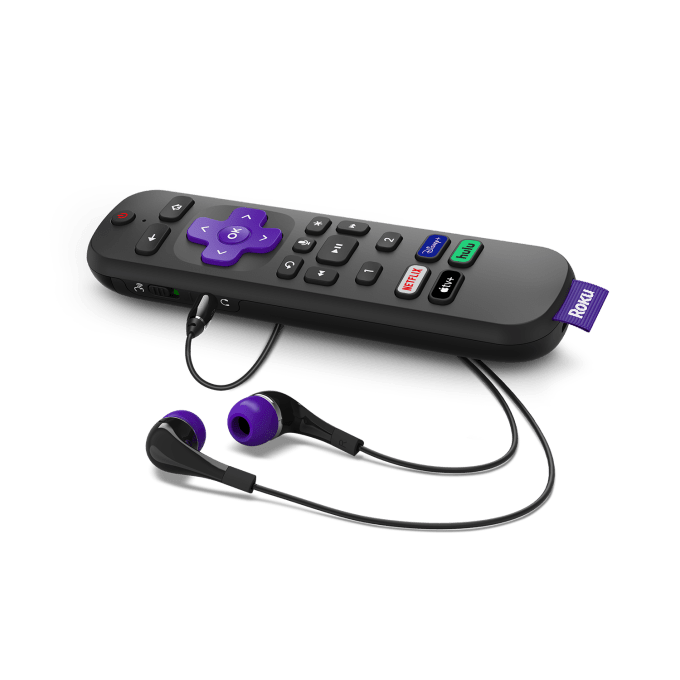
Image Credits: Roku

This feature, of course, also comes with concerns. Consumers may be wary of bringing more voice assistants into their home, after it was discovered that tech giants Google, Amazon and Apple had initially dropped the ball on respecting consumer privacy when it came to how users’ voice data was being stored and utilized. Though they’ve all made changes since, the experience may have left its mark on consumers’ minds.

For what it’s worth, Roku says it will retain some of the audio recordings it receives for technical support and to improve the quality of its service, much like the others in the market. And users can opt out of that data collection (via Roku.com/account/voice). The company notes that voice recordings are disassociated from the consumer’s account within 30 days, and it only allows access to Roku employees, not contractor workforces.

If this doesn’t appeal to you, the remote offers a mute button for the microphone if you want to upgrade for its other features, and not use the hands-free listening.

The other features still make for a worthwhile upgrade, however, as this is Roku’s first remote with a rechargeable battery, for example. The device charges via a micro-USB cable, which is more environmentally friendly. It also offers preset buttons with access to Netflix, Hulu, Disney+ and, for the first time, Apple TV+. And it offers a lost remote finder feature (which works via voice, too); private listening via the built-in headphone jack; a push-to-talk voice button if you don’t want hands-free; and two personal shortcuts for favorite voice commands.

The voice remote is on sale today via Roku’s website and will be available in retail stores in May.
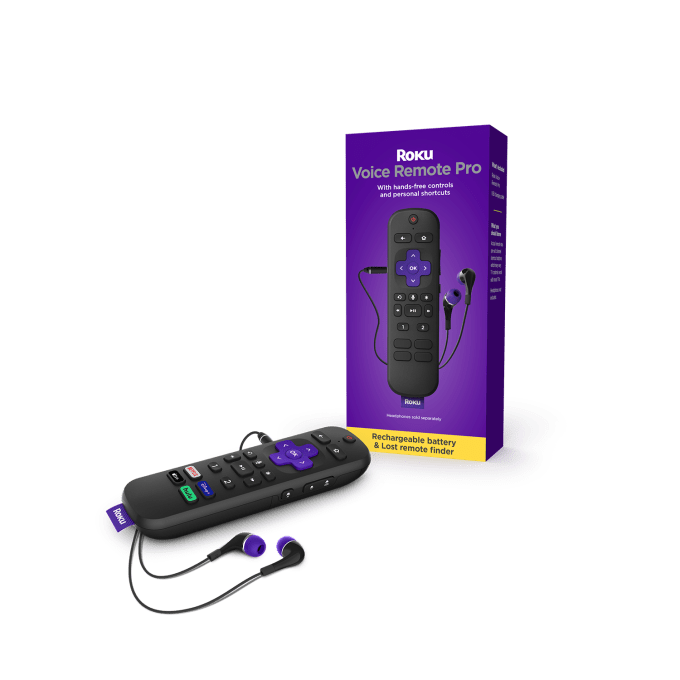
Image Credits: Roku

Another new device announced today is the Roku Express 4K+ ($39.99) which will replace the older Roku Premiere.

This digital media player is targeted towards first-time streamers and secondary TVs — which are now more often becoming 4K TVs, but where consumers don’t need the full specs of Roku’s top-of-the-line players. The Express 4K+ has a faster processor than the Premiere and more storage, as well as support for dual-band Wi-Fi. It works with third-party micro-USB and Ethernet adapters, which is a plus as hardwiring your device was previously a feature only available on the pricier Roku Ultra.

The device also brings HDR 10+ to the Roku platform for the first time, though this support will soon make its way to the Roku Ultra through the upcoming Roku OS 10 software update. It additionally supports HD, 4K, HDR, and HDR 10 and ships with a standard voice remote.

Image Credits: Roku

The device goes on sale in the U.S. in mid-May online and in retail stores. Walmart, a Roku partner, will have an exclusive version of the Roku Express 4K+ called Roku Express 4K ($35) which offers a better value by dropping the voice remote for the basic one.

Along with the launch of the media player and remote, Roku is updating its Roku Smart Soundbar in mid-May. The device is being rebranded to the Roku Streambar Pro ($179.99), and will feature both 4K streaming and cinematic sound, but now ships with the same voice remote that comes with the Ultra, which means it supports private listening on headphones. And it adds support for a new Roku OS 10 feature called Virtual Surround, which aims to simulate a surround sound setup for Roku Smart Soundbar and Roku Streambar Pro owners, who don’t have another set of speakers to offer true surround sound.
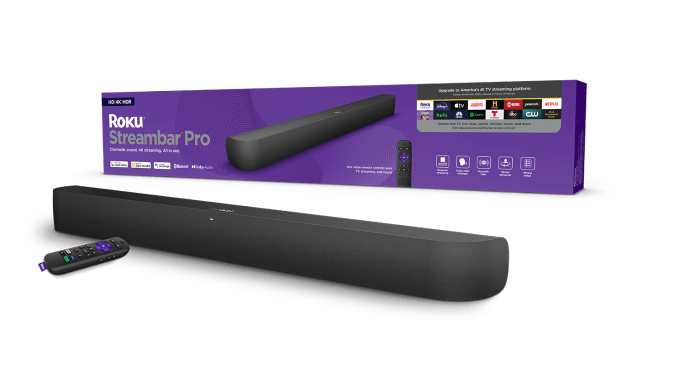
Image Credits: Roku

In addition to Virtual Surround and HDR 10+ support, Roku latest OS will roll out Apple AirPlay 2 and HomeKit support to more HD devices, including the Roku Express and some HD Roku TVs.

It will also add a customizable Live TV Channel Guide with favorites; automatic Wi-Fi network detection during setup (and it tells you which of your multiple channels is better to use); and an “instant resume” feature which takes you back to where you left off when you relaunch a supported channel.

At launch, there are over 15 channels that support “instant resume,” including AT&T TV, FilmRise, FOX Business Network, FOX News Channel, Fubo Sports Network, HappyKids TV, Plex.tv, STARZ, and The Roku Channel.
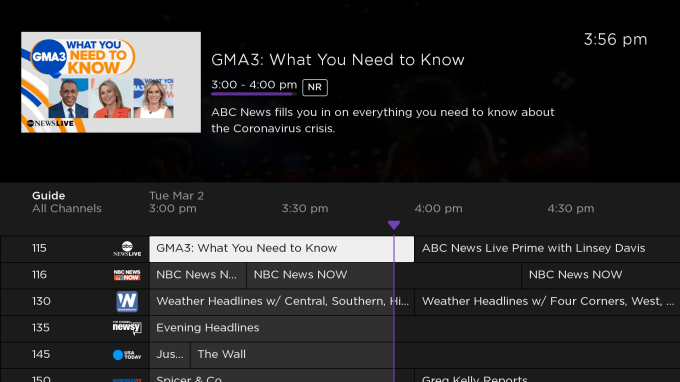
Image Credits: Roku

For gamers, a new automatic game console configuration feature, which automatically configures preferred settings, could be useful.

“Depending on the capabilities of the console and the TV, it can also mean turning on things like HDR gaming, variable refresh rates, high frame rate gaming like 120Hz, or maybe THX Certified Game Mode. So, without having to go through complex menus, a user just plugs in their console, and we know exactly how to give them the best experience on the game side,” noted Roku VP of Retail Product Strategy, Mark Ely. The feature works with both Xbox and PlayStation consoles and will also update the input on the Home Screen.
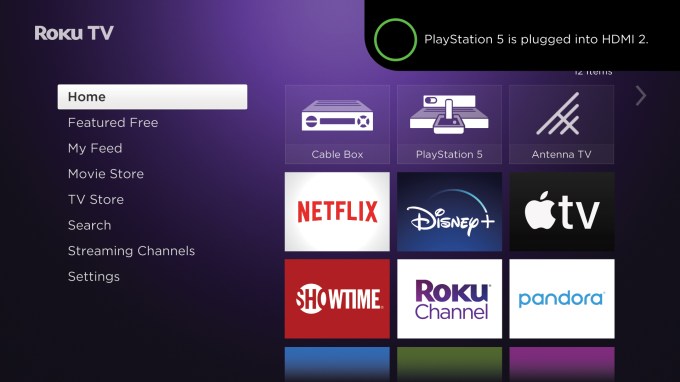
Image Credits: Roku

Roku OS 10 is rolling out to select Roku players now and is expected to roll out to all supported streaming players, including the all-new Roku Express 4K+ and Roku Streambar Pro, and all Roku TV models in the weeks ahead.

The new devices and software arrive after a year of increased at-home streaming due to the coronavirus pandemic, which forced users indoors and under lockdowns. Roku in Q4 2020 reported 51.2 million active accounts, up 39% for the year, and 58.7 billion streaming hours, while its free streaming hub, The Roku Channel, saw roughly 200% growth between just June and August 2020 when it added live linear viewing.

“Our business and streaming, in general, continues to grow and accelerate just because there’s such a shift from people that are getting rid of cable and moving over to streaming. And we saw, of course, with theater shutdowns, more people streaming first-run movies at home,” Ely noted. “So, streaming hours increased, and the volume of our products and the popularity of streaming devices increased, as well,” he added.

Roku’s continued momentum, however, cannot rely on pandemic impacts alone. Amazon remains a top competitor, and just rolled out its updated Fire TV interface months ago. There are also now rumors that Apple is planning an updated player of its own, with an Apple TV-HomePod combo of sorts, similar to the existing Roku Streambar. That will leave Roku with plenty of competition to keep it on its toes for months to come.
13 Apr 2021

Netflix gives its Kids’ profiles a visual upgrade

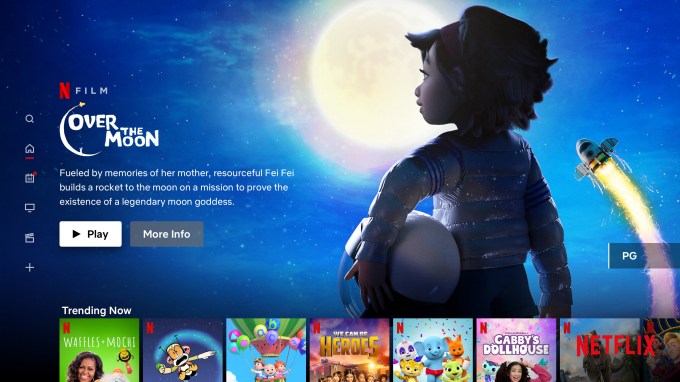
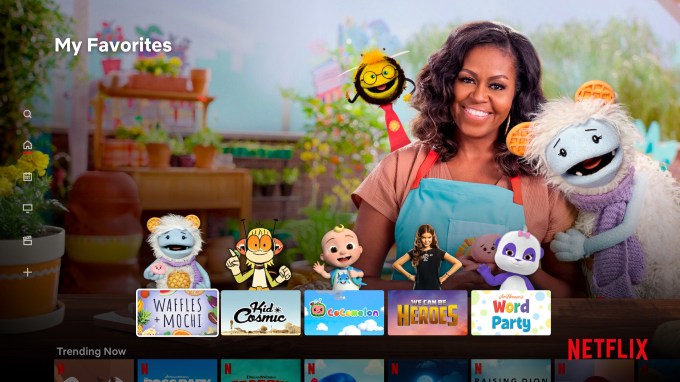
Netflix is giving its Kids’ profiles a revamp, the company announced today. While adults’ profiles are personalized with horizontal rows of recommendations that appear as they scroll down, the Kids profiles’ redesign is more visual in nature. When kids now log in to their account on a TV, they’ll be greeted with their favorite titles and characters right at the top of the screen, Netflix says.

Previously, the layout for the Kids profile was similar to an adult’s, with rows that showed Trending shows and other suggestions from Netflix’s library (See below). Now, the top row will feature the kid’s most-watched content — and for early readers, the characters will help direct kids to the show they want to watch.

Image Credits: Netflix old Kids profile

Image Credits: Netflix new Kids profile

To customize this row for each user, Netflix uses information about what was watched to improve its recommendations. It notes that the favorite shows featured at the top of the screen will come from the full Netflix catalog, not just its original programming. For the title to appear in their row, a child must watch a show at least once, Netflix says. When selected, the background updates to reflect the chosen show, as well.

Younger kids often navigate Netflix visually. Even toddlers can be found using iPads or TV remotes, moving through Netflix like a pro, at times. And during the COVID era where parents were stuck at home trying to both entertain their little kids while homeschooling older ones and somehow also finding time to work, it makes sense to update one of the most popular “TV babysitter” apps to make it something that younger children could use on their own without parental assistance. The need to serve the overwhelmed parent was part of the thinking behind the upgrade, pitching how the update would give parents who “need 30 minutes of uninterrupted time to knock out some work” time to do so. (Uninterrupted time during the pandemic? What’s that?)

Netflix says the new profiles are rolling out now to TV devices globally, but will be tested on tablets and mobile devices in the coming months.

13 Apr 2021

Zoho launches new low code workflow automation product

Workflow automation has been one of the key trends this year so far, and Zoho, a company known for its suite of affordable business tools has joined the parade with a new low code workflow product called Qntrl (pronounced control).

Zoho’s Rodrigo Vaca, who is in charge of Qntrl’s marketing says that most of the solutions we’ve been seeing are built for larger enterprise customers. Zoho is aiming for the mid-market with a product that requires less technical expertise than traditional business process management tools.

“We enable customers to design their workflows visually without the need for any particular kind of prior knowledge of business process management notation or any kind of that esoteric modeling or discipline,” Vaca told me.

While Vaca says, Qntrl could require some technical help to connect a workflow to more complex backend systems like CRM or ERP, it allows a less technical end user to drag and drop the components and then get help to finish the rest.

“We certainly expect that when you need to connect to NetSuite or SAP you’re going to need a developer. If nothing else, the IT guys are going to ask questions, and they will need to provide access,” Vaca said.

He believes this product is putting this kind of tooling in reach of companies that may have been left out of workflow automation for the most part, or which have been using spreadsheets or other tools to create crude workflows. With Qntrl, you drag and drop components, and then select each component and configure what happens before, during and after each step.

What’s more, Qntrl provides a central place for processing and understanding what’s happening within each workflow at any given time, and who is responsible for completing it.

We’ve seen bigger companies like Microsoft, SAP, ServiceNow and others offering this type of functionality over the last year as low code workflow automation has taken center stage in business.

This has become a more pronounced need during the pandemic when so many workers could not be in the office. It made moving work in a more automated workflow more imperative, and we have seen companies moving to add more of this kind of functionality as a result.

Brent Leary, principal analyst at CRM Essentials, says that Zoho is attempting to remove some the complexity from this kind of tool.

“It handles the security pieces to make sure the right people have access to the data and processes used in the workflows in the background, so regular users can drag and drop to build their flows and processes without having to worry about that stuff,” Leary told me.

Zoho Qntrl is available starting today starting at just $7 per user month.

13 Apr 2021

Why South Africa-based car subscription company Planet42 is going carbon neutral

Since ride-hailing companies like Uber and Bolt disrupted the transportation industry, one of the thorns on their sides has been traffic congestion and pollution. Research has shown that trips from ride-hailing cars have more emissions than those from personal cars.

To reduce their carbon footprint and solve the latter problem, both companies have floated the idea of ridesharing and other transportation models, like bike and scooter-sharing services. They also have toyed with integrating public transportation scheduling and providing drivers with incentives to switch to electric cars. However, these models have found little or no success.

So in 2018, Lyft decided to go a step further by promising to attain carbon neutrality. According to The Atlantic, the company planned to execute this by purchasing carbon credits from 3Degrees, a sustainability company based in San Francisco.

In 2019, Lyft said it had eliminated the amount of carbon that would take 2.4 million acres of trees to remove in a single year. It achieved this by purchasing 2,062,500 metric tons of carbon offsets, but the company reverted to its old ways in 2020.

But while the program made Lyft rides carbon neutral, it was an expensive process. The company claimed that net emissions from its rides would still increase in the long run. So Lyft promised to offer rides only in electric vehicles by 2030. This is the same with most car companies worldwide, each promising to attain carbon neutrality via electric cars in the future.

However, Planet, a car company based in South Africa wants to achieve carbon neutrality now, not later. But Planet42 isn’t a ride-hailing company. It offers a car subscription product that buys second-hand cars from dealerships and rents to customers via a subscription model.

Founded by Marten Orgna and Eerik Oja, Planet42 targets individuals in emerging markets but has a presence only in Africa. The company has bought nearly 3,000 cars in South Africa and plans to increase this number to 100,000 in the next few years — and 1 million cars globally by 2025.

So despite not being a ride-hailing company and having a huge positive social impact because it gives cars to people who otherwise would not have them, there is a limited negative environmental impact Planet42 has due to the emissions produced by its cars.

While most car companies seem lethargic toward becoming carbon neutral, Planet42, studying how it indirectly contributes to emissions, decided to act last year.

“Few people would argue that becoming carbon neutral is not a worthwhile goal, but it seemed to us that the world is not moving towards carbon neutrality fast enough,” Oja told TechCrunch. “So instead of introducing a vacuous grand plan of becoming carbon neutral by 2040 or something like that, we decided to become carbon neutral now.”

Planet42

Image Credits: Planet42

Because there are hardly any electric vehicles in Africa for mass consumption and planting trees can be costly, how has the company gone about it?

Before helping Lyft embark on its tree-planting project, 3Degrees engaged in a couple of wind farms and captured greenhouse gases from landfill projects. Planet42 chose to neutralize its carbon emission through the former; however, it works with local companies in South Africa to reach this.

Its first project is a wind farm in Northern Cape, South Africa; with the money from carbon offset credits, Planet42 has been able to finance the farm for months. The power produced from wind turbines offsets other, more harmful energy production methods like burning coal and supporting a low carbon global economy.

“We are offsetting this negative impact by investing into carbon offset projects in the markets we operate in. To put it another way, the investments we make into carbon neutrality represent a self-imposed tax. We are leading by example and hope that companies in Africa and beyond will follow us.”

When the company, which has raised $20 million in debt and equity, first launched, attaining carbon neutrality wasn’t even an afterthought. But now, not only is it certified as a carbon-neutral company by Natural Capital Partners, its investors feel enthused about the project.

Oja says what’s next for the company will be to achieve carbon neutrality via electric cars ultimately. However, that might be a reach. The adoption of electric vehicles in Africa faces additional problems different from what the U.S., Europe and even other emerging markets face. Top of mind is the dire power situation where unreliable power supply is provided at high electricity prices. Then there is a general lack of tax incentives, subsidies and policies, and the sole fact that they are too expensive for the average African car owner.

For instance, there are more than a million electric vehicles on U.S. roads and over 317,000 on U.K. roads. In South Africa — Planet42’s main market and Africa’s top electric car market, this number is just about 1,000. So, until electric cars become mainstream, wind farms will remain vital to the company’s carbon-neutral efforts.

Ideally, what we could be doing is for our cars to be electric, and that’s what we’re planning for the future. When we do that, there wouldn’t be any need for offsets on a day to day side but we’re not there right now. Everyone understands that ultimately electric cars will be ideal; however, that future is not now and we need to act right now,” the CEO said.

13 Apr 2021

Getlabs, an at-home medical labs company, launches with a $3 million raise

When you’re not feeling well and your doctor asks you to get labs drawn, you know that can increase the time between a diagnosis and care. But Getlabs, a company that brings the lab to you with its at-home, blood-drawing service, is aiming to eliminate that friction, and today announced a $3 million seed round led by PivotNorth Capital. The funding will be used to launch in Phoenix, Philadelphia, and Dallas, all of which have been soft launches so far.

“Seventy percent of all medical decisions are based on lab results, yet 30% of patients are non-compliant and skip their lab orders,” Getlabs said in a statement. For many, getting their labs drawn is just one more tedious step in getting the care they need.

With Getlabs, once a phlebotomist draws your blood, it can get processed in any lab of your choice, though the company has partnerships with Labcorp and Quest Diagnostics.

The company charges for drawing the labs, but insurance pays for the blood work to be processed, as it normally would. To get your blood drawn at home, Getlabs charges the patient between $29-$49, and it’s based on when you want them to come to you. 

“[Brick and mortar] labs usually charge a $25 blood drawing fee, which isn’t covered by insurance, so the $29 fee charged by Getlabs is only a couple more dollars,” Kyle Michelson, Getlabs founder and CEO, told TechCrunch.

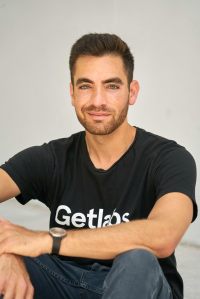
Kyle Michelson, founder and CEO, Getlabs. Image Credits: Getlabs

Getlabs is the result of a challenge Michelson himself faced.

“I needed my labs done all the time while I was in Y Combinator [for another idea],” he said. “I was there for three months, and you’re scrambling to build a business, and I had no time, and the little time I had I spent driving to the lab and waiting for an hour. So it was just a miserable experience,” he said.

“I started looking into why people didn’t get their labs done, and the top reason was inconvenience,” he added.

Getting healthcare today often includes four trips: going to the doctor, the lab, back to the doctor and then the pharmacy. But with the massive growth of virtual care and with companies like Capsule, Amazon Pharmacy and PillPack (owned by Amazon) offering prescription delivery to your door, Michelson saw a gap in the market for a more convenient lab service, too.

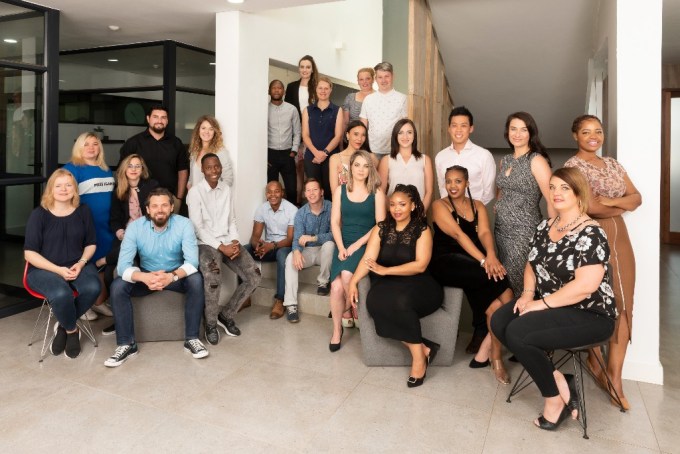
Getlabs, which is fully remote and has 37 employees, plans to use the funding to expand to Phoenix, Philadelphia and Dallas and also to expand to other verticals of home health. Other investors in the round include Tusk Venture Partners, Rosecliff Ventures, Liquid 2 Ventures, CityLight Capital, Karlin Asset Management and angel investor Matthew Dellavedova.

“I believe Getlabs is the final step in delivering at-home healthcare that will be so crucial as more organizations and individuals see the benefits of telemedicine,” said Tim Connors, founder and managing partner at PivotNorth Capital.

While not all ailments can be treated virtually, when possible, “The end goal for Getlabs is to fully partner with telemedicine services so patients never have to leave the home,” the company said. 

According to Edvard Engesaeth, co-founder of Nurx, “Getlabs could play an important part for healthcare companies like Nurx to treat more complex conditions where in-person blood draws are required by providing remote care in the home.”

13 Apr 2021

Grab to go public in the US following $40 billion SPAC deal

Ride-hailing and delivery company Grab has announced plans to go public in the U.S. Based in Singapore, the company has evolved from a ride-hailing app to a Southeast Asian super app that offers several consumer services, including food delivery, financial services, such as an e-wallet so that you can send and receive money.

It operates in Singapore, Malaysia, Cambodia, Indonesia, Myanmar, Philippines, Thailand and Vietnam. According to Crunchbase, the company has raised over $10 billion, including from SoftBank’s Vision Fund.

In order to go public, Grab has chosen to merge with a SPAC named Altimeter Growth Corp. A SPAC is a publicly-traded blank-check company based in the U.S. Going public through this process should be much easier for Grab — especially because it’s a foreign company.

If the deal goes through, it would be the world’s largest SPAC merger. Grab would be listed on NASDAQ under the symbol ‘GRAB’.

A part of the announcement, Grab has shared some metrics and some big numbers. In 2020, the company managed to generate around $12.5 billion in gross merchandise value (GMV). The merger would value Grab at $39.6 billion and the company would keep $4.5 billion in cash.

The company thinks there’s still a lot of room to grow when it comes to food delivery and on-demand mobility in Southeast Asia. It expects to see the total addressable market jump from $52 billion to $180 billion by 2025.

“This is a milestone in our journey to open up access for everyone to benefit from the digital economy. This is even more critical as our region recovers from COVID-19. It was very challenging for us too, but it taught us immensely about the resiliency of our business,” Grab co-founder and CEO Anthony Tan said in the announcement.

“Our diversified superapp strategy helped our driver-partners pivot to deliveries, and enabled us to deliver growth while improving profitability. As we become a publicly-traded company, we’ll work even harder to create economic empowerment for our communities, because when Southeast Asia succeeds, Grab succeeds,” he added.

Altimeter has agreed to a three-year lockup period for its sponsor shares, which means that Altimeter should remain committed to the company for a while.

13 Apr 2021

Elder tech company, Papa, raises $60M Led by Tiger Global

Papa, the elder tech company that offers care and companionship to seniors, today announced a $60 million Series C led by Tiger Global Management, bringing its total raised to date to $91 million.

The money will be used to propel the company’s growth this year, building on 600% year-over-year growth as of the start of 2021, the company said in a statement.

Andrew Parker, the company’s founder and CEO, launched Papa as a consumer product in 2017. Seniors signed up for the service and a college student, called a Papa Pal, would show up at their door to help with anything from taking them to doctor appointments, helping around the house, providing tech support and offering companionship. 

The idea was always to spend about six months collecting data and feedback and to then approach insurance companies. The Miami-based company has since partnered with 80 insurance providers who offer Papa nationwide as a benefit to their members. Employers can also offer Papa as a benefit. And while individuals can still sign up for the service, it is largely available through insurance.

“We have about 1 million eligible members on the platform, and about 15% use Papa every month,” Parker told TechCrunch. The company expects there to be between 5-6 million members on the platform starting January 2022.


“We’ve been able to prove that we improve the lives and health outcomes of older adults and families,” Parker said. “Most of all they’re trying to reduce loneliness and isolation to seniors.” The pandemic has only exacerbated loneliness and so Papa started offering virtual services, too.

The company has expanded its core offering to also include Papa Health, a suite of benefits that includes care navigation, virtual primary care and chronic care management, all of which are offered through the Papa platform. Additionally, the company’s services are now offered to families through Medicaid Managed Care, Parker said. “For example, maybe there’s a single mother with children who is trying to get a job – a Papa pal can help her out,” he added.

The idea for Papa came from a personal need within the Parker family. “I started Papa originally to help my grandfather – who we called Papa – who came from Argentina. He needed support and help and companionship, but he didn’t need bathing and toileting,” Parker said. To get help for his grandfather, Parker put an ad on Facebook asking, “Who wants to be a pal to my Papa?” 

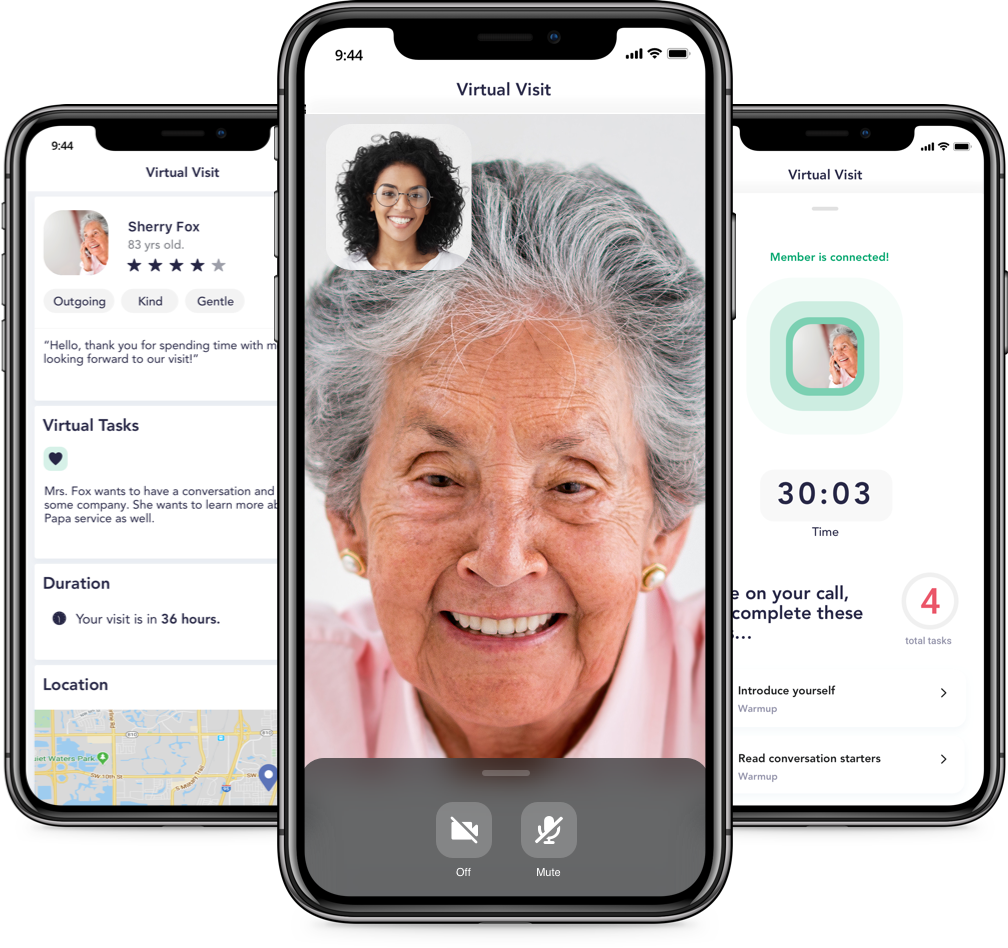
A virtual Papa visit


“We wanted someone young and energetic who would also benefit from my grandfather’s life experiences,” Parker said. While the company originally focused on students, it now works with anyone from the age of 18-45, though Parker reinforced that the company is stringent in who it accepts and has an acceptance rate below 10%. The company gets about 20,000 applications per month from people wanting to be pals.

For those who do work with Papa, Parker said their main role is to provide a sense of, “Hey, I’m here, and I care about you, and I’m here to support you.” 

“There’s so much nuance to older adults’ lives, and 50% of older adults consider themselves lonely,” Parker added.


13 Apr 2021

On-demand pediatrics app Biloba adds prescriptions and raises $1.7 million

French startup Biloba has raised a $1.7 million funding round (€1.4 million) a few months after launching its pediatrics app that lets you chat with a doctor whenever you have a question. In addition to raising some money, the startup also recently added in-app prescriptions.

Biloba’s concept is surprisingly simple. It’s a mobile app that lets you reach a general practitioner and a nurse whenever you have a medical question about your child. The service is available from 8 AM to 10 PM.

When you start a conversation, it looks like a messaging app. You can send and receive messages but also send photos and videos. There’s no real-time video conversation, no appointment. The company says that you usually get an answer in less than 10 minutes.

Last year, Biloba raised a €1.2 million pre-seed round. This year’s €1.4 million’s seed round is led by Aglaé Ventures and ID4. Existing investors Calm/Storm Ventures, Inventures, Acequia Capital and several business angels are also participating once again.

A text conversation will never replace a visit to the pediatrician. And there are many medical interactions and milestones after a baby is born. But you may have questions and you don’t want to wait for the next appointment.

And if it’s a relatively harmless issue that doesn’t need an in-person appointment, Biloba can now issue prescriptions. You receive the prescriptions in the app and it is accepted in all French pharmacies. The startup uses Ordoclic for that feature.

Biloba thinks people shouldn’t pay per consultation — even though people are particularly well covered by the French national healthcare system and private health insurance. Instead, the startup has opted for a subscription model.

Parents pay €12.99 per month, €24.99 for a three-month subscription or €79.99 per year. After that, you can start as many conversations as you want. Biloba subscriptions aren’t covered by the French national healthcare system.

Basically, if you can afford a subscription, Biloba can increase the frequency of interactions with doctors, which should lead to better medical advice.

Image Credits: Biloba

13 Apr 2021

MFS Africa leads $2.3M seed round in Ugandan fintech startup Numida

Small businesses in Africa need digital banking services including plenty of credit. Although these businesses drive economic growth and contribute up to one-third of the continent’s GDP, they are often financially excluded from credit and other financial services due to their size and informality.

One such company tackling this challenge in the eastern part of Africa is Ugandan fintech startup Numida. And today, the company is announcing the close of its $2.3 million seed round.

Mina Shahid, Catherine Denis and Ben Best founded Numida in 2017 and capitalized on the opportunity to build one of East Africa’s first digital fintechs targeting semi-formal micro and small businesses. Typically, these businesses access credit from family, loan sharks and informal money lenders that offer poorly designed consumer credit. They can also get loans from a traditional microfinance institution, although with ridiculous interest rates.

But the founders didn’t set out to offer credit to businesses when they first started. An initial pilot in 2016 was centered around a bookkeeping tool that enabled traditional microfinance institutions (MFIs) to provide unsecured credit to semi-formal businesses.

“One of the major reasons why financial institutions don’t give loans to these businesses is because they don’t have good financial track records and cash flow history,” Shahid said to TechCrunch. “That was the problem we set out to solve — to create the mechanisms to get that cashflow data and present it in a form that can be used and incorporated into the underwriting processes.”

The founders thought that these microfinance institutions would begin to use the data obtained from months of bookkeeping to serve these businesses. But they didn’t envisage what happened after nine months. Shahid stated that even though the MFIs claimed to love the data that Numida could bring out, they were unwilling to adjust their underwriting practices. In turn, they rejected all Numida’s customers who applied for loans on the platform because they lacked collateral.

“So we thought among ourselves that if our mission is to unlock access to resources that these mom and pop shops need in order to grow their businesses, we’re not going to do that by partnering with these traditional MFIs; we had to do that ourselves,” he continued.

Via a proprietary credit score, Numida offers risk-based pricing on an applicant’s first loan. After that, businesses can access unsecured working capital loans of up to $3,500 in less than two hours, according to the company.

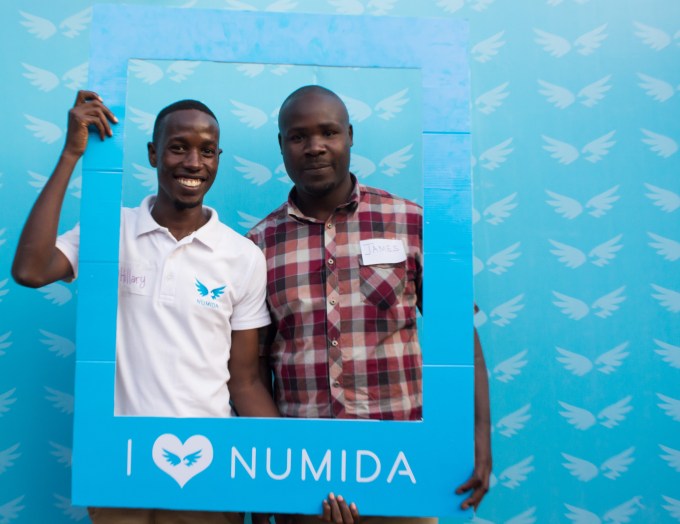
Two business people using Numida

Numida business owners

From May 2017, when it pivoted to September 2019, Numida kept its outstanding portfolio very small and iterated on its underwriting process and credit risk algorithm. After making several iterations, the company went full on to the market in October 2019, and the CEO says the company has grown 6x in lending volumes.

To date, it has provided more than $2 million in unsecured credit to 3,000 micro and small businesses in Uganda, disbursing around $250,000 per month. This is with outstanding collections, repayment rates and client retention, the CEO added.

Although the consumer digital lending space in East Africa has seen an abundance of transactions in recent years, the same cannot be said for startups targeting the micro and small business segment. As one of the few facing this segment, the business has faced issues around getting relevant data to improve its model but doesn’t collate data it thinks isn’t necessary (social media activities, SMS or mobile money transactions) for the sake of aggregating data.

“We look at the business fundamentals, the cash flow of the business, and some demographic data about the applicants. We’ve had to build our own data set because there are no readily available cashflow data on semi-formal, micro and small businesses in Africa,” remarked Shadid.

Its underwriting model was built off 15,000 loans, which took a long time to execute, and this timing puts some strain on how fast it can onboard customers and serve them. However, the pandemic helped in accelerating this model, and with this new investment, Numida is poised to grow further.

Pan-African payments company MFS Africa led the seed round. There was also participation from firms like DRK Foundation, Equilibria Capital and Segal Family Foundation alongside angel investors.

The last time MFS Africa was in the news regarding an investment dates back to June 2020, when it acquired Ugandan fintech startup Beyonic for an undisclosed amount.

Numida is another Ugandan fintech, and a similar play might be in the cards. According to Shahid, the most obvious acquisition path for any successful lending startup to small businesses in Africa is a payments platform. His reason? Because credit is one of the core financial products that will create loyalty and retention to a specific payments platform.

He adds that MFS is a strategic investor in Numida and not the typical VC. He sees the Pan-African company as owning infrastructure, which his company can ride on as a solid foundation for scale. “That’s an opportunity we see in the future. We were concerned about scaling across the continent and who would be the best partner for this. We thought MFS has a lot of expertise and footprint on the continent that will allow us to scale moving forward.”

With this new financing, Numida plans to expand aggressively in Uganda and pilot in a new market, preferably in West Africa. There are some parallels between Uganda and Ghana, Numida’s primary choice in the region. They both have similar mobile money penetration, issues with traditional financial service providers and similar businesses that Shahid says make an enticing market. Per plans, Numida will introduce additional financial services like payments, micro-insurance and deposits to its customers.

13 Apr 2021

With two new funds, LocalGlobe has more latitude than ever

“You wanted me to record this?” asks Saul Klein, LocalGlobe founding partner.

“Just in case you say anything interesting,” I quip back.

“I won’t be doing most of the talking, so maybe someone will say something interesting,” Klein replies poker-faced, before grinning.

Once again, I’ve agreed to an ensemble-style interview with multiple members of the LocalGlobe investment team: Klein, George Henry, Suzanne Ashman, Julia Hawkins, Mish Mashkautsan and Remus Brett. Unlike in 2015, however, when I visited the early-stage VC’s then offices in Tileyard Studios, the interview is taking place over Zoom, rather than the firm’s new Phoenix Court premises in the King’s Cross area of London.

Also in contrast to last time, when I wanted to scoop LocalGlobe’s latest fundraise and Klein rather I didn’t, this time it’s the other way round: I’ve been invited to write a piece partly anchored on news of two new funds that were quietly raised last year.

LocalGlobe, the entity that invests at seed stage, has an additional $150 million of capital to deploy in the U.K. and Europe (and further afield). Running alongside is Latitude, a growth-stage fund now with $220 million more to invest, which allows the LocalGlobe team to take a fresh look at breakout portfolio companies that have proven their growth potential or to back other scale-ups, which, for myriad reasons, didn’t take or weren’t offered LocalGlobe’s cash earlier.

“Latitude was born out of the idea of building continuity,” says LocalGlobe general partner George Henry. “When it comes to existing LocalGlobe companies, Latitude is very much building on top of what we’ve done. It’s giving us the capital to continue to invest more into those companies”.

However, the firm doesn’t think of Latitude as follow-on funding, in the classic sense. Not only is it able to back companies that LocalGlobe hasn’t previously invested in, but even for those it has, the LocalGlobe team, including Julian Rowe, who heads up Latitude, uses the opportunity to take a fresh look before writing a Latitude cheque.

“I think 80% of Latitude companies have at least one LocalGlobe partner fully engaged,” says Klein.

Internally, whichever fund the firm is investing from and at what stage, LocalGlobe frames its strategy as “insights and access”. Though no one explicitly explains what this means, I interpret it as having the expertise in the team (and wider LocalGlobe network) to understand a problem space and its addressable market, and having the access to see and then get in on a deal, should it want to.

“Of course, it’s easier to have insight and access when you’ve already been inside the company from pre-seed or seed,” explains Henry. “But we’ve [also] seen opportunities where we feel we had the insight and access because we know the founders already, we know the theme, we know the market [and] we know the investors really well. And then it puts us in a position where we feel confident to participate at Series B or beyond”.

LocalGlobe isn’t the only European early-stage VC firm to launch a separate later-stage fund, either to avoid too much dilution for the most promising portfolio companies or to opportunistically back companies later when there’s arguably less risk. Yet I can’t help wonder what the conversation is like when Latitude wants to invest in a company that LocalGlobe previously turned down.

One example is Monzo, the popular U.K.-based bank with its instantly recognisable hot coral pink-coloured debit card. “We were very aware of Monzo from the earliest days,” says Klein. “We weren’t big believers at the time in consumer neobanks. We thought the neobank was something that would work for SMEs or for business banking, where the incumbents were really not focused… but also it’s kind of typically a better business than consumer retail banking. And we took the view that consumer neobanks weren’t going to be a thing”.

Instead, LocalGlobe invested in Cleo, a financial assistant chatbot and app that runs on top of consumer bank accounts, and Tide, a business bank account for SMEs.

“And it turns out, you know, we were wrong,” admits Klein, before revealing that LocalGlobe general partner Suzanne Ashman was the outlier in the team. After becoming an early customer of Monzo, she backed the challenger bank’s equity crowd fund in a personal capacity.

“When we had an opportunity later on through Latitude to get involved with Monzo, we felt it’s an exceptional company,” continues Klein. “We love the investors, we work very closely with General Catalyst, and they were getting involved with the business at the time, and with Accel. And we thought it was a great opportunity to enter”.

Another example of missing out first time around is Cazoo, the used car retailer founded by Alex Chesterman. Klein and Chesterman go way back to their time at Lovefilm, and LocalGlobe was an early investor in Zoopla, the proptech company Chesterman took all the way to IPO. Access, therefore, wasn’t a problem. Instead, a perceived conflict of interest was.

LocalGlobe had invested in Motorway (curiously, as had Chesterman), which at the time looked like a potential Cazoo competitor. No longer deemed as such, Latitude would go on to write a later-stage (and more expensive) check. Then, last month, Cazoo announced plans to SPAC its way to going public with a valuation of $7 billion, proving that conflicts of interest can be costly.

These near misses are the exception, says Klein, underlining that Latitude’s core thesis is to be able to support LocalGlobe portfolio breakouts. “LocalGlobe is about that startup phase of pre-seed and seed. Latitude is the breakout phase where things are really starting to hit an inflection point,” he says.

That is, of course, true, but it can also be argued that having a later stage fund does provide additional optionality and I posit that this could make LocalGlobe less risk-taking. With Latitude potentially able to mop up deals that didn’t happen at seed, LocalGlobe can take a wait and see approach for investments where early insights are less forthcoming.

Henry shakes his head ferociously, prompting Klein to suggest he takes this question.

“You want to get in as early as possible, because that’s the way you build the relationship… There’s nothing that gives you more credit than to be the first believer in a team,” says Henry.

“Also, in the market we’re in, you don’t want to make a bet on something that looks exciting, but you’re not sure and say, ‘it’s okay, we’ll get into Series B’. Because the reality is, the more you wait, the harder it gets to get into a great company”.

In LocalGlobe’s own (interesting) words…

On capital going into private markets

“The amount of capital that is now in the private markets looking to invest in tech, it’s not just extraordinary, but, arguably, it’s necessary and important, because this is where growth comes from and this is where innovation comes from. I’ve been doing this for 20-25 years, and it took 20 years to get to the starting line. Now it gets interesting.” — Saul Klein.

On investing in regulated industries

“Opportunities in the highly regulated industries are just massive. And they were largely untouched by wave one of VC, and even five years ago, we tended not to see that many founders building in heavily regulated spaces. So it feels to me that, yes, while the base of capital has gotten much larger, the opportunity in all of these segments is now much larger.” — Suzanne Ashman

On healthcare opportunities

“We think overall, obviously, healthcare is one of the largest markets, and we are very, very bullish on that, on the opportunity at large. We’ve doubled down on specific themes within healthcare. So, for example, developing communication rails for healthcare, improving how patients get connected with hospital systems… Mental health is another enormous market and opportunity, not just in terms of market, but in terms of impact.” — Julia Hawkins

On successful exits

“You’re just the supporting cast, and obviously, you are delighted for them. But you’re never the main show. What’s lovely about being a seed investor, and then supporting with Latitude, is it is not a quick journey, and you get to know people over time, you get to know their friends, their partners. And honestly, it’s just a privilege to sit on the sidelines.” — Suzanne Ashman

On fintech’s longevity

“Over the next five years, on all dimensions, from payments to core banking to insurance, you know, we’re going to see many more interesting companies. Just when you think the market map is pretty clear, and the winners are emerging, you’ll still see these companies that emerge and completely destroy the market.” — Remus Brett

On frontier tech need for more capital

“Proper frontier tech, and foundational tech, requires even more patience and focus on what’s beyond the horizon… The available capital for proper frontier tech startups is much more limited than startups in general. And that’s something we all know and feel daily.” — Mish Mashkautsan