
Year: 2021

12 Apr 2021

Another milestone for in-space servicing as Northrop Grumman gives aging satellite new life

Northrop Grumman hit a new milestone in extending the life of active spacecraft as a purpose-built spacecraft, MEV-2, docking with Intelsat’s IS-10-02 satellite to give it another 5 years of life. It’s a strong demonstration of the possibilities in a growing field of orbital servicing operations.

MEV-2 launched in August and matched the orbit of Intelsat’s 18-year-old satellite, which would have soon be due for decommissioning, having exceeded its original mission by some 5 years. But it’s precisely this type of situation that the new “on-orbit service, assembly and manufacturing,” or OSAM, industry intends to target, allowing such satellites to live longer — likely saving their operators millions.

In last night’s operation, the MEV-2 spacecraft slowly approached IS-10-02 and docked with it, essentially adding itself as a spare engine with a full tank. It will stay attached this way for five years, after which it will move on to its next mission — another end-of-life satellite, probably. “You can think of MEV-2 as a jetpack for the 10-02 satellite,” said a Northrop Grumman representative.

The docking process is really more of a clamping-on than a docking, since while there’s a mechanical fit between the MEV-2’s probe and the IS-10-02’s engine cone, it’s not like they’re making a seal and exchanging fluids or power. The representative explained:

The MEV-2 docking system consists of a probe that we insert into the liquid apogee engine on the aft end of a satellite. Nearly 80% of satellites in orbit have this featuring, allowing the MEV service a variety of customers. The liquid apogee engine acts as a “cone to capture” to help guide the probe which once it passes through the throat of the engine, expands to capture the client satellite. The probe is then retracted pulling three stanchions, or feet, up against the launch adaptor ring, securely clamping the two vehicles together.

Last year the MEV-1 mission performed a similar operation, docking with Intelsat’s IS-901 and changing its orbit.

But in that case, the satellite was inactive and not in the correct orbit to return to service. MEV-1 therefore had a bit more latitude in how it approached the first part of the mission.

In the case of MEV-2, the IS-10-02 satellite was in active use in its accustomed orbit, meaning the servicing spacecraft had to coordinate an approach that ran no risk of disrupting the target craft’s operations. Being able to service working satellites, of course, is a major step up from only working with dead ones.

And naturally the goal is to have spacecraft that could dock and refuel another satellite without hanging onto it for a few years, or service a malfunctioning part so that a craft that’s 99% functional can stay in orbit rather than be allowed to burn up. Startups like Orbit Fab aim to build and standardize the parts and ports needed to make this a reality, and Northrop Grumman is planning a robotic servicing mission for its next trick, expected to launch in 2024.

12 Apr 2021

From pickup basketball to market domination: My wild ride with Coupang

A month ago, Coupang arrived on Wall Street with a bang. The South Korean e-commerce giant — buoyed by $12 billion in 2020 revenue — raised $4.55 billion in its IPO and hit a valuation as high as $109 billion. It is the biggest U.S. IPO of the year so far, and the largest from an Asian company since Alibaba’s.

But long before founder Bom Kim rang the bell, I knew him as a fellow founder on the hunt for a good idea. We stayed in touch as he formed his vision for what would become Coupang, and I built it alongside him as an investor and board member.

As a board member, I’ve observed a brief quiet period following the IPO. But now I want to share how exactly our paths intersected, largely because Bom exemplifies what founders should aspire to and should seek: big risks, dogged determination, and obsessive responsiveness to the market.

Bom fearlessly turned down an acquisition offer from then-market-leader Groupon, ferociously learned what he didn’t know, made a daring pivot even after becoming a billion-dollar company, and iteratively built a vision for end-to-end market dominance.

Why I like talking to founders early

In 2008, I met Bom while playing a weekend game of pickup basketball at Stuyvesant High School. We realized we had a mutual acquaintance through my recently-sold startup, Community Connect Inc. He told me about the magazine he had sold and his search for a next move. So we agreed to meet up for lunch and go over some of his ideas.

To be honest, I don’t remember any of those early ideas, probably because they weren’t very good. But I really liked Bom. Even as I was crapping on his ideas, I could tell he was sharp from how he processed my feedback. It was obvious he was super smart and definitely worth keeping in touch with, which we continued to do even after he relocated to go to HBS.

I soon began investing in and incubating businesses, starting mostly with my own capital. When I got a call from an executive recruiter working for a company in Chicago called Groupon — who told me they were at a $50 million run rate in only a few months — I became fascinated with their model and started talking to some of the investors, former employees, and merchants.

Inspired, and as a new parent, I decided to launch a similar daily-deal business for families: Instead of skydiving and go-kart racing, we offered deals on kids’ music classes and birthday party venues. While I was working on this idea, John Ason, an angel investor in Diapers.com, said I should meet with the founder and CEO Marc Lore. By the end of the meeting, Marc and I etched a partnership to launch DoodleDeals.com co-branded with Diapers.com. The first deal did over $70,000 — great start.

I’ve observed a brief quiet period following the IPO. But now I want to share how exactly our paths intersected, largely because Bom exemplifies what founders should aspire to and should seek: big risks, dogged determination, and obsessive responsiveness to the market.

All that time, I kept in touch with Bom. In February 2010, we were catching up over lunch at the Union Square Ippudo, and he asked if I had heard of Buywithme, a Boston-based Groupon clone. He hadn’t yet heard about Groupon, so I explained the business model and shared the numbers. He thought something similar might transfer well to South Korea, where he was born and his parents still lived.

This kind of conversation is exactly why I love working with founders early, even before the idea forms: You learn a lot about them as they explore, wrestle with uncertainty, and eventually build conviction on a business they plan to spend the next decade-plus building. Ultimately, success comes down to founders’ belief in themselves; when you develop the same belief in them as an investor, it is pretty magical. I was starting to really believe in Bom.

The idea gets real — and moves fast

I'm not Korean — I am ethnically Chinese — so Bom put together slides on the Korean market and why it was perfect for the daily-deal model. In short: a very dense population that’s incredibly online.

I’m not Korean — I am ethnically Chinese — so Bom put together slides on the Korean market and why it was perfect for the daily-deal model. In short: a very dense population that’s incredibly online. Image Credits: Ben Sun

I told Bom he should drop out of business school and do this. He said, “You don’t think I can wait until I graduate?” I responded, “No way! It will be over by then!”

First-mover advantage is real in a business like this, and it didn’t take Bom long to see that. He raised a small $1.3 million seed round. I invested, joined the board. Because of my knowledge of the deals market and my entrepreneurial experience, Bom asked me to get hands-on in Korea — not at all typical for an investor or even a board member, but I think of myself as a builder and not just a backer, and this is how I wanted to operate as an investor.

Once he realized time was of the essence, Bom was heads down. For context, he was engaged to his longtime girlfriend, Nancy, who also went to Harvard undergrad and was a successful lawyer. Imagine telling your fiancée, “Honey, I am dropping out of business school, moving to Korea to start a company. I will be back for the wedding. Not sure if I will ever be coming back to the U.S.”

I emailed Bom, saying: “Bom — honestly as a friend. Enjoy your wedding. It is a real blessing that your fiancée is being so supportive of you doing this. Launching a site a few weeks before the wedding is going to be way too distracting and she won’t feel like your heart is in it. Launching a few weeks later is not going to make or break this business. Trust me.”

Bom didn’t listen. He launched Coupang in August 2010, two weeks before the wedding. He flew back to Boston, got married, and — running on basically no sleep — sneaked out for a 20-minute nap in the middle of his reception. Right after the wedding, he flew back to Seoul. Nancy has to be one of the most supportive and understanding partners I have ever seen. They are now married and have two kids.

Jumping on new distribution, turning down an acquisition offer

12 Apr 2021

Blue Origin will run an “astronaut rehearsal” during a launch this week to prep for human spaceflight

Blue Origin is making progress towards its goal of flying human astronauts aboard its spacecraft, with a plan to run an “astronaut rehearsal” during a launch it has planned for Wednesday, April 14. The launch of Blue Origin’s New Shepard suborbital, reusable rocket will be a key step in verifying the vehicle for paying human passengers.

What does the rehearsal entail? Basically everything except for the actual spaceflight, including boarding and going through preflight operations, the returning to the capsule once it has landed and going through a staged version of an actual capsule exit post-mission. It’s what would happen during a Blue Origin launch with private astronauts on board, with the exception that the Blue Origin personnel standing in for those customers will get out of the capsule before actual engine ignition and launch, and then be transported to the capsule landing site where they’ll get back in and behave as though they’ve been there all along.

There will be one passenger on board the spacecraft during its actual flight: Mannequin Skywalker, a test dummy used by Blue Origin to measure data about what the launch would be like for people. Mannequin has flown previously, but this is the first time it’s playing a sort of human spaceflight relay with the simulation crew doing the ground operations rehearsal portions of the mission.

Blue Origin launched its first New Shepard rocket of 2021 back in January, and that mission included a test of improved capsule cabin crew features, like better acoustics and temperature management system, and new display and communications equipment for the eventual crew. The company expects to begin flying people on board the rocket at some point this year, as of the most recently-disclosed timelines.

This week’s launch is set for a take-off time of 8 AM CDT (9 AM EDT/6AM PDT), and will take place from the company’s launch site in West Texas. A live feed will kick off an hour ahead of the opening of the launch window, and Blue Origin also plans to include footage of the astronaut rehearsal activities, which will be the best look we’ve gotten yet at what its tourist flights might look like.

12 Apr 2021

Tiger Global leads $100 million investment in Indian social commerce DealShare

Tiger Global has invested in DealShare, a startup in India that has built an e-commerce platform for middle and lower-income groups of consumers, just three months after the Indian firm concluded its previous $21 million Series C funding round.

The New York-headquartered firm has led the $100 million Series D round in three-year-old social commerce startup DealShare, two people familiar with the matter told TechCrunch. Tiger Global declined to comment, and a founder of the Indian startup didn’t return an email sent on Sunday.

DealShare kickstarted its journey the day Walmart acquired Flipkart, the startup’s founder and chief executive Vineet Rao said at a virtual conference late last year. Rao said that even as Amazon and Flipkart had been able to create a market for themselves in the urban Indian cities, much of the nation was still underserved. There was an opportunity for someone to jump in, he said.

The startup began as an e-commerce platform on WhatsApp, where it offered hundreds of products to consumers. It didn’t take long before a major consumer spending pattern was visible, Rao said. People were only interested in buying items that were selling at discounted rates, said Rao.

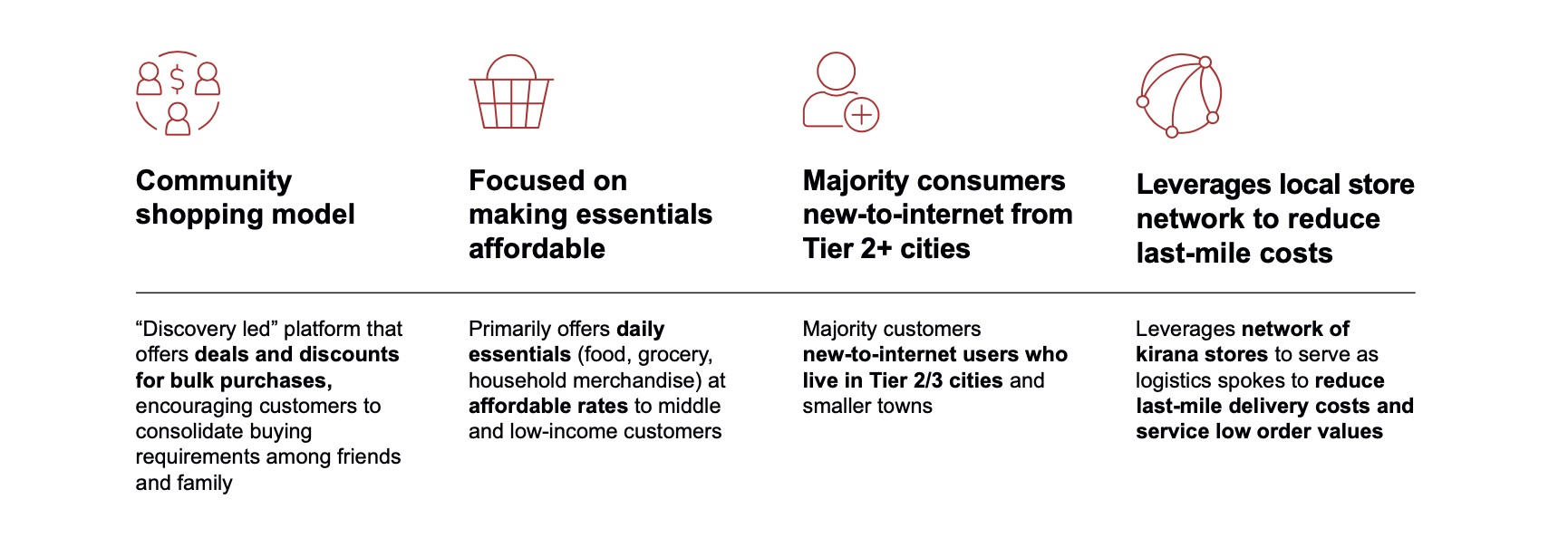
Over time, that idea has become part of DealShare’s core offering. Today it incentivizes consumers — by offering them discounts and cashbacks — to share deals on products with their friends. The startup, which has since launched its own app and website, now operates in over two dozen cities in India.

Consumers wanted products that were relevant to them and they wanted to buy these items at a price that instilled the most value for their bucks, said Rao. “We focused on locally produced items instead of national brands. Even today, 80% to 90% of items we sell are locally produced,” he said.

How DealShare model works. (Image and data by Bain & Company)

Amazon and Flipkart have captured less than 3% of the retail market in India, leaving room for firms to explore other models. Social commerce is one of the bets we’re seeing being play out in India. The other bet gaining traction is digitizing neighborhood stores in the country — without so much of the social element — that dot tens of thousands of towns, cities and villages in India.

The investment comes as Tiger Global looks to close over two dozen deals in India this year, TechCrunch reported on Monday. Tiger Global, which recently closed a $6.7 billion fund, last week led investments in social network ShareChat, business messaging platform Gupshup, and investment app Groww, and participated in fintech app CRED’s round, helping all of these startups attain the much sought after unicorn status.

Meesho, the market leading social commerce in India, also turned a unicorn last week after SoftBank led a $300 million round in the Indian firm, valuing it at $2.1 billion.

DealShare counts WestBridge, Falcon Edge Capital’s Alpha Wave, Z3Partners, and Omidyar Network among its investors.

12 Apr 2021

Chinese autonomous vehicle startup WeRide scores permit to test driverless cars in San Jose

WeRide, the Chinese autonomous vehicle startup that recently raised $310 million, has received a permit to test driverless vehicles on public roads in San Jose, California. WeRide is the seventh company, following AutoX, Baidu, Cruise, Nuro Waymo and Zoox, to receive a driverless testing permit.

In the early days of autonomous vehicle development, testing permits required human safety drivers behind the wheel. Some 56 companies have an active permit to test autonomous vehicles with a safety driver. Driverless testing permits, in which a human operator is not behind the wheel, have become the new milestone and a required step for companies that want to launch a commercial robotaxi or delivery service in the state.

The California DMV, the agency that regulates autonomous vehicle testing in the state, said the permit allows WeRide to test two autonomous vehicles without a driver behind the wheel on specified streets within San Jose. WeRide has had a permit to test autonomous vehicles with safety drivers behind the wheel since 2017. WeRide is also restricted to how and when it tests these vehicles. The driverless vehicles are designed to operate on roads with posted speed limits not exceeding 45 miles per hour. Testing will be conducted during the day Monday through Friday, but will not occur in heavy fog or rain, according to the DMV.

To reach driverless testing status in California, companies have to meet a number of safety, registration and insurance requirements. Any company applying for a driverless permit must provide evidence of insurance or a bond equal to $5 million, verify vehicles are capable of operating without a driver, meet federal Motor Vehicle Safety Standards or have an exemption from the National Highway Traffic Safety Administration, and be an SAE Level 4 or 5 vehicle. The test vehicles must be continuously monitored and train remote operators on the technology.

Driverless testing permit holders must also report to the DMV any collisions involving a driverless test vehicle within 10 days and submit an annual report of disengagements.

While the vast majority of WeRide’s operations are in China, the permit does signal its continued interest in the United States. WeRide, which is headquartered in Guangzhou, China, maintains R&D and operation centers in Beijing, Shanghai, Nanjing, Wuhan, Zhengzhou and Anqing, as well as in Silicon Valley. The startup, which was founded in 2017, received a permit in February to operate a ride-hailing operation in Guangzhou.

The company is one of China’s most-funded autonomous vehicle technology startups with backers that include bus maker Yutong, Chinese facial recognition company SenseTime and Alliance Ventures, the strategic venture capital arm of Renault-Nissan-Mitsubishi. Other WeRide investors include CMC Capital Partners, CDB Equipment Manufacturing Fund, Hengjian Emerging Industries Fund, Zhuhai Huajin Capital, Flower City Ventures and Tryin Capital. Qiming Venture Partners, Sinovation Ventures and Kinzon Capital.

12 Apr 2021

Chinese autonomous vehicle startup WeRide scores permit to test driverless cars in San Jose

WeRide, the Chinese autonomous vehicle startup that recently raised $310 million, has received a permit to test driverless vehicles on public roads in San Jose, California. WeRide is the seventh company, following AutoX, Baidu, Cruise, Nuro Waymo and Zoox, to receive a driverless testing permit.

In the early days of autonomous vehicle development, testing permits required human safety drivers behind the wheel. Some 56 companies have an active permit to test autonomous vehicles with a safety driver. Driverless testing permits, in which a human operator is not behind the wheel, have become the new milestone and a required step for companies that want to launch a commercial robotaxi or delivery service in the state.

The California DMV, the agency that regulates autonomous vehicle testing in the state, said the permit allows WeRide to test two autonomous vehicles without a driver behind the wheel on specified streets within San Jose. WeRide has had a permit to test autonomous vehicles with safety drivers behind the wheel since 2017. WeRide is also restricted to how and when it tests these vehicles. The driverless vehicles are designed to operate on roads with posted speed limits not exceeding 45 miles per hour. Testing will be conducted during the day Monday through Friday, but will not occur in heavy fog or rain, according to the DMV.

To reach driverless testing status in California, companies have to meet a number of safety, registration and insurance requirements. Any company applying for a driverless permit must provide evidence of insurance or a bond equal to $5 million, verify vehicles are capable of operating without a driver, meet federal Motor Vehicle Safety Standards or have an exemption from the National Highway Traffic Safety Administration, and be an SAE Level 4 or 5 vehicle. The test vehicles must be continuously monitored and train remote operators on the technology.

Driverless testing permit holders must also report to the DMV any collisions involving a driverless test vehicle within 10 days and submit an annual report of disengagements.

While the vast majority of WeRide’s operations are in China, the permit does signal its continued interest in the United States. WeRide, which is headquartered in Guangzhou, China, maintains R&D and operation centers in Beijing, Shanghai, Nanjing, Wuhan, Zhengzhou and Anqing, as well as in Silicon Valley. The startup, which was founded in 2017, received a permit in February to operate a ride-hailing operation in Guangzhou.

The company is one of China’s most-funded autonomous vehicle technology startups with backers that include bus maker Yutong, Chinese facial recognition company SenseTime and Alliance Ventures, the strategic venture capital arm of Renault-Nissan-Mitsubishi. Other WeRide investors include CMC Capital Partners, CDB Equipment Manufacturing Fund, Hengjian Emerging Industries Fund, Zhuhai Huajin Capital, Flower City Ventures and Tryin Capital. Qiming Venture Partners, Sinovation Ventures and Kinzon Capital.

12 Apr 2021

Tech and auto execs tackle global chip shortage at White House summit

A collection of tech and auto industry executives met with the White House to discuss solutions for the worldwide chip shortage Monday.

CEOs from Google, Intel, HP, Dell, Ford, and General Motors attended the virtual summit on semiconductors and resilience in supply chains. National security adviser Jake Sullivan, Secretary of Commerce Gina Raimondo and National Economic Council Director Brian Deese hosted the meeting, which President Biden also attended briefly.

Ahead of the summit, Intel CEO Pat Gelsinger said he hoped the U.S. could increase its semiconductor production to encompass a third of all chips sold in the U.S. Intel is in discussions to make chips designed specifically for automakers within its own facilities, a project that could take some pressure off of supply lines.

An ongoing dearth of the tiny, high tech components used in everything from car entertainment systems to smartphones has stretched supply thin. Consumers have been feeling it for months. Soaring demand has made new gaming consoles and graphics cards scarce, even months after some of those devices are released. But with semiconductors omnipresent in devices these days, the supply shortages are disrupting industries well beyond gaming.

President Biden signed an Executive Order taking aim at the supply issues in February. That order initiated a 100-day review of supply chains for semiconductors as well as advanced batteries like those found in electric vehicles, key minerals required for tech products, and pharmaceuticals and their ingredients.

Biden noted that the chip shortages have “caused delays in productions of automobiles and has resulted in reduced hours for American workers.” He also cited supply shortages for PPE during the early months of the pandemic, when many health workers were forced to work without proper protection.

The order also kicks off a longer review in cooperation with industry leaders that will look for solutions that can be implemented right away to alleviate ongoing supply chain issues.

Supply chain issues for tech components also highlight tensions with China, a fact that Sullivan’s presence at the White House summit makes clear. Biden cited concerns around “longterm competitiveness” as one motivation for undergoing a major audit of supply chains for critical tech components.

Sen. Mark Warner (D-VA) has called the shortage “a national security issue as well as an economic one,” citing the need for semiconductors in defense tech.

Warner has emphasized the need for legislative solutions that would move the U.S. toward self reliance and push back on China’s influence, pointing to a semiconductor production bill he introduced with Sen. John Cornyn (R-TX) last summer.

Biden previously said that the administration will work toward solutions to the current shortfall of the critical chips and will be leaning on political allies “to ramp up production to help us resolve the bottlenecks we face now.”

12 Apr 2021

Tech and auto execs tackle global chip shortage at White House summit

A collection of tech and auto industry executives met with the White House to discuss solutions for the worldwide chip shortage Monday.

CEOs from Google, Intel, HP, Dell, Ford, and General Motors attended the virtual summit on semiconductors and resilience in supply chains. National security adviser Jake Sullivan, Secretary of Commerce Gina Raimondo and National Economic Council Director Brian Deese hosted the meeting, which President Biden also attended briefly.

Ahead of the summit, Intel CEO Pat Gelsinger said he hoped the U.S. could increase its semiconductor production to encompass a third of all chips sold in the U.S. Intel is in discussions to make chips designed specifically for automakers within its own facilities, a project that could take some pressure off of supply lines.

An ongoing dearth of the tiny, high tech components used in everything from car entertainment systems to smartphones has stretched supply thin. Consumers have been feeling it for months. Soaring demand has made new gaming consoles and graphics cards scarce, even months after some of those devices are released. But with semiconductors omnipresent in devices these days, the supply shortages are disrupting industries well beyond gaming.

President Biden signed an Executive Order taking aim at the supply issues in February. That order initiated a 100-day review of supply chains for semiconductors as well as advanced batteries like those found in electric vehicles, key minerals required for tech products, and pharmaceuticals and their ingredients.

Biden noted that the chip shortages have “caused delays in productions of automobiles and has resulted in reduced hours for American workers.” He also cited supply shortages for PPE during the early months of the pandemic, when many health workers were forced to work without proper protection.

The order also kicks off a longer review in cooperation with industry leaders that will look for solutions that can be implemented right away to alleviate ongoing supply chain issues.

Supply chain issues for tech components also highlight tensions with China, a fact that Sullivan’s presence at the White House summit makes clear. Biden cited concerns around “longterm competitiveness” as one motivation for undergoing a major audit of supply chains for critical tech components.

Sen. Mark Warner (D-VA) has called the shortage “a national security issue as well as an economic one,” citing the need for semiconductors in defense tech.

Warner has emphasized the need for legislative solutions that would move the U.S. toward self reliance and push back on China’s influence, pointing to a semiconductor production bill he introduced with Sen. John Cornyn (R-TX) last summer.

Biden previously said that the administration will work toward solutions to the current shortfall of the critical chips and will be leaning on political allies “to ramp up production to help us resolve the bottlenecks we face now.”

12 Apr 2021

Apple and Google will both attend Senate hearing on app store competition

After it looked like Apple might no-show, the company has committed to sending a representative to a Senate antitrust hearing on app store competition later this month.

Last week, Senators Amy Klobuchar (D-MN) and Mike Lee (R-UT) put public pressure on the company to attend the hearing, which will be held by the Senate Judiciary Subcommittee on Competition Policy, Antitrust, and Consumer Rights. Klobuchar chairs that subcommittee, and has turned her focus toward antitrust worries about the tech industry’s most dominant players.

The hearing, which Google will also attend, will delve into Apple and Google’s control over “the cost, distribution, and availability of mobile applications on consumers, app developers, and competition.”

App stores are one corner of tech that looks the most like a duopoly, a perception that Apple’s high profile battle with Fortnite-maker Epic is only elevating. Meanwhile, with a number of state-level tech regulation efforts brewing, Arizona is looking to relieve developers from Apple and Google’s hefty cut of app store profits.

In a letter last week, Klobuchar and Lee, the subcommittee’s ranking member, accused Apple of “abruptly” deciding that it wouldn’t send a witness to the hearing, which is set for April 21.

“Apple’s sudden change in course to refuse to provide a witness to testify before the Subcommittee on app store competition issues in April, when the company is clearly willing to discuss them in other public forums, is unacceptable,” the lawmakers wrote.

By Monday, that pressure had apparently done its work, with Apple agreeing to attend the hearing. Apple didn’t respond to a request for comment.

While the lawmakers are counting Apple’s acquiescence as a win, that doesn’t mean they’ll be sending their chief executive. Major tech CEOs have been called before Congress more often over the last few years, but those appearances might have diminishing returns.

Tech CEOs, Apple’s Tim Cook included, are thoroughly trained in the art of saying little when pressed by lawmakers. Dragging in a CEO might work as a show of force, but tech execs generally reveal little over the course of their lengthy testimonies, particularly when a hearing isn’t accompanied by a deeper investigation.

12 Apr 2021

Atomico’s talent partners share 6 tips for early-stage people ops success

In the earliest stages of building a startup, it can be hard to justify focusing on anything other than creating a great product or service and meeting the needs of customers or users. However, there are still a number of surefire measures that any early-stage company can and should put in place to achieve “people ops” success as they begin scaling, according to venture capital firm Atomico‘s talent partners, Caro Chayot and Dan Hynes.

You need to recruit for what you need, but you also need to think about what is coming down the line.

As members of the VC’s operational support team, both work closely with companies in the Atomico portfolio to “find, develop and retain” the best employees in their respective fields, at various stages of the business. They’re operators at heart, and they bring a wealth of experience from time spent prior to entering VC.

Before joining Atomico, Chayot led the EMEA HR team at Twitter, where she helped scale the business from two to six markets and grew the team from 80 based in London to 500 across the region. Prior to that, she worked at Google in people ops for nine years.

Hynes was responsible for talent and staffing at well-known technology companies including Google, Cisco and Skype. At Google, he grew the EMEA team from 60 based in London to 8,500 across Europe by 2010, and at Skype, he led a talent team that scaled from 600 to 2,300 in three years.

Caro Chayot’s top 3 tips

1. Think about your long-term org design (18 months down the line) and hire back from there

When most founders think about hiring, they think about what they need now and the gaps that exist in their team at that moment. Dan and I help founders see things a little differently. You need to recruit for what you need, but you also need to think about what is coming down the line. What will your company look like in a year or 18 months? Functions and team sizes will depend on the sector — whether you are building a marketplace, a SaaS business or a consumer company. Founders also need to think about how the employees they hire now can develop over the next 18 months. If you hire people who are at the top of their game now, they won’t be able to grow into the employees you need in the future.

2. Spend time defining what your culture is. Use that for hiring and everything else people-related

If org design is the “what,” then culture is the “how.” It’s about laying down values and principles. It may sound fluffy, but capturing what it means to work at your company is key to hiring and retaining the best talent. You can use clearly articulated values at every stage of talent-building to shape your employer brand. What do you want potential employees to feel when they see your website? What do you want to look for in the interview process to make sure you are hiring people who are additive to the culture? How do you develop people and compensate them? These are all expressions of culture.