Year: 2021

21 Sep 2021

Bilt Rewards banks $60M growth on a $350M valuation to advance credit card benefits for renters

Bilt Rewards, a loyalty program for property renters to earn points on rent with no fees and build a path toward homeownership, announced Tuesday a round of $60 million in growth funding that values the company at $350 million.

The investment comes from Wells Fargo and Mastercard and a group of the nation’s largest real estate owners, including The Blackstone Group, AvalonBay Communities, Douglas Elliman, Equity Residential, GID-Windsor Communities, LENx, The Moinian Group, Morgan Properties, Starwood Capital Group and Related.

Bilt launched back in June out of Kairos, the startup studio led by Ankur Jain, focused on enabling over 109 million renters in the U.S. to earn points from paying their rent every month — typically someone’s largest monthly expense. Since then, the program was rolled out across over 2 million rental units, Jain told TechCrunch.

“We are the first and only alliance of the major property owners to create this kind of program and already have 15 of the top 20 owners involved,” he added. “We are also the only co-branded card to offer points on rent.”

Greg Bates, GID president and CEO, said his company has 130 assets spread across the top 20 markets and manages 40,000 apartment units. He learned about Bilt from a colleague who attended a proptech conference where Jain demoed the Bilt card.

For as long as Bates has been in the real estate industry, about 20 years or so, renters have wanted to pay rent with a credit card for convenience and to earn loyalty points. However, that was cost-prohibitive in terms of the surcharges needed to be added to the rental rate — until Bilt, he said. The card “is incredibly easy to use” and integrates into property owners’ online payment systems.

“Bilt has transformed the value proposition for residents that want to use a credit card and for landlords that want to accept them,” Bates added. “There will always be barriers to entry for products like this, but Bilt spent time with Mastercard and Wells Fargo to develop this unique product which will be a competition differentiator for a few years to come.”

In addition to the new funding, Bilt is also announcing new benefits for its loyalty members and upgraded offerings for the Bilt Mastercard, including the ability to earn up to 50,000 points on rent per year and unlimited points using the credit card.

For members, Bilt will pay interest in the form of points for a member’s account each month based on their average daily points balance over the 30-day period, and offer a concierge service for members choosing to redeem their Bilt points toward a home down payment. In addition, members can earn bonus points on top of points used by landlords on new leases and renewals.

Bilt worked with regulators, as well as Fannie Mae and the Department of Housing and Urban Development, to gain approval for using rewards points toward a mortgage. Members can also report their rent payments to the credit bureaus at no cost, which can help build credit history for millions of young renters.

Meanwhile, the company’s new “0-1-2-3” point earning structure for Bilt Mastercard holders provides no annual fee, 1x points on rent payments, 2x points on travel, 3x points on dining and 1x points on all other purchases.

This is the company’s first major external financing round and will be used to expand its real estate and loyalty partner network, grow its distribution channels and make its platform credit card more widely available to the public. Jain estimates Bilt is seeing 20% enrollment across residents.

As more renters move to homeownership over time, Bilt has plans to leverage this potential larger business to eventually become a mortgage provider for them.

“Renting is something people do for a while, and the core business has a massive scale opportunity, especially in the demographic under 35 years old, who tend to be up-and-coming professionals,” Jain added. “This is a unique target market, and Bilt will grow with them as they build their path to homeownership.”


 

21 Sep 2021

Ellen DeGeneres, Portia de Rossi, Shaun White, Shawn Mendes get behind Shelf Engine

Shelf Engine’s mission to eliminate food waste in grocery retailers now has some additional celebrity backers. The company brought in a $2 million extension to its $41 million Series B announced in March.

Ellen DeGeneres, Portia de Rossi, Shaun White and Shawn Mendes are the new backers, who came in through a strategic round of funding alongside PLUS Capital to bring the Seattle-based company’s total funding to $60 million since the company’s inception in 2016. This includes a $12 million Series A from 2020.

Shelf Engine’s grocery order automation technology applies advanced statistical models and artificial intelligence to deliver accurate food order volume so that customers can reduce their food waste by as much as 32% while increasing gross margins and sales of more than 50%. The company has already helped retailers divert 1 million pounds of food waste from landfills, Stefan Kalb, co-founder and CEO of Shelf Engine, told TechCrunch.

“We’ve had phenomenal growth last year, some of it from our mid-market customers, but mostly from customers like Target and Kroger,” Kalb said. “Our other big news is that we hired a president (Kane McCord) in the past six weeks, which is cool to have the reinforcement on the leadership side.”

Over the past 12 months, the company, which works with retailers like Kroger, Whole Foods and Compass Group, saw over 540% revenue growth. At the same time, it grew its employees to 200 from 23, Kalb said. He expects to more than double Shelf Engine’s headcount over the next 12 months.

As a result, the new funding will be used to scale with current customers and accelerate further investment in R&D of its AI systems and automation capabilities.

Meanwhile, Amanda Groves, partner at PLUS Capital, said her firm works with about 65 individuals who are in film, television, sports and culture, including the four new investors in Shelf Engine.

She says many of her clients are looking to participate in business as an investor or with sweat equity. Her firm works with them to determine interests and will then source opportunities and invest alongside them.

Shelf Engine fits into one of PLUS Capital’s core investment areas of sustainability. The firm looks across different sectors like food, energy, apparel, packaging and recycling. Shelf Engine’s approach of leveraging technology to aid in sustainability efforts was attractive to all of the investors, as was their method of scaling within grocery clients without affecting consumer behavior.

“When Shelf Engine is installed in the grocery store, they can reduce spoilage by 10% right off the bat — that immediacy of the impact was what got our clients excited,” Groves added.

One of Shelf Engine’s first celebrity investors was Joe Montana, and Kalb said partnering with celebrities enables the company’s mission to eliminate food waste and address the climate crisis to be made more aware.

“B2B software is not as glamorous, but the climate has become a big issue and something many celebrities care about,” he added. “Shawn Mendes has over 60 million followers, so for him to share about this issue is extremely meaningful. Where he invests will lead to his followers knocking on the doors of stores and saying ‘this matters to me.’ That is the strategy shift from B2B to a movement for our community.”

The company is not alone in tackling food waste, which globally each year amounts to $1.3 trillion. For example, Apeel, OLIO, Imperfect Foods, Mori and Phood Solutions are all working to improve the food supply chain and have attracted venture dollars in the past year to go after that mission.

Shelf Engine is already in over 3,000 stores nationwide in the areas of grocery, food service and convenience stores, which “is a large lift from 18 months ago,” Kalb said. Next up, the company is progressing to open new categories and managing more projects. He is specifically looking at what the company can manage in the store and manage for the customer.

“We are getting to the point where we can manage more of the store in complex categories like meat, seafood and deli that are mainly custom,” he added.

21 Sep 2021

Stairwell secures $20M Series A to help organizations outsmart attackers

Back when Stairwell emerged from stealth in 2020, the startup was shrouded in secrecy. Now with $20 million in Series A funding, its founder and CEO Mike Wiacek — who previously served as chief security officer at Chronicle, Google’s moonshot cybersecurity company — is ready to talk.

As well as raising $20M, an investment round co-led by Sequoia Capital and Accel, Stairwell is launching Inception, a threat hunting platform that aims to help organizations determine if they were compromised now or in the past. Unlike other threat detection platforms, Inception takes an “inside out” approach to cybersecurity, which starts by looking inwards at a company’s data.

“This helps you study what’s in your environment first before you start thinking about what’s happening in the outside world,” Wiacek tells TechCrunch. “The beautiful thing about that approach is that’s not information that outside parties, a.k.a. the bad guys, are privy to.”

This data, all of which is treated as suspicious, is continuously evaluated in light of new indicators and new threat intelligence. Stairwell claims this enables organizations to detect anomalies within just days, rather than the industry average of 280 days, as well as to “bootstrap” future detections.

“If you go and buy a threat intelligence feed from Vendor X, do you really think that someone who’s spending hundreds of thousands, or even millions of dollars to conduct an offensive campaign isn’t going to make sure that whatever they’re using isn’t in that field?,” said Wiacek. “They know what McAfee knows and they know other antivirus engines know, but they don’t know what you know and that’s a very powerful advantage that you have there.”

Stairwell’s $20 million in Series A funding, which comes less than 12 months after it secured $4.5 million in seed funding, will be used to further advance the Inception platform and to increase the startup’s headcount; the Palo Alto-based firm currently has a modest headcount of 21.

The Inception platform, which the startup claims finally enables enterprises to “outsmart the bad guys”, is launching in early release for a limited number of customers, with full general availability scheduled for 2020.

“I just wish we had a product to market when SolarWinds happened,” Wiacek added.

21 Sep 2021

Amazon’s Kindle Paperwhite returns with a bigger screen, USB-C and wireless charging

We’ve entered the throes of hardware season, with big events from all of the industry’s big names. Amazon has already announced a number of new Fire TVs, with plans for a big (likely Echo-focused) event a week from today. In the meantime, the retail giant just dropped a sizable surprise on our heads in the form of a brand new Kindle Paperwhite.

I say “surprise” primarily because the whole of the Kindle hardware division has been quiet for a while now. When the Paperwhite got its last major upgrade in 2018, we noted, “The Voyage may be dead, but the Kindle line still has some life left in it.” Because, let’s face it, the whole of the devoted e-reader market isn’t exactly bustling. Sure Kobo is still hanging around the edges, but Amazon more or less sits alone as a monolith these days.

Image Credits: Amazon

There were some rumblings, however, including a UI update for the line and a smattering of leaks, precipitating today’s news. And sure enough, here’s a new Paperwhite, representing the biggest update to the mid-tier Kindle in recent memory.

The star of the show is a long-awaited increase to the display — up from six to 6.8 inches, while maintaining the 330 PPI pixel density. That’s edging into the seven-inch 300 PPI Kindle Oasis territory. Like the Oasis, the bezels are flush with the device and they’ve been shaved down 12% from the previous generation (to 10.2mm) to help maintain the device’s footprint.

Image Credits: Amazon

Honestly, though, the most exciting addition here is USB-C charging. I realize that sounds a bit silly, but the Kindle line has been the last vestige of microUSB — it’s one of the few reasons I keep those cables around anymore. I fully expected the pricier Oasis to be the first device to adopt the new (well, newer) connector, but, then, that would require Amazon to release a new Oasis.

Charging is faster, requiring 2.5 hours to go from zero to full. The battery itself has also been improved, up to 10 weeks on a charge from six — but what’s a month between friends, right? The other surprise on the battery side of things is the arrival of wireless charging. That’s available with the new Paperwhite Signature Edition, which also bumps the base-level 8GB of storage up to 32GB. Amazon is also introducing a $30 charging dock, which is available separately — it should work with any standard Qi charging pad.

Image Credits: Amazon

Max brightness on the screen has been bumped up 10%, coupled with an auto-adjusting light based on ambient light. Like the Oasis, the light will adjust to a warmer color to save your eyes closer to bedtime. The processor has been improved since the last gen (no specifics there at the moment), promising 20% faster page turning. The device is made from with 60% post-consumer recycled plastics and 70% recycled magnesium.

The new Paperwhite runs $140 for standard and $190 for the Signature Edition. They come with four free months of Kindle Unlimited and are up for preorder today. Also up for preorder is the first-ever Kids edition of the device. The Kindle Paperwhite for Kids features a kid-friendly cover, a year of Amazon Kids+ and a two-year warranty. That runs $160.

21 Sep 2021

Instacart shopper activist group asks customers to delete the app until demands for better conditions are met

Yesterday, the Gig Workers Collective — representing a body of about 13,000 Instacart shoppers — launched a #DeleteInstacart campaign, urging customers to delete the Instacart app as a show of solidarity with workers advocating for better treatment. The collective of shoppers asked that customers refrain from reinstalling the app until five demands are met. They are asking to be paid by individual order, not by a batch of orders; to re-introduce item-based commissions; to ensure the rating system doesn’t punish shoppers for issues beyond their control; to provide occupational death benefits; and to make the default tip at least 10%, up from the current 5% default.

“We’re deeply committed to creating the best possible experience for our shopper community. Over the past several years, this unwavering commitment has led us to introduce new features, policies, offerings, and support for shoppers — significantly improving the shopper experience and resulting in the highest shopper sentiment in company history. During the COVID-19 pandemic, we’ve invested in countless new measures to support the health and safety of the shopper community. We take shopper feedback very seriously and remain committed to listening to and using that feedback to improve their experience,” Instacart said in a statement provided to TechCrunch.

Instacart employs 500,000 shoppers, the company said, up from 200,000 before a pandemic-driven hiring spree. The company told TechCrunch that its payment structure has not changed since February 2019. That month, the company faced a class-action lawsuit over its practice of subsidizing wages with tips — Instacart had previously instituted a $10 earning minimum per order, but on small orders that totaled less than $10, customer tips would subsidize the rest of the cost (so, if a customer bought $8 of food and tipped $3, the customer would receive $10 plus $1 in tips, rather than the $10 minimum plus a $3 tip). Former CEO Apoorva Mehta wrote an apology to shoppers and affirmed that tips should always be separate from employee compensation, and Instacart retroactively compensated shoppers whose tips were included in minimums.

A Gig Workers Collective lead organizer and Instacart shopper, Willy Solis said that he was hopeful workers’ concerns would be met when Fidji Simo took over as Instacart CEO in August. Since then, the company set up an inbox for shoppers to send messages to a VP or CEO. Instacart said that Simo has been regularly conversing with shoppers about their experiences on the job, but Solis said that shoppers don’t feel like their concerns are being heard.

“While we had hope, there seems to be a disconnect from what she’s saying publicly and what she’s actually doing,” Solis told TechCrunch.

On her first day as CEO, Simo wrote an open letter to Instacart shoppers asking for feedback. In response, the Gig Workers Collective outlined the same five demands that they shared again yesterday, posing them as dire issues that needed to be addressed. But the collective said their letter was ignored, and shoppers’ emails to Simo were met with canned responses.

“Each time the company gives us one thing, they take something else away,” the Gig Workers Collective wrote. When former CEO Mehta apologized for subsidizing wages with tip money, Instacart changed the minimum order payment from $10 to a range between $7 and $10 per batch, which can contain up to three orders. The issue of batch order payment has become a key part of the Gig Workers Collective’s demands.

“If we shopped a single order, the base pay would be $7, but if we shopped three orders at once, the base pay would be $7 for the lot. Instead of a shopper fulfilling three orders for a total of $30 base, we now do it for $7 base,” the collective wrote in their post today. “This is effectively a 76% cut to base pay, and is unacceptable.”

Shoppers can see what payment is offered before they accept a batch. But Solis told TechCrunch that there is “no rhyme or reason” to the way orders are batched.

“You would think that they would be in the same geographic location that you’re delivering to, but they’re not,” he said. “It can be totally different parts of the city, so you have to drive east for one and west for the other.”

Instacart said that batching orders makes it possible for shoppers to earn three separate tips, and that the $7 base is a minimum that is adjusted based on time, effort, items, mileage, and other factors. But tipping is another hot issue for organizers.

“We rely on tips heavily,” Solis said. “Without tips, a large majority of orders that we take are not beneficial or profitable for us.”

The default tip on Instacart is set at 5%, which means customers must manually select a higher tip. Organizers want Instacart to make the default tip 10%. Instacart told TechCrunch that tipping is encouraged, but not required. Though the default tip is 5%, the company said, if a user chooses a different tip percentage, then that percentage will become the default for their following order. So, if a customer tips 15% on their first order, for example, then their second order will default to a 15% tip instead of a 5% tip.

The collective is also demanding occupational death benefits due to the risk of shoppers’ work during the coronavirus pandemic; even beyond that, one Instacart shopper Lynn Murray was killed in a mass shooting while on the job. But Instacart does offer coronavirus protections to its shoppers, as well as shopper injury protection, which is inclusive of accidental death benefits. For example, if a part-time employee or full-service shopper is diagnosed with COVID-19 or placed in mandatory isolation, they can receive up to 14 days’ pay. Accrued sick pay is also available to in-store shoppers; pay is determined by the shopper’s average daily earnings. Instacart also provides a vaccine support stipend, enabling workers to take time off to get vaccinated, and offers access to free telemedicine and safety supplies. But in May 2020, the Gig Workers Collective alleged that a shopper who was on a ventilator was denied payment and healthcare under Instacart’s COVID-19 policy. Instacart reaffirmed to TechCrunch that since March 2020, shoppers have been able to receive up to 14 days’ pay if they have COVID-19 or are in mandatory isolation.

But some of shoppers’ health benefits were only extended after the Gig Workers Collective staged an emergency walkout on March 30, 2020. At the time, the collective said Instacart didn’t provide PPE or sick pay to people who had a doctor’s note urging them not to be on the job (for example, people who were quarantined due to an exposure).

Instacart didn’t indicate to TechCrunch that it has any plans to address the Gig Workers Collective’s demands. As Instacart considers going public, Solis thinks now is a good time to take shoppers’ demands to the next level by asking customers to boycott the service.

“People that speak out against us taking action will say things like, ‘You know, if you don’t want to do this, get another job,'” Solis said. “But the problem is that this work is so exploitative that if somebody doesn’t take a stand, then the next person in line is going to be exploited. Together, we gain so much power and traction by collectively speaking out.”

21 Sep 2021

Robinhood testing crypto wallet, cryptocurrency transfer features

Robinhood Markets is testing new crypto wallet and cryptocurrency transfer features for its app which would allow customers to send and receive digital currencies such as bitcoin, Bloomberg News reported on Monday.

A beta version of its iPhone app showed the company’s work on such features, the report said.

There was also a hidden image showing a waitlist page for users signing up for a crypto wallet feature, the report added.

A spokesperson for Robinhood declined to comment.

The company’s retail shareholders have long waited for a crypto wallet. A day before the brokerage announced its first quarterly results last month, the top question on Say, a platform that lets companies crowdsource questions from retail investors, was whether the brokerage was getting such a wallet.

The trading app operator has bet big on the retail investor interest in the digital currency space. Earlier this month, the company said it would roll out crypto recurring investments, allowing users to buy digital coins commission-free and with as little as $1 on a schedule of their choice.

The post Robinhood testing crypto wallet, cryptocurrency transfer features appeared first on ARY NEWS.


from ScienceTechnology – ARY NEWS https://ift.tt/3tXorBK https://ift.tt/eA8V8J
21 Sep 2021

French company announces first implant of its artificial heart in a woman

French artificial heartmaker Carmat announced on Tuesday that it had carried out the first implant of its Aeson artificial heart in a woman.

The company said the procedure had been performed at the UofL Health – Jewish Hospital by University of Louisville physicians in the United States.

“This third implant in the U.S. was a landmark event not only because it allowed us to finalize the enrollment of the first cohort of patients of the EFS (early feasibility study), but very importantly because it is the first time ever that our device has helped a woman suffering from heart failure,” Carmat CEO Stephane Piat said in a statement.

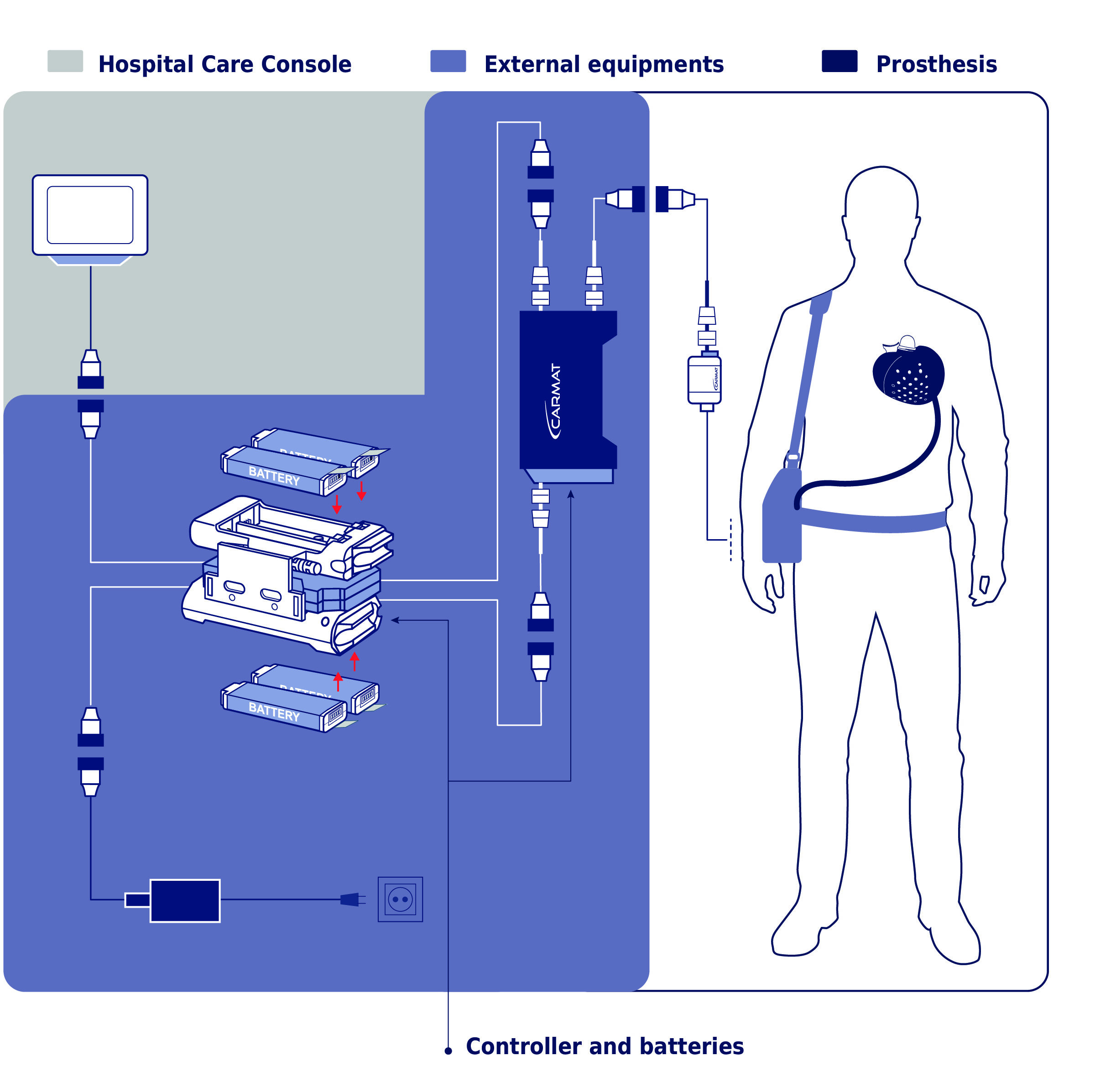
The artificial heart-Aeson- is composed of 3 parts:

One motor pump group composed of 2 micro pumps that push the actuator fluid to the membranes and generate the systole and diastole.

2 ventricles chambers, separated into two parts by a membrane, one for the blood and one for the actuator fluid. The blood-contacting layer of this membrane is made of biocompatible materials.

Embedded electronics, microprocessors and integrated sensors allowing autoregulated responses to the patient physiological needs.

One flexible external bag contained the actuator fluid.

4 biological valves at the inlet and outlet providing unidirectional pulsatile blood flow.

2 outlet conduits allowing to connect the prosthesis to the pulmonary artery and aorta.

One percutaneous driveline connecting the prosthesis to external components.

External equipment: It provides the mobility and autonomy needed to lead a near-normal life. It weighs 4 kg and includes a controller and two battery pockets providing an autonomy of approximately 4 hours.

The hospital care console: The medical team uses the hospital care console (HCC) to operate the prosthesis during implantation and track/monitor how the device is functioning.

The post French company announces first implant of its artificial heart in a woman appeared first on ARY NEWS.


from ScienceTechnology – ARY NEWS https://ift.tt/39mBDXx https://ift.tt/3CCAish
21 Sep 2021

French company announces first implant of its artificial heart in a woman

French artificial heartmaker Carmat announced on Tuesday that it had carried out the first implant of its Aeson artificial heart in a woman.

The company said the procedure had been performed at the UofL Health – Jewish Hospital by University of Louisville physicians in the United States.

“This third implant in the U.S. was a landmark event not only because it allowed us to finalize the enrollment of the first cohort of patients of the EFS (early feasibility study), but very importantly because it is the first time ever that our device has helped a woman suffering from heart failure,” Carmat CEO Stephane Piat said in a statement.

The artificial heart-Aeson- is composed of 3 parts:

One motor pump group composed of 2 micro pumps that push the actuator fluid to the membranes and generate the systole and diastole.

2 ventricles chambers, separated into two parts by a membrane, one for the blood and one for the actuator fluid. The blood-contacting layer of this membrane is made of biocompatible materials.

Embedded electronics, microprocessors and integrated sensors allowing autoregulated responses to the patient physiological needs.

One flexible external bag contained the actuator fluid.

4 biological valves at the inlet and outlet providing unidirectional pulsatile blood flow.

2 outlet conduits allowing to connect the prosthesis to the pulmonary artery and aorta.

One percutaneous driveline connecting the prosthesis to external components.

External equipment: It provides the mobility and autonomy needed to lead a near-normal life. It weighs 4 kg and includes a controller and two battery pockets providing an autonomy of approximately 4 hours.

The hospital care console: The medical team uses the hospital care console (HCC) to operate the prosthesis during implantation and track/monitor how the device is functioning.

The post French company announces first implant of its artificial heart in a woman appeared first on ARY NEWS.


from ScienceTechnology – ARY NEWS https://ift.tt/39mBDXx https://ift.tt/3CCAish
21 Sep 2021

Slack releases Clips video tool, announces 16 Salesforce integrations

Slack has been talking about expanding beyond text-based messaging for some time. Today at Dreamforce, the Salesforce customer conference taking place this week, it announced Clips, a way to leave short video messages that people can watch at their leisure.

Slack CEO Stewart Butterfield sees Clips as a way to communicate with colleagues when a full 30 minutes meeting isn’t really required. Instead, you can let people know what’s going on through a brief video. “Clips are a way to record yourself on your screen. And the idea is that a lot of the meetings shouldn’t require us to be together in real time,” Butterfield said at a Dreamforce press event yesterday.

He added that these video clips provide more value because you can still get the point that would have been delivered in a full meeting without having to actually attend to get access to that information. What’s more, he says the videos create an audit trail of activity for archival purposes.

“It’s easily shareable with people who weren’t in attendance, but [still] get the update. It’s available in the archive, so you can go back and find the answers to questions you have or trace back the roots of a decision,” he said. It’s worth noting that Slack first introduced this idea last October, and announced an early customer beta last March, at which point they hadn’t even named it yet.

He admitted that this may require people to rethink how they work, and depending on the organization that may be harder in some places than others, but he believes that value proposition of freeing up employees to meet less and work more will eventually drive people and organizations to try it and then incorporate into the way that they work.

Clips builds on the Huddles tool released earlier this year, which is a way via audio to have serendipitous water cooler kinds of conversations, again as a way to reduce the need for a full-fledged meeting when people can get together for a few minutes, resolve an issue and get back to work. Butterfield says that Huddles has had the fastest adoption of any new capability since he first launched Slack.

In March, in a Clubhouse interview with SignalFire investor Josh Constine (who is also a former TechCrunch reporter), Butterfield said that the company was also working on a Clubhouse tool for business. The company did not announce any similar tool this week though.

The company also announced 16 integrations with Salesforce that span the entire Salesforce platform. These include the sales-focussed deal room and the customer support incident response called swarms announced earlier this month, as well as new connections to other tools in the Salesforce family of product including Mulesoft and Tableau and industry-specific integrations for banking, life sciences and philanthropy.

In case you had forgotten, Salesforce bought Slack at the end of last year in a mega deal worth almost $28 billion. Today, as part of the CRM giant, the company continues to build on the platform and product roadmap it had in place prior to the acquisition, while building in integrations all across the Salesforce platform.

21 Sep 2021

PayPal launches its ‘super app’ combining payments, savings, bill pay, crypto, shopping and more

PayPal has been talking about its “super app” plans for some time, having recently told investors its upcoming digital wallet and payments app had been given a go for launch. Today, the first version of that app is officially being introduced, offering a combination of financial tools including direct deposit, bill pay, a digital wallet, peer-to-peer payments, shopping tools, crypto capabilities and more. The company is also announcing its partnership with Synchrony Bank for its new high-yield savings account, PayPal Savings.

These changes shift PayPal from being largely a payments utility that’s tacked on other offerings here and there, to being a more fully fleshed out finance app. Though PayPal itself doesn’t aim to be a “bank,” the new app offers a range of competitive features for those considering shifting their finances to neobanks, like Chime or Varo, as it will now also include support for paycheck Direct Deposits through PayPal’s bank partners, bill pay and more.

By enabling direct deposit, PayPal users can get paid up to two days earlier, which is one of the bigger draws among those considering digital banking apps over traditional banks.

In addition to shifting their paychecks to Payal, customers’ PayPal funds can then be used for things that are a part of daily life, like paying their bills, saving or shopping, for example.

The enhanced bill pay feature lets customers track, view and pay bills from thousands of companies, including utilities, TV and internet, insurance, credit cards, phone and more, PayPal says. When bill pay first arrived earlier this year, it offered access to (single-digit) thousands of billers. Now, it will support around 17,000 billers. Customers can also discover billers through an improved, intelligent search feature, set reminders to be notified of upcoming bills and schedule automatic payments for bills they have to pay on a regular basis. The bills don’t have to only be paid from funds currently in the PayPal account, but can be paid through any eligible funding source that’s already linked to their PayPal account.

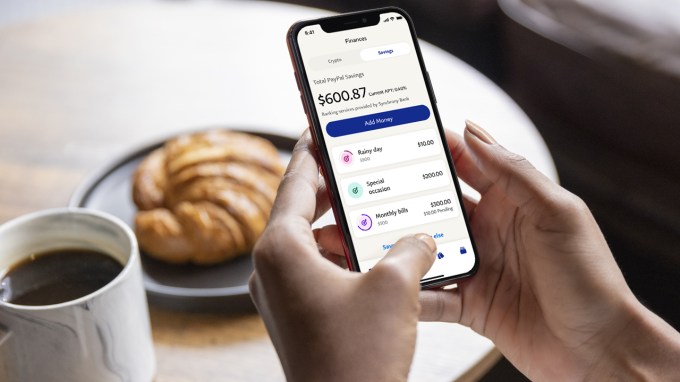
Via a Synchrony Bank partnership, PayPal Savings will offer a high-yield savings account with a 0.40% Annual Percentage Yield (APY), which is more than six times the national average of 0.06%, the company says. However, that’s lower than top rivals in the digital banking market offer, like Chime (0.50%), Varo (starts at 0.20%, but users can qualify to get 3.00% APY), Marcus (0.50%), Ally (0.50%), ONE (1.00% or 3.00% on Auto-Save transactions), and others. However, the rate may appeal to those who are switching from a traditional bank, where rates tend to be lower.

PayPal believes its high-yield offering will be able to compete not based on the APY alone, but on the strength of its combined offerings.

Image Credits: PayPal

“We know that about half of customers in the United States don’t even have a savings account, much less one with a very competitive rate,” notes PayPal SVP of Consumer, Julian King. “So all in all, we think that by bringing together the full set of solutions on the platform, it’s a really competitive offering for an individual.”

The app has also been reorganized to accommodate the new features and those yet to come.

It now features a personalized dashboard offering an overview of the customer’s account. The wallet tab lets users manage Direct Deposits and connect funding sources like bank accounts and debit and credit cards alongside the ability to enroll in PayPal’s own debit, credit and cash cards. And a finance tab provides access to the high-yield savings and the previously available crypto capabilities, which allows users to buy, hold and sell Bitcoin, Ethereum, Bitcoin Cash and Litecoin.

The payments tab, meanwhile, will hold much of PayPal’s traditional feature set, including peer-to-peer payments, international remittances, charitable and nonprofit giving, plus now bill pay and a two-way messaging feature that allows users to request payments or say thank you after receiving a payment — whether that’s between friends and family or between merchants and customers. This addition could bring PayPal more in line with PayPal-owned Venmo, which already offers the ability to add notes to payments and make comments.

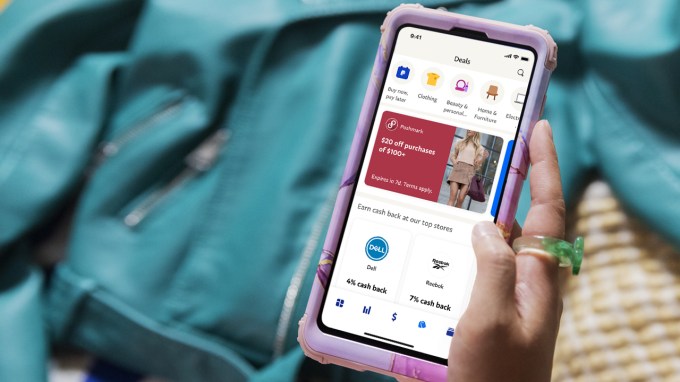
Messaging also ties into PayPal’s new Shopping hub, which is where the company is finally putting to good use its 2019 $4 billion Honey acquisition. Honey’s core features are now becoming a part of the PayPal mobile experience, including personalized deals and exclusive rewards.

Image Credits: PayPal

PayPal users will be able to browse the discounts and offers inside the app, then shop and transact through the in-app browser. The deals can be saved to the wallet for future use, so they can be applied if shopping later in the app or online. Customers will also be able to join a loyalty program, where they can earn cashback and PayPal shopping credit on their purchases. The company says these personalized deals will improve over time.

“We’ll use AI and [machine learning] capabilities to understand what kind of shopping deals are most interesting to customers and continue to develop that over time. They’ll just get smarter and smarter as the product gets more usage,” notes King. This will include using the data about the deals a customer likes, then bringing similar deals to them in the future.

Also new in the updated mobile app is the addition of PayPal’s crowdsourced fundraising platform, the Generosity Network, first launched late last year. The network is PayPal’s answer to GoFundMe or Facebook Fundraisers, by offering tools that allow individuals to raise money for themselves, others in need, or organizations like small businesses or charities. The network is also now expanding to international markets with Germany and the U.K. to start, with more countries to come.

As PayPal has said, the new app is laying the groundwork for other new products in the quarters to come. The biggest initiative on its roadmap is a plan to enter the investment space, to rival other mobile investing apps, like Robinhood. When this arrives, it will support the ability to buy stocks, fractional stocks and ETFs, PayPal says.

It will also later add support for paying with QR codes, like Venmo, and tools for using PayPal to save while in stores.

The updated app is rolling out starting today in the U.S. as a staggered release that will complete in the weeks ahead. However, PayPal Savings won’t be available immediately — it will arrive in the U.S. in the “coming months,” as will some of the shopping and rewards tools.