Year: 2021

05 Apr 2021

What happens to your NFTs and crypto assets after you die?

As consumers build their wealth, assets are typically tangible: cash, investments, property, cars, jewelry, art. But increasingly we’re adding a new type of asset to the mix: digital assets, whether in the form of cryptocurrency or a new asset class, NFTs.

We’re going through the biggest wealth transfer in history right now, with an estimated $16 trillion expected to change hands in the coming decades. While it’s easy to hand over the reins of a physical asset in the event of an emergency or death, it’s not as simple with digital assets.

A new Angus Reid study commissioned by Canadian online will platform Willful finds that only one in four consumers have someone in their life who knows all of their passwords and account details, which begs the question: Will consumers be prepared to pass on digital assets, or will billions in virtual goods be stuck in the digital ether?

While it’s easy to hand over the reins of a physical asset in the event of an emergency or death, it’s not as simple with digital assets.

Digital assets have been dominating the news cycle in 2021. While cryptocurrency isn’t new, it’s attracted a lot of attention in the past year because of its skyrocketing value, promotion from prominent figures like billionaire Elon Musk, and bitcoin offerings from traditional financial firms like Morgan Stanley. If you hold any type of cryptocurrency, the only way to access it is via a private key — typically a 64-digit passcode. No private key, no access to the virtual currency.

There have been many stories reported about people who purchased bitcoin and would be millionaires today if they hadn’t thrown out their hard drive or lost track of their key. One high-profile case is that of Gerald Cotten, the founder of cryptocurrency exchange Quadriga. When Cotten died in 2018, he took with him the private keys to over $250 million in client assets.

Consumers have also been inundated with stories about NFTs, or non-fungible tokens, which are digital assets hosted on the same blockchain that makes cryptocurrency possible. To most, it seems absurd that artist Beeple could sell a $69 million piece of art through a Christie’s auction, or that a virtual home in Toronto could sell for over $600,000, or that people would spend over $200 million trading virtual NBA highlights like we used to trade baseball cards. But this new asset class is proving that digital assets can be as valuable if not more valuable than physical assets — and similar to cryptocurrency, they likely require a private key to access them.

When someone dies, they either have a will that dictates how their assets will be distributed, or, if they die without a will, a government formula outlines how their assets will be divided. While a will outlines who should receive what, it typically doesn’t have an up-to-date asset list, nor does it contain passwords or access keys. There’s an estimated tens of billions in unclaimed assets sitting in banks today as a result of a family or executor not knowing about those accounts following an individual’s death.

But an executor can do due diligence by calling financial institutions to double-check whether the person held accounts and get access to those funds, which typically requires providing copies of the will and/or death certificate. With digital assets, it’s not as simple as calling the bank and finding out a relative had a valuable NFT. There’s no directory or central body that governs NFTs or cryptocurrency — it’s purposely decentralized, which is great for privacy but less than ideal for family members who want to figure out if someone held valuable digital assets.

And it’s not just about knowing digital assets exist — it’s about knowing how to access them. A recent study from the Angus Reid Forum, commissioned by Willful, showed that consumers under 35 are way less likely to have shared account access with loved ones (19% of those under 35 have shared account info, compared with 32% of those over 55). This makes sense, since the younger you are, the less likely you are to think about passing on assets after you die. But this tech-savvy younger demographic may leave their families in the lurch if something happens.

So what can consumers do to ensure their digital assets are protected? First, consider using a password manager like 1Password — which can store all of your account information, logins, private keys to digital assets and any other key information — and share the master access password with your executor or store it with your will.

While this can ensure easy access to your accounts in an emergency, Lee Poskanzer, the founder of Directive Communication Systems, says it can also put your family or executors at risk, highlighting that in many cases, website and app owners explicitly prohibit password sharing in their terms of service, and privacy laws in some jurisdictions prohibit account holder impersonation (in the U.S., that’s covered by the Stored Communications and Electronic Communications Privacy Act). Not to mention, accounts increasingly require two-factor authentication, which may not be easy to confirm if executors don’t have access to the person’s smartphone.

Directive Communication Systems’ platform helps manage the transfer of digital assets upon death, and Poskanzer says they don’t collect passwords for this reason. Instead, they work with the estate to provide content providers (Google, social media platforms, etc.) with required documentation, which can include a death certificate, obituary, ID or other documents. Upon meeting those requirements, which vary by company, content providers provide a data dump of an account’s contents, making them available via the cloud.

Second, consider using a digital wallet or exchange to store your digital assets — if your family has access to that, it may also include access to your private keys, depending on the wallet’s features, or the exchange itself may have a death-management process.

For example, Coinbase clearly outlines what an executor or family member can do to retrieve digital assets in case of the death of the account holder. As a backup, you can store your private key on a physical piece of paper and ensure it’s stored in a safe deposit box, fireproof safe or other safe place your executor can access in the event of your passing.

Third, create an up-to-date list of your assets that your executor and/or key family members have access to — this should include physical and digital assets, and should be reviewed and updated either annually or when you acquire a new asset or change financial institutions. Finally, create a will that clearly outlines how you want your assets to be distributed and provide specific instructions on how you want digital assets to be distributed.

Not only is this best practice to protect your assets of any kind and to appoint key roles like guardians for minor children, it will also likely be required in order to release any account contents (for example, Coinbase requires a copy of the will as part of its process to release funds to an estate).

As we go through this major wealth transfer between generations, it’s likely that banks, fintechs, crypto exchanges, social media platforms and other content providers will create clear death-management processes that make it easier to alert people about digital assets before you die and provide easy access instructions. But until that happens, following these steps means you can ensure your assets go to the people or organizations you want them to — and that they won’t be stuck in digital purgatory.
05 Apr 2021

The Supreme Court sided with Google in its epic copyright fight against Oracle

The highest court in the land has a lot to say about tech this week. The Supreme Court weighed in on Google’s long legal battle with Oracle on Monday, overturning a prior victory for the latter company that could have resulted in an $8 billion award.

In a 6-2 decision, the court ruled that Google didn’t break copyright laws when it incorporated pieces of Oracle’s Java software language into its own mobile operating system. Google copied Oracle’s code for Java APIs for Android, and the case kicked off a yearslong debate over the reuse of established APIs and copyright.

In 2018, a federal appeals court ruled that Google did in fact violate copyright law by using the APIs and that its implementation didn’t fall under fair use.

“In reviewing that decision, we assume, for argument’s sake, that the material was copyrightable. But we hold that the copying here at issue nonetheless constituted a fair use. Hence, Google’s copying did not violate the copyright law,” Justice Stephen Breyer wrote in the decision, which reverses Oracle’s previous win. Justices Samuel Alito and Clarence Thomas dissented.

“Google’s copying of the Java SE API, which included only those lines of code that were needed to allow programmers to put their accrued talents to work in a new and transformative program, was a fair use of that material as a matter of law,” Breyer wrote.

Google SVP of Global Affairs Kent Walker called the ruling, embedded below, a “big win for innovation, interoperability & computing.”

Click to access 18-956_d18f.pdf

05 Apr 2021

Fortnite users can now live stream gameplay to Houseparty’s social video app

Houseparty, the social video app acquired by Fortnite maker Epic Games in 2019, has just announced a major new step in terms of integrating these two properties: the company says it will now allow gamers to live stream their Fortnite gameplay directly into Houseparty. The feature works to allow users to share their gameplay with up to 9 other friends in a Houseparty room.

The addition follows Houseparty’s launch of a “Fortnite Mode” last November, which added a video chat feature to Fortnite where players could see live feeds from their friends while gaming, powered by Houseparty. Today’s launch is something of a reverse of that, as it lets players stream the game to friends, which is viewable inside Houseparty itself. This allows the users’ friends — including those who may not be Fortnite gamers themselves — to watch and and interact with the player.

To use the new feature, the Fortnite player will need have enabled Fortnite Mode Streaming and be connected to Houseparty. When they begin to stream their gameplay, their friends on Houseparty will be notified that their game feeds are now available to watch.

The Fortnite player can then see who is watching their stream via a graphic overlaid on their screen which shows their “watcher count.” This is represented by a little eye icon in the middle-left of the screen for the gamer, while Houseparty users will see the eye icon in the top-left of their video screen.

During the live stream, the player and their friends can watch and chat, as usual.

If the Fortnite player doesn’t want to live stream their gameplay, they can change this at any time from a setting inside Fortnite without losing their ability to use the video chat feature. Parents and guardians can also turn on and off Fortnite Mode and other privacy features inside Fortnite’s settings. The company notes that personal info will be blocked from streams, including payments information. However, The Lobby, your menus, and your gameplay can all be streamed when Fortnite Mode is enabled.

Houseparty had first gained traction as a way for friends to virtually “hang out” online through video chat, but ultimately sold to Epic Games shortly after the gaming giant had raised a massive $1.25 billion round. So far, Houseparty hasn’t given up on its other social features, even as it has become more closely integrated with Fortnite. The launch of the new feature creates potential for Houseparty to capture some of the more casual live streaming that today takes place on other platforms, like Twitch, Facebook or YouTube, where users aren’t necessarily streaming for fans, but rather for friends.

The company says the new feature won’t offer a record function for later exporting these live streams for publishing elsewhere, but notes that Fortnite already allows the ability to save replays.

At launch, Fortnite gameplay integration with Houseparty is available across PC and PlayStation only (PS4 and PS5). Epic Games didn’t say if or when other platforms would be supported. Houseparty users on iOS, Android and Chrome will be able to watch the live streams.

The previously launched video chat feature in Fortnite was also supported on PCs and PlayStations.

05 Apr 2021

Supreme Court tosses ruling that said Trump blocking Twitter critics was unconstitutional

The Supreme Court has vacated a previous ruling that found former President Trump violated the First Amendment by blocking his Twitter foes.

The ruling was upheld by a Manhattan federal appeals court in 2019, which deemed Trump’s actions unconstitutional. The court found that because Trump used Twitter to “conduct official business” and interact with the public that his decision to block users ran afoul of the First Amendment.

“… The First Amendment does not permit a public official who utilizes a social media account for all manner of official purposes to exclude persons from an otherwise open online dialogue because they expressed views with which the official disagrees,” a trio of judges wrote in that decision.

The Supreme Court’s decision to vacate the prior ruling isn’t a total surprise — Trump is no longer president and he’s banned from Twitter for life at this point.

What was unexpected was an accompanying opinion issued by Supreme Court Justice Clarence Thomas which pushed well beyond the issue at hand into novel criticisms of major tech platforms.

Thomas pivoted away from Trump’s Twitter behavior in the 12-page opinion, mounting an argument that the moderation powers of digital platforms like Twitter and Facebook are the real problem. “If the aim is to ensure that speech is not smothered, then the more glaring concern must perforce be the dominant digital platforms themselves,” Thomas wrote.

He went on to raise concerns about “concentrated control” of digital platforms by a handful of decision makers, arguing that digital platforms exercise too much power in making moderation decisions. “Much like with a communications utility, this concentration gives some digital platforms enormous control over speech,” Thomas wrote.

Thomas’s opinion Monday echoed his previous arguments that the protections conferred to digital platforms by Section 230 of the Communications Decency Act should be “pared back” and interpreted far more narrowly.

With Democrats at the wheel in Congress, some Republicans have shifted their criticisms of big tech away from its moderation powers and toward other issues, like how those services affect mental health. But the suite of grievances stirred up over the course of Trump’s four years in office lives on in Supreme Court Justice Clarence Thomas.

In January, Thomas’s wife Ginni Thomas, a fervent Trump supporter, faced criticism for cheering on the pro-Trump crowd that went on to violently invade the U.S. Capitol.

Thomas was not joined by other justices in his opinion, but his interest in tech’s moderation decisions is a signal that the issue is far from dead.

“We will soon have no choice but to address how our legal doctrines apply to highly concentrated, privately owned information infrastructure such as digital platforms,” he warned.

05 Apr 2021

Fueled by pandemic, contactless mobile payments to surpass half of all smartphone users in U.S. by 2025

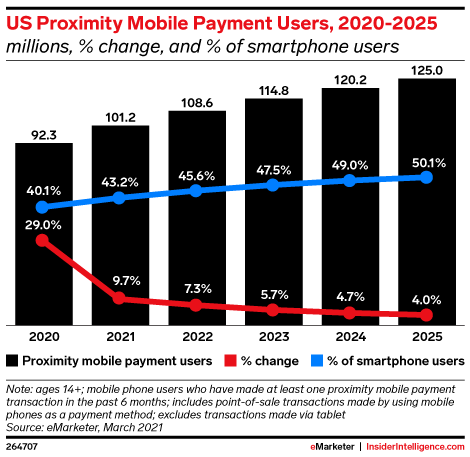
Among other technology trends accelerated by the Covid-19 pandemic, the use of contactless mobile payments boomed in 2020. According to a recent report by analyst firm eMarketer, in-store mobile payments usage grew 29% last year in the U.S., as the pandemic pushed consumers to swap out cash and credit cards for the presumably safer mobile payments option at point-of-sale.

Last year, 92.3 million U.S. consumers age 14 or older used proximity-based mobile payments at least one time during a 6-month period in 2020 — a figure the firm expects to grow to reach 101.2 million this year. And that usage is now on track to surpass half of all smartphone users by 2025, eMarketer forecasts.

Image Credits: eMarketer

Adoption last year was largest among younger consumers, including Gen Z and millennials. The former is expected to account for more than 4 million of the total 6.5 million new mobile wallet users per year from 2021 to 2025. Millennials, meanwhile, will continue to account for around 4 in 10 mobile wallet users.

Several industry reports had already noted the pandemic impacts on the mobile wallet industry in general, with one from earlier this month by finance and investment company Finaria estimating that the industry would grow 24% from last year to reach $2.4 trillion in 2021. It had said that while Asian markets and particularly China had been leading the way in mobile payments adoption, the U.S. had earlier struggled due to the slow rollout of mobile payment technologies by retail stores. But now, the U.S. has grown to become the second-largest market with $465.1 billion worth of mobile payment transactions, which will grow to $698 billion in 2023.

The pandemic had pushed lagging retailers to finally get on board with mobile payments. A mid-year survey published in 2020 by the National Retail Federation and Forrester, found that no-touch payments had increased for 69% of retailers, and that 67% now accept some form of contactless payment, including both mobile payments and contactless cards.

Image Credits: eMarketer

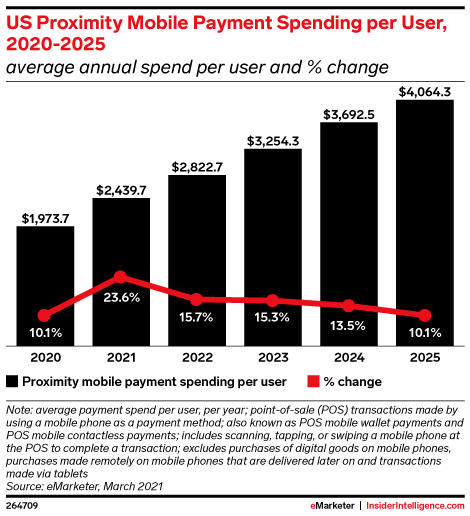
As a result of the industry changes, eMarketer reports that not only has mobile wallet usage increased, the average annual spend per user is increasing, as well. The firm predicts that figure will grow 23.6% from ~$1,973.70 in 2020 to $2,439.68 in 2021, and will surpass $3,000 by 2023.

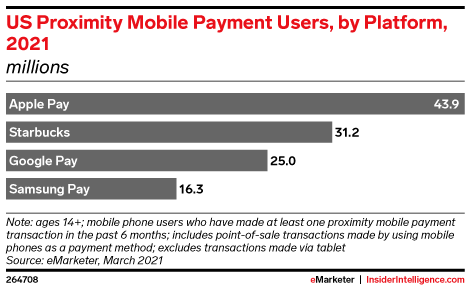
In the U.S., Apple Pay remains the top mobile payment player with 43.9 million users in 2021, growing by 14.4 million between 2020 and 2025 — more than its competitors. Starbucks will remain the No. 2 player with 31.2 million users, followed by Google Pay, which will add 10.2 million users during that time frame. Samsung Pay, meanwhile, is seeing stagnant growth, adding just 2 million more users between 2020 and 2025.

Image Credits: eMarketer

05 Apr 2021

Digging into the Alkami Technology IPO

It appears that the slowdown in tech debuts is not a complete freeze; despite concerning news regarding the IPO pipeline, some deals are chugging ahead. This morning, we’re adding Alkami Technology to a list that includes Coinbase’s impending direct listing and Robinhood’s expected IPO.


The Exchange explores startups, markets and money. Read it every morning on Extra Crunch, or get The Exchange newsletter every Saturday.


We are playing catch-up, so let’s learn about Alkami and its software, dig into its backers and final private valuation, and pick apart its numbers before checking out its impending IPO valuation. After all, if Kaltura and others are going to hit the brakes, we must turn our attention to companies that are still putting the hammer down.

Frankly, we should have known about Alkami’s IPO sooner. One of a rising number of large tech companies based in non-traditional areas, the bank-focused software company is based in Texas, despite having roots in Oklahoma. The company raised $385.2 million during its life, per Crunchbase data. That sum includes a September 2020 round worth $140 million that valued the company at $1.44 billion on a post-money basis, PitchBook reports.

So, into the latest SEC filing from the software unicorn we go!

Alkami Technology

Alkami Technology is a software company that delivers its product to banks via the cloud, so it’s not a legacy player scraping together an IPO during boom times. Instead, it is the sort of company that we understand; it’s built on top of AWS and charges for its services on a recurring basis.

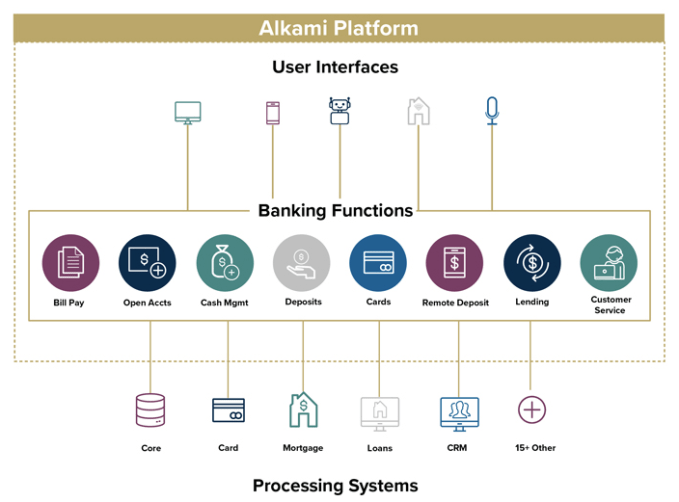
The company’s core market is all banks smaller than the largest, it appears, or what Alkami calls “community, regional and super-regional financial institutions.” Its service is a software layer that plugs into existing financial systems while also providing a number of user interface options.

In short, it takes a bank from its internal systems all the way to the end-user experience. Here’s how Alkami explained it in its S-1/A filing:

Image Credits: Alkami S-1

Simple enough!

05 Apr 2021

Knotel co-founder leaves company, describes investor Newmark as ‘a stalking horse’

Earlier this year, we covered the demise of flexible workspace operator Knotel.

The once high-flying startup had just announced it had filed for bankruptcy and that its assets were being acquired by investor and commercial real estate brokerage Newmark for a reported $70 million.

It was a hard fall for a company that just one year prior had been valued at $1.6 billion.

It was hard to pinpoint exactly the beginning of the end for Knotel, which had raised about $560 million in funding. Some said the pandemic was the nail in Knotel’s coffin, while others pointed out the proptech was already in trouble before the pandemic hit, facing a number of lawsuits and evictions.

Then this past weekend, Knotel co-founder Amol Sarva shed some more light on the situation — essentially publicly trashing Newmark, which had co-led the startup’s $70 million Series B in 2018.

In a letter that he emailed to an unspecified group of people, Sarva points out that the company had reached “nearly $400mm of run rate in early 2020, posted gross profit, and even kept more than 2/3 of revenue intact while doing everything we could to support customer continuity and work with landlord partners amicably.”

He went on to describe Newmark as “a stalking horse” that used bankruptcy to take control of Knotel with around $100 million of new capital. That process, he said, undermined important relationships and “hurt lots of customers and partners.”

“I’m so disappointed that this was the direction pressed. The process made clear to me that I would not choose to be part of the new owners’ way of moving forward,” Sarva continued.

He further criticized Newmark, saying the brokerage has hired “a group of Adam Neuman-era (sic) WeWork bros to lead the company forward.”

Newmark had not yet responded to a request for comment at the time of writing. While it’s safe to say that Sarva is bitter about the way things turned out, it would be interesting to know exactly at what point he came to this conclusion.

He did say that he’s heading back to the lab where Knotel was invented originally, as co-founder/CEO of Knote.

05 Apr 2021

Start your engines, TechCrunch is (virtually) headed to Detroit

Thanks to a warm welcome from Miami, our first City Spotlight was a big success. We met investors and entrepreneurs who are working on amazing things, and we were proud to share their personal stories on why Miami is the right city for them to live and do business.

Join us on our next (virtual) field trip to Southeast Michigan. All lights will be shining on the Motor City.

Why Detroit? This is where StockX and Rivian call home, along with a growing stable of medical technology companies, fintech startups and security companies. The area is quickly transforming thanks to active investors, a low cost of living and access to amazing universities that have a long history of supporting entrepreneurs.

If you’re interested in what’s happening in Detroit in general, are seeking out a new up-and-coming city to live in, looking for cool companies and talented founders to invest in, then you’ll want to register and drop Thursday April 15 on your calendar.

Here’s just some of what you can expect:

  • Networking: It’s what you can always count on us for. Companies are started and deals get done at TechCrunch events (yes, even the virtual ones!)
  • Panels: Meet the movers and shakers up close and personal. Hear about their journey, ask them questions and find out what’s special to them about Detroit.
  • Pitch-off: Detroit startups, submit your decks. Take part in our first Detroit pitch-off and be crowned champion.

We want to hear from everyone who lives in the birthplace of techno, and we’re looking to you for suggestions of folks who should be getting all of the attention we can throw at them on the 18th.

It’s going to be one to remember and the perfect setup for the day we can once again do this all in-person.

05 Apr 2021

The StockX EC-1

Societies are defined by their markets. What people value, what they actually buy, how they transact and who they purchase from determine not just the goods in their possession, but the very society and culture they construct. It might seem that after thousands of years of evolution and refinement, concepts like quality, authenticity, value and price would be static. Nothing could be further from the truth.

StockX is a unique company at the nexus of two radical transitions that isn’t just redefining markets, but our culture as well. E-commerce upended markets, diminishing the physical experience by intermediating and aggregating buyers and sellers through digital platforms. At the same time, the internet created rapid new communication channels, allowing euphoria and desire to ricochet across society in a matter of seconds. In a world of plenty, some things are rare, and the hype around that rarity has never been greater. Together, these two trends demanded a stock market of hype, an opportunity that StockX has aggressively pursued.

It’s a foundational new category of market — and a lucrative one. Now valued at $2.8 billion, StockX has facilitated over 10 million transactions. Its online-only marketplace is used for buying and selling sneakers, streetwear, electronics, collectibles, handbags and watches that are primarily sneaker and streetwear culture-adjacent, are in high demand and only available in low quantities. Sellers post their asking price and buyers share the price they want to pay anonymously. The platform makes all transactional data completely available to anyone that visits the site, and it authenticates every product by hand, acting as a safeguarded, price-regulating middleman.

It’s Amazon, but not exactly. It’s an auction, but not really. It conveys values like a stock market, but unlike the New York Stock Exchange, the company is defined less by financial instruments than its method of connecting buyers and sellers. It’s a local store with vetted products, but online and global. In short, it’s a unique marketplace that requires careful analysis of not just the cultural context it operates in, but the economics and incentives of the players on both sides.

TechCrunch’s writer and analyst for this EC-1 is Rae Witte. She has written extensively on technology, business and culture for publications like TechCrunch as well as the Wall Street Journal, Vogue Business and our corporate sister publication Engadget. She’s followed the rise of StockX since nearly its founding, and is in a lead position to tell this nuanced story. The lead editor for this package was Danny Crichton, the assistant editor was William E. Ketchum III, the copy editor was Richard Dal Porto and illustrations were created by Nigel Sussman.

StockX had no say in the content of this analysis and did not get advance access to it. Witte has no financial ties to StockX or other conflicts of interest to disclose.

The StockX EC-1 comprises four main articles numbering 11,700 words and a reading time of 47 minutes. Let’s take a look:

  • Part 1: Origin storyHow StockX became the stock market of hype” (2,500 words / 10 minute reading time) — Investigates how StockX evolved from a basic aggregation of price data into the multibillion dollar juggernaut we see today.
  • Part 2: E-commerce authenticationAuthentication and StockX’s global arms race against fraudsters” (3,700 words / 15 minute reading time) — A deeply nuanced analysis of StockX’s key product of authentication and the challenges of building a trusted market against an onslaught of scammers heavily incentivized to get a fake good sold.
  • Part 3: Competitive and consumer landscape Where StockX fits in the business of sneakers” (2,800 words / 11 minute reading time) — Explores how the company connected buyers and sellers, as well as its long-term impact on both groups.
  • Part 4: Future and impact The consequences of scaling up sneaker culture” (2,700 words / 11 minute reading time) — Looks at how StockX and the changes it has wrought have led to a massive change in the culture of sneakers and what that portends long term.

We’re always iterating on the EC-1 format. If you have questions, comments or ideas, please send an email to TechCrunch Managing Editor Danny Crichton at danny@techcrunch.com.

05 Apr 2021

How StockX became the stock market of hype

While the old adage goes, “Find a job you love doing, you’ll never work a day in your life,” it’s safe to assume this was well before the age of the YouTuber, “plandids” and the stock market of things. StockX may be a multibillion dollar juggernaut with massive influence radiating throughout sneaker culture today, but it started with taking the leap to transforming a personal passion into a business plan.

For founder Josh Luber, keeping his love for sneakers separate from his career was very intentional at first. As he continued to invest into his hobby, he saw something from his corporate jobs that was altogether missing from sneakers — data. As he established and dove deeper into the numbers, an entirely different vision arose. A basketball game, a check and a business later, StockX was born.

What began as a basic price chart of online sales that screamed more Microsoft Excel than startup unicorn has now become one of the most intriguing marketplaces in the world.

The timing was remarkably fortuitous. Sneakers crescendoed from a rising niche to a frenzy over the past decade, and the demand for authenticated goods likewise soared. Few other companies put together the core mechanisms required for a market to function effectively for this category. What began as a basic price chart of online sales that screamed more Microsoft Excel than startup unicorn has now become one of the most intriguing marketplaces in the world.

What’s a sneaker worth?

Before co-founding StockX, Josh Luber was consulting at IBM, deliberately working outside of sneakers to maintain it strictly as a hobby. That setup continued until he realized the opportunity to organize data around his beloved collection.

Markets can’t exist without prices, and the price of a sneaker in the secondary market a decade ago was difficult to discern. There was, of course, the retail price, but popular sneakers often gained value over time based on demand, which could wildly fluctuate over time. By scraping data openly available on eBay for over 13 million transactions, Luber and a team of 17 volunteers established Campless, a constantly updated sneaker secondary market pricing guide that launched in 2012.

“While it had a lot of flaws in it and required a lot of manual work, it gave probably the best reference point at the time,” COO and co-founder of StockX Greg Schwartz says. The Campless team was simply pulling prices from closed eBay auctions and analyzing trends from there, much like any individual seller would probably do before posting their own shoes. By scaling up the size of the dataset though, they were getting much more accurate market-clearing prices than were previously available for both buyers and sellers.

Similar to the auto industry’s Kelley Blue Book that offers estimated values for cars by model and year, Campless offered in-depth numbers on the secondary sneaker market that would eventually become a tentpole and proprietary offering of StockX.

Helicopters over malls and the chaotic rise of the sneaker craze

When Luber and his team launched Campless, there weren’t easily accessible options for buying sneakers in limited releases. Enthusiasts could buy directly from the retailer by lining up and camping out for in-store drops, scour eBay for the most legit-looking seller with the best price, or have a plug or backdoor avenue to get their prized pairs. All three options were fraught.

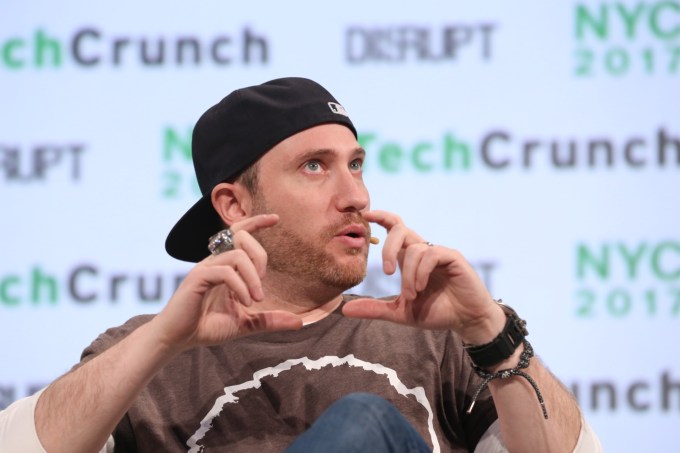
Josh Luber at TechCrunch Disrupt NY 2017.

Campless’ name and “know more, camp less” tagline referred to consumers camping out — sometimes spending days in line — for the latest, most coveted sneaker releases. Flight Club, which opened in New York City in 2005, was initially for consignment and typically carried rare, older shoes rather than new pairs. For individual resellers though, eBay and Craigslist were the only options to set up a one-on-one transaction at their own discretion, and neither platform had the necessary safeguards for sneaker authentication or price regulation.

This fractured system might have been sufficient for a market that remained a relatively small niche. But it had been steadily growing in popularity since the 1980s, and the scale got even bigger in the 2010s.

In a 2014 interview with eBay, Luber shared the significance of this period, pointing to one shoe as causing a sea change in the popularity of the category: the February 2012 NBA All-Star Weekend release of Nike’s “Galaxy” Foamposite, part of a celestial-themed pack worn by basketball greats like LeBron James, Penny Hardaway, Amar’e Stoudemire and Kevin Durant.

Trusted sneaker blog Sole Collector called this specific release “one of the most chaotic sneaker releases of the last decade” because it caused “riots nationwide as sneakerheads tried desperately to get their hands on pairs.”

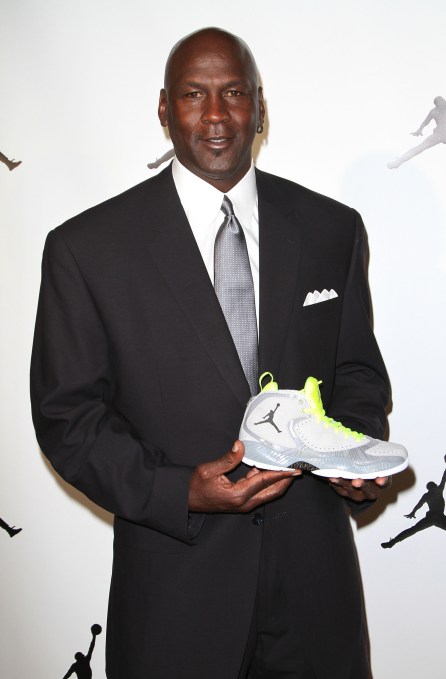
Michael Jordan attends Jordan All-Star With Fabolous 23 in 2012. Image Credits: Nike (Alexander Tamargo/WireImage)

“That was definitely the first time I remembered people other than my group of friends that loved shoes talking about a ‘drop,’” 24-year-old sneaker enthusiast Mark Sabino said.

Andy Oliver, director of e-commerce at the sneaker and streetwear lifestyle brand Kith, looks back on it as a tipping point as well. “I think it was a combination of the right model — Foams were super hot — with a graphics treatment that was really unique at the time. Then, from a marketing perspective, it’s tied to All-Star Weekend, which was a huge deal in 2012. When everyone started to get a sense that they were mostly unattainable, they blew up on another level.”

Brendan Dunne, co-host of Complex Media’s sneaker show Full Size Run, said the release set a new benchmark for chaos and hype. “I think the image of helicopters flying over the mall in Orlando where they released is the enduring image.”

A community that had been around since the 1980s was hurtled into the mainstream eye. Yet even more fuel was added to what Luber called “limited edition sneaker collecting” with the growing popularity of Instagram. For the first time, sneaker enthusiasts could share their favorites with the entire world, showing off their rare finds to potentially millions of people on their feeds and not just their friends in person. Securing that All-Star Weekend drop meant not just being cool, but globally cool, intensifying the pressure on a market that was completely unprepared for the scale of demand that was arriving.