Year: 2021

04 Mar 2021

This pan-African freelance platform is the first Zimbabwean startup backed by Techstars

On the 25th of January, Techstars Seattle announced its 12th class featuring 10 startups from different parts of the world. The accelerator, which has accepted only a handful of African startups, included one from Zimbabwe in this class.

AfriBlocks is a global pan-African marketplace of vetted African freelance professionals. The startup was founded by Tongayi Choto and Roger Roman in July 2020 and has offices in Harare and Los Angeles,.

The company is trying to address the high unemployment rate that plagues many African countries by making it easier for people to find work. Quite a number of international and local freelance websites exist to meet these needs. Still, according to CEO, Choto, most of them offer too many options with no adequate vetting process.

“It can be very hard to find African freelancers. If a customer is lucky enough to get past those hurdles and find a freelancer to work with, they often don’t have the proper collaboration tools to complete the project in a precise and timely manner,” he told TechCrunch.

In a global freelance market worth more than $800 billion, AfriBlocks says it is doing this different by equipping African freelancers with intuitive collaboration tools and a secure payment system that makes it easy to get remote contract projects completed

When a job is posted on its platform, the company claims that they save the customer the trouble of perusing thousands of freelancers profiles and portfolios. Instead, they use automation tools to match three freelancers who fit the user’s qualifications.

Also, AfriBlocks assigns a project manager to the selected freelancer who manages the project through completion. Once the job is complete, AfriBlocks collect a transaction fee, and the payment is released from escrow. This ensures that expectations are clear and deadlines are met for freelancers and customers

In addition, Choto says the company offers community and development resources that help them upskill and remain competitive in the global marketplace. This has been done in partnership with edtech company Coursera and African non-profit Ingressive for Good. It is also in talks with online learning platform, Datacamp, to do the same for data scientists.
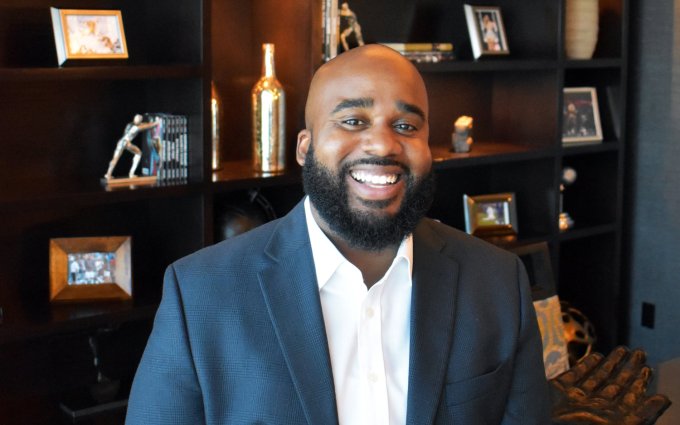
Roger Roman (co-founder)

As peculiar to most African startups, funding has been hard to come by for the team. Bootstrapping seemed like the only course of action to take, and it seems to have taken them far. In less than a year, the company has onboarded over 2,000 freelancers and more than 400 buyers. It has also completed up to 250 jobs generating over $60,000 in revenue. This progress has attracted the likes of Techstars and Google to provide them with funding and network.

“We’ve encountered the problems that many Black founders face, such as scarce fundraising sources. However, organizations like Techstars Seattle, Transparent Collective, and Google for Startups have helped us by providing mentorship, networking opportunities, and investor demo days showcases,” Roman said.

AfriBlocks joins African startups like Farmcrowdy, OnePipe, Risevest, Eversend, OjaExpress, who have participated in different Techstars accelerators worldwide.

Before AfriBlocks, Choto, who grew up in Zimbabwe, served as a product manager at BillMari, a pan-African remittance service leveraging bitcoin technology. For Roger, whose upbringing was on the westside of Chicago, he doubles as an active angel investor and a VC scout.

It is predicted that freelancers will account for as much as 80% of the entire workforce worldwide by 2030. Freelance work has become a viable source of employment and has shifted from being a vocation people engage in to supplement their income to being a full-time source of jobs for Africans.

The long term goal for AfriBlocks is to build the tech infrastructure for the future of work in Africa. According to the company, participating in Techstars is the right path to that destination.

“In anticipation of the impending global human talent shortage that could result in 85 million jobs being unfilled and the loss of $85 trillion annually, our long-term goal is to make Africa the global hub for technical and creative freelancers by providing the rails for companies to work in Africa and with remote African talent,” Choto said. 

04 Mar 2021

Bitfinex launches cryptocurrency payment gateway for merchants

Cryptocurrency exchange company Bitfinex is launching Bitfinex Pay, a cryptocurrency payment gateway. With this new product, online merchants can accept payments in various cryptocurrencies. It should make cross-border transactions easier in particular.

While there are a few crypto payment gateways already, Bitfinex Pay has the advantage of working seamlessly with the company’s exchange. Merchants can create a widget and start accepting payments in Ethereum and bitcoin. Payments are deposited on your exchange wallet.

Bitfinex’s widget works a bit like the “Buy Now with PayPal” button. When you click on the Bitfinex Pay button, you’re redirected to the cryptocurrency company’s website. Once your payment is approved, you’re redirected back to the original merchant website. Payments are capped at the equivalent of $1,000 in cryptocurrencies.

You don’t pay any fee with Bitfinex Pay transactions. Of course, there are some network fees involved with sending crypto tokens. Merchants will also end up paying fees if they want to convert their cryptocurrency holdings on the exchange and transfer fiat money out of their account.

Bitfinex Pay also lets you accept Tether payments. Tether is a stablecoin, which means that one unit of Tether is supposed to be worth one USD — it doesn’t fluctuate over time.

That statement has been challenged as the attorney general in New York has concluded that Tethers weren’t fully backed by USD sitting in bank accounts at all times. At some point, Bitfinex couldn’t access $850 million held in a Panamanian bank.

As a result, Tether and Bitfinex are currently banned in the state of New York. So you’ll have to determine whether you trust Bitfinex enough to use it as part of your checkout process on your website.

04 Mar 2021

GM, LG Chem studying the feasibility of a second battery cell plant in the U.S.

General Motors is exploring building a second U.S. battery cell manufacturing plant with its joint-venture partner Seoul, South Korea-based LG Chem.

If the plant moves forward, it would be the latest in a series of investments aimed at building out the auto giant’s portfolio of electric vehicles. The company’s joint venture with LG, Ultium Cells LLC, is already at work constructing a $2.3 billion battery cell manufacturing facility in Lordstown, Ohio.

The companies hope to have a decision on the factory in the first half of 2021, GM spokesman Dan Flores told TechCrunch. He declined to specify possible locations for the site but Tennessee is high on the list, according to reporting from the Wall Street Journal.

GM has set ambitious targets for decarbonizing its operations and pledged steep investments to get there. Through 2025 alone the company said it would bring thirty EV models across its brands to the global market and spend $27 billion on electrification and automated technology—a 35% increase from 2020 spending. By the mid-2030s, GM said its fleet will be all-EV.

“Clearly, with our commitment to an all-electric future, we will need a lot of battery cells,” Flores said.

He declined to comment on the ongoing shortage of battery cells, which has affected EV manufacturers Tesla and Nikola. President Joe Biden issued an executive order at the end of February instructing federal agencies to identify risks in the supply chains for batteries, semiconductors, and other critical items, including where supply chains are dependent on “competitor nations.”

GM CEO Mary Barra said in a virtual investor presentation last week that the battery shortage is one reason the company is investing in its own battery cell manufacturing. She alluded to plans to grow the company’s battery cell manufacturing operations but did not go into specifics.

“There’s more coming than we’ve announced already,” she said.

04 Mar 2021

SITS says its airline passenger system was hit by a data breach

Global air transport data giant SITS has confirmed a data breach involving passenger data.

The company said in a brief statement on Thursday that it had been the “victim of a cyberattack,” and that certain passenger data stored on its U.S. servers had been breached. The cyberattack was confirmed on February 24, after which the company contacted affected airlines.

SITA is one of the largest aviation IT companies in the world, said to be serving around 90% of the world’s airlines, which rely on the company’s passenger service system Horizon to manage reservations, ticketing, and aircraft departures.

But it remains unclear exactly what data was accessed or stolen.

When reached, SITA spokesperson Edna Ayme-Yahil declined to say what specific data had been taken, citing an ongoing investigation. The company said that the incident “affects various airlines around the world, not just in the United States.”

SITA confirmed it had notified several airlines — Malaysia Airlines; Finnair; Singapore Airlines; and Jeju Air, an airline in South Korea — which have already made statements about the breach, but declined to name other affected airlines.

In an email to affected customers seen by TechCrunch, Singapore Airlines said it was not a customer of SITA’s Horizon passenger service system but that about half a million frequent flyer members had their membership number and tier status compromised. The airline said that the transfer of this kind of data is “necessary to enable verification of the membership tier status, and to accord to member airlines’ customers the relevant benefits while traveling.”

The airline said passenger itineraries, reservations, ticketing, and passport data were not affected.

SITA is one of a handful of companies in the aviation market providing passenger ticketing and reservation systems to airlines, alongside Sabre and Amadeus.

Sabre reported a major data breach in mid-2017 affecting its hotel reservation system, after hackers scraped over a million customer credit cards. The U.S.-based company agreed in December to a $2.4 million settlement and to make changes to its cybersecurity policies following the breach.

In 2019, a security researcher found a vulnerability in Amadeus’ passenger booking system, used by Air France, British Airways, and Qantas among others, which made it easy to alter or access traveler records.

04 Mar 2021

Luxury air travel startup Aero raises $20M

Aero, a startup backed by Garrett Camp’s startup studio Expa, has raised $20 million in Series A funding — right as CEO Uma Subramanian said demand for air travel is returning “with a vengeance.”

I last wrote about Aero in 2019, when it announced Subramanian’s appointment as CEO, along with the fact that it had raised a total of $16 million in funding. Subramanian told me that after the announcement, the startup (which had already run test flights between Mykonos and Ibiza) spent the next few months buying and retrofitting planes, with plans for a summer 2020 launch.

Obviously, the pandemic threw a wrench into those plans, but a smaller wrench than you might think. Subramanian said that as borders re-opened and travel resumed in a limited capacity, Aero began to offer flights.

“We had a great summer,” she said. “We sold a lot of seats, and we were gross margin positive in July and August.”

The startup describes its offering as “semi-private” air travel — you fly out of private terminals, on small and spacious planes (Subramanian said the company has taken vehicles with 37 seats and retrofitted them to hold only 16), with a personalized, first-class experience delivered by its concierge team. Aero currently offers a single route between Los Angeles and Aspen, with one-way tickets costing $1,250.

Subramanian was previously CEO of Airbus’ helicopter service Voom, and she said she approached the company “very skeptically,” since the conventional wisdom in the aviation industry is that the business is all about “putting as many people into a finite amount of square footage” as possible. But she claimed that early demand showed her that “the thesis is real.”

“There is a set of people who want this,” she said. “Air travel used to be aspirational, something people got dressed up for. We want to bring back the magical part of the travel experience.”

After all, if you’re the kind of “premium traveler” who might already spend “thousands of dollars a night” on a vacation in Amangiri, Utah, it seems a little silly to be “spending hours trying to find the a low-cost flight out of Salt Lake City.”

Aero interior

Image Credits: Aero

Subramanian suggested that while demand for business travel may be slow to return (it sounds like she enjoyed the ability to fundraise without getting on a plane), the demand for leisure travel is already here, and will only grow as the pandemic ends. Plus, the steps that Aero took to create a luxury experience also means that it’s also well-suited for social distancing.

Speaking of fundraising, the Series A was led by Keyframe Capital, with Keyframe’s chief investment officer John Rapaport joining the Aero board. Cyrus Capital Partners and Expa also participated.

The new funding will allow Aero to grow its team and to add more flights, Subramanian said. Next up is a route between Los Angeles and Cabo San Lucas scheduled to launch in April, and she added that the company will be returning to Europe this year.

“It’s a horrendous time to be Lufthansa, but counterintuitively, it’s best time to start something from scratch,” she said — in large part because it’s been incredibly affordable to buy planes and other assets.


04 Mar 2021

Unraveling ThredUp’s IPO filing: Slow growth, but a shifting business model

Another day, another venture-backed IPO filing. Today it’s ThredUp, a used-goods marketplace that is approaching the public markets in the wake of Poshmark’s own strong debut.

Both companies have a related market focus, albeit different approaches to selling used goods. Poshmark allows users to sell clothing items through its app. ThredUp, in contrast, acquires goods from users and sells them itself.


The Exchange explores startups, markets and money. Read it every morning on Extra Crunch, or get The Exchange newsletter every Saturday.


But while Poshmark had profits to brag about in its own IPO filing, ThredUp does not and is also growing more slowly, expanding revenues just 13.6% in 2020. Reading its S-1 filing, it’s clear ThredUp did not have the best 2020, thanks in part to COVID-19.

This morning, let’s get into the numbers posted by the company backed by Trinity Ventures, Redpoint, Highland Capital Partners and Goldman Sachs to decide if it’s just merely to catch Poshmark’s wave, or if its business is a fine machine in its own right.

ThredUp’s model

To understand ThredUp’s business, we have to get into the mechanics of how it sells things. The company has two methods: direct sales and consignment. In the former, ThredUp buys goods and sells them. It then “recognize[s] revenue on a gross basis” and generates gross profit after deducting “inventory cost, inbound shipping and inventory write-downs, as well as outbound shipping, outbound labor and packaging costs.”

That is the model that ThredUp is leaving behind. After shifting to “primarily consignment sales” in 2019, the company’s business has skewed sharply in that direction. Consignment works by having consumers send ThredUp their goods, which it holds, and perhaps sells, remitting to the user a portion of the sale price. The method reduces write-downs and boosts gross margins.

Consignment sales at ThredUp “recognize revenue net of seller payouts,” deducting “outbound shipping, outbound labor and packaging costs” to reach gross profit results.

The revenue-mix focus change can be seen in how ThredUp generated gross profit in 2018, 2019 and 2020. In those years, consignment gross profit came to 38%, 67% and 81% of total gross profit. ThredUp’s business today is effectively a large, digital consignment effort.

What impact has that shift had on the company’s financial health? Let’s find out.

ThredUp’s growth

ThredUp posted $129.6 million in 2018 revenue, a figure that grew to $163.8 million in 2019 and $186.0 million in 2020. The company’s growth slowed from 26.4% in 2019 to 13.6% in 2020, a sharp deceleration. But at the same time, the portion of ThredUp revenues that came from consignment sales grew to 74% from 60%. Did that change have a material impact on the company’s gross margins, thus rendering its slow growth more palatable?

Not really. The company’s gross margins came to 68.7% in 2019 and 68.9% in 2020. That’s about as flat as Texas. And notably the number stayed flat despite the company noting that consignment revenues had stronger gross margins in 2019 and 2020 (77% and 75%, respectively) than its other model (57% and 51%, respectively).

04 Mar 2021

Snapcommerce raises $85M to make over your mobile shopping experience

People are not only shopping digitally more than ever. They’re also shopping using their mobile phones more than ever.

And for mobile-first companies like Snapcommerce, this is good news.

Snapcommerce, formerly known as SnapTravel, has raised $85 million in what the company is describing as a “Pre-IPO” growth round to help further its mission of “changing the way people shop on their phones.”

The Toronto, Ontario-based startup has built out an AI-driven, vertical-agnostic platform that uses messaging in an effort to personalize the mobile shopping experience and “deliver the best promotional prices.” While it was initially focused on the travel industry, the company is now branching out into other consumer verticals – hence its name change.

Inovia Capital and Lion Capital co-led the new growth round, which included participation from Acrew DCF, Thayer Ventures, Full In Partners as well as existing backers Telstra Ventures and Bee Partners. The financing brings Snapcommerce’s total raised since its 2016 inception to over $100 million. Its last raise — a $7.2 million round from Telstra and NBA star Steph Curry — took place in 2019.

The startup was founded by tech entrepreneurs Hussein Fazal, whose prior company AdParlor grew to $100+ million in revenue, then sold to AdKnowledge back in 2011; and Henry Shi, who previously built uMentioned and worked at Google, where he helped launch YouTube Music Insights, according to previous TechCrunch reporting.

Snapcommerce co-founders Henry Shi and Hussein Fazal, Image courtesy of Snapcommerce

Snapcommerce launched its first, travel-focused product in 2017. It works by using chatbots to interact with customers via messaging apps such as SMS, Facebook and Whatsapp. But the company also has human agents ready to help if people need more assistance, in the past essentially serving as on-demand travel agents.

Its service is not just for hotels and flights, but also to help people book restaurants and activities too.

“Our focus has been on building that personal relationship,” Fazal said. “Many people end up coming back to us when they travel again.” In fact, over 40% of its sales in 2020 came from repeat customers.

Over the years, the company claims to have helped more than 10 million users globally save over $75 million. It expects to cross over $1 billion in total mobile sales this year.

And now it’s ready to branch out into helping consumers save money on goods.

“When shopping, it’s hard to find the right product and even if you do, it’s hard to find a good deal,” he said. “On a desktop, there’s ways around it. But on mobile, it’s virtually impossible.”

The company turned the corner to profitability three months into the pandemic in 2020, seeing a 60% spike in sales in the second half of the year compared to H2 2019, according to CEO Fazal.

It then decided to re-invest its profits to continue growing the business.

“The profitability during the pandemic gave us confidence that we could turn to profitability whenever we needed to and gave us control of our own destiny, which enabled this fundraise,” Fazal told TechCrunch. “The third quarter of 2020 ended up being our greatest quarter ever.”

The COVID-19 pandemic, naturally, only accelerated its growth as more consumers turned to mobile.

“We believe the next wave of power purchasers will be via mobile,” Fazal said. “Some of the new generation don’t even have desktops or laptops, and they spend all their time on their mobile phone and messaging. So we’re able to be at the forefront.” 

Snapcommerce has an IPO in its sights although no specific timeline. The company did not reveal its current valuation or hard revenue figures. The company makes money by either marking up prices provided by a merchant or charging the merchant a commission.

Chris Arsenault, partner at Inovia and Snapcommerce lead investor, said his firm “tripled up” on its investment in the startup after witnessing its success in the travel space.

“Other companies out there only care about the transaction, and force consumers to look through several services to see if they got the best price, all the while telling them ‘there’s only 2 seats left,’ ” he told TechCrunch. “We believe that consumers aren’t going to accept that type of pressure-selling in the future. And Snapcommerce’s ability to build trust with its customers and service providers has attracted us to them as they are defining what the future of commerce is going to be like.”

Ultimately, the company plans to use its fresh capital to continue to scale with the goal of streamlining the entire mobile search, purchase and fulfillment process and make finding “the right item at the right price as sending a message to a trusted friend.”

04 Mar 2021

Papaya Global raises $100M more at a $1B+ valuation for tools to hire, pay and manage distributed workforces

Remote working — hiring people further afield and letting people work outside of a central physical office — is looking like it will be here to stay, and today one of the startups building tools for that environment is announcing a big fundraise in response to the opportunity.

Papaya Global, an Israeli startup that provides cloud-based payroll and hiring, onboarding and compliance services across 140 countries for organizations that employ full-time, part-time, and contract workers outside of their home country, has picked up $100 million in funding and has confirmed that its valuation is now over $1 billion.

The company targets organizations that not only have global workforces, but are expanding their employee bases quickly. They include fast-growing startups like OneTrust, nCino and Hopin (which today announced a monster $400 million round), as well as major corporates like Toyota, Microsoft, Wix and General Dynamics. Papaya is not disclosing revenue numbers but said that sales have grown 300% year-over-year for each of the last three years.

Led by GreenOaks Capital Partners, this Series C also includes significant participation from IVP Ventures and Alkeon Capital. Previous backers Insight Venture Partners, Scale Venture Partners, Bessemer Venture Partners, Dynamic Loop, New Era and Workday Ventures, Access Ventures and Group 11 also chipped in. The new investment brings Papaya’s total funding to $190 million.

Papaya has been on a fundraising tear in the last 18 months. Today’s news comes less than six months after it raised a $40 million Series B. And that round came less than a year after a $45 million Series A.

Why so much, so quickly? Partly because of the demands on the business, but possibly also to capitalize on an opportunity at a time when so many others are also going after it at the same time.

The opportunity is that companies and other organizations are finding themselves needing tools to address the current state of play: workforce growth today doesn’t look like it did in 2019, and so incumbent solutions like ADP, or cobbled together solutions covering multiple geographies, either don’t cut it, or are too costly to maintain. Papaya Global, in contrast, says it has built an AI-based platform that automates a lot of work and removes much of the manual activity comes out of trying to right-size a lot of legacy payroll products to work in new paradigms.

“The major impact of COVID-19 for us has been changing attitudes,” CEO Eynat Guez, who co-founded the company with Ruben Drong and Ofer Herman, told me in an interview last September. “People usually think that payroll works by itself, but it’s one of the more complex parts of the organization, covering major areas like labor, accounting, tax. Eight months ago, a lot of clients thought, it just happens. But now they realize they didn’t have control of the data, some don’t even have a handle on who is being paid.”

One challenge, however, is that many others are also chasing these customers in hopes of becoming the ADP distributed work. Last month, a startup called Oyster, also aimed at distributed workforces, raised $20 million. Others in the same area that have raised lots of capital include Turing,  DeelRemoteHibob, PersonioFactorialLatticeTuring and Rippling. And as we have pointed out before, these are just some of the HR startups that have raised money in the last year. There are many, many more.

“Papaya Global has built a best in class solution to onboard new employees, automate payroll, and manage a global workforce through a single pane of glass. Both growing and established companies have dramatically changed their working practices in recent years, and Papaya has seen impressive growth as a result. We’re excited to continue supporting them as they seek to simplify an increasingly complex challenge for some of the world’s biggest companies,” said Patrick Backhouse, Partner at Greenoaks Capital, in a statement.

04 Mar 2021

Robotics roundup

I’m excited for any opportunity to talk about soft robotics. There’s something other-worldly about the world of inflatable robotic bladders. Human beings are wont to develop robotics in their own image. The world of soft robots are something akin to what the technology would be like if it was developed by a sea creature.

Certainly cephalopods like octopi and squid have been a major inspiration for the category, along with other invertebrates. The benefits of the technology is clear. These far less rigid structures are more compliant and are able to squeeze into more places and conform to different shapes. We have seen a number of models deployed for different tasks, including picking and placing fragile products like foodstuffs.

Image Credits: MIT CSAIL

Another major benefit is the safety. As human-robot collaborations increase, companies are looking for ways to ensure that their big, hulking machines don’t accidentally hurt their workers. That appears to be a big part of the inspiration behind this MIT project designed to create robots that can alternate between hard and soft structures.

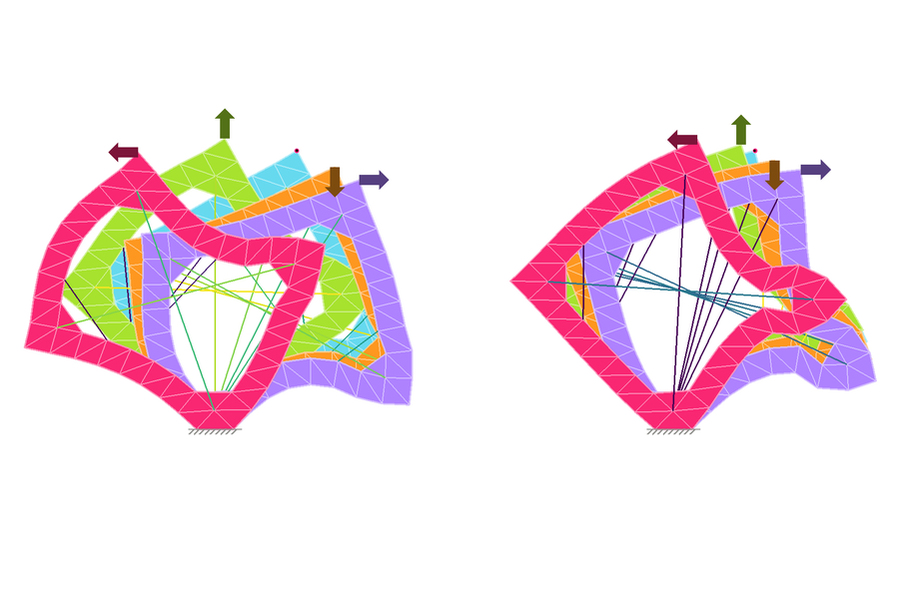
It’s still very much in the early stages, but the research presents a compelling idea, with a series of cables that help the soft structure become more rigid. The team likens the tech to the muscles in a human arm. When flexed, it becomes much more difficult to move.

New research published by researchers at National University of Singapore and the University of Lincoln (U.K.) in the journal Nature show ocean-inspired soft robots in a seemingly more natural environment: the Marina Trench. The soft structure (this time drawing more direct inspiration from rays) was able to withstand the extreme pressure that comes with being nearly 11,000 meters below the surface of the South China Sea.

Per the team:

This self-powered robot eliminates the requirement for any rigid vessel. To reduce shear stress at the interfaces between electronic components, we decentralize the electronics by increasing the distance between components or separating them from the printed circuit board.

Another entirely different — but equally fascinating — swimming robot comes out of UC San Diego. The 2 cm long fish-shaped robots have platinum tales, which propel through bubbles created by a reaction to the hydrogen peroxide in their petri dishes. After researchers cut the little robots in half or thirds, magnetic interaction makes the pieces “heal” back together. The hope is that such application could be put to use in larger swimming robots, which are frequently made of fragile material.

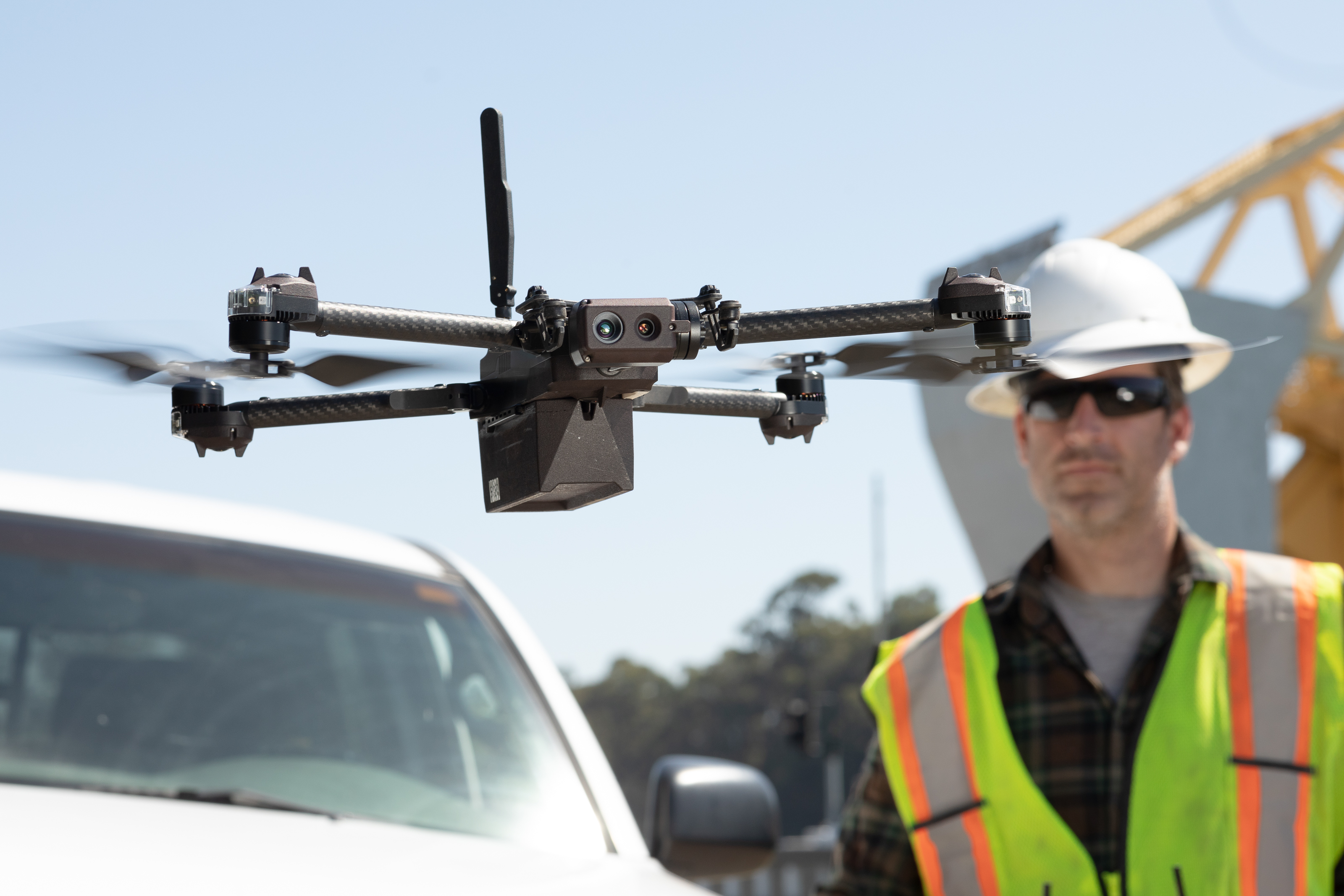
Image Credits: Skydio

The big robotics investment of the week is Skydio. Not the first time that sentiment has been uttered, of course. The Series D brings the drone makers total funding up to $340 million, as it expands to additional commercial applications. There’s also the fact that the company is U.S.-based, which likely makes it all the more appealing to investors following DJI’s addition to the DoC’s “entity list” in December.

That was one of those initiatives the Trump administration took on its way out the door. Like a number of recent entity list additions, this will hopefully be scrutinized under the new administration. Thus far, however, it hasn’t appeared to impact DJI’s ability to sell drones in the States, including the new FPV.

Image Credits: Brian Heater

I got my hands on the new model this week. It’s an interesting new category the drone giant has only dipped its toes in thus far. The DJI FPV bundles goggles for a first-person flight experience that has largely been the domain of racers and high-end hobbyist models. Given that DJI current controls roughly 70% of the global market, this marks an important moment for the burgeoning category.

Animated image of a drone floating over rebar and tying it together at intersections.

Image Credits: SkyMul

SkyMul, meanwhile, is one of the more interesting applications I’ve seen in the drone space for a bit. The startup is one of a deluge of robotics companies in the construction space. Specially, it uses quadcopters for the extremely thankless job of tying rebar.

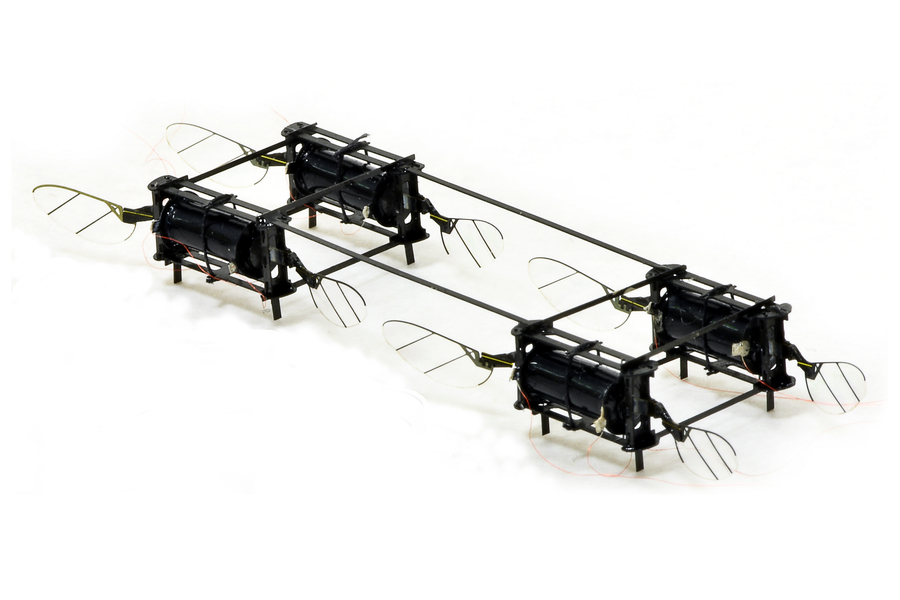
Image Credits: MIT

On the research side of the category, we’ve got these adorable little buggers out of MIT. At 0.6 grams, they weigh roughly the size of a large bumble bee. And unlike previous models, these “cassette tapes with wings” are designed to survive mid-air collisions. Turns out bumble bees tend to crash into each other a bunch while flying. That’s one of those little pieces of nature trivia that make perfect sense when you think about it for a second.

The drones are “are built with soft actuators, made from carbon nanotube-coated rubber cylinders. The actuators elongate when electricity is applied at a rate up to 500 times a second. Doing this causes the wings to beat and the drones to take flight.”

After I posted that article, someone asked if I knew about a “kids’ book about a boy who becomes an insect drone and solves mysteries?” I did not. But I asked the occasionally usual social media platform and it nearly instantly responded with the extremely 70s kids book title, “Danny Dunn, Invisible Boy.” The thirteenth book in a long-running series, the book offered a glimpse into the future of drones. Per a 2014 Medium article:

You control the drone using a keyboard box, a thoroughly funky virtual-reality helmet, and what look like a pair of souped up Nintendo Power Gloves. With head inside the helmet, the pilot sees what the dragonfly sees, and even feels what the dragonfly feels via haptic feedback in the gloves.

In less fun “science fiction predicts the future” news, a follow up from all of the hubbub surrounding Boston Dynamics last week. Once again, the ACLU is weighing in on the matter, as it did when the company debuted footage of a Spot unit in the field with the Massachusetts state PD on our stage a while back.

The org reiterates questions it and others have raised before, including some of the generally ominous images and ideas around weaponized robotics that have been floating around for a long time. Here, however, it combines these with existing conversations around policing, AI and bias:

Viewed narrowly, there’s nothing wrong with using a robot to scout a dangerous location or deliver food to hostages. But communities should take a hard look at expensive, rare-use technologies at a time when the nation is increasingly recognizing the need to invest in solving our social problems in better ways than just empowering police.

There’s a lot to untangle here, but as I said week, it’s a net positive that we’re discussing these things now, while they’re still largely hypothetical. If drones have taught us anything, it’s that technology comes at you fast. I can appreciate that last week’s art instillation was not the framing Boston Dynamics wanted to enter into this conversation — and I do think the company’s an easy target due to its profile and the framing of fiction like Black Mirror.

But having this ongoing conversation is a net positive for robotics, going forward.

04 Mar 2021

Income verification is white-hot right now, and Plaid wants in

Fresh off the termination of its planned merger with Visa, Plaid announced Thursday a new income verification product, which it said is aimed at “improving the lending lifecycle” with payroll data.

Dubbed simply Income, the new product — which is currently in beta — is designed to make it easier for people to verify their income in order to do things like secure loans, qualify for mortgages, rent apartments and lease cars, among other things.

Plaid Income gives lenders — both at fintech companies and financial institutions — verified and permissioned data on the income, employment status and tax liabilities of individual users.

The San Francisco-based company says it has been developing its Payroll product suite for more than a year. Last month, Plaid launched its other product in that suite, Deposit Switch, which is designed to allow people to “quickly” switch their direct deposits to a new or existing bank account by linking their payroll account via Plaid.

Notably, Plaid opted to build out its own income verification offering rather than partner with another fintech.

A spokesperson told TechCrunch via email that the company is “always” looking to provide people with the most holistic view of their financial lives. 

“Over the past few years, we’ve added support for several additional different types of consumer-permissioned data, including liabilities, investments, mortgage data and more,” the spokesperson added. “It’s become clearer that payroll data has huge potential value for enabling new or more streamlined services that help people better manage their financial lives, and we knew we wanted to bring that to market ourselves.”

Historically, the process of providing information so that lenders can verify employment status, income and ability to pay can place a heavy burden on applicants.

“They often need to retrieve and then share multiple documents or PDFs, which then a lender must process and review,” Plaid points out. With Income, the process is streamlined, the fintech infrastructure provider claims.

Using Plaid Link, applicants have the choice to share their payroll information using one of two methods:

  • Authenticating using their employer or payroll provider account 
  • Uploading payroll documents including paystubs, W2s and supported types of 1099s 

To provide a more “familiar and secure” experience for applicants, Plaid is developing credential-less authentication capabilities. This means that, say, an applicant for a credit card could supply key identifying information to the lender that Plaid would then use to locate his or her income information. Or maybe another bit of explanation of why this matt Also, an applicant will have the chance to review the information they are sharing and opt out of sharing it at any time.

Image Credits: Plaid

Kate Adamson, product lead at Plaid, said the company views access to payroll data as the next area of opportunity in financial services.

“The past decade of fintech innovation has shown that people can make better financial decisions more easily with better access to and control of their own financial data,” she told TechCrunch.

The income verification space is an increasingly crowded one. Last June, TechCrunch wrote about Pinwheel, an API layer for payroll data that handles everything from income and employee verification to easily switching and managing direct deposit. The company officially came out of stealth last year, announcing that it had raised a $7 million seed round from Josh Kopelman at First Round Capital and Greg Bettinelli at Upfront Ventures.

There’s also Argyle, which is building a “gateway to access employment records.” In October, that startup announced a $20 million Series A funding round led by Bain Capital Ventures. Ironically, Argyle’s name was inspired by Plaid, according to Argyle CEO and co-founder Shmulik Fishman. At the time, he told me that the company intentionally named Argyle after a pattern.

“I’m a huge fan of Plaid, and make no secret about it,” Fishman had said. “Plus, there’s a number of other successful companies such as Stripe and Checkr named after patterns. We went through a list of patterns and polka dots didn’t sound very good. So we settled on Argyle. And ultimately, we want to be the Plaid for employment records.”