Year: 2021

02 Mar 2021

Following unionization, Glitch signs collective bargaining agreement

In another key moment for the growing tech labor movement, Glitch employees today announced that they have signed a collective bargaining agreement with the company. The move comes a year after the site’s workforce voted to join the Communications Workers of America Local 1101.

“We’re excited that Glitch workers have signed their first-ever contract, a milestone in this industry,” CWA Local 1101 President Keith Purce said in a release tied to the announcement. “CWA has decades of experience helping workers improve conditions at some of this country’s largest, most powerful corporations. We know we’re stronger when we fight together, and we hope this victory inspires other software engineers to organize their workplaces.”

Glitch says the agreement has been in the works for around five months before being, “ratified overwhelmingly” by employees. The union calls the move, “the first collective bargaining agreement signed by software engineers in the tech industry,” citing industry moves designed from preventing labor movements from solidifying in tech.

In spite of this, however, the movement has been growing, particularly over the past year, among blue-collar and white-collar workers alike. Recent examples include Kickstarter and the Alphabet Workers Union.

Attempts to unionize among Amazon warehouse employees have been decidedly more rocky, as the company has purchased advertising and sent mailers attempting to dissuade workers. Still, the pro-union wing has seemingly found an ally in Joe Biden, who recently commented, “The choice to join a union is up to the workers, full stop.”

In May, Glitch laid off 18 — amounting to around a third of the staff. CEO Anil Dash noted at the time, “we are a small company in a fiercely competitive space in a tough economy. But these good people have done immensely valuable work that our entire team and community are grateful for.”

The agreement, which holds for 11 months, focuses — in part — on the rights of those impacted workers, detailing severance and rehiring those former employees if their former positions are re-instated.

“This is an absolutely historic win for us,” said software engineer Katie Lundsgaard. “We love our jobs, we love working at Glitch, which is why we wanted to ensure we have a lasting voice at this company and lasting protections. This contract does that, and I hope tech workers across the industry can see that unions and startups are not incompatible.”

Organizers add:

The contract also does not focus on wages and benefits, which are already generous at Glitch, opting instead to ensure basic union protections for workers and a continued voice in the workplace.

02 Mar 2021

Proptech startup States Title, now Doma, going public via SPAC in $3B deal

Real estate tech startup Doma, formerly known as States Title, announced Tuesday it will go public through a merger with SPAC Capitol Investment Corp. V in a deal valued at $3 billion, including debt.

SPACs, often called blank-check companies, are increasingly common. They exist as publicly traded entities in search of a private company to combine with, taking the private entity public without the hassle of an IPO.

When it floats later this year, Doma will trade on the New York Stock Exchange under the ticker symbol DOMA. The transaction is expected to provide up to $645 million in cash proceeds, including a fully committed PIPE of $300 million and up to $345 million of cash held in the trust account of Capitol Investment Corp. V. 

CEO Max Simkoff founded San Francisco-based Doma in September 2016 with the aim of creating a technology-driven solution for “closing mortgages instantly.” While it initially was founded to instantly underwrite title insurance, the company has expanded that same approach to handle “every aspect” of closing and escrow.

Doma has developed patented machine learning technology that it says reduces title processing time from five days to “as little as one minute” and cuts down the entire mortgage closing process “from a 50+ day ordeal to less than a week.” The startup has facilitated over 800,000 real estate closings for lenders such as Chase, Homepoint, Sierra Pacific Mortgage and others.

The name change is designed to more accurately reflect its intention to expand “well beyond” title into areas such as appraisals and home warranties.

Its goal with going public is to be able to “continue to invest in growth, market expansion and new products.”

Anchoring the PIPE include funds and accounts managed by BlackRock, Fidelity Management & Research Company LLC, SB Management (a subsidiary of SoftBank Group), Gores, Hedosophia, and Wells Capital. Existing Doma shareholder Lennar has also committed to the PIPE and Spencer Rascoff, co-founder and former CEO of Zillow Group, has committed a personal investment to the PIPE.

Up to approximately $510 million of cash proceeds are expected to be retained by Doma, and existing Doma shareholders will own no less than approximately 80 percent of the equity of the new combined company, subject to redemptions by the public stockholders of Capitol and payment of transaction expenses.

In mid-February, Doma announced it had closed on $150 million in debt financing from HSCM Bermuda, which had previously invested in the company. And last May, it announced a massive $123 million Series C round of funding at a valuation of $623 million.

Doma joins the growing number of proptech companies going the public route. On Monday, Compass, the real-estate brokerage startup backed by roughly $1.6 billion in venture funding, filed its S-1

In 2020, Social Capital Hedosophia II, the blank-check company associated with investor Chamath Palihapitiya, announced that it would merge with Opendoor, taking the private real estate startup public in the process.

Porch.com also went public in a SPAC deal in December. And, SoftBank-backed View, a Silicon Valley-based smart window company, will complete a recent SPAC merger to be publicly listed on the NASDAQ stock exchange on March 8. The company is expected to debut trading with a market value of $1.6 billion.

02 Mar 2021

Fluid Truck, the Zipcar of commercial trucks, raises $63M to take on rental giants

Fluid Truck has built an app-based platform that aims to take away the pain and cost of owning or leasing commercial vehicles, all while grabbing market share from established companies like Penske, Ryder and U-Haul. 

Now, it has the capital to help it get there. The Denver-based company said Tuesday it raised $63 million in a Series A funding round to expand its truck-sharing platform, which helps mid-mile and last-mile delivery companies remotely manage an on-demand rental fleet via web or mobile app. Private equity firm Bison Capital led the round, with participation from Ingka Investments (part of Ingka Group, the main Ikea retailer), Sumitomo Corporation of Americas and Fluid Vehicle Owners.  

The investment, its first external round, comes after rapid growth at the four-year-old company. Founder and CEO James Eberhard told TechCrunch that revenue increased 100x in the last two years. That type of growth sounds promising, but the company did not provide a baseline, so it’s hard to judge scale. 

With e-commerce expected to continue to rise at a global 9.5% compound annual growth rate from 2020 to 2025, the demand for accessible trucks for hire might see correlative growth. It’s no surprise that e-commerce is one of the industries Fluid Truck has targeted. 

Fluid Truck, which operates in 25 U.S. markets, operates like the car-sharing company Zipcar, with a commercial bent. Businesses such as moving and e-commerce delivery companies can use the platform to rent trucks. Fluid Truck’s pitch to businesses extends beyond the “you don’t need to buy or lease” argument. The platform also allows delivery companies to dispense with having a manager on staff who would manage, maintain and eventually sell the fleet. 

Businesses eager to outsource the purchasing and managing of their trucks can find fleets for hire in industrial parks and retail areas within Fluid’s service network. 

“You can hop on our platform, rent a truck and be in it in a matter of minutes, which really allows businesses to scale up and scale down,” said Eberhard. “We’re watching our user behavior go from a place where they used to own every vehicle they needed at a time to a place where they’re now grabbing spare capacity off Fluid.”

Eberhard hopes to see that type of supplementary use morph into an end state where companies don’t own a single truck and run solely on Fluid Truck’s platform. 

Fluid Truck argues that its tech stack, which is designed to smooth out the booking and renting process, gives it a competitive edge in a market dominated by the likes of U-Haul, Ryder and or other small depots. Eberhard said the process of going to a depot and waiting in line is slow and sloppy, whereas Fluid Truck’s app makes renting a van as easy as calling an Uber.

“We take all those complexities away and allow people to have a virtual fleet,” Eberhard told TechCrunch.

Fluid Truck’s fleet is made up of thousands — and soon to be tens of thousands — of cargo vans, pickup trucks, large box trucks and various other vehicles. The company also claims to have the largest medium-duty EV rental fleet in the United States, which it continues to expand as it works with OEMs to increase fleet capacity. Electric vehicles still make up less than 1% of its total portfolio due to the slower adoption of EVs on the commercial side. 

Eberhard wants Fluid to be a dominant force in the trucking industry. But Fluid Truck is not the only truck sharing app on the streets. Competitors GoShare and Bungii have similar offerings.

This sizable round could provide an advantage as it tries to become the household name in digital truck sharing. Perhaps, as importantly, the company has the attention and investment of Ikea. 

“This is another step in enabling Ikea retail to provide last mile delivery services to our customers, continue to improve on our customer promise, while also reducing our environmental footprint,” Krister Mattsson, managing director of Ingka Investments said in a statement, a comment that suggests a future partnership with Fluid Truck. 

With this latest capital round, Fluid’s goal is to (you guessed it) scale outwards, with a focus on expanding the team, adding dozens more markets in the U.S. and preparing to take Fluid into the EU and Canada. 

Fluid Truck will also be investing back into its own tech stack, which includes an internal proprietary telematics platform to predict and automate servicing and maintenance of the company’s fleet. 

02 Mar 2021

Twitter Spaces arrives on Android ahead of Clubhouse

Twitter announced today it’s opening up its live audio chat rooms, known as Twitter Spaces, to users on Android. Previously, the experience was only open to select users on iOS following the product’s private beta launch in late December 2020. The company says that Android users will only be able to join and talk in Spaces for the time being, but won’t yet be able to start their own.

That added functionality is expected to ship “soon,” Twitter says, without offering an exact timeframe.

The company has been working quickly to iterate on Twitter Spaces in the months since its beta debut, and has been fairly transparent about its roadmap.

Last month, the team developing Twitter Spaces hosted a Space where users were invited to offer feedback, ask questions, and learn about what Twitter had in the works for the product in both the near-term and further down the road. During this live chat, Twitter confirmed that Spaces would arrive on Android in March.

It also promised a fix to how it displays listeners, which has since rolled out.

Other Spaces features are being shared in public as they’re designed and prototyped, including things like titles and descriptions, scheduling options, support for co-hosts and moderators, guest lists, and more. Twitter has also updated the preview card that appears in the timeline and relabeled its “captions” feature to be more accurate, from an accessibility standpoint.

The time frame of some of its new developments  — like Android and scheduling options — were being promised in a matter of weeks, not months.

This fast pace has now led Twitter to beat its rival Clubhouse — the app currently leading the “social audio” market — to offer support for Android. Today, Clubhouse remains iOS-only in addition to being invite-only.

It’s also indicative of the resources Twitter is putting into this new product, which was first announced publicly just in November. Clearly, Twitter believes social audio is a market it needs to win.

The company also sees the broader potential for Spaces as being a key part of a larger creator platform now in the works. During its Investor Day last week, Twitter spoke of tying together its new products like Spaces, Newsletters along with a “Super Follow” paid subscription, for example.

It’s now also testing a Twitter “Shopping Card” that would allow users to tweets posts that link directly to product pages via a “Shop” button — a feature that would seem to fall under this new creator focus, as well.

Some Twitter users on Android had already found their way to Spaces before today’s announcement by way of the Twitter beta app on Google Play.

But now, a separate beta app won’t be required — when live Spaces are available, they’ll appear at the top of the Twitter timeline for Android users to join.


02 Mar 2021

Twitter Spaces arrives on Android ahead of Clubhouse

Twitter announced today it’s opening up its live audio chat rooms, known as Twitter Spaces, to users on Android. Previously, the experience was only open to select users on iOS following the product’s private beta launch in late December 2020. The company says that Android users will only be able to join and talk in Spaces for the time being, but won’t yet be able to start their own.

That added functionality is expected to ship “soon,” Twitter says, without offering an exact timeframe.

The company has been working quickly to iterate on Twitter Spaces in the months since its beta debut, and has been fairly transparent about its roadmap.

Last month, the team developing Twitter Spaces hosted a Space where users were invited to offer feedback, ask questions, and learn about what Twitter had in the works for the product in both the near-term and further down the road. During this live chat, Twitter confirmed that Spaces would arrive on Android in March.

It also promised a fix to how it displays listeners, which has since rolled out.

Other Spaces features are being shared in public as they’re designed and prototyped, including things like titles and descriptions, scheduling options, support for co-hosts and moderators, guest lists, and more. Twitter has also updated the preview card that appears in the timeline and relabeled its “captions” feature to be more accurate, from an accessibility standpoint.

The time frame of some of its new developments  — like Android and scheduling options — were being promised in a matter of weeks, not months.

This fast pace has now led Twitter to beat its rival Clubhouse — the app currently leading the “social audio” market — to offer support for Android. Today, Clubhouse remains iOS-only in addition to being invite-only.

It’s also indicative of the resources Twitter is putting into this new product, which was first announced publicly just in November. Clearly, Twitter believes social audio is a market it needs to win.

The company also sees the broader potential for Spaces as being a key part of a larger creator platform now in the works. During its Investor Day last week, Twitter spoke of tying together its new products like Spaces, Newsletters along with a “Super Follow” paid subscription, for example.

It’s now also testing a Twitter “Shopping Card” that would allow users to tweets posts that link directly to product pages via a “Shop” button — a feature that would seem to fall under this new creator focus, as well.

Some Twitter users on Android had already found their way to Spaces before today’s announcement by way of the Twitter beta app on Google Play.

But now, a separate beta app won’t be required — when live Spaces are available, they’ll appear at the top of the Twitter timeline for Android users to join.


02 Mar 2021

SpineZone is the latest health tech startup to raise millions in the musculoskeletal space

SpineZone is a startup that creates personalized exercise programs and treatment for neck and back pain. The company uses an online platform and in-person clinics to deliver a curriculum that, ideally, helps patients avoid the need for prescription drugs, injections and surgeries, and providers then avoid the cost of all of the above. Co-founded by brothers Kian Raiszadeh and Kamshad Raiszadeh, the company tells TechCrunch that it has raised $12 million in a Series A round led by Polaris Partners and Providence Ventures, with participation from Martin Ventures.

At its core, SpineZone is a virtual physical therapy platform augmented by in-person clinics. The latter bit is important because it takes a video repository, which has health outcomes baked into it, and helps get those same users some real-life support.

Patients can log onto the site, either through smartphone or laptop, and then answer a series of questions around pain and risk factors. Then, patients can go through a series of exercises. These exercises are created in tandem with professionals, and are based on peer-reviewed and evidence-based articles on musculoskeletal health.

Beyond this digital archive of videos, SpineZone offers an in-person clinic option to help patients practice these exercises. Off of this strategy, the startup claims that it has “1 million lives under management.”

SpineZone’s value proposition is that it helps payers and providers, whether that be employers, clinics or health plans such as Cigna or Aetna, avoid placing their patients in surgeries, which are expensive. By taking care of pain issues before they bubble up, SpineZone says that its current partners have been able to have a 50% reduction in surgery rate (it’s worth noting that COVID-19 could also play a role in this because it is high-risk to enter a medical facility).

Partners are happy because footing the bill of a non-operative procedure is remarkably cheaper than a non-operative procedure.

The cost saving that a medical center could endure can be in the millions. For example, the Sharp Community Medical Group saved $3.4 million in cost savings after working with SpineZone for two years.

SpineZone’s business model is a smidge more complicated than your classic SaaS fee. For example, it charges a clinic based on the number of members it serves per month, and also shares in the downside. For example, if SpineZone promises to get a clinic to $12 million in spend from $15 million, and the cost ends up being $17 million, the company will pay the clinic a portion of the difference. Alternatively, if SpineZone got the clinic to $10 million, even below estimates, it shares in the upside.

SpineZone joins a cohort of health tech startups that focus on musculoskeletal conditions. Venture-backed competitors include Peerwell, Force Therapeutics and Hinge Health, which was most recently valued at $3 billion, with plans to go public.

In order to win, many startups, SpineZone including, need value-based care to replace fee-for-service care. Value-based care is the idea that doctors are paid for outcomes instead of the number of times you enter a doctor’s office. The end goal is that this format creates monetary incentives around getting to an outcome faster: If a doctor is going to make $30,000 on fixing a knee, regardless of whether it takes two appointments or 20 appointments, they might as well do a more thorough job upon check-up instead of elongating the process. The flipside of this, of course, is that doctors might optimize for outcome volume and speed rather than the quality of the result itself.

While SpineZone’s early traction is promising, the healthcare ecosystem still has a ways to go before value-based models take precedence. Right now, Kian Raiszadeh estimates that 10 to 20% of revenue in a medical center comes from value-based care. SpineZone is projecting that it will get to 50% of revenue in the near future.

“And that’s the biggest evolution and tallest lift that we’re expecting,” he said.


Early Stage is the premiere ‘how-to’ event for startup entrepreneurs and investors. You’ll hear first-hand how some of the most successful founders and VCs build their businesses, raise money and manage their portfolios. We’ll cover every aspect of company-building: Fundraising, recruiting, sales, legal, PR, marketing and brand building. Each session also has audience participation built-in – there’s ample time included in each for audience questions and discussion.

02 Mar 2021

SpineZone is the latest health tech startup to raise millions in the musculoskeletal space

SpineZone is a startup that creates personalized exercise programs and treatment for neck and back pain. The company uses an online platform and in-person clinics to deliver a curriculum that, ideally, helps patients avoid the need for prescription drugs, injections and surgeries, and providers then avoid the cost of all of the above. Co-founded by brothers Kian Raiszadeh and Kamshad Raiszadeh, the company tells TechCrunch that it has raised $12 million in a Series A round led by Polaris Partners and Providence Ventures, with participation from Martin Ventures.

At its core, SpineZone is a virtual physical therapy platform augmented by in-person clinics. The latter bit is important because it takes a video repository, which has health outcomes baked into it, and helps get those same users some real-life support.

Patients can log onto the site, either through smartphone or laptop, and then answer a series of questions around pain and risk factors. Then, patients can go through a series of exercises. These exercises are created in tandem with professionals, and are based on peer-reviewed and evidence-based articles on musculoskeletal health.

Beyond this digital archive of videos, SpineZone offers an in-person clinic option to help patients practice these exercises. Off of this strategy, the startup claims that it has “1 million lives under management.”

SpineZone’s value proposition is that it helps payers and providers, whether that be employers, clinics or health plans such as Cigna or Aetna, avoid placing their patients in surgeries, which are expensive. By taking care of pain issues before they bubble up, SpineZone says that its current partners have been able to have a 50% reduction in surgery rate (it’s worth noting that COVID-19 could also play a role in this because it is high-risk to enter a medical facility).

Partners are happy because footing the bill of a non-operative procedure is remarkably cheaper than a non-operative procedure.

The cost saving that a medical center could endure can be in the millions. For example, the Sharp Community Medical Group saved $3.4 million in cost savings after working with SpineZone for two years.

SpineZone’s business model is a smidge more complicated than your classic SaaS fee. For example, it charges a clinic based on the number of members it serves per month, and also shares in the downside. For example, if SpineZone promises to get a clinic to $12 million in spend from $15 million, and the cost ends up being $17 million, the company will pay the clinic a portion of the difference. Alternatively, if SpineZone got the clinic to $10 million, even below estimates, it shares in the upside.

SpineZone joins a cohort of health tech startups that focus on musculoskeletal conditions. Venture-backed competitors include Peerwell, Force Therapeutics and Hinge Health, which was most recently valued at $3 billion, with plans to go public.

In order to win, many startups, SpineZone including, need value-based care to replace fee-for-service care. Value-based care is the idea that doctors are paid for outcomes instead of the number of times you enter a doctor’s office. The end goal is that this format creates monetary incentives around getting to an outcome faster: If a doctor is going to make $30,000 on fixing a knee, regardless of whether it takes two appointments or 20 appointments, they might as well do a more thorough job upon check-up instead of elongating the process. The flipside of this, of course, is that doctors might optimize for outcome volume and speed rather than the quality of the result itself.

While SpineZone’s early traction is promising, the healthcare ecosystem still has a ways to go before value-based models take precedence. Right now, Kian Raiszadeh estimates that 10 to 20% of revenue in a medical center comes from value-based care. SpineZone is projecting that it will get to 50% of revenue in the near future.

“And that’s the biggest evolution and tallest lift that we’re expecting,” he said.


Early Stage is the premiere ‘how-to’ event for startup entrepreneurs and investors. You’ll hear first-hand how some of the most successful founders and VCs build their businesses, raise money and manage their portfolios. We’ll cover every aspect of company-building: Fundraising, recruiting, sales, legal, PR, marketing and brand building. Each session also has audience participation built-in – there’s ample time included in each for audience questions and discussion.

02 Mar 2021

Microsoft says China-backed hackers are exploiting Exchange zero-days

Microsoft is warning customers that a new China state-sponsored threat actor is exploiting four previously undisclosed security flaws in Exchange Server, an enterprise email product built by the software giant.

The technology company said Tuesday that it believes the hacking group, which it calls Hafnium, tries to steal information from a broad range of U.S.-based organizations, including law firms and defense contractors, but also infectious disease researchers and policy think tanks.

Microsoft said Hafnium used the four newly discovered security vulnerabilities to break into Exchange email servers running on company networks, granting the attackers to steal data from a victim’s organization — such as email accounts and address books — and the ability to plant malware. When used together, the four vulnerabilities create an attack chain that can compromise vulnerable servers running Exchange 2013 and later.

Hafnium operates out of China, but uses servers located in the U.S. to launch its attacks, the company said. Microsoft said that Hafnium was the only threat group it has detected using these four new vulnerabilities.

Microsoft declined to say how many successful attacks it had seen, but described the number as “limited.”

Patches to fix those four security vulnerabilities are now out, a week earlier than the company’s typical patching schedule, usually reserved for the second Tuesday in each month.

“Even though we’ve worked quickly to deploy an update for the Hafnium exploits, we know that many nation-state actors and criminal groups will move quickly to take advantage of any unpatched systems,” said Tom Burt, Microsoft’s vice president for customer security.

The company said it has also briefed U.S. government agencies on its findings, but that the Hafnium attacks are not related to the SolarWinds-related espionage campaign against U.S. federal agencies. In the last days of the Trump administration, the National Security Agency and the FBI said that the SolarWinds campaign was “likely Russian in origin.”

02 Mar 2021

Six tips for SaaS founders who don’t want VC money

Over the past decade, venture capital has become synonymous with entrepreneurship. Founders from around the world arrive in Silicon Valley with visions of record-setting A rounds and billion-dollar valuations. But what if you don’t have unicorn dreams – or you don’t want to pursue VC money?

Bootstrapping a SaaS company is not only possible – I believe it’s a saner, more sustainable way to build and scale a business. To be clear, bootstrapping isn’t always easy. It requires patience and focus, but the freedom to create a meaningful product, on your terms, is worth more than even the biggest VC check.

I started my company, JotForm, in 2006. We’ve grown steadily from a simple web tool into a product that serves more than 8 million users – without taking a dime in outside funding. We’re profitable in an industry with big-name competitors like Google.

Most importantly, I still love this company and its mission, and I want the same for my fellow entrepreneurs. If you’re a SaaS founder who’s wary of VC funding, here are my best bootstrapping tips.

Keep your day job

Success stories from founders who leap blindly into business without resources or relevant experience are compelling, but they’re the exception, not the rule. Working inside another organization can build your skills, your network, and even inspire great product ideas.

After finishing college with a computer science degree, I worked as a developer for a New York media company. The editors always needed custom web forms, which were tedious and time-consuming to build. I kept thinking, “There has to be a better way.”

That daily frustration led me to start JotForm – but I didn’t leave my job right away. I stayed with the media firm for five years and worked on my product on the side. By the time I was ready to go all-in, I had the confidence, experience and savings I needed.

Many of the world’s biggest companies began as side projects, including Twitter, Craigslist, Slack, Instagram, Trello, and a little venture called Apple. If your day job doesn’t pay enough to fund the early stages of your business, consider a side gig or consulting work. There are so many ways to set yourself up for success without the pressure of VC cash or selling a chunk of your business.

Know you’re not alone

The exact numbers shift every year, but data compiled by Fundable show that only 0.05 percent of U.S. startups are backed by VCs. Another 0.91 percent are funded by angel investors. The vast majority, at 57 percent, are funded by credit and personal loans, while 38 percent get funding from friends and family.

It may feel like most founders raise multi-million-dollar rounds, but that’s simply not the case. It’s also good to remember that securing VC money is complicated and time-consuming. You can spend months taking meetings and presenting the perfect deck – and still leave empty-handed. Be patient and stick to your own path.

Measure profits, not popularity

SaaS founders often emphasize vanity metrics, like user acquisitions and total downloads. These numbers can measure short-term popularity, but they don’t reveal how users and customers feel about your product – or your long-term potential.

02 Mar 2021

Retail Zipline raises $30M as it helps retailers adapt to the pandemic

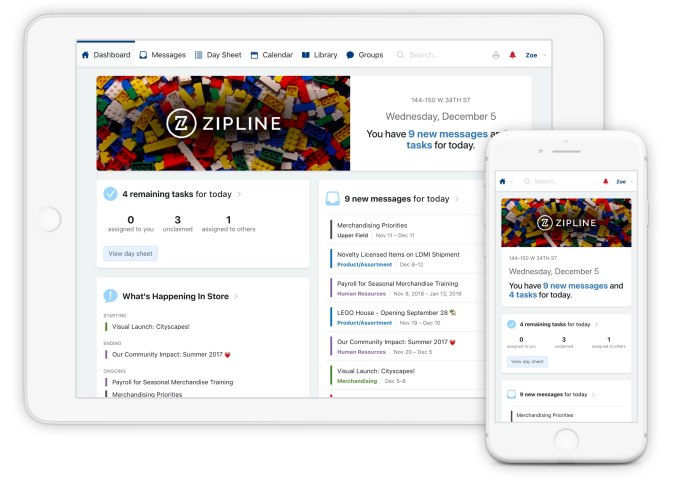
When I first wrote about Retail Zipline in 2019, the startup was focused on building a communication platform that would help corporate decision-makers in retail communicate with individual stores. As you’d probably guess, the startup saw some changes in 2020.

“When COVID first hit, you might think a company that’s primarily focused on retail would be in trouble,” said co-founder and CTO Jeremy Baker. “But it turns out that a product that helps retailers communicate critical information when everything is changing is no longer a nice to have.”

In other words, where Retail Zipline might previously have been used for coordinating sales and promotions, it suddenly became a channel for managing things like health and safety protocols and communicating about furloughs and closures.

Co-founder and CEO Melissa Wong said the platform supports both engagement (a company executives sending a message to retail associates) and execution (translating a broader corporate strategy into an in-store experience). While you might think that execution was the only thing that mattered in the middle of a pandemic, Wong argued that the engagement side was also essential, particularly when employees felt they were putting themselves at risk.

“The engagement part means that we can explain to a retail employee what we’re doing to protect you during this crisis, and your role as part of this company and this brand,” she said.

Retail Zipline screenshot

Image Credits: Retail Zipline

She added that the company has doubled its customer baes during the pandemic and seen revenue increase 2.5x. Retailers using the platform include Sephora, AEO, L.L.Bean, Gap, Hy-Vee, Lush Cosmetics, BevMo, LL Flooring, Cole Haan, The LEGO Group, TOMS and Torrid.

The pandemic also spurred dramatic growth in e-commerce, but Wong (who previously worked on the corporate side of Gap and Old Navy) suggested that this won’t eliminate the need for physical stores. Instead, it just means they’ll have to live up to the long-standing “omni-channel promise,” where they serve as both a store and a distribution center for online orders.

“Retail will become more complex,” she said. “We will enable them to meet those complexities.”

Today, Retail Zipline is announcing that it has raised $30 million in Series B funding. The round was led by real estate-focused firm Fifth Wall, with partner Dan Wenhold joining the board of directors. Emergence Capital, Ridge Ventures, Hillsven Capital, Veeva co-founder Matt Wallach and the Fisher Family Fund also participated.

The company has now raised more than $39 million, according to Crunchbase.

In a blog post, Fifth Wall wrote:

The Fifth Wall network is rich with opportunities for Zipline to explore potential partnerships among our retail-focused partners and portfolio companies. However, we believe retail to be just the beginning for Zipline as we envision the product appealing to many Built World industries. The opportunity for Zipline within real estate could lie with organizations whose HQ office must communicate daily with field operations workers, such as more traditional brokers with a geographic focus (e.g., CBRE, Cushman & Wakefield), leasing agents within multifamily and SFR (e.g., Equity Residential, Greystar), or construction site workers.