Year: 2021

26 Feb 2021

Yelp puts trust and safety in the spotlight

Yelp released its very first trust and safety report this week, with the goal of explaining the work that it does to crack down on fraudulent and otherwise inaccurate or unhelpful content.

With focus on local business reviews and information, you might think Yelp would be relatively free of the types of misinformation that other social media platforms struggle with. But of course, Yelp reviews are high stakes in their own way, since they can have a big impact on a business’ bottom line.

Like other online platforms, Yelp relies on a mix of software and human curation. On the software side, one of the main tasks is sorting reviews into recommended and not recommended. Group Product Manager for Trust and Safety Sudheer Someshwara told me that a review might not be recommended because it appears to be written by someone with a conflict of interest, or it might be solicited by the business, or it might come from a user who hasn’t posted many reviews before and “we just don’t know enough information about the user to recommend those reviews to our community.”

“We take fairness and integrity very seriously,” Someshwara said. “No employee at Yelp has the ability to override decisions the software has made. That even includes the engineers.”

He added, “We treat every business the same, whether they’re advertising with us or not.”
Yelp trust and safety report

Image Credits: Yelp

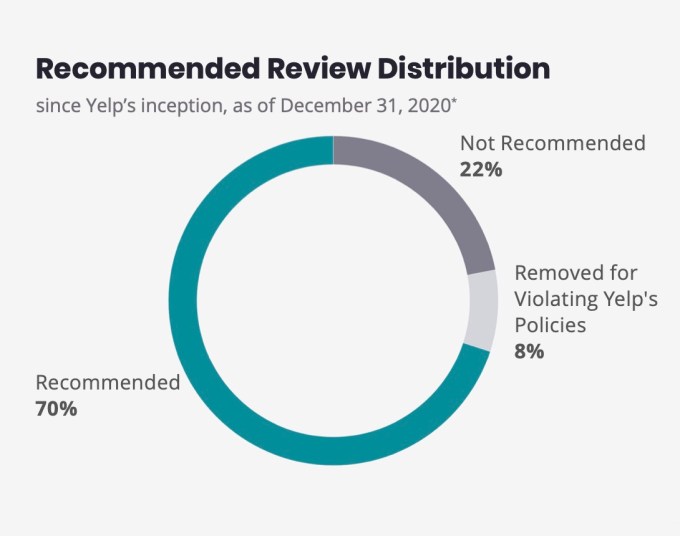
So the company says that last year, users posted more than 18.1 million reviews, of which 4.6 million (about 25%) were not recommended by the software. Someshwara noted that even when a review is not recommended, it’s not removed entirely — users just have to seek it out in a separate section.

Removals do happen, but that’s one of the places where the user operations team comes in. As Vice President of Legal, Trust & Safety Aaron Schur explained, “We do make it easy for businesses as well as consumers to flag reviews. Every piece of content that’s flagged in that way does get reviewed by a live human to decide whether it should should be removed violating our guidelines.”

Yelp says that last year, about 710,000 reviews (4%) were removed entirely for violating the company’s policies. Of those, more than 5,200 were removed for violating the platform’s COVID-19 guidelines (among other things, they prohibit reviewers from claiming they contracted COVID from a business, or from complaining about mask requirements or that a business had to close due to safety regulations). Another 13,300 were removed between May 25 and the end of the year for threats, lewdness, hate speech or other harmful content.

“Any current event that takes place will find its way onto Yelp,” acknowledged Vice President of User Operations Noorie Malik. “People turn to Yelp and other social media platforms to have a voice.”

But expressing political beliefs can conflict with what Malik said is Yelp’s “guiding principle,” namely “genuine, first-hand experience.” So Yelp has built software to detect unusual activity on a page and will also add a Consumer Alert when it believes there are “egregious attempts to manipulate ratings and reviews.” For example, it says there was a 206% increase in media-fueled incidents year-over-year.

It’s not that you can’t express political opinions in your reviews, but the review has to come from first-hand experience, rather than being prompted by reading a negative article or an angry tweet about the business. Sometimes, she added, that means the team is “removing content with a point of view that we agree with.”

One example that illustrates this distinction: Yelp will take down reviews that seem driven by media coverage suggesting that a business owner or employee behaved in a racist manner, but at the same time, it also labeled two businesses in December 2020 with a “Business Accused of Racism” alert reflecting “resounding evidence of egregious, racist actions from a business owner or employee.”

Beyond looking at individual reviews and spikes in activity, Someshwara said Yelp will also perform “sting operations” to find groups that are posting fraudulent reviews.

In fact, his team apparently shut down 1,200 user accounts associated with review rings and reported nearly 200 groups to other platforms. And it just rolled out an updated algorithm designed to better detect and un-recommend reviews coming from those groups.

26 Feb 2021

Broaden your view of ‘best’ to make smarter, more inclusive investments

What can we learn from the best 40 venture capital investments of all time? Well, we learn to invest exclusively in men, preferably white or Asian.

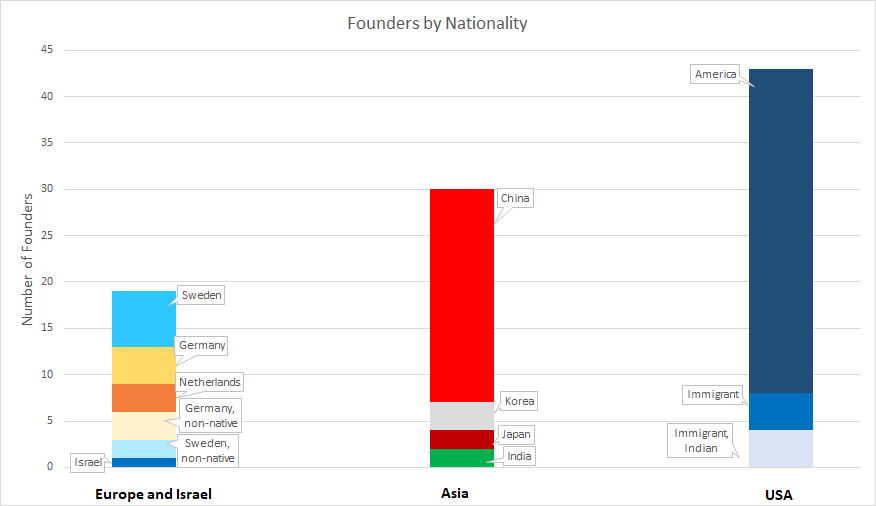
We reviewed CB Insights’ global list of “40 of the Best VC Bets of all Time.” All of the 40 companies’ 92 founders were male.

  • Of the 43 U.S.-based founders, 35 were white American; four were white immigrant/first generation, from France, Ukraine, Russia and Iran; and four were Indian immigrant/first generation.
  • Of the 19 Western Europe/Israel-based founders, all were white.
  • Of the 30 Asia-based founders, all were natives of the country in which they built their businesses: 23 Chinese, three Japanese, two Korean and two Indian.

Of course, this dataset is incomplete. There are numerous examples of founders from underrepresented backgrounds who have generated extremely impressive returns. For example, Amazon’s Jeff Bezos is Cuban American; Calendly’s Tope Awotona is Nigerian American; Sendgrid’s Isaac Saldana is Latinx; and Bumble’s Whitney Wolfe Herd is the second-youngest woman to take a company public.

That said, the pattern in the dataset is striking. So, why invest in anyone who’s not a white or Asian male? 

The conventional answer is that diversity pays. Research from BCG, Harvard Business Review, First Round Capital, the Kauffman Foundation and Illuminate Ventures shows that investors in diverse teams get better returns:

  • Paul Graham, cofounder of Y Combinator (2015): “Many suspect that venture capital firms are biased against female founders. This would be easy to detect: among their portfolio companies, do startups with female founders outperform those without? A couple months ago, one VC firm (almost certainly unintentionally) published a study showing bias of this type. First Round Capital found that among its portfolio companies, startups with female founders outperformed those without by 63%.”
  • Kauffman Fellows Report (2020): “Diverse Founding Teams generate higher median realized multiples (RMs) on Acquisitions and IPOs. Diverse Founding Teams returned 3.3x, while White Founding Teams returned 2.5x. The results are even more pronounced when looking at the perceived ethnicity of the executive team. Diverse Executive Teams returned 3.3x, while White Executive Teams only returned 2.0x. As mentioned above, we report realized multiples (RMs) only for successful startups that were acquired or went through the IPO process.”
  • BCG (June 2018): “Startups founded and cofounded by women actually performed better over time, generating 10% more in cumulative revenue over a five-year period: $730,000 compared with $662,000.”
  • BCG (January 2018): “Companies that reported above-average diversity on their management teams also reported innovation revenue that was 19 percentage points higher than that of companies with below-average leadership diversity — 45% of total revenue versus just 26%.”
  • Peterson Institute for International Economics (2016): “The correlation between women at the C-suite level and firm profitability is demonstrated repeatedly, and the magnitude of the estimated effects is not small. For example, a profitable firm at which 30 percent of leaders are women could expect to add more than 1 percentage point to its net margin compared with an otherwise similar firm with no female leaders. By way of comparison, the typical profitable firm in our sample had a net profit margin of 6.4 percent, so a 1 percentage point increase represents a 15 percent boost to profitability.”

How do we reconcile these two sets of data? Research going back a decade shows that diverse teams, companies and founders pay, so why are all of the VC home runs from white men, or Asian men in Asia, plus a few Asian men in the U.S.?

First Round did not include their investment in Uber in their analysis we reference above on the grounds that it was an outlier. Of course, one could rebut that by saying traditional VC is all about investing in outliers.

  • Seth Levine analyzed data from Correlation Ventures (21,000 financings from 2004-2013) and writes that “a full 65% of financings fail to return 1x capital. And perhaps more interestingly, only 4% produce a return of 10x or more, and only 10% produce a return of 5x or more.” In Levine’s extrapolated model, he found that in a “hypothetical $100M fund with 20 investments, the total number of financings producing a return above 5x was 0.8 – producing almost $100M of proceeds. My theoretical fund actually didn’t find their purple unicorn, they found 4/5ths of that company. If they had missed it, they would have failed to return capital after fees.”
  • Benedict Evans observes that the best investors don’t seem to be better at avoiding startups that fail. “For funds with an overall return of 3-5x, which is what VC funds aim for, the overall return was 4.6x but the return of the deals that did better than 10x was actually 26.7x. For >5x funds, it was 64.3x. The best VC funds don’t just have more failures and more big wins —  they have bigger big wins.”

The first problem with the outlier model of investing in VC is that it results in, on average, poor returns and is a risker proposition compared to alternative models. The Kauffman Foundation analyzed their own investments in venture capital (100 funds) over a 20-year period and found “only 20 of the hundred venture funds generated returns that beat a public-market equivalent by more than 3% annually,” while 62 “failed to exceed returns available from the public markets, after fees and carry were paid.”

The outlier model of investing in VC also typically results in a bias toward investing in homogeneous teams. We suggest that the extremely homogeneous profiles of the big wealth creators above reflect the fact that these are people who took the biggest risks: financial, reputational and career risk. The people who can afford to take the biggest risks are also the people with the most privilege; they’re not as concerned about providing for food, shelter and healthcare as economically stressed people are. According to the Kauffman Foundation, a study of “549 company founders of successful businesses in high-growth industries, including aerospace, defense, computing, electronics and healthcare” showed that “more than 90 percent of the entrepreneurs came from middle-class or upper-lower-class backgrounds and were well-educated: 95.1 percent of those surveyed had earned bachelor’s degrees, and 47 percent had more advanced degrees.” But when you analyze the next tier down of VC success, the companies that don’t make Top 40 lists but land on Top 500 lists, you see a lot more diversity.

In VC, 100x investment opportunities only come along once every few years. If you bet your VC fund on opportunities like that, you’re relying on luck. Hope is not a strategy. There are many 3x-20x return opportunities, and if you’re incredibly lucky (or Chris Sacca), you might get one 100x in your career.

We prefer to invest based on statistics, not luck. That’s why Versatile VC provides companies with the option of an “alternative-VC” model, using a non-traditional term sheet designed to better align incentives between investors and founders. We also proactively seek to invest in diverse teams. Given the choice of running a fund with one 100x investment, or a fund with two 10x investments, we’ll take the latter. The former implies that we came perilously close to missing our one home run, and therefore we’re not doing such a great job investing.

“While we all want to have invested in those exciting home-runs/unicorns, most investors are seeking the data points to construct reliable portfolios,” Shelly Porges, co-founder and managing partner of Beyond the Billion, observed. “That’s not about aiming for the bleachers but leveraging experience to reliably deliver on the singles and doubles it takes to get to home base. A number of the institutional investors we’ve spoken to have gone so far as to say that they can no longer meet their targets without alternatives, including venture investments. “

Lastly, the data above reflects companies that typically took a decade to build. As the culture changes, we anticipate that the 2030 “Top 40” wealth creators list will include many more people with diverse backgrounds. Just in 2018, 15 unicorns were born with at least one woman founder; in 2019, 21 startups founded or co-founded by a woman became unicorns. Why?

  • “All else being equal, a larger pool of female-founded companies to select from for VC investing should increase the odds of a higher number of female-founded VC home runs,” said Michael Chow, research director for the National Venture Capital Association and Venture Forward. According to PitchBook, investments in women-led companies grew approximately 54 percent from 2015 to 2019, from 459 to 709. In the first three quarters of 2020, there have been 468 fundings of women-led companies; this figure beats 2015, 2016 and nearly 2017 total annual fundings. ProjectDiane highlights that from 2018 to 2020, the number of Black women who have raised $1 million in venture funding nearly tripled, and the number of Latinx women doubled. Their average two-year fail rate is also 13 percentage points lower than the overall average.
  • “Millennials value a diverse workforce,” Chow added, according to Gallup and Deloitte Millennial surveys. “In the battle for talent, diverse founders may have the edge in attracting the best and brightest, and talent is what is required for going from zero to one.”
  • The rise in popularity of alternative VC models, which are disproportionately attractive to women and underrepresented founders. We are in the very early days of this wave; according to research by Bootstrapp, 32 U.S. firms have launched an inaugural Revenue-Based Finance fund. Clearbanc notes on their site they have “invested in thousands of companies using data science to identify high-growth funding opportunities. This data-driven approach takes the bias out of decision making. Clearbanc has funded 8x more female founders than traditional VCs and has invested in 43 states in the U.S. in 2019.”
  • More VCs are working proactively to market to underrepresented founders. Implicit biases are robust and pervasive; it takes a proactive and intentional approach to shift the current status quo of funding,” Dreamers & Doers Founder Gesche Haas said. Holly Jacobus, an investment partner at Joyance Partners and Social Starts, noted that “we’re proud to boast a portfolio featuring ~30% female founders in core roles —  well above the industry average —  without specific targeting of any sort. However, there is still work to be done. That’s why we lean heavily on our software and CEOs to find the best tech and teams in the best segments, and we are always actively working on improving the process with new systems that remove bias from the dealflow and diligence process.”

Thanks to Janet Bannister, managing partner, Real Ventures, and Erika Cramer, co-managing member, How Women Invest, for thoughtful comments. David Teten is a past Advisor to Real Ventures.

26 Feb 2021

Facebook launches BARS, a TikTok-like app for creating and sharing raps

Facebook’s internal R&D group, NPE Team, is today launching its next experimental app, called BARS. The app makes it possible for rappers to create and share their raps using professionally created beats, and is the NPE Team’s second launch in the music space following its recent public debut of music video app Collab.

While Collab focuses on making music with others online, BARS is instead aimed at would-be rappers looking to create and share their own videos. In the app, users will select from any of the hundreds of professionally created beats, then write their own lyrics and record a video. BARS can also automatically suggest rhymes as you’re writing out lyrics, and offers different audio and visual filters to accompany videos as well as an autotune feature.

There’s also a “Challenge mode” available, where you can freestyle with auto-suggested word cues, which has more of a game-like element to it. The experience is designed to be accommodating to people who just want to have fun with rap, similar to something like Smule’s AutoRap, perhaps, which also offers beats for users’ own recordings.

Image Credits: Facebook

The videos themselves can be up to 60 seconds in length and can then be saved to your Camera Roll or shared out on other social media platforms.

Like NPE’s Collab, the pandemic played a role in BARS’ creation. The pandemic shut down access to live music and places where rappers could experiment, explains NPE Team member DJ Iyler, who also ghostwrites hip-hop songs under the alias “D-Lucks.”

“I know access to high-priced recording studios and production equipment can be limited for aspiring rappers. On top of that, the global pandemic shut down live performances where we often create and share our work,” he says.

BARS was built with a team of aspiring rappers, and today launched into a closed beta.

Image Credits: Facebook

Despite the focus on music, and rap in particular, the new app in a way can be seen as yet another attempt by Facebook to develop a TikTok competitor — at least in this content category.

TikTok has already become a launchpad for up-and-coming musicians, including rappers; it has helped rappers test their verses, is favored by many beatmakers and is even influencing what sort of music is being made. Diss tracks have also become a hugely popular format on TikTok, mainly as a way for influencers to stir up drama and chase views. In other words, there’s already a large social community around rap on TikTok, and Facebook wants to shift some of that attention back its way.

The app also resembles TikTok in terms of its user interface. It’s a two-tabbed vertical video interface — in its case, it has  “Featured” and “New” feeds instead of TikTok’s “Following” and “For You.” And BARS places the engagement buttons on the lower-right corner of the screen with the creator name on the lower-left, just like TikTok.

However, in place of hearts for favoriting videos, your taps on a video give it “Fire” — a fire emoji keeps track. You can tap “Fire” as many times as you want, too. But because there’s (annoyingly) no tap-to-pause feature, you may accidentally “fire” a video when you were looking for a way to stop its playback. To advance in BARS, you swipe vertically, but the interface is lacking an obvious “Follow” button to track your favorite creators. It’s hidden under the top-right three-dot menu.

The app is seeded with content from NPE Team members, which includes other aspiring rappers, former music producers and publishers.

Currently, the BARS beta is live on the iOS App Store in the U.S., and is opening its waitlist. Facebook says it will open access to BARS invites in batches, starting in the U.S. Updates and news about invites, meanwhile, will be announced on Instagram.

Facebook’s recent launches from its experimental apps division include Collab and collage maker E.gg, among others. Not all apps stick around. If they fail to gain traction, Facebook shuts them down — as it did last year with the Pinterest-like video app Hobbi.

26 Feb 2021

In freemium marketing, product analytics are the difference between conversion and confusion

The freemium marketing approach has become commonplace among B2C and B2B software providers alike. Considering that most see fewer than 5% of free users move to paid plans, even a slight improvement in conversion can translate to significant revenue gains. The (multi) million-dollar question is, how do they do it?

The answer lies in product analytics, which offer teams the ability to ask and answer any number of questions about the customer journey on an ad-hoc basis. Combined with a commitment to testing, measurement and iteration, this puts data in the driver’s seat and helps teams make better decisions about what’s in the free tier and what’s behind the paywall. Successful enterprises make this evaluation an ongoing exercise.

Often, the truth of product analytics is that actionable insights come from just a fraction of the data and it can take time to understand what’s happening.

Sweat the small stuff

A freemium business model is simply a set of interconnected funnels. From leads all the way through to engagement, conversion and retention, understanding each step and making even small optimizations at any stage will have down-funnel implications. Start by using product analytics to understand the nuances of what’s working and what isn’t, and then double down on the former.

For example, identify specific personas that perform well and perform poorly. While your overall conversion average may be 5%, there can be segments converting at 10% or 1%. Understanding the difference can shine a light on where to focus. That’s where the right analytics can lead to significant results. But if you don’t understand what, why and how to improve, you’re left with guesswork. And that’s not a modern way of operating.

There’s a misconception that volume of data equals value of data. Let’s say you want to jump-start your funnel by buying pay-per-click traffic. You see a high volume of activity, with numbers going up at the beginning of your funnel and a sales team busy with calls. However, you come to learn the increased traffic, which looked so promising at the outset, results in very few users converting to paid plans.

Now, this is a story as old as PPC, but in the small percentage that do convert, there’s a lot to learn about where to focus your efforts — which product features keep users hooked and which ones go unused. Often, the truth of product analytics is that actionable insights come from just a fraction of the data and it can take time to understand what’s happening. Getting users on board the free plan is just the first step in conversion. The testing and iteration continue from there.

The dropped and the languished

Within the free tier, users may languish — satisfied with whatever features they can access. If your funnel is full of languishing users, you’ve at least solved the adoption problem, so why are they stuck? Without a testing and tracking approach, you’ll struggle to understand your users and how they respond, by segment, to changes.

26 Feb 2021

Sources: Lightspeed Venture Partners is close to hiring a new London-based partner to put down further roots in Europe

Lightspeed Venture Partners, the well-known Silicon Valley venture capital firm that has backed the likes of DoubleClick and Snapchat, is in the midst of hiring a new London-based investment partner as it looks to put down further ties to Europe, TechCrunch has learned.

According to multiple sources, Paul Murphy, whose investments include Tier, Hopin, Klang, and Bunch, is being hired away from Northzone, the European VC firm that’s probably best-known for being an early backer of Spotify. The signing is still in progress but could be announced in the next few weeks. Murphy has been at the Northzone for three years, and was promoted to general partner in late 2019 when the firm raised a new $500 million fund in late 2019.

I’ve reached out to Murphy and Lightspeed for comment, and will update this article if or when I hear back.

Prior to VC, Murphy co-founded Dots, the mobile games company in New York. He also built and invested in various companies at startup studio Betaworks. (Notably, Murphy helped launch Giphy in the U.S., which Lightspeed ended up backing and later sold to Facebook for $400 million). Before that, he held several roles at Microsoft in the U.S., UK and India. He also holds a BS in Computer Engineering from Virginia Tech and an MBA from The IE Business School in Spain, according to the Northzone website.

Meanwhile, the fact that Lightspeed is formerly putting more people on the ground in Europe should come as no surprise to close watchers of the ecosystem here. TechCrunch first heard rumours that the Menlo Park-based VC was recruiting a partner in London as far back as August in 2019. That saw Rytis Vitkauskas join the U.S. as its first partner in London the following September, according to LinkedIn. Should Murphy’s recruitment be confirmed it would signal a significant expansion of a Lightspeed London “office,” and confirmation that the VC is doubling down in the region.

Those rumours in late last 2019 coincided with news spreading that another Silicon Valley VC heavyweight, Sequoia, was also doing the same — along with talk of other U.S. VC firms — as European tech companies continue to create more value than ever before. Sequoia’s own plans were finally announced in November, including that it had poached Luciana Lixandru away from rival Accel Partners.

26 Feb 2021

How to ace the 1-hour, and ever-elusive, pitch presentation at TC Early Stage

Lisa Wu, a partner at Norwest with investments like Calm, Plaid, Opendoor and Grove Collaborative, has a message for founders: Think like a VC during your pitch presentation. After all, accepting capital isn’t simply adding more money to your balance sheet. It is about picking a venture partner who will be there with you through the highs and lows. Some even liken it to a marriage that you can’t divorce from.

No pressure, of course.

Don’t worry, we won’t leave you hanging: Wu is joining us at TechCrunch Early Stage, our annual event with content specifically tailored to first-time founders and investors, to talk about exactly this.

Before Norwest, Wu worked in Amazon’s corporate development team, Bessemer Venture Partners and founded BANZAI, which brought food focused on quality and nutrition to schools.

With experience on both sides of the investing table, Wu is going to talk about how founders can make the most out of each minute within a one-hour pitch presentation. She’ll discuss ways that founders can read the virtual room, how to take advice and how to talk big-picture ideas to convey market size and competition.

Wu joins a fantastic cast of top experts, discussing topics such as fundraising, operations and marketing. Her workshop is part of the two days of events that explore seed and Series A fundraising, recruiting and more for early-stage startups at TC Early Stage – Operations and Fundraising on April 1 & 2. Grab your ticket now before prices increase tonight!


26 Feb 2021

Hear from Black Female Founders, Latinx founders, Startout and Socos Labs next week at TC Sessions: Justice 2021

We’re less than a week away from TC Sessions: Justice 2021, a deep, day-long exploration of diversity, inclusion and equity in tech. On Wednesday, March 3, leading experts, founders, social justice warriors will discuss topics ranging from systemic bias, essential workers’ rights and formerly incarcerated people to accountability in social media and funding for underrepresented communities. And that’s just for starters.

Pause for a cause: Tickets to this event are just $5 — we want as many diverse voices at the table as possible. Secure your seat at this event today and join this essential conversation.

In addition to panel discussions and workshops (you’ll find the agenda here), don’t miss the smaller breakout sessions where you’ll have more opportunity to ask questions and share specific challenges with our speakers, editors and each other.

The smaller breakouts at every TC Sessions — regardless of their focus — lend themselves to deeper conversations as noted by Karin Maake, senior director of communications at FlashParking, who attended TC Sessions: Mobility.

“I enjoyed the big marquee speakers, but it was the individual presentations where you really started to get into the meat of the conversation.”

There’s no shortage of fascinating presentations but be sure to leave room in your day to dig a little deeper into these breakout sessions waiting for you at TC Sessions: Justice 2021.

Black Female Unicorns in the Making: With all of the economic and racial disparities that have become so pronounced, this timely session will unpack the skills, tools and networks required along every stage of this journey. We will also share insights on what role policy, philanthropy and civic organizations might play in helping to address the systemic challenges, roadblocks and obstacles that have historically served as barriers. Brought to you by Black Female Founders.

Latinx Founders Leading with Inclusion: Hear from Latinx Founders who are leading with inclusion through diverse teams and/or supporting a diverse mission. Inclusion is a part of their DNA. Featuring William Falcon (Grid.ai), Fanny Grande and Nelson Grande (Avenida), Martha Hernandez (madeBOS), Jesse Martinez (Latinx Startup Alliance) and Federico Von Son (SOMOS). Brought to you by Latinx Founders Alliance.

The Impact of Out LGBTQ+ Entrepreneurs: StartOut and Socos Lab are excited to speak at TechCrunch Justice, and cover the Inclusion Impact Indexes. Its first iteration; the StartOut Pride Economic Impact Index quantifies the economic value of under-utilized LGBTQ+ entrepreneurs. The project looks at entrepreneurs’ economic impact in terms of job creation, patents, financings and exits in the U.S. Our agenda will be a brief introduction, a demo of the index and its current findings, and a Q&A discussion with the publishers of the index. Featuring Sarah Burgaud and Jessica Chin Foo (StartOut), and Dr. Vivienne Ming (Socos Labs). Brought to you by Startout.

TC Include Founders Pitch Feedback Sessuib: Join us for a pitch feedback session open to all startups exhibiting at TC Sessions: Justice 2021 moderated by TechCrunch staff.

Add your voice to the essential conversations taking place on March 3. Reserve your seat today and learn how to build a more diverse and just tech industry at TC Sessions: Justice 2021.

26 Feb 2021

Aurora acquires a second lidar company in push to bring self-driving trucks to the road

Aurora, the autonomous vehicle company that recently closed its acquisition of Uber’s self-driving subsidiary, has snapped up another startup. 

This time, Aurora is buying OURS Technology, the second lidar startup it has acquired in less than two years. Aurora acquired Blackmore, a Montana-based lidar startup in May 2019.  Aurora declined to disclose the acquisition price or other financial terms of the deal. OURS Technology, which was founded in 2017 by a team of University of California-Berkeley researchers and Phds, employs 12 people. The entire team is heading to Aurora, according to the company.

“We are always on the lookout for how we can make progress as quickly as possible and OURS’s expertise in developing lidar chips adds to the expertise we already have and accelerates our work,” an Aurora spokesperson said.

Lidar, or light detection and ranging radar, is considered by most companies developing autonomous driving systems a critical and necessary sensor to safely deploy self-driving vehicles at scale. A future where millions of self-driving vehicles coursing through cities is still years — even decades some argue — away. But that hasn’t prevented dozens of lidar companies from launching, each one aiming to cash in on that eventual demand. 

The vast majority of the 70-odd companies that exist in the industry today are developing and trying to sell time-of-flight lidar sensors, which send out pulses of light outside the visible spectrum and then measures how long it takes for each of those pulses to return. As they come back, the direction of, and distance to, whatever those pulses hit are recorded as a point and eventually forms a 3D map.

Some lidar companies, including Blackmore and OURS Technology, are pursuing Frequency Modulated Continuous Wave (FMCW) lidar, which emits a low-power and continuous wave, or stream, of light. FMCW lidar developers tout two primary benefits of this technology. It can measure distance with a higher dynamic range and instant velocity, meaning it can gauge the speed of the objects coming to or moving away from them. It also doesn’t struggle with interference from sun or other other sensors.

But FMCW is also complex. FMCW starts as a range finder on a chip. To make it a 3D lidar, many FMCW developers use big mirrors and other components to provide the field of view, which pushes up the size of the sensors. OURS Technology claims to be a lidar-on-a-chip company, which suggests that this four-year-old company has developed a way to combine everything into a solid-state scanning mechanism. This would allow the sensor to shrink in size, solving one of FMCW’s primary issues.

Aurora unveiled last summer its so-called FirstLight Lidar, a sensor based on Blackmore’s technology that was developed for its fleet of self-driving vehicles, namely long-haul trucks. Aurora is clearly interested in OURS’ speed of development, noting in its announcement that the startup been able to produce four generations of lidar in just three years and developed a solid-state scanning mechanism compatible with its technology.

The company plans to use the startup’s expertise and development know-how to make its sensor scaleable. In short: Aurora hopes to use OURS’ team and their blueprint for key elements such as the solid-state scanning mechanism and development process to accelerate development.

“Now, as we look to expand our fleet and commercialize our driverless trucks, FirstLight lidar must be increasingly scalable — it needs to be smaller and less expensive, but just as powerful,” the company said.


26 Feb 2021

Only a few hours left to buy early-bird passes to TC Early Stage 2021

By now you probably know that we’re hosting two TC Early Stage events this year — one on April 1-2 and another on July 8-9 — each with its own set of topics, speakers and content — both designed to help nascent startup founders build a better, more successful business.

What you may not know is that you have only a few hours left to take advantage of early-bird pricing on a single event or dual-event pass. Beat the deadline — 11:59 p.m. (PST) tonight — score the lowest possible price and save $100.

TC Early Stage functions like a minibootcamp for entrepreneurs. You’ll hear from top experts, founders and investors from across the startup ecosystem. They’ll share valuable tips, advice and hard-won lessons they learned in the trenches. We’re talking issues that every startup founder needs to master or understand well enough to delegate wisely.

Our slate of experts will present workshops on subjects like operations, fundraising, pitch deck pointers, term sheet tips, product-market fit, brand building, growth marketing, recruiting, taming your tech stack and a lot more.

Here are just two examples to whet your entrepreneurial appetite. Marlon Nichols, founding managing partner of MaC Venture Capital, will discuss how to get noticed by investors, how to grow your business and how to survive in the crowded, competitive space of tech startups. He’ll offer insights on how to network, craft a great pitch and target the best investors for your success.

You’re just beginning to build your startup — what could go wrong? Plenty according to Fuel Capital’s Leah Solivan. Currently an early-stage investor, Solivan founded TaskRabbit, a startup she led to a successful exit in 2017 (acquired by IKEA). She’ll share ways to avoid making big mistakes early in your founding journey.

We reserved day two of TC Early Stage for something truly exciting — the TC Early Stage Pitch Off. We sent out a call for competitors and the response was overwhelming. Narrowing the field wasn’t easy, but we chose 10 early-stage startup founders. They’ll each get five minutes to deliver their best pitch to a panel of prominent VC judges — followed by a five-minute Q&A. Those judges will pick three founders to move to the finals for a second pitch-and-Q&A to a new set of judges. The winner receives a feature article on TechCrunch.com, a free, one-year subscription to ExtraCrunch and a free Founder Pass to TechCrunch Disrupt 2021.

TC Early Stage 2021 takes place on April 1-2. Learn the best ways to build a better, more successful business from the folks who paved the way. Buy your pass before the deadline hits tonight at 11:59 p.m. (PST) and save up to $100.

26 Feb 2021

Jumia co-CEO Jeremy Hodara talks African e-commerce, and his company’s path to profitability

This month, African e-commerce giant Jumia released its second full-year financials for Q4 and its fiscal year 2020. The results were mixed — active customers and gross profit increased, while orders and gross merchandise volume (GMV) fell.

A particular feature that has troubled the company since its inception in 2012 was also present, namely persistent adjusted EBITDA and operating losses. However, those metrics fell year over year, and the company, in a statement, said that it had demonstrated “meaningful progress on our path to profitability.”

The unevenness of Jumia’s business is also reflected in how its share price performed in the past year. In March 2020, the company hit rock bottom and traded at an all-time low of $2.15 after facing fraud allegations. But it hit an all-time high of $69.89 almost a year later this February. 

With the release of its financials, two things were top of TechCrunch’s mind: What made Jumia’s value swell by more than 3,000 percent in the last year, and will the e-commerce player’s unending losses end anytime soon?

I spoke with Jumia co-CEO Jeremy Hodara to get his insights on these two questions and on issues that have faced the company in the past.

Talking profitability with Jumia

This interview has edited for length and clarity.

TechCrunch: This time last year, Jumia was trading between $2 and $4. Now it’s within $40 to $50. What do you think has been the driving factor behind this?

Jeremy Hodara: What I think is really important about the stock rise is two things. First, in general, the world realized that there was a big paradigm shift in e-commerce and that e-commerce was the way to go for the future. This is something you can look at for every e-commerce company in the past 12 to 18 months. The second thing that happened is that we at Jumia have been very clear about the opportunities e-commerce represents in Africa. E-commerce is a real problem of access to consumption and has a strong value proposition to those who necessarily don’t fancy brick-and-mortar stores in Africa.

What we never really have proven is that you can build a profitable e-commerce business. However, I think that will change soon because what we’ve done quarter after quarter is to be disciplined to bring clarity that we’re going after a profitable business model and profitable growth. And as people understood and saw what we were doing, it also gave them more confidence about how exciting this opportunity is. In my opinion, what happened in the last 12 months was the combination of people understanding how important e-commerce is worldwide. Secondly, Jumia brought proof points that it was building a sustainable and profitable business model.

Would you say Andrew Left’s reversal in October and his decision to take long positions at Jumia also affected the share price?

Not really. Like I said earlier, I think it had to do with the story of e-commerce change for the future. That didn’t start in October; it started months before. Also, we being disciplined quarter after quarter to build what’s right started months before, so I can’t really comment if his decision affected our share price or if an investor’s negative or positive comments would change market sentiment towards our stock.

You’ve talked about how Jumia is trying to build a profitable business. But how’s it going to do that if the company reports losses quarter after quarter and year after year?

I think we’re on the right path, considering that our EBITDA losses reduced by 47 percent last quarter, and we’ll be trying to do so every quarter. We want to go about it by improving the efficiency of the business and opening new avenues for growth.

The most exciting thing about e-commerce is that first, you build large assets for your own use, but it becomes relevant for other stakeholders over time. For us, we have an application and website with very engaged visitors, and we’re exploring having third-party advertisers who place ads on the platform.

Our logistics service is also another way. We’re building tools and technology to equip our logistics partners and help them become more productive. This drives our costs per delivery down and is the type of benefit that comes with scaling. So I think there’s a path to profitability by opening the assets we’ve built for ourselves to benefit our ecosystem.

Jumia’s expenses dropped last year, but revenue also dropped despite a little increase in customer base. Aren’t those worrying signs?

On the revenue side, here’s how we should look at it. When you’re a marketplace, your revenue is the commission that you make from a transaction. So if you’re a seller on Jumia and sell something that costs $100 and your commission is 10 percent, your revenue inside the P&L of Jumia will be $10. If I buy a product from you at $90 and sell it to my consumer for $100, I’ll record $100 as the revenue.

That’s the insurance from the financial pinpoint between what you call the third-party and the first-party model. At the first-party model, you record as the revenue the value of the product. At the marketplace, you only record the commission. Jumia has, give or take, 10 percent of its business as the first-party model and 90 percent as the marketplace model. But that percentage changed over time, and when it did, you can see how the revenue went down.

So we don’t base our profitability on revenue. What is the right KPI for us is the gross profit as it shows the monetization of Jumia. It has been growing quarter after quarter, this time by 12% percent. Our active consumers growing 12 percent from 6.1 million in Q4 2019 to 6.8 million in Q4 2020 shows a disciplined growth towards profitability.

If there’s indeed a path to profitability, why did Jumia investors — Rocket Internet and MTN — exit the company? And does that put pressure on the company?

Oh, not at all. The fact that Jumia was able to gain support from the companies was a blessing, and they’ve come a long way with us. But like any investor after six to nine years, I think it was time for them to decide to leave the company, and I’ll say the company was lucky to have had them along our side from the beginning. Well, I can’t say for them, but for myself, I don’t think one can say that their leaving after so many years is a sign of distrust in our ability to become profitable.

One of the positives of your financials was JumiaPay. Does it tie into Jumia’s journey to being profitable?

JumiaPay is an amazing opportunity for us. Once you have a great commerce platform, you have a fantastic opportunity to build a great payments solution for your consumers. We can see that consumers are adopting it very fast, and I think this is because the platform also gives them access to other digital services where they top up their phone, pay bills and get loans. Also, it is a great payment method for consumers who want to prepay for services. And when you prepay for products, you make logistics more efficient and have more sales.

Sales remind me of the fraud issues in 2019 when some J-Force team members engaged in improper sales practices. What is Jumia doing to avoid situations like that?

It’s a lesson we’ve learnt, and we have put in the right compliance, the right internal control team to resolve such situations. I’ll say one of the reasons why we’re becoming one of the most professional organizations in Africa is because we now have these systems in place.

As an African company, how is Jumia addressing concerns around diversity, especially at top positions?

I think what’s really African with Jumia is who we are serving, our African sellers, our African consumers and our African team. In Nigeria, Juliet Anammah, who was the CEO of Jumia Nigeria, is now the chairperson of Jumia Group. I don’t know what constitutes an African or a non-African company, but what I can tell you is that our team is African, our consumers are African, and we’re selling on the continent every day. I think that’s what should make sense to our ecosystem.