
Year: 2021

24 Feb 2021

Aquarium scores $2.6M seed to refine machine learning model data

Aquarium, a startup from two former Cruise employees, wants to help companies refine their machine learning model data more easily and move the models into production faster. Today the company announced a $2.6 million seed led by Sequoia with participation from Y Combinator and a bunch of angel investors including Cruise co-founders Kyle Vogt and Dan Kan.

When the two co-founders CEO Peter Gao and head of engineering Quinn Johnson, were at Cruise they learned that finding areas of weakness in the model data was often the problem that prevented it from getting into production. Aquarium aims to solve this issue.

“Aquarium is a machine learning data management system that helps people improve model performance by improving the data that it’s trained on, which is usually the most important part of making the model work in production,” Gao told me.

He says that they are seeing a lot of different models being built across a variety of industries, but teams are getting stuck because iterating on the data set and continually finding relevant data is a hard problem to solve. That’s why Aquarium’s founders decided to focus on this.

“It turns out that most of the improvement to your model, and most of the work that it takes to get it into production is about deciding, ‘Here’s what I need to go and collect next. Here’s what I need to go label. Here’s what I need to go and retrain my model on and analyze it for errors and repeat that iteration cycle,” Gao explained.

The idea is to get a model into production that outperforms humans. One customer Sterblue offers a good example. They provide drone inspection services for wind turbines. Their customers used to send out humans to inspect the turbines for damage, but with a set of drone data, they were able to train a machine learning model to find issues. Using Aquarium, they refined their model and improved accuracy by 13%, while cutting the cost of human reviews in half, Gao said.
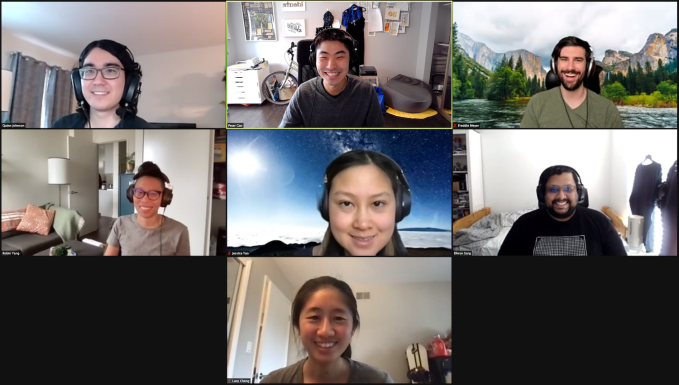
The 7 person Aquarium startup team.

The Aquarium team. Image: Aquarium

Aquarium currently has 7 employees including the founders, of which three are women. Gao says that they are being diverse by design. He understands the issues of bias inherent in machine learning model creation, and creating a diverse team for this kind of tooling is one way to help mitigate that bias.

The company launched last February and spent part of the year participating in the Y Combinator Summer 2020 cohort. They worked on refining the product throughout 2020, and recently opened it up from beta to generally available.

24 Feb 2021

Meet the LatinX Startup Alliance and Startout founders from TC Include at TC Sessions: Justice 2021

We love nothing more than highlighting notable early-stage startups, and you’ll find plenty of them in the spotlight on March 3 at TC Sessions: Justice 2021, a virtual conference exploring diversity, inclusion and the human labor that powers tech. You do not want to miss meeting and learning more about these impressive early-stage founders — all participants in the TC Include Program.

Not familiar with TC Include? TechCrunch partners with various founder organizations who act as advisors and nominate promising early-stage founders to participate in the program. In a collective collaboration with VC organizations like Kleiner Perkins, Salesforce Ventures and Initialized Capital and the founder organizations, TC Include provides educational resources and mentorship over the course of the year to help program participants develop and succeed.

You’ll have plenty of opportunity to meet and network with TC Include founders, and you won’t want to miss their live pitch feedback session. Each TC Include founder gets a 60-second pitch to a TechCrunch staffer. It’s a great opportunity to learn how to structure your pitch and pick up a few tips and strategies. Who knows? The pitch you improve could be your own.

We’ve already announced the TC Include startups affiliated with partner organizations Black Female Founders (here) and the Female Founder Alliance (here). Today, we’re thrilled to share with you just some of the early-stage founders affiliated with StartOut and the LatinX Startup Alliance.

StartOut

Endo Industries: Endo Industries sells cannabis plants and, through collaboration with farmers, is building a platform that helps operators scale brands grounded in equity, diversity and wellness. Founded by Nancy Do.

Kyndoo: Kyndoo is a data platform for solving social media’s biggest problems — fraud, attribution and content safety. It helps brands avoid working with #FakeFamous and helps them find companies that share their mission and values. Founded by Kelly McDonald.

Thimble: Thimble is a monthly subscription service that teaches kids robotics and coding skills through a curated STEM curriculum, robotics and coding kits and live, build-along classes. Founded by Oscar Pedroso.

LatinX Startup Alliance

Hoy Health: Hoy Health, a digital health company with a bilingual platform, provides access to primary care products and services, at low cost, to underserved communities. Founded by Mario Anglada.

Caribu: Caribu‌ ‌helps‌ ‌kids have virtual playdates with family and friends by ‌playing games, reading‌ and coloring ‌together in‌ ‌an‌ ‌interactive‌ ‌video-call. Founded by Max Tuchman.

Pandocap.co: Pandocap is a financial media company built around the capital markets. Bilingual content focuses on easy-to-understand information and highlights diverse voices through different strategies. Founded by Laura Moreno.

TC Sessions: Justice 2021 takes place on March 3. Check out the event agenda, buy your pass today, and discover the opportunities that come from building a more diverse, inclusive and just industry.

24 Feb 2021

VCs are chasing Hopin upwards of $5-6B valuation

Virtual events platform Hopin is hopin’ for a mega valuation.

According to multiple sources who spoke with TechCrunch, the company, which was founded in mid-2019, is running around the fundraise circuit and perhaps nearing the end of a fundraise in which it is looking to raise roughly $400 million at a pre-money valuation of $5 billion for its Series C. Two sources implied that the valuation could reach as high as $6 billion, but with greater dilution based on some offered terms the company has received. The deal is in flux, and both the round size and valuation are subject to change.

One source told TechCrunch that the company’s ARR has grown to $60 million, implying a valuation multiple of 80-100x if the valuation we’re hearing pans out. That sort of multiple wouldn’t be out of line with other major fundraises for star companies with SaaS-based business models.

Hopin has been on a fundraise tear in recent months. The company raised $125 million at a $2.125 billion valuation late last year for its Series B, which came just a few months after it raised a Series A of $40 million over the summer and a $6.5 million seed round last winter. All told, the roughly 20-month-old company has raised a known $171.4 million in VC according to Crunchbase.

When we last reported on the company, Hopin’s ARR had gone from $0 to $20 million, while its overall userbase had grown from essentially zero to 3.5 million users in November. The company reported then that it had 50,000 groups using its platform.

Hopin’s platform is designed to translate the in-person events experience into a virtual one, providing tools to recreate the experience of walking exhibition floors, networking one-on-one and spontaneously joining fireside chats and panels. It’s become a darling in the midst of the COVID-19 pandemic, which has seen most business and educational conferences canceled in the midst of mass restrictions on domestic and international travel worldwide.

It’s probably also useful to note that our business team uses Hopin to run all of TechCrunch’s editorial events, including Disrupt, Early Stage, Extra Crunch Live and next week’s TechCrunch Sessions: Justice 2021 event (these software selections and their costs are — thankfully — outside the purview of our editorial team).

Hopin may be the mega-leader of the virtual events space right now, but it isn’t the only startup trying to take on this suddenly vital industry. Run The World raised capital last year, Welcome wants to be the ‘Ritz-Carlton for event platforms,’ Spotify is getting into the business, Clubhouse is arguably a contender here, InEvent raised a seed earlier this month and Hubilo is another entrant which nabbed a check from Lightspeed a few months ago. Plus, quite literally dozens of other startups have either started in the space or are pivoting toward it.

We have reached out to Hopin for comment.

24 Feb 2021

VCs are chasing Hopin upwards of $5-6B valuation

Virtual events platform Hopin is hopin’ for a mega valuation.

According to multiple sources who spoke with TechCrunch, the company, which was founded in mid-2019, is running around the fundraise circuit and perhaps nearing the end of a fundraise in which it is looking to raise roughly $400 million at a pre-money valuation of $5 billion for its Series C. Two sources implied that the valuation could reach as high as $6 billion, but with greater dilution based on some offered terms the company has received. The deal is in flux, and both the round size and valuation are subject to change.

One source told TechCrunch that the company’s ARR has grown to $60 million, implying a valuation multiple of 80-100x if the valuation we’re hearing pans out. That sort of multiple wouldn’t be out of line with other major fundraises for star companies with SaaS-based business models.

Hopin has been on a fundraise tear in recent months. The company raised $125 million at a $2.125 billion valuation late last year for its Series B, which came just a few months after it raised a Series A of $40 million over the summer and a $6.5 million seed round last winter. All told, the roughly 20-month-old company has raised a known $171.4 million in VC according to Crunchbase.

When we last reported on the company, Hopin’s ARR had gone from $0 to $20 million, while its overall userbase had grown from essentially zero to 3.5 million users in November. The company reported then that it had 50,000 groups using its platform.

Hopin’s platform is designed to translate the in-person events experience into a virtual one, providing tools to recreate the experience of walking exhibition floors, networking one-on-one and spontaneously joining fireside chats and panels. It’s become a darling in the midst of the COVID-19 pandemic, which has seen most business and educational conferences canceled in the midst of mass restrictions on domestic and international travel worldwide.

It’s probably also useful to note that our business team uses Hopin to run all of TechCrunch’s editorial events, including Disrupt, Early Stage, Extra Crunch Live and next week’s TechCrunch Sessions: Justice 2021 event (these software selections and their costs are — thankfully — outside the purview of our editorial team).

Hopin may be the mega-leader of the virtual events space right now, but it isn’t the only startup trying to take on this suddenly vital industry. Run The World raised capital last year, Welcome wants to be the ‘Ritz-Carlton for event platforms,’ Spotify is getting into the business, Clubhouse is arguably a contender here, InEvent raised a seed earlier this month and Hubilo is another entrant which nabbed a check from Lightspeed a few months ago. Plus, quite literally dozens of other startups have either started in the space or are pivoting toward it.

We have reached out to Hopin for comment.

24 Feb 2021

Marc Benioff and this panel of judges will decide who gets one seat on the first all-civilian spaceflight

SpaceX’s first all-civilian human spaceflight mission, which will carry four passengers to orbit using a Crew Dragon capsule later this year if all goes to plan, will include one passenger selected by a panel of judges weighing the submissions of entrepreneurs. The panel will include Salesforce CEO Marc Benioff, Fast Company Editor-in-Chief Stephanie Mehta, YouTuber Mark Rober and Bar Rescue TV host Jon Taffer. It may seem like an eclectic bunch, but there is some reason to the madness.

This seat is one of four on the ride – the first belongs to contest and mission sponsor Jared Isaacman, the founder of Shift4 Payments and a billionaire who has opted to spend a not insignificant chunk of money funding the flight. The second, Isaacman revealed earlier this week, will go to St. Jude Children’s Research Hospital employee and cancer survivor Hayley Arceneaux.

That leaves two more seats, and they’re being decided by two separate contests. One is open to anyone who is a U.S. citizen and who makes a donation to St. Jude via the ongoing charitable contribution drive. The other will be decided by this panel of judges, and will be chosen from a pool of applicants who have build stores on Shift4’s Shift4Shop e-commerce platform.

That’s right: This absurdly expensive and pioneering mission to space is also a growth marketing campaign for Isaacman’s Shopify competitor. But to be fair, the store of the winning entrant doesn’t have to be news – existing customers can also apply and are eligible.

The stated criteria for deciding the winner is “a business owner or entrepreneur the exhibits ingenuity, innovation and determination” so in other words it could be just about anybody. I’m extremely curious to see what Benioff, Mehta, Rober (also a former NASA JPL engineer in addition to a YouTuber) and Taffer come up with between them as a winner.

The Inspiration4 mission is currently set to fly in the fourth quarter of 2021, and mission specifics including total duration and target orbit are yet to be determined.

24 Feb 2021

Marc Benioff and this panel of judges will decide who gets one seat on the first all-civilian spaceflight

SpaceX’s first all-civilian human spaceflight mission, which will carry four passengers to orbit using a Crew Dragon capsule later this year if all goes to plan, will include one passenger selected by a panel of judges weighing the submissions of entrepreneurs. The panel will include Salesforce CEO Marc Benioff, Fast Company Editor-in-Chief Stephanie Mehta, YouTuber Mark Rober and Bar Rescue TV host Jon Taffer. It may seem like an eclectic bunch, but there is some reason to the madness.

This seat is one of four on the ride – the first belongs to contest and mission sponsor Jared Isaacman, the founder of Shift4 Payments and a billionaire who has opted to spend a not insignificant chunk of money funding the flight. The second, Isaacman revealed earlier this week, will go to St. Jude Children’s Research Hospital employee and cancer survivor Hayley Arceneaux.

That leaves two more seats, and they’re being decided by two separate contests. One is open to anyone who is a U.S. citizen and who makes a donation to St. Jude via the ongoing charitable contribution drive. The other will be decided by this panel of judges, and will be chosen from a pool of applicants who have build stores on Shift4’s Shift4Shop e-commerce platform.

That’s right: This absurdly expensive and pioneering mission to space is also a growth marketing campaign for Isaacman’s Shopify competitor. But to be fair, the store of the winning entrant doesn’t have to be news – existing customers can also apply and are eligible.

The stated criteria for deciding the winner is “a business owner or entrepreneur the exhibits ingenuity, innovation and determination” so in other words it could be just about anybody. I’m extremely curious to see what Benioff, Mehta, Rober (also a former NASA JPL engineer in addition to a YouTuber) and Taffer come up with between them as a winner.

The Inspiration4 mission is currently set to fly in the fourth quarter of 2021, and mission specifics including total duration and target orbit are yet to be determined.

24 Feb 2021

Metal 3D printing company Markforged announces plans to go public via SPAC

Big morning for Massachusetts tech companies planning to go public via SPAC. Shortly after Berkshire Grey unveiled its intentions, Watertown-based Markforged has announced its own plans. The metal 3D printing company intends to merge with ONE, a special purpose acquisition company created by Kevin Hartz, who will join its board.

The deal, which could value the additive manufacturing company at around $2.1 billion, would bring in around $400 million in cash. Markforged plans to use the money on R&D for new products, materials and building out new verticals for its tech. Shai Terem will stay on as CEO.

“We’ve been at the forefront of the additive manufacturing industry,” the executive said in a release tied to the news, “and this transaction will enable us to build on our incredible momentum and provide capital and flexibility to grow our brand, accelerate product innovation, and drive expanded adoption among customers across key verticals.”

The company says its technology has been used to print north of 10 million parts since its 2013 founding, with its machines deployed in some 10,000 locations across 70 countries. Last year, it pulled in around $70 million in revenue. It has raised north of $136 million thus far, including an $82 million round back in 2019.

3D printing seen some strong growth in recent years, and that’s expected to continue as companies look to the technology to expand beyond the rapid prototyping it’s best known for. Metal printing from the likes of Markforged and competitors including Desktop Metal are seen as an important step, offering far more durability than plastic deposits.

SPACs are, of course, becoming an increasingly popular route for taking companies public. Hardware makers haven’t been a huge player thus far (with a few exceptions like smart lock mater, Latch), though that looks like it may be changing. The deal is expected to close over the summer.

24 Feb 2021

Understanding Toast’s expected IPO through the lens of Olo’s 2020 results

Boston-based Toast has been on a roller coaster over the last year.

From raising $400 million in February 2020 at a nearly $5 billion valuation, the company cut staff in March after COVID-19 turned its business upside down. Toast had recorded 109% revenue growth in 2019.

Toast’s ups and downs were hardly over. The company has since recovered greatly since those early-COVID layoffs. Evidence of that comes in the form of the company’s reportedly-pending IPO and reportedly possible $20 billion valuation.


The Exchange explores startups, markets and money. Read it every morning on Extra Crunch, or get The Exchange newsletter every Saturday.


It feels like every IPO these days is blasting final private valuations out of the water, but Toast’s ascent from layoffs to an IPO in under a year is an impressive turnaround. And that’s if it prices flat at $5 billion. Anything higher is just cream for the software unicorn.

Until we get the S-1, we won’t know the full details. That said, anotherr company that operates in a similar part of the restaurant technology market is going public at the moment, and we have its S-1 filing: New York-based Olo.

This morning, while we await the numbers from Toast that should prove as interesting as Airbnb’s own COVID-19 recovery, let’s peek at Olo’s results to get a taste of the market that Boston’s leading startup dealt with in 2020.

Olo’s IPO

Olo isn’t a company that has been very loud in recent years; The New York-based software company last raised capital in 2016 when it picked up $40 million in a Series D.

It’s business has three parts, per its S-1 filing. First, Olo offers white-labeled ordering software. And its service also helps restaurants handle delivery options, what it calls “dispatch.” Finally, Olo’s software, in a nearly Yext-like fashion, delivers restaurant information to online platforms.

Toast, as a reminder, offers point-of-sale services, along with online ordering and delivery services similar to Olo. Notably, Toast has been expanding its software lineup, adding payroll management recently among other offerings, including email marketing tools.

But both companies generate software (SaaS) and consumption (transaction-based services) incomes from the restaurant space, so if one had a big 2020, it’s likely that the other swam in similar waters.

24 Feb 2021

Primary Venture Capital raises $150M third fund to back NYC startups

Primary Venture Partners, a firm focused exclusively on investing in New York-area startups, has raised $150 million in its third fund for seed investments (its largest so far), as well as $50 million for the Select fund it uses to participate in later-stage rounds.

The firm’s portfolio includes New York success stories like Jet.com (acquired by Walmart for $3.3 bill million), Mirror (acquired by Lululemon for $500 million) and Latch (which is planning to go public via SPAC). And the firm has doubled down on its association with New York by publishing an NYC Founder Guide.

Still, the idea of limiting your investments to a specific geography might sound old-fashioned at a time when offices largely go unused, teams are increasingly distributed and some investors are loudly trumpeting new startup hubs. But General Partner Brad Svrluga (who founded the firm with General Partner Ben Sun) told me that the New York focus remains crucial for the firm — for example, in its work to help startups hire the best employees.

“When you think about [our three-person talent team], their charge is to understand, track and be connected to the top 10% of all talent in New York City,” Svrluga said. “That’s a big, ambitious challenge, but it’s also one that we’ve got a really good shot at doing in a relatively confined geography. If we were trying to simultaneously recruit for companies in New York, Seattle, Boston, Austin, L.A., the Bay Area, etc., you just can’t do it — or you’d need an army.”

And while he said San Francisco and Silicon Valley remain “unquestionably the center of the universe that we operate in, the sun around which everything else evolves,” he suggested that New York has unique advantages: “Unlike the Bay Area, New York is powered by a whole collection of industries. That diversity makes the place radically more resilient.”

That doesn’t mean things won’t change as we emerge from the pandemic. For one thing, Svrluga anticipated that companies that are ostensibly New York based will be more distributed, with “a relatively lower percentage of their workforce in New York City proper,” and of that NYC workforce, “fewer of them in the office on any given day.” He’s also hopeful that startup real estate costs will “shrink materially.”

“I would love it if you and your peers continue to trumpet the demise of New York, so other investors can stop paying attention and we can have a less competitive environment,” he added.

Another change — one that’s not limited to geography — is the growing size of seed rounds, which Svrluga said is one of the reasons for the larger fund. The seed, he suggested, has become “the first third of the A” round, but that doesn’t mean startups raising seed rounds need to be more further along.

“A whole bunch of what we do has always has been way pre-product,” he said. “It could be just a founder or just two three people …. some early code might be written but you’re months and months way from launch. They’re now capable raising $2.5, $3, $4 million right out of the gate.”

In addition to the new funds, Primary is also announcing that it has appointed Rebecca Price as operating partner and promoted Jason Shuman to partner.

24 Feb 2021

4 essential truths about venture investing

After making pre-seed investments for seven years, I have observed how different the pre-seed stage is from Series A and later-stage investing.

Today, I want to highlight four ideas that are true across different stages of investing.

Venture outcomes are driven by a power law

Power law is an immutable law of the universe. Examples include the distribution of population in cities, price of artwork, and unfortunately, wealth distribution. This law is also known as the Pareto principle, and colloquially known as the 80%-20% rule.

The average manager faces a very real possibility of making no money at all because of how steep the power law curve is.

Venture capital is no exception and the outcomes of every venture portfolio will likely follow a power law distribution. There are two significant things to think about here:

One: Because most startups fail, the distribution is going to have a lot of zeros (or near zeros) in the long tail. The zeros are going to be followed by singles and doubles.

Two: The biggest winners, when they happen, tend to be huge. Unicorns were hard to come by when Aileen Lee penned her now-famous article in 2013. Today, unicorns are no longer as rare and top-tier firms are constructing their portfolio with the goal of funding a decacorn — a company valued at $10 billion or higher.

There is nothing mysterious about the power law dynamic in venture. Just like the rich get richer, the biggest companies get bigger.

A startup that reaches $10 million in revenue is much more likely to double, double again and then cruise by $100 million in revenue versus a startup at the $1 million mark now trying to get to $10 million.

At scale, everything is different — the resources, the possibilities and access to capital. Of course, even companies that reach very substantial scale may run into obstacles and eventually underperform. But that is not the point.

The point is that the ones that do end up winning and driving all the returns keep doubling and continue getting bigger and bigger.

Hence, the outcomes of the venture portfolio fit a power law curve.

The best managers in the business are distinguished by a few more at the very top of the curve.

The average manager faces a very real possibility of making no money at all because of how steep the power law curve is.

Your fund size is your strategy

There is a piece of feedback that fund of fund managers frequently give to GPs: Your fund size is your strategy.

What they are essentially saying is that a fund’s portfolio construction will depend on how much capital is under management, and vice versa. Why is that?

Let’s take two extreme examples — a manager of a $10 million fund and a manager of a $1 billion fund. Let’s assume that both managers want to lead rounds. If the first one decided to be a Series A fund, it would be extremely concentrated. It may be able to lead 1-2 rounds, but that’s it. Given the power law nature of outcomes, it would be extremely unlikely for this manager to generate a good return.