
Year: 2021

22 Feb 2021

Why I felt fine about not disclosing my pregnancy to investors

I closed two major rounds of funding for my geothermal energy startup, Dandelion Energy, while pregnant. I did not disclose either pregnancy to my investors during the fundraising process either time. I felt fine doing this, and I believe other founders should feel free to keep their pregnancies private as well if they’d prefer to.

No one would think twice about a male founder who declined to share the details of his health or family status with investors during an initial fundraising meeting. On the contrary, it would be an unusual move for him to do so.

For some context, my co-founder and I spun our startup, Dandelion Energy, out of Alphabet’s X in April 2017 and raised our first small round of outside funding that summer. Our goal was to set up a commercial pilot and start selling and installing heat pumps to demonstrate that our product worked and show that there was demand for affordable geothermal before we raised a larger round. We had to prove that our business was viable.

No one would think twice about a male founder who declined to share the details of his health or family status with investors during an initial fundraising meeting.

That same summer, in 2017, I became pregnant.

Round one

As summer turned to fall, I had to figure out how to approach being pregnant while raising Dandelion’s second round of funding. I was lucky to be able to choose whether to tell people I was pregnant because it turned out I didn’t end up looking visibly pregnant until about seven months in, and even then I could dress to make it nonobvious. Without knowing anyone who’d gone through a similar experience, I had to decide how I would handle my status as a pregnant person when speaking with investors.

At first, it worried me that I would be hiding something if I didn’t disclose my pregnancy. But I really didn’t want to. I was a first-time entrepreneur with no real track record. Oh yeah, and I was a woman. And almost all of the investors were men who typically funded men.

Especially early on in a startup’s life, these investors are judging the founder as much as the business. Making an impression is key, and “pregnant” didn’t strike me as accretive in any way to my ability to deliver the type of impression that would lead to investment in my business (I hope this changes over time, but I am being honest about how things seemed to me).

And then there was this: Even if I had decided to tell investors I was expecting, how could I broach the topic in a way that wouldn’t threaten to derail the entire tenor of the meeting? I was meeting most of these people for the first time and had a limited amount of time to spend explaining payback periods and vapor compression refrigeration cycles. It seemed like the best-case scenario was if disclosing pregnancy made the meeting no worse than it would otherwise have been. In no world could I imagine it would be a net positive.

Given all of this, I made the decision to not talk about it. It worked out for me. As soon as I started showing, around seven months in, everyone left their offices for the holidays, and so I was never forced to address what was becoming visibly obvious.

But of course there was a downside to my approach. I would have to tell them eventually, and I’d pushed it off so long that by the time I finally got around to it we basically had to have a conversation like this:

Me: “Some happy news to share: I’m pregnant!”

Investors: “Congratulations! We are so thrilled for you! When’s the due date?”

Me: “Ahhh … Next month.”

Happily, all of them were extremely supportive and gracious when I told them. Their uncomplicated and positive acceptance of the news even made me wonder if all my internal wrangling about whether to tell investors had been unnecessary. I gave birth to my daughter literally one day after the money was wired.

Round two

Time passed and it became clear we were ready to raise our next round of funding. Also, I become pregnant again. This time, most of the fundraising happened in the early stages of my pregnancy. Early enough that I hadn’t even really told my friends, so it was obvious to me I wouldn’t be telling investors I was just meeting. After having gone through it once before, it was an easier decision the second time around.

Looking back

Reflecting on my experience, I do think it helped that I got to know my investors throughout the fundraising process, so by the time I told them I was pregnant, they already knew me and I had already established my credibility as an entrepreneur. Being pregnant was just something going on in my life; it didn’t define who I was to them. That is one advantage of introducing it later: It did not define me because they knew so much else about me by that point.

In many ways, I am a stereotypical founder: I have a CS degree from Stanford, I worked as a PM at Google, I have an engineering background. I have many advantages. Yet, more present in my mind during fundraising were the parts of my identity that seemed atypical, and the primary aspect here was my being a woman.

Because there is so much conversation about how women receive so much less investment, I was worried that being a woman would be a disadvantage, and there’s nothing like being pregnant to highlight in the strongest possible way that you’re a woman.

I now feel lucky to know other founders who have raised money while visibly pregnant, and so I’ve seen firsthand that it’s possible. But it is not something that a pregnant founder should feel obligated to disclose. I hope that it becomes common for women to start businesses and raise capital for those businesses in every stage of their lives, including when they’re pregnant.

Because as soon as the pregnant woman and the guy with the hoodie both seem equally probable as startup founders, it will suddenly matter much less whether to talk about your pregnancy.
22 Feb 2021

Equity Monday: Everyone is going public so what’s wrong with your startup?

Hello and welcome back to Equity, TechCrunch’s venture capital-focused podcast where we unpack the numbers behind the headlines.

This is Equity Monday, our weekly kickoff that tracks the latest private market news, talks about the coming week, digs into some recent funding rounds and mulls over a larger theme or narrative from the private markets. You can follow the show on Twitter here and myself here — and be sure to check out our last main ep, in which Natasha coins a slogan for a16z that I both hate, and became the headline of the show!

But enough of all of that, we have a lot to get through this morning. Here’s what we talked about:

  • The Weekend: Coinbase at $100 billion? More on that to come. Toast is going public! Probably! Wait Toast the company that laid off staff last year? Yep that Toast! It’s not toast! And new rules on online lending in China.
  • This Morning: Oscar Health put together an IPO price range that is interesting, and Apex Clearing is going public via a SPAC.
  • Funding Rounds: Gophr raises money! Ageras Group raises money! Promise raises money! It was hard to pick just three, but each of those rounds has something notable about it. Enjoy!
  • Deeper Dive/Riff: If the public markets will float even the most leaden of startup via a SPAC-balloon, any late-stage startup that doesn’t take the ride out of the private markets must either be perfect or too heavy to lift. And if it’s the second, we can write it off? Maybe?

And, finally, this is precisely what I feel like this Monday morning. Chat soon and stay safe!

Equity drops every Monday at 7:00 a.m. PST and Thursday afternoon as fast as we can get it out, so subscribe to us on Apple PodcastsOvercastSpotify and all the casts.

22 Feb 2021

Creatio raises $68M as the low-code space keeps attracting huge checks

This morning Creatio, a Boston-based software company, announced that it has raised $68 million. Volition Capital, a growth-equity fund, led the round. The deal was a minority investment in the startup.

The deal is notable not merely thanks to its sheer size, but because up until today Creatio had bootstrapped. That’s according to founder and CEO Katherine Kostereva, with whom TechCrunch caught up with last week regarding the investment.

Per Kostereva, her company’s low-code platform helps other companies automate business processes. Creatio’s competitive edge, she said, comes in part from how quickly it can help companies automate; the faster that companies can get from a low-code platform to live apps matters.

Creatio also has a genre-focus, namely that it touts its platform’s ability to help automate work in the CRM space — think marketing and sales-related tasks. But its crowning “jewel,” Kostereva said, is Creatio’s underlying low-code automation platform.

The low-code world that Creatio competes in is a broad space that is seeing active investment from the very-early to the very-late stage. For example, last month TechCrunch covered no-code focused Stacker’s $1.7 million round. And earlier this month TechCrunch wrote about low-code focused OutSystems’ $150 million raise at a $9.5 billion valuation.

To see another low-code company raise a big check was therefore not too surprising.

TechCrunch was curious where the company and its founder came down on the concept of low-code versus no-code, a topic that is always good to ask players in either space. Kostereva highlighted the importance of citizen developers, folks who can use drag-and-drop interfaces to create apps but who are less adept with code. But she added that with today’s no-code tools one can only build simple things. Creatio, she continued, is more focused on the mid-market and enterprise. As such, it’s just not possible for Creatio to go no-code today. But, her view did appear to be that citizen devs should be able to do more and more in time without code.

It’s a fair perspective, and an encouraging one. The more that folks can do sans code, the more power that can shift into the hands of business orgs that traditionally had to depend on other departments for dev lift.

Back to the money side of things, Creatio has historically targeted breakeven financial results per its CEO. That means it reinvested in itself as it grew, an arrangement that made us was curious as to why the company would raise capital now; why change up a working formula?

In short the company was getting itself ready for to accelerate, according to its founder. Kostereva said that she wanted Creatio to have “world class” numbers for metrics like net retention, revenue growth, and net promoter score before it took on external funds.

Was the wait worth it? The company’s net retention was 122% last year, and its NPS score is 34, she disclosed. On the growth side of things, Kostereva said that her company started off doubling and tripling and is still close to doubling. Our read of her comments is that Creatio is probably growing its ARR in the high double-digits today.

The company wants to use its capital to invest in sales-and-marketing to help spread the the word about its business, invest in its partner program, a key growth mechanism, and R&D, it said. So, a little bit of everything.

TechCrunch has recently noticed just how big the software world really is, indexing off the fast that there is enough room for a host of OKR-focused startups to grow and raise external capital without weeding weaker players out. Given how many businesses processes there are in the world to automate, it may be that Creatio and other low-code platforms that want to help other companies accelerate will enjoy similar market dynamics. Investors, at least, are betting like that’s the case.

22 Feb 2021

A race to reverse engineer Clubhouse raises security concerns

As live audio chat app Clubhouse ascends in popularity around the world, concerns about its data practices also grow.

The app is currently only available on iOS, so some developers set out in a race to create Android, Windows and Mac versions of the service. While these endeavors may not be ill-intentioned, the fact that it takes programmers little effort to reverse engineer and fork Clubhouse — that is, when developers create new software based on its original code — is sounding an alarm about the app’s security.

The common goal of these unofficial apps, as of now, is to broadcast Clubhouse audio feeds in real-time to users who cannot access the app otherwise because they don’t have an iPhone. One such effort is called Open Clubhouse, which describes itself as a “third-party web application based on flask to play Clubhouse audio.” The developer confirmed to TechCrunch that Clubhouse blocked its service five days after its launch without providing an explanation.

“[Clubhouse] asks a lot of information from users, analyzes those data and even abuses them. Meanwhile, it restricts how people use the app and fails to give them the rights they deserve. To me, this constitutes monopoly or exploitation,” said Open Clubhouse’s developer nicknamed AiX.

Clubhouse cannot be immediately reached for comment on this story.

AiX wrote the program “for fun” and wanted it to broaden Clubhouse’s access to more people. Another similar effort came from a developer named Zhuowei Zhang, who created Hipster House to let those without an invite browse rooms and users, and those with an invite to join rooms as a listener though they can’t speak — Clubhouse is invite-only at the moment. Zhang stopped developing the project, however, after noticing a better alternative.

These third-party services, despite their innocuous intentions, can be exploited for surveillance purposes, as Jane Manchun Wong, a researcher known for uncovering upcoming features in popular apps through reverse engineering, noted in a tweet.

“Even if the intent of that webpage is to bring Clubhouse to non-iOS users, without a safeguard, it could be abused,” said Wong, referring to a website rerouting audio data from Clubhouse’s public rooms.

Clubhouse lets people create public chat rooms, which are available to any user who joins before a room reaches its maximum capacity, and private rooms, which are only accessible to room hosts and users authorized by the hosts.

But not all users are aware of the open nature of Clubhouse’s public rooms. During its brief window of availability in China, the app was flooded with mainland Chinese debating politically sensitive issues from Taiwan to Xinjiang, which are heavily censored in the Chinese cybserspace. Some vigilant Chinese users speculated the possibility of being questioned by the police for delivering sensitive remarks. While no such event has been publicly reported, the Chinese authorities have banned the app since February 8.

Clubhouse’s design is by nature at odds with the state of communication it aims to achieve. The app encourages people to use their real identity — registration requires a phone number and an existing user’s invite. Inside a room, everyone can see who else is there. This setup instills trust and comfort in users when they speak as if speaking at a networking event.

But the third-party apps that are able to extract Clubhouse’s audio feeds show that the app isn’t even semi-public: It’s public.

More troublesome is that users can “ghost listen,” as developer Zerforschung found. That is, users can hear a room’s conversation without having their profile displayed to the room participants. Eavesdropping is made possible by establishing communication directly with Agora, a service provider employed by Clubhouse. As multiple security researchers found, Clubhouse relies on Agora’s real-time audio communication technology. Sources have also confirmed the partnership with TechCrunch.

Some technical explanation is needed here. When a user joins a chatroom on Clubhouse, it makes a request to Agora’s infrastructure, as the Stanford Internet Observatory discovered. To make the request, the user’s phone contacts Clubhouse’s application programming interface (API), which then creates “tokens”, the basic building block in programming that authenticates an action, to establish a communication pathway for the app’s audio traffic.

Now, the problem is there can be a disconnect between Clubhouse and Agora, allowing the Clubhouse end, which manages user profiles, to be inactive while the Agora end, which transmits audio data, remains active, as technology analyst Daniel Sinclair noted. That’s why users can continue to eavesdrop on a room without having their profile displayed to the room’s participants.

The Agora partnership has sparked other forms of worries. The company, which operates mainly from the U.S. and China, noted in its IPO prospectus that its data may be subject to China’s cybersecurity law, which requires network operators in China to assist police investigations. That possibility, as the Stanford Internet Observatory points out, is contingent on whether Clubhouse stores its data in China.

While the Clubhouse API is banned in China, the Agora API appears unblocked. Tests by TechCrunch find that users currently need a VPN to join a room, an action managed by Clubhouse, but can listen to the room conversation, which is facilitated by Agora, with the VPN off. What’s the safest way for China-based users to access the app, given the official attitude is that it should not exist? It’s also worth noting that the app was not available on the Chinese App Store even before its ban, and Chinese users had downloaded the app through workarounds.

The Clubhouse team may be overwhelmed by data questions in the past few days, but these early observations from researchers and hackers may urge it to fix its vulnerabilities sooner, paving its way to grow beyond its several million loyal users and $1 billion valuation mark.

22 Feb 2021

Snack, where TikTok meets dating, gets $3.5 million in funding

After online dating’s tremendous 2020 growth that culminated in last week’s epic Bumble IPO, a new entrant has tossed its hat into the dating app ring.

Snack, founded by Kimberly Kaplan, looks to merge the popularity and format of TikTok with the dating world. Kaplan hails from Plenty of Fish, where she was one of the earliest employees at the dating site. She led product, marketing and revenue and was on the executive team that eventually sold PoF to Match Group for $575 million in 2015.

Kaplan said that she noticed a specific user behavior among folks using dating apps, particularly the coveted Gen Z demographic. Essentially, folks would match on Bumble or Tinder and immediately move the connection over to apps like Snap and Instagram, where they would watch each others’ stories and more casually flirt, rather than carrying on in a more high-pressure DM conversation on the dating apps.

Around the same time, TikTok surged in popularity, showing a shift in the average consumer’s attitude toward creating short-form video on the web.

Snack is a video-first dating app that asks users to create a video and post it to a feed. Other users can scroll through a feed (a la Instagram) rather than swipe right or left on individual profiles, and when someone likes a video, it opens up the ability to comment. Once two users have liked each others’ videos, DMs are open.

The app is still in its early days, so there is no location filtering yet to ensure that everyone who joins the app has a full feed of videos to browse through. Kaplan said that Snack is also working on video editing features similar to that of TikTok to let people get super creative with their profiles.

Thus far, Snack has received $3.5 million in funding, led by Kindred Ventures and Coelius Capital, with participation by Golden Ventures, Garage Capital, Panache Ventures and N49P.

Though we’re still a ways away from monetization, Kaplan says her experience in the dating space should be beneficial when looking to generate revenue at Snack, and that the startup will likely follow the same playbook as other dating apps, employing premium subscriptions and potentially ads.

There are 10 people on the Snack team, and Kaplan says that the team is 60 percent diverse with 40 percent of employees being visible minorities.

“The biggest challenge is going up against big players that have a lot of capital,” said Kaplan. “Starting out is hard and getting that initial foothold is hard. I fundamentally believe in our product and I see this open opportunity in the market. I very much believe someone will come in and usurp Tinder, and it’s going to be around video.”

22 Feb 2021

Winning enterprise sales teams know how to persuade the Chief Objection Officer

Many enterprise software startups at some point have faced the invisible wall. For months, your sales team has done everything right. They’ve met with a prospect several times, provided them with demos, free trials, documentation and references, and perhaps even signed a provisional contract.

The stars are all aligned and then, suddenly, the deal falls apart. Someone has put the kibosh on the entire project. Who is this deal-blocker and what can software companies do to identify, support and convince this person to move forward with a contract?

I call this person the Chief Objection Officer.

Who is this deal-blocker and what can software companies do to identify, support and convince this person to move forward with a contract?

Most software companies spend a lot of time and effort identifying their potential buyers and champions within an organization. They build personas and do targeted marketing to these individuals and then fine-tune their products to meet their needs. These targets may be VPs of engineering, data leaders, CTOs, CISOs, CMOs or anyone else with decision-making authority. But what most software companies neglect to do during this exploratory phase is to identify the person who may block the entire deal.

This person is the anti-champion with the power to scuttle a potential partnership. Like your potential deal-makers, these deal-breakers can have any title with decision-making power. Chief Objection Officers aren’t simply potential buyers who end up deciding your product is not the right fit, but are instead blockers-in-chief who can make departmentwide or companywide decisions. Thus, it’s critical for software companies to identify the Chief Objection Officers that might block deals and, then, address their concerns.

So how do you identify the Chief Objection Officer? The trick is to figure out the main pain points that arise for companies when considering deploying your solution, and then walk backward to figure out which person these challenges impact the most. Here are some common pain points that your potential customers may face when considering your product.

Change is hard. Never underestimate the power of the status quo. Does implementing your product in one part of an organization, such as IT, force another department, such as HR, to change how they do their daily jobs?

Think about which leaders will be most reluctant to make changes; these Chief Objection Officers will likely not be your buyers, but instead the heads of departments most impacted by the implementation of your software. For example, a marketing team may love the ad targeting platform they use and thus a CMO will balk at new database software that would limit or change the way customer segment data is collected. Or field sales would object to new security infrastructure software that makes it harder for them to access the company network from their phones. The head of the department that will bear the brunt of change will often be a Chief Objection Officer.

Is someone’s job on the line?

Another common pain point when deploying a new software solution is that one or more jobs may become obsolete once it’s up and running. Perhaps your software streamlines and outsources most of a company’s accounts payable processes. Maybe your SaaS solution will replace an on-premise homegrown one that a team of developers has built and nurtured for years.

22 Feb 2021

Nanit raises another $25M for its AI-powered baby monitor

Nanit’s nursery camera pairs computer vision with specially-patterned clothing to help answer the question that most new parents ask themselves roughly every 90 seconds: “Is my baby still breathing?”

This morning the company is announcing that it has raised an additional $25 million in a Series C round led by GV.

As part of the deal, GV’s Frederique Dame will join Nanit’s Board of Directors.

The company raises this Series C on the momentum of a strong year. While declining to share exactly how many cameras the company had sold to date, Nanit CEO Sarah Dorsett tells me that camera sales were up 130% in 2020 versus 2019.

Earlier this month Nanit debuted the Nanit Pro, an upgraded model ($299 vs $249 for the Nanit Plus) that increases the camera’s resolution while improving things like the built-in night light and overall usability. It also launched a line of “smart sheets” complete with a custom black-and-white pattern the camera reads to help measure and record your baby’s height between doctor visits.

Dorsett tells me the company plans to expand its lineup into a broader ecosystem of nursery items, mentioning things like changing pads and nightlights as things “that exist today, but that [Nanit] could really amplify because of the app experience.”

This Series C brings Nanit’s total raised to $75M. While round-leader GV is a new investor here, it was backed by existing investors Jerusalem Venture Partners, RRE Ventures, Upfront Ventures, and Rho Capital Partners.

22 Feb 2021

Bringing jobs and health benefits, BlocPower unlocks energy efficiency retrofits for low income communities

Retrofitting buildings to make them more energy efficient and better at withstanding climate change induced extreme weather is going to be a big, multi-billion dollar business. But it’s one that’s been hard for low-income communities to tap, thanks to obstacles ranging faulty incentive structures to an inability to adequately plan for which upgrades will be most effective in which buildings.

Enter BlocPower, a New York-based startup founded by a longtime advocate for energy efficiency and the job creation that comes with it, which has a novel solution for identifying, developing and profiting off of building upgrades in low income communities — all while supporting high-paying jobs for workers in the communities the company hopes to serve.

The company also has managed to raise $63 million in equity and debt financing to support its mission. That money is split between an $8 million investment from some of the country’s top venture firms and a $55 million debt facility structured in part by Goldman Sachs to finance the redevelopment projects that BlocPower is creating.

These capital commitments aren’t charity. Government dollars are coming for the industry and private companies from healthcare providers, to utility companies, to real estate developers and property managers all have a vested interest in seeing this market succeed.

There’s going to be over $1 billion carved out for weatherization and building upgrades in the stimulus package that’s still making its way through Congress

For BlocPower’s founder, Donnel Baird, the issue of seeing buildings revitalized and good high-paying jobs coming into local communities isn’t academic. Baird was born in Brooklyn’s Bedford Stuyvesant neighborhood and witnessed firsthand the violence and joblessness that was ripping the fabric of that rich and vibrant community apart during the crack epidemic and economic decline of the 1980s and early 90s.

Seeing that violence firsthand, including a shooting on his way to school, instilled in Baird a desire to “create jobs for disconnected Black and brown people” so they would never feel the hopelessness and lack of opportunity that fosters cycles of violence.

Some time after the shooting, Baird’s family relocated from Brooklyn to Stone Mountain, Georgia, and after graduating from Duke University, Baird became a climate activist and community organizer, with a focus on green jobs. That led to a role in the presidential campaign for Barack Obama and an offer to work in Washington on Obama’s staff.

Baird declined the opportunity, but did take on a role reaching out to communities and unions to help implement the first stimulus package that Obama and Biden put together to promote green jobs.

And it was while watching the benefits of that stimulus collapse under the weight of a fragmented building industry that Baird came up with the idea for BlocPower.

“It was all about the implementation challenges that we ran into,” Baird said. “If you have ten buildings on a block in Oakland and they were all built by the same developer at the same time. If you rebuild those buildings and you retrofit all of those buildings, in five of those buildings you’re going to trap carbon monoxide in and kill everybody and in the other five buildings you’re going to have a reduction in emissions and energy savings.”

Before conducting any retrofits to capture energy savings (and health savings, but more on that later), Baird says developers need to figure out the potential for asbestos contamination in the building; understand the current heating, ventilation, and cooling systems that the building uses; and get an assessment of what actually needs to be done.

That’s the core problem that Baird says BlocPower solves. The company has developed software to analyze a building’s construction by creating a virtual twin based on blueprints and public records. Using that digital twin the company can identify what upgrades a building needs. Then the company taps lines of credit to work with building owners to manage the retrofits and capture the value of the energy savings and carbon offsets associated with the building upgrades.

For BlocPower to work, the financing piece is just as important as the software. Without getting banks to sign off on loans to make the upgrades, all of those dollars from the federal government remain locked up. “That’s why the $7 billion earmarked for investment in green buildings did not work,” Baird said. “At BlocPower our view is that we could build software to simulate using government records… we could simulate enough about the mechanicals, electrical, and plumbing across buildings in NYC so that we could avoid that cost.”

Along with co-founder Morris Cox, Baird built BlocPower while at Columbia University’s business school so that he could solve the technical problems and overcome the hurdles for community financing of renewable retrofit projects.

Right before his graduation, in 2014, the company had applied for a contract to do energy efficiency retrofits and was set to receive financing from the Department of Energy. The finalists had to go down to the White House and pitch the President. That pitch was scheduled for the same day as a key final exam for one of Baird’s Columbia classes, which the professor said was mandatory. Baird skipped the test and won the pitch, but failed the class.

After that it was off to Silicon Valley to pitch the business. Baird met with 200 or more investors who rejected his pitch. Many of these investors had been burned in the first cleantech bubble or had witnessed the fiery conflagrations that engulfed firms that did back cleantech businesses and swore they’d never make the same mistakes.

That was the initial position at Andreessen Horowitz when Baird pitched them, he said. “When I went to Andreessen Horowitz, they said ‘Our policy is no cleantech whatsoever. You need to figure out how software is going to eat up this energy efficiency market’,” Baird recalled.

Working with Mitch Kapor, an investor and advisor, Baird worked on the pitch and got Kapor to talk to Ben Horowitz. Both men agreed to invest and BlocPower was off to the races.

The company has completed retrofits in over 1,000 buildings since its launch, Baird said, mainly to prove out its thesis. Now, with the revolving credit facility in hand, BlocPower can take bigger bites out of the market. That includes a contract with utility companies in New York that will pay $30 million if the company can complete its retrofits and verify the energy savings from that work.

There are also early projects underway in Oakland and Chicago, Baird said.

Building retrofits do more than just provide energy savings, as Goldman Sachs managing director Margaret Anadu noted in a statement.

“BlocPower is proving that it is possible to have commercial solutions that improve public health in underserved communities, create quality jobs and lower carbon emissions,” Anadu said. “We are so proud to have supported Donnel and his team…through both equity and debt capital to further expand their reach.”

These benefits also have potential additional revenue streams associated with them that BlocPower can also capture, according to investor and director, Mitch Kapor.

“There are significant linkages that are known between buildings and pollution that are a public health issue. In a number of geographies community hospitals are under a mandate to improve health outcomes and BlocPower can get paid from health outcomes associated with the reduction in carbon. That could be a new revenue stream and a financing mechanism,” Kapor said. “There’s a lot of work to be done in essentially taking the value creation engine they have and figuring out where to bring it and which other engines they need to have to have the maximum social impact.”

Social impact is something that both Kapor and Baird talk about extensively and Baird sees the creation of green jobs as an engine for social justice — and one that can reunite a lot of working class voters whose alliances were fractured by the previous administration. Baird also believes that putting people to work is the best argument for climate change policies that have met with resistance among many union workers.

“We will not be able to pass shit unless workers and people of color are on board to force the U.S. senate to pass climate change policy,” Baird said. “We have to pass the legislation that’s going to facilitate green infrastructure in a massive way.”

He pointed to the project in Oakland as an example of how climate policies can create jobs and incentivize political action.

“In Oakland we’re doing a pilot project in 12 low income buildings in oakland. I sent them $20K to train these workers from local people of color in Oakland… they are being put to work in Oakland,” Baird said. “That’s the model for how this gets built. So now we need them to call Chuck Shumer to push him to the left on green building legislation.” 


22 Feb 2021

Netflix launches ‘Downloads for You,’ a new feature that automatically downloads content you’ll like

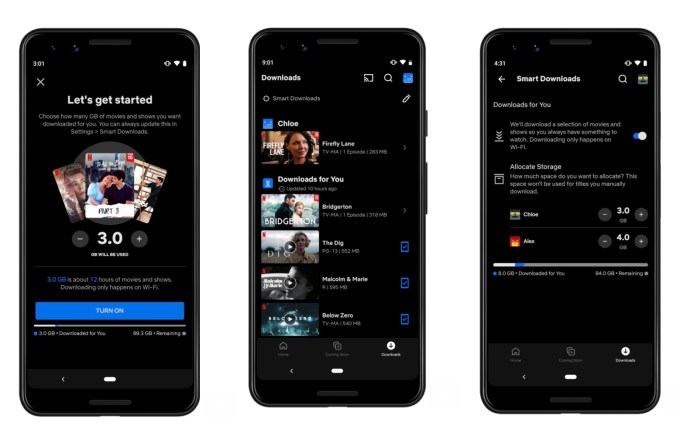
Netflix today is launching a new feature that aims to bring more offline content to users who opt in automatic downloads. With “Downloads for You” enabled, the Netflix app will download recommended TV shows and movies to your mobile device based on your tastes, as determined by your Netflix watch history.

After turning on the feature for the first time, you’ll be able to select the amount of storage space you want to dedicate to saving these recommended downloads on your device: either 1GB, 3GB, or 5GB. The downloads will then take place when you’re connected to a Wi-Fi network, and will contain a mix of recommendations that Netflix believes you’ll like. Typically, the app will download the first few episodes of a TV show — enough to get you started.

You can also cast the downloaded content to a nearby TV, where it will stream directly from your phone.

After you’ve watched the episodes or movies, you can delete them from the device to free up more storage space for the next time you’re connected to WiFi.

Netflix notes its full catalog is available for download, not just its own original content. However, there will be some titles with download limitations due to licensing restrictions.

The feature is an addition, not a replacement for Netflix’s existing offline access feature known as Smart Downloads. First launched in 2018 before becoming globally available, Smart Downloads allows users to pick which shows or movies they want to save for offline viewing.

Netflix says it began testing Downloads for You in late 2020, but is today making the feature available to all users worldwide, initially on Android. A version for iOS is in the works and will arrive later this year.

Offline downloads can make sense for those who are traveling — for example, by plane or underground train, where internet access is not a given. But it also makes sense for users in emerging markets, where access to a reliable cellular connection or bandwidth can be a concern.

During tests, Netflix notes it saw high usage of the feature in the U.S. But it considers the emerging market use case — where Android devices are more heavily used and connections are often unreliable — to be of particular importance. This especially true for countries like India and Brazil, and elsewhere in the Asia-Pacific region.

“We’re excited to introduce Downloads for You. People who choose this new feature will have shows or movies automatically downloaded to their devices, with recommendations based on their tastes,” said Patrick Flemming, Netflix’s Director of Product Innovation, in a statement. “We want to make discovering your next new favorite series or film even easier, whether you’re connected or not.”

22 Feb 2021

Lightspeed’s COO David Baga leaving to join pay advance startup Even as CEO

David Baga is going to be getting a new paycheck, which is fitting all things considered.

Even, an “on-demand pay” startup that ‘evens’ out paychecks for workers to give them financial stability and flexibility, will announce later this morning that Baga is joining the company as its new CEO effective March 1, replacing co-founder and current CEO Jon Schlossberg. Schlossberg will remain full-time at the company as executive chairman.

Baga was most recently at Lightspeed Venture Partners, the prominent VC firm which he joined in late 2019 as chief operating officer. Prior to Lightspeed, Baga was chief business officer at Lyft and chief revenue officer at RocketLawyer.

Even was founded in 2014 by Schlossberg and a coterie of other co-founders focused on a mission of disrupting the payday loan industry with better tools for workers who increasingly live paycheck-to-paycheck. Workers who get dropped from a shift, for instance, often have to scramble to meet their upcoming financial obligations, forcing them to take usurious payday loans. Even’s product was designed to give workers better visibility and more control over their paycheck, offering tools like Instapay that offers an advance on their future earnings. Notably, Even works on a subscription model that is designed to align its incentives with its worker-users to avoid the predatory practices that plague the industry.

I last covered the company in 2018 when it raised a $40 million Series B from Keith Rabois, who was then at Khosla Ventures. Even has had significant traction, reaching 650,000 members today according to the company, and most notably, it has an extensive partnership with Walmart, which just this week announced it was raising wages for 425,000 of its in-store associates, or roughly a third of its workforce. Even said that 53% of its members use the product daily.

Schlossberg says that while the company has had significant success in building out a high-quality product, it needs to pivot to a greater focus on revenue growth. “I am a very product-minded CEO and what we needed in the zero-to-one phase,” he said, referencing the concept of reaching product-market fit. But, “I am not an enterprise-growth CEO. This opportunity and problem deserves someone who can massively increase the probability of making [Even] as ubiquitous as 401Ks.”

He said that the company began searching for a COO to add enterprise sales experience to the executive team, but came up empty-handed. “So we offered the top job to get better candidates, and it did and we found David,” he said.

For Baga, the Even story fits in with his own background. I “grew up around a lot of blue-collar, first-generation Canadians — I can relate to Even in a lot of [ways],” he said. He migrated down to the Valley during the dot-com bubble, taking on a variety of sales jobs at companies like Oracle. His first startup experience was at RocketLawyer when it was just 20 people. “RockertLayer was about making legal services affordable to all Americans,” a mission that resonated with Baga.

David Baga will join Even as CEO on March 1. Photo via Even.

From there, he said he eventually linked up with Logan Green and John Zimmer in 2012 when they were still operating Zimride, and would eventually join the rebranded company Lyft in 2015 when it was “thinking about a B2B version with large businesses.” He worked on enterprise and urban partnerships as well as Lyft Health, a rideshare product designed for non-emergency medical transportation.

Baga says that he wanted to stay at smaller orgs, and so as Lyft went public and grew to gargantuan size, he wanted to reset to a smaller company. He eventually landed at Lightspeed as the firm’s COO.

Baga demurred during our call to describe his time at Lightspeed or his reasoning for departing after a year and a half. Notably, Even is not a Lightspeed portfolio company. Instead, he connected with Schlossberg as Even was accelerating its CEO search and found that there was “strong values alignment” and that “they are addressing real pain points … but with a fair business model.”

In an email later, Baga stated that “It has been a privilege to work with Lightspeed Ventures and I will always be grateful for the opportunity to be a part of such a fantastic organization. At Lightspeed, I had a front row seat to entrepreneurs sharing their vision to change the world. They inspired me to heed the call to build again.”

Taking the reins on March 1, Baga said that his top priorities are to “help the team to get to know me, to understand the customers and our prospects, and to understand the product roadmap and strategy.” Schlossberg said that Even already has “a roster of pretty marquee referenceable customers across verticals of employment” and that “now is the time to scale it.” As Baga transitions into the role, Schlossberg said that the company is likely to raise a Series C round “sometime this year.”

Precarity isn’t going away in America anytime soon, yet as the last year has shown, there are tools that can help more workers find resilience in the labor they do. Even’s hope is that a well-built machine to improve pay can be rapidly expanded to make a difference in this economy.