Year: 2021

19 Feb 2021

Brex applies for bank charter, taps former Silicon Valley Bank exec as CEO of Brex Bank

Brex is the latest fintech to apply for a bank charter.

The fast-growing company, which sells a credit card tailored for startups with Emigrant Bank currently acting as the issuer, announced Friday that it has submitted an application with the Federal Deposit Insurance Corporation (FDIC) and the Utah Department of Financial Institutions (UDFI) to establish Brex Bank.

The industrial bank will be located in Draper, Utah, and be a wholly-owned subsidiary of Brex.

The company has tapped former Silicon Valley Bank (SVB) exec Bruce Wallace to serve as the subsidiary’s CEO. He served in several roles at SVB, including COO, Chief Digital Officer and head of global services. It also has named Jean Perschon, the former CFO for UBS Bank USA, to be the Brex Bank CFO.

Last May, Brex announced that it had raised $150 million in a Series C extension from a group of existing investors, including DST Global and Lone Pine Capital.

With that raise, Brex, which was co-founded by Henrique Dubugras and Pedro Franceschi, had amassed $465 million in venture capital funding to-date.

The company said in a statement today that “Brex Bank will expand upon its existing suite of financial products and business software, offering credit solutions and FDIC insured deposit products to small and medium-sized businesses (SMBs).”

Offering credit products to small businesses has become a popular product offering and source of revenue for tech companies serving entrepreneurs, including Shopify and Square in the commerce arena. Likewise, offering business-focused bank accounts, like Shopify Balance, which is currently in development with a plan to launch sometime this year in the U.S.

These financial products can provide additional opportunities for revenue on interest and cost of borrowing for these companies, who might have better insight into the risk profiles of the types of businesses they serve than traditional lenders and FIs.

“Brex and Brex Bank will work in tandem to help SMBs grow to realize their full potential,” said Wallace.

Brex is based in San Francisco and counts Kleiner Perkins Growth, YC Continuity Fund, Greenoaks Capital, Ribbit Capital, IVP, and DST Global as well as Peter Thiel and Affirm CEO Max Levchin among its investors. It currently has over 400 employees, and though it had significant layoffs mid-year in 2020, it cited restructuring rather than financial difficulty as the cause of that downsize.

Other fintechs that have made moves toward bank charters include Varo Bank, which this week raised another $63 million and SoFi, which last October was granted preliminary approval for a national bank charter.

19 Feb 2021

Brex applies for bank charter, taps former Silicon Valley Bank exec as CEO of Brex Bank

Brex is the latest fintech to apply for a bank charter.

The fast-growing company, which sells a credit card tailored for startups with Emigrant Bank currently acting as the issuer, announced Friday that it has submitted an application with the Federal Deposit Insurance Corporation (FDIC) and the Utah Department of Financial Institutions (UDFI) to establish Brex Bank.

The industrial bank will be located in Draper, Utah, and be a wholly-owned subsidiary of Brex.

The company has tapped former Silicon Valley Bank (SVB) exec Bruce Wallace to serve as the subsidiary’s CEO. He served in several roles at SVB, including COO, Chief Digital Officer and head of global services. It also has named Jean Perschon, the former CFO for UBS Bank USA, to be the Brex Bank CFO.

Last May, Brex announced that it had raised $150 million in a Series C extension from a group of existing investors, including DST Global and Lone Pine Capital.

With that raise, Brex, which was co-founded by Henrique Dubugras and Pedro Franceschi, had amassed $465 million in venture capital funding to-date.

The company said in a statement today that “Brex Bank will expand upon its existing suite of financial products and business software, offering credit solutions and FDIC insured deposit products to small and medium-sized businesses (SMBs).”

Offering credit products to small businesses has become a popular product offering and source of revenue for tech companies serving entrepreneurs, including Shopify and Square in the commerce arena. Likewise, offering business-focused bank accounts, like Shopify Balance, which is currently in development with a plan to launch sometime this year in the U.S.

These financial products can provide additional opportunities for revenue on interest and cost of borrowing for these companies, who might have better insight into the risk profiles of the types of businesses they serve than traditional lenders and FIs.

“Brex and Brex Bank will work in tandem to help SMBs grow to realize their full potential,” said Wallace.

Brex is based in San Francisco and counts Kleiner Perkins Growth, YC Continuity Fund, Greenoaks Capital, Ribbit Capital, IVP, and DST Global as well as Peter Thiel and Affirm CEO Max Levchin among its investors. It currently has over 400 employees, and though it had significant layoffs mid-year in 2020, it cited restructuring rather than financial difficulty as the cause of that downsize.

Other fintechs that have made moves toward bank charters include Varo Bank, which this week raised another $63 million and SoFi, which last October was granted preliminary approval for a national bank charter.

19 Feb 2021

Ironclad’s Jason Boehmig: The objective of pricing is to become less wrong over time

In 2017, Ironclad founder and CEO Jason Boehmig was looking to raise a Series A. As a former lawyer, Boehmig had a specific process for fundraising and an ultimate goal of finding the right investors for his company.

Part of Boehmig’s process was to ask people in the San Francisco Bay Area about their favorite place to work. Many praised RelateIQ, a company founded by Steve Loughlin who had sold it to Salesforce for $390 million and was brand new to venture at the time.

“I wanted to meet Steve and had kind of put two and two together,” said Boehmig. “I was like, ‘There’s this founder I’ve been meaning to connect with anyways, just to pick his brain, about how to build a great company, and he also just became an investor.'”

On this week’s Extra Crunch Live, the duo discussed how the Ironclad pitch excited Loughlin about leading the round. (So excited, in fact, he signed paperwork in the hospital on the same day his child was born.) They also discussed how they’ve managed to build trust by working through disagreements and the challenges of pricing and packaging enterprise products.

As with every episode of Extra Crunch Live, they also gave feedback on pitch decks submitted by the audience. (If you’d like to see your deck featured on a future episode, send it to us using this form.)

We record Extra Crunch Live every Wednesday at 12 p.m. PST/3 p.m. EST/8 p.m. GMT. You can see our past episodes here and check out the March slate right here.

Episode breakdown:

  • The pitch — 2:30
  • How they operate — 23:00
  • The problem of pricing — 29:00
  • Pitch deck teardown — 35:00

The pitch

When Boehmig came in to pitch Accel, Loughlin remembers feeling ambivalent. He had heard about the company and knew a former lawyer was coming in to pitch a legal tech company. He also trusted the reference who had introduced him to Boehmig, and thought, “I’ll take the meeting.”

Then, Boehmig dove into the pitch. The company had about a dozen customers that were excited about the product, and a few who were expanding use of the product across the organization, but it wasn’t until the ultimate vision of Ironclad was teased that Loughlin perked up.

Loughlin realized that the contract can be seen as a core object that could be used to collaborate horizontally across the enterprise.

“That was when the lightbulb went off and I realized this is actually much bigger,” said Loughlin. “This is not a legal tech company. This is core horizontal enterprise collaboration in one of the areas that has not been solved yet, where there is no great software yet for legal departments to collaborate with their counterparts.”

He listed all the software that those same counterparts had to let them collaborate: Salesforce, Marketo, Zendesk. Any investor would be excited to hear that a potential portfolio company could match the likes of those behemoths. Loughlin was hooked.

“There was a slide that I’m guessing Jason didn’t think much of, as it was just the data around the business, but I got pretty excited about it,” said Loughlin. “It said, for every legal user Ironclad added, they added nine other users from departments like sales, marketing, customer service, etc. It was evidence that this theory of collaboration could be true at scale.”

19 Feb 2021

Ironclad’s Jason Boehmig: The objective of pricing is to become less wrong over time

In 2017, Ironclad founder and CEO Jason Boehmig was looking to raise a Series A. As a former lawyer, Boehmig had a specific process for fundraising and an ultimate goal of finding the right investors for his company.

Part of Boehmig’s process was to ask people in the San Francisco Bay Area about their favorite place to work. Many praised RelateIQ, a company founded by Steve Loughlin who had sold it to Salesforce for $390 million and was brand new to venture at the time.

“I wanted to meet Steve and had kind of put two and two together,” said Boehmig. “I was like, ‘There’s this founder I’ve been meaning to connect with anyways, just to pick his brain, about how to build a great company, and he also just became an investor.'”

On this week’s Extra Crunch Live, the duo discussed how the Ironclad pitch excited Loughlin about leading the round. (So excited, in fact, he signed paperwork in the hospital on the same day his child was born.) They also discussed how they’ve managed to build trust by working through disagreements and the challenges of pricing and packaging enterprise products.

As with every episode of Extra Crunch Live, they also gave feedback on pitch decks submitted by the audience. (If you’d like to see your deck featured on a future episode, send it to us using this form.)

We record Extra Crunch Live every Wednesday at 12 p.m. PST/3 p.m. EST/8 p.m. GMT. You can see our past episodes here and check out the March slate right here.

Episode breakdown:

  • The pitch — 2:30
  • How they operate — 23:00
  • The problem of pricing — 29:00
  • Pitch deck teardown — 35:00

The pitch

When Boehmig came in to pitch Accel, Loughlin remembers feeling ambivalent. He had heard about the company and knew a former lawyer was coming in to pitch a legal tech company. He also trusted the reference who had introduced him to Boehmig, and thought, “I’ll take the meeting.”

Then, Boehmig dove into the pitch. The company had about a dozen customers that were excited about the product, and a few who were expanding use of the product across the organization, but it wasn’t until the ultimate vision of Ironclad was teased that Loughlin perked up.

Loughlin realized that the contract can be seen as a core object that could be used to collaborate horizontally across the enterprise.

“That was when the lightbulb went off and I realized this is actually much bigger,” said Loughlin. “This is not a legal tech company. This is core horizontal enterprise collaboration in one of the areas that has not been solved yet, where there is no great software yet for legal departments to collaborate with their counterparts.”

He listed all the software that those same counterparts had to let them collaborate: Salesforce, Marketo, Zendesk. Any investor would be excited to hear that a potential portfolio company could match the likes of those behemoths. Loughlin was hooked.

“There was a slide that I’m guessing Jason didn’t think much of, as it was just the data around the business, but I got pretty excited about it,” said Loughlin. “It said, for every legal user Ironclad added, they added nine other users from departments like sales, marketing, customer service, etc. It was evidence that this theory of collaboration could be true at scale.”

19 Feb 2021

Will the Texas winter disaster deter further tech migration?

Austin is known for its usually mild winters. But on February 12, a winter storm hit the state — leading to over a week of freezing temperatures. This has resulted in a statewide disaster with millions of Texas residents losing power or water, or both.

It’s too early to tell the exact toll this has all taken in loss of life, property damage and economic activity. But it’s clear that this disaster is, and will continue to be, devastating on many levels. Austin-area hospitals even lost water this week, as an indication of how bad things have been.

Since last Thursday, my own household lost power and got it back multiple times. On February 17, we lost water, with no idea of when it will be restored. I realize there are many worse off than me, so I’ll spare you the pity party, but it’s definitely been a humbling experience. Boiling snow/ice for toilet water and rationing the little bottled water we had left with fear of frozen/bursting pipes. At least we have been warm the past couple of days, as many still don’t have power.

Meanwhile, over the past few months (and years, really), Austin has been making headlines for other news — namely the fact that so many tech companies, founders (ahem, Elon) and investors are either moving their headquarters here (Oracle), building significant factories (Tesla) or offices (Apple, Google, Facebook) here, or are thinking about relocating entirely.

The lack of state income taxes has been a big draw, as well as the housing/land/office prices that are affordable when compared to those in the Bay Area. This is nothing new, but only accelerated as the pandemic has encouraged/forced more remote work.

Ironically, some of the very things that have led to the state being more attractive to companies have also contributed to the crisis: Fewer taxes means less money for infrastructure, for one.

But it goes beyond that. Many other states have had freezing cold temperatures without the loss of power and water that Texas is currently experiencing. As The Washington Post reported earlier this week, the state’s choice to deregulate electricity led to “a financial structure for power generation that offers no incentives to power plant operators to prepare for winter. In the name of deregulation and free markets, critics say, Texas has created an electric grid that puts an emphasis on cheap prices over reliable service.”

Even Elon shared his disappointment on Twitter:

It’s fair to say Texas has attracted widespread criticism of its handling of this new crisis — both in terms of its lack of preparation and mismanagement (Sen. Cruz, we’re looking at you). But are the events of the past week going to take away some of the shine on Austin as a potential relocation destination for tech and investors? Will this deter people from wanting to move here? Isn’t it also ironic that some folks who didn’t want to move here due to the scorching summer temperatures are now also slamming the city/state for the impacts of a major winter storm?

So I did what many other enterprising tech reporters might do in this situation, and took to Twitter. The results were pretty much as expected — varied and passionate on either side.

There were many tweets from Austinites who defended their city and praised how its residents have come together during crises:

Then there were some tweets from people who lived here but are disgusted and disappointed:

There were also some tweets from others who said they were so turned off they’d never contemplate moving to Texas or that they were dismayed by the lack of preparation:

And there were those who don’t live here but scoffed at the notion that this was enough to keep people away, while others pointed out that natural disasters happen all over:

Then there were those who joked that the disaster was engineered as a ploy to “keep California people away,” or at least might have that effect:

I have lived on all three coasts — East, West and Gulf. There are pluses and minuses to each. This likely is enough of a deterrent to keep people away. But I will say that the state could — and should — have been more prepared when it decided to deregulate electricity. I am heartbroken at all the suffering people in the city and state are dealing with and for now, just want to see things get back to “normal” as soon as possible so the only crisis we’re dealing with is the COVID-19 pandemic. Never thought we’d look back fondly on those days.

Here’s to hoping that migration of techies can build solutions that could maybe help prevent similar disasters in the future.

19 Feb 2021

Dizzying view of Perseverance mid-descent makes its ‘7 minutes of terror’ feel very real

The Perseverance Mars rover landed safely yesterday, but only after a series of complex maneuvers as it descended at high speed through the atmosphere, known by the team as the “seven minutes of terror.” NASA has just shared a hair-raising image of the rover as it dangled from its jetpack above the Martian landscape, making that terror a lot easier to understand.

Published with others to the rover’s Twitter account (as always, in the first person), the image is among the first sent back from the rover; black-and-white shots from its navigation cameras appeared almost instantly after landing, but this is the first time we’ve ever seen the rover — or anything, really — from this perspective.

The image was taken the “jetpack,” a rocket-powered descent module that took over once the craft had sufficiently slowed via both atmospheric friction and its parachute. Once the heat shield was jettisoned, Perseverance scanned the landscape for a safe landing location, and once that was found, the jetpack’s job was to fly it there.

Perseverance rover and its spacecraft in an exploded view showing its several main components.

The image at the top of the story was taken by the descent stage’s “down-look cameras.” Image Credits: NASA/JPL-Caltech

When it was about 70 feet above the landing spot, the jetpack would have deployed the “skycrane,” a set of cables that would lower the rover to the ground from a distance that safely allowed the jetpack to rocket itself off to a crash landing far away.

The image at top was taken just moments before landing — it’s a bit hard to tell whether those swirls in the Martian soil are hundreds, dozens, or just a handful of feet below, but follow-up images made it clear that the rocks you can see are pebbles, not boulders.

Photo of the Mars rover Perseverance's wheel and rocks on the surface.

Image Credits: NASA/JPL-Caltech

The images are a reminder that the processes we see only third-hand as observers of an HQ tracking telemetry data sent millions of miles from Mars are in fact very physical, fast and occasionally brutal things. Seeing such an investment of time and passion dangling from cords above a distant planet after a descent that started at 5 kilometers per second, and required about a hundred different things to go right or else end up just another crater on Mars… it’s sobering and inspiring.

That said, that first person perspective may not even be the most impressive shot of the descent. Shortly after releasing that, NASA published an astonishing image from the Mars Reconnaissance Orbiter, which managed to capture Perseverance mid-fall under its parachute:

Photo taken from 700km away by the Mars reconnaissance Orbiter of the Perseverance rover descending under its parachute.

Image Credits: NASA/JPL-Caltech/University of Arizona

Keep in mind that MRO was 700 km away, and traveling at over 3 km/second at the time this shot was taken. “The extreme distance and high speeds of the two spacecraft were challenging conditions that required precise timing and for Mars Reconnaissance Orbiter to both pitch upward and roll hard to the left so that Perseverance was viewable by HiRISE at just the right moment,” NASA wrote in the description of the photo.

Chances are we’re going to be treated to a fuller picture of the “seven minutes of terror” soon once NASA collects enough imagery from Perseverance, but for now the images above serve as reminders of the ingenuity and skill of the team there, and perhaps a sense of wonder and awe at the capabilities of science and engineering.

19 Feb 2021

Block Party’s Tracy Chou will join us at TechCrunch Sessions: Justice on March 3

Tracy Chou’s resume is impressive. She interned at RocketFuel, Google and Facebook before becoming a software engineer at Quora and Pinterest. She is also a major advocate for diversity within the tech industry, launching Project Include in 2016.

Now, she’s the founder and CEO of Block Party, a platform aimed at making people feel safer on social media platforms.

Obviously, we’re absolutely thrilled to announce that we’ll be sitting down with Chou at TechCrunch Sessions: Justice in early March.

Block Party was born specifically out of Chou’s experience working at places like Quora — building a block button was one of the first things she built after being harassed on the platform. As an advocate for diversity, and a big name in the tech sphere in general, Chou has had her fair share of experience with online harassment.

Chou will join us as part of our Founders in Focus series, talking to us about the process of spinning up and launching Block party, as well as her strategies around growing the business. We’ll also talk through how Chou makes product decisions for a platform like Block Party, which tackles sensitive issues of safety and wellbeing.

Chou joins an outstanding cast of speakers at TC Sessions: Justice, including Arlan Hamilton, Brian Brackeen, and a panel that includes the likes of Netflix’s Wade Davis and Uber’s Bo Young Lee.

The event goes down on March 3, and will explore diversity, equity and inclusion in tech, the gig worker experience, the justice system and more in a series of interviews with key figures in the technology community.

You don’t want to miss it. Get a ticket here.

19 Feb 2021

With $20M A round, Promise brings financial flexibility to outdated government and utility payment systems

The last year has been one of financial hardship for billions, and among the specific hardships is the elementary one of paying for utilities, taxes and other government fees — the systems for which are rarely set up for easy or flexible payment. Promise aims to change that by integrating with official payment systems and offering more forgiving terms for fees and debts people can’t handle all at once, and has raised $20 million to do so.

When every penny is going toward rent and food, it can be hard to muster the cash to pay an irregular bill like water or electricity. They’re less likely to be shut off on short notice than a mobile plan, so it’s safer to kick the can down the road… until a few bills add up and suddenly a family is looking at hundreds of dollars of unpaid bills and no way to split them up or pay over time. Same with tickets and other fees and fines.

CEO and co-founder of Promise, Phaedra Ellis-Lamkins, explained that this (among other places) is where current systems fall down. Unlike buying a TV or piece of furniture, where payment plans may be offered in a single click during online checkout, there frequently is no such option for municipal ticket payment sites or utilities.

“We have found that people struggling to pay their bills want to pay and will pay at extremely high rates if you offer them reminders, accessible payment options and flexibility. The systems are the problem — they are not designed for people who don’t always have a surplus of money in their bank accounts,” she told TechCrunch.

“They assume for example that if someone makes their first payment at 10 PM on the 15th, they will have the same amount of money the next month on the 15th at 10 PM,” she continued. “These systems do not recognize that most people are struggling with their basic needs. Payments may need to be weekly or split up into multiple payment types.”

Even those that do offer plans still see many failures to pay, due at least partly to a lack of flexibility on their part, said Ellis-Lamkins — failure to make a payment can lead to the whole plan being cancelled. Furthermore, it may be difficult to get enrolled in the first place.

“Some cities offer payment plans but you have to go in person to sign up, complete a multiple page form, show proof of income, and meet restrictive criteria,” she said. “We have been able to work with our partners to use self-certification to ease the process as opposed to providing tax returns or other documentation. Currently, we have over a 90 percent repayment rate.”

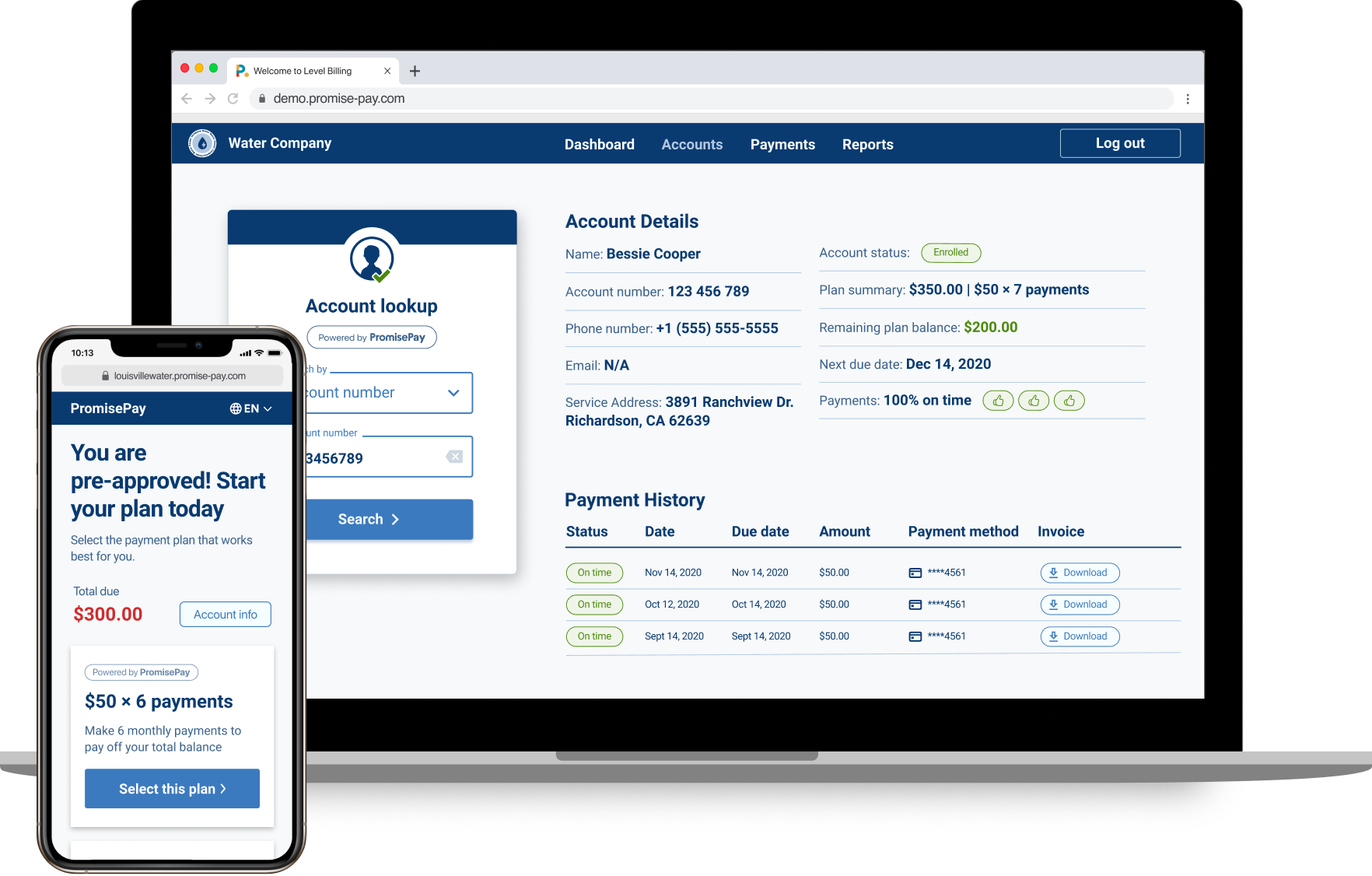
Promise acts as a sort of middleman, integrating lightly with the agency or utility, which in turn makes anyone owing money aware of the possibility of the different payment system. It’s similar to how you might see various payment options, including installments, when making a purchase at an online shop.

Mobile and computer screens showing payment interfaces with optiosn to pay over time.

Image Credits: Promise

The user enrolls in a payment plan (the service is mobile-friendly since that’s the only form of internet many people have) and Promise handles that end of it, with reminders, receipts, and processing, passing on the money to the agency as it comes in — the company doesn’t cover the cost up front and collect on its own terms. Essentially it’s a bolt-on flexible payment mechanism that specializes in government agencies and other public-facing fee collectors.

Promise makes money by subscription fees (i.e. SaaS) and/or through transaction fees, whichever makes more sense for the given customer. As you might imagine, it makes more sense for a utility to pay a couple bucks to be more sure of collecting $500, than to take its chance on getting none of that $500, or having to resort to more heavy-handed and expensive debt collection methods.

Lest you think this is not a big problem (and consequently not a big market), Ellis-Lamkins noted a recent study from the California Water Boards showing that there are 1.6 million people with a total of $1 billion in water debt in the state — one in eight households is in arrears to an average of $500.

Those numbers are likely worse than normal given the immense financial pressure that the pandemic has placed on nearly all households — but like payment plans in other circumstances, households of many incomes and types find their own reason to take advantage of such systems. And pretty much anyone who’s had to deal with an obtusely designed utility payment site would welcome an alternative.

The new round brings the company’s total raised to over $30 million, counting $10 million it raised immediately after leaving Y Combinator in 2018. The funding comes from existing investors Kapor Capital, XYZ, Bronze, First Round, YC, Village, and others.

19 Feb 2021

3 strategies for elevating brand authority in 2021

A lot of clients come to us saying they want to be more respected in their space. They know their competitors are trusted and they want the same recognition, if not more.

This feels even more important now after the absolute disaster that was 2020. Consumers and clients alike just want to be able to count on brands and not stress over whether they’re making the right decision.

Marketers seem to know this. When we teamed up with Semrush to explore keyword search data in 2020 related to marketing goals, brand awareness and authority showed steady upward trends.

If you’re one of these marketers, I have some strategies you can use to improve your brand’s authority this year. It can’t happen overnight, but you can start implementing these strategies now to see results over time.

I have some strategies you can use to improve your brand’s authority this year.

Strategy #1: Get media coverage

Media coverage can build the authority of your brand in a few ways.

For one, it’s hard for people to trust you if they don’t know you exist. Of course, you can pay for ads or kill it on social to get your name out there, but media coverage has other benefits, as well.

When reputable publications and websites reference your brand and link to your site, they’re sending a signal that they trust what you have to say. It’s third-party confirmation that you know what you’re talking about and/or have something to offer.

For example, for our client Stoneside, we surveyed folks to see how many purchased and cared for houseplants in 2020.

The report got coverage on TreeHugger and Simplemost, but it also served as great context for other articles, like HelloGiggles and The Weather Network.

hello giggles article headere

Image Credits: Fractl

having a houseplant article screenshot

Image Credits: Fractl

weather network screen shoit

Image Credits: Fractl

Of course, getting media coverage isn’t easy. You need newsworthy content or an expert opinion to contribute, and you need to know how to pitch it to writers.

Small budget options

Are there industry blogs you can write a guest post for? Are there peers in your industry who are looking for quotes for their content? Start building connections with other industry experts. Cite their work in your content and build a rapport.

For example, I sometimes work with marketing tool brands like Semrush and BuzzSumo because those brands align well with Fractl, as we all work in the same industry.

You can also sign up for HARO, in which journalists post requests to speak to particular types of experts. However, it’s not often you’ll see relevant requests, and even then it’s a toss up whether they’ll reach out to you specifically.

Larger budget options

If you can afford it, a combination of content marketing and digital PR is the way to go. If you have resources internally — marketing folks who are savvy with data analysis and content creation — you can start by seeing if you have any internal data that would be interesting to a wider audience.

19 Feb 2021

Meet the Female Founders Alliance startups from TC Include at TC Sessions: Justice 2021

We’re less than two weeks away from TC Sessions: Justice 2021, a day-long deep dive into the state of diversity, inclusion and equity in tech. March 3 is your opportunity to hear from and engage with the people who, through entrepreneurship, venture capital, labor organizing and advocacy, are both using and challenging tech to disrupt the status quo for the betterment of all.

This programming-packed day features presentations, breakout sessions and interactive Q&As with the leading movers, shakers and makers who are laser focused on, well, justice. Peruse the agenda, and plan your day accordingly.

We’re stoked about showcasing the participating members of our TC Include Program. Do not miss meeting and connecting with these impressive early-stage founders, nominated by our partner founder organizations, Black Female Founders, Latinx Startup Alliance, Startout and the Female Founders Alliance.

TechCrunch, in collaboration with these organizations and VC firms like Kleiner Perkins, Salesforce Ventures and Initialized Capital, provides these young founders with educational resources and mentorship over the course of a year.

What’s more, the TC Include founders will take the virtual stage for a live pitch feedback session with a TechCrunch staffer during the conference. Tune in a get ready to take notes — the advice you hear could help you improve your pitch deck.

We already turned the spotlight on the startups nominated by Black Female Founders, and today we focus on these awesome, early-stage founders in the Female Founders Alliance cohort.

I-Ally: I-Ally is a community-driven app that saves millennial family caregivers time and enables informed decision-making by providing services that fulfill their unique needs. Founded by Lucinda Koza.

Proneer: Proneer is virtual try-on and size-recommendation software that helps reduce returns in apparel retail. Founded by Nicole Faraji.

Tribute: Tribute is the only mentorship platform that creates a continuous learning and development environment by connecting employees together for mentorship using the power of personal stories. Founded by Sarah Haggard.

Cirkled In: LinkedIn for Gen-Z students, Cirkled is a 21st century online profile and portfolio platform connecting gen-z with best-fit colleges, employers and endless win-win opportunities. Founded by Reetu Gupta.

Datacy: Datacy is a consumer to business insights data marketplace. We connect consumers and businesses to enable high-quality, ethical and transparent data exchange. Founded by Paroma Indilo.

We’ll be highlighting the cohorts from the Latinx Startup Alliance and Startout soon, so stay tuned!

TC Sessions: Justice 2021 takes place on March 3. Join this essential discussion, infuse justice into the DNA of your startup and make tech better for everyone. We can’t wait to get started.