Year: 2021

18 Feb 2021

Why do SaaS companies with usage-based pricing grow faster?

Today we know of HubSpot — the maker of marketing, sales and service software products — as a preeminent public company with a market cap above $17 billion. But HubSpot wasn’t always on the IPO trajectory.

For its first five years in business, HubSpot offered three subscription packages ranging in price from $3,000 to $18,000 per year. The company struggled with poor churn and anemic expansion revenue. Net revenue retention was near 70%, a far cry from the 100%+ that most SaaS companies aim to achieve.

Something needed to change. So in 2011, they introduced usage-based pricing. As customers used the software to generate more leads, they would proportionally increase their spend with HubSpot.  This pricing change allowed HubSpot to share in the success of its customers.

In a usage-based model, expansion “just happens” as customers are successful.

By the time HubSpot went public in 2014, net revenue retention had jumped to nearly 100% — all without hurting the company’s ability to acquire new customers.

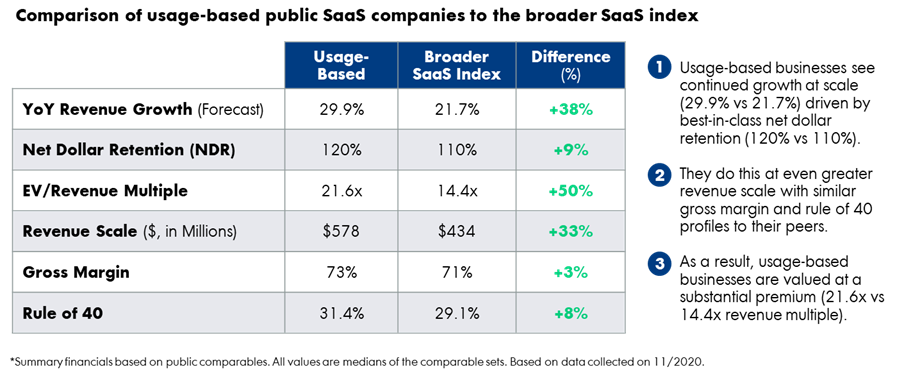
HubSpot isn’t an outlier. Public SaaS companies that have adopted usage-based pricing grow faster because they’re better at landing new customers, growing with them and keeping them as customers.

Image Credits: Kyle Povar

Widen the top of the funnel

In a usage-based model, a company doesn’t get paid until after the customer has adopted the product. From the customer’s perspective, this means that there’s no risk to try before they buy. Products like Snowflake and Google Cloud Platform take this a step further and even offer $300+ in free usage credits for new developers to test drive their products.

Many of these free users won’t become profitable — and that’s okay. Like a VC firm, usage-based companies are making a portfolio of bets. Some of those will pay off spectacularly — and the company will directly share in that success.

Top-performing companies open up the top of the funnel by making it free to sign up for their products. They invest in a frictionless customer onboarding experience and high-quality support so that new users get hooked on the platform. As more new users become active, there’s a stronger foundation for future customer growth.

18 Feb 2021

Outfit wants to make DIY home improvements easier to tackle

Doing home renovations yourself can be more cost-effective than hiring a contractor, but many people don’t know where to begin. Ian Janicki, the founder and CEO of DIY home renovation startup Outfit, has always wanted to make architecture and design more accessible to people.

“I realized I could leverage my knowledge of being handy to create a product that scaled,” he told TechCrunch.

For those who want to go through the Outfit process, the first step is submitting information about the space they’re looking to renovate, such as dimensions and photos, as well as the maximum amount they’re looking to spend. Outfit then provides information about the expected cost of the project, the handiness level required to complete the project and everything that would need to be done in order to complete the project.

“We make sure it’s transparent and that you understand the amount of time that might be required,” Janicki said.

Once someone decides they want to move forward, Outfit then sends all the necessary tools and materials to the customer. Through the app, Outfit offers a step-by-step guide for completing the project. In the event someone gets stuck, they can chat with Janicki or someone else from the Outfit team for support.

Image Credits: Outfit

Outfit has had a small set of pilot customers — some who have completed their projects and some whose projects are still underway.

“The millennial generation is now starting to purchase their homes and has been accelerated because of remote work and COVID,” Janicki said. “They’re the Ikea generation and can put together bookshelves and are really used to digital experiences and now demanding this digital solution.”

So far, the projects have ranged in cost from $1,000 to $15,000, but it really depends on things like how invasive the project is, how big the space is and more, Janicki said. The rendered after photo below would probably cost about $9,000. In general, Outfit charges customers the cost of the actual materials (e.g. power drills, wrenches, cabinets, tiles, etc.) and then adds a percentage of the total on top as a surcharge to the customer.

outfit before and after kitchen renovation

Image Credits: Outfit

Down the road, Outfit envisions offering rentals of the tools themselves but Janicki said he just wanted to streamline everything in the early days.

“Reverse logistics is complicated to we’re trying to take it one step at a time,” he said.

There are a number of home improvement startups out there, such as Eano, Renno and others, but Janicki said he’s not aware of any direct competitors. He said he recognizes that there are some people who are fully capable of buying all the necessary items themselves, watching a video on YouTube and then completing the project. Meanwhile, homeowners are also just as capable of hiring someone to do the project for them. But with Outfit, however, Janicki sees it as somewhere in between. He calls it “DIY plus.”

“In terms of being handy, it’s a rare trait that everyone appreciates,” Janicki said. “If we can elevate people in their handiness level, i’m going to be super happy. It’s that pride that you were actually able to accomplish that.”

Outfit is currently available nationwide. To date, the company has backing from Y Combinator, and previously raised about $700,000 from investors like GitHub CEO Nat Friedman, B Capital Group’s Crissy Costa, Gumroad CEO Sahil Lavingia and others.

18 Feb 2021

Outfit wants to make DIY home improvements easier to tackle

Doing home renovations yourself can be more cost-effective than hiring a contractor, but many people don’t know where to begin. Ian Janicki, the founder and CEO of DIY home renovation startup Outfit, has always wanted to make architecture and design more accessible to people.

“I realized I could leverage my knowledge of being handy to create a product that scaled,” he told TechCrunch.

For those who want to go through the Outfit process, the first step is submitting information about the space they’re looking to renovate, such as dimensions and photos, as well as the maximum amount they’re looking to spend. Outfit then provides information about the expected cost of the project, the handiness level required to complete the project and everything that would need to be done in order to complete the project.

“We make sure it’s transparent and that you understand the amount of time that might be required,” Janicki said.

Once someone decides they want to move forward, Outfit then sends all the necessary tools and materials to the customer. Through the app, Outfit offers a step-by-step guide for completing the project. In the event someone gets stuck, they can chat with Janicki or someone else from the Outfit team for support.

Image Credits: Outfit

Outfit has had a small set of pilot customers — some who have completed their projects and some whose projects are still underway.

“The millennial generation is now starting to purchase their homes and has been accelerated because of remote work and COVID,” Janicki said. “They’re the Ikea generation and can put together bookshelves and are really used to digital experiences and now demanding this digital solution.”

So far, the projects have ranged in cost from $1,000 to $15,000, but it really depends on things like how invasive the project is, how big the space is and more, Janicki said. The rendered after photo below would probably cost about $9,000. In general, Outfit charges customers the cost of the actual materials (e.g. power drills, wrenches, cabinets, tiles, etc.) and then adds a percentage of the total on top as a surcharge to the customer.

outfit before and after kitchen renovation

Image Credits: Outfit

Down the road, Outfit envisions offering rentals of the tools themselves but Janicki said he just wanted to streamline everything in the early days.

“Reverse logistics is complicated to we’re trying to take it one step at a time,” he said.

There are a number of home improvement startups out there, such as Eano, Renno and others, but Janicki said he’s not aware of any direct competitors. He said he recognizes that there are some people who are fully capable of buying all the necessary items themselves, watching a video on YouTube and then completing the project. Meanwhile, homeowners are also just as capable of hiring someone to do the project for them. But with Outfit, however, Janicki sees it as somewhere in between. He calls it “DIY plus.”

“In terms of being handy, it’s a rare trait that everyone appreciates,” Janicki said. “If we can elevate people in their handiness level, i’m going to be super happy. It’s that pride that you were actually able to accomplish that.”

Outfit is currently available nationwide. To date, the company has backing from Y Combinator, and previously raised about $700,000 from investors like GitHub CEO Nat Friedman, B Capital Group’s Crissy Costa, Gumroad CEO Sahil Lavingia and others.

18 Feb 2021

Google launches the first developer preview of Android 12

Almost exactly a year after Google announced the first developer preview of Android 11, the company today released the first developer preview of Android 12. Google delayed the roll-out of Android 11 a bit as the teams and the company’s partners adjusted to working during a pandemic, but it looks like that didn’t stop it from keeping Android 12 on schedule. As you would expect from an early developer preview, most of the changes here are under the hood and there’s no over-the-air update yet for intrepid non-developers who want to give it a spin.

Image Credits: Google

Among the highlights of the release so far — and it’s important to note that Google tends to add more user-facing changes and UI updates throughout the preview cycle — are the ability to transcode media into higher quality formates like the AV1 image format, faster and more responsive notifications and a new feature for developers that now makes individual changes in the platform togglable so they can more easily test the compatibility of their apps. Google also promises that just like with Android 11, it’ll add a Platform Stability milestone to Android 12 to give developers advance notice when final app-facing changes will occur in the development cycle of the operating system. Last year, the team hit that milestone in July when it launched its second beta release.

“With each version, we’re working to make the OS smarter, easier to use, and better performing, with privacy and security at the core,” writes Google VP of Engineering Dave Burke. “In Android 12 we’re also working to give you new tools for building great experiences for users. Starting with things like compatible media transcoding, which helps your app to work with the latest video formats if you don’t already support them, and easier copy/paste of rich content into your apps, like images and videos. We’re also adding privacy protections, refreshing the UI, and optimizing performance to keep your apps responsive.”

Image comparison from AVIF has landed by Jake Archibald

Obviously, there are dozens of developer-facing updates in Android 12. Let’s look at some in detail.

For the WebView in Android 12, Google will now implement the same SameSite cookie behavior as in Chrome, for example. Last year, the company slowed down the roll-out of this change, which makes it harder for advertisers to track your activity across sites,  in Chrome, simply because it was breaking too many sites. Now, with this feature fully implemented in Chrome, the Android team clearly feels like it, too, can implement the same privacy tools in WebView, which other apps use to display web content, too.

As for the encoding capabilities, Burke notes that, “with the prevalence of HEVC hardware encoders on mobile devices, camera apps are increasingly capturing in HEVC format, which offers significant improvements in quality and compression over older codecs.” He notes that most apps should support HEVC, but for those that can’t, Android 12 now offers a service for transcoding a file into AVC.

Image Credits: Google

In addition, Android 12 now also supports the AV1 Image File Format as a container for images and GIF-like image sequences. “Like other modern image formats, AVIF takes advantage of the intra-frame encoded content from video compression,” explains Burke. “This dramatically improves image quality for the same file size when compared to older image formats, such as JPEG.”

Image Credits: Google

As with every Android release, Google also continues to tinker with the notification system. This time, the team promises a refreshed design to “make them more modern, easier to use, and more functional.” Burke calls out optimized transitions and animations and the ability for apps to decorate notifications with custom content. Google now also asks that developers implement a system that immediately takes users from a notification to the app, without an intermediary broadcast receiver or service, something it recommended before.

Image Credits: Google

Android 12 will now also offer better support for multi-channel audio with up to 24 channels (a boon for music and other audio apps, no doubt), spatial audio, MPEG-H support, and haptic-coupled audio effects with the strength of the vibration and frequency based on the audio (a boon for games, no doubt). There’s also improved gesture navigation and plenty of other optimizations and minor changes across the operating system.

Google also continues to drive its Project Mainline forward, which allows for an increasing number of the core Android OS features to be updated through the Google Play system — and hence bypasses the slow update cycles of most hardware manufacturers. With Android 12, it is bringing the Android Runtime module into Mainline, which will then let Google push updates to the core runtime and libraries to devices. “We can improve runtime performance and correctness, manage memory more efficiently, and make Kotlin operations faster – all without requiring a full system update,” Burke says. “We’ve also expanded the functionality of existing modules – for example, we’re delivering our seamless transcoding feature inside an updatable module.”

You can find a more detailed list of all of the changes in Android 12 here.

Image Credits: Google

Developers who want to get started with bringing their apps to Android 12 can do so today by flashing a device image to a Pixel device. For now, Android 12 supports the Pixel 3/3 XL, Pixel 3a/3a XL, Pixel 4/4 XL, Pixel 4a/4a 5G and Pixel 5. You can also use the system image in the Android Emulator in Google’s Android Studio.

18 Feb 2021

Report: social audio app Clubhouse has topped 8 million global downloads

Social audio app Clubhouse has now topped 8 million global downloads, despite still being in a prelaunch, invite-only mode, according to new data released today by mobile data and analytics firm App Annie. Per its estimates, Clubhouse grew from over 3.5 million global downloads as of Feb. 1, 2021, to reach 8.1 million by Feb. 16, 2021. This sharp growth is attributed to several high-profile guest appearances, including those from Tesla and SpaceX founder Elon Musk and Facebook CEO Mark Zuckerberg, for example.

App Annie also estimates that 2.6 million-plus of the total global installs took place in the U.S. — a figure that highlights the app’s global appeal.

Image Credits: App Annie

Clubhouse, meanwhile, hasn’t officially shared its total number of downloads or registered users, but CEO Paul Davison revealed in January the app had grown to 2 million weekly active users — which means the app’s monthly active user figure and total registered user count would be much higher. Other estimates have put the app’s registered user base in between 6 million and 10 million (the latter citing unnamed sources.)

Reached for comment on App Annie’s report, Clubhouse said it doesn’t publish user numbers.

It’s worth noting that app install figures aren’t typically a valid proxy for registered users as many people often download an app but then never open it or sign up. But in Clubhouse’s case, the two figures could be more closely aligned as people who are installing the app are motivated to join. The app is not open to the public, so the users installing the app are likely either in possession of a Clubhouse invite or are aiming to get one from a friend or trusted contact who’s already joined.

Also in the new report, App Annie noted how Clubhouse phenomenon is having an impact on the larger app ecosystem. Local rivals to Clubhouse offering their own social audio experience have also gained downloads in recent days, including Dizhua, Tiya and Yalla, which have attracted users in China, the U.S., Egypt, Saudi Arabia and Turkey. 

Dizhua, for example, has 174,000 downloads; Tiya has 6 million; and Yalla has 34.5 million, the report says. Yalla, notably, has been live since 2016, but Clubhouse’s popularity is giving it a boost. 

Beyond this small handful, there’s been an explosion of social audio experiences, including those in  from startups like Sonar, Locker Room, Quilt, Yoni Circle, Roadtrip, Space, Capiche.fm, Yac, Cappuccino, and others. Twitter, meanwhile, is building its own Clubhouse rival with Spaces, which it said yesterday will expand to Android by March. Facebook, too, is reportedly planning a Clubhouse competitor.

The question on everyone’s minds now is how much of this growth is sustainable. Skeptics say Clubhouse lends itself to those who tend to dominate conversations by talking at length; that many of its conversations are just kind of boring; that the app favors the “hustle culture”-obsessed; and so on. Some also wonder to how well social audio apps will fare when the world reopens post-COVID and there’s more to do — including the return traditional networking events.

But these concerns don’t take into account that social audio has the potential to carve out space for itself by supplanting users’ other mobile spoken-word audio activities, like podcast listening or audiobooks. Of course, questions about Clubhouse’s future can’t really be answered now, as the pandemic continues, and with an app that’s not fully open to the public.

18 Feb 2021

Report: social audio app Clubhouse has topped 8 million global downloads

Social audio app Clubhouse has now topped 8 million global downloads, despite still being in a prelaunch, invite-only mode, according to new data released today by mobile data and analytics firm App Annie. Per its estimates, Clubhouse grew from over 3.5 million global downloads as of Feb. 1, 2021, to reach 8.1 million by Feb. 16, 2021. This sharp growth is attributed to several high-profile guest appearances, including those from Tesla and SpaceX founder Elon Musk and Facebook CEO Mark Zuckerberg, for example.

App Annie also estimates that 2.6 million-plus of the total global installs took place in the U.S. — a figure that highlights the app’s global appeal.

Image Credits: App Annie

Clubhouse, meanwhile, hasn’t officially shared its total number of downloads or registered users, but CEO Paul Davison revealed in January the app had grown to 2 million weekly active users — which means the app’s monthly active user figure and total registered user count would be much higher. Other estimates have put the app’s registered user base in between 6 million and 10 million (the latter citing unnamed sources.)

Reached for comment on App Annie’s report, Clubhouse said it doesn’t publish user numbers.

It’s worth noting that app install figures aren’t typically a valid proxy for registered users as many people often download an app but then never open it or sign up. But in Clubhouse’s case, the two figures could be more closely aligned as people who are installing the app are motivated to join. The app is not open to the public, so the users installing the app are likely either in possession of a Clubhouse invite or are aiming to get one from a friend or trusted contact who’s already joined.

Also in the new report, App Annie noted how Clubhouse phenomenon is having an impact on the larger app ecosystem. Local rivals to Clubhouse offering their own social audio experience have also gained downloads in recent days, including Dizhua, Tiya and Yalla, which have attracted users in China, the U.S., Egypt, Saudi Arabia and Turkey. 

Dizhua, for example, has 174,000 downloads; Tiya has 6 million; and Yalla has 34.5 million, the report says. Yalla, notably, has been live since 2016, but Clubhouse’s popularity is giving it a boost. 

Beyond this small handful, there’s been an explosion of social audio experiences, including those in  from startups like Sonar, Locker Room, Quilt, Yoni Circle, Roadtrip, Space, Capiche.fm, Yac, Cappuccino, and others. Twitter, meanwhile, is building its own Clubhouse rival with Spaces, which it said yesterday will expand to Android by March. Facebook, too, is reportedly planning a Clubhouse competitor.

The question on everyone’s minds now is how much of this growth is sustainable. Skeptics say Clubhouse lends itself to those who tend to dominate conversations by talking at length; that many of its conversations are just kind of boring; that the app favors the “hustle culture”-obsessed; and so on. Some also wonder to how well social audio apps will fare when the world reopens post-COVID and there’s more to do — including the return traditional networking events.

But these concerns don’t take into account that social audio has the potential to carve out space for itself by supplanting users’ other mobile spoken-word audio activities, like podcast listening or audiobooks. Of course, questions about Clubhouse’s future can’t really be answered now, as the pandemic continues, and with an app that’s not fully open to the public.

18 Feb 2021

Volta Energy Technologies raises over $90M of a targeted $150M fund to back energy storage startups

Volta Energy Technologies, the energy investment and advisory services firm backed by some of the biggest names in energy and energy storage materials, has closed on nearly $90 million of a targeted $150 million investment fund, according to people familiar with the group’s plans.

The venture investment vehicle compliments an $180 million existing commitment from Volta’s four corporate backers — Equinor, Albermarle, Epsilon, and Hanon Systems — and comes at a time when interest in energy storage technologies couldn’t be stronger. 

As the transition away from internal combustion engines and hydrocarbon fuels begins in earnest companies are scrambling to drive down costs and improve performance of battery technologies that will be necessary to power millions of electric cars and store massive amounts of renewable energy that still needs to be developed.

“Capital markets have noticed the enormity of the opportunity in transitioning away from carbon,” said Jeff Chamberlain, Volta’s founder and chief executive.

Born of an idea that that began in 2012 when Chamberlain began talking with the head of the Department of Energy under the Obama Administration back in 2014. What began when Chamberlain was at Argonne National Lab leading the development of JCESR, the lead lab in the US government’s battery research consortium, evolved into Volta Energy as Chamberlain pitched a private sector investment partner that could leverage the best research from National Laboratories and the work being done by private industry to find the best technology.

Support for the Volta project remained strong through both public and private institutions, according to Chamberlain. Even under the Trump Administration, Volta’s initiative was able to thrive and wrangle some of the biggest names in the chemicals, utility, oil and gas and industrial thermal management to invest in a $180 million fund that could be evergreen, Chamberlain said.

According to people with knowledge of the organizations plans, the new investment fund which is targeting $150 million but has hard cap of $225 million would compliment the existing investment vehicle to give the firm more firepower as additional capital floods into the battery industry.

Chamberlain declined to comment specifically on the fund, given restrictions, but did say that his firm had a mandate to invest in technology that is battery and storage related and that “enables the ubiquitous adoption of electric vehicles and the ubiquitous adoption of solar and wind.”

Back during the first cleantech boom the brains behind Volta witnessed a lot of good money getting poured into bad ideas and vaporware that would never amount to commercial success, said Chamberlain. Volta was formed to educate investors on the real opportunities that scientists were tracking in energy storage and back those companies with dollars.

“We knew that investors were throwing money into a dumpster fire. We knew it could have a negative impact on this transition to carbon,” Chamberlain said. “Our whole objective was to help guide individuals deploying massive amounts of their personal wealth and move it from putting money into an ongoing dumpster fire.”

That mission has become even more important as more money floods into the battery market, Chamberlain said.

The SPAC craze set off by Nikola’s public offering in electric vehicles and continuing through QuantumScape’s battery SPAC through a slew of other electric vehicle offerings and into EV charging and battery companies has made the stakes higher for everyone, he said.

Chamberlain thinks of Volta’s mission as finding the best emerging technologies that are coming to market across the battery and power management supply chain and ensure that as manufacturing capacity comes online, the technology is ready to meet growing demand.

“Investors who do not truly understand the energy storage ecosystem and its underlying technology challenges are at a distinct disadvantage,” said Goldman Sachs veteran and early Volta investor Randy Rochman, in a statement. “It has become abundantly clear to me that nothing happens in the world of energy storage without Volta’s knowledge. I can think of no better team to identify energy storage investment opportunities and avoid pitfalls.”  

The new fund from Volta has already backed a number of new energy storage and enabling technologies including: Natron, which develops high-power, fire-safe Sodium-ion batteries using Prussian blue chemistry for applications that demand a quick discharge of power; Smart Wires, which develops hardware that acts as a router for electricity to travel across underutilized power lines to optimize the integration of renewable power and energy storage on the grid; and Ionic Materials, which makes solid lithium batteries for both transportation and grid applications. Ionic Materials’ platform technology also enables breakthrough advancements in other growing markets, such as 5G mobile, and rechargeable alkaline batteries. 


18 Feb 2021

Volta Energy Technologies raises over $90M of a targeted $150M fund to back energy storage startups

Volta Energy Technologies, the energy investment and advisory services firm backed by some of the biggest names in energy and energy storage materials, has closed on nearly $90 million of a targeted $150 million investment fund, according to people familiar with the group’s plans.

The venture investment vehicle compliments an $180 million existing commitment from Volta’s four corporate backers — Equinor, Albermarle, Epsilon, and Hanon Systems — and comes at a time when interest in energy storage technologies couldn’t be stronger. 

As the transition away from internal combustion engines and hydrocarbon fuels begins in earnest companies are scrambling to drive down costs and improve performance of battery technologies that will be necessary to power millions of electric cars and store massive amounts of renewable energy that still needs to be developed.

“Capital markets have noticed the enormity of the opportunity in transitioning away from carbon,” said Jeff Chamberlain, Volta’s founder and chief executive.

Born of an idea that that began in 2012 when Chamberlain began talking with the head of the Department of Energy under the Obama Administration back in 2014. What began when Chamberlain was at Argonne National Lab leading the development of JCESR, the lead lab in the US government’s battery research consortium, evolved into Volta Energy as Chamberlain pitched a private sector investment partner that could leverage the best research from National Laboratories and the work being done by private industry to find the best technology.

Support for the Volta project remained strong through both public and private institutions, according to Chamberlain. Even under the Trump Administration, Volta’s initiative was able to thrive and wrangle some of the biggest names in the chemicals, utility, oil and gas and industrial thermal management to invest in a $180 million fund that could be evergreen, Chamberlain said.

According to people with knowledge of the organizations plans, the new investment fund which is targeting $150 million but has hard cap of $225 million would compliment the existing investment vehicle to give the firm more firepower as additional capital floods into the battery industry.

Chamberlain declined to comment specifically on the fund, given restrictions, but did say that his firm had a mandate to invest in technology that is battery and storage related and that “enables the ubiquitous adoption of electric vehicles and the ubiquitous adoption of solar and wind.”

Back during the first cleantech boom the brains behind Volta witnessed a lot of good money getting poured into bad ideas and vaporware that would never amount to commercial success, said Chamberlain. Volta was formed to educate investors on the real opportunities that scientists were tracking in energy storage and back those companies with dollars.

“We knew that investors were throwing money into a dumpster fire. We knew it could have a negative impact on this transition to carbon,” Chamberlain said. “Our whole objective was to help guide individuals deploying massive amounts of their personal wealth and move it from putting money into an ongoing dumpster fire.”

That mission has become even more important as more money floods into the battery market, Chamberlain said.

The SPAC craze set off by Nikola’s public offering in electric vehicles and continuing through QuantumScape’s battery SPAC through a slew of other electric vehicle offerings and into EV charging and battery companies has made the stakes higher for everyone, he said.

Chamberlain thinks of Volta’s mission as finding the best emerging technologies that are coming to market across the battery and power management supply chain and ensure that as manufacturing capacity comes online, the technology is ready to meet growing demand.

“Investors who do not truly understand the energy storage ecosystem and its underlying technology challenges are at a distinct disadvantage,” said Goldman Sachs veteran and early Volta investor Randy Rochman, in a statement. “It has become abundantly clear to me that nothing happens in the world of energy storage without Volta’s knowledge. I can think of no better team to identify energy storage investment opportunities and avoid pitfalls.”  

The new fund from Volta has already backed a number of new energy storage and enabling technologies including: Natron, which develops high-power, fire-safe Sodium-ion batteries using Prussian blue chemistry for applications that demand a quick discharge of power; Smart Wires, which develops hardware that acts as a router for electricity to travel across underutilized power lines to optimize the integration of renewable power and energy storage on the grid; and Ionic Materials, which makes solid lithium batteries for both transportation and grid applications. Ionic Materials’ platform technology also enables breakthrough advancements in other growing markets, such as 5G mobile, and rechargeable alkaline batteries. 


18 Feb 2021

TikTok parent ByteDance joins patent troll protection group LOT Network

LOT Network, the non-profit that helps businesses of all sizes and across industries defend themselves against patent trolls by creating a shared pool of patents to immunize themselves against them, today announced that TikTik parent ByteDance is joining its group.

ByteDance has acquired its fair share of patents in recent years and is itself embroiled in a patent fight with its rival Triller. That’s not what joining the LOT Network is about, though. ByteDance is joining a group of companies here that includes the likes of IBM, the Coca-Cola Company, Cisco, Lyft, Microsoft, Oracle, Target, Tencent, Tesla, VW, Ford, Waymo, Xiaomi and Zelle. In total, the group now has over 1,300 members.

As LOT CEO Ken Seddon told me, the six-year-old group had a record year in 2020, with 574 companies joining it and bringing its set of immunized patents to over 3 million, including 14% of all patents issued in the U.S.

Among the core features of LOT, which only charges members who make more than $25 million in annual revenue, is that its members aren’t losing control over the patents they add to the pool. They can still buy and trade them as before, but if they decide to sell to what the industry calls a ‘patent assertion entity,’ (PAE) that is, a patent troll, they automatically provide a free licence to that patent to every other member of the group. This essentially turns LOT into what Seddon calls a ‘flu shot ‘ against patent trolls (and one that’s free for startups).

“The conclusion that people are waking up to is, is that we’re basically like a herd, we’re herd immunization, effectively,” Seddon said. “And every time a company joins, people realize that the community of non-members shrinks by one. It’s like those that don’t have the vaccination shrinks — and they are, ‘wait a minute, that makes me a higher risk of getting sued. I’m a bigger target.’ And they’re like, ‘wait a minute, I don’t want to be the target.'”

ByteDance, he argues, is a good example for a company that can profit from membership in LOT. While you may think of patents as purely a sign of a company’s innovativeness, for corporate lawyers, they are also highly effective defense tools (that can be used aggressively as well, if needed). But it can take a small company years to build up a patent portfolio. But a fast-growing, successful company also becomes an obvious target for patent trolls.

“When you are a successful company, you naturally become a target,” Seddon said. “People become jealous and they become threatened by you. And they covet your money and your revenue and your success. One of the ways that companies can defend themselves and protect their innovation is through patents. Some companies grow so fast, they become so successful, that their revenue grows faster than they can grow their patent portfolio organically.” He cited Instacart, which acquired 250 patents from IBM earlier this month, and Airbnb, which was sued by IBM over patent infringement in early 2020 (the companies settled in December), as examples.

ByteDance, thanks to the success of TikTok, now finds itself in a situation where it, too, is likely to become a target of patent trolls. The company has started acquiring patents itself to grow its portfolio faster and now it is joining LOT to strengthen its protection there.

“[ByteDance] is being a visionary and trying to get ahead of the wave,” Seddon noted. “They are a successful global company that needs to develop a global IP strategy. Historically, PAEs were just a US problem, but now ByteDance has to worry about PAEs being an issue in China and Europe as well.  By joining LOT, they protect themselves and their investments from over 3 million patents should they ever fall into the hands of a PAE.”

Lynn Wu, Director and Chief IP Counsel, Global IP and Digital Licensing Strategy at ByteDance, agrees. “Innovation is core to the culture at ByteDance, and we believe it’s important to protect our diverse technical and creative community,” she said in today’s announcement. “As champions for the fair use of IP, we encourage other companies to help us make the industry safer by joining LOT Network. If we work together, we can protect the industry from exploitation and continue advancing innovation, which is key to the growth and success of the entire community.”
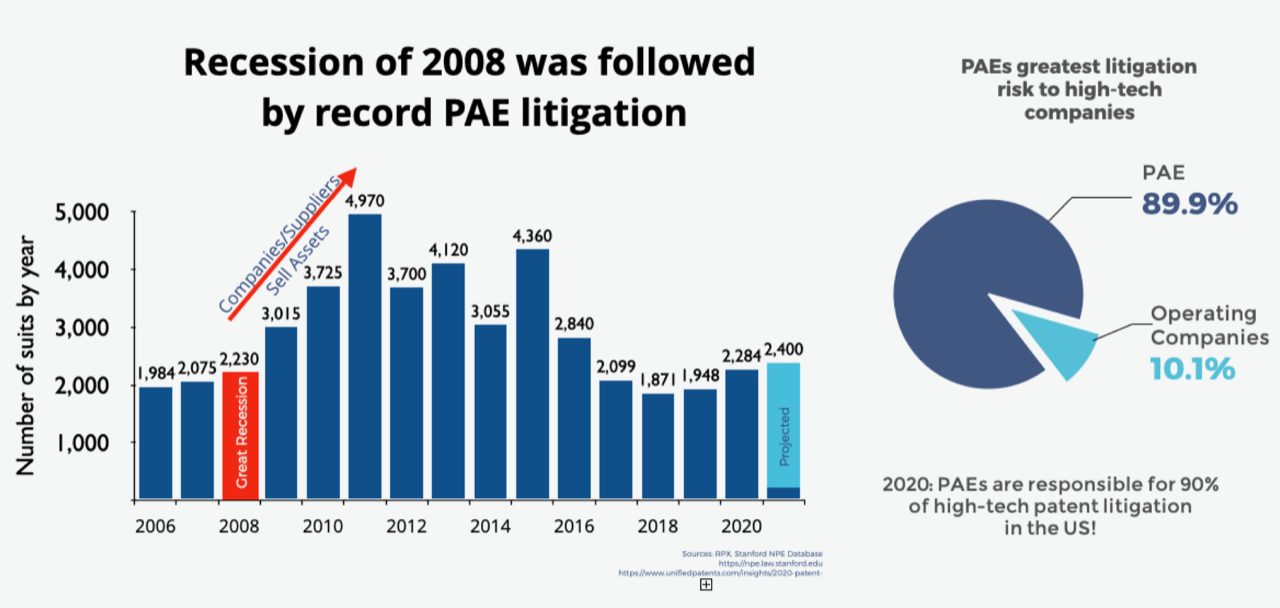
There’s another reason companies are so eager to join the group now, though, and that’s because these patent assertion entities, which had faded into the background a bit in the mid- to late-2010s, may be making a comeback. The core assumption here is a bit gloomy: many companies seem to assume we’re in for an economic downturn. If we hit a recession, a lot of patent holders will start looking at their patent portfolios and start selling off some their more valuable patents in order to stay afloat. Since beggars can’t be choosers, that often means they’ll sell to a patent troll if that troll is the highest bidder. Last year, a patent troll sued Uber using a patent sold by IBM, for example (and IBM gets a bit of a bad rap for this, but, hey, it’s business).

That’s what happened after the last recession — though it typically takes a few years for the effect to be felt. Nothing in the patent world moves quickly.

Now, when LOT members sell to a troll, that troll can’t sue other LOT members over it. Take IBM, for example, which joined LOT last year.

“People give IBM a lot of grief and criticism for selling to PAEs, but at least IBM is giving everybody a chance to get a free license,” Seddon told me. “IBM joined LOT last year and what IBM is effectively doing is saying to everybody, ‘look, I joined LOT.’ And they put all of their entire patent portfolio into LOT. And they’re saying to everybody, ‘look, I have the right to sell my patents to anybody I want, and I’m going to sell it to the highest bidder. And if I sell it to a patent troll and you don’t join LOT — and if you get sued by a troll, is that my fault or your fault? Because if you join LOT, you could have gotten a free license.'”


18 Feb 2021

Paying $115B for Stripe or $77B for Coinbase might be quite rational

CoinDesk reported yesterday that crypto trading startup Coinbase is being valued at $77 billion on private exchanges. And Forbes reported that Stripe is being valued at $115 billion on secondary markets, where private shares can be bought and sold, albeit in a limited fashion.

I instantly wanted to write a piece headlined “Beware those super hot secondary market valuations, but after a little digging, I cannot. It turns out that the public markets are so hot, there is historical precedent for seemingly aggressive secondary market transactions being conservative compared to later IPO valuations. And there is further precedent for private market transactions that are more conservative in price terms than venture-determined valuations also working out.


The Exchange explores startups, markets and money. Read it every morning on Extra Crunch, or get The Exchange newsletter every Saturday.


The hot equities market is making stock pickers out of many startup investors, regardless of whether they are leading priced rounds of buying shares on modern secondary markets.

It’s hard to overvalue a startup when the public market is willing to double its valuation the moment it starts to trade.

Let’s explore the new prices for Coinbase and Stripe by starting with a look at their dated private valuations, their new, reported secondary prices and where some companies that went public with notable secondary prices wound up trading today.

This will be fun! I promise!

Overprice me, I dare you

Coinbase was last valued by private-market money at around $8 billion, per Crunchbase data back in October of 2018. More recently we’ve seen secondary transactions that value the firm at $50 billion, other notes concerning a $75 billion possible valuation, and even some enthusiastic chat from a former employee that the company could be worth $100 billion.

Its new $77 billion price tag might seem somewhat pedestrian in that mix, but recall that we’re largely discussing the valuations associated with Coinbase set by buyers not in the know; retail secondary buyers of shares in the cryptocurrency exchange are probably not its board members.

So, the public is, to some degree, repricing Coinbase. The question is whether those prices make any sense. Hold your answer: we have more work to do.

Stripe at $115 billion on secondary exchanges is perhaps bonkers, or perhaps nothing more than rationality. In its last round, a $600 million Series G that came in mid-2020, Stripe was valued at around $36 billion. And, it is rumored to be raising capital at a $100 billion valuation.