Year: 2021

16 Feb 2021

Onboard says it can help SaaS companies bring their new customers up to speed faster and better

While companies have embraced the offerings of software-as-a-service companies with growing vigor, getting those new offerings to work in a seamless way from the outset isn’t so easy, with some business customers feeling forgotten as soon as the digital ink dries.

Enter Onboard, a 10-month-old startup that aims to help SaaS businesses delight those new customers instead of turning them off.

The company was co-founded by CEO Jeff Epstein, who previously launched the referral marketing and affiliate marketing software company Ambassador, which sold in 2018, eight years after it was founded.

Terms of the sale to West Corporation — now Intrado — were never disclosed, but Epstein says it was a “good outcome” for shareholders. (Ambassador was sold again last month to a small Seattle company.)

As for how Onboard works, Epstein makes the process sound straightforward. “You determine the variables of your customer segment, because different plan types might mean that companies need to do something different.” (They could use an API or some code snippet, for example.) After that, Onboard works with the SaaS company to create a global task list with requirements it has hopefully gleaned from the sales process, and helps it create a kind of dynamic, drop-down task list with assignees and due dates and alerts and notifications.

It’s largely a self-service product that makes accountability more transparent, ultimately, though Epstein describes the onboarding process as a “shared responsibility” between his company and its customers. He also says his nascent startup is already working on building out a more sophisticated notification layer with automated nudges that are helpful yet not obnoxious.

The five-person company is not charging its dozens of beta customers right now. It wants to get the product right before it shifts into revenue gear, says Epstein. The plan eventually is to charge the types of customers it is chasing — mid-size companies — hundreds of dollars of month, plus a per-person-per-month fee. (“We don’t plan on being enterprise-y in any way,” says Epstein of the company’s plan to eschew long contracts.)

Onboard is not without competitors. On the contrary, a lot of upstarts have sprung up around this problematic slice of the enterprise universe. That it’s an aggravating period for many new customers was brought to Epstein’s attention by one of his co-founders, William Stevenson, who spent four years as Ambassador’s VP of customer success, where, like a lot of people in his position at other companies, he was trying to make do with a less-than-ideal patchwork of offerings, sometimes from Monday or Asana or Basecamp or Google Docs.

It was the same problem that Jonathon Triest of Ludlow Ventures — whose firm quietly led a $1.25 million seed round for Onboard in late summer, joined by Zelkova Ventures and Detroit Venture Partners — says he knows well.
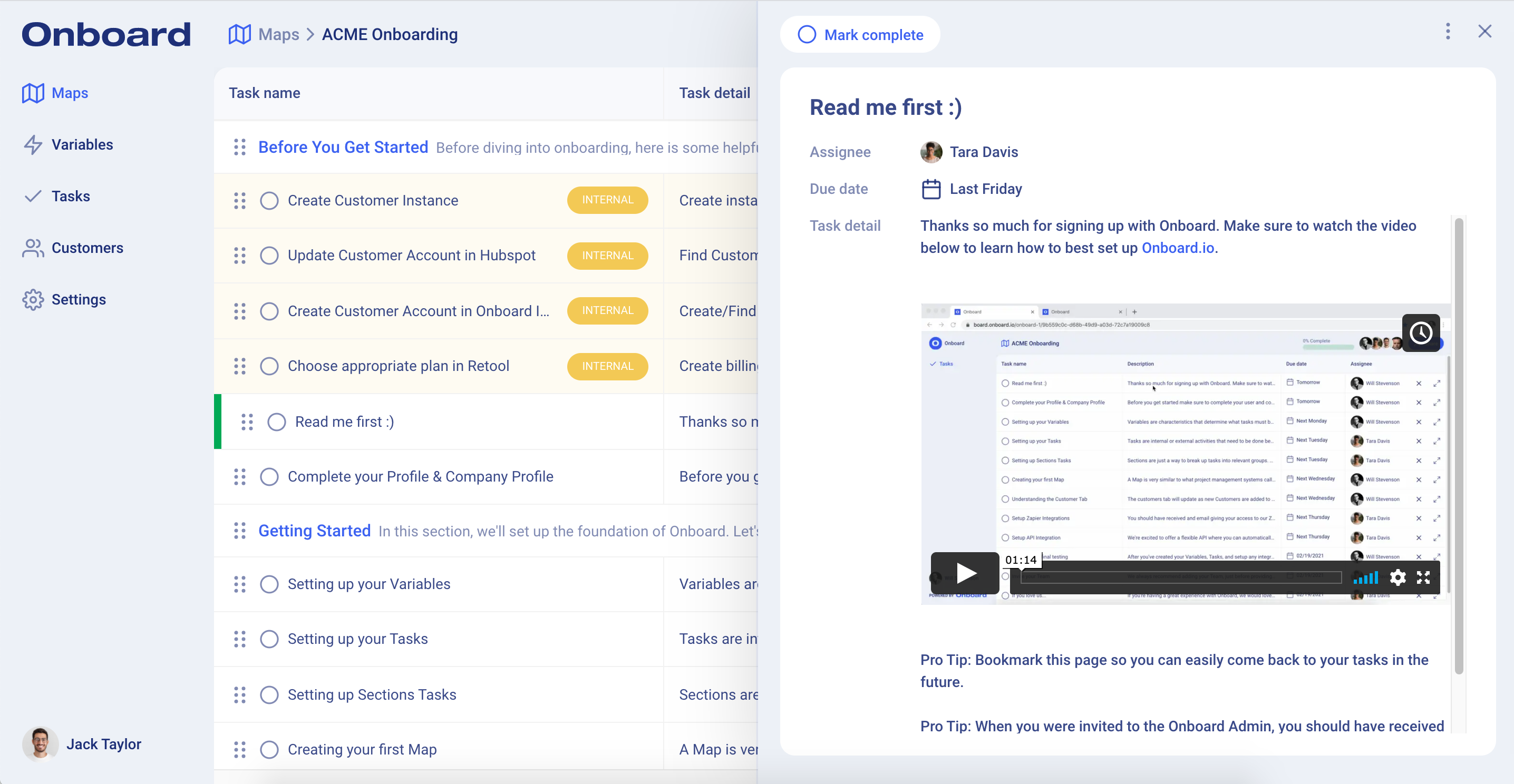
Image Credits: Onboard

“Over and over again, throughout our portfolio, especially in B2B SaaS sales,” Ludlow’s portfolio companies have been “forced to piece together solutions or use tools not made for them,” Triest says.

The question is whether Onboard can gain a foothold faster than some of its other rivals, and unsurprisingly, Epstein believes his team has what it takes to get started. (A third founder, Matt Majewski, more recently left Ambassador to help the company gain momentum.)

Epstein’s resume is helping, too, he says. As a founder in Detroit who sold a company, he’s known to local investors, and then some. (“We were able to be a big fish in a small pond,” he says.)

Epstein also says that investors realize there’s “an opportunity generally in the space,” adding that “partners [from venture firms] have been calling — not associates — and they are coming through third-party connections on LinkedIn in some cases.”

He has “obviously raised a bit of money” in the past, Epstein says, but he hasn’t seen anything quite like this before. “It’s weird,” he adds, “but cool.”
16 Feb 2021

Onboard says it can help SaaS companies bring their new customers up to speed faster and better

While companies have embraced the offerings of software-as-a-service companies with growing vigor, getting those new offerings to work in a seamless way from the outset isn’t so easy, with some business customers feeling forgotten as soon as the digital ink dries.

Enter Onboard, a 10-month-old startup that aims to help SaaS businesses delight those new customers instead of turning them off.

The company was co-founded by CEO Jeff Epstein, who previously launched the referral marketing and affiliate marketing software company Ambassador, which sold in 2018, eight years after it was founded.

Terms of the sale to West Corporation — now Intrado — were never disclosed, but Epstein says it was a “good outcome” for shareholders. (Ambassador was sold again last month to a small Seattle company.)

As for how Onboard works, Epstein makes the process sound straightforward. “You determine the variables of your customer segment, because different plan types might mean that companies need to do something different.” (They could use an API or some code snippet, for example.) After that, Onboard works with the SaaS company to create a global task list with requirements it has hopefully gleaned from the sales process, and helps it create a kind of dynamic, drop-down task list with assignees and due dates and alerts and notifications.

It’s largely a self-service product that makes accountability more transparent, ultimately, though Epstein describes the onboarding process as a “shared responsibility” between his company and its customers. He also says his nascent startup is already working on building out a more sophisticated notification layer with automated nudges that are helpful yet not obnoxious.

The five-person company is not charging its dozens of beta customers right now. It wants to get the product right before it shifts into revenue gear, says Epstein. The plan eventually is to charge the types of customers it is chasing — mid-size companies — hundreds of dollars of month, plus a per-person-per-month fee. (“We don’t plan on being enterprise-y in any way,” says Epstein of the company’s plan to eschew long contracts.)

Onboard is not without competitors. On the contrary, a lot of upstarts have sprung up around this problematic slice of the enterprise universe. That it’s an aggravating period for many new customers was brought to Epstein’s attention by one of his co-founders, William Stevenson, who spent four years as Ambassador’s VP of customer success, where, like a lot of people in his position at other companies, he was trying to make do with a less-than-ideal patchwork of offerings, sometimes from Monday or Asana or Basecamp or Google Docs.

It was the same problem that Jonathon Triest of Ludlow Ventures — whose firm quietly led a $1.25 million seed round for Onboard in late summer, joined by Zelkova Ventures and Detroit Venture Partners — says he knows well.

Image Credits: Onboard

“Over and over again, throughout our portfolio, especially in B2B SaaS sales,” Ludlow’s portfolio companies have been “forced to piece together solutions or use tools not made for them,” Triest says.

The question is whether Onboard can gain a foothold faster than some of its other rivals, and unsurprisingly, Epstein believes his team has what it takes to get started. (A third founder, Matt Majewski, more recently left Ambassador to help the company gain momentum.)

Epstein’s resume is helping, too, he says. As a founder in Detroit who sold a company, he’s known to local investors, and then some. (“We were able to be a big fish in a small pond,” he says.)

Epstein also says that investors realize there’s “an opportunity generally in the space,” adding that “partners [from venture firms] have been calling — not associates — and they are coming through third-party connections on LinkedIn in some cases.”

He has “obviously raised a bit of money” in the past, Epstein says, but he hasn’t seen anything quite like this before. “It’s weird,” he adds, “but cool.”
16 Feb 2021

The creator movement is entering prime time, and so is Circle with a fresh $4M

The creator movement has exploded in the last few years as platforms ranging from Substack to Clubhouse have made it easier than ever to reach an audience of willing readers and listeners. Yet the key to building sustainable creator businesses is the economics of these enterprises themselves. Get enough subscribers, and what often starts as a side hobby can quickly become a full-time job.

Circle was founded in January 2020 to make engaging with paying customers and thus building creator businesses as effortless as possible. We profiled the NYC-based startup last year when it announced its $1.5 million seed round in August, discussing how its founder DNA originates in the online course platform Teachable. Since then, all signs point to very strong early growth.

The company surpassed $1 million ARR last month, and it already has 1,000 paying customers and is heading toward 2,000 paying communities. Usage is also growing rapidly, expanding 40-50% per month for both DAUs and MAUs, according to the company. It also brought its iOS app out of beta last month.

CEO and co-founder Sid Yadav said that “we happened to catch the tide at the right time [with] the creator movement, the community movement.” So far, paying communities have been largely centered around “a lot of YouTubers, course creators, Twitch streamers, Patreon personalities,” with Yadav estimating that 60% of the platform’s communities are “personality-led.” That said, “a lot of brands are starting to think of this creatively.”

All that positive news can’t be ignored by VCs too long. The company announced today that it has raised a $4 million seed round at a valuation “north of” $40 million, which closed late last year. The round was officially led by Notation Capital, which led the company’s pre-seed round last year, but the firm only took a quarter of a round according to Yadav.

Circle’s team has grown to 20 across multiple continents. Photo via Circle.

Instead, much of the round’s allocations were handed out to the entrepreneurs building on the platform. “We had all of these offers from top-tier firms, but for the kind of product that we are — which is a creator platform — it made sense to allocate the round as much as possible to our customers,” Yadav said. According to the company, a majority of the round went to individual angels and community builders on the platform, among them Anne-Laure Le Cunff, David Perell, Tiago Forte and Nat Eliason.

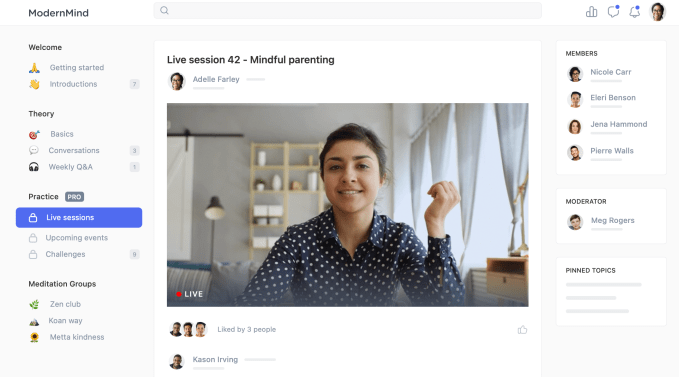
Given the company’s early stage, product development remains the highest priority. “Our approach is like a Notion,” Yadav said, describing how Circle allows its communities to stitch together “building blocks” to lay out pages. Circle’s primary mode is through a Space, where community members can discuss topics with each other and the creator as well. Communities built on Circle can be white-labeled, with their own custom domains.

Circle’s community platform allows creators to publish content and engage with their community. Photo via Circle.

Circle’s ultimate goal is to integrate under one roof every tool a creator needs to engage with a customer, from publishing newsletters and podcasts to setting up streaming, event ticket sales, merchandise and event calendars — all buttressed by a payments layer. Many of those features remain to be built on top of the company’s core community platform, but Yadav and his team are certainly ambitious in their expansive scope.

Circle’s team is now 20 people, with team members in Europe, India, Australia and across the United States.

16 Feb 2021

The creator movement is entering prime time, and so is Circle with a fresh $4M

The creator movement has exploded in the last few years as platforms ranging from Substack to Clubhouse have made it easier than ever to reach an audience of willing readers and listeners. Yet the key to building sustainable creator businesses is the economics of these enterprises themselves. Get enough subscribers, and what often starts as a side hobby can quickly become a full-time job.

Circle was founded in January 2020 to make engaging with paying customers and thus building creator businesses as effortless as possible. We profiled the NYC-based startup last year when it announced its $1.5 million seed round in August, discussing how its founder DNA originates in the online course platform Teachable. Since then, all signs point to very strong early growth.

The company surpassed $1 million ARR last month, and it already has 1,000 paying customers and is heading toward 2,000 paying communities. Usage is also growing rapidly, expanding 40-50% per month for both DAUs and MAUs, according to the company. It also brought its iOS app out of beta last month.

CEO and co-founder Sid Yadav said that “we happened to catch the tide at the right time [with] the creator movement, the community movement.” So far, paying communities have been largely centered around “a lot of YouTubers, course creators, Twitch streamers, Patreon personalities,” with Yadav estimating that 60% of the platform’s communities are “personality-led.” That said, “a lot of brands are starting to think of this creatively.”

All that positive news can’t be ignored by VCs too long. The company announced today that it has raised a $4 million seed round at a valuation “north of” $40 million, which closed late last year. The round was officially led by Notation Capital, which led the company’s pre-seed round last year, but the firm only took a quarter of a round according to Yadav.

Circle’s team has grown to 20 across multiple continents. Photo via Circle.

Instead, much of the round’s allocations were handed out to the entrepreneurs building on the platform. “We had all of these offers from top-tier firms, but for the kind of product that we are — which is a creator platform — it made sense to allocate the round as much as possible to our customers,” Yadav said. According to the company, a majority of the round went to individual angels and community builders on the platform, among them Anne-Laure Le Cunff, David Perell, Tiago Forte and Nat Eliason.

Given the company’s early stage, product development remains the highest priority. “Our approach is like a Notion,” Yadav said, describing how Circle allows its communities to stitch together “building blocks” to lay out pages. Circle’s primary mode is through a Space, where community members can discuss topics with each other and the creator as well. Communities built on Circle can be white-labeled, with their own custom domains.

Circle’s community platform allows creators to publish content and engage with their community. Photo via Circle.

Circle’s ultimate goal is to integrate under one roof every tool a creator needs to engage with a customer, from publishing newsletters and podcasts to setting up streaming, event ticket sales, merchandise and event calendars — all buttressed by a payments layer. Many of those features remain to be built on top of the company’s core community platform, but Yadav and his team are certainly ambitious in their expansive scope.

Circle’s team is now 20 people, with team members in Europe, India, Australia and across the United States.

16 Feb 2021

Uber vet raises $5.2M for blue-collar logistics marketplace

After working as a general manager for Uber in Nevada, Jason Radisson realized the need for a way to connect blue-collar workers to companies looking to employ them.

So in late 2018, the idea for Shift One — a marketplace aimed at pairing workers and employers — was born. The startup is focused on last-mile logistics and delivery, e-commerce fulfillment and large-scale event management.

Since formally launching in 2019, Shift One has grown to have 25,000 workers on its platform — many of whom it says were unemployed at the time of hire. And it has about 50 clients in the U.S. and Colombia, including Amazon, NASCAR, Weee!, Mensajeros Urbanos and the Consumer Electronics Show (CES).

It matches employers with workers, and also helps them with tasks such as time, taxes, attendance, productivity and work-order management.

To help it grow and further expand its reach, Shift One just raised a $5.2 million seed round led by City Light Capital and Tinder co-founder Justin Mateen’s JAM fund, with participation from K50 Ventures, Ventura Investments and Human Ventures, as well as angel Felipe Villamarin.

On the operations side, all of Shift One’s original team either worked for Uber or Lyft, according to founder and CEO Radisson. The early technical team were all previously Uber employees.

Radisson says the impetus behind starting the company was the desire “to correct and improve some of the things in Gig 1.0.”

“We wanted it to be more balanced for workers, and break some negative flywheels where people were cycling through a lot of logistics jobs and not getting paid well,” he told TechCrunch. “We wanted to give them stability.”

At the same time, Radisson said, he knew that companies on the logistics side were struggling to find good workers. Shift One works with a range of skill levels, from entry-level employees to supervisors and warehouse managers.

Knowing that many logistics workers are used to working as contract employees with no benefits, Shift One gives all the workers on its platform full benefits with “low contributions” from the first day of hire. It also provides them with checking accounts and debit cards.

“A lot of these workers are unbanked and didn’t have the ability to even get a paycheck,” Radisson said.

It also aims to give them “full schedules” and have them work on whole teams as much as possible.

“It’s part of our value prop that our teams are cohesive and really high functioning,” he added.

Until now, San Francisco-based Shift One has been bootstrapped. It is “slightly” profitable and has been re-investing that money into growing the business. It saw its revenue climb by tenfold in 2020 from an admittedly “small base.” The startup has offices in Las Vegas, Minneapolis, Bogotá and Bucharest. 

Looking ahead, it plans to use its new capital to expand into new markets (it’s currently operating in about 12 states), boost its headcount of 20 and accelerate its tech roadmap.

“In the last four to five months, we’ve moved very strong into last mile” as the COVID-19 pandemic has continued, Radisson said. “We want to give opportunities to millions that didn’t go to college and that have seen stagnant wages for years. We want to give them opportunities to get ahead.”

JAM Fund principal and Tinder co-founder Mateen believes Shift One is turning the labor problem of “adverse selection” on its head.

“Gig work has been defined by seasonality and availability — neither are particularly good for workers,” he said. 

Even Miami Mayor Francis Suarez has thoughts, pointing out that blue-collar jobs have been among the hardest hit by COVID-19.

With Shift One, “workers receive fairly compensated jobs with the opportunity to grow and develop,” he said in a written statement. “Companies get access to a steady, predictable source of high-quality labor. And Miami benefits from the virtuous circle of higher employment and strong local businesses.”

16 Feb 2021

Ad Practitioners acquires Knoq to move the startup’s door-to-door marketing approach online

Knoq (formerly known as Polis) was a startup that recruited representatives to go door-to-door in their neighborhoods, talking up client products and services. So for obvious reasons, it faced challenges in 2020.

“We stopped knocking on doors in February, and this summer, we were trying to figure out what the path forward was,” founder and CEO Kendall Tucker told me.

The company had already pivoted once, shifting focus from political work to commercial marketing. But Tucker said Knoq also had some attractive assets, namely its “unique, huge consumer models” designed to predict whether someone would be interested in a given product, as well as “the experience of building out these teams of neighborhood representatives.”

So after what she described as a competitive bidding process, Knoq was acquired by Ad Practitioners, a digital media company that owns properties like Money.com and ConsumersAdvocate.org.

As part of Ad Practitioners, Tucker said Knoq’s network of “Knoqers” will be able to interact with visitors to those properties and help “pair consumers with the right product,” whether that’s auto insurance or software. After all, she noted that plenty of consumers are connecting with Ad Practitioners via chat bots and phone calls: “These are people already asking for help … we’re really just connecting the dots.”

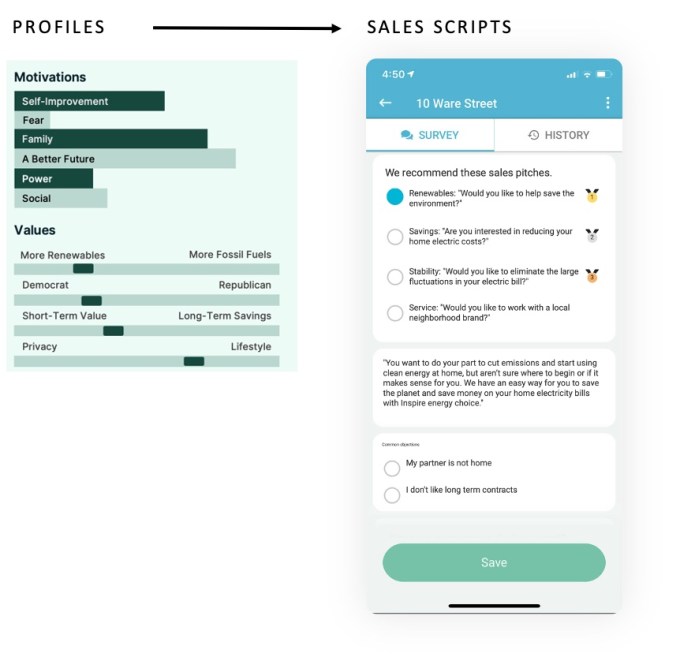
Knoq screenshot

Image Credits: Knoq

In the acquisition announcement, Ad Practitioners CEO Greg Powel made a similar point, saying that the deal represents “a shared vision of helping people make decisions through conversations driven by data and technology while educating people about products and services that matter.”

“The Money and ConsumersAdvocate.org brands are already trusted by millions of highly engaged users,” Powel continued. “Together, we foresee a world where consumers come to our sites for great content [and] reviews and to speak with representatives who can help them find the personal information they need.”

Knoq leadership has already moved to join Ad Practitioners in Puerto Rico, with the rest of the Knoq team set to relocate later this year as well.

You might think a startup would be inclined to stay put in its current location (in Knoq’s case, Boston), at least for the duration of the pandemic, but Tucker said she’s a big believer in seeing your team in person. In fact, the Knoq team had socially distanced outdoor meetups over the summer, “to brainstorm or just hang out and make sure people are okay.” Plus, she’s excited about the possibility of “hiring the amazing people on this island.”

The financial terms of the acquisition were not disclosed. Knoq had most recently raised $2.5 million from Initialized Capital and Haystack.vc, and Tucker said it was crucial that the acquisition provided a good outcome not just for her team and herself, but also her investors.

“We’re so excited for Kendall and her team on their successful exit to Ad Practitioners,” said Initialized General Partner Alda Leu Dennis in a statement. “It’s been a pleasure partnering with Knoq over the last few years. The Knoq team will bring a tech-forward approach to sales outreach and customer analytics. And, Kendall’s skills as a brilliant builder, operator and strategic thinker will be a huge asset for Ad Practitioners.”

16 Feb 2021

Ad Practitioners acquires Knoq to move the startup’s door-to-door marketing approach online

Knoq (formerly known as Polis) was a startup that recruited representatives to go door-to-door in their neighborhoods, talking up client products and services. So for obvious reasons, it faced challenges in 2020.

“We stopped knocking on doors in February, and this summer, we were trying to figure out what the path forward was,” founder and CEO Kendall Tucker told me.

The company had already pivoted once, shifting focus from political work to commercial marketing. But Tucker said Knoq also had some attractive assets, namely its “unique, huge consumer models” designed to predict whether someone would be interested in a given product, as well as “the experience of building out these teams of neighborhood representatives.”

So after what she described as a competitive bidding process, Knoq was acquired by Ad Practitioners, a digital media company that owns properties like Money.com and ConsumersAdvocate.org.

As part of Ad Practitioners, Tucker said Knoq’s network of “Knoqers” will be able to interact with visitors to those properties and help “pair consumers with the right product,” whether that’s auto insurance or software. After all, she noted that plenty of consumers are connecting with Ad Practitioners via chat bots and phone calls: “These are people already asking for help … we’re really just connecting the dots.”

Knoq screenshot

Image Credits: Knoq

In the acquisition announcement, Ad Practitioners CEO Greg Powel made a similar point, saying that the deal represents “a shared vision of helping people make decisions through conversations driven by data and technology while educating people about products and services that matter.”

“The Money and ConsumersAdvocate.org brands are already trusted by millions of highly engaged users,” Powel continued. “Together, we foresee a world where consumers come to our sites for great content [and] reviews and to speak with representatives who can help them find the personal information they need.”

Knoq leadership has already moved to join Ad Practitioners in Puerto Rico, with the rest of the Knoq team set to relocate later this year as well.

You might think a startup would be inclined to stay put in its current location (in Knoq’s case, Boston), at least for the duration of the pandemic, but Tucker said she’s a big believer in seeing your team in person. In fact, the Knoq team had socially distanced outdoor meetups over the summer, “to brainstorm or just hang out and make sure people are okay.” Plus, she’s excited about the possibility of “hiring the amazing people on this island.”

The financial terms of the acquisition were not disclosed. Knoq had most recently raised $2.5 million from Initialized Capital and Haystack.vc, and Tucker said it was crucial that the acquisition provided a good outcome not just for her team and herself, but also her investors.

“We’re so excited for Kendall and her team on their successful exit to Ad Practitioners,” said Initialized General Partner Alda Leu Dennis in a statement. “It’s been a pleasure partnering with Knoq over the last few years. The Knoq team will bring a tech-forward approach to sales outreach and customer analytics. And, Kendall’s skills as a brilliant builder, operator and strategic thinker will be a huge asset for Ad Practitioners.”

16 Feb 2021

LA-based Metropolis raises $41 million to upgrade parking infrastructure

Metropolis is a new Los Angeles-based startup that’s looking to compete with BMW-owned ParkMobile for a slice of the automated parking lot management market.

Upgrading parking with a computer vision-based system that recognizes cars as they enter and leave garages has been Metropolis’ mission since founder and chief executive Alex Israel first formed the business back in 2017.

Israel, a serial entrepreneur, has spent decades thinking about parking. His last company, ParkMe, was sold to Inrix back in 2015. And it was with those earnings and experience that Israel went back to the drawing board to develop a new kind of parking payment and management service.

Now, the company is ready for its closeup, announcing not only its launch, but $41 million in financing the company raised from investors, including the real estate managers Starwood and RXR Realty; Dick Costolo and Adam Bain’s 01 Advisors; Dragoneer; former Facebook employees Sam Lessin and Kevin Colleran’s Slow Ventures; Dan Doctoroff, the head of Alphabet’s Sidewalk Labs initiative; and NBA All Star and early-stage investor, Baron Davis. Global growth equity firm 3L led the round. 

According to Alex Israel, the parking payment application is the foundation for a bigger business empire that hopes to reimagine parking spaces as hubs for a broad array of urban mobility services.

In this, the company’s goals aren’t dissimilar from the Florida-based startup, REEF, which has its own spin on what to do with the existing infrastructure and footprint created by urban parking spaces. And REEF’s $700 million round of funding from last year shows there’s a lot of money to be made — or at least spent — in a parking lot.

Unlike REEF, Metropolis will remain focused on mobility, according to Israel. “How does parking change over the next 20 years as mobility shifts?” he asked. And he’s hoping that Metropolis will provide an answer. 

The company is hoping to use its latest funding to expand its footprint to more than 600 locations over the course of the next year. In all, Metropolis has raised $60 million since it was formed back in 2017.

While the computer vision and machine learning technology will serve as the company’s beachhead into parking lots, services like cleaning, charging, storage and logistics could all be part and parcel of the Metropolis offering going forward, Israel said. “We become the integrator [and] we also in some cases become the direct service provider,” Israel said.

The company already has 10,000 parking spots that it’s managing for big real estate owners, and Israel expects more property managers to flood to its service.

“[Big property owners] are not thinking about the infrastructure requirements that allow for the seamless access to these facilities,” Israel said. His technology can allow buildings to capture more value through other services like dynamic pricing and yield optimization as well.

“Metropolis is finding the highest and best use whether that be scooter charging, scooter storage, fleet storage, fleet logistics or sorting,” Israel said.  


15 Feb 2021

India lifts restrictions on mapping and surveying to help local firms

India said on Monday local firms will no longer need license or other permission to collect, generate, store and share geospatial data of the country, bringing sweeping changes to its earlier stance that it admitted hindered innovation.

Until now, New Delhi required Indian firms to seek licenses and additional approvals to create and publish topographical data. India’s Prime Minister Narendra Modi said today’s “deregulation” step will help the country become more self-reliant and reach its $5 trillion GDP goal.

“The regulations that apply to geospatial data and maps henceforth stand radically liberalised. The Department of Science and Technology is announcing sweeping changes to India’s mapping policy, specifically for Indian companies. What is readily available globally does not need to be restricted in India and therefore geospatial data that used to be restricted will now be freely available in India,” New Delhi said in a statement.

In its guidelines, New Delhi said local firms will be permitted access to “ground truthing/verification” that includes access to Indian ground stations and augmentation services for real-time positioning. Indian firms will also be provided access to terrestrial mobile mapping survey, street view survey and surveying in Indian territorial waters.

New Delhi said in the guidelines that only Indian firms shall be permitted access to the aforementioned surveys. Google has previously made unsuccessful attempts to launch its Street View service in India. A Google spokesperson told TechCrunch that the company was reviewing the guidelines and had no immediate comment to offer.

“Foreign companies and foreign owned or controlled Indian companies can license from Indian Entities digital Maps/Geospatial Data of spatial accuracy/value finer than the threshold value only for the purpose of serving their customers in India. Access to such Maps/Geospatial Data shall only be made available through APIs that do not allow Maps/Geospatial Data to pass through Licensee Company or its servers. Re-use or resale of such map data by licensees shall be prohibited,” the guidelines added.

Devdatta Tengshe, who works in the GIS space, told TechCrunch that the government’s move today was significant for the local ecosystem including citizens as previous restrictions had created an uncertainty on what precisely was permitted.

“Today’s announcement makes it explicitly clear that Indian entities can perform any location data collection and we can collect data on our own,” he said. “Additionally, the location data from agencies like municipality will be made available to Indian entities.”

Flipkart-backed 25-year-old firm MapMyIndia said today’s move by the government is “historic” as it opens up maps and the geospatial sector and ushers the self-reliance era in “strategic areas of maps to empower all 1.3 billion Indians and give unprecedented opportunities and growth for Indian companies.”

Modi said: “The reforms will unlock tremendous opportunities for our country’s start-ups, private sector, public sector and research institutions to drive innovations and build scalable solutions. India’s farmers will also be benefited by leveraging the potential of geo-spatial & remote sensing data. Democratizing data will enable the rise of new technologies & platforms that will drive efficiencies in agriculture and allied sectors. These reforms demonstrate our commitment to improving ease of doing business in India by deregulation.”

15 Feb 2021

GM unveils a refreshed Chevy Bolt EV and its bigger, yet compact crossover sibling

GM revealed Sunday a refreshed Chevrolet Bolt EV and a new, bigger — yet still compact — crossover called the Chevrolet Bolt EUV as part of the automaker’s goal to introduce 30 electric vehicles in the next four years.

The vehicles, which are expected to go on sale this summer, are like siblings: the pair share much of the same DNA but have their own distinct differences. The 2022 Chevy Bolt EUV is bigger than the Chevy Bolt hatchback. GM lengthened the wheelbase of the EUV by about 3 inches. In all, the EUV sits some 6 inches longer than the Bolt EV. The result is a compact crossover with 39.1 inches of rear seat legroom.

The EUV — a GM acronym that means electric utility vehicle — also has the notable distinction of being the first Chevrolet to have the hands-free driver assistance system known as Super Cruise. The hands-free system won’t come standard, however. Drivers will have to upgrade beyond the EUV’s $33,995 base price.

That $33,995 price point stands out because it’s actually slighter cheaper than the 2021 Chevy Bolt that is currently sitting in dealerships. The new refreshed Chevy Bolt, which is described in greater details below, has also received a price cut.

The takeaway: GM is using its scale to keep prices low in hopes of attracting customers who have a growing pool of EV options.

2022 Chevrolet Bolt EUV

2022 Chevrolet Bolt EUV

The EUV will have an estimated range of 250 miles, which is a few miles lower than the Bolt EV. The vehicle will also come with a standard dual level charge cord with a changeable plug that lets drivers choose 120V and 240V charging.

The EUV will also come with native navigation. That’s an important addition in this two-member Bolt portfolio. The Chevy Bolt EV, which first debuted in 2016, doesn’t have a native in-car navigation and instead relies on either Android Auto or Apple CarPlay for maps and driving directions.

Importantly, neither one of these vehicles is part of the new Ultium battery platform that GM revealed in spring 2020. The Ultium platform is designed to support a wide range of products across its brands, including compact cars, work trucks, large premium SUVs, performance vehicles. The Bolt EUV and Bolt EV should be viewed as an important placeholder, two vehicles that will help keep it in the game while it works on its more ambitious EV strategy.

The 2022 Chevrolet Bolt

2022 Chevrolet Bolt EV

2022 Chevrolet Bolt EV

The Bolt EUV wasn’t the only vehicle GM revealed Sunday. The automaker has also refreshed the Chevrolet Bolt, the hatchback electric vehicle that first debuted more than four years ago.

The upshot: many of the specs stayed the same, the interior got an upgrade and the price dropped by $5,500.
The 2022 Chevy Bolt’s underlying battery platform, the BEV2, has remained unchanged.

The car, which goes on sale this summer, has a 65 kilowatt-hour battery pack that provides an estimated 259 miles of range. It is also still powered by a single motor — just like the original — that generates 200 horsepower and 266 pound-feet of torque. The vehicle is the same width as before, but gained a skosh in height and is now 63.4 inches taller, while losing less than an inch in length.

2022 Chevrolet Bolt EV

The 2022 Chevy Bolt, which starts at $31,995, is a couple grand cheaper than the new Bolt EUV. For that price, GM tried to pack in a bit more such as an updated modern interior and “more comfortable” bucket seating, according to the company. GM said the improvements were based on customer feedback.

The vehicle includes a touchscreen display that is a bit larger at 10.2 inches as well as an 8-inch digital instrument cluster. Just like the previous version, the 2022 model comes standard with Android Auto and Apple CarPlay. As mentioned before, the 2022 Chevy Bolt still doesn’t come standard with in-car navigation, relying instead on CarPlay or Android Auto.

One new feature is a button in the center console that when engaged allows one-pedal driving. The driver depresses the accelerator pedal to move; once the driver’s foot leaves the pedal, the vehicle’s regenerative braking kicks in and will bring the vehicle to a stop.

The Chevy Bolt doesn’t come with GM’s hands-free driver assistance system known as Super Cruise. GM chose the Chevy Bolt EUV for that system, which has been corralled over in Cadillac for the past several years. The Bolt hatchback does come standard with the “Chevy Safety Assist,” six  features that includes lane keeping assist and a warning if the vehicle leaves the lane.